Original Research Article
Assessment of national vector borne disease control
programme in state of Karnataka
Puneet Kumar Arali
1*, Deepthi N. Shanbhag
2INTRODUCTION
The National Vector Borne Disease Control Programme (NVBDCP) is an aegis which includes the programmesfor prevention and control of vector borne diseases viz., malaria, filaria, Japanese encephalitis (JE), Dengue/DHF, chikungunya, lymphatic filariasis and Kala Azar. The programme is executed as per the National Policy of Government of India, Directorate of NVBDCP, Delhi.Since December 2003, it is being implemented in Karnataka.1
The NVBDCP was originated from centrally executed programmes like National Malaria Control Programme (NMCP) launched in 1953 for malaria control in high endemic areas; National Malaria Eradication Programme (NMEP) in 1958 started in view of spectacular success of NMCP; Modified Plan of Operation (MPO) in 1977 with the immediate objectives to prevent deaths and to reduce morbidity due to malaria; Malaria Action Programme (MAP) in 1995based on the recommendations of the Expert Committee; Enhanced Malaria Control Project (EMCP)’ which was initiated to tackle malaria problem ABSTRACT
Background: National vector borne disease control programme (NVBDCP) was launched to control the prevalence of vector borne diseases like malaria, filaria, Japanese encephalitis (JE), Dengue/DHF, chikungunya, lymphatic filariasis and Kala Azar. The present study was done to assess the activities of NVBDCP in state of Karnataka and to analyze selective qualitative and quantitative indicators related to the activities.
Methods: Quantitatively retrospective data was collected from Directorate office Department of Health and Family Welfare, NVBDCP section from April 2016 to March 2017. Qualitatively questionnaire based protocol was made and interviews were conducted with District programme officer, PHC medical officer and grass root level health workers like ANM, ASHA with reference to one each of selected least performing districts and good performing districts in the state. The collected data was analysed by using Microsoft Excel 2010 version.
Results: The highest prevalent districts in Karnataka are Dakshina Kannada for malaria, Udupi for dengue, Tumakuru for chikungunya and Bidar for lymphatic filariasis. Major factors related to poor outcome in some districts were rigid attitude of the community, poor support of local panchayats and less human resources.
Conclusions: The result of this investigation revealed that Dakshina Kannada has got highest number of cases with greater proposition and high prevalence rate of vector borne diseases due to lack of sufficient human resources and geographical factors. Strengthening the surveillance activities along with integrated vector control programmes will improves the outcome of the programme.
Keywords: Vector borne diseases, Karnataka, NVBDCP 1
Rajiv Gandhi Institute of Public Health and Centre for Disease Control, RGUHS, Bangalore, Karnataka, India 2
St John's Medical College and Hospital, Bangalore, Karnataka, India
Received: 18 December 2018
Accepted: 07 January 2019
*Correspondence:
Dr. Puneet Kumar Arali,
E-mail: [email protected]
Copyright: © the author(s), publisher and licensee Medip Academy. This is an open-access article distributed under the terms of the Creative Commons Attribution Non-Commercial License, which permits unrestricted non-commercial use, distribution, and reproduction in any medium, provided the original work is properly cited.
in high risk areas other than North-Eastern (NE) states and National Anti-Malaria Programme (NAMP) in the year 1998 to reduce the overall incidence of malaria in the Nation. The prevention and control of other vector borne diseases namely lymphatic filariasis, kala- azar, was also being dealt by the Directorate of NAMP in addition to need based support for Japanese encephalitis and dengue.2
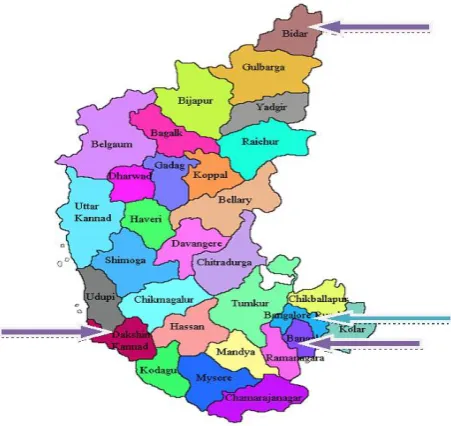
Karnataka state with the vast semi-urban areas,rich irrigated lands and good monsoon, facilitates prolific growth of mosquitoes and transmission of malaria.3The total population of Karnataka as per NVBDCP is around 5,78,00,000 in 2016-17. The state is divided into 30 administrative districts, 176 taluks and there are 40,323 villages/urban agglomerations with earmarked boundaries (Figure 1).
The state of Karnataka is committed to elimination of malaria by 2022 in the line with national goal of elimination the state framework for elimination of malaria has been drawnup this has been possible because of organised malaria prevention and control activity.
Vector borne disease is an important public health problem in India. They account for more than 17% of all infectious diseases causing about 7 lakhs deaths annually.4There are no published studies done on overall evaluation of NVBDCP in state of Karnataka. However there are some studies done individually for malaria, dengue, chikungunya, JE, Kala-azar and lymphatic filariasisfor assessing the programme progress, current statistical data and disease burden in different districts.
Hence the present study was done with the objectives to evaluate the activities of NVBDCPin state of Karnataka and to enumerate and critically analyze selective qualitative and quantitative indicators.
Figure 1: Map of district visited.
METHODS
The present cross sectional study was conducted after getting approval from Institution ethics committee, Rajiv Gandhi Institute of Public Health and Centre for Disease Control at Bangalore in different districts of Karnataka for a period of 6 months.
Quantitatively retrospective data was collected from Directorate office Department of Health and Family Welfare, NVBDCP section from 1st April 2016 to 31st March 2017. Data analysis was done for individual diseases in particular with district. Indicators were assessed under inputs, processes, outputs, outcomes and impacts as recommended by NVBDCP.
Qualitatively, content analysis with reference to burden of diseases in the districts of Bangalore rural, Bangalore urban, Dakshina Kannada, Bidar and Kolarwas done after going through the secondary analysis of data. Following this, several in-depth interviews/key informant interviews were conducted with District programme officer, PHC Medical Officer and grass root level health workers like ANM, ASHA with reference to one each of selected least performing districts and good performing districts in the state. The standard check list for monitoring and evaluation under the NVBDCP will be used to assess the ongoing programme of the same selected least and good performing district.
Statistical analysis
The collected data was analysed by using Microsoft Excel 2010 version. Descriptive statistics like frequency, mean will be used to analyze the data. From the analysis the best and worst performing were identified. Additionally the interview guide was focused mainly to understand main reason for the program success and failure.
RESULTS
Quantitative analyses
prevalence of 7.31, zero deaths and zero CFR. As per the records of 2016-17, total number of Japanese encephalitis (JE) and acute encephalitis syndrome (AES) cases in the 2016-17 was 746 AES and 22 JE cases. Zero deaths with the prevalence rate of 0.04 and CRF is Zero. Among the various districts Dakshina Kannada stands with 98 AES cases and 5 JE cases with prevalence rate of 1.00, zero deaths and zero CFR.
Table 1: Prevalence of vector borne disease in Karnataka state between April 2016 to March 2017.
Disease Cases Prevalence* CFR
Malaria 9655 1.67 0
Dengue 1471 2.54 0
JE and AES 746.00 and 22.00 0.04 0
*No of cases per 100000 population, CFR=case fatality rate, Total population=57865468, no of districts=30.
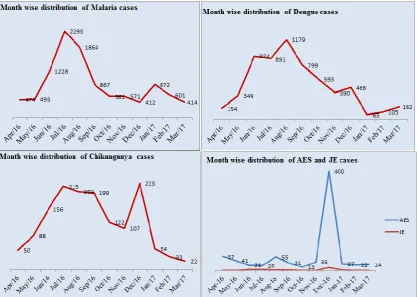
Figure 2: Month wise distribution of vector borne disease in Karnataka State between April 2016 to March 2017.
Table 2: Distribution of blood sample collected, examined, positive case, slide examination rate and slide positivity rate for vector borne disease in Karnataka state between April 2016 to March 2017.
Disease Blood sample
collected
Blood sample
examined Positive cases
Slide examination rate
Slide
positivity rate
Malaria 9392515 9392515 9002 100 0.958
Dengue 34084 17130 3453 50.3 20.2
Chikungunya 13482 7591 1315 56.30 17.32
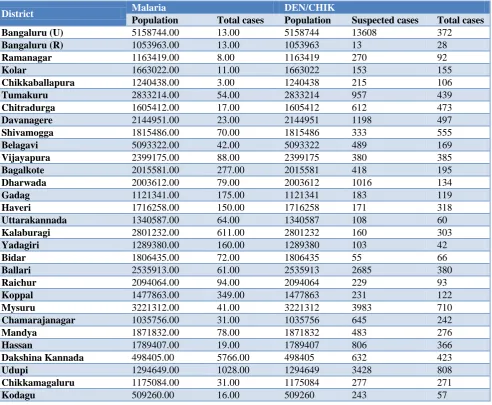
Table 3: Population and cases for the vector borne disease in districts of Karnataka state between April 2016 to March 2017.
District Malaria DEN/CHIK
Population Total cases Population Suspected cases Total cases Bangaluru (U) 5158744.00 13.00 5158744 13608 372
Bangaluru (R) 1053963.00 13.00 1053963 13 28
Ramanagar 1163419.00 8.00 1163419 270 92
Kolar 1663022.00 11.00 1663022 153 155
Chikkaballapura 1240438.00 3.00 1240438 215 106
Tumakuru 2833214.00 54.00 2833214 957 439
Chitradurga 1605412.00 17.00 1605412 612 473
Davanagere 2144951.00 23.00 2144951 1198 497
Shivamogga 1815486.00 70.00 1815486 333 555
Belagavi 5093322.00 42.00 5093322 489 169
Vijayapura 2399175.00 88.00 2399175 380 385
Bagalkote 2015581.00 277.00 2015581 418 195
Dharwada 2003612.00 79.00 2003612 1016 134
Gadag 1121341.00 175.00 1121341 183 119
Haveri 1716258.00 150.00 1716258 171 318
Uttarakannada 1340587.00 64.00 1340587 108 60
Kalaburagi 2801232.00 611.00 2801232 160 303
Yadagiri 1289380.00 160.00 1289380 103 42
Bidar 1806435.00 72.00 1806435 55 66
Ballari 2535913.00 61.00 2535913 2685 380
Raichur 2094064.00 94.00 2094064 229 93
Koppal 1477863.00 349.00 1477863 231 122
Mysuru 3221312.00 41.00 3221312 3983 710
Chamarajanagar 1035756.00 31.00 1035756 645 242
Mandya 1871832.00 78.00 1871832 483 276
Hassan 1789407.00 19.00 1789407 806 366
Dakshina Kannada 498405.00 5766.00 498405 632 423
Udupi 1294649.00 1028.00 1294649 3428 808
Chikkamagaluru 1175084.00 31.00 1175084 277 271
Kodagu 509260.00 16.00 509260 243 57
Figure 2 presents the month wise distribution of vector borne diseases during the period from April 2016 to March 2017. As per Figure 2, the prevalence of malaria and dengue was more during monsoon i.e., from the period May to October. The prevalence of chikungunya reached to the peak level in the month of December and declined by March. Incidence of JE and AES cases shoot up to 400 cases in the month of December and by January it was drastically reduced to 27 and later was stagnant.
Table 4: Population and cases affected with lymphatic filariasis in districts of Karnataka state between April
2016 to March 2017.
District Population Cases
Belagavi 5093322 0
Vijayapura 2399175 355
Bagalkote 2015581 644
Uttara Kannada 1340587 0
Kalaburagi 2801232 0
Yadagiri 1289380 2101
Bidar 1806435 3264
Ballari 2535913 0
Raichur 2094064 0
Koppal 1477863 0
Dakshina Kannada 498405 0
Udupi 1294649 0
As per NVBDCP guideline, blood samples were collected, to screen for vector borne diseases annually. As presented in Table 2, blood samples were collected from 93,92,515 cases to examine the presence of malarial parasite. Of them 9002 cases were positive with slide examination rate by100% and slide positivity rate by 0.95%. Among all the districts of Karnataka, large number of blood samples was collected from Dakshina Kannada (36585). Of them positive case 5502 cases were positive for malarial parasite with slide examination rate of 100% and slide positivity rate of 15.04%. About 34084 blood samples were suspected for dengue and blood samples were collected from 17130. Of them, 3453 cases showed positivity for dengue with slide examination rate of 50.3% and slide positivity rate was 93.3%.In Shivamogga, positive cases of dengue were noted in 251 cases, with slide examination rate of 80.8% and slide positivity rate of 93.3%.Chikungunya was suspected in 13482 cases and blood samples were collected from 7591cases total positive cases reported 1315 with sample collection rate of 56.30% and positivity rate of 17.32%. The district Shivamogga records 53 suspected cases, 53 samples collected, positive cases 53 indicating 100% sample collection rate and positivity rate.
Table 3and 4 shows population and cases affected by the vector borne disease in Karnataka state. Large number of malaria cases (5766) was noted for Dakshi Kannada, dengue/ chikungunyacases (3428) was highly noticed for Udupi district. Prevalence of lymphatic filariasiscases (3264) was higher in Bidar district.
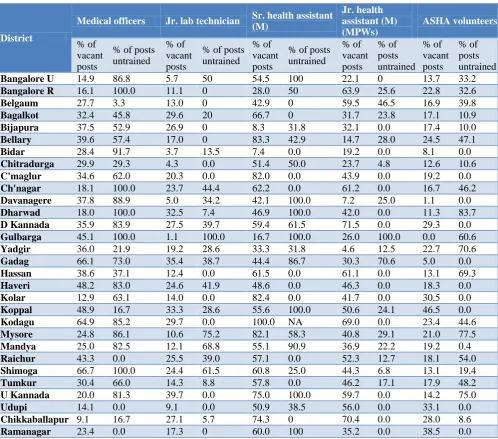
Table 5 shows the prevalence rate of malaria and percentage of vacant and untrained personnel allocated for each district. Among all the districts, Shimoga had prevealnece rate of 115.69 of malaria and 35.9% of medical officers posts are vacant. Of them, 83.9% were untrained health personnels whereas for D. Kannada district the prevalence rate of malaria was 115.69 and 27.5% of Jr. lab technician posts were vacant and 39.7% of them were untrained health personnels. Sr. health assistant post were 83.3% vacant and 42.9% were
untrained. Likewise Jr health assistant post were 14.7% vacant and 28.0% were untrained. 24.5% of ASHA worker post was vacant and 47.1% are untrained in vector borne disease control program. As per the statistics of the annual year Asst Entomologist posts vacant are vacant (100%) in Bangalore urban, Bidar, Chikkamagaluru, Chamarajanagar, Yadgir, Koppal. Posts were not at all sanctioned for areas of Chikaballapur and Ramanagar.
Qualitative data
The qualitative data was obtained from the respondent after taking their consent for the in-depth interview. The respondent were medical officer in-charge of the NVBDCP and also medical officer handling PHC were also included other staff like lab technicians, staff nurses, ANMs and the ASHA workers from good and worst performing districts to better understand the causes, factors responsible for the status of the NVBDCP.
Bangalore rural
The staff of PHC and ASHA workers replied that the output of NVBDCP was very good. The factors for the better outcome listed are as follows “firstly good and competent human resource, regularly conducting IEC and re-orientation training program, attending to the training programmes of NVBDCP regularly, active community participation, sustained and strong support local panchayat’s and implementing innovative ideas like posters, drawing competition for school children regularly”.
Dakshina Kannada
As per the staff of the district the result of NVBDCP was poor. Medical officer replied “that one of the reasons for the high burden of diseases is the weather of the coastal region and the geography of the region, the next reason is proper reporting”. Staff nurse of the area reported that the outcome was poor due to “insufficient staff, burden of work, lack of leadership and rigid attitude of the community”. Positive response was given by ASHA workers and DVBDC officer regarding implementation of IEC activities. They replied that “they were regularly visiting to houses and giving awareness about the vector borne disease and its complication, maintaining the register and promptly reporting regularly to the concerned authorities. Any case reported will be taken serious and immediately medical officer will be communicated and the concerned program officer will rush to the field and they are having good and supportive staff. But the poor outcome was due to rigid community behaviour”.
Bidar
activities in village, also home to home visit to create awareness of disease risk, we use innovative ideas for health education like TV shows, jatara etc. There is good support from local panchayat, regular training and ROTP are conducted very often, there is screening and awareness about lymphatic filariasis and grass root workers are doing survey on vector borne diseases and lastly mass drug administration (MDA) strategy was used”.
Bangalore urban
The faculty of PHC and other related health workers replied that have “got good and competent staff and grass root level health workers for implementing NVBDCP. The negative part is lack of support from local panchayat and no political support and week community participation. We conduct health education and awareness programm in school, colleges, community, jatras etc, grass root level workers were going to field and house to house survey”.
Table 5: Human resources, vacant post and untrained person in the districts.
District
Medical officers Jr. lab technician Sr. health assistant
(M)
Jr. health assistant (M) (MPWs)
ASHA volunteers
% of vacant posts
% of posts untrained
% of vacant posts
% of posts untrained
% of vacant posts
% of posts untrained
% of vacant posts
% of posts untrained
% of vacant posts
% of posts untrained
Bangalore U 14.9 86.8 5.7 50 54.5 100 22.1 0 13.7 33.2
Bangalore R 16.1 100.0 11.1 0 28.0 50 63.9 25.6 22.8 32.6
Belgaum 27.7 3.3 13.0 0 42.9 0 59.5 46.5 16.9 39.8
Bagalkot 32.4 45.8 29.6 20 66.7 0 31.7 23.8 17.1 10.9
Bijapura 37.5 52.9 26.9 0 8.3 31.8 32.1 0.0 17.4 10.0
Bellary 39.6 57.4 17.0 0 83.3 42.9 14.7 28.0 24.5 47.1
Bidar 28.4 91.7 3.7 13.5 7.4 0.0 19.2 0.0 8.1 0.0
Chitradurga 29.9 29.3 4.3 0.0 51.4 50.0 23.7 4.8 12.6 10.6
C'maglur 34.6 62.0 20.3 0.0 82.0 0.0 43.9 0.0 19.2 0.0
Ch'nagar 18.1 100.0 23.7 44.4 62.2 0.0 61.2 0.0 16.7 46.2
Davanagere 37.8 88.9 5.0 34.2 42.1 100.0 7.2 25.0 1.1 0.0
Dharwad 18.0 100.0 32.5 7.4 46.9 100.0 42.0 0.0 11.3 83.7
D Kannada 35.9 83.9 27.5 39.7 59.4 61.5 71.5 0.0 29.3 0.0
Gulbarga 45.1 100.0 1.1 100.0 16.7 100.0 26.0 100.0 0.0 60.6
Yadgir 36.0 21.9 19.2 28.6 33.3 31.8 4.6 12.5 22.7 70.6
Gadag 66.1 73.0 35.4 38.7 44.4 86.7 30.3 70.6 5.0 0.0
Hassan 38.6 37.1 12.4 0.0 61.5 0.0 61.1 0.0 13.1 69.3
Haveri 48.2 83.0 24.6 41.9 48.6 0.0 46.3 0.0 18.3 0.0
Kolar 12.9 63.1 14.0 0.0 82.4 0.0 41.7 0.0 30.5 0.0
Koppal 48.9 16.7 33.3 28.6 55.6 100.0 50.6 24.1 46.5 0.0
Kodagu 64.9 85.2 29.7 0.0 100.0 NA 69.0 0.0 23.4 44.6
Mysore 24.8 86.1 10.6 75.2 82.1 58.3 40.8 29.1 21.0 77.5
Mandya 25.0 82.5 12.1 68.8 55.1 90.9 36.9 22.2 19.2 0.4
Raichur 43.3 0.0 25.5 39.0 57.1 0.0 52.3 12.7 18.1 54.0
Shimoga 66.7 100.0 24.4 61.5 60.8 25.0 44.3 6.8 13.1 19.4
Tumkur 30.4 66.0 14.3 8.8 57.8 0.0 46.2 17.1 17.9 48.2
U Kannada 20.0 81.3 39.7 0.0 75.0 100.0 59.7 0.0 14.2 75.0
Udupi 14.1 0.0 9.1 0.0 50.9 38.5 56.0 0.0 33.1 0.0
Chikkaballapur 9.1 16.7 27.1 5.7 74.3 0 70.4 0.0 28.0 8.6
Ramanagar 23.4 0.0 17.3 0 60.0 100 35.2 0.0 38.5 0.0
DISCUSSION
From the analysis of quantitative data the present study showed that Dakshina Kannada has 5766 cases of malaria in April 2016 to March 2017 with 115.69% prevalence rate and zero CFR likewise Bangalore Rural has 13 cases, 0.12% prevalence and zero CFR. This can
be attributed to systemic surveillance activity both active and passive by ANM and other filed staff.
For chikungunya, Dakshina Kannada had 1 case with 0.20% of prevalence rate and zero CFR. Bangalore rural stands with 10cases, 0.95% prevalence rate and zero CFR.
For JE and AES cases Dakshina Kannada stands 5 and 98 cases respectively with 1% prevalence rate for JE and zero CFR for JE. This can be because of attitude and practices of the community. Community participation is yet to be achieved to a desired degree. The human resources are seen vacant at many places also the geographical and climate do influence.
In Bidar district 3264 lymphatic filariasis cases were found and in Yadgiri 2101 cases have been detected likewise in Bijapur and Bagalkote district 365 and 644 respectively.
From the analysis of qualitative data we came to know that the following are the factors associated with successes or fall of the national program. Failure factors are related to the Geographical and weather condition of the Dakshina Kannada in which the vector borne diseases hail much during winter and monsoon seasons. Other factors includes are lack of human resource and competent worker force, lesser community participation and poor support of local panchayats in some areas of Karnataka. These findings are supported by the conclusions made by Prasad et al in his study in three selected districts of Assam, India.5 His findings revealed that malaria control programme had been jeopardized seriously due to improper implementation of vector control measures, lack of adequate professional support and varied commitment on the part of the State Government. He concluded that long-term malaria control strategy can be made by increasing awareness in the local communities about its incidence, prevalence and control. The observation also necessitates further in-depth evaluation with appropriate regular active surveillance round the year with prompt detection and treatment facilities in order to control malaria effectively in these districts.
In some areas of the state (Bangalore rural and Bidar) the NVBDCP was running successful with good outcome due inter-sectoral co-ordination for achieving targeted health goals, NGOs inter-sectoral co-ordination and support, effective training to the health care professionals', implementing the programme with innovative ideas, Good reporting system and effective leadership of human resource personnels. These statements are in accordance with the observations of Srivastava et al.6 He noted that vector control strategies implementing under NVBDCP were proved to be a successful tools in interrupting disease transmission with high coverage area in India.
Recommendations
All the vacant posts must be filled on permanent basis or contract wherever they are required.
Employing enough number of public health personnel in required areas will improve the outcome of the programme.
Utilization of services of AYUSH is highly beneficial. If we utilized AYUSH physician in various activities like IEC, research etc. so that we can achieve UHC and ease the burden of diseases. Training from resourceful person will be benefits. Capacity building and strong leader ship will be of
most important.
Strong IEC is necessary to create awareness and to bring community participation.
CONCLUSION
With these observations, it can be concluded that among all other states Dakshina Kannada has got highest number of cases, greater proposition and high prevalence rate of vector borne diseases. This was mainly due to rigid attitude of the community, geographical factors, and insufficient human resources. The problem can be solved by employing adequate human resources, by increasing awareness in the community by conducting health camps, jatras and by creating responsiveness in the young generation by conducting competitions in the relevant areas in schools and colleges. Active participation of local panchayats, health workers and NGO’s should be made compulsory.
ACKNOWLEDGEMENTS
The authors of the study are very much grateful and highly obliged for their support and the guidance given by Director, Directorate of Health and Family Welfare, Govt of Karnataka; The Joint Director and all staff of NVBDCP, Directorate of Health and Family Welfare, Govt. of Karnataka; Dr. Pallavi Sarji Uthkarsh, Associate Professor & In-charge HOD, Rajiv Gandhi Institute of Public Health & Centre For Disease Control, RGUHS, Bangalore; and the faculty Dr. Allen P Ugargol, Associate Professor and Dr. Ram Mohan Reddy Assistant Professor for the successful completion of the study.
Funding: No funding sources Conflict of interest: None declared
Ethical approval: The study was approved by the Institutional Ethics Committee
REFERENCES
1. National Vector Borne Disease. Available at: https://www.karnataka.gov.in/hfw/nhm/pages/ndcp_ cd_nvbdcp.aspx. Accessed on 21 December 2017. 2. National Vector Borne Disease Control Programme.
Annual Report. 2012;115. Available at: http://www.nvbdcp.gov.in/Doc/Annual-report-NVBDCP-2012.pdf. Accessed on 13 October 2013. 3. Acharya AR, Lakshmi Magisetty J, Adarsha
India for 2001 to 2011. Sch Res Libr Arch ApplSci Res. 2013;5(3):104–11.
4. Vector-borne diseases. Available at:
https://www.who.int/news-room/fact-sheets/detail/vector-borne-diseases. Accessed on 31 October 2017.
5. Prasad H. Evaluation of malaria control programme in three selected districts of Assam, India. J Vector Borne Dis. 2009;46(4):280-7.
6. Srivastava PK, Sharma RS, Sharma SN, Singh S, Das Gupta RK, Baruah K, et al. Integrated vector
management: Policy and implementation under National Vector Borne Disease Control Programme, India. J Commun Dis. 2014;46(2):46–50.