RESEARCH ARTICLE
SOLUTION TO PROFIT BASED UNIT COMMITMENT PROBLEM
USING GENETIC ALGORITHM
*
1Rama Krishna, P. V. and
2Sukhdeo Sao
1
Department of Electrical Engineering, Gitam University, Hyderabad, India
2
Department of Electrical Engineering, Bharat Institute of Engineering and Technology, India
ARTICLE INFO
ABSTRACT
In this paper a genetic algorithm approach is used to solve profit based unit commitment problem under deregulated environment. The profit based unit commitment under deregulation involves determining the time intervals for commitment of generating units for an individual power producer to maximize his profit considering the effect of spot market prices. To validate the proposed algorithm a system with 10 unit data has been considered with usual unit constraints.
Copyright © 2014 Rama Krishna and Sukhdeo Sao. This is an open access article distributed under the Creative Commons Attribution License, which permits unrestricted use, distribution, and reproduction in any medium, provided the original work is properly cited.
INTRODUCTION
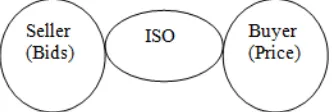
Electric power consumption varies with time reflecting the cyclical nature of human activities. to meet the electricity demand electric power generation companies have to plan the operation of generating units in such a way to minimize their production cost and at the same time to maximize their profits .In deregulated frame work any power producer who is having available generating units can participate in power contribution in power market. The system under deregulation works based on selling and buying of power with intermediate operator of ISO (independent system operator). In this scenario suppose if a power producer is having M number of generating units and if he wants to maximize his profit then he has to commit the generating units in such a way to maximize his profit satisfying all the constraints. The most important constraints includes satisfying the load demand and meeting up and down time constraints and meeting ramp up and ramp down constraints and other start up and shut down constraints etc. The unit commitment problem under deregulation involves commitment of generating units of an individual power producer for maximization of his profit; this problem is of highly complex in nature as so many constraints are involved for maximization of profit as main objective function. In this paper the problem is attacked using advanced binary genetic algorithm. The proposed algorithm seems to be efficient as compared to normal conventional technique like
*Corresponding author: Rama Krishna
Department of Electrical Engineering, Gitam University, Hyderabad, India
dynamic programming in terms of constraints satisfaction and convergence time. The Genetic algorithm approach is found to be simpler in constraints handling and meeting up the critical constraints like ramping up and ramping down and power generation limits.
Profit based unit commitment problem
Under deregulated environment the profit based unit commitment problem can be analyzed by maximizing the profit of an individual power producer considering the spot market price and demand fluctuations set be independent system operator. under this situation
Fig. 1. Structure of deregulated frame work
Problem Formulation
The main objective function of the problem is
Profit =Revenue-Total cost (1)
The revenue is obtained by supplying a certain amount of power at spot market price and the total cost is the cost of production as well as starts up and shut down costs included if
ISSN: 0976-3376
Asian Journal of Science and Technology Vol. 5, Issue 6, pp. 355-359, June, 2014ASIAN JOURNAL OF
SCIENCE AND TECHNOLOGY
Article History:
Received 13th March, 2014
Received in revised form 01st April, 2014
Accepted 12th May, 2014
Published online 30th June, 2014
Key words:
any. The startup cost can be considered by taking in to account of the number of hours the unit has been off line and unit cooling time as well. This can be interpreted in the following equation
))
/
exp(
1
(
, it i off i
i t
i
X
SU
(2)
Where
SU
itthe startup cost of unit i at the interval of time t.i
: Combined crew start-up costs and equipment maintenancecosts [$];
i
: Cold start-up cost [$];t i off
X
, : Number of hours the unit has been offline [h];i
: Unit-cooling time constant [h].In addition to startup cost the generating unit must satisfy all the constraints (minimum up time, minimum down time, ramp up and ramp down, minimum power and maximum power generation) as given below.
Loading constraint
Where is the power generation of ith unit at hour t and is the state of ith unit at hour t
Unit limits
(4) Unit minimum up and down time constraints
(5)
MUT = Minimum up time, MDT=Minimum down time, Ton = Generator on time, Toff = Generator off time
Unit ramp rate limits
(6)
DR = Ramp down limit UR =Ramp up limit
In addition to all the above constraints there are some other constraints like spinning reserve constraints and crew constraints and must run constraints that must be satisfied. From the above equations there are two decision variables
by unit i at time t and is the control variable whose value is
chosen to be “1” if the generating unit i is committed at hour t and “0” otherwise (of course if =0, then =0).
Genetic Algorithms
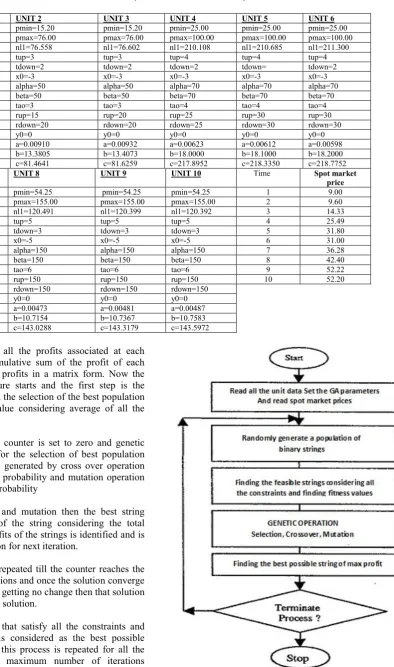
Genetic algorithm approach is used for solving the profit based unit commitment problem and it has several advantages as compared to other methods. The genetic algorithm approach is based on selection of best population among the search space and the selection of best solution is based on the fitness value associated with the string. The steps involved in applying the genetic algorithm to the profit based unit commitment problem are as follows.
Solution to Profit Based Unit Commitment Using Genetic Algorithms
Step-1: The unit data is considered for 10 generating units which includes minimum power limit, maximum power limit, minimum up time, minimum down time ,initial status, cost coefficient parameters,
i
i
i, ramp up and ramp down limits, the spot market price profile for the given scheduling time period etc. the genetic algorithm parameters are considered such as population size, chromosome length, cross over probability, mutation probability, number of iterations etc.Step-2: Considering the first unit, randomly generate the status of generating unit (on or off) for the scheduling time period i.e. if the time period considered is let us say 10 hours then randomly generate a string length of 10 bits of 0s and 1s in binary format with the population size as chosen in step-1
Step-3: From step-2 within the population of strings generated randomly consider only those strings which satisfy the minimum up and down time and ramp up and ramp down limits by considering the up and down time limits of the generator and initial status of the generator.
Step-4: now we have all the strings which are called feasible strings, now for all these feasible strings identify the start up cost as well as shut down costs associated when the status is changing from off to on status or from on to off status. Considering the start up and shut down costs find the total production cost using F=a + b (p) + c (p2). This cost is the fitness value corresponding to each binary string. The power p for each
Interval when the unit is on is calculated using where
Where is the power generated by ith unit at time t and is the maximum power limit of unit i at time t and is the ramp up limit of unit i at time t and is the ramp down limit of unit i at time t.
Step-5: Once we get all the values of power generation levels and total cost associated with each power level then calculate the total profit associated with the power level using
Step-6: After calculating all the profits associated at each interval then find the cumulative sum of the profit of each string and arrange all the profits in a matrix form. Now the genetic algorithm procedure starts and the first step is the selection of the strings and the selection of the best population is based on the fitness value considering average of all the fitness values.
Step-7: Now the iteration counter is set to zero and genetic operators are considered for the selection of best population and the new population is generated by cross over operation considering the cross over probability and mutation operation considering the mutation probability
Step-8: After cross over and mutation then the best string having maximum profit of the string considering the total cumulative sum of the profits of the strings is identified and is stored for future comparison for next iteration.
Step-9: The procedure is repeated till the counter reaches the maximum number of iterations and once the solution converge to the values which further getting no change then that solution is considered to be the best solution.
Step-10: The final string that satisfy all the constraints and having maximum profit is considered as the best possible solution for that unit and this process is repeated for all the generating units till the maximum number of iterations reached.
Figure 2. Flow chart Table 1. Unit data (IEEE REFERENCE DATA)
UNIT 1 UNIT 2 UNIT 3 UNIT 4 UNIT 5 UNIT 6 pmin=15.20 pmin=15.20 pmin=15.20 pmin=25.00 pmin=25.00 pmin=25.00 pmax=76.00 pmax=76.00 pmax=76.00 pmax=100.00 pmax=100.00 pmax=100.00 nl1=76.473 nl1=76.558 nl1=76.602 nl1=210.108 nl1=210.685 nl1=211.300 tup=3 tup=3 tup=3 tup=4 tup=4 tup=4 tdown=2 tdown=2 tdown=2 tdown=2 tdown= tdown=2 x0=-3 x0=-3 x0=-3 x0=-3 x0=-3 x0=-3 alpha=50 alpha=50 alpha=50 alpha=70 alpha=70 alpha=70 beta=50 beta=50 beta=50 beta=70 beta=70 beta=70 tao=3 tao=3 tao=3 tao=4 tao=4 tao=4 rup=15 rup=15 rup=20 rup=25 rup=30 rup=30 rdown=15 rdown=20 rdown=20 rdown=25 rdown=30 rdown=30
y0=0 y0=0 y0=0 y0=0 y0=0 y0=0
a=0.00895 a=0.00910 a=0.00932 a=0.00623 a=0.00612 a=0.00598 b=13.3538 b=13.3805 b=13.4073 b=18.0000 b=18.1000 b=18.2000 c=81.2980 c=81.4641 c=81.6259 c=217.8952 c=218.3350 c=218.7752 UNIT 7 UNIT 8 UNIT 9 UNIT 10 Time Spot market
price pmin=54.25 pmin=54.25 pmin=54.25 pmin=54.25 1 9.00 pmax=155.00 pmax=155.00 pmax=155.00 pmax=155.00 2 9.60 nl1=120.673 nl1=120.491 nl1=120.399 nl1=120.392 3 14.33
tup=5 tup=5 tup=5 tup=5 4 25.49
tdown=3 tdown=3 tdown=3 tdown=3 5 31.80
x0=-5 x0=-5 x0=-5 x0=-5 6 31.00
alpha=150 alpha=150 alpha=150 alpha=150 7 36.28 beta=150 beta=150 beta=150 beta=150 8 42.40
tao=6 tao=6 tao=6 tao=6 9 52.22
rup=100 rup=150 rup=150 rup=150 10 52.20 rdown=100 rdown=150 rdown=150 rdown=150
y0=0 y0=0 y0=0 y0=0
Conclusions
It is recognized that the optimal unit commitment of thermal systems results in a great saving for electric utilities. Unit Commitment is the problem of determining the schedule of generating units subject to device and operating constraints. The formulation of profit based unit commitment has been discussed and the solution is obtained by genetic algorithm approach. An algorithm based on genetic algorithm, which is fitness based optimization technique, has been developed to solve the profit based unit commitment problem. The effectiveness of these algorithms has been tested on system
REFERENCES
R. H. Kerr, J. L. Scheldt, A. J. Fontana and J. K. Wiley, “Unit
Commitment”, IEEE Transactions on Power Apparatus
And Systems.vol. PAS-85, No. 5, pp. 417-421. May 1966. K. Hara, M. Kimura and N. Honda, “A Method for Planning
Economic Unit Commitment and Maintenance of Thermal Power Systems”, IEEE Transaction on Power Apparatus
And Systems, vol. PAS-85, NO.5, pp.421-436. May 1966 P. G. Lowery, “Generating Unit Commitment by Dynamic
Programming”, IEEE Transaction on Power Apparatus and
Systems, vol. PAS-85, No. 5, pp. 422-426. May 966. J. D. Guy. “Security Constrained Unit Commitment”. IEEE
Transactions on Power Apparatus and Systems, vol. 90, pp. GA parameters
Population size=2000; Chromosome length=10 Pc=0.6(cross over probability) Pm=0.6(mutation probability)
dai =200 (maximum number of iterations)
All the parameters are defined in addition to time intervals and corresponding spot market prices are defined when reading unit data.
RESULTS
Table 2. UNIT COMMITMENT SCHEDULE FOR 10 HOURS
Unit t=1 2 3 4 5 6 7 8 9 10 1 1 1 1 1 1 1 1 1 1 1 2 1 1 1 1 1 1 1 1 1 1 3 0 1 1 1 1 1 1 1 1 1 4 0 0 1 1 1 1 1 1 1 1 5 0 0 1 1 1 1 1 1 1 1 6 0 0 1 1 1 1 1 1 1 1 7 0 0 1 1 1 1 1 1 1 1 8 0 0 1 1 1 1 1 1 1 1 9 0 0 1 1 1 1 1 1 1 1 10 0 0 1 1 1 1 1 1 1 1
Table 3. POWER GENERATION SCHEDULE FOR 10 HOURS
Unit T=1 2 3 4 5 6 7 8 9 10 1 15.2 30.2 45.2 60.2 75.2 76.0 76.0 76.0 76.0 76.0 2 15.2 30.2 45.2 60.2 75.2 76.0 76.0 76.0 76.0 76.0 3 0.0 20.0 40.0 60.0 76.0 76.0 76.0 76.0 76.0 76.0 4 0.0 0.0 25.0 50.0 75.0 100.0 100.0 100.0 76.0 76.0 5 0.0 0.0 30.0 60.0 90.0 100.0 100.0 100.0 100.0 100.0 6 0.0 0.0 30.0 60.0 90.0 100.0 100.0 100.0 100.0 100.0 7 0.0 0.0 100.0 155.0 155.0 155.0 155.0 155.0 155.0 155.0 8 0.0 0.0 150.0 155.0 155.0 155.0 155.0 155.0 155.0 155.0 9 0.0 0.0 150.0 155.0 155.0 155.0 155.0 155.0 155.0 155.0 10 0.0 0.0 150.0 155.0 155.0 155.0 155.0 155.0 155.0 155.0
Table 4. PROFIT SCHEDULE FOR 10 HOURS
C. K. Fang, G. B. Sheble and F. Albu, “Evaluation Of
Dynamic Programming Based Methods And Multiple Area Representation For Thermal Unit Commitments”, IEEE
Transactions on Power Apparatus and Systems. vol. 100, No. 3, pp. 1212-1218, Mar. 1981.
G. S. Lauer, N. R. Sandell, Jr., Bertsekas and T.A. Posbergh, “Solution Of Large Scale Optimal Unit Commitment
Problem”. IEEE Transactions on Power Apparatus and
Systems, vol. 101, pp. 79-96, Jan. 1982.
K.D. Lee, R.H. Vierra, G.D. Nagel and R.T. Jenkins, “Problems Associated With Unit Commitment In
Uncertainty”, IEEE Transactions on Power Apparatus and
Systems, vol. 104, No. 8, pp.2072-2078, Aug.1985. P.PJ van den Bosch and G. Honderd, “A Solution Of The Unit
Commitment Problem Via Decomposition And Dynamic Programming”, IEEE Transactions on Power Apparatus
and Systems, vol. 104, pp. 1684-1690, July 1985.
G. L. Kusic and H. A. Putnam, “Dispatch And Unit
Commitment Including Commonly Owned Units”, IEEE
Transactions on Power Apparatus and Systems, vol. 04. pp. 2408-2412. Sep. 1985.
Walter L. Snyder. Jr., H. David Powell, Jr. and John C. Rayburn, “Dynamic Programming Approach to Unit Commitment”, IEEE Transaction on Power System. vol. 2, pp. 339-347. May 1987.
R. Nieva, A. lnda and I. Guillen, ”Lagrangian Reduction Of
Search-Range For Large-Scale Unit Commitment”, IEEE
Transaction on Power System, vol. 2, pp. 465- 473. May 1987.
A .I. Cohen and S.H. Wan,“ A Method For Solving The Fuel
Constrained Unit Commitment Problem”, IEEE
Transaction on Power System, vol.2, pp. 608-614, Aug. 1987.
S. Mukhtari, J. Singh and B. Wollenberg, “A Unit Commitment
Expert System”, IEEE Transaction on Power System, vol.
3, No. I, pp. 272-277. 1988.
Fred. N. Lee, “Short-Term Thermal Unit Commitment - A New
Method”, IEEE Transaction on Power System, vol. 3, pp.
421-428, May 1988.
Walter J. Hobbs, Gary Hermon, Stephen Warner and Gerald B. Sheble, “An Enhanced Dynamic Programming
Approach for Unit Commitment”, IEEE Power
Engineering Review, pp.70. Aug. 1988.
K. Aoki, M. Itoh, T. Satoh, K. Nara and M. Kanezashi, “Optimal Long-Term Unit Commitment In Large Scale
Systems Including Fuel Constrained Thermal And Pumped Storage Hydro”, IEEE Transaction on Power System, vol.
4, pp. 1065-1073, Aug 1989.
S. K. Tong and Shahidehpour, “Combination of
Lagrangian-Relaxation and Linear- Programming Approaches for Fuel-Constrained Unit Commitment Problems”. IEE Proc-
Gener. Tansnm. Distrib., vol. 136, Pt. C. pp.162-174, May 1989.
Biographical notes
P.V. Rama Krishna obtained B.E from Osmania University, Hyderabad. M.Tech from IIT Roorkee, He has total 10 years of teaching and industrial experience. Presently he is working as assistant professor in Gitam University. His areas of interest are Power Systems operation and control, application of artificial intelligence techniques to power systems, deregulation etc. He is life member of Indian Society for Technical Education (ISTE). He has published three papers in International Journals and various conferences to his credit.
Dr. Sukhdeo sao is a Professor in the Department of Electrical Engineering, Bharat Institute of Engineering And Technology, India. He has more than 20 years of experience in teaching and research. His current area of research includes power systems, electrical machines, and application of Optimization techniques to power Simulation. He has published more than thirty papers in referred international journals. He has also presented more than 40 research articles in national and international conferences.