IJSRSET1738121 | Received : 15 Nov 2017 | Accepted : 03 Dec 2017 | November-December-2017 [(3)8: 366-373]
© 2017 IJSRSET | Volume 3 | Issue 8 | Print ISSN: 2395-1990 | Online ISSN : 2394-4099 Themed Section: Engineering and Technology
366
Context and Movement Aware VIKOR MADM Based Vertical
Handover Algorithm for Heterogeneous Networks
Silki Baghla
1, Savina Bansal
21
Research Scholar, Department of Electronics & Communication Engineering, IKG Punjab Technical University, Kapurthala, India
2
Professor, Department of Electronics & Communication Engineering, Maharaja Ranjeet Singh State Technical University, Bathinda, India
ABSTRACT
Heterogeneous wireless networks comprise of variety of wireless technologies integrated to satisfy user’s demand. Vertical handover algorithm is the need of present scenario to select optimum network among the available networks. Multiple attribute decision making based handover algorithm are capable to select optimum network having requisite set of context parameters. Context information related to quality of service parameters offered by networks varies with movement of mobile terminal. Thus, context and movement aware has been designed with vector normalized preferred performance based VIKOR method (CMV-VPP). The performance has been analyzed for conversational traffic and compared with other available normalization methods as MAX normalization based VIKOR (CMV-MAX) and Vector normalization based VIKOR (CMV-VEC) methods. Simulation results show that the proposed algorithm performs better in terms of network selection and number of handovers as compared with other methods used in this work.
Keywords : Heterogeneous, CMV-VPP, VIKOR, CMV-MAX, CMV-VEC
I.
INTRODUCTION
Vertical handover is necessity of fourth generation and beyond 4G heterogeneous networks where different wireless technologies are incorporated and user has the choice to select suitable network from number of available wireless networks [3]. The decision of network selection with principle of “Always best connected” [1]should not rely solely on signal strength but context information of mobile device and networks needs to be included[9]. Different wireless networks offer varying quality of service and the user’s demand may also vary with time. Further, to select optimum network among the networks available while on move is again a critical task. Thus a movement based context aware (MBCA) vertical handover technique is desirable in the present era of heterogeneous environment. The context information related to mobile user may involve battery status and application whereas wireless networks advertise information pertaining to signal strength, bandwidth, level of security, cost, network load etc. as context information. The handover technique should be
decision making method for network selection. The performance of proposed algorithm has been compared with Max normalization based CMV-MAX and Vector normalization based CMV-VEC techniques applied to VIKOR method.
Rest of the paper is organized as follows: Following section presents the work done by various researchers in this area so as to appreciate and appraise their contributions made in this upcoming field, section 3 presents procedural details of proposed algorithm. Section4 describes the simulation set up used and compare the performance analysis with present. Section 5 provides results of simulation and section 6 conclude the work with final remarks.
II.
RELATED WORK
In next generation wireless networks, different network technologies such as WLAN, UMTS etc. coexist and offer variety of quality of services to user. The information regarding network related context parameters like bandwidth, network load, coverage, security and many more has been advertised by different networks on control channels periodically. Traditional signal strength based algorithms lacks in suggesting suitable network for application based requisite quality of service in heterogeneous networks. Thus context aware vertical handover techniques are required to perform intelligent network selection in integrated wireless network. Q. Wei et.al [9] proposed a flexible and integrated approach for context management between mobile devices and networks. Programmable platforms, distributed context management components in network nodes and mobile devices were deployed in performing handover decision. Soft handoff procedure can be employed with vertical handoff allows multi connection between user and base stations/access points during handoff as compared with hard handoff. Kemeng Yang et.al[12] proposed a context-aware vertical soft handoff algorithm resulting in lower dropping probability, lower average cost and high throughput as compared with vertical hard handoff. Moreover location of mobile user play vital role in performing optimum handover among different networks. M. Ylianttila et.al[6] proposed a location aware architecture to support vertical roaming between WLAN hotspots and cellular networks. Power and dwell-timer based two handoff algorithms were used for moving-in and moving- out transitions between two networks.
Several other approaches were also used in literature to design context aware vertical handover algorithms. Meriem Zekri et.al [15] proposed Fuzzy logic and Analytic hierarchy process based intelligent context-aware algorithm which considered both user’s and service’s requirements. Information regarding static (user’s preference, cost) and dynamic context parameters( mobile terminal velocity, RSS etc.) was gathered and applied to Fuzzy inference system in handover initiation phase of vertical handover to check whether handover is required or not. Network selection is then performed by AHP. Due to multi-criteria nature of vertical handover,Multiple attribute decision making (MADM) algorithms are able to incorporate number of context attributes and provide compromising solution among conflicting criterion involved in complex vertical handover decision. Payman Talebi Ferd [16] proposed weighted product method based context-aware network selection algorithm for dynamic selection of best access network among available networks. In this work VIKOR MADM method has been used as baseline algorithm for performing context awareness based network selection in heterogeneous environment of three networks as WLAN, UMTS and WIMAX.
III.
CONTEXT AND MOVEMENT AWARE
VECTOR NORMALIZED PREFERRED
PERFORMANCE BASED VIKOR METHOD
(CMV-VPP)
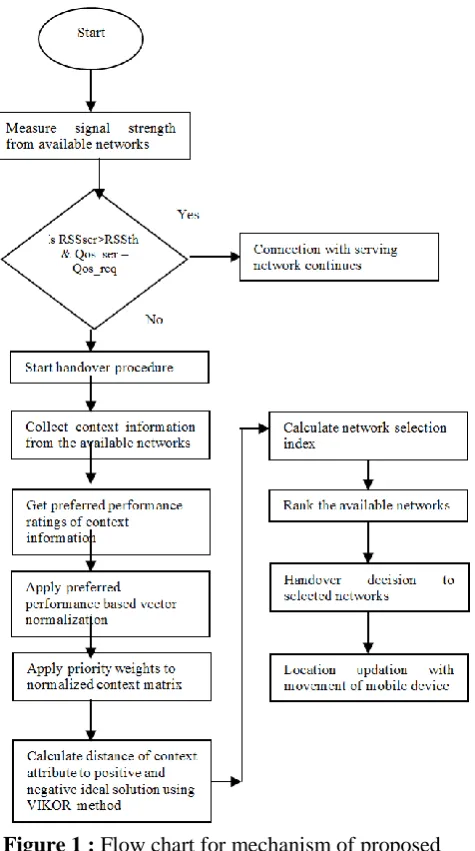
Figure 1 : Flow chart for mechanism of proposed method
RSSser and RSSthr represent received signal strength from serving base station/ access point and threshold value respectively. Qos_ser and Qos_req represents quality of service provided by serving base station/access point and required quality of service as desired by user respectively. Normalized context attribute matrix is applied to VIKOR [1] multiple attribute decision making algorithm for selecting the optimum network from available networks. Application of VIKOR method to normalized matrix resulted in matrix containing network selection index (NSI) of all the available networks. The networks are arranged in decreasing value of NSI and the network having least value of NSI will be considered as optimum network. The other two techniques mentioned in this work differ with normalization method are MAX and MCV-VEC for max normalization and vector normalization respectively.
IV.
SIMULATION SETUP
Three wireless networks considered for designing heterogeneous environment include WLAN, WIMAX and UMTS that are to be available uniformly throughout the region of interest with variable signal strength and other context parameters.
Five simulation scenarios have been designed using MATLAB platform for different context information to analyze the performance of the proposed MCV-VPP handover technique. In every scenario, velocity of mobile device is varied in equal intervals of 10 Kmph to analyze the movement based aspect of the handover technique.
Figure 2: Scenario for heterogeneous network
Fig. 2 presents the heterogeneous network considered in this work. Table I provides the overall simulation setup used whereas Table II explains the design of five scenarios on the basis of received signal strength.
TABLE I: SIMULATION SETUP
No. of networks 3 (WLAN,WIMAX and UMTS)
Traffic
class/application preference
Conversational
Velocity of mobile device
10KMph- 100KMph(in 10 intervals)
Network load 100%
Context related parameters
Received signal strength, Delay, jitter, throughput, security, cost and packet loss,
Number of Vertical handoff Scenarios
The values of other context parameters vary randomly in the range given in Table III. It is assumed that context related information is available in database of handover module attached with mobile user and updated with time. The quality Application preference (Conversational) of mobile user is used to assign priority values to different parameters. Analytical network process (ANP) is used to assign priority weights to all the parameters according to the characteristics of conversational traffic class. Packet delay and Jitter have assigned highest priority after Relative signal strength.
TABLE II: LEVEL OF SIGNAL STRENGTH FOR 3 NETWORKS IN 5 SCENARIOS
Scenario Network
UMTS WLAN WIMAX
1 Low Medium High
2 Medium High Low
3 Max Low Medium
4 Comparable
5 Low Comparable
In every scenario, the network selected by proposed handover algorithm will illustrate the optimal network selection feature of the handover algorithm. The performance of proposed technique is compared with two other techniques as described in section 3 on the bases of network selection as well as number of handovers. The performance of the proposed CMV-VPP (Context and Movement aware VPP based VIKOR) method has been analyzed on the basis of selected network and number of handovers for variation in velocity of mobile user. The performance is also compared with other normalization techniques namely CMV-MAX (Context and Movement aware Max normalization based VIKOR) method and CMV-VEC (Context and Movement aware vector normalization based VIKOR) method.
TABLE III: RANGE OF CONTEXT ATTRIBUTES FOR THREE NETWORKS[13]
Context attribute Network
UMTS WLAN WIMAX
Delay(ms) 25-50
100-150 60-100
Jitter(ms) 5-10 10-20 3-10
Packet loss(per
10^6) 20-80 20-80 20-80
Throughput(Mbps) 0.1-3 50-150 20-100
Security (%) 70 50 60
Cost (%) 60 10 40
V.
RESULTS AND DISCUSSION
As outlined in section 4, five scenarios have been constructed in the heterogeneous environment. In every scenario, the three wireless networks offer different context information to the user. The network selection will be done on the basis of values of network selection index (NSI) parameter of handover technique. The network having minimum value of NSI will be selected for given set of context parameters at any location in overlapping area of three networks. As the user is involved in conversation while on move then UMTS network will be the optimum choice as per the cost and other quality of service parameters required for conversational traffic and context information offered by UMTS network. Although received signal strength will be the trigger input in the decision but if UMTS network is available and signal strength received by mobile device is above threshold then it should be given priority in selection. The performance analysis of proposed CMV-VPP method is as follows:
A. Scenario 1:
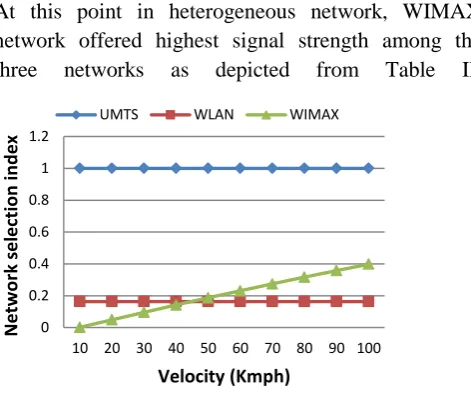
At this point in heterogeneous network, WIMAX network offered highest signal strength among the three networks as depicted from Table II.
Figure 3 : (a) Network selection index and handover decision in scenario 1 for CMV-MAX method
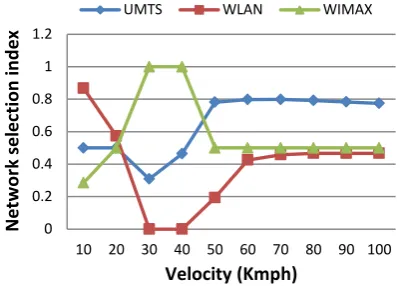
Fig. 3(a-c) shows the variation in network selection index with velocity for the three handover techniques based on VIKOR method. As shown in Fig. 3(a), in CMV-MAX method, UMTS network has least priority
0 0.2 0.4 0.6 0.8 1 1.2
10 20 30 40 50 60 70 80 90 100
N
e
tw
o
rk
sel
e
ction
in
d
e
x
Velocity (Kmph)
among the three networks for all the time though it is the best choice for conversational traffic. Moreover handover occurred
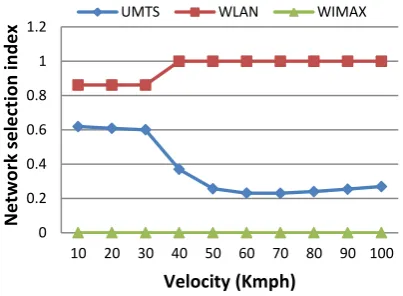
Figure 3 : (b) Network selection index and handover decision in scenario 1 for CMV-VEC method
between WLAN and WIMAX networks at velocity from 50-60Kmph.WIMAX network can be the reason for network selected on the basis of signal strength but this method selected WLAN for high velocity which is not the suitable choice. In the same manner, V-VEC method selected WLAN most of the time as can be seen from Fig. 3(b). This is again not the optimal choice for conversational traffic. Handover occurred at velocity of 30Kmph.
CMV-VPP method selected WIMAX network due to maximum signal strength and UMTS network is next choice which is justified. No handover occurred.
Figure 3 : (c) Network selection index and handover decision in scenario 1 for CMV-VPP method
B. Scenario 2
Here WLAN offered maximum signal strength among the three wireless networks. The performance of three normalization methods is shown in Table IV.
TABLE IV: Network selection by three methods
Velocit y(Kmp h)
Normalization method
CMV-MAX
CMV-VEC
CMV-VPP
10 WLAN WIMAX UMTS
20 WLAN WIMAX UMTS
30 WLAN WLAN UMTS
40 WLAN WLAN UMTS
50 WLAN WLAN UMTS
60 WLAN WIMAX UMTS
70 WLAN WIMAX UMTS
80 WLAN WIMAX UMTS
90 WLAN WIMAX UMTS
100 WLAN WIMAX UMTS
As shown in Table IV, V-MAX method selected WLAN network even though the velocity of mobile user increases. WIMAX network has lowest priority irrespective of signal strength. Priority of UMTS is next to WLAN but the difference between the NSI values is larger enough for continuous connection with WLAN network.
On the other hand CMV-VEC method resulted in handovers between WLAN and WIMAX networks; UMTS network has least priority in selection. CMV-VEC method selected UMTS network which is the optimal choice for conversational traffic.
C. Scenario 3
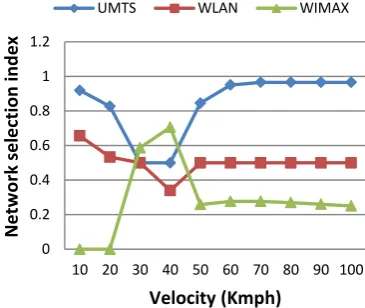
As given in Table II, here the signal strength received from UMTS network is largest as compared with other networks. Thus depending on signal strength and quality of service offered by UMTS network, mobile user should be connected with it. Fig. 4(a-c) presents NSI values provided by three normalization methods for three networks with variation in velocity of mobile user. CMV-MAX and CMV-VPP method suggested UMTS network to be selected for conversational traffic. CMV-VEC assigned least priority to UMTS network which is not acceptable. Moreover 2 handovers occurred.
0 0.2 0.4 0.6 0.8 1 1.2
10 20 30 40 50 60 70 80 90 100
N
e
tw
o
rk
sel
e
ction
in
d
e
x
Velocity (Kmph)
UMTS WLAN WIMAX
0 0.2 0.4 0.6 0.8 1 1.2
10 20 30 40 50 60 70 80 90 100
N
e
tw
o
rk
sel
e
ction
in
d
e
x
Velocity (Kmph)
Figure 4 : (a) Network selection index and handover decision in scenario 3 for CMV-MAX method
Figure 4 : (b) Network selection index and handover decision in scenario 3 for CMV-VEC method
Figure 4 : (c) Network selection index and handover decision in scenario 3 for CMV-VEC method
D. Scenario 4
This is the critical location in the heterogeneous network as the signal strength received from the three networks is nearly equal. Thus the value of network selection index will highlight the effectiveness of normalization method regarding optimum network selection. Table V shows the performance of three normalization methods with variation in velocity of mobile device. Only CMV-VPP method selected
desired UMTS network among the three methods. This indicates the context aware feature of vector normalized preferred performance normalization method. The other methods suggested WLAN network with 2 or 3 handovers which is not justified network selection.
TABLE V: Network selection by 3 normalization methods
Veloci ty(Km ph)
Normalization method
CMV-MAX
CMV-VEC
CMV-VPP
10 WLAN,WIMAX WIMAX UMTS
20 WLAN,WIMAX WIMAX UMTS
30 WLAN WLAN UMTS
40 WLAN WLAN UMTS
50 WLAN WLAN UMTS
60 WLAN WLAN UMTS
70 WLAN WLAN UMTS
80 WLAN WLAN UMTS
90 WLAN WLAN UMTS
100 WLAN WLAN UMTS
E. Scenario 5
In this scenario, the signal strength received from WLAN and WIMAX networks is almost equal and larger than UMTS. The signal strength received from UMTS network is adequate enough to maintain a call. Fig. 5(a-c) shows the network selection index values calculated by three normalization methods. Again CMV-VPP method recommended UMTS network as per the requirement of conversational matrix. WIMAX network is given priority next to UMTS which offers highest mobility among the three networks.
Figure 5 : (a) Network selection index and handover decision in scenario 5 for CMV-MAX method 0 0.2 0.4 0.6 0.8 1
10 20 30 40 50 60 70 80 90 100
Ne two rk sel ec ti on in d ex Velocity (Kmph)
UMTS WLAN WIMAX
0 0.2 0.4 0.6 0.8 1 1.2
10 20 30 40 50 60 70 80 90 100
N e tw o rk sel e ction in d e x Velocity (Kmph)
UMTS WLAN WIMAX
0 0.2 0.4 0.6 0.8 1 1.2
10 20 30 40 50 60 70 80 90 100
N le tw o rk sel e ction in d e x Velocity (Kmph)
UMTS WLAN WIMAX
0 0.2 0.4 0.6 0.8 1 1.2
10 20 30 40 50 60 70 80 90 100
N e tw o rk sel e ction in d e x Velocity (Kmph)
Figure 6 : (b) Network selection index and handover decision in scenario 5 for CMV-VEC method
VI.
CONCLUSION
Context awareness is desired property for vertical handover in today’s era of heterogeneous environment. Different kinds of networks offer variable network conditions in accordance with changing location of mobile user. The velocity of mobile terminal play important role in decision making phase of vertical handover. In view of these two factors, context and movement aware handover technique has been proposed and analyzed with five different scenarios to analyze robustness and effectiveness of proposed technique. Simulation results show that proposed technique select optimum network for conversational traffic with minimum number of handovers in five different situations defined by five scenarios. The proposed technique is also compared with two other techniques and showed better result in terms of optimum network selection.
VII.
REFERENCES
[1]. S. Opricovic, "Multi-criteria optimization of civil engineering systems" Faculty of Civil Engineering, Belgrade, 1998.
[2]. E. Gustafsson and A. Jonsson, "Always best connected", IEEE Wireless Communications Magazine, Vol.10, No.1,pp. 49-55, Feb. 2003. [3]. J. McNair and F. Zhu, "Vertical Handoffs in
Fourth-generation Multi network Environments", IEEE Wireless Communications, Vol. 11, pp. 8-15, 2004.
[4]. W Zhang, "Handover Decision Using Fuzzy MADM in Heterogeneous Networks", in Proceedings of IEEE conference on Wireless Communications and Networking (WCNC’04), Atlanta, USA, pp. 653-658, 2004.
[5]. T. L. Saaty, "Theory and Applications of the Analytic Network Process" RWS Publications, 2005.
[6]. M. Ylianttila, J.Makela, K.Pahlavan, " Analysis of handoff in a location- aware vertical multi-access network" Computer Networks, Vol. 47, pp.185-201, 2005.
[7]. O Ormond, J Murphy and G M Muntean, "Utility-based Intelligent Network Selection in Beyond 3G Systems", in Proceedings of IEEE International Conference on Communications, Vol. 4, pp. 1831-1836, Jun. 2006.
[8]. E Stevens-Navarro and V WS Wong, "Comparison between Vertical Handoff Decision Algorithms for Heterogeneous Wireless Networks", in Proceedings of 63rd IEEE Conference on Vehicular Technology (VTC’06-Spring), Melbourne, Australia, pp. 947-951, 2006. [9]. Q. Wei, K. Farkas, C. Prehofer, P. Mendes, B. Plattner, "Contextaware handover using active network technology", Computer Networks, Vol. 50, Issue 15, pp.2855–2872, 2006.
[10]. F Bari and V Leung, "Application of ELECTRE to network selection in a heterogeneous wireless network environment", in Proceedings of IEEE Conference on Wireless Communication and Networking (WCNC’07), Hong Kong, China, pp. 3810-3815, 2007.
[11]. Nkansah-Gyekye, Y Agbinya, J.I., "A Vertical Handoff Decision Algorithm for Next Generation Wireless Networks", in Proceedings of 3rd International Conference on Broadband Communications, Information Technology and Biomedical Applications, pp. 358-364, Nov. 2008.
[12]. Kemeng Yang, Iqbal Gondal and Bin Qiu, " Context aware vertical soft handoff algorithm for heterogeneous wireless networks" in Proceedings of IEEE 68th Vehicular Technology conference (VTC 2008- Fall), pp.1-5, 27-28 Sept.2008. [13]. J R Gallardo-Medina, U Pineda-Rico and E
Stevens-Navarro, "VIKOR Method for Vertical Handoff Decision in Beyond 3G Wireless Networks", in Proceedings of 6th IEEE International Conference on Electrical Engineering, Computing Science and Automatic Control (CCE’09), Toluca, Mexico, pp. 1-5, 2009. [14]. Universal Mobile Telecommunications System (UMTS): Quality of Service (QoS) concept and 0
0.2 0.4 0.6 0.8 1 1.2
10 20 30 40 50 60 70 80 90 100
N
e
tw
o
rk
sel
e
ction
in
d
e
x
Velocity (Kmph)
architecture, 3GPP TS 23.107 version 5.10.0 Release 5.
[15]. Meriem Zekri, Badii Jouaber and Djamal Zeghlache, " Context aware vertical handover decision making in heterogeneous wireless networks", in Proceedings of 35th IEEE conference on Local Computer Networks (LCN) pp.764-768,10-14 Oct. 2010, Denver, Colorado. [16]. Paymen TalebiFard and Victor C.M.Leung, "