1 |
P a g e
IMPLEMENTATION OF PROTOTYPE FOR
DETECTION AND MANAGEMENT OF DIABETES
USING ANDROID MOBILE PHONE APPLICATION
AND RULE BASE SYSTEM
Prof. Aihtesham N. Kazi
1, Prof. Amit R. Wasukar
2,
Prof. Chetan S. Deshmukh
31,2
Department of Computer Sci. & Engineering
JDIET, Yavtamal Amravati University Amravati (India)
ABSTRACT
Recent technological advances in mobile communication and rule based expert system together enable new
types of healthcare systems. Especially the availability of Android OS based more user friendly GUI and cheap
smart phones gives new possibilities for a continuously monitoring of human health status such his/her BP,
Glucose level and there physiological parameters data allows an early detection of diabetes that leads other
potential dieses. Our proposed healthcare system mainly takes care of patients who suffer from chronic disease
like diabetes such person can live normally when the health condition is stable, but in critical condition he/she
needs desperate help of doctors and assistance to reduce the probability of deteriorating health conditions. Such
chronic patients can perform some simple self healthcare and monitoring functions via mobile phones through
our proposed system to know about the probable diseases. This paper presents a prototype mobile
healthcare system intended to take the various symptoms in the form of questioner from a patient that can be
analyzed by the remote Diabetes expert systems.
Keywords: Android OS, CLIPS, JSON, mHealth, PHP
I INTRODUCTION
Diabetes is a serious health problem today. Most of people are unaware that they are in risk of or may even have
type 2 diabetes. Type 2 diabetes is the most common form of diabetes is a complex disease and very common in
the modern world. Diabetes is a serious disease that affects almost every organ in the body like heart, eyes,
kidney, skin, nerves, blood vassals, foot etc. If left the disease unchecked it will make serious complications
including death
This work is aimed for people who are far way from doctors or specialist so that they could not see a heath
checkup regularly or even they do not have time to see a doctor. In this world of era people are so busy and they
are ignoring their glucose level, Blood pressure but suddenly they come across the situation like any sort of
2 |
P a g e
patient having high glucose level and having diabetes, but at that time, time has been passed and patient isalready diabetic. If people were aware of the factors of diabetes and know how much of risks they are of getting
diabetes, diabetes may be prevented early. In this paper, a mobile application based self-diagnosis system is
developed, which is simple, easy to operate and user-friendly.
The intention of our research is to create a mobile application that will connect to remote online self-diagnosis
system for people to see their risk for having diabetes. Since health diagnosis results expressed by verbal
language often involve a mixture of uncertainties in the outcomes that are governed by the meaning of linguistic
terms, inference under uncertainty is always a major issue.
II SYSTEM OVERVIEW
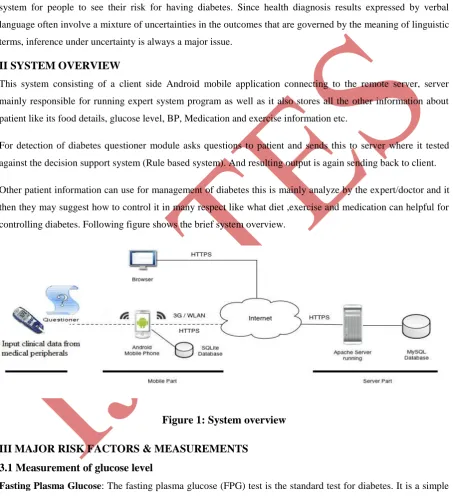
This system consisting of a client side Android mobile application connecting to the remote server, server
mainly responsible for running expert system program as well as it also stores all the other information about
patient like its food details, glucose level, BP, Medication and exercise information etc.
For detection of diabetes questioner module asks questions to patient and sends this to server where it tested
against the decision support system (Rule based system). And resulting output is again sending back to client.
Other patient information can use for management of diabetes this is mainly analyze by the expert/doctor and it
then they may suggest how to control it in many respect like what diet ,exercise and medication can helpful for
controlling diabetes. Following figure shows the brief system overview.
Figure 1: System overview
III MAJOR RISK FACTORS & MEASUREMENTS
3.1 Measurement of glucose level
Fasting Plasma Glucose: The fasting plasma glucose (FPG) test is the standard test for diabetes. It is a simple
blood test taken after 8 hours of fasting.
FPG levels are considered normal up to 100 mg/dL
Levels between 100 and 125 mg/dL are referred to as impaired fasting glucose or Pre-diabetes. These
levels are considered to be risk factors for type 2 diabetes and its complications.
3 |
P a g e
Postprandial blood glucose test (PPB): This test is followed by Fasting plasma glucose test. Take goodamount of food after FPG wait 2 hours, and do the blood test again. Postprandial glucose level should be under
140 mg/dL. The value between 140 and 199mg/dL indicate prediabetes.200 and above value may indicate
diabetes.
Random blood glucose test: A random blood glucose test can also be used to diagnose diabetes. A blood
glucose level of 200 mg/dl or higher indicates diabetes
Measurement of heart rate: Normal resting heart rates range anywhere from 40 beats per minute up to 100
beats per minute. Ideally the normal heart rate is between 60-90 beats per minute. From a generally used
formula, the maximum heart rate is about 220 minus person’s age.
Measurement of blood pressure: The blood pressure is an essential and normal part of the way the body
works. As blood is pumped around the body, it carries oxygen and nutrients that are essential for life. High
blood pressure can enlarge and weaken the heart. It also damages the blood vessels. If the blood vessels become
narrow or blocked, it may result in a heart attack or stroke. General expression for the blood pressure is two
numbers, such as 120/80 mmHg. The top number is the systolic blood pressure that is a measure of the pressure
when the heart muscle is contracted and pumping blood. The bottom number is the diastolic blood pressure that
is the pressure when the heart is relaxed and filling with blood.
Measurement of Body Mass Index (BMI): Body mass index is measure of body fat based on height and
weight that applies to both adult men and women. The BMI categories are listed as follows:
BMI≤18.5 underweight
18.5≤BMI≤25 normal weight
25≤BMI≤30 overweight
30≤BMI Obesity
IV RULE BASED EXPERT SYSTEMS
One of the most popular types of expert system today is the rule based or production rule system. A rule is
conditional statement that links given conditions to actions or outcomes. Expert systems making use of rules to
store knowledge are called rule based expert systems. It is based on an efficient algorithm called rete pattern
matching algorithm for matching facts against the patterns in rules to determine which rules have had their
conditions satisfied. Rete algorithm performance is theoretically independent of the number of rules in the
system and requires less memory. Rule based expert system use human expert knowledge to solve real world
problems that normally would require human intelligence. Expert’s knowledge is represented in the form of
rules or as data within the computer. Depending upon the problem requirement these rules and data can be
recalled to solve problems.
4.1 Inference Engines in Rule Based Systems
The inference engine:The Inference engine may infer solutions or conclusions from the knowledge base, based
on the facts supplied by the user. The inference engine acts as an interpreter or scheduler that interprets which
rules matches with the facts. The word inference or reasoning is very important in expert system; because
reasoning is the standard technique by which expert system solve problems. It makes inferences by deciding
4 |
P a g e
These conclusions are the expert system’s response to the user queries, as the user supplies facts or otherinformation to the expert system for getting the expertise or expert advice or response. So the purpose of
inference engine to seek information and relationship from the knowledge base and to provide answers,
predictions and suggestions in the way a human expert would. The inference engine must find the right facts,
interpretations and rules and assemble them correctly.
V DIABETES DETECTION
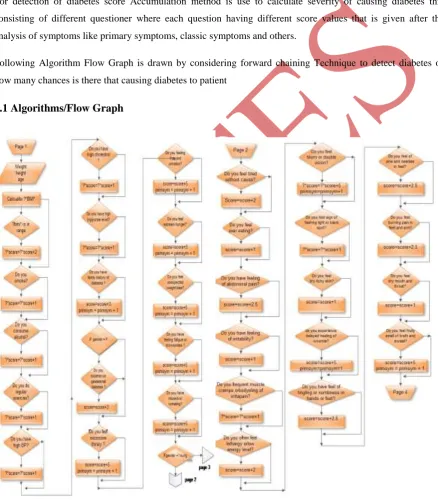
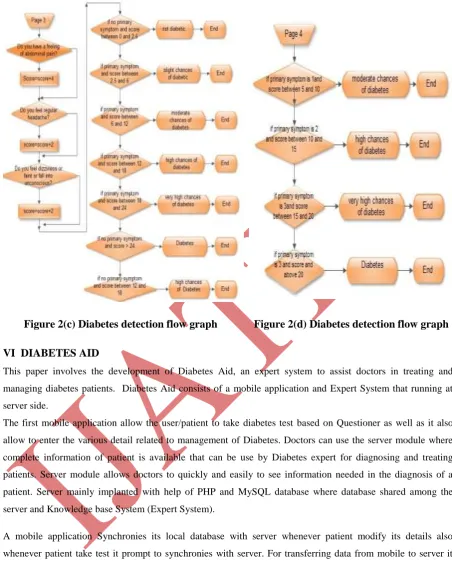
For detection of diabetes score Accumulation method is use to calculate severity of causing diabetes this
consisting of different questioner where each question having different score values that is given after the
analysis of symptoms like primary symptoms, classic symptoms and others.
Following Algorithm Flow Graph is drawn by considering forward chaining Technique to detect diabetes or
how many chances is there that causing diabetes to patient
5.1 Algorithms/Flow Graph
5 |
P a g e
Figure 2(c) Diabetes detection flow graph
Figure 2(d) Diabetes detection flow graph
VI DIABETES AID
This paper involves the development of Diabetes Aid, an expert system to assist doctors in treating and
managing diabetes patients. Diabetes Aid consists of a mobile application and Expert System that running at
server side.
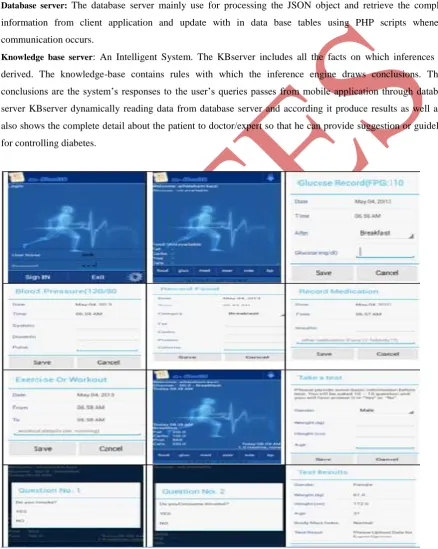
The first mobile application allow the user/patient to take diabetes test based on Questioner as well as it also
allow to enter the various detail related to management of Diabetes. Doctors can use the server module where
complete information of patient is available that can be use by Diabetes expert for diagnosing and treating
patients. Server module allows doctors to quickly and easily to see information needed in the diagnosis of a
patient. Server mainly implanted with help of PHP and MySQL database where database shared among the
server and Knowledge base System (Expert System).
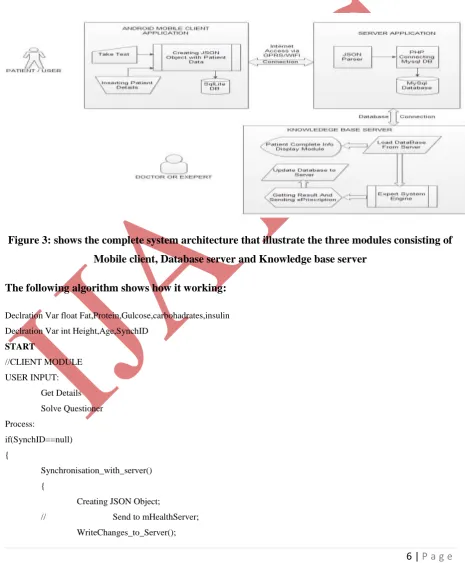
A mobile application Synchronies its local database with server whenever patient modify its details also
whenever patient take test it prompt to synchronies with server. For transferring data from mobile to server it
uses Light weight JSON object that reduces the transferring time also load on mobile client.
This architecture makes it easier for patient as they need only to carry one item with them throughout the day
after uploading patient records for the patients they are to see that day. To aid ease of use, simple GUI has been
implemented it’s more user-friendly that consisting of forms with editable textboxes and message boxes for
questioner and easy Tab view. In addition to data presentation, Diabetes Aid can also make suggestions of
6 |
P a g e
controlling diabetes in case of emergency visiting advice to expert. Android OS and the java were chosen for thedevelopment of the code for Mobile application for connecting patient to server remotely. This combination
provided the best environment and ease of learning for the project. Diabetes Aid is intended to run on Android
2.3 on ward devices Expert medical information was assimilated from interviewing with Dr. Shabbir who
having their own Diabetes Research Center at city Yavatmal (India) and the collecting the information from
Various books as well as from American Diabetes Association’s guidelines for the treatment of diabetes. By
using the American Diabetes Association’s guidelines, a doctor can feel confident that the medical advice given
by Diabetes Aid is sound.
Figure 3: shows the complete system architecture that illustrate the three modules consisting of
Mobile client, Database server and Knowledge base server
The following algorithm shows how it working:
Declration Var float Fat,Protein,Gulcose,carbohadrates,insulin Declration Var int Height,Age,SynchID
START
//CLIENT MODULE USER INPUT:
Get Details Solve Questioner Process:
if(SynchID==null) {
Synchronisation_with_server() {
Creating JSON Object;
7 |
P a g e
}}
//DATABASE SERVER MODULE Process:
Read JSON object; if(SynchID==null)
{
Encode Parameters; Update_Into_DataBase();
Synchronisation_with_client() {
WriteChanges_to_client(); }
}
//KNOWLEDGEBASE SERVER MODULE Declaration
float score;
String test_result,ePricecription; Process:
while(1) {
//Runninng knowledge base server Run()
{
Read_Database();
Read_table_test_quetion() {
//evaluate with knowledge base program Evaluate_Test();
return test_result; }
} }
Write_ePriscription_Database();
8 |
P a g e
VII IMPLEMENTATION
The system is implemented by means of Android 2.3, PHP and CLIPS. CLIPS are a tool for building expert
systems. PHP is a server-side web programming language. The components are described as follows:
Mobile client Application:The user can access the system through a Mobile Application in Android OS interface,
which has been implemented by using Android 2.3 and JSON is for transferring of data to the database server.
Database server: The database server mainly use for processing the JSON object and retrieve the complete
information from client application and update with in data base tables using PHP scripts whenever
communication occurs.
Knowledge base server: An Intelligent System. The KBserver includes all the facts on which inferences are
derived. The knowledge-base contains rules with which the inference engine draws conclusions. These
conclusions are the system’s responses to the user’s queries passes from mobile application through database
server KBserver dynamically reading data from database server and according it produce results as well as it
also shows the complete detail about the patient to doctor/expert so that he can provide suggestion or guideline
for controlling diabetes.
9 |
P a g e
VIII ONLINE mHEALTH SERVER
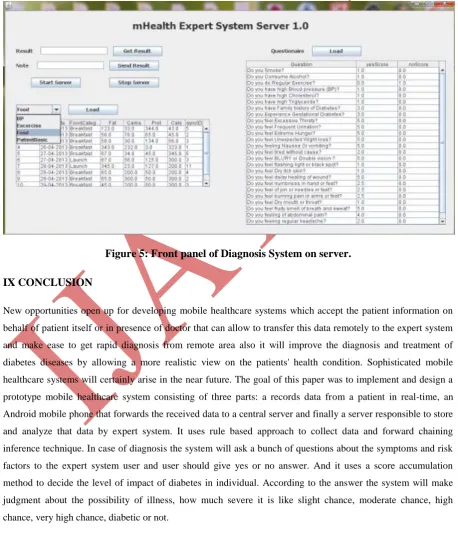
The system has been evaluated by sample data. The main page is shown in Figure 5. The system provides two
types of diagnosis. Version 1 is advice/suggestion self-test, as which is based on Yes/No questions. For
managing diabetes exert suggestion is must that is why this module have interaction with human doctor.
Intentionally we put explicit result sending options to this module.
Figure 5: Front panel of Diagnosis System on server.
IX CONCLUSION
New opportunities open up for developing mobile healthcare systems which accept the patient information on
behalf of patient itself or in presence of doctor that can allow to transfer this data remotely to the expert system
and make ease to get rapid diagnosis from remote area also it will improve the diagnosis and treatment of
diabetes diseases by allowing a more realistic view on the patients' health condition. Sophisticated mobile
healthcare systems will certainly arise in the near future. The goal of this paper was to implement and design a
prototype mobile healthcare system consisting of three parts: a records data from a patient in real-time, an
Android mobile phone that forwards the received data to a central server and finally a server responsible to store
and analyze that data by expert system. It uses rule based approach to collect data and forward chaining
inference technique. In case of diagnosis the system will ask a bunch of questions about the symptoms and risk
factors to the expert system user and user should give yes or no answer. And it uses a score accumulation
method to decide the level of impact of diabetes in individual. According to the answer the system will make
judgment about the possibility of illness, how much severe it is like slight chance, moderate chance, high
10 |
P a g e
REFERENCES
[1] Diabetic Self-Diagnosis Monitoring System for Artificial Heart” ieee transactions on information technology in biomedicine, vol. 9, no. 4, December 2005
[2] A PHP-CLIPS Based Intelligent System for Diabetic Self-Diagnosis Huiqing H. Yang and Sharnei MillerDepartment of Math & Computer Science, Virginia State University Petersburg, VA, 23806, United State
[3] Wail M. Omar and A. Taleb-Bendiab P 35-41 March ❘ April 2006 IT Pro ” E-Health Support Services Based on Service-Oriented Architecture “
[4] Mr.A.N.Kazi, Prof S.R.Jadhao.“Mobile based health care system for patient diagnosis using Android OS” at Iternational conference on Electrical,Electronics and Computer science (ICEECS) held at Nagpur duration 16th Dec 2012.
[5] Ren-Guey Lee, Member, IEEE, Kuei-Chien Chen, Chun-Chieh Hsiao, and Chwan-Lu Tseng “A Mobile Care System with Alert Mechanism” ieee transactions on information technology in biomedicine, vol. 11, no. 5, september 2007 [6] What is Android? - AndroidDevelopers,http://developer.android.com/guide/basics/what-is-android.html,
[7] http://www.mhealthinfo.org/What is mHealth in Low-Resource Settings.htm
[8] “Medical Knowledge-Based System for Diagnosis from Symptoms and Signs” international journal of applied Yaw Asabere School of Software, DUT, P.R. China