www.orientjchem.org
An International Open Free Access, Peer Reviewed Research Journal
2016, Vol. 32, No. (4): Pg. 2117-2123
Molecular Interaction Studies of Benzyl Alcohols with
Methacrylates in Carbon Tetrachloride using Frequency
Domain Technique
S. RADHAkRISHNAN
1,2, k. RAMACHANDRAN
3and k.SAMUvEL
31Researchand Development Centre, Bharathiar University, Coimbatore-641 046, Tamilnadu, India. 2Department of Physics, Sriram Engineering College, Perumalpattu-602 024, Tamilnadu, India. 3Department of Physics, Vadapalani Campus, SRM University, Chennai-600 026, Tamilnadu, India.
*Corresponding author E-mail address: [email protected] http://dx.doi.org/10.13005/ojc/320440
(Received: June 27, 2016; Accepted: August 09, 2016)
ABSTRACT
The dielectric relaxation of benzyl alcohol substitutents (benzyl alcohol, m-methylbenzyl alcohol and m-nitrobenzyl alcohol) with methyl methacrylate and butyl methacrylate in dilute solution of carbon tetrachloride is measured at 9.37 GHz using Frequency domain (X-band) technique. Different dielectric parameters like dielectric constant (ε'), dielectric loss factor (ε'') at Microwave frequency, static dielectric constant (ε0) and dielectric constant at infinite dilution (ε∞) at optical frequency have
been determined. From the measured dielectric data, the relaxation time (t) calculated using Higasi
method and activation energies (DFt and DFh) have been determined. All the dielectric parameters
that are vary with the substitutent change in benzyl alcohol and chain length of acrylic esters. Suggests that, the proton donating ability is varying with the substitution of benzyl alcohol and proton accepting ability is varying with the chain length of acrylic esters. The relaxation time and molar free energy activation of 1:1 molar ratio is greater than other higher molar ratios (i.e. 3:1, 2:1, 1:2, 1:3) confirm that the existence of most likely 1:1 complex formation between the studied systems and also complex formation formed between free hydroxyl group of substituted benzyl alcohols and carbonyl group of acrylic esters (MMA and EMA).
keywords: Relaxation time, Activation free energy, Benzyl alcohol, Methyl methacrylate, Butyl methacrylate.
INTRODUCTION
Benzyl alcohol and its substitutents are found in the natural products and used for mechanistic investigation3, 10, 14. Benzyl alcohol is
also used as a photographic developer. Acrylic esters are industrially important chemicals and precursors in the synthesis of polymers15. Methacrylates are an important monomer for a synthetic polymer poly, which is an excellent substitute for glass and has a wider area of use in dental and industrial applications15. Dielectric studies of liquid in pure state or in inert solvents have remained a subject of interest4 because they provide useful information about the complex formation in solution. The dielectric relaxation studies are useful to investigate intermolecular and intramolecular interactions6. Liakath Ali khan et al.,12 have investigated the complex formation of acrylic esters with phenol derivatives in non-polar solvents using frequency domain technique. Singh et al.,16 have studied the relaxation mechanism of some substituted alcohols using NMR techniques. Singh and Sinha17 measured the dielectric constant for benzyl alcohol with 1-hexanol in non-polar solvents. Dharmalingam et
al., 1 have reported the hydrogen bonding between acrylic esters with aliphatic alcohols in non-polar solvents through dielectric studies. keeping both the industrial and scientific interest in mind, an attempt has been made in this research paper to study the hydrogen bonding between aromatic alcohols and ester using dielectric method.
Experimental Section and method
Materials
Methyl methacrylate, Butyl methacrylate, benzyl alcohol, m-methylbenzyl alcohol, and
m-nitrobenzyl alcohol with purity > 99% (spectroscopic
grade) were purchased from Aldrich and used without any further purification. AR grade carbon tetrachloride was purified by standard method19 and redistilled before use. The physical parameters of all the chemicals used in this study were checked against their literature values.
Dielectric Measurements
The static dielectric constants were measured by heterodyne beat method at 308 k using a commercial instrument, Dipolemeter DM 01 supplied by Wissenschaijftlich Technische Werkstatter, Germany, operated at 220 V. The refractive indices were measured by Abbe’s refractometer. The measurements of dielectric
constant at an angular frequency (ε') and dielectric loss (ε'') were carried out in the X-band microwave frequency of 9.37 GHz. The viscosities were measured with the help of Oswald’s viscometer. The temperature of all these measurements was maintained at 35 ± 0.1°C using a water circulating thermostat.
Theory
According to the method of Higasi et al.,5 the individual relaxation time t(1) is described by
t(1) = ( ' )
"
∞ −a a
a w
While the overall dielectric relaxation t(2) is given by,
and the most probable relaxation time t(0) is given by,
Where, w is the angular frequency; a0, a',
a'', and a are defined by the following:
in which subscript 1 refers to the pure solvent, 2 refers to the solute, 0 refers to the static frequency, and ¥ refers to the infinite or optical frequency measurements, and w 2 is the weight fraction of the solute.
The molar free energy of activation, for both dielectric relaxation DFt as well as the viscous flow processes DFh has been evaluated using the
equations given by Eyring et al.,2
Table 1: Static dielectric constant (ε0), dielectric constant at angular frequency ( ε0 ), dielectric constant ( ε' ), dielectric loss ( ε'' ), dielectric relaxation time and activation energies ( ∆Fτ , ∆Fη )
for m-methylbenzyl alcohol with acrylic esters in carbon tetrachloride
Esters Ratio Relaxation time (ps)
Ester: ε' ε'' εo ε¥ τ(1) τ(2) τ(0) ∆Ft DFh
Alcohol kJ/mole kJ/mole
MMA 0:1 2.5116 0.2296 2.7652 2.1298 13.19 18.65 15.69 1:3 2.5536 0.2402 2.8526 2.2318 17.34 21.02 19.09 1:2 2.5702 0.2745 2.9874 2.2326 18.56 25.66 21.83
1:1 2.5889 0.2887 3.1178 2.2461 19.13 30.94 24.32 12.02 13.19 2:1 2.5713 0.2779 2.9865 2.2319 18.66 25.23 21.70
3:1 2.5574 0.2397 2.8528 2.2326 17.09 20.81 18.86 1:0 2.2845 0.0306 2.3046 2.1317 7.96 11.09 9.40 BMA 0:1 2.5116 0.2296 2.7652 2.1298 13.19 18.65 15.69
1:3 2.5381 0.2305 2.8392 2.2418 18.68 22.06 20.30 1:2 2.5653 0.2608 2.9704 2.2483 19.22 26.23 22.45
1:1 2.5692 0.2793 3.0998 2.2507 20.45 32.08 25.61 12.52 14.18 2:1 2.5642 0.2619 2.9726 2.2454 19.15 26.33 22.46
3:1 2.5408 0.2321 2.8372 2.2403 18.44 21.56 19.94 1:0 2.2718 0.0204 2.2876 2.1516 10.66 13.08 11.81
Table 2: Static dielectric constant (ε0), dielectric constant at angular frequency (ε0), dielectric constant (ε'), dielectric loss (ε''), dielectric relaxation time and activation energies ( ∆Fτ , ∆Fη )
for benzyl alcohol with acrylic esters in carbon tetrachloride
Esters Ratio Relaxation time (ps)
Ester: ε' ε'' εo ε¥ τ(1) τ(2) τ(0) ∆Ft DFh
Alcohol kJ/mole kJ/mole
MMA 0:1 2.4537 0.1689 2.6834 2.1891 16.14 22.96 19.25 1:3 2.5012 0.2023 2.7917 2.2484 20.72 24.25 22.41 1:2 2.5216 0.2422 2.9302 2.2528 22.61 28.49 25.38
1:1 2.5398 0.2617 3.0686 2.2679 24.02 34.12 28.63 13.21 14.81 2:1 2.5221 0.2435 2.9324 2.2557 23.04 28.45 25.60
3:1 2.5034 0.2041 2.7947 2.2495 20.76 24.10 22.37 1:0 2.2845 0.0306 2.3046 2.1317 7.96 11.09 9.40 BMA 0:1 2.4537 0.1689 2.6834 2.1891 16.14 22.96 19.25
1:3 2.4632 0.1723 2.7632 2.2593 25.08 29.40 27.16 1:2 2.4861 0.2084 2.8795 2.2634 26.11 31.88 28.85
1:1 2.5009 0.2273 3.0207 2.2709 27.01 38.62 32.30 13.59 14.54 2:1 2.4831 0.2075 2.8766 2.2618 26.27 32.02 29.00
3:1 2.4657 0.1764 2.7628 2.2584 24.95 28.44 26.64 1:0 2.2718 0.0204 2.2876 2.1516 10.66 13.08 11.81
RESULTS AND DISCUSSION
The value of dielectric constant (ε’), dielectric loss (ε”), dielectric constant at static frequency (εo),
Table 3: Static dielectric constant ( εο), dielectric constant at angular frequency (εο), dielectric constant (ε'), dielectric loss ( ε'' ), dielectric relaxation time and activation energies ( ∆Fτ , ∆Fη )
for m-nitrobenzyl alcohol with acrylic esters in carbon tetrachloride
Esters Ratio Relaxation time (ps)
Ester: ε' ε'' εo ε¥ τ(1) τ(2) τ(0) ∆Fτ ∆Fη
Alcohol kJ/mole kJ/mole
MMA 0:1 2.3548 0.0217 2.4132 2.2576 39.40 45.44 42.32 1:3 2.3741 0.0603 2.5542 2.2627 43.33 50.43 46.75 1:2 2.3846 0.0901 2.6641 2.2638 46.24 52.38 49.22
1:1 2.4047 0.1176 2.8108 2.2778 50.92 58.31 54.49 15.75 16.64 2:1 2.3851 0.0937 2.6786 2.2632 46.54 52.89 49.61
3:1 2.3742 0.0622 2.5551 2.2628 44.69 49.11 46.85 1:0 2.2845 0.0306 2.3046 2.1317 7.96 11.09 9.40 BMA 0:1 2.3548 0.0217 2.4132 2.2576 39.40 45.44 42.32
1:3 2.3689 0.0411 2.4984 2.2671 49.93 53.21 51.54 1:2 2.3797 0.0532 2.5708 2.2754 54.78 60.66 57.64
1:1 2.3979 0.0737 2.6745 2.2888 58.70 63.37 60.99 16.68 17.51 2:1 2.3793 0.0502 2.5603 2.2761 55.40 60.88 58.08
3:1 2.3696 0.0405 2.5002 2.2682 50.66 54.45 52.52 1:0 2.2718 0.0204 2.2876 2.1516 10.66 13.08 11.81
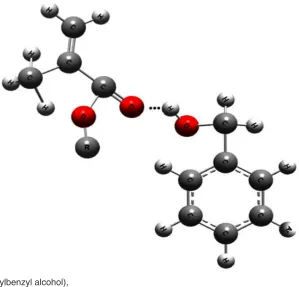
relaxation time (τ(0)) and the free energy of activation for dielectric relaxation process (∆Fτ)and viscous flow (∆Fη) of proton donors (m-methylbenzyl alcohol, benzyl alcohol and m-nitrobenzyl alcohol) with proton acceptor (methyl methacrylate and butyl methacrylate) in carbon tetrachloride at 308 k are shown in Tables 1, 2 and 3. A perusal of Tables 1, 2 and 3 show that the values of e’, e” and eo for substituted benzyl alcohols with carbon tetrachloride systems decrease in the order: m-methylbenzyl alcohol > benzyl alcohol > m-nitrobenzyl alcohol. This may be due to induced dipole moment of substituted benzyl alcohols increasing in the same sequence. In Table 1to 3, it is observed that the values of τ(2) are significantly higher than τ(1) and τ(0) for all the systems. Higher values of τ(2) indicate thatthe contribution of intermolecular or overall molecular relaxation is larger in comparison to intramolecular or individual molecular relaxation in the systems9. In the present study, it has been observed that the relaxation time of ternary mixtures (benzyl alcohol derivatives with MMA or BMA in ccl4) is much greater than the binary mixture (benzyl alcohol derivatives with ccl4 or MMA with ccl4 or BMA with ccl4). This result indicates that there is a hydrogen bond formation between the hydrogen atom in O-H group of substituted benzyl
alcohols and the oxygen atom in C=O group of methacrylates, and is shown in Fig 1.
Fig. 1: Hydrogen bonding between meta substituted benzyl alcohols and acrylic esters
Ar = CH3 (methylbenzyl alcohol), H (benzyl alcohol),
NO2 (nitrobenzyl alcohol). R = CH3 (methyl methacrylate), C4H9 (butyl methacrylate)
the strong hydrogen bond would be expected to form between m-nitrobenzyl alcohol with methacrylates in carbon tetrachloride and weakest hydrogen bond between m-methylbenzyl alcohol with methacrylates in carbon tetrachloride as reflected by the higher relaxation time for former systems and lower relaxation time for lesser systems. Similar results of methacrylates with phenol derivatives were carried out by Liakath Ali khan et al.,11.
Table1 shows that, the relaxation times of all studied systems are larger at 1:1 molar ratio than other higher molar ratios (3:1, 2:1, 1:2, 1:3). This indicates that the 1:1 complex formation is the predominant value in substituted benzyl alcohol - methacrylates systems. Similar results were reported
by Malathi et al.,13 in some carbonyl + phenol derivative systems.
of a proton donor increases as the acceptor ability of the solvent environment increases. All the results are in complete accordance with this conclusion.
The values of τ(1), τ(2), τ(0), ∆Fτand ∆Fη for acrylic esters with carbon tetrachloride are shown in Tables 1-3. They follow in the order: methyl methacrylate < butyl methacrylate. This indicates that the relaxation time varies in accordance with the size, shape and viscosity of the molecules. Further, the values of τ(1), τ(2), τ(0), ∆Fτand ∆Fη for proton donors (substituted benzyl alcohols) with acrylic esters in carbon tetrachloride increase in the order: methyl methacrylate < butyl methacrylate for alkyl methacrylates. This trend suggests that the proton accepting ability of acrylic esters increases with increasing chain length i.e. butyl group of alkyl methacrylate has higher proton accepting ability than
that of methyl groups of alkyl methacrylate. This is probably due to electron contribution of the butyl group to C=O group which is significantly greater than that from methyl group.
CONCLUSION
The complex formation between substituted benzyl alcohols with methyl methacrylate and butyl methacrylate in carbon tetrachloride has been carried out using dielectric method. From this study, it may be concluded that the proton donating ability of substituted benzyl alcohols and the proton accepting ability of acrylic esters vary linearly with the substitution in benzyl alcohols and carbon chain length of acrylic esters and 1:1 complex formation is more predominant than other higher order complexes.
REFERENCES
1. Dharmalingam k, Sivagurunathan P, Ramachandran k and kalamse G M, Molecular association of alkyl methacrylates and alcohols in non-polar solvents: Dielectric
study, 2005.. 4(3) , 227-234
2. Eyring H,Glasstone S and Laidler k J, The Theory of rate process, (Mc Graw Hill: New York). 1941.
3. Faubel M, Steiner B and Toennies P, Photoelectron spectroscopy of liquid water, some alcohols, and pure nonane in free micro jets. J. Chem. Phys, 1997. 106, 9013 -9031. 4. Gupta k k, Banshal A k, Singh P J and
Sharma k S, Temperature dependence of dielectric relaxation of rigid polar molecules acetophenone, pyridine and their mixtures in dilute solutions of benzene. Indian J Pure &
Appl. Phys 2003. 41, 57-63.
5. Higasi k, koga Y and Nakamura M, Dielectric Relaxation and Molecular Structure. V. Application of the Single Frequency Method to Systems with two Debye Dispersions. Bull
Chem. Soc. Japan, 1971,.44, 988.-992. 6. Hill N E, Vaughan W E, Price A H and Davies
M, Dielectric properties and molecular behaviour Reinhold, London 1969.
7. Huang T T, Ching-Ta Yeh and
Chein-Hsiun Tu,.Densities, Viscosities, Refractive Indices, and Surface Tensions for the Ternary Mixtures of 2-Propanol + Benzyl Alcohol + 2-Phenylethanol at T = 308.15 k. J. Chem. Eng. Data, 2008 53, 1203–1207
8. kalaivani T, kumar S and krishnan S, Dielectric relaxation studies of ternary liquid mixtures of alcohols with triethylamine in the microwave region. Ind. J. Chem. 2004. 43A, 291-294.
9. khameshara S M, kavadia M S, Lodha M S,Mathur D C and Vaidya V k, J Dielectric relaxation time and dipole moment of isometric butanols in benzene solutions J.
Mol. Liq., 1983. 26, 77-84.
10. knop.S, Strassmair H, Engel J, Rothe M and Steffen k D, Binding of benzyl alcohol to the peptide CO group of cyclotri-L-prolyl studied by infrared spectroscopy. Biopoly. 1972. 11,731-733.
11. Liakath Ali khan F, Asghar J and Aravinthraj M, Dielectric Relaxation studies of 1:1 complexes of alkyl methacrylate with phenols derivatives. Rasayan J. of Chem. 2010. 3(4)
766-771.
tetrachloride using microwave absorption techniques. Indian J Pure & Appl. Phys.
2008.,46, 54-59.
13. Malathi M, Sabesan R, krishnan S, Dielectric relaxation of N, N-dimethyl formamide and N,N-dimethyl acetamide on complexation with phenols. Mat.Sci. and Engg. B. 2003.
100,318-322.
14. Matheu M.I, Echarri R and Castillón S, Synthesis of isochromane derivatives by metallocene-promoted reaction of 2-alkoxy-2-fluoro-glycosyl fluorides with benzyl alcohol. Tetra. lett, 1993. 34, 2361-2365. 15. Schildknecht. C.E., “Vinyl and Related
Polymers” (Wiley: New York). (1977).
16. Singh A, Singh A k and Mehrotra N k, Study of NMR spin –lattice relaxation mechanism and mutual viscosity in some substituted alcohols. J. Mol. Liq. 2005. 121, 110-114. 17. Singh RP and Sinha CP, Dielectr ic
behaviour of the ternary mixtures of toluene, chlorobenzene, 1-hexanol, and benzyl alcohol. J. Chem. Engg. Data 1985. 30(4), 474-476.
18. Smyth C P, Ratajczak H and Orvile-thomas WJ (Eds), (1981). Molecular Interactions, Vol II, (Wiley: New York).
19. Weissberger A, Technique of Organic Chemistry, Wiley Interscience, New York