IJEDR1704204
International Journal of Engineering Development and Research (
www.ijedr.org
)
1264
A Report on the Viability of Hyperlocal Strategy in
Indian E-Commerce
Prof.Debadrita Panda, Dr.Arpita Basak, Mr.Dipto Halder Assistant Professor, Associate Professor, Executive Trainee Brainware University, Brainware University, M-Junction Pvt.Ltd.
________________________________________________________________________________________________________
Abstract— The rising income levels, growing aspirations, favourable demographics and easy credit availability has accelerated and encouraged Indian retail industry to emerge as one of the most dynamic and fast-growing industries in-spite of several new players. Presently, it is valued at USD 672 billion and generates 8% of the employment, thereby contributing to over 10% of the country’s Gross Domestic Product (GDP). It is growing at a rate of 12% per annum and is positioned as fifth-largest global destination in the retail space. Online retail business has been identified as the next generation format which has high growth potential for further development in the near future. In order to reach out to more customers in tier-2 and tier-3 cities, retailers are attempting to endeavour into the sphere of e-retailing to take advantage of the digital retail channels (commerce). It means that they need to invest less money on real estate. e-Commerce is considered as one of the fastest growing channels for commercial transactions in India. According to a ASSOCHAM-Forrester study paper, the annual growth rate is 51% which is considered as the highest of the world and is expected to reach $120 billion in 2020 from $30 billion in 2016. Hyper local is the next frontier which is merging the online and offline platforms in order to bring massive scale demand and deliver the goods in the shortest possible time. In general terms, Hyper local refers to a very specific area, area in proximity of our home or our business or our current location. The term ‘hyper-local commerce’ arrives with the addition of payments and, marketing options available in our vicinity. The copious outgrowth of Internet users, increase of payment options, increase in geo-location aware devices and increased demand for insta-delivery, have paved the way for hyperlocal businesses in India. While the term seems to have come to prominence in 2015, it’s not at all a new concept. For consumers, of course, this feels like an extension of tech-powered convenience they have become increasingly used to. They are able to enjoy doorstep deliveries of products that are usually needed quickly such as groceries medicines, laundry, food etc. This research study focusses on adopting and embracing hyperlocal strategy in Indian e-Retailing companies to bridge the gap between online and offline stores and change the face of Indian retail with the help of Chi-Square Test and Binary Logistics Regression.
Keywords: Retailing, E-Retailing, Hyperlocal strategy
________________________________________________________________________________________________________
I.INTRODUCTION
The word retail originates from the French word “retaillier” which means to break bulk. Retailing is the set of activities that markets products or services to final consumers for their personal use by organizing their availability on a large scale and supplying them to consumers at a relatively small scale. It is the last stage in movement of goods and services to consumers. Retailing has emerged as a sunrise industry in India and is presently the largest employer after agriculture. Some economists say Retailing is one of the pillars of Indian economy, and some call it a gold mine. Retail industry is divided into organized and unorganized sectors; and also Online e-tailers and Offline Brick & Mortar stores based on the channel presence.[1]
India’s retail market is expected to grow at a Compound Annual Growth Rate (CAGR) of 10 per cent to US$ 1.6 trillion by 2026 from US$ 641 billion in 2016. While the overall retail market is expected to grow at 12 per cent per annum, modern trade would expand twice as fast at 20 per cent per annum and traditional trade at 10 per cent#. Indian retail market is divided into “Organised Retail Market” which is valued at $60 billion which is only 9 per cent of the total sector and “Unorganised Retail Market constitutes the rest 91 per cent of the sector. [2]
The entry of a number of high profile participants into the online retail field recently, along with an influx of private equity funds and investment from foreign venture capitalists, has resulted in a huge boost in funding that translated to tremendous sales growth in e-tail. Mall owners are currently, looking for a defense strategy to ensure the viability of their retail assets. [3] However, as they say there is always an opportunity with a threat, it is observed that retailers are increasingly integrating both offline and online presence through different combinations of product presentation, payment, and delivery modules for their stores and digital platforms.[4]
The study aims to explore the potential of localised procurement and delivery model – termed as Hyperlocal strategy – in integrating online and offline retail sectors and improving consumer experience.
II.RETAIL IN INDIA
IJEDR1704204
International Journal of Engineering Development and Research (
www.ijedr.org
)
1265
Retailing in India can be classified into 3 segments :• Organized Retail • Unorganized Retail • Online Retail
Organized Retailing
Organized retailing, in India refers to trading activities undertaken by licensed retailers, that is, those retailers who are registered for sales tax, income tax etc. This will include the publicly traded supermarkets, corporate backed hypermarkets and retail chains, and also the privately owned retail businesses.
Organized retailing comprises mainly of modern retailing with busy shopping malls, multi-stored malls and huge complexes that offer a large variety of products in terms of quality, value for money and makes shopping a memorable experience. The retail sector is presently undergoing a transition in India. Organized retailing is on continuous rise of market share from the past, and is expected to grow faster than GDP growth in next few years driven by favourable demographic patterns, changing lifestyles and strong income growth.
According to McKinsey & Co.,it showed a tendency to grow by 14-18% by the year 2015 from 8% in 2008.[6] Being in the same notion, A report by Boston Consulting Group (BCG),the country's organized retail is estimated at US$ 28 billion with around 7 per cent penetration, indicating an position to become a US$ 260 billion business over the next decade with around 21 per cent penetration. [6]
The following figure1. shows the break-up of the purchase done in organized retailing platform in the year of 2016.
Fig1. Break-up of segments of organized retail in India
(Source: Unlocking the Potential, a report published by techonopak.)
Unorganized Retailing : This sector is a predominant factor in Indian market. From the viewpoint of AT Kearney, an overwhelming proportion of the Rs. 400,000 crore retail markets are unorganized in India with a market of 20,000 crore segment is organized. It is mainly driven by the traditional family stores, custom stores. Retailing in unorganized sector is thus not a profit oriented vocation but a mere source of livelihood[8]
Online Retailing
Online retailing has gained considerable foothold in India and has bridged the gap between sellers and buyers by creating an online marketplace where a buyer from any part of the country can purchase a product from a seller located in any part of the country.
Online retail business is the next generation format which has high potential for growth in the near future. After conquering physical stores, retailers are now foraying into the domain of e-retailing. E-commerce is expected to be the next major area supporting retail growth in India. The industry is projected to touch USD100 billion by 2020 growing from USD30 billion in 2016.With growth in the e-commerce industry, online retail is estimated to reach USD70 billion by 2020 from USD 3 billion in 2014.The government plans to allow 100 per cent FDI in e-commerce, under the arrangement that the products sold must be manufactured in India to gain from the liberalised regime [9]
In FY 2016, India’s largest online grocery store, BigBasket, grew by three times, and registered sales of over USD76.38 million [10]
IJEDR1704204
International Journal of Engineering Development and Research (
www.ijedr.org
)
1266
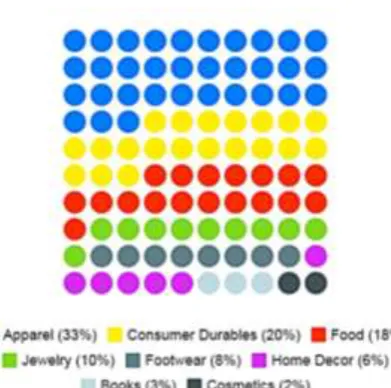
This has been proved with a report of ASSOCHAM-Resurgent India study that the number of consumers who purchase online is expected to cross 100 million by 2017 end with e-retail market likely jumping 65% on year in 2018.[11]Cash-on-delivery and manufacturers’ warranty are acting as a catalyst. Cash-on-delivery is the most preferred payment option with over 30 per cent of Indian buyers. Apparels, Consumer Durables, Food, Jewelry and other lifestyle segments are the most preferable areas based on customers choice.[9] Fig 3. Shows a visual representation of the most preferred segments up to the status of July 2-017 followed by (Fig.4) another data representation of the year 2014.
E-commerce companies such as Flipkart Internet Pvt. Ltd. and Amazon India are leading the race of scouting commercial real estate space for warehousing.[12]
Fig3. Break-up of e- retail sector in India fig 3: May 2014 | (E-tailing in India: Unlocking the Potential, a report published by techonopak).
Fig 4: E-tail revenue break-up (in %) in 2014
IJEDR1704204
International Journal of Engineering Development and Research (
www.ijedr.org
)
1267
Fig5: Projected Sales of Indian E-commerce in billion USD till 2021An industry research published on june2, 2017 on behalf of Care Rating gives the following break-up of different types of Retailing in India.
Hyperlocal Strategy
Logistics is one of the biggest pressure points of the e-commerce industry in India. Infrastructure is not up to the mark to facilitate smooth logistics and neither is the last mile connectivity scenario good enough. These drawbacks in the infrastructure lead to inefficient logistics. Logistics, as the backbone of the e-commerce industry needs to be optimal in order for the industry to thrive and grow. In India, these logistics weaknesses result in long waiting periods for the consumer to get the products delivered from the seller. One of the main reasons behind this is the latent distance between the seller and the buyer.Previously, e-tailers used to maintain their own inventory of products by purchasing from other sellers, and then sell them via their portals to consumers. However, due to legal and financial reforms, e-tailers have been reduced to being marketplace facilitators. They no longer hold inventory as sellers. They list the products of the registered sellers and upon purchase of a product by a shopper, they procure it from the seller and then deliver it to the consumer via a lengthy chain of procuring, bringing to warehouse and then delivering to the consumer.[14][15]
This results in a generally considerable waiting time, especially when the seller and the buyer are physically located in different parts of the country. This also leads to another pressure point that is the provision for alteration and replacement of products if needed. When the seller and the buyer are physically located considerably apart, it results in unwanted hassle and issues in replacing or altering a product when needed. Hyperlocal strategy, or localized procurement and delivery can be a way forward in eliminating these existing pressure points in Indian e-commerce.
Hyperlocal strategy takes the delivery model adopted by online food delivery portals and applies it to other e-commerce portals on a bigger scale. When we order food online specific to a particular chain, it locates the outlet of the chain nearest to us, and the delivery personnel procures the food and immediately delivers it to us at one go. And this usually takes place within an hour at the maximum. [16][17]
IJEDR1704204
International Journal of Engineering Development and Research (
www.ijedr.org
)
1268
III.OBJECTIVES OF THE STUDY1. Identify the major drivers for online shoppers. 2. Identify the major product types purchased by buyers.
3. Identify the product categories that most entail an offline research before online purchase. 4. Identify the attributes that consumers feel will be improved by adoption of hyperlocal strategy.
5. Identify the level of excitement that hyperlocal strategy brings to consumers and find a relation, if any, between excitement level and frequency of online shopping.
6. Identify the type of offline retailers most impacted by online retail.
7. Determine the possibility of embracing hyperlocal strategy by offline retailers by registering with online platforms.
IV.RESEARCH METHODOLOGY
An online questionnaire was administered to gather data from consumers and data from stores was collected via face to face interview.
A sample size of 60 was used for consumer survey and a sample size of 30 was used in the survey of businesses. A method of purposive sampling was used in consumer survey with only those consumers that shop online. A method of simple random sampling was used in the survey of businesses.
V.CONSUMER SURVEY FINDINGS
Here we can see that 95% of the
interviewed people fell in the 20 to 30
years age bracket. It mainly comprises
young employed people that drive
online shopping majorly.
IJEDR1704204
International Journal of Engineering Development and Research (
www.ijedr.org
)
1269
30% of the people are regular online
shoppers while the majority 63% of
them shops online occasionally and
only 7%
of them rarely shop online.
Amazon and Flipkart evoke universal
recall, followed by Myntra, Snapdeal and
Jabong. Fynd – a platform that currently
actively employs hyperlocal strategy is
found familiar by only 15% people.
Small gadgets and apparel make up the
biggest categories of products
generally purchased
online. Mobile phones and
durable electronic goods are also
IJEDR1704204
International Journal of Engineering Development and Research (
www.ijedr.org
)
1270
People were asked to rank the factors
that impact online
shopping experience.
Weighted scores reveal Delivery Time
and Trust to be top factors for people,
followed by Price.
Durable Electronic Goods and Mobile
phones make up the largest categories
of products that people prefer to
research about in offline stores before
purchasing them online.
More than 1/3rd of people also prefer to
try out apparel in physical stores before
buying online.
Almost 4/5th of people stated that
Hyperlocal strategy would improve
Delivery Time Very Much.
Half of the people also felt that the
scenario of replacement and
alteration would also be Very Much
IJEDR1704204
International Journal of Engineering Development and Research (
www.ijedr.org
)
1271
V.BUSINESS SURVEY FINDINGSAlmost 90% of the people felt that
adopting Hyperlocal
strategy would be very much
effective in bridging the existing gap
between online shopping platforms and
offline brick and mortar stores
.
Here people were asked to
mention their level of
excitement about Hyperlocal
strategy as shoppers on a scale of 1 to
5, 5 being the maximum level of
excitement. Around
1/4th of people were extremely excited
and around half of the
people were generally very
excited regarding the possible
improvements that Hyperlocal strategy
can bring about.
IJEDR1704204
International Journal of Engineering Development and Research (
www.ijedr.org
)
1272
VI.IN-DEPTH ANALYSIS1. Chi-square Test
A chi-square test was performed to find whether a relationship exists between frequency of online shopping and the level of excitement regarding Hyperlocal strategy. The top 2 levels of excitement were considered as High and the bottom 3 levels were considered as Low.
H0 = There is no influence of frequency of shopping on level of excitement H1 = Frequency of shopping has impact on level of excitement.
More than half of the stores mentioned
that their business was affected
moderately
by
online
shopping
platforms, and more than 1/4th of the
stores stated that their businesses have
been critically affected by the upsurge
of online shopping.
IJEDR1704204
International Journal of Engineering Development and Research (
www.ijedr.org
)
1273
2. Logistic RegressionA logistic regression was performed to see how the priority levels attached to the different attributes associated with online shopping has an impact on the excitement level that the respondents show towards hyperlocal strategy.
The model can be seen to be 78.3% accurate in predicting excitement level.
We can see that the priority assigned to fast delivery time has a significant impact on the level of excitement for hyperlocal strategy (sig.<0.05). Thus we can say that greater the priority that people give to fast delivery time, greater is the chance that those people are excited by the idea of hyperlocal strategy.
3. Among the 22 who mentioned they purchase durable Electronic Goods online, almost 60% stated fast delivery time as one of the top 2 priorities.
4. Of the 43 shoppers who mentioned buying mobile phones online, more than half stated fast delivery time and more than 1/4th stated provision for replacement among top 2 priorities while shopping online.
5. 45 people mentioned purchasing apparel online and almost half of them stated fast delivery time and almost 1/3rd of them stated provision for replacement among top 2 priorities while shopping online.
42 people said that before purchasing Electronic Goods online they would research about it in local brick and mortar stores. 40 of those 42 people stated that the aspect of fast delivery would improve, and more than 3/4th of them mentioned the possibility of
high degree of improvement from hyperlocal strategy. 39 of the 42 people mentioned possible improvement
in provision of replacement by adopting hyperlocal strategy, and more than half of them stated the degree of improvement would be high.
the null hypothesis cannot
be rejected and we can state that there is no
impact of frequency of online
shopping on the level of excitement regarding
Hyperlocal strategy.
IJEDR1704204
International Journal of Engineering Development and Research (
www.ijedr.org
)
1274
7. 36 people felt the need to visit local stores before purchasing a mobile phone online. 35 of them felt delivery time would improve through hyperlocal strategy, and 4/5th of them felt the improvement would be significant. All of the 36 people felt the provision of replacement would be improved by adoption of hyperlocal strategy.8. 22 people mentioned browsing and trying out apparel in brick and mortar stores before ordering the specific colour and fit of apparel online. Almost 90% of them felt hyperlocal strategy would bring significant improvement to delivery time, while everyone of the 22 people stated possibility of improvement in provision of alteration and replacement by adopting hyperlocal strategy.
9. 34 people originally ranked Provision for Replacement among the bottom 2 when they were asked to rank the attributes associated with online shopping. However, when they were educated regarding hyperlocal strategy, almost every one of those 34 people felt hyperlocal strategy would bring about improvement to the aspect of replacement and alteration.
10. Around 3/4th of the stores felt that collaborating with online platforms would help improve their business. More than half of those stores were small stores, all of whom stated that that their business had been affected, either moderately or critically by the onslaught of online shopping platforms.
VII.CONCLUSION
The Indian retail industry is in a state of flux. And the way forward is not through clicks alone or only through brick and mortar. It is time for both realms to join hands and allow Click and Mortar model to come through.
The online shopping platforms have grown leaps and bounds in the past few years and have currently stagnated with hardly anything to differentiate the major players in the market. They are slowly realising that the price and deals war cannot go on forever as the major players in Indian e-retail are already bleeding cash from providing ridiculous offers to consumers and hurting their own revenues in the process. They are venturing into expanding their presence in the offline brick and mortar realm from the digital marketplace.
The offline brick and mortar stores have also begun to realise that they cannot shun the digital arena forever and that it is an attractive way of reaching out to prospective customers. More and more offline stores have begun to create a digital footprint by way of online portals.
However, in India, the vast majority of brick and mortar retail are in the unorganised space and even those in the organised space are not large enough entities to create their own digital footprint.
Herein we have seen from our findings how Hyperlocal strategy has the potential to improve the scenario of Indian retail. Most of the brick and mortar stores felt they were affected in some way by online shops, and the majority of them said that collaborating with online platforms to employ hyperlocal strategy would help their business. Consumers have also felt that adopting Hyperlocal strategy could bring exciting new improvements to retail. Majority of them stated that fast delivery time was a top priority while shopping online, and most of them were of the opinion that Hyperlocal strategy would bring considerable improvement to the aspect of rapid delivery. They also felt that the aspect of reliability and provision of replacement and alteration of products would be greatly improved. Thus Hyperlocal strategy can be a key differentiator and driver for businesses. It has the potential to bring more local clients to local stores and dramatically reduce inventory and logistics expenses of online shopping platforms. It also has a considerable appeal to consumers given the possibility of unforeseen reduction in delivery times and also the great degree to which it would facilitate easier and faster replacements and alterations of products.
VIII.REFERENCES
1. Nicolas Alexander (2005)- International Retailing, Oxford University Press
2. BCG Retail 2020, Ernst and Young, Deloitte, indiaretailing.com, Economist Intelligence Unit, Euro monitor, https://www.ibef.org/download/Retail-October-2017.pdf
3. Venture Capital in China Jun Zhang Department of Geography, University of Toronto Forthcoming, chapter 6 in Yu Zhou, William Lazonick, and Yifei Sun (eds.) China as An Innovation Nation, Oxford: Oxford University Press.
4. http://cafemutual.com/news/alternative-investments/9279-how-venture-capital-and-private-equity-funds-boost-economic-growth
5. The Associated Chambers of Commerce & Industry of India ,"The Knowledge Chamber: Serving the Nation since 1920" 6. Changing Consumer Preferences From Unorganized Retailing Towards Organized Retailing: A Study in Jammu,Urvashi Gupta ,Baddi University of Emerging Sciences &Technology Journal of Emerging Knowledge on Emerging Markets Volume 4. 8. An overview of Unorganized Retail sector in India: Valsamma Anthony (2009) - Small Retail Stores thrive on Customer relations – An Empirical Study, Marketing Mastermind, Feb,68-709. Projection of Brick and mortar space in 2020 vs 2014 (in million sq ft)
9. www.ibef.org:IndianBrand Equity Foundation,Jan,2017
10. https://tech.economictimes.indiatimes.com/news/internet/bigbasket-sales-jump-3x-to-rs-563-crore-in-fy16-losses-up-4x/56342508
11 https://economictimes.indiatimes.com/industry/services/retail/online-retail-consumers-to-cross-100-million-by-2017-assocham-resurgent-india-study/articleshow/56417797.cms
IJEDR1704204
International Journal of Engineering Development and Research (
www.ijedr.org
)
1275
14. https://www.coxblue.com/hyper-local-marketing-strategy-can-use-small-business/15. http://julysystems.com/5-secrets-for-successful-hyperlocal-marketing/
16. https://searchengineland.com/rise-hyperlocal-marketing-2017-5-tips-stay-top-269442