5276
Binary Particle Agent Swarm Optimization For
Best Fit Feature Weight Selection In
Multi-Document Text Summarization
Jebamalai Robinson, Dr. V Saravanan
ABSTRACT : Auto-Text summarization is the process through which a compressed version of the original text is created. Extraction based approaches are the one through which the important sentences and information are extracted from a single or multi document. This method select the sentences based on the calculation of scores for each sentence. The process of extracting sentences that are most important is a trivial task for the text mining researchers. The previous works concentrated on the automatic extraction of features through weighted TF-IDF and dimension reduction using the centroid based k-means clustering. This paper is intended to apply the extractive methods for automatic text summari9zation in multi-document level using the swarm intelligence. Particle swarm optimization is used in this research for identifying the optimal weight of the feature scores for differentiating between the relevant and irrelevant features. The ROUGE tool is used for the evaluation. The student data provided by the educational department of US is considered for the experiment. The summary that are generated using the proposed methodology is compared to that of other methods such as Genetic Algorithm and Ant Colony Optimization and used the TF-IDF: CBC as the benchmark method. The results from the experiment proves that the extracted summaries produced after the integration of the proposed method into TF-IDF: CBC are performs better.
Key words: Text Summarization, k-means clustering, TF-IDF, Particle Agent Swarm Optimization, ROUGGE and GA-ACO. —————————— ——————————
1.
INTRODUCTION
In the digital era, most of the information needed from a user are available as a large source of unstructured data. These unstructured data usually are normally found as large pieces of texts. The volume of data getting accumulated is increasing rapidly with respect time. The need of automatic summarization of these large textual data has become vital for the efficient extraction of information [1]. Summaries that are man-made are termed as manual summarization and these involves the process of reading and understanding the text and thereafter to highlight the important information. On the other hand, the summaries that are generated through machine are termed as automatic summarization. The essentiality of automatic summaries are very much in demand owing to the size and complexity of these large texts. The overheads such as information overload, time complexity and accuracy that are faced by manual methods of summarizations has made the auto-summarization methods more popular and vital. Text summarization involves the process of bringing in the important information extracted from a large piece or pieces of texts. It takes a longer time and more human power to understand these texts and to extract the most relevant information [2]. Hence auto-summarization methods are largely preferred in domains such as email categorizations, news summary, article summarization and research works, etc. The earlier effort on automatic text summarization system that more developed in the late 1950s formed of selecting important sentences from original document and concatenating them into shorter form. Automatic text summarization techniques are classified into different approaches. Some of these techniques are classified based on the input document used for the summary. Single document summarization uses only one document to
produce a single summary while multi-document summarization uses many document that are related to the some topic to create a single summarization The summarization methods are broadly classified into extractive and abstractive summarization [3]. The former method consists of selecting the most important sentences from the source document and to concatenate them into shorter version. The latter is the technique where at least few of the entire material is purposefully left out in the input [4] The task of evaluation of the quality of summary is very important. The evaluation can be assessed manually and/or automatically. Manual evaluation is done by human or automatic by special tools. Two categories of methods used in text summarization are extrinsic and intrinsic [5-6]. Extrinsic evaluation measures the efficiency acceptability of summaries in some task based on the idea of how useful the summaries are for a given task, for example reading comprehension or relevance assessment. On the other hand, intrinsic evaluation measures a summary quality of the system of itself by comparison to some gold standard such as human generated summaries. The evaluation can be assessed manually and/or automatically. Manual evaluation is done by human. The Recall-Oriented Understanding for Gisting Evaluation (ROUGE) for example, is an automatic intrinsic evaluator of summary systems for the Document Understanding. [7].One of the easier way for the determination of optimum feature weight is through the exhaustive research in which the subset of features are evaluated with the universal set of all features. This approach is not practical even for a feature set of a medium size. The feature extraction normally involves heuristic search methods to avoid the complexities. However, the optimality of the end subset is normally reduced [8]. Some of the methods that has attracted more researchers are the Genetic Algorithms, ACOs and PSOs that collects better solutions using the knowledge obtained from previous steps. Genetic method of optimization are based on the natural selection process. They are operated similar to that of the natural genetics for supervising the searches in the given space [9]. Owing to its advantages, GAs are normally used as a tool for feature extraction in
__________________________
1. Research Scholar, Bharathiar University, Coimbatore email: :[email protected]
5277
text mining. PSO was introduced by Kennedy [10] and are based on the social and psychological behavior of swarms in nature. The particles in the swarm follows a simple behavior which kindles the success of the neighbor particles. The outcome behavior of the entire group identifies the optimum regions in a high dimension space. This research work proposes a Particle Agent Swarm Optimization based text summarization technique for identifying the best fit weight in TF-IDF: CBC for multi-document auto text summarization. The evaluations are done through the ROUGE toolkit and for performance measures. The results from experiments proved that the summaries generated after the integration of proposed method into TF-IDF: CBC are better than other algorithms. The rest of the paper is organized as follows. Section 2 gives the gist of the related works in the PSO based summarization. Section 3 elucidates the problem statement and section 4 deals with the proposed methodology in detail. Section 5 describes the experimental setup and the evaluation measures. Section 6 depicts the results obtained over experiments and discusses the same. Section 7 gives the conclusion and open research problems that can be taken for future experiments.
2.
RELATED WORKS
The PSO method is used in the current research as a machine learning technique for feature extraction and to study the effect of it in the optimum weight calculation of the features. The scores are combined to the features that are produced by the PSO in the proposed method for auto text summarization. Only a few researches have been carried out with the PSO method on the text summarization problem and the important such studies are follows: PSO was successfully applied in some related problems like text classification. The particle swarm optimization was also applied successfully in the feature selection problem. PSO was implemented for selecting the subset in features for a classification and to train the neural network [11]. The classification problem of the extracted features are addressed using the PSO method [12]. PSO was adopted for the feature extraction for enhancement of performance of the SVMs and the neural network for obtaining a optimum solution to the e-learning texts [13]. PSO was deployed with Support Vector Machine for the determination of parameters and to improve the accuracy of classification [14] According to successes of PSO in above studies, PSO method was deployed to investigate the impact of feature extraction in its structure of the summarized text[15],where the features used are divided into two types: “complex” features and “simple” features. Complex features are “sentence centrality”, “title feature”, and “word sentence score”; simple features are “keyword” and “first sentence similarity”. After computing each feature score, the PSO was used to identify which features are more effective. Score of ROUGE-1 was used to calculate the value of the fitness function. The dataset used for training the system comprised one-hundred articles from DUC-2002. The PSO parameters were initialized and “gbests” values were computed to extract the weight of each feature. Results showed that complex features received higher weights than did simple features, which indicates that feature structure plays an important role in
the feature selection process. To assess the results, the authors installed one human model summary as a reference and a second as a benchmark. The MS word summarizing tool and the initial human made summary are compared. The results proved that the PSO method performed better than the Microsoft word tool and achieved accuracy closest to human tailored summary. The maximal margin relevance [16] (MMR) method is proposed to enhance summary diversity.
3.
PROBLEM DEFINITION
Features are the most important entities in summarization of texts. Considering that all the features are equal will result in generation of poor summary. Building an optimal feature weighting mechanism for high quality summary generating is considered a complex task. PSO was proposed before to solve this problem but when the same is surveyed, especially text summarization based on evolutionary and swarm intelligence algorithms, it is found that previous works established an unfair comparison criterion to test which evolutionary and swarm algorithm is better. In this work, the criteria is unified to judge which algorithm is better in reality for implementing text summarizer application.
4.
PROPOSED METHEDOLOGY
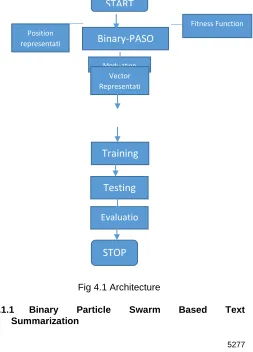
The operational framework of this research consists of four phases, phase1: Feature extraction through TF-IDF: CBC, Phase 2: Binary Particle Swarm Based Text Summarization, Phase 3: Training Procedure and Phase 4: Testing Procedure. The architecture is shown in figure 4.1
Fig 4.1 Architecture
4.1.1 Binary Particle Swarm Based Text Summarization
Modulation
Fitness Function
START
Binary-PASO
Positionrepresentati on
Vector Representati
on
Training
Testing
Evaluatio n
5278
The feature scoring is considered the base of the text summarization process. The particle swarm optimization (PSO) is used as a machine learning method to learn the feature weight from the training data. The extracted weights are used to adjust the feature scores
.
A. Particle Position Representation and Configuration
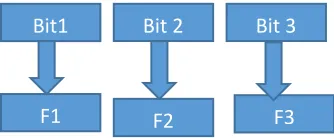
The Binary-PSO is considered where the position of the particle are represented as a binary string. Every bit takes the value of either 0 or 1 and represents individual features. The bit value of 1 indicates that a feature is selected and unselected otherwise. The initial bit represent the first feature and the second bit represent the second feature and the same is followed throughout. The pictorial representation of the same is provided in figure 4.2.
Figure 4.2 Bit representation of features
B. Particle Velocity Representation and Configuration
The velocity of the particle is depicted in the same manners as the position of the particle wherein every value of the bit being retrieved using the sigmoid function. The velocity used in the sigmoid is represented in equations (4.1) and (4.2)
Vi(t +1) = w.Vi(t)+c1.r1(t).[Pi(t)−Xi(t)] +c2.r2(t).[Pg(t)−Xi(t)] (4.1)
Xi(t +1) = Xi(t)+Vi(t +1) (4.2)
In which c1 and c2 represents the positive constants and are called as learning rates and
5
X
i= (
x
i1, x
i2, . . . , x
iD) shows the position belonging to particle (i) in the space with dimension D. denotes the number of iterations and the weight of inertia is denoted by . The best particle from the entire population is denoted by the indexand
shows the positions change with respect to time. If the summation pertaining to the factors present in the RHS of equation (4.1) exceeds a certain threshold, the velocity of the particle on every dimension are then clamped with that of the maximum velocity
C. Binary Modulation formula
Particle Swarm Optimization algorithm is one of the Swam Intelligence algorithms. The Swarm Intelligence algorithms are used real values. To enable PSO to search in a binary space, we need a modulation formula in order to modulate real value into binary values. In this research we used modulation as in equation (4.3) to perform this task.
{
}
(4.3)
Or 0 other wise.
D. The Fitness Function
The fitness function is used as a measuring unit in optimization techniques. The fitness function is used to determine which particle obtains the best solution and is considered fittest value. This value will change if the new particle generated better fitness than previous particle. Equation (4.4) shows the fitness function determination. The function to represent the fitness is obtained through the least degree of the saw particle which is jumping off from the path and the finest change in the strength of the particle in the degree of equation
(4.4)
In the above equation denotes the subset of the feature identified by the particle in an iteration with the length given as , the fitness is calculated to measure the performance of the classifier ( ) with the length of the subset. are the couple of parameters which controls the relative weight of the classifier and the length of the subset features denoted by
This indicates that the performance of the classifier and the feature subset have contrasting effect on the features that are extracted. In this research, more importance is given to the classifiers’ performance rather than the length of the subsets. Hence, the same is set as
4.2 Training procedure
In this research the PSO used 70 documents from US education department. In the beginning, all the documents are dealt with initial pre-processing of sentence segmentation, tokenization and removal of stop words. Then, the Weighted TF-IDF method is used to extract the features [18]. The scores of each sentences are then represented using the vectors as in table 4.1 and the results of the scores obtained as used as the input for the scoring function of PSO as in equation(4.5)
Table 1 Sample feature scores
∑
(4.5)
The ( ) denoted the score of the sentence and , s( ) represents the score for the feature and
represents the value of the in the present position after calculating the scores of all the documents using the equation (4.5) and are ranked in a descending manner and finally the sentences are selected to frame the summary wherein n denotes the length of the summary
Sentence / Feature
TF SL SP ND TW Total
S1 0.68 0.57 0.42 0.24 0.81 2.72 S2 0.48 0.47 0.28 0.67 0.74 2.64 S3 0.27 0.42 0.68 0.81 0.42 2.60
S… … … … …
S10 0.38 0.42 0.48 0.61 0.74 2.63
Bit1
Bit 2
Bit 3
5279
which is pre-defined. The proposed method uses the threshold value of 20% of the size of the source text as the summary length. The proposed PSO makes use of the equation as in (4.5) for selecting sentences from the source for composing the summary. The summary that is generated is again used as the input for the fitness function. The evaluation of the summary is made and the is identified which represents the value of evaluation of the best summary that is generated by that particular particle.
The is also calculated which indicates the value of evaluation of the best summary that is generated by the particle in the search space. By the end of an iteration, the particle’s position that has the value of will be selected as the vector for the best selected feature in every document. The final features weights are calculated over the vectors of the features weight of all documents in the data collection
(4.6)
4.3 Testing procedure
The goal of employ the PSO is to find and optimize the corresponding weight of each feature . Equation 4.7 is calculating the features weights
∑ (4.7)
Where score weights ( ) is the score of sentence s, is the weight of the feature that produced by PSO, is the number of feature and is a function that calculate the score of the feature . The testing procedure used 30 documents from DUC2002 data set. The testing procedure is begin with input document, then implementing the preprocessing process (segmentation, tokenization, remove stop word and stem the word), then extracting features for each sentence, then modify the score of each feature based on the features weights that produced in training process, the score of each sentence is then calculated for all documents as in equation (4.7) followed by the ordering of these sentences in an descending manner and to select the sentence and re-ordering to the original order of the source document is done. The ROUGE evaluation measures are used for performance evaluation.
5.
EXPERIMENTAL
ENVIRONMENT
AND
METRICS
This research is based on the functional approximation (random research) approach using an intelligent swarm algorithm named "particle swarm optimization". The PSO algorithm is provided with learning approach (feature weighting). The PSO used to obtain an appropriate feature weights. We have set the particle swarm optimization parameters as follows: number of particles=30, maximum number of iteration=500. The commonly used information retrieval metrics of precision, recall, and F-Score. The summary that generated by human is a best choose for evaluation. Therefore, the generated summaries in this study evaluated and compared with the human generated
summaries. Precision (P) is calculated as the no of sentences that are intersected in-between the summary generated by the system and that of the human divided by the no of sentences in the summary generated through system . It is calculated using equation (4.8)
(4.8)
Recall denoted by R is the no of sentences that are intersected in-between the summary generated by the system and the summary generated by human divided by the no of sentences in the model. It is calculated using the equation (4.9)
(4.9)
The F-Socre maintains the performance of the system based on the “Precision” and “Recall” values and is calculated using Equation(4.10)
(4.10)
ROUGE: METHOD OF EVALUATION
The ROUGE (Recall-Oriented Understudy for Gisting Evaluation) is an evaluation system for the measurement of the quality of the summaries in comparison with the human created summaries [17]. The ROUGE tool depends on counting n-grams co-occurrences in the system summary and in the reference summary. ROUGE provides four different measures, namely ROUGE-N, ROUGE-L, ROUGE-W, ROUGE-S and ROUGE-SU.
ROUGE-N
ROUGE-N measures co-occurrences of n-grams. The ROUGE-N score can be calculated as
:
∑
∑
(4.11)
Where S is the sentence taken as a reference, n denotes the length of the gram and is the
that are shared in-between a given set of reference
summaries and the is the total count of the
in-between the set of summaries that are present
in the system generated summary.
5.
RESULTS AND DISCUSSIONS
5280
hum an sum mary
calle d (H2) with refer ence
hum an sum mary called (H1). This compression is established to evaluate the summary against human performance. These algorithms are used same five statistical features (Title Feature, Sentence Length, Sentence Position, Numerical Data and Thematic Words) and same data set .ROUGE packet is used to evaluate the obtained results. When implementation of the testing process, we used ROUGE-N evaluation measure .ROUGE-N measure is counting all occurring (shared) words. The generated summary by these algorithms (PSO, GA, ACO) are compared with DE algorithm summary. Table 4.1, 4.2 compare the three methods using ROUGE-1, ROUGE-2. Average recall (avg-R), average precision (avg-P) and average F-measure (avg-F) are calculated for each method. Figures 4.1, 4.2 visualize the same results obtained.
Method Performance Measures
Avg-P Avg-R Avg-F-Score
H2-H1 96.1 96.8 96.8
DE 87.4 86.8 86.8
ACO 81.2 84.6 82.5
GA 91.2 92.4 93.4
PASO 95.1 96.2 94.8
Table 5.1 Results based on ROGUE 1
Fig 5.1 Comparative results – ROUGE 1
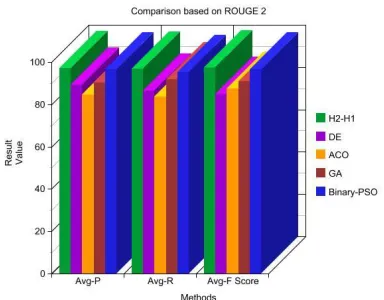
Table 5.2 shows the results obtained from the ROUGE 2 evaluation. It is seen that the proposed method has the closest proximity to hand written summaries when compared to all the other methods under discussion. Figure 5.2 depicts the same in a graphical format
.
Table 5.2 – Results Based on ROGUE 2
Figure 5.2 Comparative results based on ROUGE 2
6.
CONCLUSION
The performance of feature-weighting in automatic text summarization has been proven to generate high quality summarization. In this research, binary PSO used to obtain features weights. The standard version of PSO used real-values for position and velocity of the particles. The modulation function used to modulate the real-values into binary values to determine the inclusion of features for weighting. Binary PSO used to determine better particle for each document. The structure of particle includes five bits, each bit represent one feature. After end of PSO iterations, the average weight of each feature is calculated, called the feature-weight. The proposed method is applied to the TF-IDF model and the generated summary in this stage compared with other algorithms (GA, DE and ACO). The experiments were conducted on the large data from US educational records and the evaluation is done using the ROUGE tools. The experiments prove that the proposed methodology performs better than other Genetic Algorithms and ACOs.
7.
REFERENCES
[1] Alzuhair and M. Al-Dhelaan, "An Approach for Combining Multiple Weighting Schemes and Ranking
Methods in Graph-Based Multi-Document
Summarization," in IEEE Access, vol. 7, pp. 120375-120386, 2019
[2] X. Cai and W. Li, "Ranking Through Clustering: An
Integrated Approach to Multi-Document
Summarization," in IEEE Transactions on Audio, Speech, and Language Processing, vol. 21, no. 7, pp. 1424-1433, July 2013
[3] P. Goyal, L. Behera and T. M. McGinnity, "A Context-Based Word Indexing Model for Document Summarization," in IEEE Transactions on Knowledge
Method Performance Measures
Avg-P Avg-R Avg-F-Score
H2-H1 97.2 96.8 97.4
DE 89.2 86.6 84.8
ACO 84.7 83.8 87.4
GA 90.4 91.7 90.9
5281
and Data Engineering, vol. 25, no. 8, pp. 1693-1705, Aug. 2013
[4] S. Yan and X. Wan, "SRRank: Leveraging Semantic Roles for Extractive Multi-Document Summarization," in IEEE/ACM Transactions on Audio, Speech, and Language Processing, vol. 22, no. 12, pp. 2048-2058, Dec. 2014
[5] M. Indu and K. V. Kavitha, "Review on text summarization evaluation methods," 2016 International Conference on Research Advances in Integrated Navigation Systems (RAINS), Bangalore, 2016, pp. 1-4 [6] P. Gupta, R. Tiwari and N. Robert, "Sentiment analysis
and text summarization of online reviews: A survey," 2016 International Conference on Communication and Signal Processing (ICCSP), Melmaruvathur, 2016, pp. 0241-0245
[7] T. He et al., "ROUGE-C: A fully automated evaluation method for multi-document summarization," 2008 IEEE International Conference on Granular Computing, Hangzhou, 2008, pp. 269-274
[8] S. Modi and R. Oza, "Review on Abstractive Text Summarization Techniques (ATST) for single and multi documents," 2018 International Conference on Computing, Power and Communication Technologies (GUCON), Greater Noida, Uttar Pradesh, India, 2018, pp. 1173-1176
[9] L. Gnanaprasanambikai and N. Munusamy, "Survey of genetic algorithm effectiveness in intrusion detection," 2017 International Conference on Intelligent Computing and Control (I2C2), Coimbatore, 2017, pp. 1-5
[10]J. Kennedy and R. Eberhart. Particle swarm optimization. In Proceedings of IEEE International Conference on Neural Networks, pages 1942-1948, IEEE Press, Piscataway, NJ, 1995.
[11].J. Kennedy, and R. Eberhart. Swarm Intelligence. Morgan Kaufmann, San Francisco, CA, 2001
[12]J. H. Lee, J. Kim, J. Song, Y. Kim and S. Jung, "A Novel Memetic Algorithm Using Modified Particle Swarm Optimization and Mesh Adaptive Direct Search for PMSM Design," in IEEE Transactions on Magnetics, vol. 52, no. 3, pp. 1-4, March 2016
[13]J. Sun, V. Palade, X. Wu and W. Fang, "Multiple Sequence Alignment with Hidden Markov Models Learned by Random Drift Particle Swarm Optimization," in IEEE/ACM Transactions on Computational Biology and Bioinformatics, vol. 11, no. 1, pp. 243-257, Jan.-Feb. 2014
[14]Abdelhafiz, L. Behjat and F. M. Ghannouchi, "Generalized Memory Polynomial Model Dimension Selection Using Particle Swarm Optimization," in IEEE Microwave and Wireless Components Letters, vol. 28, no. 2, pp. 96-98, Feb. 2018
[15]W. Ding and W. Fang, "Target Tracking by Sequential Random Draft Particle Swarm Optimization Algorithm," 2018 IEEE International Smart Cities Conference (ISC2), Kansas City, MO, USA, 2018, pp. 1-7
[16]Shengbo Guo , Scott Sanner ,"Probabilistic Latent Maximal Marginal Relevance", SIGIR’10, July 19–23, 2010, Geneva, Switzerland.
[17]F. Liu and Y. Liu, "Exploring Correlation Between ROUGE and Human Evaluation on Meeting Summaries," in IEEE Transactions on Audio, Speech,
and Language Processing, vol. 18, no. 1, pp. 187-196, Jan. 2010