
IJEDR1802154
International Journal of Engineering Development and Research (www.ijedr.org)
838
Embedded Control System for Smart Walking
Assistance Device: An Implementation
1
Ruchita Yashwant Patil,
2Mr. H. B. Mali
1Student, 2Assistant Professor
1Electronics And Telecommunication Department, 1Sinhgad Institute of Technology and Science, Pune, India
________________________________________________________________________________________________________
Abstract— These paper gives the rules for setting up a framework for thinking about the trouble in rebounding of the stroke patients neurons by current arrangement, the reclamation robots are by and large thought to empower the patient to reduce impact caused by the stroke disease. In this wander, we display the layout and usage of an exceptional control system for a clever raise, a remedial device that is used as a piece of rebounding of walking. The control system includes an extraordinary human machine interface. Consequently, just by moving or turning its body it allows the human to normally control the system . This report contains an outline of the whole system, past work done and embedded structure based central control system. The proposed control system interface is beyond question normal and simple to get by the customer.
Index Terms— Walk rehabilitation, Walking assistance device, Human Machine Interface, Fail-safe, Crane.
________________________________________________________________________________________________________
I.INTRODUCTION
Hoist is a remedial device that was made for the use in rebounding of walking around wounds or neural handicaps. Rebuilding of walking is a multi-step process that is wanted to reestablish the adaptability of development to the patient. It is a complex encountering, generally in perspective of dull assignments execution. It starts with uncommon treatment of the strong structure and proceeds with the directed static and dynamic modify planning. The dynamic modify getting ready is generally performed in proximity of no under two master specialist who physically help the subject to walk and keep up the alter meanwhile. A couple of specific game plans have been proposed to facilitate the consultants from this physically amassed secure actualize, for instance, walking sticks, fundamental static derricks, treadmill-based contraptions, mechanical member controllers, compact help stages, etc.
The fame of the helped living exploration subjects brought about introduction of different comparative gadgets that were intended for strolling help to elderly individuals and those with engine handicaps. Such gadgets are normally in light of a portable stage that is either effectively guided or completely mechanized and may consolidate extra highlights, for example, dynamic help for holding up what's more, taking a seat, or even help with other ordinary undertakings, for example, getting things. The vast majority of these frameworks are controlled with the utilization of steerable handle bars or static handles, outfitted with constrain sensors. Since step and adjust shakiness is one of the most basic wellsprings of fall prompted wounds, it is fundamental that the falls are anticipated amid the restoration frameworks that can't give the help to patients full body weight amid a disappointment occasion (loss of adjust, stumbling, faltering and so on.) are most certainly not favored since consistent supervision and nearness of the physiotherapist is required. The Hoist gadget model gives a safeguard what's more, quiet captivating way to deal with stride restoration.In a wireless charging system, the effectiveness and the measure of energy transferred to the output are influenced by the source(i.e. transmitter) and load (i.e. receiver) impedances. The main downside of presently existing wireless power transfer systems for consumer applications are, amongst others, the comparatively low overall efficiency and the limited power transferability. These outcomes in long charging circumstances which hampers the boundless utilization of the wireless power exchange innovation. To overcome these problems, various improvements have been done in the proposed system.
Necessity
In developing society, various elderly people can't perform average step by step family, business related and recreational practices due to lessen in drive making farthest point of their body. Today, the 23.5% of elderly person who does not stay at the recuperating office can't play out each day presence without nursing by different people. For their self-governing life, they require a family help structure, which enable them to play out each day practices alone easily paying little mind to regardless of whether their physical quality reduces.
IJEDR1802154
International Journal of Engineering Development and Research (www.ijedr.org)
839
Appropriately, walking enable contraption to can be helpful in above cases. Essential examinations of the impact on utilitarian outcomes, for instance, walking help and self-picked walking speed, regardless, display that procedures are on a very basic level the same as each other as for improvements in prosperity related individual fulfillment.Motivation
The idea behind the crane venture was to grow the manual control strategy for the current walking help structure by viewing the patient and altering the control framework as requirements is. A present change in mechanical self-governance is the layout of robots for the mechanization of non-nosy treatment, generally speaking implied as computerized (neuro) rehabilitation or robot intervened (or on the other hand - upheld) treatment. These robots supplant the physical planning exertion of a pro. This may be profitable in circumstances where a guide’s exertion is amazingly moved inciting confinements in availability or even injuries. In the general setting of these mechanical systems, a counselor is so far accountable for the nonphysical participation and view of the patient by keeping up a supervisory piece of the readiness, while the robot finishes the authentic physical joint effort with the patient. A couple of social occasions are starting at now making robots for arm getting ready, and furthermore for step planning, which is the point of convergence of this assignment. The proposed structure may adequately find getting ready conditions that compare well to tolerant capacities and in like manner may possibly be significant in enhancing dynamic change in the midst of over ground walking around walk reclamation of neurological individuals.
II.RELATEDWORK
Matev Bonak and Igor krjanc has proposed embedded control system for smart walking assistance device.[1]. This paper presents the outline and usage of a helpful gadget which is a one of a kind control framework that is utilized as a part of restoration of strolling. The control framework includes a novel human-machine interface It enables the human to simply move or turn its body and control the framework with it. The paper contains a review of the total framework, including the outline and execution of custom sensors, DC servo engine controllers, correspondence interfaces and inserted framework based focal control framework. The gadget comprises of four caster wheels, fueled with battery control supply and two extra wheels which are electrically determined which move as a two-wheel robot. There is a rotating appendage which is the interface between the gadget undercarriage and the vertical help outline, outfitted with customizable coaxial springs that have restricted scope of movement as far as certain suitable vertical identification points. This edges permits level of flexibility in movement, however to forestall wounds in instances of stumbling, bumbling or falling it constrains the clients movement. The edge between the left/right (vertical) struts and the base casing decides the client position. Henceforth it comprises of tilt sensors, which decides permitting the relative points between the frame and struts. At the point when not in movement, the tilt sensor facilitate framework tomahawks are lined up with the stage outline organize framework. It utilizes recovery gadget THERA-Trainer e-go. To watch the gadgets and clients movement and position, the gadget has been outfitted with different sensors that. Each determined wheel has been furnished with a rotational encoder to decide the position. It gauges speed and position of each wheel. Likewise to gauge the case and client support strut introduction, three MEMS (Micro-Electro-Mechanical) precise rate and straight increasing speed sensors are utilized. Facilitate the information accumulation, preparing and control is finished dealing with between gadget correspondence undertakings, information gathering, information handling synchronization and so on. The Hoist gadget model exhibited in this article gives a safeguard and patient-connecting with way to deal with step restoration.
M. G. Bowden, A. E. Embry, L. A. Perry, and P. W. Duncan has proposed Rehabilitation of walking after stroke.[2]. Recuperation of walking around stroke has been explored with an arrangement of intercessions, which is portrayed out in this audit. To date, the bigger piece of interventions have displayed a positive, however practically identical effect in the fundamental clinical consequence of self-picked walking speed. Unsurprising among the best interventions is a consideration on the energy of the intercession and the ability to progress rebounding in a composed form. Productive development of rebounding of walking likely lies in the ability to merge intercessions in light of a comprehension of contributing hidden setbacks (eg, motor control, quality, cardiovascular duration, and dynamic alter). Recuperation programs must record for the need to get ready dynamic change for falls balancing activity. At long last, clinicians and experts need to check the effects of reclamation on venture and prosperity related individual fulfillment. Despite the consideration on energy of getting ready, walking rebuilding programs have inspected the effects on clinical measures of modify control and have found that rebuilding of walking can determinedly impact these measures. Be that as it may, past considers recommend that action programs that don't contain a piece of dynamic adjust getting ready may achieve an extended risk of falls among the versatile populace with alter challenges. Examinations not simply need to base on the impact of treatment programs on walking execution, yet what's more need to take after patients for an extended time allotment to choose the effect on genuine falls inescapability.
A. Olenek, J. Oblak, I. Cikajlo, P. Novak, K. Jere, and Z. Matjaci has proposed Adaptive dynamic balance training during overground walking with assistive device.[3]. In this paper a motorized gadget and relating flexible control strategy for dynamic alter planning in the midst of overground walking. The device gives portable level of supporting forces at the pelvis while adaptable control framework periodically changes the arrangement trouble by adjusting step speed with respect to picked execution standard.
IJEDR1802154
International Journal of Engineering Development and Research (www.ijedr.org)
840
III.PROPOSEDSYSTEM
The proposed system architecture of the actual project has been given in Figure 1. The Figure 2 explains the control system interfacing block diagram.
Fig. 1: Proposed System Architecture [1]
Fig. 2: Block Diagram [1]
Figure 1 indicates the proposed system architecture. We referred different reference papers identified with the framework, which in the end contains the data of already proposed calculations. It additionally contains the correlation between different algorithms and why we pick specific algorithm. The gadget comprises of four caster wheels, fueled with battery control supply and two extra wheels which are electrically determined which move as a two-wheel robot. There is a ball joint which is the interface between the gadget skeleton and the vertical help outline, furnished with flexible coaxial springs that have restricted scope of movement as far as certain passable vertical recognition points. This points permits level of flexibility in movement, yet to avoid wounds in instances of stumbling, bumbling or falling it confines the clients movement. The edge between the left/right (vertical) struts and the base casing decides the client position. Henceforth it comprises of tilt sensors, which decides permitting the relative points between the edge and struts.
Figure 2 shows the block diagram of the system. The system consists of following blocks:
IJEDR1802154
International Journal of Engineering Development and Research (www.ijedr.org)
841
Hardware of The SystemTo measure tilt position ADXL335 3 axis accelerometer can be used. To measure object distance and to avoid collision HCSR04 ultrasonic distance meter can be used. For wireless connectivity HC-05 Bluetooth module can be used. All sensors are interfaced with atmega8 controller. And output of all devices converted from analog to UART output. All sensors are attached to central control system using UART to form distributed network system. For central controlling and monitoring LPC2148 and ARM7 can be used. To operate device over wireless connectivity android application can be developed separately.
Fig. 4: Hardware Components of the System
IV.METHODOLOGY
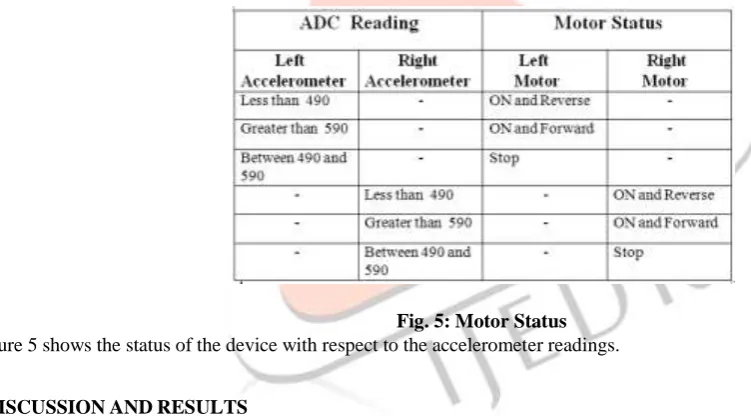
Since the displayed gadget is a model, the analysis will be done on the bases of the accelerometer readings. The accelerometer readings are read and accordingly the motion and the direction of the device is decided.
Fig. 5: Motor Status Figure 5 shows the status of the device with respect to the accelerometer readings.
V.DISCUSSIONANDRESULTS
The model of the proposed system is completely functional. Up to this point, about 5 healthy people have "strolled in" the gadget for around an hour in the "patient in control" mode with no mechanical issues. Be that as it may, for use in clinical investigate, gadget must be made completely fall safe. This suggests, for instance, an autonomous wellbeing circuit that can control the framework down in the event of any danger and a covering of all conceivable unsafe moving parts.
The design and evaluation of a gait rehabilitation for walking assistance device is impedance controlled on six DOFs (Degree Of Freedom) namely,
1.Forward
2.Reverse 3.Left 4.Right 5.Strong Left 6.Strong Right
This DOF gives all possible motions and speed for patients in charge maintaining the fundamental stability for walking. The model will be in between two modes:
• Patient in charge mode: Where the patient controls the walkiing by its own efforts.
IJEDR1802154
International Journal of Engineering Development and Research (www.ijedr.org)
842
Assessment of the plan demonstrated that, strolling in the gadget is extremely conceivable, and that any torques/forces expected for a walk example can be accomplished.The simulation result demonstrates that the speed of the device can be adjusted by the movement of the device model. In simulation results, the speed of the device is checked whether it can be controlled or not. The tilt angle limit is set to the value of ±10°. At the point when the tilt is moved forward, the accelerometer is expected to be as - 10°. Whereas, At the point when the tilt is moved reverse, the accelerometer is expected to be as +10°. By utilizing these presumption, we can figure the movement and direction of the device. The tilt angle is calculated from these real time values and the graph is plotted as shown in the figure. Here we are expected that the speed is directly proportional to the tilt angle. At the point when both of the wheels are running in consistent speed, the obtained graph for increasing speed is likewise steady as shown.
Fig. 6: Graph when both wheels are running in constant speed [11]
The angle made between the tilt and base isn't varying, along these lines we can state that the speed is steady. The angle between the tilt concerning base edge are figured and are plotted in the diagram demonstrated as follows. On the off chance that the crane is turning in left side, the speed of left wheel is more noteworthy than that of right wheel.
Figure 7: Graph of speed variation in left and right wheel [11]
VI.CONCLUSION
The model of walking assistance device with the execution of the displayed control framework has been demonstrated in test contemplate for being exceptionally instinctive and simple to receive by the clients. Most characteristic are the test runs executed in External control mode (remote control by the administrator), which created information, that obviously demonstrate a positive connection between's the client's expectation (pelvic turn) and the rotational speed along the endorsed reference direction.
REFERENCES
[1] Matevž Bošnak and Igor Škrjanc, “Embedded control system for smart walking assistance device”, IEEE Transactions on Neural Systems and Rehabilitation Engineering, Volume: 25, No. 3, pp 205 – 214, 2017
[2] M. G. Bowden, A. E. Embry, L. A. Perry, and P. W. Duncan, “Rehabilitation of walking after stroke,” Current Treatment Options in Neurology, vol. 14, no. 6, pp. 521–530, 2012.
[3] A. Olenšek, J. Oblak, I. Cikajlo, P. Novak, K. Jere, and Z. Matjaˇci´c, “Adaptive dynamic balance training during over ground walking with assistive device,” Proceedings of the IEEE RAS and EMBS International Conference on Biomedical Robotics and Biomechatronics, pp. 1066–1070, 2012.
[4] Zhang, X. Kong, G. Liu, and Y. Wang, “Research on the walking gait coordinations of the lower limb rehabilitation robot,” in 2010 IEEE International Conference on Robotics and Biomimetics, ROBIO 2010, pp. 1233–1237.
[5] J. F. Veneman, R. Kruidhof, E. E. G. Hekman, R. Ekkelenkamp, E. H. F. Van Asseldonk, and H. Van Der Kooij, “Design and evaluation of the LOPES exoskeleton robot for interactive gait rehabilitation,” IEEE Transactions on Neural Systems and Rehabilitation Engineering, vol. 15, no. 1, pp. 379–386, 2007.
[6] A. J. Rentschler, R. Simpson, R. A. Cooper, and M. L. Boninger, “Clinical evaluation of Guido robotic walker.” Journal of rehabilitation research and development, vol. 45, no. 9, pp. 1281–1293, 2008.
[7] D. Chugo, T. Asawa, T. Kitamura, J. Songmin, and K. Takase, “A motion control of a robotic walker for continuous assistance during standing, walking and seating operation,” 2009 IEEE/RSJ International Conference on Intelligent Robots and Systems, IROS 2009, pp. 4487–4492, 2009.
IJEDR1802154
International Journal of Engineering Development and Research (www.ijedr.org)
843
[9] B. T. Tyson, M. T. Pham, N. T. Brown, and T. R. Mayer, “Patient Safety Considerations in the Rehabilitation of theIndividual with Cognitive Impairment,” Physical Medicine and Rehabilitation Clinics of North America, vol. 23, no. 2, pp. 315–334, may 2012. [Online].
[10]{m}edica, “THERA-Trainer e-go (http://www.theratrainer.de/english/professional/gait/thera-trainer-e-go/index.html),” 2015. [Online].
[11]Anchumol V.N., Dr.Dinakardas CN, “Embedded Control System Based Intelligent Walking Assistance Device”, International Journal of Advanced Scientific Technologies , Engineering and Management Sciences, Volume.3, Special Issue.1, April.2017.
![Fig. 1: Proposed System Architecture [1]](https://thumb-us.123doks.com/thumbv2/123dok_us/8196143.1369002/3.595.157.450.94.557/fig-proposed-system-architecture.webp)
![Fig. 6: Graph when both wheels are running in constant speed [11]](https://thumb-us.123doks.com/thumbv2/123dok_us/8196143.1369002/5.595.180.437.162.260/fig-graph-wheels-running-constant-speed.webp)
