POLICY STATEMENT
Patient- and Family-Centered Care Coordination:
A Framework for Integrating Care for Children and
Youth Across Multiple Systems
abstract
Understanding a care coordination framework, its functions, and its effects on children and families is critical for patients and families themselves, as well as for pediatricians, pediatric medical subspecialists/ surgical specialists, and anyone providing services to children and families. Care coordination is an essential element of a transformed American health care delivery system that emphasizes optimal qual-ity and cost outcomes, addresses family-centered care, and calls for partnership across various settings and communities. High-quality, cost-effective health care requires that the delivery system include elements for the provision of services supporting the coordination of care across settings and professionals. This requirement of sup-porting coordination of care is generally true for health systems pro-viding care for all children and youth but especially for those with special health care needs. At the foundation of an efficient and effec-tive system of care delivery is the patient-/family-centered medical home. From its inception, the medical home has had care coordina-tion as a core element. In general, optimal outcomes for children and youth, especially those with special health care needs, require inter-facing among multiple care systems and individuals, including the following: medical, social, and behavioral professionals; the educa-tional system; payers; medical equipment providers; home care agen-cies; advocacy groups; needed supportive therapies/services; and families. Coordination of care across settings permits an integration of services that is centered on the comprehensive needs of the pa-tient and family, leading to decreased health care costs, reduction in fragmented care, and improvement in the patient/family experience of care.Pediatrics2014;133:e1451–e1460
The medical home is the standard of care for all children and adults.1–3
The patient-/family-centered medical home (PFCMH) is well positioned to provide coordinated, compassionate, family-centered health care by forming strong links among the primary care provider team, specialist team, nurses, social workers, educators, hospitals, and other health care facilities where patients access services with their family/caregivers and community providers.4
COUNCIL ON CHILDREN WITH DISABILITIES and MEDICAL HOME IMPLEMENTATION PROJECT ADVISORY COMMITTEE
KEY WORDS
care coordination, family-centered care, patient-centered care, medical home, patient-/family-centered medical home, PFCMH ABBREVIATIONS
ACO—accountable care organization CPT—Current Procedural Terminology ED—emergency department EHR—electronic health record
PFCMH—patient-/family-centered medical home
This document is copyrighted and is property of the American Academy of Pediatrics and its Board of Directors. All authors havefiled conflict of interest statements with the American Academy of Pediatrics. Any conflicts have been resolved through a process approved by the Board of Directors. The American Academy of Pediatrics has neither solicited nor accepted any commercial involvement in the development of the content of this publication.
The guidance in this statement does not indicate an exclusive course of treatment or serve as a standard of medical care. Variations, taking into account individual circumstances, may be appropriate.
All policy statements from the American Academy of Pediatrics automatically expire 5 years after publication unless reaffirmed, revised, or retired at or before that time.
www.pediatrics.org/cgi/doi/10.1542/peds.2014-0318
doi:10.1542/peds.2014-0318
PEDIATRICS (ISSN Numbers: Print, 0031-4005; Online, 1098-4275).
Copyright © 2014 by the American Academy of Pediatrics
Care coordination is a “cross-cutting system intervention”5 that is “the
de-liberate organization of patient care activities between ≥2 participants (including the patient) involved in a patient’s care to facilitate the ap-propriate delivery of health care services. Organizing care involves the marshalling of personnel and other resources needed to carry out all re-quired patient care activities, and is often managed by the exchange of information among participants re-sponsible for different aspects of care.”6 Within the context of a
high-performing medical home model fo-cused on addressing family-centered needs, care coordination is para-mount in developing and fostering partnerships across various settings and communities.7
Successful care coordination takes into consideration the continuum of health, education, early child care, early intervention, nutrition, mental/ behavioral/emotional health, commu-nity partnerships, and social services (as well as payments for these ser-vices) needed to improve the quality of care for all children and youth in-cluding those with special health care needs, while acknowledging the im-portance of language and culture in achieving desired outcomes.8 It is to
be distinguished from disease or case management, which primarily focuses on patients’ medical issues. Case managers work with and guide ser-vices intrinsic to their specific agency, often within the constraints of eligi-bility criteria. In contrast, care coor-dinators work with and guide the team process, which includes and is driven by the needs of patients and families for services across the com-munity.9 These functions include care
planning and building collaboration/ partnerships with all medical and nonmedical providers working with a patient/family.10 Rather than
focus-ing on titles (eg, patient navigator, care coordinator, case manager), it is critical to focus on competencies, job descriptions, and functions in the physician-led team caring for the pa-tient and his or her family in and outside the PFCMH.11
NEW INFORMATION AND POLICY DEVELOPMENTS
The American health care system is being challenged to reduce costs of care while improving quality out-comes. A key component of recent legislative and regulatory efforts to achieve these savings includes the redesign of systems of care, building on robust medical and health care homes for both children and adults.12
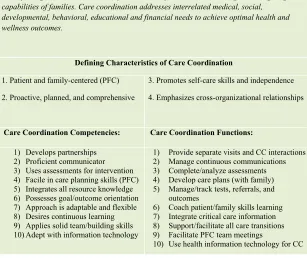
One method of achieving these fi nan-cial outcomes is the reduction in care fragmentation and inefficiency within and across health systems. Fragmen-tation of care can be addressed with care coordination: “a patient and family centered, assessment driven, team based activity designed to meet the needs of children and youth while enhancing the caregiving capabilities of families.”13 Care coordination has
been characterized as the set of ac-tivities that occurs in the space be-tween providers, visits, and entities.14
Ultimately, coordination of care ena-bles the achievement of the “triple aim” (better care, better health, and lower cost), a principal outcome for health system transformation.15
Although adult and pediatric health care organizations underscore com-mon elements of the medical home (which includes care coordination across systems), there are intrinsic differences in their respective sys-tems.16 The“Five Ds” that distinguish
pediatric from adult medical home models are as follows: developmental trajectory, dependency on adults, dif-ferential epidemiology of chronic dis-ease, demographic patterns of poverty
and diversity, and overall dollars spent on children versus adults.17
Another key differentiation is the clusion and importance of family in-put in all aspects of coordinated pediatric care. A recent Institute of Medicine report provides 10 key rec-ommendations for high-quality health care, including 1 emphasizing the in-tegral role of the family: “involve patients and families in decisions re-garding health and health care, tai-lored tofit their preferences.”18Thus,
it is essential that“family”is included in the“patient”-centered care model.19
As such, we refer to this model as the “patient-/family-centered medical home” (PFCMH).
Payment for care coordination services has had limited success over the past decade. The American Medical Associa-tion added codes 99487–99489 to its
Current Procedural Terminology (CPT) manual for care coordination for patients with complicated, ongoing health issues within a medical home, accountable care organization, or simi-lar model.20 The inception of these
codes allows physicians to document and bill for coordinating care between community service agencies, linking patients to resources, supporting the transition of patients from inpatient to other settings, and working to limit so-called preventable readmissions.21
Pediatricians need to advocate for rec-ognition of the codes via third-party payers in their respective regions.
to achieve optimal health and well-ness outcomes.13
BENEFITS OF AND EVIDENCE FOR CARE COORDINATION
Simply put, care coordination improves outcomes (eg, health care utilization, family functioning/satisfaction, and fi -nances). In a 2009–2010 National Sur-vey of Children with Special Health Care Needs, 43% of parents reported receiving care coordination, as op-posed to 47% in the 2005–2006 itera-tion of the survey.22These data, which
suggest a decrease in receipt of care coordination services over time, war-rant further examination. Data analy-ses from the 2005–2006 National
Survey of Children with Special Health Care Needs revealed positive associa-tions between care coordination, family-provider relations, and family/ child outcomes. Specifically, the pro-vision of care coordination was posi-tively associated with patient- and family-reported “receipt of family-centered care,” resulting in “ partner-ships with professionals, satisfaction with services, ease of getting referrals, lower out of pocket expenses and family financial burden, fewer hours per week spent coordinating care, less impact on parental employment, and fewer school absences and ED visits.”23
An Illinois study showed that children, youth, and their families had a higher
need for care coordination when communication between health care providers was inadequate.24 Care
co-ordination within primary care pedi-atric practices is associated with decreased unnecessary office and emergency department (ED) visits, enhanced family satisfaction, and re-duced unplanned hospitalizations and ED visits.25–27According to research in
New Orleans, families of children and youth with special health care needs in an underserved population experi-enced enhanced services from nurse care coordinator support.28 In short,
fewer unmet needs for services ensue when primary care clinicians are sensitive to the culture and needs of children and youth with special health care needs and their families and in-corporate levels of care coordination in care delivery.29 Care coordination
conducted as a standard of pediatric practice resulted in increased family satisfaction with the quality of care and also decreased barriers to care.30
Other data have suggested that the PFCMH represents a process of care that may help families manage the daily demands of caring for children with special health care needs through family-centered care, provider-to-provider communication, and provision of care coordination.31 A 2011 study in
chil-dren and youth with special health care needs and their families who received care coordination and in-dividualized care plans via a Medicaid managed care plan study reported improved satisfaction with mental health services and specialized ther-apies and participants were observed to have a decline in unmet needs, improved satisfaction with specialty care, and improved ratings of child health and family functioning.32
In a busy medical practice, care co-ordination fosters improved pro-ductivity and efficiency by transferring the mechanics of follow-up care, FIGURE 1
referrals, equipment acquisition, let-ters of medical necessity, patient in-formation, transition of care, and previous authorization to care coor-dinators rather than physicians. As such, efficiency ensues because physicians can spend less time on nonclinical issues for patients.
IMPLEMENTING CARE
COORDINATION IN TRANSFORMED SYSTEMS OF CARE
Quality improvement processes are essential in the transformation to health care delivery models that sup-port care coordination. However, it is critical to recognize that broad implementation of care coordination requires consideration of financing models, workforce development, and the development and implementation of tools supporting the provision of care coordination.33The costs of care
coordination are not directly re-imbursable under many traditional payment models, such as fee-for-service, despite evidence of reduc-tions in health care costs.29,34,35 The
most recent CPT manual includes codes for care coordination and transition services.20
Health information technology can play a pivotal role in care coordination. Electronic tools can facilitate in-formation sharing among patients/ families and their health care teams, and subsequently, health care teams, community partners, and medical and nonmedical providers. For example, previsit summaries, comprehensive health care plans, medical summaries, and personal health records can be shared with, among, and between partners and health care teams caring for patients.9
Tracking and monitoring patients via the use of patient registries can sup-port care coordination activities and functions and improve patient safety.7
These registries can be incorporated
and supported via electronic health records (EHRs) and other software tools with some adaptation. This technology is still evolving with “meaningful use” criteria of EHRs. Meaningful use is intended to use certified EHR technology to improve quality, safety, efficiency, and ac-countability; reduce health disparities; engage patients and families as part-ners; improve care coordination and population and public health; and maintain privacy and security of pa-tient health information.36 Ultimately,
it is hoped that meaningful use com-pliance will result in better clinical outcomes, improved population health outcomes, increased transparency and efficiency, empowered patients/ families, and more robust research data on health systems.36
Interop-erability of registry functionality and care plans with team members out-side of the medical arena, but still in the medical and community “ neigh-borhood”caring for a child, is critical.
Care planning includes the use of an “actionable” care plan with assigned tasks/roles, a care plan document, an emergency information form, and/or a medical summary, including past medical history and salient specialist information.7 These care plans are
developed and implemented with in-put from members of the team caring for a child, including community partners, educational specialists, pri-mary care providers, dental pro-viders, medical subspecialists and surgical specialists, and, most im-portantly, the family and patient themselves. Coordinated care plans are used across the continuum of care by including medical, educa-tional, mental health, community, and home care provider input.37 These
plans should explicitly state goals with therapeutic (including early interven-tion) educational/vocational and fam-ily interventions to maximize outcomes
for children and youth with special health care needs and to drive suc-cessful transitions to adult systems of care. It is essential that care plans are maintained and updated with timely and salient information from all partners to avoid duplication of ser-vices and to optimize care for patients.
Health care teams are essential to the provision of coordinated care. Teams include, but are not limited to, the patient/family, primary care providers, community partners/agencies, mental health care providers, educational systems, medical subspecialists and surgical specialists, urgent care/ED centers, nurse practitioners, physi-cian assistants, dietitians, child care centers, nursing staff, social workers, therapists, home visitors, and other medical staff. Team building starts with establishing teams of physicians and ancillary staff and working with patients, families, and communities to coach patients/families to optimize their health care and chronic condition management.38
“Relational coordination” is an emerg-ing topic highlightemerg-ing the fact that coordination is not merely manage-ment of the interdependence between tasks but addresses management of the people who are performing tasks. It is defined as“a mutually reinforcing process of interaction between com-munication and relationships carried out for the purpose of task integra-tion.”39 This concept is particularly
Internet-based tools can optimize communication between families and providers, provide information, sup-port skills training, allow networking among families, facilitate connections between health care providers and community partners, and elicit patient feedback about care. Comanagement with specialists ensures high quality of care and fosters communication across disciplines for patients with multiple diagnoses.40Also, care
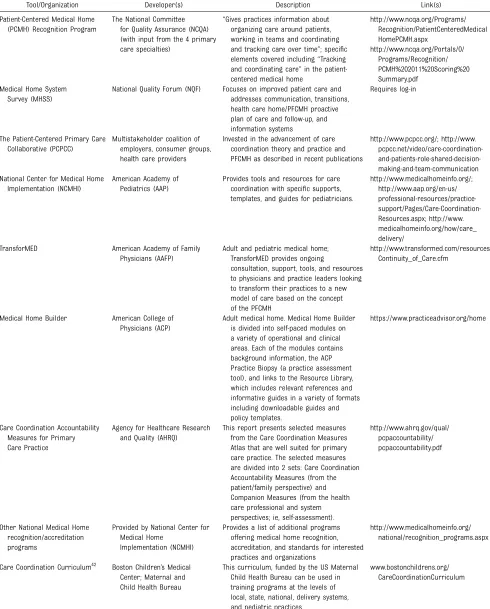
coor-dination augments reciprocity of pa-tient information with transfer across settings (eg, from inpatient to out-patient settings). As health care sys-tem redesign evolves, it is critical that practitioners are cognizant of tools and organizations providing resour-ces for care coordination. Several national organizations incorporate standards on care coordination struc-ture, process, and outcomes. Table 1 shows a variety of such organizations and tools.
Given this rapidly changing and in-novative landscape, it is imperative to continue education on care coordi-nation, the PFCMH, accountable care organizations (ACOs), and family-centered and -driven health care for practicing physicians, medical stu-dents, resident trainees, nurses, nurse practitioners, physician assistants, mental/behavioral health practitioners, and social workers. This workforce training goal can be accomplished through maintenance of certification, continuing medical education, con-tinuing education units, and curricula/ competency changes in training. Edu-cation of the workforce is critically important, because care coordination functions and family-centered princi-ples must be learned and cultivated. The training of current and future physicians on the value and pragmatic adoption and implementation of care coordination is paramount in ensuring its success in practice. The Accreditation
Council for Graduate Medical Educa-tion has selected a care coordinaEduca-tion milestone as a key competency in the semiannual assessment of residents in its “Next Accreditation System,”41
which shows a fundamental commit-ment to training the next generation of physicians in care coordination. In addition, a Care Coordination Curric-ulum (funded by the US Maternal and Child Health Bureau) is now available to support the education of care ordination providers. This care co-ordination curriculum is designed to help fill the void of inadequate train-ing opportunities for care coordina-tors presently. The target audience for this curriculum includes families and patients as well as physicians, nurses, social workers, and administrative staff. Essentially, it provides a frame-work for the evolution of team-based patient- and family-centered care co-ordination. It is currently being used in several state programs and de-livery systems working to create care coordination capacity.42
CARE COORDINATION AND ACCOUNTABLE CARE
ACOs are expected to play a key role in achieving the outcomes of the “triple aim.”15 The Medicare Payment
Advi-sory Commission has defined ACOs as “a set of providers associated with a defined population of patients, ac-countable for the quality and cost of care delivered to that population.”43
ACO providers could include a hospi-tal, a group of primary care providers, specialists, and possibly other health professionals who share responsi-bility for the delivery of the highest quality care at the lowest appropriate cost. Key elements of accountable care include payment reform, performance measurement and accountability, and coordinated continuum of care. In the ACO model, there are incentives to manage health care utilization and
improve quality with shared savings to control cost. The PFCMH model can be enhanced through the ACO model with greater organization, coordina-tion, and integration throughout the care system; yet, defining account-ability within and across systems will be a formidable challenge.44One must
begin with the premise that, from the perspective of the patient and family, care integration means that seamless and coordinated health care services are delivered across the entire care continuum, irrespective of institu-tional and departmental boundaries.45
Implementing the activities of care coordination, with explicitly articu-lated roles and responsibilities for all members of the care team, will be foundational to the success of ACOs. The recommendations of a national expert panel tasked with defining the core elements of accountable care for children are presented in Table 2. These elements emphasize the unique needs of children and the role of care coordination in their health care de-livery system.
IMPLEMENTATION
Pediatricians are encouraged to pro-vide and partner with the PFCMH team in the office setting to manage patients and work with families and community partners across systems.35 The Care
Coordination Measures Atlas, de-veloped by the Agency for Healthcare Research and Quality, provides a list of activities proposed as a means of achieving coordinated care that are organized by domains and per-spectives (patient/family, health care professional, system representative) and can be a useful tool in achieving these aims.46 There are several
TABLE 1 Care Coordination Tools and Organizations Supporting Care Coordination
Tool/Organization Developer(s) Description Link(s)
Patient-Centered Medical Home (PCMH) Recognition Program
The National Committee for Quality Assurance (NCQA) (with input from the 4 primary care specialties)
“Gives practices information about organizing care around patients, working in teams and coordinating and tracking care over time”; specific elements covered including“Tracking and coordinating care”in the patient-centered medical home
http://www.ncqa.org/Programs/ Recognition/PatientCenteredMedical HomePCMH.aspx
http://www.ncqa.org/Portals/0/ Programs/Recognition/ PCMH%202011%20Scoring%20 Summary.pdf
Medical Home System Survey (MHSS)
National Quality Forum (NQF) Focuses on improved patient care and addresses communication, transitions, health care home/PFCMH proactive plan of care and follow-up, and information systems
Requires log-in
The Patient-Centered Primary Care Collaborative (PCPCC)
Multistakeholder coalition of employers, consumer groups, health care providers
Invested in the advancement of care coordination theory and practice and PFCMH as described in recent publications
http://www.pcpcc.org/; http://www. pcpcc.net/video/care-coordination- and-patients-role-shared-decision-making-and-team-communication National Center for Medical Home
Implementation (NCMHI)
American Academy of Pediatrics (AAP)
Provides tools and resources for care coordination with specific supports, templates, and guides for pediatricians.
http://www.medicalhomeinfo.org/; http://www.aap.org/en-us/ professional-resources/practice- support/Pages/Care-Coordination-Resources.aspx; http://www. medicalhomeinfo.org/how/care_ delivery/
TransforMED American Academy of Family Physicians (AAFP)
Adult and pediatric medical home; TransforMED provides ongoing
consultation, support, tools, and resources to physicians and practice leaders looking to transform their practices to a new model of care based on the concept of the PFCMH
http://www.transformed.com/resources/ Continuity_of_Care.cfm
Medical Home Builder American College of Physicians (ACP)
Adult medical home. Medical Home Builder is divided into self-paced modules on a variety of operational and clinical areas. Each of the modules contains background information, the ACP Practice Biopsy (a practice assessment tool), and links to the Resource Library, which includes relevant references and informative guides in a variety of formats including downloadable guides and policy templates.
https://www.practiceadvisor.org/home
Care Coordination Accountability Measures for Primary Care Practice
Agency for Healthcare Research and Quality (AHRQ)
This report presents selected measures from the Care Coordination Measures Atlas that are well suited for primary care practice. The selected measures are divided into 2 sets: Care Coordination Accountability Measures (from the patient/family perspective) and Companion Measures (from the health care professional and system perspectives; ie, self-assessment).
http://www.ahrq.gov/qual/ pcpaccountability/ pcpaccountability.pdf
Other National Medical Home recognition/accreditation programs
Provided by National Center for Medical Home
Implementation (NCMHI)
Provides a list of additional programs offering medical home recognition, accreditation, and standards for interested practices and organizations
http://www.medicalhomeinfo.org/ national/recognition_programs.aspx
Care Coordination Curriculum42
Boston Children’s Medical Center; Maternal and Child Health Bureau
This curriculum, funded by the US Maternal Child Health Bureau can be used in training programs at the levels of local, state, national, delivery systems, and pediatric practices.
services to children and families. As health care reform implementation continues with delivery system changes and ACO evolution, pediatricians can work via their state’s American Acad-emy of Pediatrics’ chapters, with chil-dren’s cabinets in respective states/ commonwealths, and with other inter-/ intraagency state coordinating bodies to ensure that system changes sup-port improved care coordination op-portunities for meeting the needs of children and youth. Care coordination activities for implementation include the following:
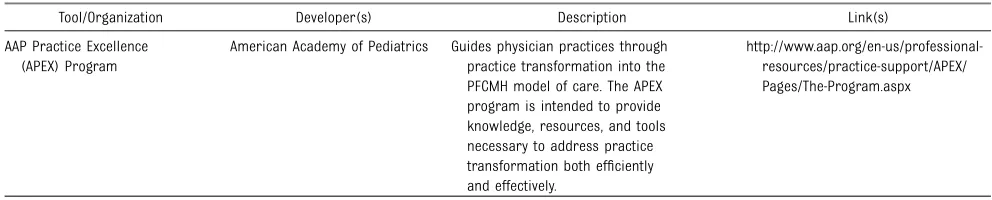
establishing formal responsibili-ties among team members and with the patient and family to com-prehensively address patient needs; fostering strength-based relation-ships with families and children while building on existing strengths of patients and their family sup-port systems; collaborating with all team mem-bers and providers involved in car-ing for a patient and family, including (but not limited to) med-ical subspecialists and surgmed-ical specialists, nurse practitioners, nurses, mental health care pro-viders, social workers, dietitians, educators, community partners, child care centers, home visitors, and family networks; communicating across all systems (medical and nonmedical) involved in a child’s care while adhering to Health Insurance Portability and Accountability Act rules and Family Educational Rights and Privacy Act regulations and consent driven by families and patients; facilitating transitions between en-tities (eg, pediatric/adult providers, community partners, hospitals, urgent/emergency care facilities, offices, specialists) and across time; assessing needs and establishing clear goals for the patient, family, health care team, and system; creating, implementing, and updat-ing a formal written plan of care with family/patient input that is sensitive to their language, values, and culture; examples can be found at the National Center for Medical Home Implementation Web site (http://www.medicalho-meinfo.org/how/care_delivery/ #care); monitoring, following, and respond-ing to needs and changes over time; supporting self-management goals as outlined by the team and pa-tient/family; linking and collaborating with community resources and part-ners, including state Title V Chil-dren and Youth with Special Health Care Needs programs (eg, formal meetings, education collab-orations, task forces, policy devel-opment meetings); fostering knowledge about com-munity resources and linking families/patients to those resour-ces commensurate with the needs of the patient, family, and popula-tion; using quality improvement strate-gies to facilitate implementation for the medical home team, staff, and partners (eg, EQIPP medical home course, APEX-AAP digital nav-igator) (see Table 1); visiting the National Center for Medical Home Implementation Web site (www.medicalhomeinfo.org)TABLE 1 Continued
Tool/Organization Developer(s) Description Link(s)
AAP Practice Excellence (APEX) Program
American Academy of Pediatrics Guides physician practices through practice transformation into the PFCMH model of care. The APEX program is intended to provide knowledge, resources, and tools necessary to address practice transformation both efficiently and effectively.
http://www.aap.org/en-us/professional-resources/practice-support/APEX/ Pages/The-Program.aspx
TABLE 2 Summary of Core Principles for Creating Accountable Child Health Outcomes
1. Child health care delivery has the potential to deliver both short- and long-term cost savings. 2. The epidemiology and treatment of chronic
conditions in children are different than they are in adults.
3. Families are the drivers of child health. 4. Implementation of life-course approaches is
essential for optimal child, adult, and population health outcomes.
5. Children’s health care requires a diverse and complex network of nonmedical and medical stakeholders.
6. There is a strong need for well-defined care coordination and integration in children’s health care.
7. Children represent a disproportionate segment of the population living in poverty, with large disparities among different subgroups. 8. Child health care quality measures require
further development and specialized methods. 9. Payment for child health must incentivize
stakeholders to provide elements of accountable care.
for assistance and examples of support, resources, and templates in transforming clinical practice into a PFCMH;
using health information technol-ogy and tools to facilitate care co-ordination7–9,40; advocating for adequate pay-ment mechanisms for supporting care coordination (using CPT codes)20,21,26; ensuring ACOs and integrated de-livery systems address and pro-mote the integrity of the care coordination model (see Table 2)44–46; engaging with national organiza-tions dedicated to quality measure-ment to ensure care coordination metrics and standards are appro-priate to advance child health out-comes47; and supporting efforts to develop prac-tical implementation of care coor-dination algorithms in practice, practice management, and team development.SUMMARY AND CONCLUSIONS
Care coordination should be a team-and family-driven process that improves family and health care practitioner satisfaction, facilitates children’s and youth’s access to ser-vices, improves health care outcomes, and reduces costs associated with health care fragmentation, which can lead to under- and overutilization of care. It is imperative that well-defined care coordination is integrated into children’s health care. Tools for care coordination include health informa-tion technology, integrated health care teams, and Internet-based resources. Because of their foundational reliance on PFCMH, ACOs may support the de-livery of high-quality, lower-cost care but only if explicit elements of care coordination are included in delivery
system design and training and resources are provided for care co-ordination.
RECOMMENDATIONS
1. Use and create mechanisms for patients/families to learn the skills they may need to be part-ners in their own care and in decision-making for optimal care coordination.48
2. Ensure that the patient’s and fam-ily’s needs for services and infor-mation sharing (eg, care planning) across people, systems, and func-tions are met via (a) formal as-sessments, (b) infrastructure (eg, teams), and (c) tracking (eg, reg-istries); this is crucial in opera-tionalizing care coordination.46
3. Continually involve the patient/ family (eg, families as partners/ advisors), build on the strengths of the patient/family, clearly delin-eate responsibilities of team mem-bers, and create careful handoffs when transitioning across settings (eg, between inpatient and outpa-tient settings and between pediat-ric and adult care providers or settings).46,49–51
4. Use and develop efficient and accredited health information sys-tems and information technology advances to foster successful transfer of information; to sup-port collaborative communica-tions between patients, families, and the care team; and to facili-tate shared decision-making (eg, developing and using care plans).
5. Use care coordination across transitions between entities of the health care system (ie, be-tween and among patient care teams, across settings, between caregivers, and between health care organizations) and with tran-sitions over time (ie, across the
life span, between episodes of care, across trajectory of ill-nesses).49–51
6. Ensure that comanagement and communication occur among spe-cialists and primary care pro-viders. This care model requires reciprocal and bidirectional com-munication (ie, secure e-mail, phone call, note, fax), which can be augmented, but not replaced, with health information technol-ogy.7,37
7. Ensure ongoing education of ele-ments of care coordination and the medical home for practicing physicians, nurse practitioners, phy-sician assistants, nurses, medical students, resident trainees (across disciplines), mental/behavioral health care practitioners, social workers, and other health care profession-als via specific training/curricula, continuing medical education pro-grams, and publications.41,42
8. Understand the landscape of the PFCMH and care coordination as they relate to national organiza-tions and certification/standards, such as ACOs, the National Com-mittee for Quality Assurance, the Patient-Centered Primary Care Collaborative, the National Quality Forum, quality metrics broadly, and health care reform, including
financing of care coordination as well as remote collaborative ser-vices (eg, phone, e-mail consults with specialists, phone/e-mail en-counters with families) that max-imize the potential of children, youth, and families.47
10. Understand and use new care co-ordination codes (99487–99489)20
and advocate for payment of these care coordination services by payers.
LEAD AUTHORS
Renee M. Turchi, MD, MPH, FAAP Richard C. Antonelli, MD, MS, FAAP
COUNCIL ON CHILDREN WITH
DISABILITIES EXECUTIVE COMMITTEE, 2013–2014
Kenneth W. Norwood Jr, MD, FAAP, Chairperson Richard C. Adams, MD, FAAP
Timothy J. Brei, MD, FAAP Robert T. Burke, MD, MPH, FAAP Beth Ellen Davis, MD, MPH, FAAP Sandra L. Friedman, MD, MPH, FAAP Amy J. Houtrow, MD, PhD, MPH, FAAP Dennis Z. Kuo, MD, MHS, FAAP Susan E. Levy, MD, MPH, FAAP Renee M. Turchi, MD, MPH, FAAP Susan E. Wiley, MD, FAAP
Miriam A. Kalichman, MD, FAAP, Past Executive Committee Member
Nancy A. Murphy, MD, FAAP, Immediate Past Chairperson
LIAISONS
Carolyn Bridgemohan, MD, FAAP –Section on Developmental and Behavioral Pediatrics
Marie Y. Mann, MD, MPH, FAAP–Maternal and Child Health Bureau
Georgina Peacock, MD, MPH, FAAP–Centers for Disease Control and Prevention
Bonnie Strickland, PhD – Maternal and Child Health Bureau
Nora Wells, MSEd–Family Voices
Max Wiznitzer, MD, FAAP–Section on Neurology
STAFF
Stephanie Mucha, MPH
MEDICAL HOME IMPLEMENTATION PROJECT ADVISORY COMMITTEE, 2013–2014
W. Carl Cooley, MD, FAAP, Chairperson Richard C. Antonelli, MD, MS, FAAP Joan Jeung, MD, FAAP
Beverly Johnson
Thomas S. Klitzner, MD, PhD, FAAP Jennifer L. Lail, MD, FAAP Linda L. Lindeke, PhD, RN, CNP Amy Mullins, MD
Lee Partridge William Schwab, MD
Christopher Stille, MD, MPH, FAAP
Debra Waldron, MD, MPH, FAAP Nora Wells, MSEd
Calvin Sia, MD, FAAP, Immediate Past Chair-person
LIAISONS
Colleen Kraft, MD, FAAP–Council on Community Pediatrics
Thomas F. Long, MD, FAAP–Committee on Child Health Financing
Marie Y. Mann, MD, MPH, FAAP–Maternal and Child Health Bureau
Bonnie Strickland, PhD– Maternal and Child Health Bureau
STAFF
Michelle Zajac Esquivel, MPH Angela Tobin, AM, LSW
ACKNOWLEDGMENT
The authors acknowledge the support of the Health Resources and Services Administration Maternal and Child Health Bureau in the inception and de-velopment of the care coordination curriculum.
REFERENCES
1. Turchi RM, Gatto M, Antonelli R. Children and youth with special healthcare needs: there is no place like (a medical) home.
Curr Opin Pediatr. 2007;19(4):503–508 2. Homer CJ, Baron RJ. How to scale up
pri-mary care transformation: what we know and what we need to know?J Gen Intern Med. 2010;25(6):625–629
3. Starfield B, Shi LY, Macinko J. Contribution of primary care to health systems and health.Milbank Q. 2005;83(3):457–502 4. Cooley WC. Redefining primary pediatric
care for children with special health care needs: the primary care medical home.
Curr Opin Pediatr. 2004;16(6):689–692 5. Institute of Medicine Committee on Quality
of Health Care in America. Crossing the Quality Chasm: A New Health System for the 21st Century. Washington, DC: National Academy Press; 2001
6. Agency for Healthcare Research and Qual-ity. Care coordination and quality im-provement. Closing the quality gap: a critical analysis of quality improvement strategies. Vol 7, Care Coordination. Rock-ville, MD: Agency for Healthcare Research and Quality; 2007
7. McAllister JW, Presler E, Turchi RM, Antonelli RC. Achieving effective care coordination in the medical home.Pediatr Ann. 2009;38(9): 491–497
8. Turchi RM, Mann M. Building a medical home for children and youth with special health care needs. In: Hollar D, ed. Handbook of Children With Special Health Care Needs. New York, NY: Springer-Verlag; 2013:399–418 9. McAllister JW, Presler E, Cooley WC.
Practice-based care coordination: a medi-cal home essential.Pediatrics. 2007;120(3). Available at: www.pediatrics.org/cgi/con-tent/full/120/3/e723
10. Denboba D, McPherson MG, Kenney MK, Strickland B, Newacheck PW. Achieving family and provider partnerships for chil-dren with special health care needs. Pedi-atrics. 2006;118(4):1607–1615
11. Watson AC. Finding common ground in case management: new titles and terminology along the health care continuum.Prof Case Manag. 2011;16(2):52–54
12. Patient Protection and Affordable Care Act. Pub L No. 111-148 (2010). Available at: www. gpo.gov/fdsys/pkg/PLAW-111publ148/pdf/PLAW-111publ148.pdf. Accessed April 11, 2013
13. Antonelli R, McAllister J, Popp J.Developing Care Coordination as a Critical Component of a High Performance Pediatric Health Care System: Forging a Multidisciplinary Frame-work for Pediatric Care Coordination. Washington, DC: The Commonwealth Fund; 2009
14. Antonelli RC.Leveraging Care Coordination Strategies to Reduce Hospital Readmissions: A Measurement Framework. Washington, DC: National Quality Forum, Measure Ap-plications Partnership, Care Coordination Task Force; July 2012
15. Berwick DM, Nolan TW, Whittington J. The triple aim: care, health, and cost.Health Aff (Millwood). 2008;27(3):759–769
16. American Academy of Family Physicians; American Academy of Pediatrics; American College of Physicians; American Osteopathic Association. Joint Principles of the Patient-Centered Medical Home. February 2007. Available at: www.acponline.org/running_ practice/delivery_and_payment_models/pcmh/ demonstrations/jointprinc_05_17.pdf. Accessed April 11, 2013
Family-Centered Medical Home. The family-centered medical home: specific consid-erations for child health research and policy.Acad Pediatr. 2010;10(4):211–217 18. Institute of Medicine. Best Care at Lower
Cost: The Path to Continuously Learning Health Care in America. Washington, DC: National Academies Press; 2012
19. Patient-Centered Primary Care Collabora-tive. Care coordination. Available at: www. pcpcc.net/topic/care-coordination. Accessed April 11, 2013
20. American Medical Association. 2013 CPT (Current Procedural Terminology). Stan-dard ed. Chicago, IL: American Medical As-sociation; October 2012
21. Elliott VS. Revised CPT book includes new codes for care coordination. AmedNews. August 16, 2012. Available at: www.amed-news.com/article/20120816/business/308169997/ 8/. Accessed April 11, 2013
22. Maternal and Child Health Bureau; Health Resources and Services Administration; US Department of Health and Human Services. The National Survey of Children with Special Health Care Needs chartbook 2005–2006. Rockville, MD: US Department of Health and Human Services; 2008. Available at: http://mchb.hrsa. gov/cshcn05. Accessed April 11, 2013 23. Turchi RM, Berhane Z, Bethell C, Pomponio A,
Antonelli R, Minkovitz CS. Care coordination for CSHCN: associations with family-provider relations and family/child outcomes. Pedi-atrics. 2009;124(suppl 4):S428–S434 24. Rosenberg D, Onufer C, Clark G, Wilkin T,
Rankin K, Gupta K. The need for care co-ordination among children with special health care needs in Illinois.Matern Child Health J. 2005;9(2 suppl):S41–S47 25. Palfrey JS, Sofis LA, Davidson EJ, Liu J, Freeman
L, Ganz ML; Pediatric Alliance for Coordinated Care. The Pediatric Alliance for Coordinated Care: evaluation of a medical home model.
Pediatrics. 2004;113(5 suppl):1507–1516 26. Antonelli RC, Stille CJ, Antonelli DM. Care
co-ordination for children and youth with special health care needs: a descriptive, multisite study of activities, personnel costs, and out-comes. Pediatrics. 2008;122(1). Available at: www.pediatrics.org/cgi/content/full/122/1/e209 27. Cooley WC, McAllister JW, Sherrieb K, Kuhlthau K. Improved outcomes associated with medi-cal home implementation in pediatric primary care.Pediatrics. 2009;124(1):358–364 28. Berry S, Soltau E, Richmond NE, Kieltyka RL,
Tran T, Williams A. Care coordination in a medical home in post-Katrina New Orleans:
lessons learned.Matern Child Health J. 2011; 15(6):782–793
29. Benedict RE. Quality medical homes: meet-ing children’s needs for therapeutic and supportive services. Pediatrics. 2008;121 (1):e127–e134
30. Wood DL, McCaskill QE, Winterbauer N, et al. A multi-method assessment of satisfaction with services in the medical home by parents of children and youth with special health care needs (CYSHCN).Matern Child Health J. 2009;13(1):5–17
31. Drummond A, Looman WS, Phillips A. Cop-ing among parents of children with special health care needs with and without a health care home.J Pediatr Health Care. 2012;26(4):266–275
32. Farmer JE, Clark MJ, Drewel EH, Swenson TM, Ge B. Consultative care coordination through the medical home for CSHCN: a randomized controlled trial.Matern Child Health J. 2011;15(7):1110–1118
33. Margolius D, Bodenheimer T. Transforming primary care: from past practice to the practice of the future.Health Aff (Millwood). 2010;29(5):779–784
34. Antonelli RC, Antonelli DM. Providing a medical home: the cost of care co-ordination services in a community-based, general pediatric practice.Pediatrics. 2004; 113(5 suppl):1522–1528
35. Taylor A, Lizzi M, Marx A, Chilkatowsky M, Trachtenberg SW, Ogle S. Implementing a care coordination program for children with special healthcare needs: partnering with families and providers.J Healthc Qual. 2013;35(5):70–77
36. US Department of Health and Human Services; Office of the National Coordinator. EHR incen-tives and certification: meaningful use defi ni-tion & objectives. Available at: www.healthit. gov/providers-professionals/meaningful-use-definition-objectives. Accessed April 11, 2013
37. Stille CJ. Communication, comanagement, and collaborative care for children and youth with special healthcare needs.
Pediatr Ann. 2009;38(9):498–504
38. Chen EH, Thom DH, Hessler DM, et al. Using the Teamlet model to improve chronic care in an academic primary care practice.J Gen Intern Med. 2010;25(suppl 4):S610–S614 39. Gittell JH, Seidner R, Wimbush J. A relational
model of how high-performance work sys-tems work.Organ Sci. 2010;21(2):490–506 40. National Quality Forum. Available at: www.
qualityforum.org/Publications/2010/10/Preferred_
Practices_and_Performance_Measures_for_ Measuring_and_Reporting_Care_Coordination. aspx. Accessed April 11, 2013
41. Accreditation Council for the Graduate Medi-cal Education; American Board of Pediatrics. The Pediatrics Milestone Project. 2012. Avail-able at: https://www.abp.org/abpwebsite/pub-licat/milestones.pdf. Accessed April 11, 2013 42. Antonelli RC, Browning DM, Hackett-Hunter P, McAllister JW, Risko W. Pediatric Care Coordination Curriculum. Boston, MA: Boston Children’s Hospital; 2012
43. Joint Principles for Accountable Care Organizations. November 19, 2010. Available at: www.aafp.org/media-center/releases-statements/all/2010/aco-jointprinciples.html. Accessed April 11, 2013
44. Academy Health. Medical homes and ac-countable care organizations: if we build it, will they come? Research Insights. 2009. Available at: www.academyhealth.org/files/ publications/RschInsightMedHomes.pdf. Ac-cessed April 11, 2013
45. American Academy of Pediatrics. Account-able care organizations (ACOs) and pedia-tricians: evaluation and engagement. AAP News. 2011;32(1):1
46. McDonald KM, Schultz E, Albin L, et al.Care Coordination Atlas Version 3. Rockville, MD: Agency for Healthcare Research and Qual-ity; November 2010. AHRQ Publication 11-0023-EF
47. Henderson M, Kaye N. Policies for Care Coordination Across Systems: Lessons from ABCD III. Portland, ME: National Academy for State Health Policy; May 2012 48. HealthyPeople.gov. Maternal, infant, and child health. Healthy People 2020 objectives 2012. Available at: www.healthypeople.gov/ 2020/topicsobjectives2020/default.aspx. Ac-cessed April 11, 2013
49. Cooley WC, Sagerman PJ; American Academy of Pediatrics; American Academy of Family Physicians; American College of Physicians; Transitions Clinical Report Authoring Group. Supporting the health care transition from adolescence to adulthood in the medical home.Pediatrics. 2011;128(1):182–200 50. Lye PS; American Academy of Pediatrics
Com-mittee on Hospital Care and Section on Hospital Medicine. Clinical report—physicians’roles in coordinating care of hospitalized chil-dren.Pediatrics. 2010;126(4):829–832 51. Peikes D, Chen A, Schore J, Brown R. Effects
DOI: 10.1542/peds.2014-0318 originally published online April 28, 2014;
2014;133;e1451
Pediatrics
IMPLEMENTATION PROJECT ADVISORY COMMITTEE
Services
Updated Information &
http://pediatrics.aappublications.org/content/133/5/e1451
including high resolution figures, can be found at:
References
http://pediatrics.aappublications.org/content/133/5/e1451#BIBL
This article cites 30 articles, 11 of which you can access for free at:
Subspecialty Collections
nsition_-_discharge_planning_sub
http://www.aappublications.org/cgi/collection/continuity_of_care_tra
Continuity of Care Transition & Discharge Planning
b
http://www.aappublications.org/cgi/collection/hospital_medicine_su
Hospital Medicine
sub
http://www.aappublications.org/cgi/collection/quality_improvement_
Quality Improvement
e_management_sub
http://www.aappublications.org/cgi/collection/administration:practic
Administration/Practice Management
ves_for_children_with_special_needs_project_advisory_committee http://www.aappublications.org/cgi/collection/medical_home_initiati
Project Advisory Committee
Medical Home Initiatives for Children With Special Needs
with_disabilities
http://www.aappublications.org/cgi/collection/council_on_children_
Council on Children with Disabilities
http://www.aappublications.org/cgi/collection/current_policy
Current Policy
following collection(s):
This article, along with others on similar topics, appears in the
Permissions & Licensing
http://www.aappublications.org/site/misc/Permissions.xhtml
in its entirety can be found online at:
Information about reproducing this article in parts (figures, tables) or
Reprints
http://www.aappublications.org/site/misc/reprints.xhtml
DOI: 10.1542/peds.2014-0318 originally published online April 28, 2014;
2014;133;e1451
Pediatrics
IMPLEMENTATION PROJECT ADVISORY COMMITTEE
COUNCIL ON CHILDREN WITH DISABILITIES and MEDICAL HOME
Care for Children and Youth Across Multiple Systems
Patient- and Family-Centered Care Coordination: A Framework for Integrating
http://pediatrics.aappublications.org/content/133/5/e1451
located on the World Wide Web at:
The online version of this article, along with updated information and services, is
by the American Academy of Pediatrics. All rights reserved. Print ISSN: 1073-0397.