A CLUSTER BASED INTRUSION DETECTION TECHNIQUES FOR WIRELESS SENSOR
NETWORKS
A. Sunitha nandhini and T. Rajesh kumar
*Sri Krishna College of Technology, Coimbatore, Tamil nadu, India. E
.mail:
*[email protected]
Article received13.2.2018, Revised 23.4.2018, Accepted 28.4.2018
ABSTRACT
An inventive application for different condition in light of remote sensor systems is being produced in the business part. Discovering strings and blocking them without influencing the system is basic without expanding the overheads and vitality. In the proposed calculation called CTACK (Cluster trust based affirmation) for WSN depends on number of dynamic effective conveyances and Kalman Filter is utilized to anticipate the hub trust. In view of the trust estimation of whole course, affirmation is started on chosen bundles to diminish the control overhead. It is watched that bundle conveyance proportion enhances notwithstanding when vindictive hubs are distinguished and keep away from them in the course disclosure process.
Keywords:Hierarchical trust, trust assessment, state context, intrusion detection, remote sensor arrange
1. INTRODUCTION
A remote sensor arranges (WSN) is an accumu- lation of asset sensor hubs with numerous functiona-lities, for example, detecting, handling and correspo-ndence to different applications. Sensor hubs conseq-uently frame a system through remote interchanges and sensor hubs are static in nature, additionally send portable hubs in application needs. An asset rich hub, are known as the base station (BS) or door hub is like- wise utilized as a part of systems. The BS is effective information preparing and capacity unit is an entrance point in human interface. The BS gathers the sensor readings, performs exorbitant activities rather than sensor hubs. BS can ready to achieve all the sensor hubs in WSN and it has bigger correspondence extend when contrasted with the sensor hubs. The BS forms the data send by the sensor hubs and send it to outside world through either fantastic remote or wired conn-ections. Moreover, the WSN specialist can send differ- rent inquiries (i.e., information question) to the BS, which spreads those quest-ions into the system. In this way, the BS goes about as an entryway between the WSN and the outer world.
1.1 Wireless Sensor Networks
Wireless systems depend on framework like GSM, UMTS, and so forth. In the event that no framework is accessible or excessively costly, making it impossible to set up, at that point remote specially appointed syst-ems happens. The convention stack utilized by the WSN is like the seven layers determined in the OSI demonstrate. It contains the application layer, transport layer, organize layer, information connect layer, and the physical layer. The motivation behind each layer: Physical layer – in charge of regulation, transmission and getting systems
Data interface layer – in charge of medium access and guaranteeing dependable associations
Network layer – in charge of steering the information provided by the vehicle layer
Transport layer – in charge of giving information to be exchanged
Application layer – in charge of determining how the information will be given.
1.2 Attacks on Wireless Sensor Networks:
Most of the customary assaults in PC systems are likewise utilized as a part of WSNs. As information is transmitted over the air as suggested by Butun et al.,
(2014), it is anything but difficult to sniff activity and meet stringent spending prerequisites, sensor hubs req-uire not be carefully designed and offer no insurance against hub trade off. The present interruption disco-very frameworks endeavor to identify and influence the system layer and furthermore on the accessible layers. 2. INTRUSION DETECTION SYSTEM
Although, sensor nodes have low computation and communication abilities given by He et al., (2012) a wireless sensor hub gathers the data and sends it to the base station which needs security from the aggressors. Since Cryptographic security isn't sufficient to ensure, it needs a moment line of resistance like interruption location framework (IDS). IDS screen the movement of the system and finds malignant action by any hub and send an alarm mess-age to base station with the hub information. When a parcel is transmitted, the IDS screen the bundle then aggressor can assault a hub that transmit counterfeit bundle into system to lessen the battery life of the hubs. Not at all like wired systems, does an aggressor not have to increase physical access to links/changes to trade off switches and to direct listening stealthily.
All PC or system action can be grouped into three unique classes: 1. typical movement 2. Anomalous however not malevolent 3. Vindictive movement two fundamental interruption discovery procedures are having based and organize based interruption identi-fication. Irregularity location accumulates data about the typical exercises and looks at the present exercises to the ordinary conduct to identify inconsistencies as deviation from the standard. The disadvantage of this system is that it might regard all irregularities as inter-ruptions; consequently, false identifications are normal. 2.1 Intrusion Detection Techniques
WSNs is displayed. Right off the bat, definite data about IDSs is given. Furthermore, a short overview of IDSs proposed for Mobile Ad-Hoc Networks (MAN-ETs) is displayed and materialness of those frameworks to WSNs are talked about. Thirdly, IDSs proposed for WSNs are displayed. The intrusion detection system for wireless sensor networks can base their detection techniques on the same approaches as the traditional systems.
Anomaly detection and misuse detection, or they could also use specification-based detection techni-ques suggested by Dhakne et al., (2015). In misuse detection technique the system compares the actions in the system with known attack patterns. As port-rayed in the customary IDS frameworks, these frameworks have the downside of not having the capacity to recognize new and unknown attacks.
In this manner, false identifications ought normal as suggested by Butun et al., (2014). Detail based discovery procedures screen arrange conduct and look at, in an indistinguishable way from oddity location methods, current conduct with what is relied upon to be "typical" conduct. The IDS banners hubs that contrast from the standard by a noteworthy factual sum as interlopers.
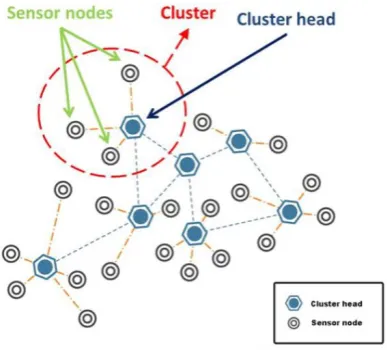
2.2 Cluster Based WSN: A run of the mill various leveled WSN comprises of bunches, as appeared in Figure 1.1 Each group is a gathering of interconnected sensor hubs with a committed hub called the group head (CH). CHs are in charge of dealing with the part (subordinate) sensor hubs, for example, planning of the medium access, spread of the control messages and, above all, information conglomeration. In some prag-matic arrangements of various leveled WSNs, CHs may likewise shape a larger amount of bunch in which one of the CHs is appointed as the CH (Level 2) of all different CHs (Level 1). This leveled engineering is appeared in Figure 1.
Figure 1. A typical clustered WSN
In a leveled and bunched WSN; the identification of strange practices of base level hubs (sensor hubs) isn't sufficient to distinguish the majority of the inter-ruptions of the system. This is a result of the way that CHs and upper level bunches may likewise be traded
off. Following the arrangement of the hubs and the development of the groups and the CHs, CHs may constitute a solitary purpose of disappointment. Hence, keeping in mind the end goal to have a total interrup-tion recogniinterrup-tion framework (IDS) for progressive WSNs, interruptions through CHs should be identified, too Figure 1.1 A typical clustered WSN.
3. SOFTWARE OVERVIEW
NS is composed in C++, with an OTcl1 mediator as a summon and arrangement interface. The OTcl part, which runs much slower yet can be changed quick immediately, at that point it is utilized for recreation design. One of the upsides of this split-dialect program, that it takes into account quick age of extensive situations. To just utilize the test system, it is adequate to know OTcl. Other hand, it has one inconvenience is that altering and broadening the test system requires programming and troubleshooting in the two dialects. NS can recreate the accompanying:
1. Topology: Wired, remote
2. Planning Algorithms: RED, Drop Tail, 3. Transport Protocols: TCP, UDP
4. Directing: Static and dynamic steering as a progenitor class of TclObject, NsObject class is the super class of all fundamental system part protests that handle parcels. Fundamental system segments are additionally isolated into two subclasses, Connector and Classifier, in view of the quantity of the conceivable yield DATA ways.
3.1 CLASS Tcl: The class Tcl exemplifies the real
occasion of the OTcl mediator and gives the techniques to get to and speak with that translator, code.
The class gives strategies to the accompanying activities: 1. Get a reference to the Tel occurrence 2. Summon OTcl techniques through the mediator 3. Recover or go back outcomes to the mediator 4. Report blunder circumstances and exit in a uniform way 5. Store and query "Tcl Objects" 6. Procure guide access to the mediator.
3.1 A Reference To Class Tcl: A solitary example of the class is proclaimed in - tclcl/Tcl.cc as a static part factor. The announcement required to get to this occur-rence is Tel& tel = Tcl::instance ();
3.2 Invoking Otcl Procedures: There are four unique strategies to conjure an OTcl order through the occa-sion, tcl.Each work passes a string to the translator that at that point assesses the string in a worldwide setting.
These techniques will come back to the guest if the mediator returns TCL_OK. Then again, if the translator returns TCL_ERROR, the techniques will call tkerror {}. The client can over-burden this method to specifi-cally ignore certain sorts of blunders.
1. Passing Results to/from the Interpreter: When the mediator conjures a C++ technique, it expects the outcome back in the private part factor, tcl-> result.
2. Mistake Reporting and Exit: This strategy gives a uniform method to report blunders in the accumulated code.
3.5 NS2 Features
• Protocols: TCP, UDP, HTTP, Routing calculations
• Traffic Models: CBR, VBR, Web and so forth • Error Models: Uniform, burst and so forth Radio
engendering,
• Mobility models Energy Models Topology
Gene-ration devices Visualization instruments Extensi-bility
4. DESIGN METHODOLOGY
In WSNs, most conventions at the information interface layer accomplish by wakeup routine for sen-sors. Existing Medium Access Control (MAC) conven-tions in view of the procedure that has been turned out to be vitality effective. The S-MAC is a Carrier Sense Multiple Access MAC convention, with occasional composed wakeup obligation cycles and the system is isolated into virtual bunches and each group has its own particular wakeup plans. The hubs transmit and get information parcels amid its wake time and the information transmission takes after bearer sense and RTS/CTS methodology. A chromosome with b genes represents an input channel. The encoding was binary (Rajesh kumar. et al., 2017).
Hubs on awakening embraces its neighbor plan and in the event that it sees distinctive calendars then it functions as outskirt hub with essential and auxiliary timetable. The essential calendar is utilized for corres-pondence inside its virtual group and auxiliary time-table to speak with different bunches. In MS-MAC convention, portability of the hubs is distinguished and loss of association is affirmed after a timeout period.
Data is proliferated so each node knows about its relative position concerning different hubs. Flooding is a standout amongst the most regularly utilized steering calculation where a hub sends information bundle to every one of its neighbors inside its range till the parcel achieves goal. The proposed a group trust based affir-mation (CTACK) IDS for WSNs depends on the quan-tity of dynamic fruitful conveyances which is utilized to construct trust and uses Kalman channel to foresee hub trust.
In view of confide in esteem (low, medium or high) of whole course, ''Adaptive Acknowledgment (AACK)'' is started on picked bundles to diminish cont-rol overhead. Bundles for which source gets AACK depends on the courses confide in esteem. The AACK conspire is conceivable on any source steering conven-tion. This takes after that AACK bundles get course from source course settled for comparing information parcel. .
5. IMPLEMENTATION
5.1 Network Model: Consider countless of bunch-based system with thickly conveyed sensor hubs, in light of which a two-level progressive trust component is advanced. The individuals from the WSN are classi-fied into group heads (CHs), sensor hubs (SNs) and base station (BS). In a bunch, a CH has more vitality than SNs, and all SNs could speak with CH specifi- cally, while a CH could forward the combination infor-mation to a BS straightforwardly or through different CHs, which is like the structure. Every SN has a novel character and has a place with a special group. The
information transmission display in a WSN is cross-over, including consistent and occasion driven.
The conditions of SNs incorporate hibernation, observing and dynamic, and the progress amongst checking and dynamic is mulled over amid the put stock in assessment of SNs.
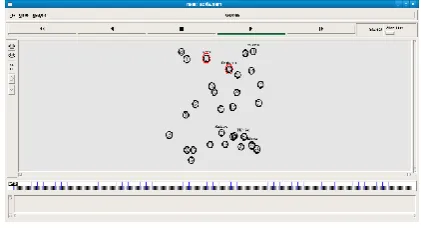
Figure 2. Network Model
5.2 Cluster Head Selection: Cluster Heads trust assessment is implemented in the work by CH-to-CH assessment, BS-to-CH assessment and input from 1-bounce neighbors of CH with a specific end goal to maintain a strategic distance from noxious CHs in WSNs suggested by Hao et al., (2014). Intuitive trust and trustworthiness trust are registered by BS-to-CH and input from 1-jump neighbors of CHs, while content trust is assessed by BS-to-CH assessment through the vicinity between the combination information. The information transmission conventions for WSNs, inclu-ding group-based conventions (LEACH-like conven-tions), are defenseless against various security assaults In Clustering, each group speaks to a work organ-ize where every hub in a bunch must be situated inside the correspondence scope of every other hub in a simi-lar group. Hosting services are provided for hosting the virtual servers in order to utilize the resources from the physical web servers (Rajesh kumar. et al., 2017) Every sensor hub picks an arbitrary number, temp, in the vicinity of 0 and 1 and the number is then contra-sted and edge esteem, T (n), which relies upon different parameters given underneath. In the event that the arbitrary number is not as much as limit esteem, at that point that hub turns into the bunch set out toward current round.
responsible for social affair the detected information from the sensor hubs in the group.
The CHs assembles the information and pack and advances it to the base station (sink). Each hub utilizes the stochastic calculation to discover the CH and limit esteem is figured. _ Here, p is the coveted level of CH, r means the tally of present round, and G is the gathering of sensor hubs that are not CHs in the past 1/p rounds.
Figure 3. Cluster Head Selection
The threshold value is calculated based on the following equation,
𝑘(𝑠) =
(
𝑝
1 − 𝑝 (𝑟 𝑚𝑜𝑑1𝑝)
0 𝑜𝑡ℎ𝑒𝑟𝑤𝑖𝑠𝑒)
𝑖𝑓 𝑠 ∈ 𝐺
Here, p is the desired percentage of CH, r denotes the count of present round, and G is the group of sensor nodes that are not CHs in the previous 1/p rounds.
An initial population was randomly generated.
Figure 4. False Positive Rate
5.3 Ids Node Identification Based on Kalman Filter The Kalman channel is an arrangement of recur-sive scientific conditions giving an approach to appra-ise a dynamic framework's present state. To ease intro-duction, a mono-dimensional framework with state spoke to by vector and administered by Eq. (i.e.)
𝑥𝑡+1= 𝑥𝑡+ 𝑣𝑡 𝑡 = 1,2 … . (1)
Condition of framework at time t+1 relies upon condition of framework at time t and an arbitrary pro-cedure commotion term. Mentioning occasional object-tive facts _ of framework, so that in Eq. (2)
𝑦𝑡= 𝑥𝑡+ 𝑤𝑡, 𝑡 = 1,2 … … . (2)
Perceptions rely upon current framework state and an irregular estimation commotion term Wt. Singular trust lit levels, a solitary esteem, that communicates a
hub's general dependability level is registered by making utilities from singular characteristics in Eq. (3)
𝑇𝑠,𝑡=
∑𝑛𝑖=1𝑤𝑖× 𝑙𝑖𝑡
∑𝑛𝑖=1𝑤𝑖
= ∑ 𝑤𝑖× (1 − 𝑥𝑖𝑡)
𝑛 𝑖=1
∑𝑛𝑖=1𝑤𝑖
(3)
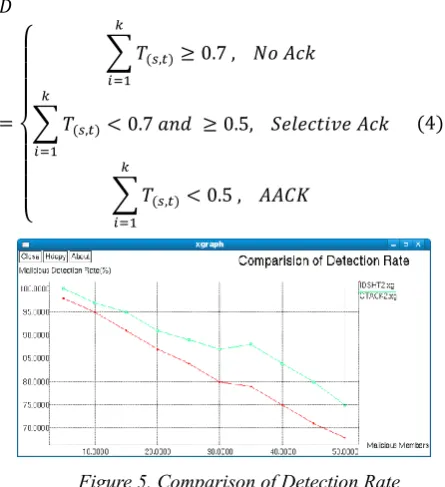
A planning window component is depended on appraise the trust levels as given by Zhihua Zhang et al., (2017). Source hub S conveys Packet 1 without overhead but to be of banner demonstrating parcel write. Middle of the road hubs forward this bundle. At the point when goal hub D gets Packet 1, it sends an ACK affirmation bundle to source hub S along a similar course backward. Inside a predefined time, if source hub S gets ACK affirmation parcel, at that point bundle transmission from hub S to D is fruitful. Or there will be consequences, source hub S changes to CTACK plot conveying a CTACK bundle. Henceforth, the proposed trust AACK recognizes malignant hubs and diminishes organize overhead. In CTACK, the AACK parcel is sent in light of put stock in condition in Eq. (4)
𝐷
=
{
∑ 𝑇(𝑠,𝑡)≥ 0.7 , 𝑁𝑜 𝐴𝑐𝑘 𝑘
𝑖=1
∑ 𝑇(𝑠,𝑡)< 0.7 𝑎𝑛𝑑 ≥ 0.5, 𝑆𝑒𝑙𝑒𝑐𝑡𝑖𝑣𝑒 𝐴𝑐𝑘 𝑘
𝑖=1
∑ 𝑇(𝑠,𝑡)< 0.5 , 𝐴𝐴𝐶𝐾 𝑘
𝑖=1
(4)
Figure 5. Comparison of Detection Rate
If the hubs are exceedingly dependable over the whole way, then AACK isn't sent diminishing control parcel overheads.
On account of medium trust, AACK is sent aimlessly succession to guarantee that parcels are not disturbed along the way. On the off chance that the course trust is low then AACK is used. The course measurements utilize the put stock in an incentive to choose the way.
5.4 Routing Message: The directing convention in WSN incorporates the disadvantages and insufficien-cies of other approaches that was suggested by Bao et al., (2012), which is handled as far as neighborhood disclosure and course remaking/support stage. The con-vention can take focal points of both responsive and proactive conventions.
association with D by performing Route Discovery. At that point, the goal D performs Route Selection by picking the ideal course in light of potential steering measurements. At the succeeding obtainable memory location, the arriving sensory data would be stowed, and indeed might be stockpiled superfluously at numer-ous bare locations (Rajesh kumar.T., et.al., 2016). 6. CONCLUSION AND FUTURE ENHANCE-MENT: The proposed bunch trust based acknowledge-ment (CTACK) Intrusion-Detection System and Kal-man filter is used to detect the malicious node.
In CTACK the whole course based trust quality for multi bounce sensor systems is returned to hubs going about as Security Agent. In view of trust estimation of whole course, Acknowledgment is started on select bundles to diminish control overhead. It is watched that the bundle conveyance proportion for the proposed CTACK strategy enhances notwithstanding when pern-icious hubs are available, the proposed method CTACK can recognize noxious hubs and maintain a strategic distance from them in the course disclosure process.
Later on, works, the investigation of the vitality protection in portable intellectual radio system utilizing our group based directing convention component to decrease stacking of systems, vitality preservation and increment lifetime of hubs and systems will be executed.
7. REFERENCES
Dhakne D. and P. Chatur, Distributed trust-based intrusion detection approach in wireless sensor network, Proc. IEEE Int. Conf. Commun. Control Intell. Syst., Nov. Pp. 96101 (2015)
He, D., C. Chen, S. Chan, J. Bu and A.V. Vasilakos, Re Trust: Attack-resistent and lightweight trust mana-gement for medical sensor networks,” IEEE Trans. Inf. Technol. Biomed. 16(4): 623-632 (2012) Bao, F., I.-R. Chen, M. Chang and J. Cho, Hierarchical
trust management for wireless sensor networks and its applications to trust-based routing and intrusion detection.' IEEE Trans. Netw. Service Manage 9 (2): 169-183 (2012)
Hao, F., G. Min, M. Lin, C. Luo and L.Yang, Mobi Fuzzy Trust: An efficient fuzzy trus inference mec-hanism in mobile social networks. IEEE Trans. Parallel Distrib. Syst. 25(11): 2944-2955 (2014) Bao, F., I.R. Chem, M. Chang and J. Cho, Hierarchical
trust management for wireless sensor networks and its applications to trust-based routing and intrusion detection. IEEE Trans. Netw. Service Manage 9 (2): 169-183 (2012)
Han, G., J. Jiang, L. Shu and M. Guizani, An attack-resistant trust model based on multidimensional trust matrics in under water acoustics sensor network. IEEE Trans. Mobile Comput. 14(12): 2447-2459 (2015)
Butun, I., S.D. Morgera and R. Sankar, A survey of intrusion detection systems in wireless sensor net-works. IEEE Commun. Surveys Tuts. 16(1): 234-241 (2014)
Onat I. and A. Miri, An intrusion detection system for wireless sensor networks, Proc. IEEE Int. Conf. Wireless Mobile Comput. Netw. Commun. Aug. Pp. 253- 259 (2005)
Rajesh kumar, T. and K. Geetha, A Perspective Appro-ach on Artificial Cognitive Computing and its Future Development. International Journal of Innovative Research in Computer and Communi-cation Engineering 4(11): 2016,
Rajesh kumar, T. and K. Geetha, An Artificial Techni-que Based Approach for Channel Selection and Classification of Electroencephalogram Signals. International Journal of Printing, Packaging & Allied Sciences 5(1): (2017).
Rajesh kumar, T., K. Geetha, R. Satheesh and N.S. Barkath, MRI Brain Image Segmentation using Fuzzy C Means Cluster Algorithm for Tumor Area Measurement. International Journal of Engineering Technology Science and Research 4(9): 929-935 (2017)
Rajesh kumar, T., S. Preethi, R. Siva Rubini and V. Yamini, speed detecting and reporting system using GPS/GPRS AND GSM. International Jour-nal of Pure and Applied Mathematics 118(20): 73-79 (2018)
Rajesh kumar, T., G. Remmiya devi, K. Abinaya, N.N. Deepika and S. Priyadharshini, An Integrated Density Based Traffic Load Balancing System in A Cloud Environment. Pak. J. Biotechnol. 14(4) 623-627 (2017).
Ganeriwal S. and M. Srivastava, Reputation-based framework for high integrity sensor networks. ACM Trans. Sensor Netw. 4(4): 66-77 (2004) Yu, Y., K. Li, W. Zhou, and P. Li, Trust mechanisms in
wireless sensor networks: Attack analysis and countermeasures. J. Netw. Comput. Appl. 35(3): 867880 (2012).