Asian Journal of Pharmaceutical Research and Development
(An International Peer-Reviewed Journal of Pharmaceutical Research and Development)www.ajprd.com
ISSN 2320-4850
Research Article
FORMULATION DEVELOPMENT AND EVALUATION OF
ARIPIPRAZOLE-IR TABLETS BY USING DIFFERENT STARCH
DERIVATIVE DISINTEGRANTS.
P.Sireesha*, N.Lal Mahammed, K.Narendra Kumar Reddy
Department of Pharmaceutics,Vikas Group of Institutions,Nunna,Vijayawada Rural-521212, Andhra Pradesh, India.
Received: April 2014 Revised and Accepted: May 2014
ABSTRACT:
Aripiprazole used as anti-psychotic drug therapy in the form of immediate release tablet. This paper represents the disintegrants like starch, pre-gelatinated starch and corn starch which were used as suitable disintegrants for drug release. The investigation of drug release profile in the formulation of immediate release tablet with manufacturing includes the use of wet granulation processes. In this work the Characteristic study of drug release from immediate release tablets by taking 8 different formulations. It was obtained that disintegrants like starch, pre-gelatinated starch and corn starch formulations were shown comparable results with innovator.There was no more significant impact on physical properties of the formulations by interchanging starch, pre-gelatinated starch and corn starch. But higher percentage of drug release was observed when the formulation contained corn starh(f4) compared to other formulations. From this study it concluded that formulation(f4) which contained corn starch as disintegrant showed similar dissolution profile with innovator.
Key words: Aripiprazole,corn starch, pregelatinated starch, starch,wet granulation.
INTRODUCTION:
ripiprazole is an atypical III generation antipsychotic and antidepressant used in the treatment of schizophrenia, bipolar disorder, and clinical depression. It was approved by the US Food and Drug Administration (FDA) for schizophrenia . Aripiprazole is also a partial agonist at the 5-HT1A receptor and like the other atypical antipsychotics displays an antagonist profile at the 5-HT2A receptor. Tablet is the most popular among all dosage forms existing today because of its convenience of self administration, compactness and ease of manufacturing; however in many cases immediate onset of action is required than conventional therapy.
*Corresponding Author:
P.Sireesha.
Department of Pharmaceutics, Vikas Group Of Institutions,
Nunna,Vijayawada Rural-Andhra Pradesh(India).
Mob:+91-9676674077.
To overcome these drawbacks, immediate release pharmaceutical dosage form has emerged as alternative oral dosage forms. There are novel types of dosage forms that act very quickly after administration. Immediate release (IR) tablets are a better choice for drugs which need to elicit their action in a short duration. In contrast to conventional tablets IR tablets are intended to disintegrate in the stomach in less than three minutes and must release 85% or more of stated amount of drug with in 30 min.Anti psychotics are used to treat schizophrenia. Immediate release tablet/disintegrating tablets are a perfect fit to take dose of an antipsychotic easily.IR formulation of an antipsychotics drug can have several advantages like quick onset of action, increased bioavailability, reduced dose, minimal side effects etc; over conventional tablets. Immediate release tablets (IR) have received ever-increasing demand during the last decade and the field has become a rapidly growing area in the pharmaceutical
easly disintegrate and the drug will be released in 2-3min. The main objective of this work is to formulate an immediate release oral solid dosage form of aripiprazole which is considered to be stable and pharmaceutically equivalent to that of the reference [marketed] product for the treatment of schizophrenia disease.
To achieve this goal various trials are to be taken and evaluated with respect to the various quality parameters such as dissolution and related studies. The objectives of the present study are to design, optimize and evaluate immediate release tablets of antipsychotic drug.
MATERIALS AND METHODS:
Materials:
Aripiprazole (Hetero labs limited(unit-I)), Lactose monohydrate, ph.Eur (HMS Impalable)#Corn starch, USP/NP(extra white maize),Starch-1500,Pregelatinised Starch, ph.Eur(Extra white maize),Cellulose, microcrystalline, ph.eur(Avicel PH101) Hydroxypropyl cellulose,ph.Eur(Klucel EXF),Purified water, IHS/USP/Ph.Eur,Purified water, Cellulose microcrystalline, Ph.eur(avicel PH 112)Magnesium stearate, Ph.Eur.All other reagents and chemicals were of analytical grade.
METHODS:
For the following study we are taken Aripiprazole which is an antipsychoyic third generation drug. In this study first we did preformulation studies.
Preformulation Studies:
In this preformulation studies we studied about the API characterization,Drug - Excipient Compatibility Studies, Analytical Method Development and Pre-compression parameters.
API Characterization: It is necessary to study the physicochemical properties of the bulk drug like physical appearance, solubility, melting point, particle size and compatibility.
Drug - Excipient Compatibility Studies: The compatibility studies provide the framework for the drugs combination with excipients in the fabrication of the dosage form. Basically two methods were followed. Here we followed FT-IR Spectrophotometric Method. It is performed by KBr pellet method [6,7].
Analytical Method Development: Analytical method development is studied for knowing about the purity of the drug [8]. It is carried out by two methods.
HPLC or U.V. Here we are followed U.V method.
Pre-compression parameters: Before going to formulation we need to study pre compression parameters like Angle of Repose, Bulk density, Tapped density, Compressibility index, Hausner ratio and Sieveanalysis.
Then we went for the formulation development…
Formulation Development and Evaluation:
For this study we developed 8 formulations by using different disintegrants. The following table shown
the formulation development for the present study.
Table I: Formulation development of aripiprazole
s.no Ingredients(mg) F1 F2 F3 F4 F5 F6 F7 F8
1 Aripiprazole, IH 10 10 10 10 10 10 10 10
2 Lactose monohydrate, USP/NF(HMSimpalpable)
68.24 68.24 68.24 68.24 72.24 73.24 66.24 63.24
3 Cornstarch, USP/NP(extra white maize)
- - - 10.0 8.0 9.0 12.0 15.0
4 Starch-1500 9.0 10.0 - - - -
5 Pregelatinised Starch - - 10.0 - - - - - 6 Microcrystalline cellulose,
USP/NF(avicel ph101)
8.5 8.5 8.5 8.5 8.5 8.5 8.5 8.5
7 Ferricoxide,USP/NF(sicovit red 30E172)
0.06 0.06 0.06 0.06 0.06 0.06 0.06 0.06
8 Hydroxypropyl cellulose, (binder)USP/NF(klucelEX)
2.0 1.0 1.0 1.0 1.0 1.0 1.0 1.0
9 Purified water, HIS/Ph.Eur/USP 12.0 12.0 12.0 12.0 12.0 12.0 12.0 12.0
After completion of the formulation development we did the manufacturing of the tablets. For the preparation of the tablets we are selected wet granulation method. After completion of compression of the tablets we need to study the evaluation parameters of the prepared tablets.
Evaluation Parameters:
The following test were done for the evaluation of the tablets.like Physical appearance,Weight variation test,Hardness,Thickness,Percentage Friability,Disintegration time, Assay by HPLC and Dissolution.
Assay by HPLC:
Chemicals & Reagents used in the assay:
Orthophosphoric acid : AR grad Methanol : HPLC grade
Acetonitrile : HPLC grade Water : Milli-Q grade
The Chromatographic Conditions are..
(i)Column:inertsil ODS-3V, 150×4.6mm; 5µm or equivalent.
(ii)Detection:UV, 215nm. (iii)Flow rate : 1.5mL/minute. (iv)Column temp : 400c. (v) Injection volume : 10µl. (vi)Run time:15 minutes.
Dissolution:
Chemicals & reagents used for the dissolution;
(i)Hydrochloric acid: AR grade. (ii)Potassium chloride: AR grade. (iii)Triethylamine: AR grade. (iv)Orthophosphoric acid :AR grade. (v) Acetonitril : HPLC grade . (vi)Methanol : HPLC grade
(vii)Water: HPLC grade
Dissolution parameters are….
(i)Medium : pH 1.2 buffer. (ii)Volume: 900 ml.
(iii)Apparatus :paddle.Speed:60rpm. (iv)Temp : 37.0 ± 0.50c
Sampling time :
(i)For single point : 30mintues. (ii)For profile : 10,20,30,&45 mintues.
Chromatographic conditions are…
(i) Column : inertsil ODS-3 ;250 X 4.6 MM,5µm or equilent.
(ii) Flow rate : 1.0mL/minute. (iii) Detection:UV,215nm. (iv) Colum temperature: 400c. (v) Injection volume: 20µ L. (vi) Run time: 10 mintues.
After completion of the in-vitro evaluation, tablets were subjected to the Accelerated stability studies.Finally we concluded that formulation 4 which contain corn starch shown better results than other formulations.
RESULTS:
Pre-Formulation Studies: Api Characterization:
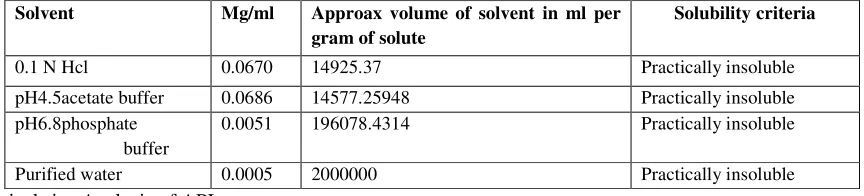
Appearance:Aripiprazole is a white to half weight crystalline solid. Based on the above inferences the drug ARIPIPRAZOLE was determined to be practically soluble in0.1 N Hcl, pH 4.5 acetate buffer, pH 6.8 phosphate buffer, Purified water. Solubility: Based on the below inferences the drug ARIPIPRAZOLE was determined to be practically soluble in0.1 N Hcl, pH 4.5 acetate buffer, pH 6.8 phosphate buffer, Purified water.
Table II: Solubility of Aripiprazole
Solvent Mg/ml Approax volume of solvent in ml per gram of solute
Solubility criteria
0.1 N Hcl 0.0670 14925.37 Practically insoluble
pH4.5acetate buffer 0.0686 14577.25948 Practically insoluble
pH6.8phosphate buffer
0.0051 196078.4314 Practically insoluble
Purified water 0.0005 2000000 Practically insoluble
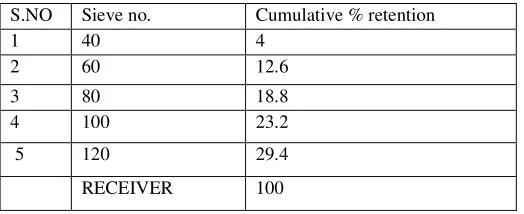
S.NO Sieve no. Cumulative % retention
1 40 4
2 60 12.6
3 80 18.8
4 100 23.2
5 120 29.4
RECEIVER 100
Drug-Excipients Compatability Studies: Physical Compatibility:
Table IV: Physical Compatibility Results
Material
Sample Status After 1 month, kept at Accelerated40oC±2oC/75% RH ±5% RH
Sample Status After 1 month, kept at 25ºC ± 2ºC /60%RH ± 5% RH
Aripiprazole+microcrystalline No Change No Change
Aripiprazole+HPC No Change No Change
Aripiprazole+cornstarch No Change No Change
Aripiprazole+magnesiumstearate No Change No Change
Result:
Above study states that there was not any type of color change or lumps were formed.
Analytical Method Development:
Table V: Standard graph of Aripiprazole
Sl. No Concentration (µg/ml) Absorbance
1 0.00 0.00
2 2.00 0.307
3 4.00 0.616
4 6.00 0.900
5 8.00 1.247
6 10.00 1.544
FTIR-Reports:
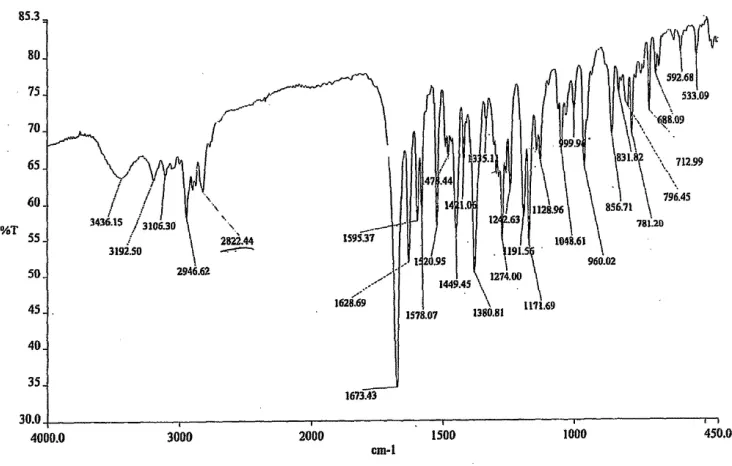
Figure 2: FTIR of Formul Atiom 8-Drug+ Excipient
Precompression Parameters Results of Granules:
Flow properties:
Table VI: Flow properties
s.no Blend characterization data
Parameters F1 F2 F3 F4 F5 F6 F7 F8
1 Bulkdensity (gm/ml)
0.5912 0.5913 0.5918 0.5915 0.5912 0.5915 0.5912 0.5915
2 Tapdensity (gm/ml)
0.7422 0.7425 0.7424 0.7425 0.7422 0.7425 0.7422 0.7425
3 Compressibility Index (%)
20.334 20.334 20.334 20.336 20.334 20.336 20.334 20.336
4 Angle of repose 25.590 25.590 25.590 25.594 25.590 25.594 25.590 25.594
5 Haursner ratio 1.25541 1.2557 1.2544 1.2552 1.2554 1.2552 1.2554 1.2552
The formulated granules were characterized with respect to Angle of repose, bulk density and tapped density. Angle of repose of API was found to be 250-260, thus indicating that the flow properties were Excellent.Hausner’s ratio was more than 1.25 for all the batches indicating Fair Passable flow properties.Compressibility index was 20%-21% for all the batches indicating Fair-Passable flow properties.
Sieve Analysis:
Formulation-Results:
Table VII: Characteristics of Optimized Formulation:
S.NO Formulation code
Hardness of tablets(KP)
Thickness
of tablets
(mm)
Friability (%)
Average wt(mg)
Disintegration time (min)
1 F1 4.52 2.50 0.063 95 2.5
2 F2 4.55 2.52 0.070 95.5 1.5
3 F3 4.32 2.50 0.052 95.2 2
4 F4 4.20 2.50 0.055 95 2.2
5 F5 4.10 2.53 0.059 95.2 2.5
6 F6 4.25 2.55 0.066 95 2.8
7 F7 4.2 2.52 0.063 95.2 3.5
8 F8 4.2 2.52 0.070 95 3.8
i)Hardness of each formulation was analysed for formulations F1 to F8 and all formulations were found to have good hardness. So they were taken for further studies to measure hardness of tablets of each batch range between 4.2to4.5 kp .
ii)Tablets mean thickness were almost uniform in all formulations and were found to be in the range of 2.50to 2.55 mm.
iii)The total weight of each formulation was not
maintained constant however the weight
variation of the tablet was within the limits of 0.5% .iv)All the tablets passed the pharmacopoeial specifications for the disintegration of uncoated tablets within 2.0-3.0. Formulations containing starch1500 (lycotab-c) 5% shows rapid disintegration when compared with the other formulations. The disintegration time of F1to F8 were found to have equivalent time with that of innovator product.
Assay by HPLC:
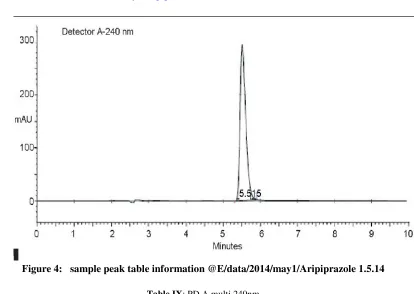
HPLC Report
Sample information@E/data/2014/may1/aripiprazole 1.5.124
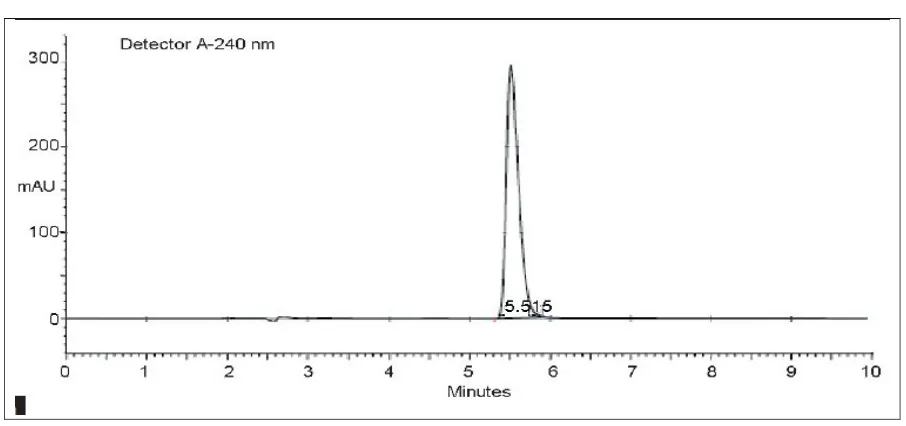
Figure 3: standard peak table information@E/data/2014/may1/aripiprazole 1.5.14
Peak Name Ret.time Theoretical plates Tailing factor
1 aripiprazole 5.151 3000 1.12
HPLC Report
Sample information@E/data/2014/may1/aripiprazole 1.5.14
Figure 4: sample peak table information @E/data/2014/may1/Aripiprazole 1.5.14
Table IX: PD A multi 240nm
Peak Name Ret.time Area Area
1 aripiprazole 5.151 8877654 100%
Total 8877654
Dissolution Profile of Aripiprazole Tablets:
Table X : Dissolution profile of Aripiprazole Formulations
BATCH
Cumulative % of Drug release TIME (min)
0 10 20 30 45
INNOVATOR
0 86 93 94 95
F1 0 83 90 92 92
F2 0 82 89 91 92
F3 0 82 87 92 93
F4 0 84 92 94 94
F5 0 83 90 92 94
F6 0 83 91 92 93
F7 0 81 90 91 93
Figure 5: Dissolution profile of Innovator, F1-F8batches
Invitro dissolution studies of formulations F1-F8 were carried out PH 1.2 buffer medium and percentage of drug release was calculated. All the formulations were kept for 45mins. It was found that all the formulations met the limits( NLT 90% in 30min ).The dissolution profile of each formulation was compared with that of the innovator product and found the formulation F4
had approximate values of percentage drug release with that of innovator.
Accelerated Stability Studies:
Aripiprazole 10mg tablets were evaluated for accelerated stability studies at 20-250C / 75 % RH condition. The stability details / results are presented as below.Storage Condition: 20-250C / 75 % RH Pack: HDPE Container
Storage Period: 1 month and 2 months.
Table XI:Summary of Accelerated Stability Studies:
The stability studies on aripiprazole IR tablets in HDPE container at 20-250C / 60 % RH for 2 months were conducted as per ICH protocol. After the specified time period (1 month and 2 months), the samples were unloaded from the stability chambers and were tested for any physical or chemical changes. Also the tests for dissolution and assay were conducted to assess the stability of
product. The results for dissolution and assay are summarised below.
Dissolution: No significant change was observed in the percentage drug dissolved after a storage period of 1 month at 4o±20C / 75 % RH and 2 months at 20-250C / 60 % RH for aripiprazole IR tablets.
Assay:No significant change was observed in the assay value ofaripiprazole IR tablets, after a
S.no Test Specifications Initial After1
month
After2 months
1 Description Light pink to pink,modified rectangular, bevel edged binconvex tablets
Complies Complies Complies
2 Identification The retention time of major peak in the chromatogram of the assay preparation corresponds to that in the chromatogram of the standard preparation as obtained in the assay.
Complies Complies Complies
3 Dissolution NLT 75% release after 30min 94% 93.8% 93.7%
4 Related Substances
(%) NMT 0.30%w/w Complies Complies Complies
storage period of 1 month at 40±20C / 75 % RH and 2 months at 20-250C / 60 % RH. Inference:
From the above data it was evident that there was no significant change in the physical and chemical parameters of aripiprazole IR tablets during the stability studies conducted at 40±2°C & 75%RH for1 month period and 2 months at 20-25°C & 60%RH.
DISCUSSION:
The prepared tablets were checked for assay as per IP specifications. All the formulations passed the test and the percentage of active ingredient ranges from 96 to 99.8%. In preformulation study API characterization is done[Table2,3,4], drug and excipient blends are subjected to compatibility studies[Table5]. From the FT-IR reports, it is found that there is no incompatibility [Fig 1, 2]. Physical compatibility is also tested by subjecting the blend to various storage conditions and it is found that the blend is stable. The blend was compressed into tablets and were analysed for the parameters such as average weight, disintegration, friability, thickness and hardness.
All formulations shows satisfactory values compared to innovator product But the dissolution profile of F4 have equivalent profile that of innovator as compared to other formulations and concluded that F4 is better and similar to innovator product. Because other formulations have low drug release profile on dissolution compared to innovator product[Fig 5]. The F4 formulation has been subjected to stability studies according to ICH guidelines. This formulation is found to be stable for 2months.
CONCLUSION:
The present study concluded that aripiprazole 10mg tablets have been formulated and developed by using wet granulation technique. In order to obtain best optimised product, 8 different formulations were developed. For 8 formulations
the different physical properties showed best comparable with reference product. But higher percentage of drug release was observed when the formulation contained corn starch when compared with formulations contained starch and Pregelatinised starch. The formulation F4 has shown drug release NLT 94% in 45min accordance with the USP dissolution criteria for IR aripiprazole tablet formulation. The results suggest that formulation with corn starch showed similar dissolution profile with innovator drug.
ACKNOWLEDGEMENTS:
The Authors are thankful to Mr.K.Narendra
Kumar Reddy,Principal-depaerment of
pharmacy,vikas group of
institutions,nunna,Vijayawada rural, Krishna dt. For providing necessary facilities and for his support to carry out this Research Project.
REFERENCES:
1. Lee TWY, Robinson JR., 20th ed, 2000. Remington: The Science and Practice of Pharmacy, Lippincott Williams and Wilkins, Maryland, 1069-70.
2. Loyd V. Allen J, Nicholas G. Popovich, Howard C. Ansel, 8th ed, 2006. Ansel: Pharmaceutical dosage forms and drug delivery system, Lippincott Williams and Wilkins, Philadelphia, 260-275.
3. Saptarshi D, Mukul S., Modified release dosage form and drug delivery. Journal of Pharm Research, 2009. 2(11):1728-29.
4. Zak. T., Chowhan. T., ‘’Tablet ingredients” Problem Solver, 3(7), 2002, 31-40.
5. LoydAllen.V., Nicholas.,Popo vich. G.,Howard AnselC., ‘Ansel’s Pharmaceutical Dosage Forms and Drug Delivery System’. 8th edition., 233.
6. Sameer. GL.,2008. ‘Effects of disintegration promoting agent, lubricants and moisture treatment on optimized fast disintegrating tablets, Int J pharm., 08.
7. Schreiner.T., 2005‘Immediate drug release from solid oral dosage forms’., J Pharm Sci., 94:120-133.