GSJ© 2019
GSJ: Volume 7, Issue 8, August 2019, Online: ISSN 2320-9186
www.globalscientificjournal.com
INFLUENCE
OF
HUMAN
RESOURCE
DEVELOPMENT
AND
ICT
POLICY
ON
ORGANIZATIONAL
PERFORMANCE
OF
TELECOMMUNICATIONS
SERVICE
PROVIDERS
IN
KENYA:
A
CASE
STUDY
OF
UNITEL
SERVICES
LIMITED
Denis Radonji a
,
James Mwikya Reubenba
Management University of Africa, P.O Box 29677-00100, Nairobi Kenya
b Management University of Africa, P.O Box 29677-00100 Nairobi Kenya
a
b
[email protected]
Abstract
The success of any introduced ICT to the achievement of organisational objectives is highly dependent on the
Human Resource development to match of the staff. The study seeks to determine the Influence of Human Resource
development and ICT policy on organizational performance of Telecommunications Service Providers in Kenya: a
case study of UNITEL services limited. The specific objectives were to determine the influence of Human Resource
Development in ICT on organizational performance, determine the impact of ICT policy on organizational
performance. A descriptive survey study design was used and stratified sampling technique applied. Data was
collected quantitatively from UNITELservices limited staff using a questionnaire. A total of 40 staff was sampled
with 33 questionnaires successfully being returned. Descriptive analysis was conducted on the data using Statistical
Package for the Social Sciences (SPSS) Version 22. The results findings established that on ICT Human Resource
Development, above 48% of the respondents strongly agree that ICT good knowledge, experience in ICT, Adoption
of new technology and induction of new employees enhances productivity. On ICT policy and organisation
performance it was found that only 37.9 % of the respondents agreed that ICT policy has a positive correlation on
the performance of the organization.This implies that may be most of the UNUTEL staff are not aware of the ICT
policies governing their organization. The study recommends that The organization should come up with some
periodic in-service, seminars to update the staff on the current changes in ICT field and remain competitive and
have a competitive advantage over its competitors in the same field. The company ICT policy should be improved
and staff trained on its contents.
Key words: ICT; Human Resource Development; Policy; Performance; UNITEL
INTRODUCTION
1.0 Background of the study
In the current unpredictable work setting, managers are partaking in various ways that aimed toward boosting performance at the individual, cluster and structure levels (Wright and McMahan, 2011). Since many organizations are faced with the demanding need to attract and retain talented workforce, while at the same time handle the work life contentions, the management of these organizations need to apply good HR management practices to achieve their goals (McLean and Collins, 2011). Owing to several factors, organizations therefore, will do everything possible to keep those foremost effective employees on favorable terms as the market demands (Boxall, and Bartram, 2011). Prudent managers thrive to achieve effectiveness and efficiency that translates in higher organizational performance levels (Ployhart and Moliterno, 2011). As a result, many organizations are currently initiating ICT resolution strategies that aim at achieving greater commitment, higher employee satisfaction with considerably higher performance expectations of staff.
1.1 UNITEL Limited Organizational Structure
GSJ© 2019 1.2 Problem statement
Effective adoption and appropriate implementation of Information and Communication Technology (ICT) is an important aspect that an organization can use to enhance its communication with those working within the setup to achieve organizational goals. However, most of the organizations do not make effective and efficient use of ICT in the delivery of their services and or products (McLean and Collins, 2011). A major problem lies in the inefficient and selective adoption, implementation, the application of the technology and staff training level on the ICT applications in the organization. The success of any introduced ICT to the achievement of organisational objectives is highly dependent on the Human Resource development to match of the staff. It is on this basis that the study seeks to determine the Influence of Human Resource development and ICT policy on organizational performance of Telecommunications Service Providers in Kenya: a case study of UNITEL services limited. In particular, the study will establish the influence of Human Resource development on ICT skills and competency, ICT policy for the organization, financial management and organization working culture on organizational performance.
1.3 General objective
The general objective of the study will be to determine Influence of Human Resource development and ICT policy on organizational performance of Telecommunications Service Providers in Kenya: a case study of UNITEL services limited
1.3.1Specific objectives
Specifically, the study will seek to;
i. To determine the influence of Human Resource Development in ICT on organizational performance of Telecommunications Service providers in Kenya at UNITEL services limited. ii. To determine the impact of ICT policy on organizational performance of Telecommunications
Service providers in Kenya at UNITEL services limited.
1.4 Research questions
i. How does Human Resource Development in ICT influence organizational performance of Telecommunications Service providers in Kenya at UNITEL services limited?
ii. What is the impact of ICT policy on organizational performance of Telecommunications Service providers in Kenya at UNITEL services limited?
2.0.1 Technology Acceptance Model (TAM)
This theory tries to clarify the technology and its aspects as received, adopted and applied by the user. consistent with (Fred Davis) argued that the acceptance of a brand new technology is predicated on how the user perceived its quality, that is how the technology will improve the performance or the potency on the individual worker and general performance of the organization, and also the simple use of the technology, its options and application on to day to day tasks undertaken user. an employee’s perception on a freshly introduced technology among a geographical point can verify the employee’s perspective towards exploitation the technology and this may influence the behavioral significance to use the technology that successively will influence the particular acceptance of the technology. TAM assumes that once one forms an intention to act, that he or she is going to be liberal to act without limitation. It was observed that barriers like restricted notions and how the individual perceive ICT limits and unconscious behavior can limit the freedom to act, Davis (1989). Jeyaraj et al. (2006) reviewed the empirical studies specializing in the writing of variable touching the adoption of ICT. Venkas et al. (2003) reviewed user acceptance literature and mentioned the eight models so as to push a unified theory of the acceptance and use of technology. The Technology Acceptance Model above all has invited several reviews. Lee et al. (2003) created analysis and survey on TAM studies. They targeted on the progress, limitation, and also the future direction of cap. Legris et al., did analysis specializing in the progressive development of TAM and self-addressed the strength and also the limitation of the model. From the finding on TAM it is recommended that organizations to comply and remain committed on the implementation of ICT in order to be competitive hence competitive advantage over their competitors. Malhotra and Mukherjee (2004) found that organizations that are dedicated to the utilization of ICT as a vital facet to service quality. Steer and Porter (1983) printed organization commitment as a result of the shut relationship of members inside the organization and includes behavior that is harmonic with the firm’s values and culture of showing unity, disposition and motivation to undertake to organization activities on.
GSJ© 2019
predicting how users will accept the changes brought by new technological development. Acceptance has been conceptualized as an outcome variable in an exceedingly psychological means that users bear in creating choices concerning technology. During this literature, there is very little or no stress placed on the planning of usable interfaces to researchers during this space, the system style (including the computer program and therefore the tasks supported) square measure, for sensible functions, fixed. Instead, this analysis seeks to grasp the dynamics of human deciding within the context of exceptive or resisting technology. The bulk of this work comes from the sphere of Management Information Systems (MIS), where analysis seeks to predict whether users in a corporation can accept and appreciate the new technologies. Based on the opinion of the psychologists involved with human activity, this analysis offers how behavioral attitude of the user impacts on the acceptance issue of technology utilization.
2.0.2 Innovation Diffusion Theory and Information Technology
Diffusion theory of innovation was developed by E.M. Rodgers in 1962. The theory originated in communication to explain how over a time, a concept picks up and spreads out through a specific population or social system. What is then achieved by diffusion is that people as part of the social system, adopt new idea, behaviour, product of the information technology in the system of the organization. Innovation is the process of creating a new technology, device or the procedure (Roger,2003) diffusion is the process of spreading ideas, concepts, skills, and knowledge through the society. The Innovation Diffusion Theory (IDT) describes how innovations or technology become accepted and spread through societies large or small (Roger, 2003). In IDT the process of choosing to use a technology is known as the innovation-decision process. Through this process a person passes from gaining knowledge about the innovation to forming an attitude about the innovation (Demir, 2006). Once an attitude is formed an individual has the choice on what action to take on the innovation implementation. If he/she accepts the innovation, the person implements the innovation and proceeds to confirm their decision. The entire process occurs in five stages, the first being called the Knowledge stage, the second stage is persuasion stage, stage three is decision stage, and the final state is the confirmation stage at the stage the new adopter looks for support regarding the decision (Demir, 2006). Notably perceived usefulness in TAM is similar to relative advantage in IDT and perceived ease of use is much like complexity in IDT (Tung, Lee, Chen & Hsu, 2009).
2.0.3 Information Systems Success Model
into six prime groups that are based on quality of the system and information, the impact and level of satisfaction of the user, and how it influences changes in the organizational.
2.1 Empirical literature review.
2.1.1 Human Resource Development in ICT on organizational performance.
According to Ruel (2008) Information communication technology has become something that is indispensable part of the contemporary world while human resource management globally affected in a number of ways through the adoption of ICT and its application in e-HRM and e-commerce in the business world. The introduction and implementation of ICT in human resource department is a multiplex issue and the need for the implementation and the effect of the technology differ organization to organization culture and nature of human resource management strategies and of the technology. Wachira (2010) in his research study concluded that HRM in Africa should be concerned with the application of internet and web based systems and increasing mobile technologies to change their mode of interplay among HR staff, line mangers and the employees to enhance effective and efficient communication. However, the introduction of information technology to human resource management departments has posited a potential improvement in the speed and efficiency of processes, cost savings, improved customer satisfaction, increased accuracy of data, improved transparency and consistency of processes, increased accessibility of information and the facilitation of a change in the human resource function of the mangers. Human Resource managers need to be aware that the change in technology will not only increase the quality of employee information, but also will have a strong result on the overall effectiveness of the organization (Shammy Shiri, 2012). Information Communication Technology (ICT) is a term associated with mobile communication, internet, and new media which allows organizations to aim higher success in their approach to internal procedures, strengths and benchmark their performance to the global market competition. Information Communication Technology is spreading throughout every sector of the economy and has implications for almost every enterprise (Helfen& Kruger, 2002).
GSJ© 2019 2.1.2 Impact of ICT Policy on organizational performance
A good ICT policy is essential for efficient managerial and operations in both public and private sectors. ICT policy is basically guiding principles that influence decisions and actions required for the smooth running of the organization. The link between ICT and productivity of an organization is related to the Human Resource. According to Valverde et al. (2006), Human Resource function is a managerial function that is observed at all the levels in the organization upon the entry, development and exit of people in the organization so that their abilities, skills and talents are used at their best in order to achieve organizations set objectives, goals, visions and missions. It includes the staff and their relevant job design.
Mathur (2009) did financial analysis of ICT industry. He quantified the technical efficiency of the ICT. The findings confirmed that productivity related to growth in the ICT industry is higher in the develop world than in the developing and newly industrialized countries, suggesting a point of contact for third world countries which are experiencing industrialization. From the research he found that ICT investment substantially increases the general performance of the organizations. Saleem et al. (2011), was keen to relate Productivity (Efficiency and Effectiveness) to ICT implementation in an organization with the effect of improved Organizational Performance (Cost, Time, and Quality) using IRA (ICT role and adoption model). Factor affecting ICT Adoption and results of ICT on human asset on organizational mass production were also examined. The study pointed out that ICT adoption had a positive correlation on effectiveness and no effect on efficiency of the organization. On his part Zafar (2009) carried out an investigative research on the electronic HRM (e.HRM) practices in organizations. The study outcome determined extent of ICT adoption level in relation to the changes in professional competence of the HR department. The study significantly noted that e-HRM practices and implementation is not fully applicable in most organizations and needs time to mature in its implementation, however its impact on employees was notably recognized in terms of easing the work processes. There was no empirical evidence to support this research other than the already available literature. Doran (2001) a consultant, insists that behind every successful HRIS implementation there is a thorough need analysis. McDonagh, (2001, Spring), another organizational challenge is the creation of performance metrics to assess the value-added contribution of new HRIS initiatives (Hagood, and Friedman, 2002).
and beginner work performance. It can even support compensation programs, earnings forecasts, pay budgets, employee relations with information on contract negotiations, and worker help desires (Kovach and Hughes 2002). But, most of the existing studies are focusing on the utilization of IT in general. There are three new dimensions of development which require additional investigation and application these areas include: the data technology innovation and e-HRM process approaches, the globally distributed engineering and international technology entrepreneurship, skilled service, and client relations management Wang (2005). This is supported by Shrivastava and Shaw (2004) observations that, despite proof of use of hour connected technology by individual companies, there is very little theory development during this space. They have indicated that the sector in which the organization operates is significant in terms of influence on the structure of IT activities.
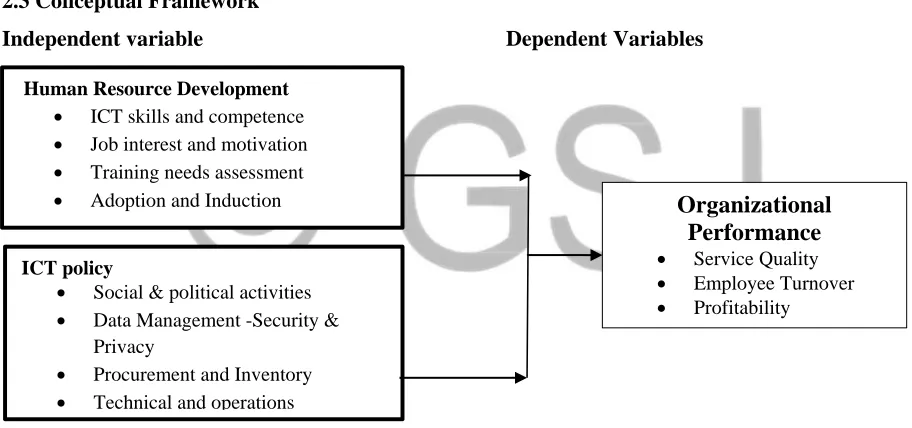
2.3 Conceptual Framework
Independent variable Dependent Variables
Figure 2.1 Conceptual Framework
RESEARCH DESIGN AND METHODOLOGY
3.1Research Design
Ogula (2005) describes a look design as a concept, structure and strategy of investigation to get answers to analysis queries and management variance in addition, a study style is that the arrange of action the scientist adopts for responsive the analysis queries and it sets up the framework for study or is that the blueprint of the scientist (Kerlinger, 1973). This research used descriptive research design. This is because descriptive research presents facts concerning the nature and status of the situation as it exists at
ICT policy
• Social & political activities
• Data Management -Security & Privacy
• Procurement and Inventory
• Technical and operations
Human Resource Development
• ICT skills and competence
• Job interest and motivation
• Training needs assessment
• Adoption and Induction
Organizational
Performance
• Service Quality
• Employee Turnover
GSJ© 2019
the time of the study. The descriptive method was used because it describes things the way they are (Neuman, 2007).
3.2 Target Population
According to Ogula, (2005), a target population refers to any cluster of establishments, individuals or objects that have common characteristics. The target population for this study can represent of all the people who are involved in UNITEL business operations, including Directors (Top management), middle management staff and operations staff.
Table 3. 1:Target Population
Staff Cadre Target Population
Top Management 12
Middle Management 28
Operational Staff 60
Total 100
3.3 Sample and Sampling Techniques
The study used stratified random sampling. When the population from which a sample is to be drawn does not constitute a homogeneous group, then stratified sampling technique is used to obtain a representative sample. The population is stratified, and sample items are selected from each stratum, the item chosen from each stratum is based on random sampling. Ghauri and Grönhaug (2005) argues that for any sample to be representative, the sample must be at least above 10% of the target population. For this study 40% of the target population was used as sample size.
Table 3.1 Sample size
Staff Cadre Target Population Percentage (40%) Sample Size
Top Management 12 40 5
Middle Management 28 40 11
Operational Staff 60 40 24
Total 100 40
3.4 Data Collection Instruments
The researcher used questionnaire as the instrument for the research study. This method of data collection was arrived at by the researcher because of the following reasons: its ability in reaching required number of the respondents within a short time, able to offer the respondents humble time to respond to the questions in the research study.
The pilot study was to determine the validity and reliability of the questionnaire. A pilot test is a test research project that authenticates the research tools used and it increased the level of accuracy of the data collected. It provided the researcher with an opportunity to rectify questions that might be misinterpreted or may not have been necessary and those that contradicted the objectives of the research undertaken. A total of 7 people were used in the pilot study.
3.6 Validity
Validity refers to the extent of accuracy of the results of the study. The validity of instrument is that the extent to it will prove what it's presupposed to reflect. According to Mugenda and Mugenda (2003). The analysis instrument is valid in terms of content and face validity. The content connected technique measures the degree to it the research questionnaires reflected the actual areas lined with research objectives on the study.
3.7 Reliability
Reliability is the ability of a research instrument to consistently measure characteristics of interest over time. The researcher will measure the reliability of the questionnaire to determine its consistency in testing what they are intended to measure. The test re-test technique will be used to estimate the reliability of the instruments. This will involve administering the same test twice to the same group of respondents who have been identified for this purpose.
3.8 Data Analysis and Presentation
Once the questionnaires had been received from the respondents, they were checked through to ensure that the questions were completely and accurately answered. Then results were presented using percentages, frequency distribution tables, line graphs, bar graphs and pie charts. Data analysis and presentation were concerned with editing, coding, classifying, tabulating and charting and diagramming research data. Quantitative analysis was used.
DATA ANALYSIS AND DISCUSSION OF RESULTS
4.1.1 Questionnaire Response Rate Table 4. 1: Response Rate
Category Frequency Percentage
Response 33 82.5
Non-response 7 17.5
Total 40 100
GSJ© 2019
indication that the respondents actively participated in the study and thus the study findings can be relied upon.
4.1.2 Respondents’ Level of education Table 4. 2: Respondents’ level of Education
Level of Education Frequency Percent
Certificate 4 12.1
Diploma 17 51.5
Bachelor’s Degree 11 33.3
Post Gradate 1 3.0
Total 33 100.0
Table 4.2 indicates that 12.1% of the respondents are certificate holders, 51.5% have diploma, while 33.3% have degrees and 3.0% are post graduates. This shows that majority of the respondents have diploma qualifications and below hence there is need for the organization to come up with an elaborate Human Resource Development policy that offers employees more opportunities to acquire and utilize knowledge and skills necessary to enhance the organizations’ performance.
4.1.3 Respondents’ Work Experience in Years Table 4. 3: Respondents’ Work Experience
Category Frequency Percent
Less than 5 years 12 36.4
5-10 years 15 45.5
10-15 years 3 9.1
Above 15 years 3 9.1
Total 33 100.0
That table 4.3 shows that 36.4% of the respondents have worked in the organization for less than 5 years, 45.5% have worked for between 5-10 years, while 9.1% are between 10-15 years and above 15 years are 9.1 %. A total of 81.9% of the respondents have been in the organization for 10 years or less. This outcome implies a marked growth in the organization over the last 10 years which necessitated more human resource recruitment during the same period.
4.1.4 Respondents Employment Level Table 4. 4: Respondents Employment Level
Category Frequency Percent
Top Management 3 9.1
Middle Management 5 15.2
Operational Staff 25 72.7
Total 33 100.0
and satellite offices. Most of middle level management staff and the operations staff are found in the regions.
4.2 Human Resource Development in ICT on organizational performance of Telecommunications
Service providers in Kenya atUNITEL services limited
The outcome of this analysis illustrates the perceptions on staff knowledge and experience in ICT, the work environment, employees’ ICT training needs, adoption of new technology and employees’ induction and ICT related factors that enhance employee productivity.
Table 4. 5: UNITEL staff knowledge and experience in ICT to undertake daily tasks
Rate Frequency Percent
Strongly Disagree 1 3.0
Neutral 1 3.0
Agree 19 57.6
Strongly Agree 12 36.4
Total 33 100.0
Table 4.5 denotes that 94% of the respondents agree that staff have good knowledge and experience in ICT to undertake their daily duties, while 3% strongly disagree and 3% of the respondents were neutral about this. From the table it is a clear indication that majority of the employees have good knowledge and experience in ICT that helps them in discharging their daily duties.
Table 4. 6:The work environment at UNITEL creates job interest and motivation
Rating Frequency Percent
Strongly Disagree 6 18.2
Disagree 10 30.3
Neutral 5 15.2
Agree 8 24.2
Strongly Agree 4 12.1
Total 33 100.0
Table 4.6 indicates that a total of 48.5% of the respondents disagreed that the work environment at the organization creates job interest and motivation while 15.2% were neutral and a total of 36.3% of the respondents agreed. The majority of the respondents have disagreed and this is an illustration that the internal work environment is not conducive. The organization should look for ways to improve the employees working conditions especially in the internal work environment to motivate the employee’s and create job interest in order to achieve organizational objectives.
Table 4. 7: management always consults and supports its employees on their ICT training needs
Rating Frequency Percent
GSJ© 2019
Disagree 10 30.3
Neutral 6 18.2
Agree 11 33.3
Strongly Agree 3 9.1
Total 33 100.0
The table 4.7 shows the rating on whether management of the organization always consults and supports it employees on their ICT training needs. It indicates that a total of 39.4% of the respondents disagreed while 18.2% were neutral on this and a total of 41.4% agreed. The percentage of the employees who disagree is quite significant and this calls for the organization to institute a better approach of employees’ involvement on their decision making processes pertaining to training needs assessment.
Table 4.8:UNITEL has good mechanism for adoption and induction of new technology and new
employees.
Rating Frequency Percent
Strongly Disagree 4 12.1
Disagree 9 27.3
Neutral 3 9.1
Agree 16 48.5
Strongly Agree 1 3.0
Total 33 100.0
Table 4.8 shows the rating of employees on mechanism for adoption and induction of new technology and new employees, it indicates that a total of 39.4% of the respondents disagreed while 9.1% were neutral on the matter and a total of 51.5% agreed that the organization has good mechanism for technology adoption and induction of new employees. This indicates that majority of the respondents agreed that a good mechanism is in place, however a significant percentage disagreed and this calls for the organization to look into this.
Table 4.9:UNITEL management has adequately addressed ICT and other related factors that
enhance employee productivity
Rating Frequency Percent
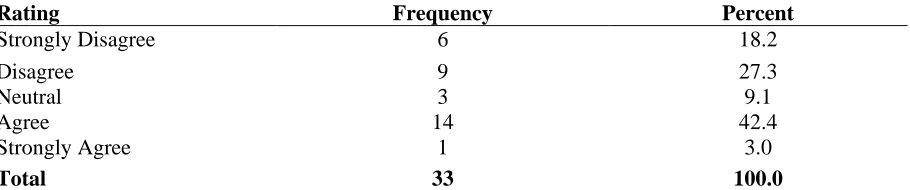
Strongly Disagree 6 18.2
Disagree 9 27.3
Neutral 3 9.1
Agree 14 42.4
Strongly Agree 1 3.0
Total 33 100.0
4.3 impact of ICT policy on organizational performance of Telecommunications Service providers
in Kenya at UNITEL services limited
Analysis of user responses on UNITEL ICT policy and its impact on organisational performance
Table 4. 10:UNITEL has a clear data management policy on security and privacy
Rating Frequency Percent
Strongly Disagree 3 9.1
Disagree 11 33.3
Neutral 10 30.3
Agree 9 27.3
Total 33 100.0
Table 4.10 indicates that 42.4% of the respondents did not agree while 30.3% of the respondents were neutral and 27.3 % agreed that UNITEL has a clear data management policy on security and privacy. This shows that the organization should check on their management security and privacy policy which will provide use confidence to the staff on their personal and organisational data security thus motivating the staff to use ICT systems at the organisation.
Table 4. 2:UNITEL has put in place clear guidelines on the use of ICT for businesses, social and
political interaction
Rating Frequency Percent
Strongly Disagree 1 3.0
Disagree 6 18.2
Neutral 16 48.5
Agree 10 30.3
Total 33 100.0
From table 4.11 a total of 21.2% of the respondents disagree while 48.5% are neutral and 30.3% of the respondents agree that the organization has put in place clear guidelines on the use of ICT for business, social and political interaction. Since majority is neutral this may mean that most them may have not understood or did not have knowledge on how ICT affects businesses, social and politics.
Table 4. 12:UNITEL has good procurement guidelines on acquisition and storage of ICT materials
and equipment
Rating Frequency Percent
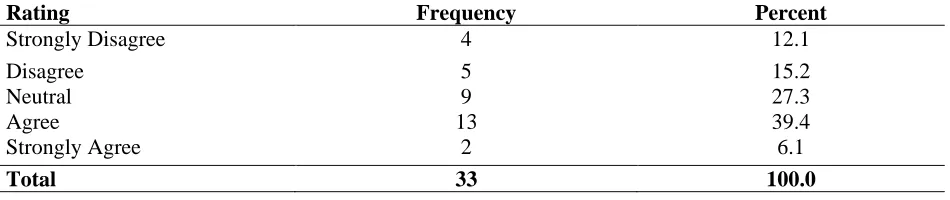
Strongly Disagree 4 12.1
Disagree 5 15.2
Neutral 9 27.3
Agree 13 39.4
Strongly Agree 2 6.1
GSJ© 2019
From table 4.12 the response rate shows that a total of 45.5% of the respondents agreed that the company has good procurement guidelines on acquisition and storage of ICT materials and equipment, while a total of 27.3% disagreed and 27.3% of the respondents were neutral. Less than 50% of the staff consent to the fact that management of ICT materials in the organization is adequate. However more than 50% either disagree or choose to stay neutral.
Table 4. 3:UNITEL has provided a policy that guides technical and operational processes on the
use and services pertaining ICT
Rating Frequency Percent
Strongly Disagree 3 9.1
Disagree 8 24.2
Neutral 6 18.2
Agree 13 39.4
Strongly Agree 3 9.1
Total 33 100.0
From table 4.13 it indicates that 48.5% of the respondents agree while 18.2% of the respondents were neutral and 33.3% of the respondents disagree that UNITEL has provided a policy on work processes related to ICT. Majority of the respondents have agreed but there is a reasonable good number of the respondents that stayed neutral. This could mean that they neither see the positive nor the negative effects of ICT in the work processes they undertake.
SUMMARY, RECOMMENDATIONS AND CONCLUSIONS
5.1 Summary of the Findings
5.1.1Human Resource Development in ICT on organizational performance of Telecommunications
Service providers in Kenya atUNITEL services limited.
The purpose of the study was intended to establish whether human resource development some relation to performance. It is determined from the responses that good knowledge and experience in ICT enabled delivery of given tasks. Respondents strongly agree that Adoption of new technology and induction of
new employees enhance productivity
.
However, work environment and employees’ ICT training needsorganization clients who intern translate to the improved organizations performance and the market share of the organization.
5.1.2 Impact of ICT policy on organizational performance of Telecommunications Service
providers in Kenya at UNITEL services limited
From the findings it was found that only 37.9 % of the respondents agreed that ICT policy has a positive correlation on the performance of the organization this is much below the average, this implies that may be most of the UNUTEL staff are not aware of the ICT policies governing their organization. A wellstructured ICT policy on an organization ensures that, social & political activities, data Management -security & privacy procurement and Inventory and Technical and operations of the organization are efficiently and effectively managed.
5.2 Recommendation
5.2.1 Human Resource Development on ICT skills and Competency
The organization should come up with some policies that aims at training its staff to enhance their skills and competency this can be achieved by conducting periodic in-service, seminars to update the staff on the current changes in ICT field and remain competitive and have a competitive advantage over its competitors in the same field.
5.2.2 Impact of ICT policy on organizational performance of Telecommunications Service
providers in Kenya at UNITEL services limited
From the findings, the researcher recommends that the UNITEL should improve its ICT policy to make it adaptable to prevailing business operating environment and also educate its employees the ICT. This can be done effectively by the organization during the induction of the employees and effective implementation of the ICT policies in the organization, this can be done by HR in conjunction with ICT policy formulators.
5.3 Conclusion
GSJ© 2019
The scope of the study was UNITEL Kenya Limited performance which the researcher focused only on the UNITEL staff on which the performance of the organization relied on. The study was based on the theories on Technological Theory Model (TAM), Innovation Diffusion Theory (IDT) and Information Systems Success Model (ISSM) in which they address the importance and acceptance of the ICT in the organizations and the impact of ICT on the general performance of the organization.
It is from the empirical literature review form various researchers that were discussed and analyzed the effect of the following independent variables; Human resource development on ICT skills and competency, ICT policy, financial Management and organization working culture on the performance of telecommunication service providers, where the researcher established the gaps from these reviews
References
Azhar, K (2003), Business Policy and Strategic Management, New Delhi, Tata.
Bose, R. and Luo, X. (2011). Integrative framework for assessing firms’ potential to undertake Green IT initiatives via virtualization – A theoretical perspective. Journal of Strategic Information Systems, 20, 38-54.
Boxall, Ang and Bartram, 2011 Analyzing the ‘Black Box’ of HRM: Uncovering HR Goals,
Mediators, and Outcomes in a Standardized Service Environment Volume48, Issue7 November 2011Pages 1504-1532.
Chivee, L.L, Hamilton, B.A and Cowan, E. (2008). Networking the Way to Success: Online Social Networks for Workplace and Competitive Advantage, People and Strategy, New York, 31(4), 40, DeLone, W.H. and McLean, E.R. (2003). The DeLone and McLean Model of Information system
Success: A Ten-Year Update, Journal of Management Information Systems. 19(4), 9-30.
Henderson, A. and Bowley, R. (2010). Authentic dialogue? The role of “friendship” in a social media recruitment campaign. Journal of Communication Management, 14(3), 237-257
HRmarketer.com (2005), Looking for ways to Boost your company’s Bottom-Line Results?
Research shows big impact of positive, PR Newswire
Jimoh(2007). Students’ Attitude towards ICT in Nigeria Tertiary Institution. Education Focus, 1(1), 73–79.
Kim, A.J and Ko, E. (2011). Do social media marketing activities enhance customer equity? An empirical study for luxury fashion brand. Journal of Business Research, doi:
10.1016/j.jbusres.2011.10.014.0
Mathur, K. (2009). “Financial Analysis of the ICT Industry: A Regulatory Perspective”. Journal of Infrastructure Development, 1, 17.
McLean and Collins, (2011) High‐commitment HR practices, employee effort, and firm performance:
Investigating the effects of HR practices across employee groups within professional services firms
Volume50, Issue3 May/June 2011 Pages 341-363.
McGraw- Hill Performance-Based Management Special Interest Group (PBM SIG) (2001),The performance Based Management Handbook: Establishing an Integrated Performance Measurement
System. U.S.A, Oak Ridge Associated Universities.
Mohammed Elhazzam (2015) “The Effect of ICT on Human Resources Management Practices” International Journal of Innovative Research in Engineering & Management (IJIREM) ISSN: 2350–0557, Volume-2, Issue-3, May-2015.
Mugenda and Mugenda, 2003,Quantitative and Qualitative Approaches. Nairobi, ACT Press.
Nguyen, T.D. (2007). Factors affecting the utilization of the internet by internationalizing firms in transition markets: Evidence from Vietnam. Marketing intelligence & Planning, 25(4), 360-376.
Ployhart and Moliterno, (2011).The Effects of Staffing and Training on Firm Productivity and Profit Growth Before, During, and After the Great Recession.
Prof. V.V Apagu, Bala Adamu Wakili in their journal (2015)Availability and Utilization of ICT Facilities for Teaching and Learning of Vocational and Technical Education Volume-04, Issue-02,
pp-113-118
Saleem, I., Qureshi, M.Q., Mustafa, S., Anwer,F., & Hijazi,T. (2011). “Role of Information and
Communicational Technologies in Perceived Organizational Performance”: Empirical Evidence
from Higher Education Sector of Pakistan. IBA Business Review, 6(1), 81–95.
Schein, E.H. (2004) 2nd ed, Organizational Culture and Leadership. San Francisco: Jossey-Bass.
Wachira F.N (2010), Improving the Management of Human Resources in the Public Service through application of Information and Communication Technologies (ICTs): The Africa Public Service Human Resource Management Network: Cotonou, Benin 12th -16th April, 2010.
Wang, Z. (2005). “Organizational Effectiveness through Technology Innovation and HRM Strategies”. International Journal of Manpower, 26(6), 481–487.
GSJ© 2019
Wright and McMahan, 2011)Exploring human capital: putting ‘human’ back into strategic human resource management Volume21, Issue2 April 2011Pages 93-104.