A Framework for Classification of Stressed and Hypertensive
Patients
Komal
1, Sunil K Panjeta
21Electronics & Communication Engineering,
YIET, Gadholi
Email: [email protected]
2Electronics & Communication Engineering,
YIET, Gadholi
Email: [email protected]
Abstract—this paper investigates the adaptation of automatic dialogue recognition to disease detection by analyzing the voice parameters. The analysis of the voice allows the identification of the diseases which affect the vocal apparatus and at present is carried out from an expert doctor through methods based on the auditory analysis. Proposed work presents a novel method to keep track of patient’s pathology easy to use, fast, noninvasive for the patient and affordable for the clinician. This method uses parametric method (jitter, shimmer, harmonic to noise etc…) to estimate the pathological voice. The method for this task also depends on Mel Frequency Cepstral Coefficient (MFCC) as feature extraction and Dynamic Time Warping (DTW) as feature Matching. This paper summarizes the step by step process of voice analysis of stressed patients. The classification accuracy achieved corresponding to each extracted features verifies the success of our approach in distinguishing the people with stress. Thus the voice analysis on PRAAT platform has proven an efficient tool for discriminating people with stress as compared to normal one and generated positive results. The work represents the various 2D and 3D graphs of training and predicted subjects in MATLAB.
Keywords- Survival Stress, Internal Stress, Environmental Stress, Fatigue and Overwork
1.INTRODUCTION
1.1 Introduction to Stress
Stress is a physical, mental, or emotional factor that causes bodily or mental tension. Stress is a normal physical response to events that makes one feel threatened or upsets a person’s balance in some way [1]. The term stress was coined by Hans Selye in 1936, who specified as “the non-specific reaction of the body to any demand for change”. When a person sense danger whether its actual or imagined the body defenses kick into high gear in a rapid, automatic process known as the “fight-or-flight-or-freeze” reaction or stress response [2] shown in Fig.1.1.
1.2 Cause of Stress
Many different things can form stress from physical (such as fear of something precarious) to emotional (such as worry over your family or job). Some of the most common sources of stress are:
a) Survival Stress – “Fight or Flight” response is a common response to danger in all people and animals. When a person is scared that someone or something may physically hurt his/her body, the body naturally responds with a burst of energy so that the person will be better able to survive the dangerous situation (fight) or escape it all together (flight). This is survival stress.
b) Internal Stress – Internal Stress is one of the most significant kinds of stress to understand and manage. Internal stress is when people make themselves stressed. This often happens when a person worries about things he/she can't control or put themselves in situations. Some people become obsessed to the kind of hurried, tense, lifestyle that results from being under stress.
c) Environmental Stress - This is a response to things around the person that cause stress, such as noise, crowding, and pressure from work or family. Identifying these environmental stresses and learning to avoid them or deal with them will help lower persons stress level.
d) Fatigue and Overwork - This kind of stress builds up over a long time and can take a hard toll on one’s body. It can be caused by working too much or too hard at job(s), school, or home. It can also be caused by not knowing how to manage time well or how to take time out for rest and relaxation. This can be one of the hardest types of stress to avoid because many people feel this is out of their control [4].
1.3 Stress and its types
Stress can be defined as require of coordination with the human body and mind, and which can be controlled by relaxation as well the sfitting management techniques. There are different types of stress:
a) Acute Stress – Acute stress is typically caused by the daily demands and pressures encountered by every individual. Acute stress is what actually brings about excitement, joy and thrill in our lives
1) Emotional distress: such as anger, anxiety, irritability, and acute periods of depression.
2) Physical troubles: like as ache, stomach upset, dizziness, headache, heart palpitations, and squatness of breath, hypertension and bowel disorders [5].
b) Episodic Stress: Acute stress that is suffered too frequently is called episodic stress. This class of stress is typically seen in people who make idealistic, self-inflicted or unreasonable demands which get all mixed up and bring too much stress in their attempt to accomplish these goals. Episodic stress [6] is also normally observed in people with “Type A” personality, which engages being overly competitive, aggressive, demanding and sometimes tense and hostile. Because of this, the symptoms of episodic stress are found in Type a person [7].
1.4 Signs and Symptoms of Stress Overload
The signs and symptoms of stress overload can be almost anything. Stress effects the mind, body, and behavior in many ways, and everybody experiences strain differently shown in Table 1.1. Not only can overwhelming stress lead to serious mental and physical health problems, it can also take a toll on person’s relationships at home, work and school [7].
1.5 Blood Pressure
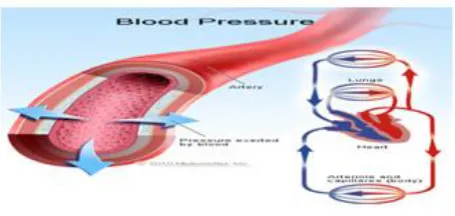
The blood pressure is the pressure of the blood within the arteries. It is produced principally by the contraction of the heart muscle. Blood pressure is usually measured at person’s upper arm. Blood pressure is expressed in terms of the systolic (maximum) pressure and diastolic (minimum) pressure and is measured in millimeters of mercury (mm Hg). It is one of the vital cipher along with respiratory rate, heart rate, oxygen saturation, and body temperature. Normal resting blood pressure in a mature is approximately 120/80 mm Hg. Blood pressure varies depending upon the situation, activity, and disease states. It is synchronized by the nervous and endocrine systems. Blood pressure that is low owed a disease state is called hypotension, and pressure that is consistently high is hypertension. The Fig. 1.3 shows the Blood pressure below:
Fig. 1.3: Blood pressure
1.6 Hypertension (High Blood Pressure)
Hypertension, also referred to as high blood pressure, is a common condition in which the force of blood against one’s artery walls is high enough. Blood pressure is determined by the quantity of blood that heart pumps and the amount of resistance to blood flow in the arteries. The more blood the heart pumps and narrower the arteries, the higher the blood pressure. Hypertension can direct to several illnesses as well as injured parts, such as renal failure, heart failure, stroke, or heart attack. Researchers from UC Davis reported in the journal of the American Academy of Neurology that high blood pressure during middle age may raise the risk of cognitive decline later in life.
2.RELATEDWORK
N. P. Dhole et al. [1] discussed an approach for the detection of speech in English language. The stress detection is necessary which provides real time information of state of mind of a person. Author considered the MFCC Voice features which is influenced by Stress and to examine the effect of exam stress on speech production an experiment was conducted on the first year students of age group 18 to 20. An assignment was given to them and instructs them that viva on that assignment and their performance in the viva will decide their final internal marks in the examination. The experiment and the analysis of test results showed that students were stressed due to which there is remarkable change in MFCC.
S. V. Bakhtiyari [2] finds out the relationship between various individual aspects and work environment with reference to the stress of employees. The research was focused on identifying the impact of various factors which control the stress of an employee. It was found that with the age group the stress level changes and the need of counseling for employees differs with age group. The study revealed that most of the employees have tendency of feeling stressed because of work load. Author tried to find out the relationship between the qualifications and the stress, and also tried to find out the possible ways through which the stress can be controlled. The data for analysis was collected from different levels of employees so as to conducted a good research and suggest to the organization some measures for managing stress in the work environment.
U. Devi [3] discussed that Stress has become significant due to dynamic social factor and changing needs of life styles. Stress is adaptive reaction to an outward situation which would lead to physical, mental and behavioral changes, even though stress kills brain cells. Appropriate amount of stress can actually trigger passion for work, tap latent abilities and even ignite inspirations. The work stress is found in all professions. IT professionals are very stressed because they are highly target driven and highly pressured on results. Stress can make a person productive and constructive, when it is identified and well managed. Author focused to study the stress level among IT employees and to suggest the coping strategies. A survey of 200 IT employees in the IT companies situated in and around Hyderabad was done by author. Some of the strain coping techniques studied by this study includes stress management programs, physical activities planned in job design, life style modification programs, finding triggers and stressors, supportive organization culture, stress counseling programs, and spiritual programs.
families. The purpose of this research paper was to investigate how police officer job stress can negatively affect the officer and his/her family. The research method used for this project relied upon professional papers, magazine articles, and Internet sources. Police Officers are stressed by many things including their supervisors, shift-work resulting in the loss of time spent with their families, fellow officers, and the citizens at large. Police Officers are stressed by abundant other factors like as low pay, lopsided sleep schedules, and conflict with family and friends. Author analyzed that when officers were properly trained and had the ability to recognize the effects of stress, they were able to manage their stress more effectively. This stress management resulted in officers taking less stress home with them to their families and they were able to maintain higher morale. The police departments need to take more responsibility in educating, training, and combating officer stress. The department also needs to provide confidential counseling to officers that are being affected negatively by job stress.
M. Kotteshwari et al. [5] discussed that job stress is negatively related to performance. In other words, lower the performance when higher the stress. Workplace stress derives from many sources. It can be a demanding boss, annoying co-workers, rebellious students, angry customers, hazardous conditions, long commutes and a never-ending workload. The nature of work has gone through drastic changes over the last century and it is still changing at whirlwind speed. With change comes stress will appear automatically. Job stress poses a threat to physical health. The business process outsourcing (BPO) industry in India has always been characterized by ungodly hours, monotonous job, low perceived value, dispirited efficiency resulting to high attrition level. The purpose of this research was to determine what and how job-related and demographic variables are associated with employee satisfaction of the BPO employees. This paper has made an attempt to find out the job stress factors affecting the performance of the employees.
H. Lu et al. [6] explained that Stress can have long term adverse effects on individuals’ physical and mental well-being. Changes in the speech production process are one of many physiological changes that happen during stress. Microphones, embedded in mobile phones and carried ubiquitously by people, present the opportunity to continuously and non-invasively monitor stress in real-life situations. In this study, author suggested stress sense for unobtrusively recognizing stress from human voice using smart phones. Author investigated methods for adapting one-size-fits all stress models to individual speakers and scenarios. Author demonstrated that the Stress Sense classifier can robustly identify stress across multiple individuals in diverse acoustic environments: using model adaptation. Stress Sense achieves 81% and 76% accuracy for indoor and outdoor environments, respectively. Author showed that Stress Sense can be implemented on commodity Android phones and run in real-time. To presume voice based stress finding and model adaptation in diverse real-life conversational situations using smart phones Author investigate the first system.
J. H. L Hansen et al. [6] discussed about analysis, modeling, and recognition of speech under stress. Author started by defining stress, effect of stress on speech production system. Author explored how individuals differ in their perception of stress, and hence understand the cues associated with perceiving stress. Having considered the domains of stress, areas for speech analysis under stress, Author shifted to the development of algorithms to estimate, classify or distinguish different stress conditions. Author concluded with the techniques to overcome the effects of stress for speech recognition and human computer interactive systems.
N. Mbitiruet al. [7] studied that by evaluating fluctuations in the physiological micro tremor present in speech (VSA) Voice stress analysis is accomplished. Author discussed in this paper about the Empirical Mode Decomposition. Empirical Mode Decomposition was compared to traditional Fast Fourier Transform in the analysis of the physiological micro tremor. The results showed that EMD was better suited for the detection of stress in voice.
3.PROPOSEDWORK
3.1 Problem Statement
The major objective of this dissertation work is to study Dysphonia in stressed and hypertensive patients and discriminate people with stress on the basis of extracted voice features by analysis the voice signals.
3.2 Proposed Work
First of all voice database of normal, stressed, and hypertensive persons are prepared. Then this database is analyzed and various features like jitter shimmer, HNR, DVB, pitch, and standard deviation are extracted from the recorded voice of patients. Then K-means classifier is used for classification. The K-mean classifier will differentiate between normal and stressed persons, hypertensive and normal persons. At the end classifier accuracy is checked.
4. RESULTS & ANALYSIS
4.2 Stressed Versus Normal Female Samples
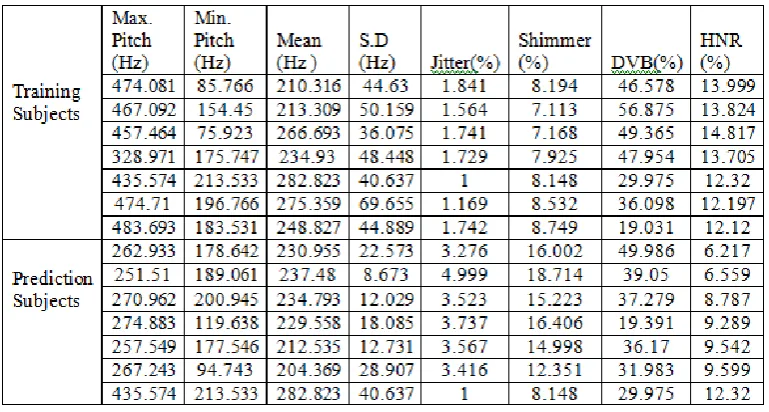
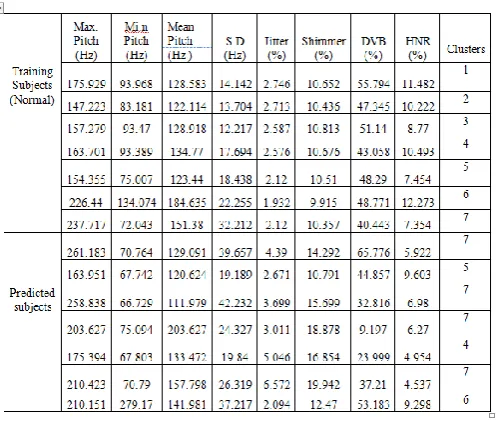
The Table 4.1 shows the Training (normal) and predicted (stressed) females as shown below
Table 4.1: Training and Predicted Subjects.
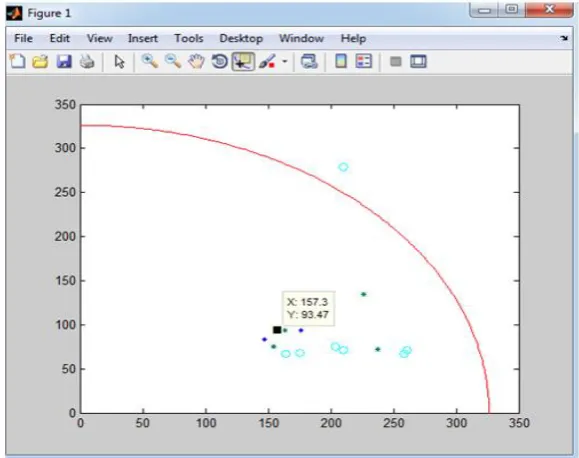
From Table 4.1 it is clear that the first seven females are taken as training subjects and the next seven females are taken as predicted subjects. The training and predicted subjects are shown in Fig. 4.1. In Fig. 4.1 cyan circles shows the predicted subjects and the blue circles indicate the training subjects.
K-means classification is used to differentiate between normal and stressed females. After applying K-means algorithm to the training and predicted subjects, different clusters are formed shown in Table 4.2.
Table 4.2: Clusters of training and predicted subjects (females)
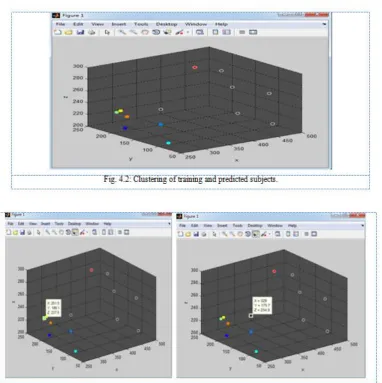
Fig. 4.3 clearly explains the KNN classification. The 3rd patient of Prediction dataset is shown in Fig. 4.2 by
yellow color circle and 2nd patient of the same dataset is shown by green circle. After assigning coordinates to
the clusters it is clearly understood that the 4th patient of training dataset is lying close to the 2nd and 3rd patient
of predicted dataset.
4.3 Stressed Versus Normal Male Samples
The table 4.3 shows the Training (normal) and predicted (stressed) males as shown below
Table 4.3: Training and Predicted Subjects.
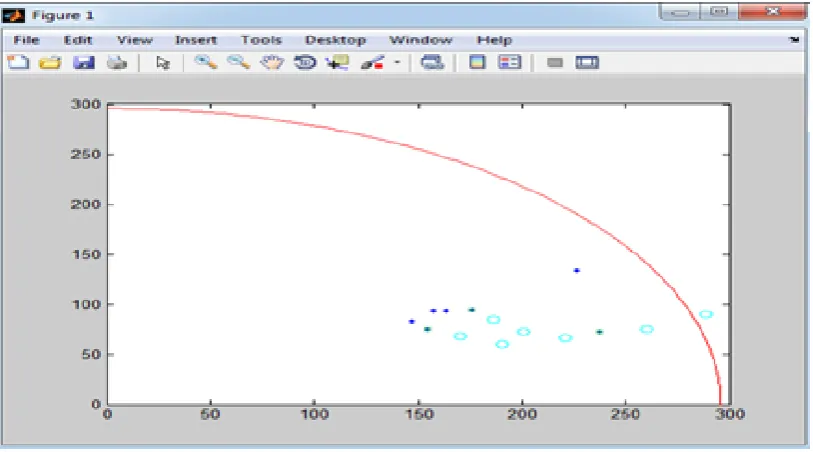
From Table 4.3 it is clear that the first seven females are taken as training subjects and the next seven females are taken as predicted subjects. The training and predicted subjects are shown in Fig. 4.4. In Fig. 4.4 cyan circles shows the predicted subjects and the blue circles indicate the training subjects
Fig. 4.4: Indication of training and predicted subjects.
Table 4.4: Clusters of training and predicted subject (males)
The Fig. 4.5 shows the clusters of training and predicted datasets.
Fig. 4.5: Clustering of training and predicted subjects
Fig. 4.6: Coordinates of subjects.
Fig. 4.6 clearly explains the KNN classification. The 5th patient of Predicted dataset is shown in Fig. 4.5 by red
color circle. After assigning coordinates to the clusters it is clearly understood that the 1st patient of training
4.4 Hypertensive Versus Normal Female Samples
The table 4.5 shows the Training (normal) and predicted (hypertensive) females as shown below:
Table 4.5: Training and Predicted Subjects.
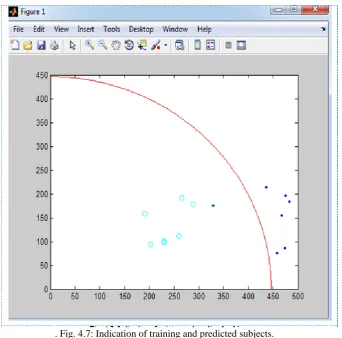
From Table 4.5 it is clear that the first seven females are taken as training subjects and the next seven females are taken as predicted subjects. The training and predicted subjects are shown in Fig. 4.7. In Fig. 4.7 cyan circles shows the predicted subjects and the blue circles indicate the training subjects.
. Fig. 4.7: Indication of training and predicted subjects.
Table 4.6: Clusters of training and predicted subjects (females)
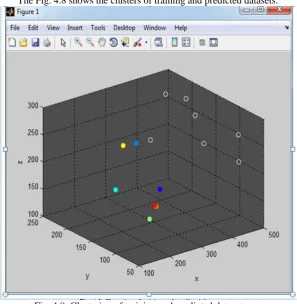
The Fig. 4.8 shows the clusters of training and predicted datasets:
Fig. 4.8: Clustering of training and predicted dataset
4.5 Hypertensive Versus Normal Male Samples
Table 4.7: Training and Predicted Subjects.
From Table 4.7 it is clear that the first seven males are taken as training subjects and the next seven males are taken as predicted subjects. The training and predicted subjects are shown in Fig. 4.9. In Fig. 4.9 cyan circles shows the predicted subjects and the blue circles indicate the training subjects.
Fig. 4.9: Indication of training and predicted subjects (males)
Table 4.8: Clusters of training and predicted subjects (males)
The Fig. 4.10 shows the clusters of training and predicted datasets (males)
Fig. 4.10: Clustering of training and predicted dataset.
4.6 Classifier Performance
In order to test the classifier performance, several measures namely, accuracy, and precision are considered. These measures are calculated from the measures true positive, true negative, false positive, false negative. The percentage of positive predictions those are correct.
Table 4.8: Classifier Accuracy and Precision
5. CONCLUSION & FUTURE SCOPE
The broad aim of the work is to study Stress from patient’s voice. This was successfully achieved with the help of PRAAT software. In addition, it is also detected that there are various similarities between the feature extracted values of Stress and Hypertension. This concludes that Hypertensive patients are also the victims of Stress. This work entitled “Discrimination of Stressed Person with Normal Person Using Voice Analysis” has been mostly implemented on PRAAT, a virtual computer operated phonetics application. This dissertation work has been helpful in enriching the knowledge about various aspects of Voice Analysis and applications of voice analyzing tools in our daily lives. Voice Analysis involves the transformation of voice signal into a set of parameters with an objective to simplify the voice signal to extract desirable features. The PRAAT works on the principle of short-time window analysis which allows the grasping of these distinguished time varying features of voice, in order to ease the tasks of understanding, comparison, modification, and resynthesis. Thus, PRAAT tool Voice can be used by speech pathologists and medical professionals to study evaluate and diagnose the quality of the Patient’s voice signal on the basis of measurable features. The K-means classification algorithm is also implemented in MATLAB software for clustering. The Voice Analysis has arisen as an important area of study for its various applications in medical as well as engineering sciences. The scientific innovations of twenty first century have equipped the researchers with highly versatile and fast digital processors to exploit the vast aspects of human voice. The system employed for Voice Analysis has yielded better results and positive outcomes. The result obtained further verified the success of the Voice Analysis approach in the practical environments. In this work, Voice samples of persons are used for detecting the stress and also found stress as a cause of Hypertension. However, this stress causes number of other diseases like Heart disease, Diabetes, Gastrointestinal problems, Obesity etc. So in future one can also use voice for the detection of these diseases. Thus the beginning of the third millennium has opened new horizons for the advancement of voice diagnosis systems. As it seems now, the process of evolution of biomedical technology has already begun and the way it is nurturing the humankind, looks very promising for the future generations.
REFERENCES
[1]. Neha P. Dhole,and Dr. Ajay A. Gurjar, “Detection of Speech under Stress”, International Journal of Engineering and Innovative Technology (IJEIT), Vol. 2, Issue 10, April 2013.
[2]. Syed Valiullah Bakhtiyari, “Research paper on factors influencing on stress and its management with reference to employees of idea cellular”, EXCEL International Journal of Multidisciplinary Management Studies, Vol. 4, February 2014 3. Uma Devi .T , “A Study on Stress Management and Coping Strategies With Reference to IT Companies”, Journal of Information Technology and Economic Development, Vol. 2, October 2011.
[3]. Sergeant Corey Haines, “Police Stress and the Effects on the Family”, an applied research project submitted to the Department of Interdisciplinary Technology as part of the School of Police Staff and Command Program, September 2003.
[4]. M. Kotteeswari, and Dr. S. Tameem Sharief, “Job Stress and Its Impact on Employees Performance: A study with reference to employees working in BPOS”, Vol. 5, Issue 2, April 2014.
[5]. Hong Lu, Mashfiqui Rabbi Cornell, and Gokul T. Chittaranjan ,”Stress Sense: Detecting Stress in Unconstrained Acoustic Environments using Smart phones”, September 2012.
[6]. John H.L Hansen, and Sanjay Patil, “Speech under Stress: Analysis, Modeling and Recognition”, VOL. 43, pp. 108-137, January 2007.
![Fig. 1.1: Fight or Flight Response [3].](https://thumb-us.123doks.com/thumbv2/123dok_us/8427200.1696412/1.595.204.448.554.729/fig-fight-or-flight-response.webp)
![Table 1.1: Stress overloads signs and symptoms [7].](https://thumb-us.123doks.com/thumbv2/123dok_us/8427200.1696412/2.595.169.462.544.760/table-stress-overloads-signs-symptoms.webp)