www.j-sens-sens-syst.net/4/53/2015/ doi:10.5194/jsss-4-53-2015
© Author(s) 2015. CC Attribution 3.0 License.
Alternative strategy for manufacturing of all-solid-state
reference electrodes for potentiometry
J. C. B. Fernandes and E. V. Heinke
The Municipal University of São Caetano do Sul, USCS, Centre Campus, 50, Santo Antônio Street, 09521-160, São Caetano do Sul – SP, Brazil
Correspondence to: J. C. B. Fernandes ([email protected], [email protected])
Received: 9 October 2014 – Revised: 9 January 2015 – Accepted: 18 January 2015 – Published: 12 February 2015
Abstract. This paper presents an alternative strategy for manufacturing solid-state reference electrodes based on particles of graphite/silver/silver chloride synthesized by electroless deposition of metallic silver and silver chloride on graphite powder. Two kinds of reference electrodes were manufactured by mixing these particles with epoxy resin and hardener: quasi-reference and all-solid-state containing salts of alkaline or alkaline earth metals. All-solid-state reference electrodes can be sterilized with high-pressure saturated steam at 394.15 K (121◦C) using an autoclave. These electrodes presented a stable potential between pH 2 and 11. The electrode surface was characterized by scanning electron microscopy and showed the presence of silver and salt particles. The size of the silver particles was less than 2.5 µm. We successfully applied the all-solid state reference electrodes in potentiometric cells to measure pH and potassium ions in complex matrix by direct potentiometry and L-ascorbic acid by potentiometric titration.
1 Introduction
Reference electrodes have been the Achilles heel for many electrochemical systems, especially for potentiometric tech-niques. A good reference electrode for potentiometric mea-surements must maintain a constant comparative potential value and cannot respond to the presence of chloride ions in the sample solution. The most common reference electrodes have a plastic or glass body for storing the saturated solution of potassium chloride called electrolyte. A silver wire coated with silver chloride, a paste of mercury and mercury chlo-ride (calomel), or a paste of thallium, mercury and thallium chloride (Thalamid) is dipped into this solution (Guth et al., 2009).
The calomel electrode has better technical characteris-tics than reference electrodes based on silver/silver chloride (Ag/AgCl, Cl−). The potential drift of the calomel electrode is low and not even light influences this electrode. However, the calomel electrode cannot be used in temperatures above 353.15 K (80◦C) because it presents hysteresis at these tem-peratures (Janz and Taniguchi, 1953). Like Thalamid elec-trodes, calomel electrodes will probably be banned in the next years, because mercury is very hazardous to the
envi-ronment. Therefore, reference electrodes based on Ag/AgCl, Cl−may be the most popular in the future.
Conventionally, reference electrodes based on Ag/AgCl, Cl−are produced by electroplating of silver on the surface of a platinum wire (5–6 h) and 15–25w/w% of the silver is converted to silver chloride by anodic treatment with hy-drochloric acid for 30 min (Janz and Taniguchi, 1953).
nan-54 J. C. B. Fernandes and E. V. Heinke: Alternative strategy for manufacturing
otubes were also used as a transducer from a polyacrylate
membrane containing Ag/AgCl, Cl− system (Rius-Ruiz et
al., 2011). Thin film technology has also been used for mi-crofabrication of reference electrodes (Suzuki et al., 1999). Valdés-Ramírez et al. (2011) electrodeposited silver and sil-ver chloride on a graphite-epoxy electrode surface under ade-quate conditions of electrical potential and electrical current. On the one hand, the large number of layers may compli-cate the miniaturization by techniques of thin film or of thick film. On the other hand, reference electrodes manufactured by electroplating using a potentiostat have an Ag/AgCl layer thickness that may be destructed by friction.
Other problems of reference electrodes include the fol-lowing: classical reference electrodes can develop a poten-tial due to outflow of the inner electrolyte through the liq-uid connection. One strategy to overcome this problem is to use gel electrolytes. However, gels of agar-agar or gelatin are unstable with temperature variation and reference electrodes with these gels cannot be sterilized into autoclave. Since, advanced gels such as polyvinyl acrylamide, polyvinyl al-cohol, hydroxymethyl cellulose and hydroxyethyl cellulose have higher temperature resistance, these gels can be used alternatively. However, advanced gels have lower solubility for salts, therefore, a potential drift can be developed if chlo-ride ions are in the sample solution (Guth et al., 2009).
The aim of this work is to propose an alternative strategy for manufacturing of all-solid state reference electrodes by developing silver and silver chloride particles that are de-posited on graphite powder by electroless deposition without need of electroplating equipment.
2 Experimental
2.1 Materials
Trizma base buffer (minimum 99.9 %), silica gel (60 µm size), valinomycin and bis-2-ethylhexyl adipate were purchased from Sigma-Aldrich. Potassium tetraoxalate
dehydrate (pH=1.679), potassium hydrogen phthalate
(pH=4.008), potassium dihydrogen phosphate, sodium
hydrogen phosphate (pH=6.865), sodium tetraborate
(pH=9.180) and calcium hydroxide (pH=12.454) were
used for preparing primary standard pH solutions at 298.15 K (25◦C). These reagents were also purchased from Sigma-Aldrich. High molecular weight poly(vinyl)chloride (PVC) was donated by Solvay-Brazil. BQ164 ink based on Ag/AgCl particles was acquired from DuPont Micro-circuit Materials. Other reagents, such as L-ascorbic acid, potassium chloride, anhydrous sodium sulfate, potassium iodide, barium chloride, potassium hydroxide, ammonium hydroxide, sodium hydroxide, silver nitrate, glucose, sodium fluoride, hydrochloric acid, sulfuric acid, propanone, tetrahydrofuran and graphite powder (50–300 µm size) were analytical grade reagents. We also acquired Brascola’s epoxy resin and poly(imide) of the trademark Araldite.
Noncarbonated sports drinks and syrups were obtained from local markets or pharmacies. All solutions were prepared using distilled water.
2.2 Instrumentation and protocols
All potentiometric measurements were carried out using an ion analyser HI 223 model from Hanna instruments. All reference electrodes were characterized analysing their po-tential response against a commercial reference electrode (Ag/AgCl), R684-105 model from Analion. In our experi-ments, the reference electrolyte was potassium chloride solu-tion at 3 mol L−1. Potentiometric cells with a pH single-rod measuring cell (HI-1131P model) or a homemade potassium ion selective electrode (ISE-K) were used for testing the all-solid-state reference electrodes in real samples for direct po-tentiometry. The ISE-K was prepared according to previous work (Fernandes et al., 2000).
Potentiometric titrations of L-ascorbic acid were made with a mercury indicator electrode. The mercury electrode was prepared according to literature (Riyazuddin and Nazer, 1997), with some adaptations. We used a copper rod of 2 mm diameter and 5 cm length. The copper rod was immersed in a solution of epoxy : polyimide (weight proportion, 3:1) in propanone to form a film that electrically isolates the cop-per from the environment. The bottom of the copcop-per rod was trimmed to remove the cured resin. Afterwards, this rod was polished with abrasive papers. The copper elec-trode was immersed in acid solution of mercury (II) nitrate at 0.02 mol L−1for 10 min for deposition of the metallic mer-cury on the copper surface. The electrode was washed with distilled water and polished using a filter paper with a pore size of 8 µm.
Morphological studies of the surface were performed us-ing FEI Quanta FEG 250 scannus-ing electron microscopy. The samples were coated with a thin layer of gold (Au) by a sput-ter coasput-ter to reduce charging.
2.2.1 Synthesis of metallic silver and silver chloride particles on graphite powder
J. C. B. Fernandes and E. V. Heinke: Alternative strategy for manufacturing 55
5
powder.
2
Metallic silver particles were obtained by electroless deposition using silver nitrate, ammonia, 3
potassium hydroxide and glucose solutions (Koura, 1990). For electroless deposition of silver 4
and silver chloride particles, silver nitrate solutions concentrated between 0.04 and 8.00 mol 5
L-1 were used. The concentrations of the other solutions were estimated by the stoichiometry 6
of the reactions according to chemical equations from 1 to 3. 7 NH3 NH3 OH O H OH O H H H OH H OH
+ 2 Ag(NH3)2OH + 2 Ag0 + 2 H
2O + 3 NH3 (3)
OH O H OH O H H H OH H OH NH4+-O
8 9
Silver chloride particles were obtained using only silver nitrate and potassium chloride 10
solutions. Electroless silver deposition was carried out at 283.15 K (10 ºC) and silver chloride 11
precipitation at room temperature. 12
For preparation of the silver particles on graphite, about 8.00 grams of graphite powder were 13
weighed. The graphite powder was put uniformly in a glass container of 2 L up to form a 14
layer with thickness < 1mm. We carefully added 10 ml of silver nitrate solution at 8.0 mol L-1, 15
10 ml of ammonium hydroxide at 16.0 mol L-1, 32 ml of glucose solution at 2.1 mol L-1 and 16
10 ml of potassium hydroxide solution at 4.0 mol L-1 to the graphite powder without stirring. 17
Similar procedure was used for deposition of silver chloride particles on the graphite/silver 18
powder. In this case, we weighed 8.00 g of graphite/silver powder and put it in a glass 19
container of 2 L. Afterwards, we added 100 ml of silver nitrate solution and 100 ml of 20
potassium chloride solution (both 0.4 mol L-1) into the glass container. 21
The graphite/silver/silver chloride particles were washed with cold distilled water and filtered 22
under vacuum. The powder was dried in an oven at 313.15 K (40 ºC) by one hour. The 23
Ag(H2O)n-1NH3 Ag(H2O)n-2(NH3)2 + H2O (2) Ag(H2O)n Ag(H2O)n-1NH3 + H2O (1)
Silver chloride particles were obtained using only silver nitrate and potassium chloride solutions. Electroless silver deposition was carried out at 283.15 K (10◦C) and silver chloride precipitation at room temperature.
For preparation of the silver particles on graphite, about 8.00 g of graphite powder were weighed. The graphite pow-der was put uniformly into a glass container of 2 L to form a layer with thickness <1 mm. We carefully added 10 mL of silver nitrate solution at 8.0 mol L−1, 10 mL of ammo-nium hydroxide at 16.0 mol L−1, 32 mL of glucose solution at 2.1 mol L−1and 10 mL of potassium hydroxide solution at 4.0 mol L−1to the graphite powder without stirring.
A similar procedure was used for deposition of silver chlo-ride particles on the graphite/silver powder. In this case, we weighed 8.00 g of graphite/silver powder and put it into a glass container of 2 L. Afterwards, we added 100 mL of sil-ver nitrate solution and 100 mL of potassium chloride solu-tion (both 0.4 mol L−1)into the glass container.
The graphite/silver/silver chloride particles were washed with cold distilled water and filtered under vacuum. The powder was dried in an oven at 313.15 K (40◦C) for 1 h. The graphite/silver/silver chloride particles were stocked in a dark glass flask to avoid decomposition by action of light.
2.2.2 Preparation of the quasi-reference electrodes
We manufactured quasi-reference electrodes mixing the par-ticles of graphite/silver/silver chloride with epoxy resin and hardener (3:1). The weight of these particles was main-tained constant at 100 mg while the weight of epoxy resin plus hardener (3:1) was changed to obtain a percentage of graphite/silver/silver chloride particles of between 15 and 75 %w/w. We added 2 mL of propanone to the paste in or-der to dissolve the adhesive. The paste was homogenized in a glass mortar with a glass pestle. Afterwards, propanone was left to evaporate until the mixture reached the proper viscos-ity to be transferred to a tube with a 3 mm inner diameter and 5 cm of length.
Finally, a copper wire was dipped into a mercury (II) ni-trate solution (0.02 mol L−1)to produce a thin layer of metal-lic mercury on its surface. Mercury layer avoids the copper oxidation by the silver chloride. The wire was inserted into the paste to obtain electrical contact.
All electrodes were left to dry for 8 h at 363.15 K (90◦C).
The surface of the reference electrodes was polished with abrasive papers of 150–2 000 meshes before use.
We also verified the use a commercial ink (BQ164, see Sect. 2.1) for manufacturing potentiometric reference elec-trodes. These electrodes were fabricated in the same manner described before.
2.2.3 Preparation of the all-solid-state reference electrodes
The protocol for manufacturing all-solid-state reference elec-trodes was similar to the one described previously. The amount of epoxy resin plus hardener was maintained con-stant in a proportion of 3:1 in terms of weights. The concen-tration of graphite/silver/silver chloride particles was about 45 %w/w. Salts of halogens (F−, Cl−and I−)with cations
of alkaline metals (Na+ and K+)or alkaline earth metals
(Ba2+)were added to the paste at concentrations of between 1.5 and 3.0 mol kg−1. Sulfate anion (SO24−)was used in some formulations as well. Silica (SiO2)was studied for reducing
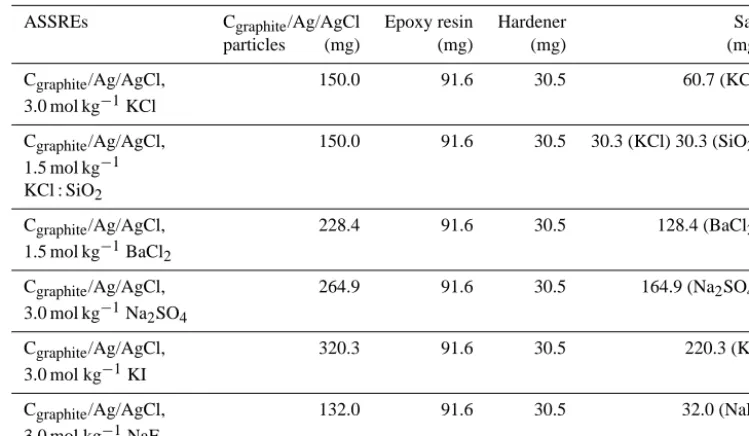
the surface tension of the reference electrode. Table 1 shows the amount used in the preparation of all-solid-state reference electrodes with additives.
2.2.4 Characterization of the reference electrodes
Standard solutions of chloride ions (KCl) from 1×10⁻⁶ to 1×10⁻¹mol L−1 were prepared in 0.2 mol L−1 Trizma sulfate buffer at pH 7.0 to maintain a constant ionic strength. Manufactured reference electrodes were charac-terized against a conventional reference electrode based on Ag/AgCl, 3 mol L−1KCl.
The effect of the pH on all-solid-state reference electrodes was studied in the pH range from 1 to 13. Primary and sec-ondary standard solutions of pH were prepared according to the literature (Weast, 1998) and employed in these studies.
The leaching out effect of salts from an all-solid-state reference electrode was studied maintaining the reference electrode with 3.0 mol kg−1of KCl continuously immersed in 1 mL of deionized water during 20 days. Afterwards, the potassium chloride content of storage water was anal-ysed by gravimetric method using a silver nitrate solution 0.5 mol L−1as a precipitating agent.
A potentiometric cell for potassium ions (ISE-K) based on valinomycin as an ionophore against an all-solid-state refer-ence electrode was used in real samples. The potentiometric cell was calibrated with standard solutions of potassium ions (KCl) from 1×10⁻⁴ to 1×10⁻¹mol L−1. These standard solutions and the samples of the noncarbonated sports drinks and syrups were also diluted in 0.2 mol L−1 Trizma sulfate buffer at pH 7.0.
mer-56 J. C. B. Fernandes and E. V. Heinke: Alternative strategy for manufacturing
Table 1.Formulations of the all-solid-state reference electrodes (ASSREs).
ASSREs Cgraphite/Ag/AgCl Epoxy resin Hardener Salt
particles (mg) (mg) (mg) (mg)
Cgraphite/Ag/AgCl,
3.0 mol kg−1KCl
150.0 91.6 30.5 60.7 (KCl)
Cgraphite/Ag/AgCl, 1.5 mol kg−1 KCl:SiO2
150.0 91.6 30.5 30.3 (KCl) 30.3 (SiO2)
Cgraphite/Ag/AgCl,
1.5 mol kg−1BaCl2
228.4 91.6 30.5 128.4 (BaCl2)
Cgraphite/Ag/AgCl,
3.0 mol kg−1Na2SO4
264.9 91.6 30.5 164.9 (Na2SO4)
Cgraphite/Ag/AgCl, 3.0 mol kg−1KI
320.3 91.6 30.5 220.3 (KI)
Cgraphite/Ag/AgCl,
3.0 mol kg−1NaF
132.0 91.6 30.5 32.0 (NaF)
cury (Hg). A weight of L-ascorbic acid of between 7.5 and 15.0 mg was weighed in a beaker (50 mL) with an analytical balance. We added 30 mL of distilled water, 500 µL of am-monium thiocyanate at 0.1 mol L−1 and 500 µL of sodium acetate/acetic acid buffer solution (pH 4.7/1 mol L−1)to the beaker. We titrated the L-ascorbic acid with a copper sul-fate solution at 0.0125 mol L−1 as titrant using a burette of 10 000 mL.
All-solid-state reference electrodes were sterilized by high-pressure saturated steam at 394.15 K (121◦C) using an
autoclave during 15 min in order to verify its resistance to temperature and pressure.
3 Results and discussion
Among the strategies for manufacturing reference electrodes for potentiometry, the use of silver and silver chloride seems to be considered the most suitable.
We employed graphite powder as a support of the Ag/AgCl particles. Silver particles were obtained by reduc-ing the silver ammonia complex with glucose as shown in chemical Eq. (3), while silver chloride particles were ob-tained by means of a precipitating agent.
The production of small particles (less than 500 nm in di-ameter) by electroless deposition depends on the concentra-tion of reagents. On the one hand, a low concentraconcentra-tion gener-ates small particles, because there is not a sufficient number of particles to form a crystal. On the other hand, a high con-centration yields small particles since many nucleation points are formed due to the fact that a very viscose medium has a higher friction coefficient. Thus, migration of particles is dif-ficult and, consequently, particles do not agglomerate
(Har-ris, 2007). The concentration of silver nitrate solutions used for the production of silver and silver chloride particles were respectively 8.0 and 0.4 mol L−1.
The size of a particle formed by electroless deposition can also be influenced by temperature since high temperatures provoke an agglomeration of the particles. We avoided the agglomeration of silver particles by electroless deposition by generating these particles at 283.15 K (10◦C). Silver chlo-ride particles were produced at room temperature, because no agglomeration was observed at this temperature.
The electroless deposition of silver yielded a metalized graphite powder. Silver particles produced by chemical syn-thesis are charged positively due to an excess of silver ions that adsorb on the silver surface. Since graphite particles have a negative charge (Sengupta et al., 2011), silver particles are attracted to their surface.
Silver chloride particles were deposited on graphite/silver powder using a lower concentration of silver nitrate since potassium chloride has a limited solubility in water (3 mol L−1). For silver nitrate concentrations higher than 0.4 mol L−1, the excess of silver ions in the solution adsorb onto the surface of the silver chloride particles provoking their agglomeration (Harris, 2007).
In our syntheses, the yield of silver particles and silver chloride particles varied between 60–84 and 90–97 %, re-spectively. The particles of graphite/silver/silver chloride ex-hibited a grey colour with a content of silver chloride of about 40 %.
conven-Figure 1.Potential measured with the quasi-reference electrodes (Quasi-RE) or all-solid-state reference electrodes (ASSREs) against a conventional reference electrode at room temperature. Curves obtained with (A) quasi-RE with an amount of Cgraphite/Ag/AgCl particles in
the paste equal to (a) 15 %w/w, (b) 30 %w/w, (c) 45 %w/w, and (d) BQ164 ink from Dupont; and (B) ASSREs containing the salts (a) KCl, (b) KCl:SiO2, (c) BaCl2, (d) NaF, (e) Na2SO4, and (f) KI.
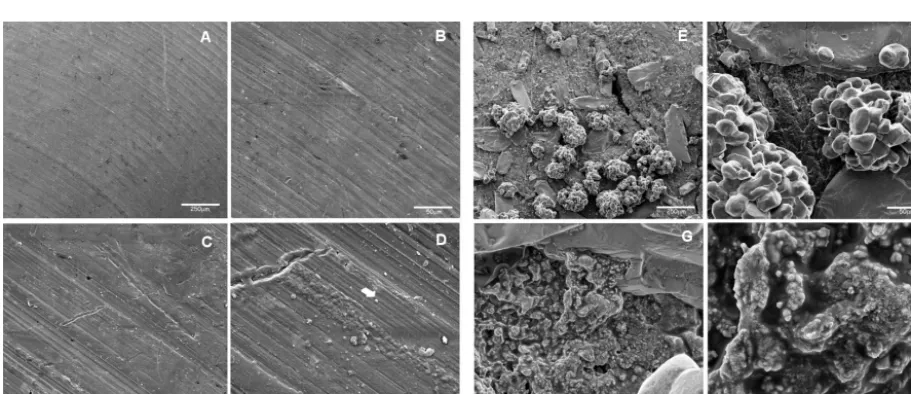
Figure 2.Surface photomicrographs of quasi- and all-solid-state reference electrodes containing 45 %w/wCgraphite/Ag/AgCl (from a to
d) and 3.0 mol kg−1KCl (from e to h), respectively. Magnifications are for (a) and (e) 200×, (b) and (f) 1000×, (c) and (g) 5000×, and (d)
and (h) 20 000×.
tional reference electrode in solutions with different chloride concentrations. The quasi-reference electrodes developed a potential change to concentration of chloride ions above 1×10⁻³mol L−1. Similar behaviour was obtained with ref-erence electrodes made from BQ 164 ink.
Although quasi-reference electrodes have been employed in strips to measure glucose based on amperometric measure-ments (Matsumoto et al., 2002; Mami´nska et al., 2006), these electrodes are not suited for use in potentiometric cells. The stability of the potential of a potentiometric cell must be in-dependent of the concentration of chloride ions in the sample solution. Hence, the response only depends on the ion
se-lective electrode. We added a high concentration of chloride ions, to overcome the problem of the quasi-reference elec-trodes, to the paste of graphite/silver/silver chloride mixed with epoxy resin and hardener. Any value between 1 and 3 mol kg−1 in the paste is acceptable because this concen-tration is about 10 times higher than the one found in real samples (whole blood, for example). Other anions such as sulfate, iodide, and fluoride were also studied. Figure 1b shows the behaviour of these all-solid-state reference elec-trodes containing salts in their formulation.
58 J. C. B. Fernandes and E. V. Heinke: Alternative strategy for manufacturing
Figure 3.Influence of the pH and reducing agent on ASSREs. (A) Curves of pH obtained against ASSREs containing the salts (a) KCl, (b) KCl : SiO2, (c) BaCl2, (d) NaF, (e) Na2SO4, and (f) KI. (B) Curves of potentiometric titration of L-ascorbic acid using indicator electrode of
mercury against ASSREs. Titrant: 0.0125 mol L−1copper (II) sulfate solution. Conditions and results: salts in ASSRE, mass of L-ascorbic acid titrated (in parenthesis), volume of titrant in the end-point and L-ascorbic acid content (%w/w) found (in brackets). (a) KCl (9.1 mg) 4.102 mL [99 %], (b) KCl:SiO2(10.6 mg) 4.911 mL [102 %], (c) BaCl2(10.1 mg) 4.484 mL [98 %], (d) NaF (9.2 mg) 4.136 mL [99 %], (e)
Na2SO4(11.0 mg) 4.800 mL [96 %], (f) KI (10.3 mg) 4.901 mL [105 %]. The measurements were taken at room temperature.
Table 2.pH measured using a glass electrode against an all-solid-state reference electrode containing 1.5 mol kg−1 BaCl2at room
temperature.
pH
Nominal Combined Glass (pH) vs. Relative error*
value electrode Cgraphite/Ag/AgCl, (%)
1.5 mol kg−1BaCl2
2.0 1.88±0.03 1.85±0.08 −1.6 %
3.0 2.97±0.03 3.00±0.07 +1.0 %
4.0 4.03±0.03 4.11±0.06 +2.0 %
5.0 5.08±0.02 5.12±0.04 +0.8 %
6.0 6.00±0.01 6.11±0.03 +1.8 %
7.0 7.12±0.01 7.19±0.02 +1.0 %
8.0 8.15±0.01 8.22±0.01 +0.9 %
9.0 8.89±0.02 9.09±0.01 +2.3 %
10.0 10.01±0.02 10.19±0.01 +1.8 %
11.0 11.25±0.03 11.35±0.03 +0.9 %
* Average of three determinations and standard deviation estimate.
chloride ions. The presence of silica in the paste did not in-fluence the behaviour of the reference electrode containing potassium chloride. Figure 1b reveals that all-solid-state ref-erence electrodes containing other anions also kept a constant potential on the potentiometric cell. The potential change was lower than 5 mV at chloride concentration changes from 1×10⁻⁶to 1×10⁻¹mol L−1.
Figure 2 shows the surface photomicrographs of the refer-ence electrodes obtained by means of scanning electronic mi-croscopy. The white arrow in Fig. 2d illustrates the brilliant silver sub-particles on the surface of quasi-reference elec-trodes that presented diameters smaller than 2.5 µm. Figure 2
(from e to h) also shows the presence of potassium chloride particles on the surface of the all-solid-state reference elec-trode.
Reference electrodes have to satisfy many requirements. These electrodes have to exhibit stable potential at changing pH, redox species, complexing agents, salts and dissolved oxygen. Due to its importance for sterilization purposes, a high resistance to temperature and pressure is sometimes de-sirable too (Guth et al., 2009).
The effect of the pH on all-solid-state reference electrodes is shown in Fig. 3a. Silver ions may form a complex with hy-droxyl ions poisoning the reference electrodes. The potential of the electrochemical cell was slightly affected in extreme regions of pH, but the potential variation within the investi-gated pH range was lower than 15 mV. In these regions, fac-tors such as liquid junction potentials and ionic strength are dependent on the pH and may have contributed to this prob-lem (Feldman, 1956).
We applied the all-solid-state reference electrode contain-ing 1.5 mol kg−1of BaCl2to measure pH using a glass
elec-trode. The analytical performance is described by the follow-ing equation:
1E=(841±6)−(56.0±0.7)pH. (1)
Figure 4.Behaviour of all-solid-state reference electrodes after the sterilization and diffusion process in deionized water during 20 days. Curves obtained in the conditions (A) after sterilization in autoclave with ASSREs containing the salts (a) KCl, (b) KCl:SiO2, (c) BaCl2, (d)
NaF, (e) Na2SO4, and (f) KI. (B) ASSREs containing KCl at 3.0 mol kg−1(a) after sterilization, (b) after diffusion process, and (c) before
everything.
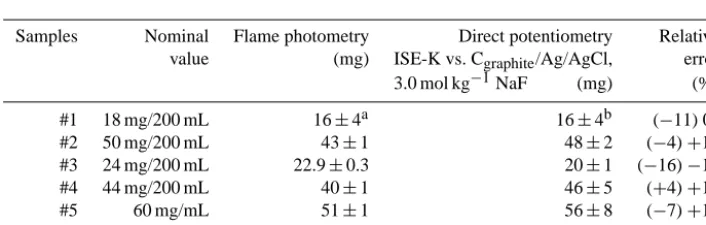
Table 3.Results of the determination of potassium ions in real samples using an all-solid-state reference electrode containing 3.0 mol kg−1 NaF against ion-selective electrodes for potassium (ISE-K).
Samples Nominal Flame photometry Direct potentiometry Relative
value (mg) ISE-K vs. Cgraphite/Ag/AgCl, error
3.0 mol kg−1NaF (mg) (%)
#1 18 mg/200 mL 16±4a 16±4b (−11) 0c
#2 50 mg/200 mL 43±1 48±2 (−4)+12
#3 24 mg/200 mL 22.9±0.3 20±1 (−16)−13
#4 44 mg/200 mL 40±1 46±5 (+4)+15
#5 60 mg/mL 51±1 56±8 (−7)+10
#6 100 mg/5 mL 90±3 99±13 (−1)+10
Sample composition: noncarbonated sports drinks – #1: water, sucrose, potassium dihydrogen phosphate, sodium chloride, citric acid, sodium citrate, natural tangerine flavour, dimethyl carbonate (preservative), calcium disodium EDTA, sunset yellow dye and tartrazine dye. #2: water, sucrose, potassium dihydrogen phosphate, sodium chloride, magnesium sulfate, calcium phosphate, citric acid, sodium benzoate, potassium sorbate, sodium citrate, acacia gum, calcium disodium EDTA and ester gum. #3: water, sucrose, glucose, potassium dihydrogen phosphate, sodium chloride, citric acid, flavouring, sodium citrate, 40 red dye and sunset yellow dye. #4: water, sucrose, potassium dihydrogen phosphate, sodium chloride, citric acid, sodium benzoate, potassium sorbate, arabic gum, natural carambole flavour, sodium citrate, sunset yellow dye, ascorbic acid and calcium disodium EDTA. Syrups; #5: water, potassium chloride, sodium cyclamate, sodium saccharin dihydrate, methylparaben, propylparaben, propylene glycol, hydroxyethyl cellulose, sorbitol, cherry essence and riboflavin phosphate sodium. #6: water, potassium iodide, sodium cyclamate, sodium saccharin, parabens, ethyl alcohol, sorbitol, mint essence, red dye and lobelia extract.aAverage of three determinations and standard deviation estimate.bCalculated by error propagation.c Relative error between direct potentiometry and nominal value (parenthesis) or direct potentiometry and flame photometry.
Another all-solid-state reference electrode was applied to measure potassium ions using an ion selective electrode based on valinomycin as ionophore. Potassium ions were de-termined by direct potentiometry in real samples of noncar-bonated sports drinks and syrups using an all-solid-state ref-erence electrode containing fluoride ions since this anion was not present in the samples. Table 3 shows these results com-pared to flame photometry. The samples presented a complex matrix containing salts, EDTA, dyes and other substances that could affect the all-solid state reference electrode. How-ever, this effect was not observed. The obtained results by
direct potentiometry agree with those determined by flame photometry within an acceptable band of deviation.
60 J. C. B. Fernandes and E. V. Heinke: Alternative strategy for manufacturing
ions was not observed on the all-solid state reference elec-trodes.
The all-solid-state reference electrodes were tested for sterilization in autoclave (Fig. 4a). The reference electrodes were fully functional after sterilization. However, we ob-served that the potential of these electrodes differed from the one measured before sterilization. We believed that this effect occurred due to a change in the structure of the composite, with migration of salt particles to the surface. This hypoth-esis was based on the observation of a white powder on the surface of the electrodes after sterilization, but the potential was independent of the chloride ions concentration.
The leaching out effect of the salt was studied with all-solid-state reference electrodes containing 3.0 mol kg−1KCl submitted to a diffusion process in deionized water for 20 days. We examined this water by means of a silver nitrate solution and we observed the formation of silver chloride precipitate (4.1 mg), which corresponds to 2.1 mg of potas-sium chloride. Every day, about 0.18 % of potaspotas-sium chlo-ride was leached out of the reference electrode. This ref-erence electrode was re-examined in a new potentiometric cell with a commercial reference electrode to measure chlo-ride ions (from 10−6to 10−1mol L−1). Comparing the mea-sures, before and after of the diffusion process, we observed a potential-drift of about 50 mV (Fig. 4). Despite the loss of the chloride ions, this all-solid state reference electrode maintained a constant potential of the potentiometric cell to all range of chloride ions concentration. Therefore, this kind of electrode must be stored in dry conditions.
4 Conclusions
All-solid-state reference electrodes based on particles of graphite/silver/silver chloride, salts and epoxy resin showed good operational characteristics for potentiometry. The po-tential was stable and independent of any chloride ions concentration. These electrodes were not sensitive to abra-sion, redox species, pH and high-pressure saturated steam at 394.15 K (121◦C). Moreover, they can be miniaturized eas-ily by thick film technology since the components can be transformed into an ink.
The strategy of manufacturing by electroless deposition of silver and silver chloride particles on graphite powder is a simple and efficient methodology and does not require the use of a potentiostat.
The results for measuring potassium ions and pH by direct potentiometry or L-ascorbic acid by potentiometric titration indicate that the proposed methodology for manufacturing all-solid-state reference electrodes is very promising.
Author contributions. J. C. B. Fernandes designed the experi-ments and E. V. Heinke carried them out. J. C. B. Fernandes pre-pared the manuscript with contributions from all co-authors.
Acknowledgements. This research was supported in part by FAPESP (2007/556277 process) and by USCS in terms of a scholar-ship to E. V. Heinke. We thank the Centre of Electronic Microscopy from UNIFESP (hhtp://www.unifesp.br/centros/ceme/links.htm) for obtaining photomicrographs. We also thank Denise O. Alonso, USCS, and Peter Sussner, UNICAMP, for the English revision.
Edited by: A. Schütze
Reviewed by: three anonymous referees
References
Cha, G. S., Cui, G., Yoo, J., Lee, J. S., and Nam, H.: Planar reference electrode. U.S. Patent 6,964,734 B2, 2005.
Feldman, I.: Use and Abuse of pH Measurements, Anal. Chem., 28, 1859–1866, 1956.
Fernandes, J. C. B., Kubota, L. T., and Neto, G. O.: Potentiometric sensor for L-ascorbic acid based on EVA membrane doped with copper (II), Electroanal., 11, 475–480, 1999.
Fernandes, J. C. B., Neto, G. O., Rohwedder, J. J. R., and Kubota, L. T.: Simultaneous determination of chloride and potassium in car-bohydrate electrolyte beverages using an array of ion-selective electrodes controlled by a microcomputer, J. Braz. Chem. Soc., 11, 349–354, 2000.
Guth, U., Gerlach, F., Decker, M., Oelßner, W., and Vonau, W.: Solid-state reference electrodes for potentiometric sensors, J. Solid State Electrochem., 13, 27–39, 2009.
Harris, D. C.: Quantitative Chemical Analysis, 7th Edn., WH Free-man and Company, New York, 2007.
Janz, G. J. and Taniguchi, H.: The silver-silver halide electrodes, Chem. Rev., 3, 397–437, 1953.
Jayaweera, P., Passel, T. O., and Millett, P. J.: Solid state reference electrode for high temperature electrochemical measurements, U.S. Patent 5,425,871, 1995.
Koura, N.: Electroless plating of silver, in: Electroless plating: Fun-damentals & Applications, edited by: Mallory, G. O. and Hadju, J. B., 1st Edn., American Electroplaters and Surface Finishers Society, Florida, 441–462, 1990.
Mami´nska, R., Dybko, A., and Wróblewski, W.: All-solid-state miniaturised planar reference electrodes based on ionic liquids, Sens. Actuators B, 115, 552–557, 2006.
Matsumoto, T., Ohashi. A., and Ito, N.: Development of a micro-planar Ag/AgCl quasi-reference electrode with long-term sta-bility for an amperometric glucose sensor, Anal. Chim. Acta, 462, 253–259, 2002.
Rius-Ruiz, F. X., Kisiel, A., Michalska, A., Maksymiuk, K., Riu, J., and Rius, F. X.: Solid-state reference electrodes based on carbon nanotubes and polyacrylate membranes, Anal. Bioanal. Chem., 399, 3613–3622, 2011.
Riyazuddin, P. and Nazer, M. M. A. K.: Potentiometric determi-nation of ascorbic acid in pharmaceutical preparations using a copper based mercury film electrode, J. Pharm. Biomed. Anal., 16, 545–551, 1997.
Rodes, M. L.: Solid state reference electrode, U.S. Patent 7,318,887 B2, 2008.
Shin, J. H., Lee, S. D., Nam, H., Cha, G. S., and Bae, B. W.: Minia-turized solid-state reference electrode with self-diagnostic func-tion, US Patent 6,554,982B1, 2003.
Sorensen, P. R. and Zachau-Christiansen, B.: Electrode device with a solid state reference system, U.S. Patent 2004/0163949 A1, 2004.
Suzuki, H., Hirakawa, T., Sasaki, S., and Karube, I.: Micromachined liquid-junction Ag/AgCl reference electrode, Sens. Actuators B, 46, 146–154, 1998.
Suzuki, H., Shiroishi, H., Sasaki, S., and Karube, I.: Microfabri-cated liquid junction Ag/AgCl reference electrode and its ap-plication to a one-chip potentiometric sensor, Anal. Chem., 71, 5069–5075, 1999.
Tymecki, L., Zwierkowska, E., and Koncki, R.: Screen-printed ref-erence electrodes for potentiometric measurements, Anal. Chim. Acta, 526, 3–11, 2004.
Valdés-Ramírez, G., Ramírez-Silva, M. T., Palomar-Pardavé, M., Romero-Romo, M., Álvarez-Romero, G. A., Hernández-Rodríguez, P. R., Marty, J. L., and Juárez-García, J. M.: De-sign and construction of solid state Ag/AgCl reference elec-trodes through electrochemical deposition of Ag and AgCl onto a graphite/epoxy resin-based composite. Part 1: Electrochemical deposition of Ag onto a graphite/epoxy resin-based composite, Int. J. Electrochem. Sci., 6, 971–987, 2011.