Aspects and Roles in Software Modeling: A Composition
Based Comparison
Valentino Vrani´c and Milan Laslop
Institute of Informatics and Software Engineering Faculty of Informatics and Information Technologies
Slovak University of Technology in Bratislava Ilkoviˇcova 2, 84216 Bratislava, Slovakia
[email protected], [email protected]
Abstract. It’s intriguing how the work on inherent aspect-oriented modeling al-most completely ignores the similarity between aspect-oriented and role based de-composition and de-composition. Ever since the notion of aspect entered the software development arena, it has been compared to the notion of role. Findings range from identifying greater similarities to more cautious observations that albeit aspects and roles are similar, they appear to be more as complimentary with a significant effort needed to really bring them together in programming. Even a cursory compari-son of Theme/UML, which represents a design part of Theme, probably the best known and most comprehensive approach to aspect-oriented modeling, to OOram, a prominent representative of approaches to role based modeling that influenced UML, reveals striking similarities in both decomposition and composition. Within a more comprehensive effort of finding the principles of a sustainable approach to aspect-oriented modeling, this paper pursues further this observation by establishing a partially reversible transformation of a Theme/UML model to the corresponding OOram model that proves principal analogy of themes to OOram collaboration view diagrams accompanied by the corresponding scenario view and interface view dia-grams. An important implication is that aspects have their counterpart not in roles themselves, but in role collaboration. Based on these results, a possibility of using UML composite structure diagrams for aspect-oriented design is sketched out in the paper.
Keywords:aspect-oriented modeling, aspect, role, transformation, Theme/UML, OOram, UML, composite structure.
1.
Introduction
This is probably more remarkable in symmetric aspect-oriented approach where ev-erything is decomposed into the units of one kind each of which covers only a specific aspect or view. These views recallroles. Roles extend functionality of objects enabling them to fit into different contexts, perform (play) the corresponding functionality, and take the effect into their inherent structure.
Roles are usually expected to have the capability of being added, removed, or replaced at runtime [15], and this is not intrinsic to aspects, though there are several approaches targeting dynamic aspect weaving [28]. However, from the perspective of modeling, this is not a critical difference. Moreover, the technology improvement or aspect-oriented im-plementations in dynamic environments are likely to change this in the future. It is in-teresting that even in their mainstream form aspects can be used—though statically—to enforce roles. The way to achieve this is embodied in the Director design pattern [25].
The close relationship of aspects and roles has been known for some time. There have been attempts to unify two concepts [15], to model aspects with roles [12], or to show how role systems are a special kind of aspect-oriented systems [14]. On the other hand, it’s intriguing how the work on inherent aspect-oriented modeling almost completely ignores the similarity between aspect-oriented and role based decomposition and composition. While it is true that the similarity of Theme/UML, which represents a design part of Theme, probably the best known and most comprehensive approach to aspect-oriented modeling, to OOram, a prominent representative of approaches to role based modeling, has been observed in the initial work on Theme/UML, known at that time as composition patterns [8, 9], later work pays no attention to this [2, 7, 32].
Indeed, even a cursory comparison of Theme/UML with OOram reveals striking sim-ilarities in both decomposition and composition. This paper pursues further this observa-tion by establishing a partially reversible transformaobserva-tion of a Theme/UML model to the corresponding OOram model within a more comprehensive effort of finding the princi-ples of a sustainable approach to aspect-oriented modeling. Given the fact that OOram has had significant impact on the UML’s part known as composite structure [26], this effort is likely to have a more immediate effect on aspect-oriented modeling in a broader sense of so-called advanced modularization. Such models could be based on pure UML employ-ing its advanced features to achieve advanced modularization while beemploy-ing decoupled from implementation presumptions making them applicable in the context of object-oriented, aspect-oriented, or role based implementation.
2.
Symmetry in Aspect-Oriented Programming
If an approach to software modeling is to serve as a basis for an effective implementation in a range of programming approaches, it has to take a broader perspective that embraces at least all known potential target implementation approaches. Aspect-oriented program-ming is usually identified with the AspectJ style of programprogram-ming, known also as PARC aspect-oriented programming, where the aspects, as separate modularization units, affect the base object-oriented or other aspect code using sophisticated constructs, known as pointcuts, to address the points to be affected, known as join points, by the code provided in these aspects, known as advice. The complexity of such programming lies in effectively forming pointcuts out of the primitive ones. In AspectJ, this pointcut language comprises more than twenty primitive pointcuts each of which has also its annotation based variant. In the AspectJ style of aspect-oriented programming, aspects are asymmetric with respect to the code they affect. One side of this asymmetry lies in aspects being a dif-ferent kind of elements than classes. They may affect aspects, too, but some classes are necessary for a program to be executable. This is element asymmetry [16, 5, 4]. There is also relationship asymmetry: relationships among aspects and classes are defined by aspects exclusively in the form of pointcuts. Technically, in AspectJ, classes can contain pointcuts, but these can’t be put into effect without the advice code.
The AspectJ style of aspect-oriented programming has undoubtedly had some influ-ence in practice [19]. Although this style is asymmetric, inter-type declarations and advice can be used to emulate symmetric aspect-oriented programming [5], though this is proba-bly rarely used in practice. While academic programming languages promoting symmet-ric aspect-oriented programming can’t be said to have been ever used in practice, several popular programming languages like Scala, Ruby, or JavaScript make possible to program in a symmetric aspect-oriented way using the specific language mechanisms they bring: traits, open classes, and prototypes, respectively [5]. The importance of the interplay of asymmetric and symmetric aspect-oriented programming is apparent in use cases as a technique of choice for the initial modeling of interactive software systems (today popular user stories may be seen as their lightweight form [10]) with the extend relationship corre-sponding to asymmetric aspect-oriented programming and peer use cases correcorre-sponding to symmetric aspect-oriented programming [5, 17]. Consequently, it makes sense to ex-plore the possibilities of providing a corresponding design level modeling approach that will serve as a basis for both asymmetric and symmetric aspect-oriented programming.
3.
Theme/UML
Theme/UML is a UML based approach to aspect-oriented design. It is a part of the Theme approach [7], whose other part called Theme/Doc covers aspect-oriented analysis. Atheme, a central notion to both parts of the approach, is actually a modeling represen-tation of a concern. In Theme/UML, a theme is modeled as a package with the «theme» stereotype. Such a package may contain several structural and behavioral diagrams that together describe a particular view of a system. The overall system is obtained by theme composition.
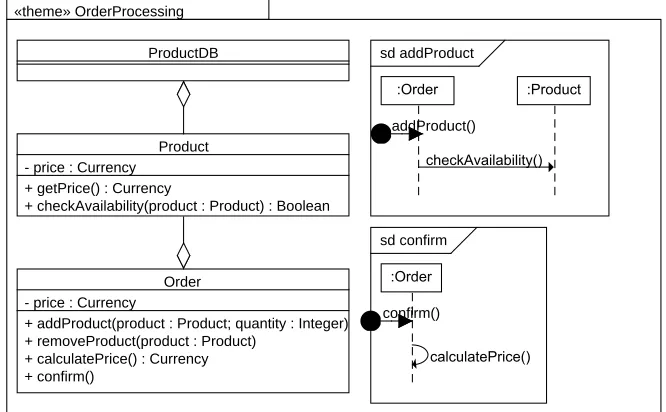
Each order contains products selected from the product database.1 Other concerns, such
as customer sign up, traffic statistics, or even product database content management, rep-resent separate concerns not included in this theme. Thereafter, the definitions of classes contained in the theme are partial. For example, theProduct class contains no operations related to manipulating basic product information.
«theme» OrderProcessing
confirm() sd addProduct
addProduct()
sd confirm
Order - price : Currency
+ addProduct(product : Product; quantity : Integer) + removeProduct(product : Product)
+ calculatePrice() : Currency + confirm()
Product - price : Currency
+ getPrice() : Currency
+ checkAvailability(product : Product) : Boolean ProductDB
Fig. 1.A base theme.
Accordingly, behavior in themes is limited to a particular concern. Operations related to orderOrderProcessingembraceaddProduct() andconfirm() that enable a product to be added to an order and to confirm that order, respectively, are presented using sequence diagrams. Themes allow for other behavioral diagrams, too, which is out of the scope of this paper.
The basic setting of order processing abstracts from the information on possible bonus-es related both to adding a product and to order confirmation: a special free product is added whenever a customer adds a particular product or when the total price of the order is higher than a certain amount. Bonuses actually may be applicable in other cases, too. A general case is captured as theBonusProvidingtheme in Fig. 2. In the Theme vocabulary, this is an aspect theme, while theOrderProcessingtheme from Fig. 1 is a base theme.
Aspect themes are parameterized and their behavior is defined with respect to for-mal parameters. InOrderProcessing there are two parameters—two operations: Bonus-Requester.op()andBonusRequester.provideBonus(). The first operation in the parameter list is always the trigger: an operation to be “caught” by the theme. Additional behavior is specified in a sequence diagram that redefines this operation (operation parameter lists
1
<BonusRequester.op(), BonusRequester.provideBonus()>
BonusDB
+ bonusAvailable(type : String) : Boolean «theme» BonusProviding
sd op
alt [bonus available] op()
BonusRequester
+ op()
+ provideBonus()
Fig. 2.An aspect theme.
are omitted for brevity). However, the original operation is preserved and available to be executed under a different name that consists of the_do_prefix attached to the original operation name.
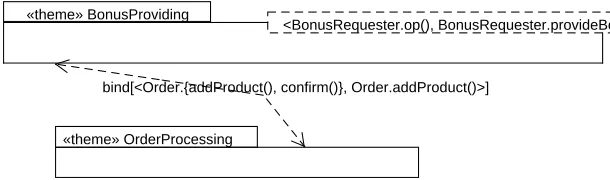
The actual operations are supplied during theme composition via thebind clause.2
This asymmetric aspect-oriented composition is depicted in Fig. 3.
bind[<Order.{addProduct(), confirm()}, Order.addProduct()>]
«theme» OrderProcessing «theme» BonusProviding
<BonusRequester.op(), BonusRequester.provideBonus()>
Fig. 3.A composition of an aspect theme with a base theme.
Note that any class referred to by the theme parameter list is automatically a parameter class. In Theme/UML terminology, such class is a placeholder: it just stands for a real class to be supplied during parameter binding.
The behavior prescribed byBonusProviding is performed both in the context of the
addProduct()andconfirm()operations of theOrderclass. In both cases, theaddProduct()
operation is supplied also as the operation by which the bonus is provided. Figure 4 shows how theaddProduct()operation would look like after being affected by the BonusProvid-ingtheme.
2
sd addProduct
alt [bonus available] addProduct()
Fig. 4.TheaddProduct()operation as affected byBonusProviding.
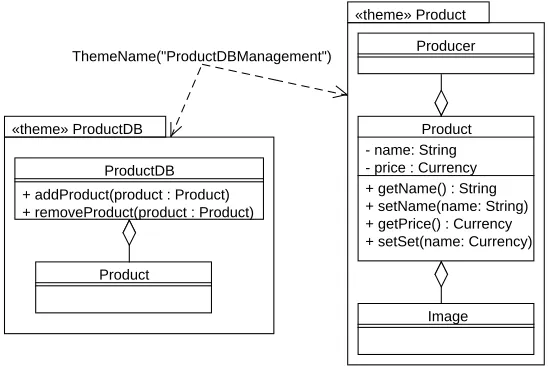
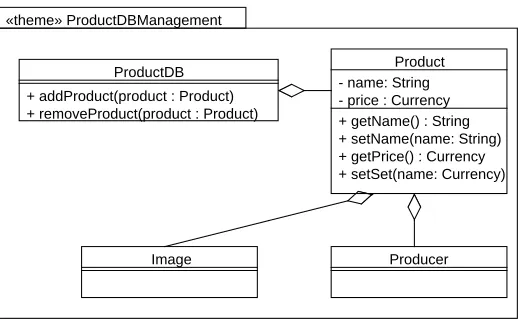
Theme/UML supports symmetric aspect-oriented composition, too. Figure 5 shows this case. TheProductDB theme covers the fundamentals of product storing, while the details of a product are covered by theProduct theme. Both themes are base themes, yet they are complementary and as such can be composed. In composition, themes can be merged or one theme may override another, which is indicated by the composition arrow (bidirectional or unidirectional, respectively). In this case, themes are merged, where de-fault is to match elements by name. The resulting theme is shown in Fig. 6. Theme/UML enables full control of the composition at the level of individual class elements.
ThemeName("ProductDBManagement") Producer
Image Product - name: String - price : Currency + getName() : String + setName(name: String) + getPrice() : Currency + setSet(name: Currency) «theme» Product
«theme» ProductDB
Product ProductDB
+ addProduct(product : Product) + removeProduct(product : Product)
Producer Image
Product - name: String - price : Currency + getName() : String + setName(name: String) + getPrice() : Currency + setSet(name: Currency) ProductDB
+ addProduct(product : Product) + removeProduct(product : Product) «theme» ProductDBManagement
Fig. 6.A composed theme.
4.
OOram
OOram—Object-Oriented Role Analysis and Modeling—is a role-based method of object-oriented software development proposed by Trygve Reenskaug, who phrased the famous Model-View-Controller pattern. OOram influenced UML to incorporate the concept of role in composite structure and the notion of collaborations [26]. Ten years prior to Theme, OOram included ideas of separating and modularizing concerns and building more complex ones via composition [31, 7].
It is important to note that OOram is not a mere modeling exercise. In fact, the actual program realization has been at its heart from the beginning [31] and the foundations laid in OOram appear as very relevant for achieving a necessary flexibility in code as demonstrated by the DCI approach (Data, Context and Interaction), in which roles and role binding are used to depart use cases from more stable parts of software systems [10, 30, 11]. This is of the utmost interest in the broader area of preserving use cases in code [6, 18, 24].
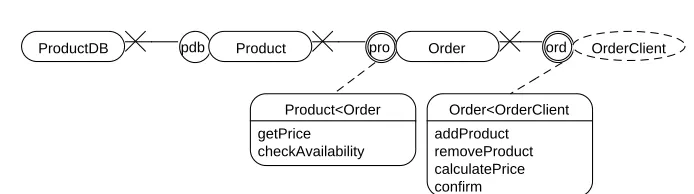
OOram employs several views of a model. One of them is the interface viewthat shows roles in collaboration with interfaces through which they collaborate. The struc-tural part of a theme fits quite well into this representation. The classes in themes are not full-fledged classes, but partial ones containing only elements necessary with respect to the concern modularized by the theme they belong to. Figure 7 presents the structural part of theOrderProcessingtheme from Fig. 1 rewritten as an OOram interface view. The Or-derClientrole represents a so-called environmental role, depicted as a dashed oval, which is used to express an expected client role to be defined by some further role composition. The client role is required by the OOram notation soOrdercan provide the corresponding interface to it (Order<OrderClientin this case).
OrderClient ord
Order Product
ProductDB
Order<OrderClient
addProduct removeProduct calculatePrice confirm Product<Order
getPrice checkAvailability
pdb pro
Fig. 7.An OOram interface view diagram.
role can send messages to multiple instances. Where there is no communication possible, a cross is displayed instead of a circle.
Interfaces are attached to ports. They contain operations the role expects to be pro-vided by the role at the opposite side of the edge. For example, anOrderexpects aProduct
to provide an interface denoted asProduct<Ownerby which it would be able to perform operationsgetPriceandcheckAvailability.
Thescenario viewshows a sequence of interactions among roles. It is quite similar to rudimentary UML sequence diagrams accompanied by chunks of text specification used to explain what is in sequence diagrams usually expressed by combined fragments, so no example is given here.
Thecollaboration viewis virtually the same as the interface view without showing the actual interfaces. The composition of role models is usually expressed using the col-laboration view. This composition is similar to theme composition. Figure 8 mimics the structural part of the theme composition defined in Fig. 3. Each theme corresponds to a separate model. The resulting model consists of the rolesderivedfrom the roles in initial models. Deriving is expressed by wide arrows on a per role basis. In general, roles can be derived from multiple initial roles. An example of this is theBonusRequesterrole derived from bothOrderandBonusRequester.
Of course, the structural part isn’t sufficient to express the composition. The behav-ioral side is captured by composing scenario view diagrams. In the composition under consideration one of such composed scenario view diagrams would principally depict the same as the sequence diagram in Fig. 4. Compared to Theme/UML, in which composi-tions are defined via thebindclause, in OOram they have to be expressed explicitly.
5.
Transformation from Theme/UML to OOram
Even a cursory comparison of the examples given in the previous two sections reveals that Theme/UML and OOram are similar. As we saw, both Theme/UML and OOram involve a similar process of modeling aiming at the separation of concerns. Concerns are modularized as themes in Theme/UML with each one presented (literally) as a package of the corresponding structural and behavioral models. In this, OOram relies on the notion of role model comprising of several views not necessarily displayed at once, but intended to be perceived as a whole.
OrderClient
OrderClient ord
OrderWithBonus Product
ProductDB pdb pro
ord Order
Product
ProductDB pdb pro
BonusDB
BonusDB BonusRequester
log
log
OrderProcessingWithBonus
BonusProviding
OrderProcessing
Fig. 8.Synthesis of role models.
views express the system structure and interfaces, which is similar to UML class diagrams used in Theme/UML.
In this and the following section, a more thorough comparison of Theme/UML and OOram is going to be provided by defining a transformation process of a model in The-me/UML model into an equivalent one in OOram and back. Effectively, this is going to give more practical insight on concepts of aspect and role and how they are related to each other.
The key to a correct transformation is to take elements in relationships. Let’s first take a look at how could a base and aspect theme composition be transformed into OOram. Recall our web application example from Section 3. The structural part (class diagrams) of themes can be mapped to the OOram interface view as exemplified by the OOram diagram in Fig. 7 as a transformation of theOrderProcessingbase theme from Fig. 1 and the diagram in Fig. 2 as a transformation of theBonusProvidingaspect theme contained in Fig. 8 with suppressed interfaces. The behavioral part expressed by sequence diagrams remains practically the same (omitted here).
Next, a composition of the OOram diagrams matching the original Theme/UML com-position has to be created. In creating a merged role diagram displayed in Fig. 8, theOrder
Order-WithBonus.OrderWithBonus is derived from bothOrder andBonusRequester and as such occurs in the relationships each of these roles has to other roles.
The base theme composition is transformed into OOram in a similar manner as a base and aspect theme composition. The themes are mapped to OOram diagrams the same way that has been demonstrated and the composition of two collaboration view diagrams corresponding to base themes is similar to the composition of the original base themes: the common roles are identified and the diagrams are merged, showing the common role only once.
In general, the transformation of a Theme/UML model into the corresponding OOram model involves these steps:
1. Create an interface view diagram for the structural part (class diagram) of each theme (as an example consider the OOram diagram in Fig. 7 as a transformation of the
OrderProcessingbase theme from Fig. 1 and theBonusProvidingrole collaboration in the diagram in Fig. 8, with suppressed interfaces, as a transformation of the aspect theme with the same name depicted in Fig. 2).
(a) Create a role for each class.
(b) Since classes tend to be wider in scope than roles, one class can be divided into several fragments according to its relationships (association) to other classes. Create a role for each such fragment.
(c) Name each role. In the roles that correspond to whole classes, the name of the role is simply the name of the class. The names of the roles created from class fragments should reflect the relationship semantics according to which they have been created.
(d) By this, the collaboration diagrams have been obtained. Determine the inter-faces between the roles according to the methods provided by the corresponding classes. Include any environmental role as required by OOram.
2. Create a scenario view diagram for the behavioral part (sequence diagram) of each theme that describes the interaction among the roles identified in step 1
(a) The original interactions from the sequence diagram are preserved and attached to the roles corresponding to the classes from the sequence diagram.
(b) In the roles created by class decomposition, the proper role to appear in the sce-nario view diagram has to be determined according to the operations being em-ployed.
3. For each base theme composition create the composition of the corresponding col-laboration view diagrams the result of which is a new colcol-laboration view diagram. (a) The correspondence of roles is determined by the correspondence of classes
de-fined by themergeoroverride clause.
(b) Consequently, the roles corresponding to the classes that correspond to each other (in the default composition this is by name, but in general, defined by themerge
or override clause) will be derived from these corresponding roles. Determine their names so to reflect their combined semantics.
(c) The roles corresponding to the non-composed classes are to be simply transferred into the resulting collaboration view diagram.
4. Create the appropriate scenario view diagrams for each new collaboration view dia-gram that corresponds to a base theme composition.
(b) For related operations, the composed scenario view diagrams have to be created according to the correspondingmergeoroverride clause.
5. For each aspect and base theme composition create the composition of the corre-sponding collaboration view diagrams the result of which is a new collaboration view diagram (an example is provided in Fig. 8, which represents a transformation of the theme composition presented in Fig. 3).
(a) The correspondence of roles is determined by the correspondence of classes de-fined by thebindclause.
(b) Consequently, the roles corresponding to the base theme classes affected by the aspect theme will be derived from several corresponding roles. Determine their names so to reflect their combined semantics.
(c) The unaffected roles corresponding to the base theme classes and the roles cor-responding to the classes added by the aspect theme will be derived directly just from these roles preserving their names or making them specific to the new con-text of the collaboration view diagram being created.
6. Create the appropriate scenario view diagrams for each new collaboration view dia-gram that corresponds to a composition of an aspect and base theme
(a) The unrelated operations are simply transferred as such.
(b) For related operations, the composed scenario view diagrams have to be created according to the correspondingbindclause.
The transformation confirms what we have already observed from examples. If we understand a theme as an aspect in the broader sense of this notion covering both sym-metric and asymsym-metric perspective, an aspect corresponds not to one role as could have been expected, but to a collaboration of roles.
6.
Reverse Transformation
Unlike Theme/UML with its packages, OOram provides no explicit construct that will serve as a container to all the artifacts relevant to a particular concern. However, collab-oration view diagrams are effectively the main entry point into the role model around which all other diagrams are based, so in our effort to define the transformation of an OOram model into the corresponding Theme/UML model, we are going to rely on this observation.
While Theme/UML records the composition in a declarative form, OOram records it in a constructed form, i.e., as another collaboration view diagram accompanied by the corresponding interface view diagram and scenario view diagrams. Thus, in a transfor-mation from OOram to Theme/UML only initial, non-composed collaboration view di-agrams should be regarded as themes. All other, composed collaboration view didi-agrams are actually specifications of compositions and as such have to be transformed into theme compositions.
based on how are aspect and base theme composition usually applied. Aspect themes are applied in more complicated cases heavily affecting behavioral side, while base theme composition is used mainly to interleave partial class definitions without actually compos-ing operations with each other. Consequently, aspect theme composition tends to produce combined scenario view diagrams.
Roughly, the transformation of an OOram model into the corresponding Theme/UML model can be achieved as follows:
1. Create a theme out of each non-composed collaboration view diagram and accompa-nying interface view and scenario view diagrams (an example of this are the Order-Processingbase theme from Fig. 1, viewed as a transformation of the OOram diagram in Fig. 7, and theBonusProvidingtheme in Fig. 2, viewed as a transformation of the role collaboration with the same name depicted in Fig. 2). For each theme represented as a (non-parameterized) package, transform the collaboration view diagram and re-spective interface view diagrams into a class diagram (some roles may be merged into a single class) and transform each scenario view diagram into a sequence diagram. 2. Create a specification of theme composition out of each composed collaboration view
diagram and accompanying interface view and composed scenario view diagrams. This will yield the corresponding merge or bind clause (an example of this can be seen in the theme composition presented in Fig. 3, viewed as a transformation of the composed collaboration view diagram depicted in Fig. 8).
3. Along with step 2, adjust the packages of the themes estimated as aspect themes to be parameterized. For each such theme, determine the parameter list based on how are the corresponding roles involved in compositions.
7.
Discussion and Outlook
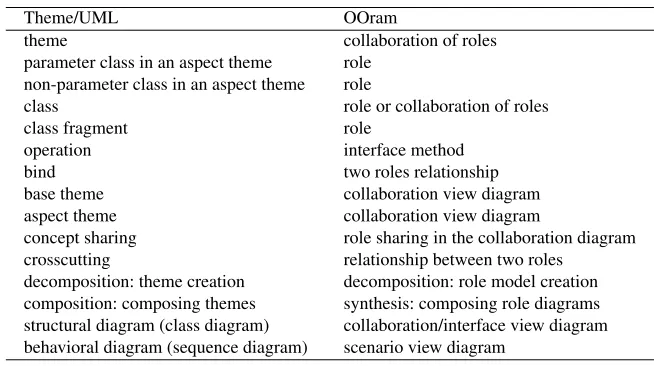
Table 1 summarizes the corresponding notions in Theme/UML and OOram.
Table 1.The corresponding notions in Theme/UML and OOram.
Theme/UML OOram
theme collaboration of roles
parameter class in an aspect theme role non-parameter class in an aspect theme role
class role or collaboration of roles
class fragment role
operation interface method
bind two roles relationship
base theme collaboration view diagram
aspect theme collaboration view diagram
concept sharing role sharing in the collaboration diagram crosscutting relationship between two roles
When comparing aspects and roles in isolation according to their main properties, an aspect might seem to correspond to a role. However, the comparison based on the transformation of models clearly showed that if we understand a theme as an aspect in the broader sense of this notion covering both symmetric and asymmetric perspective, an aspect corresponds to a collaboration of roles, which is represented by a collaboration view diagram in Theme/UML. Aspect composition then corresponds to the composition of role collaborations.
The full interchangeability of OOram and Theme/UML would have been proven if a reversible transformation could have been established. A reversible transformation (the original model can be reconstructed from the one it has been transformed into) would guarantee that no information is lost during the transformation confirming that both ap-proaches have an equal power of expression. However, the transformation shown in this paper can’t be considered fully reversible, because the information whether a composition is symmetric or asymmetric is lost in OOram and when performing the reverse transfor-mation (from OOram back to Theme/UML) this infortransfor-mation can be reconstructed only with some probability.
To some extent, the tendency of asymmetric aspect-oriented composition to affect many places at once, which is known as quantification, can be of help in deciding the symmetry of role composition. This can be observed even at the structural level: if the matching role in the composition at some level of specialization has a relationship to several different roles, then probably an asymmetric composition is in case. However, even if this doesn’t hold, the asymmetric composition can still be used, e.g., to prepare a crosscutting concern involved only in one place to be applicable to other places, too.
With respect to quantification, it is worthwhile noting that OOram lacks any kind of quantification mechanism, while Theme/UML supports these by enabling multiple ele-ment specification [7], which is based on using regular expressions in name signatures in a similar way as they are is used in AspectJ.
It is worthwhile observing that the composite structure diagrams in UML strongly re-call collaboration view and interface view diagrams of OOram. This can be a basis for a common approach to expressing role and aspect-oriented models in a standard UML. Figure 9 depicts the composition of role models captured as collaborations. In UML, a
collaboration, depicted as a dashed ellipse, describes some aspect of the cooperation of certain instances, depicted as rectangles [27]. The instances in this case representroles. A role can be derived from another role. A role derived from more than one role conse-quently represents their composition.
«derive» «derive»
BonusDB «derive» «derive»
«derive»
BonusDB BonusRequester
OrderWithBonus Product
ProductDB
OrderProcessingWithBonus
BonusProviding Order Product
ProductDB
OrderProcessing
Fig. 9.Composition of role models in UML.
8.
Related Work
As has been mentioned in the introduction, the similarity of Theme/UML to OOram has been observed in the initial work on Theme/UML [8, 9]. Theme merging in The-me/UML, i.e., symmetric aspect-oriented composition, has been related to role composi-tion in OOram, but no further elaboracomposi-tion of this has been provided, neither the themes have been explicitly related to roles.
Hanenberg et al. base their assessment of roles from the aspect-oriented perspective in how both aspect and roles may enhance a given set of objects with additional features and may influence their dynamic behavior [14], which corresponds to the asymmetric understanding of aspects. This paper takes a broader perspective that incorporates the symmetric aspect-oriented approach.
Hanenberg and Unland—again in the asymmetric manner—compare characteristics of aspects and roles concluding they are not the same [15]. They also explored how aspects and roles can be used together in AspectJ finding this to be of a questionable usability.
application, as Rashid and Moreira point out, obliviousness is not an essential property of aspects [29].
Graversen and Østerbye argue that a role can’t define an aspect since it is a crosscut-ting concern and as such affects multiple entities [12]. This is known as quantification and has also been disputed as an essential property of aspects [29]. Nevertheless, Graversen and Østerbye claim that because of inability of roles to affect multiple entities, a set of roles is necessary to define an aspect. This is exactly opposite to the findings of this paper where an aspect is seen as a collaboration of roles.
The comparison of Theme/Doc, the analytical part of the Theme approach, with use cases [36] has revealed that analytical themes correspond to use cases. This is in accor-dance with Jacobson and Ng’s approach of aspect-oriented software development based on use cases [17]. While Jacobson and Ng do carry use cases a step further in modeling and capture their realization as collaborations, which represent a concept that belongs to composite structure mentioned in the previous section, they don’t discuss the possibility of the composition of these collaborations.
Apel et al. [1] compare the possibilities of implementing aspects as roles with respect to the asymmetric style of aspect-oriented implementation. They conclude that aspects in asymmetric aspect-oriented programming can serve as role implementations both on individual basis, i.e., one aspect per role, or having each collaboration of roles captured by an aspect, finding the latter to be very similar to their so-called feature oriented pro-gramming language Jak, which embraces elements of role based propro-gramming. Jak is actually an attempt at providing symmetric aspect-oriented programming, as the authors themselves admit:
Note that we do not consider symmetric AOP approaches [57] (for example, subject-oriented programming [56], [92] or aspectual components [68]) since they are much closer (if not similar) to our notion of FOP than to our notion of AOP.
This is consistent with our findings regarding the relationship between aspect and role in modeling as a higher level of abstraction, which—referring back to programming—can be stated as follows: aspects in both asymmetric and symmetric aspect-oriented program-ming can be seen as role collaborations.
In our discussion of symmetry in aspect-oriented programming, we haven’t taken into account join point symmetry. As conceived by Harrison et al. [16], join point symmetry is defined only in the sense of static aspect-oriented composition (that can be performed on lexical basis), so it is of a limited applicability to contemporary aspect-oriented ap-proaches [5].
9.
Conclusion and Further Work
The main difference between Theme/UML and OOram is that symmetry or asymme-try of composition, which is supported explicitly in Theme/UML, disappears in OOram. Another important difference is that Theme/UML is more declarative in representing composition making it easier to maintain it, while OOram is very explicit in its graph-ical expression of composition based on resulting (composed) diagrams. Despite these differences, the study presented in this paper brings us to the conclusion that aspects both in their symmetric and asymmetric understanding have their counterpart not in the roles themselves, but in role collaboration.
Yet another important finding is that composite structure diagrams in UML strongly recall collaboration view and interface view diagrams of OOram. This a logical direction for further work: reestablishing aspect-oriented modeling at the design stage on the basis of composite structure diagrams.
Acknowledgments.The work reported here was supported by the Scientific Grant Agency of Slo-vak Republic (VEGA) under the grant No. VG 1/1221/12. This contribution/publication is also a partial result of the Research & Development Operational Programme for the project Research of Methods for Acquisition, Analysis and Personalized Conveying of Information and Knowledge, ITMS 26240220039, co-funded by the ERDF.
References
1. Apel, S., Leich, T., Saake, G.: Aspectual feature modules. IEEE Transactions on Software Engineering 34(2), 162–180 (2008)
2. Baniassad, E.L.A., Clarke, S.: Theme: An approach for aspect-oriented analysis and design. In: Proceedings of the 26th International Conference on Software Engineering, ICSE 2004. Edinburgh, UK (2004)
3. Bebjak, M., Vrani´c, V., Dolog, P.: Evolution of web applications with aspect-oriented de-sign patterns. In: Brambilla, M., Mendes, E. (eds.) Proceedings of ICWE 2007 Work-shops, 2nd International Workshop on Adaptation and Evolution in Web Systems Engineer-ing, AEWSE 2007, in conjunction with 7th International Conference on Web EngineerEngineer-ing, ICWE 2007. pp. 80–86. Como, Italy (Jul 2007)
4. Bálik, J., Vrani´c, V.: Sustaining composability of aspect-oriented design patterns in their sym-metric implementation. In: 2nd International Workshop on Empirical Evaluation of Software Composition Techniques, ESCOT 2011, at ECOOP 2011. Lancaster, UK (2011)
5. Bálik, J., Vrani´c, V.: Symmetric aspect-orientation: Some practical consequences. In: Proceed-ings of NEMARA 2012: International Workshop on Next Generation Modularity Approaches for Requirements and Architecture, at AOSD 2012. ACM, Potsdam, Germany (2012) 6. Bystrický, M., Vrani´c, V.: Preserving use case flows in source code. In: Proceedings of 4th
East-ern European Regional Conference on the Engineering of Computer Based Systems, ECBS-EERC 2015. IEEE, Brno, Czech Republic (2015)
7. Clarke, S., Baniassad, E.: Aspect-Oriented Analysis and Design: The Theme Approach. Addison-Wesley (2005)
8. Clarke, S., Harrison, W., Ossher, H., Tarr, P.: Subject-oriented design: Towards improved align-ment of requirealign-ments, design and code. In: Proceedings of 14th ACM SIGPLAN Conference Object-Oriented Programming, Systems, Languages, and Applications, OOPSLA’99. Denver, Colorado, USA (1999)
10. Coplien, J., Bjørnvig, G.: Lean Architecture: for Agile Software Development. Wiley (2010) 11. Coplien, J.O., Reenskaug, T.: The data, context and interaction paradigm. In: Proceedings of
3rd Annual Conference on Systems, Programming, and Applications: Software for Humanity, SPLASH ’12. pp. 227–228 (2012)
12. Graversen, K.B., Østerbye, K.: Aspect modelling as role modelling. In: Proceedings of OOP-SLA ’02 Workshop on Tool Support for Aspect Oriented Software Development (2002) 13. Gregoroviˇc, L., Polášek, I., Sobota, B.: Software model creation with multidimensional UML.
In: Proceedings of of International Conference on Research and Practical Issues of Enterprise Information Systems, CONFENIS 2015, 23rd IFIP World Computer Congress International Conference on Research and Practical Issues of Enterprise Information Systems. LNCS 9357, Springer, Daejeon, Korea (2015)
14. Hanenberg, S., Stein, D., Unland, R.: Roles from an aspect-oriented perspective. In: Proceed-ings of VAR’05: Views, Aspects and Roles Workshop, ECOOP 2005. Glasgow, UK (2005) 15. Hanenberg, S., Unland, R.: Roles and aspects: Similarities, differencies, and synergetic
poten-tial. In: Proceedings of 8th International Conference on Object-Oriented Information Systems, OOIS 2002. Montpellier, France (Sep 2002)
16. Harrison, W.H., Ossher, H.L., Tarr, P.L.: Asymmetrically vs. symmetrically organized paradigms for software composition. Tech. Rep. RC22685, IBM Research (Dec 2002) 17. Jacobson, I., Ng, P.W.: Aspect-Oriented Software Development with Use Cases.
Addison-Wesley (2004)
18. Khelifi, N.Y., ´Smiałek, M., Mekki, R.: Generating database access code from domain models. In: Proceedings of 2015 Federated Conference on Computer Science and Information Systems, FedCSIS 2015, 5th Workshop on Advances in Programming Languages, WAPL 2015. IEEE, Łód´z, Poland (2015)
19. Laddad, R.: A real-world perspective of aop. Transactions on Aspect-Oriented Software De-velopment VIII (2011)
20. Laddad, R.: Abstract syntax driven approach for language composition. Central European Jour-nal of Computer Science 4(3), 107–117 (2014)
21. Lang, J., Jantošoviˇc, M., Polášek, I.: Re-usability in complex event pattern monitoring. In: Proceedings of IEEE 10th Jubilee International Symposium on Aplied Machine Intelligence and Informatics, SAMI 2012. IEEE, Herl’any, Slovakia (2012)
22. Lang, J., Jánik, J.: Reactive distributed system modeling supported by complex event process-ing. In: Proceedings of 3rd Eastern European Regional Conference on the Engineering of Com-puter Based Systems, ECBS-EERC 2013. IEEE ComCom-puter Society, Budapest, Hungary (2013) 23. Menkyna, R., Vrani´c, V.: Aspect-oriented change realization based on multi-paradigm design with feature modeling. In: Proceedings of 4th IFIP TC2 Central and East European Conference on Software Engineering Techniques, CEE-SET 2009, Revised Selected Papers. LNCS 7054, Springer, Krakow, Poland (2012)
24. ´Smiałek, M., Nowakowski, W., Jarz˛ebowski, N., Ambroziewicz, A.: From use cases and their relationships to code. In: Proceedings of 2nd IEEE International Workshop on Model-Driven Requirements Engineering, MoDRE 2012. IEEE, Chicago, IL, USA (2012)
25. Miles, R.: AspectJ Cookbook. O’Reilly (2004)
26. Møller-Pedersen, B.: Scandinavian contributions to object-oriented modeling languages. In: History of Nordic Computing 3 – 3rd IFIP WG 9.7 Conference, HiNC 3, Revised Selected Papers. IFIP, Stockholm, Sweden (2010)
27. Object Management Group: OMG Unified Modeling Language (OMG UML) Superstructure, Version 2.4.1. OMG (Aug 2011), formal/2011-08-06
29. Rashid, A., Moreira, A.: Domain models are NOT aspect free. In: Nierstrasz, O., Whittle, J., Harel, D., Reggio, G. (eds.) Proceedings of MoDELS/UML 2005, 9th International Confer-ence. pp. 155–169. LNCS 4199, Springer, Genova, Italy (2006)
30. Reenskaug, T., Coplien, J.O.: The DCI architecture: A new vision of object-oriented program-ming.http://www.artima.com/articles/dci_vision.html(3 2009)
31. Reenskaug, T., Wold, P., Lehne, O.A.: Working With Objects: The OOram Software Engineer-ing Method. Prentice Hall (1996)
32. Sánchez, P., Fuentes, L., Jackson, A., Clarke, S.: Aspects at the right time. Transactions on Aspect-Oriented Software Development IV, 54–113 (2007)
33. Steimann, F.: On the representation of roles in object-oriented and conceptual modelling. Data & Knowledge Engineering 35, 83–106 (Oct 2000)
34. Steimann, F.: Domain models are aspect free. In: Proceedings of ACM/IEEE 8th International Conference On Model Driven Engineering Languages And Systems, MoDELS 2005. pp. 171– 185. LNCS 3713, Springer, Montego Bay, Jamaica (2005)
35. Vrani´c, V., Bebjak, M., Menkyna, R., Dolog, P.: Developing applications with aspect-oriented change realization. In: Proceedings of 3rd IFIP TC2 Central and East European Conference on Software Engineering Techniques, CEE-SET 2008, Revised Selected Papers. LNCS 4980, Springer, Brno, Czech Republic (Oct 2011)
36. Vrani´c, V., Michalco, P.: Are themes and use cases the same? Information Sciences and Tech-nologies, Bulletin of the ACM Slovakia, Special Section on Early Aspects at AOSD 2010 2(1), 66–71 (2010)
Valentino Vrani´cis an associate professor of software engineering at the Institute of Informatics and Software Engineering, Faculty of Informatics and Information Technolo-gies of the Slovak University of Technology in Bratislava, Slovakia. He explores different aspects of software development. In particular, he is interested in preserving intent com-prehensibility in code and models using advanced modularization, as well as in effective agile and lean organization of software development.
Milan Laslopreceived an MSc. in software engineering from the Faculty of
Informat-ics and Information Technologies of the Slovak University of Technology in Bratislava, Slovakia. Currently, he works as a software engineer at ESET in Bratislava, Slovakia.