AR T I CLE
THE CONSTITUTIONAL IMPLICATIONS OF
THE HUDSON DECISION: LESSONS FOR
ADAPTING TO THE HEALTH EFFECTS OF
CLIMATE CHANGE IN CANADA
Carolyn Poutiainen*
CITED: (2013) 18 Appeal 139-162
INTRODUCTION
Climate change policy is divided into two main types of action, mitigation and adaptation. Mitigation refers mainly to interventions aimed at reducing greenhouse gas emissions at the source.1 Adaptation refers to “adjustment in natural or human systems
in response to actual or expected climatic stimuli or their effects, which moderates harm or exploits beneficial opportunities.”2 Historically, adaptation has been viewed as the
poor cousin of climate change mitigation,3 but it is now seen as a crucial component of
climate change policy.4
Climate change has been identified as one of the biggest health threats of the 21st century,5 and should be a key priority for the global health community.6 Canada will
likely experience climatic impacts with severe consequences for public health.7 Canadians’
* Carolyn Poutiainen is a BCL/LLB candidate at McGill University Faculty of Law. She has also worked with the Climate Change Adaptation Reseach Group at McGill University. This paper was originally written for a term essay course under the supervision of Professor Vrinda Narain. The author gratefully acknowledges Professor Narain for her guidance, and Professor James Ford, Eric Bolo, Andra Syvanen, Jessica Magonet, and Alexandra Lesnikowski for comments on earlier drafts.
1 Klein et al, “Inter-Relationships Between Adaptation and Mitigation” in ML Parry et al, eds,
Climate Change 2007: Impacts, Adaptation and Vulnerability. Contribution of Working Group II to the Fourth Assessment Report of the Intergovernmental Panel on Climate Change (Cambridge: Cambridge University Press, 2007) 745 at 750.
2 Ibid.
3 Roger Pielke, Jr, et al, “Climate Change 2007: Lifting the Taboo on Adaptation” (2007) 445 Nature 597.
4 Ibid; Barry Smit et al, “An Anatomy of Adaptation to Climate Change and Variability” (2000) 45:1 Climatic Change 223.
5 Anthony Costello et al, “Managing the Health Effects of Climate Change” (2009) 373:9676 Lancet 1693 [Costello et al 2009]; Costello et al, “Global Health and Climate Change: Moving from Denial and Catastrophic Fatalism to Positive Action” (2011) 369:1942 Philosophical Transactions of the Royal Society A - Mathematical Physical and Engineering Sciences 1866.
6 Margaret Chan, World Health Organization, Media Statement, “The Impact of Climate Change on Human Health” (7 April 2008), online: WHO < http://www.who.int/mediacentre/news/ statements/2008/s05/en/index.html>.
vulnerability has been highlighted recently, through events including the 1998 Ice Storm and 2000 Walkerton water crisis.8 Emergencies such as these are expected to increase,
and adaptation actions will be necessary to prevent, reduce, and manage climate change-related risks.9
In this paper, I will address the question: to what extent are Canadian municipalities constitutionally able to adopt adaptations to the impacts of climate change on health? For example, to what extent will municipalities be able to implement emergency management programs, or protect local water sources from contamination? I will argue that municipalities have potentially wide latitude for local environmental regulation, including health adaptation.10 While municipal authority in this domain is not unlimited,
courts and provincial legislatures are increasingly adopting a deferential approach to municipal authority, as exemplified by the landmark decision 114957 Canada Ltée
(Spray-Tech, Société d’arrosage) v Hudson (City of) (“Hudson”).11 Drawing on Hudson, I will argue
that, depending on the initiative, municipal adaptations may be: (i) implemented under authority of existing enumerated powers, although supported by omnibus provisions; (ii) supported by the principle of subsidiarity; (iii) supported by the precautionary principle; and (iv) permitted to complement federal or provincial regulations related to the same matter.
This paper takes a novel approach to examining climate change adaptation in Canada. Climate change law literature is dominated by mitigation.12 Division of powers analyses
exist regarding climate change mitigation efforts generally and in other jurisdictions,13
and to a limited extent, in Canada specifically.14 These analyses examine how different
levels of government could construct carbon taxes or other tools intra vires their powers. Little has been written about division of powers and climate change adaptation in Canada and this gap must be filled, because unclear division of responsibilities and lack of
8 From Impacts to Adaptation, supra note 7.
9 Kristie L Ebi & Ian Burton, “Identifying Practical Adaptation Options: An Approach to Address Climate Change-Related Health Risks” (2008) 11:4 Environmental Science & Policy 359. 10 Note that “health adaptation” refers to an adaptation to the health effects of climate change. 11 114957 Canada Ltée (Spray-Tech, Société d’arrosage) v Hudson (City of), 2001 SCC 40, [2001] 2 SCR
241 [Hudson].
12 Robert L Glicksman, “Climate Change Adaptation: A Collective Action Perspective on Federalism Considerations” (2010) 40:4 Envtl L 1159 (“Although an extensive literature concerning the federalism implications of climate change mitigation policy has developed, less has been written about the federalism issues arising from climate change adaptation policy” at 1159); W Neil Adger, Nigel W Arnell & Emma L Tompkins, “Successful Adaptation to Climate Change Across Scales” (2005) 15:2 Global Environmental Change 77 (The “dynamic nature of linkages between levels of governance” regarding adaptation is poorly understood and not well-studied – at 80).
13 See e.g. Robert K Huffman & Jonathan M Weisgall, “Climate Change and the States: Constitutional Issues Arising from State Climate Protection Leadership” (2007-2008) 8:2 Sustainable Development Law and Policy 6; Alice Kaswan, “A Cooperative Federalism Proposal for Climate Change Legislation: The Value of State Autonomy in a Federal System” (2007-2008) 85:4 Denv UL Rev 791; Thomas D Peterson, Robert B McKinstry, Jr & John C Dernbach, “Developing a Comprehensive Approach to Climate Change Policy in the United States that Fully Integrates Levels of Government and Economic Sectors” (2008) 26 Va Envtl LJ 227; Carol M Rose, “Federalism and Climate Change: The Role of the States in a Future Federal Regime – An Introduction” (2008) 50:3 Ariz L Rev 673.
coordination between actors can represent serious barriers to adaptation.15 Furthermore,
this paper takes an innovative approach to analysing Hudson by connecting the local pesticide issue in Hudson to climate change adaptation.
Climate change adaptation has the potential to evoke complex division of powers issues in Canada. As a federalist state, Canada faces “special challenges” in developing effective environmental regulations,16 since environmental issues do not fit neatly into constitutional
categories.17 These challenges will likely surface for climate change adaptation because
adaptation processes, by their nature, occur across various interacting scales.18 On one
hand, adaptation is often characterized as a local matter; climate impacts tend to be felt and dealt with relatively locally and top-down, ‘one size fits all’ solutions do not apply to all localities.19 Canada is currently experiencing, and is expected to experience, various
local climate impacts given the country’s diverse landscapes and vulnerabilities.20 On
the other hand, local adaptation occurs in the context of larger processes.21 Regional
and national adaptation programs and strategies guide adaptation research, planning, and resources, with implications for local adaptation. Larger-scale processes may also be necessary to combat collective action problems.22 Adaptation taken by one local actor may
have “adverse spillover effects” in other jurisdictions, potentially undermining the overall effectiveness. Adaptation may require policy coordination across multiple jurisdictions to avoid this leakage problem.23 For these reasons, adaptation involves complex interactions
between different levels of government that may lead to constitutional disputes. These issues must be resolved for adaptation measures to be successful.
Municipalities are a relevant level of government to study for two key reasons. First, as mentioned, municipal adaptation is crucial because climate change impacts tend to be felt and addressed locally. Urban municipalities face unique vulnerabilities to climate change. Eighty percent of Canada’s population lives in municipalities.24 Although urban
15 Emma Tompkins et al, “Observed Adaptation to Climate Change: UK Evidence of Transition to a Well-Adapting Society” (2010) 20:4 Global Environmental Change 627 at 628; James D Ford & Lea Berrang-Ford, “Introduction” in James D Ford & Lea Berrang-Ford, eds, Climate Change Adaptation in Developed Nations: From Theory to Practice (Dordrecht: Springer, 2011) 3 at 9. 16 “Preface” in Kenneth M Holland, FL Morton & Brian Galligan, eds, Federalism and the Environment:
Environmental Policymaking in Australia, Canada, and the United States (Westport, CT: Greenwood Press, 1996) vii at vii.
17 John Swaigen, “The Hudson Case: Municipal Powers to Regulate Pesticides Confirmed by Quebec Courts” (2000) 34 Canadian Environmental Law Reports 162 at 182; Chalifour, supra note 14 at 173; FL Morton, “The Constitutional Division of Powers with Respect to the Environment in Canada” in Kenneth M Holland, FL Morton & Brian Galligan, eds, Federalism and the Environment: Environmental Policymaking in Australia, Canada, and the United States (Westport, Conn: Greenwood Press, 1996) 37 at 37.
18 Adger et al, supra note 12.
19 Thomas J Wilbanks, “Scale and Sustainability” (2007) 7:4 Climate Policy 278 at 284; Jan McDonald, “Mapping the Legal Landscape of Climate Change Adaptation” in Tim Bonyhady, Andrew Macintosh & Jan McDonald, eds, Adaptation to Climate Change (Annandale, NSW: Federation Press, 2010) 1 at 23-25; Glicksman, supra note 12 at 1164.
20 From Impacts to Adaptation, supra note 7; Human Health, supra note 7. 21 Adger et al, supra note 12 at 79; Wilbanks, supra note 19 at 284.
22 Collective action problems may arise in the federalism context when individual states have incentives to act in a way that deviates from the interests of the nation as a whole (Glicksman,
supra note 12 at 1175).
23 Glicksman, supra note 12 at 1165.
centres have high adaptive capacity in some respects,25 they rely heavily on critical
energy, transportation, and water infrastructure and suffer greater heat stress and poorer air quality.26 Second, municipalities represent a dynamic level of government from a
constitutional perspective. The constitutional status of municipalities as mere “creatures” of the provinces has been questioned recently, particularly following Hudson.27 Municipal
responsibilities have grown to include broad and diverse matters. Most municipalities have environment-related responsibilities, including water and waste systems, zoning,28
and hydroelectric plants.29 Municipalities have also been subject to federal and provincial
downloading of services, which has further increased their responsibilities.30 Have
municipalities become a de facto third level of government in Canada with the power to regulate environmental issues?31
Hudson provides a prism through which to view health adaptation because it demonstrates
municipalities’ potential power to regulate issues at the nexus of environmental health and constitutional law. In this case, the Town of Hudson, Quebec (“Hudson”), adopted By-law 270 (“the By-law”) in 1991. The By-law responded to residents’ concerns by restricting the use of cosmetic pesticides in Hudson. In 1992, two landscaping and lawncare companies, Spraytech and Chemlawn, were charged with violating the By-law. Spraytech and Chemlawn asserted that the By-law was ultra vires Hudson’s authority and inoperative due to a conflict with provincial and federal regulation.32 The By-law was
found to be valid and operable at the Superior Court and the Court of Appeal, and this finding was upheld at the Supreme Court of Canada (SCC). Although the By-law was not framed as addressing adaptation to climate change per se, it could easily be construed as such: climate change will likely lead to increased heavy precipitation events,33 and this
precipitation could increase pesticide runoff into water bodies,34 with negative effects on
human health.35 Hudson may also have wider implications for other adaptations. The
By-law relied on a general welfare (‘omnibus’) provision in the Cities and Towns Act: “the council may make by-laws: to secure peace, order, good government, health and general welfare in the territory of the municipality […].”36 Presumably, omnibus provisions such
25 Urban centers tend to have higher levels of wealth, education and skill sets, and access to technology and institutions (From Impacts to Adaptation, supra note 7 at 14).
26 These vulnerabilities are particularly dangerous for poor and elderly populations, which tend to cluster in urban areas (ibid).
27 Meehan et al, supra note 24 at 43-44.
28 For an excellent summary of municipal powers and land use, see Howard M Epstein,
“Subsidiarity at Work — The Legal Context for Sustainability Initiatives at the Local Government Level: How an Environmental Agenda Could be Advanced by Canadian Municipalities” (2010) 63 Municipal and Planning Law Reports 56 [Epstein 2010].
29 Donald Lidstone, “A Comparison of New and Proposed Municipal Acts of the Provinces: Revenues, Financial Powers and Resources” (Paper prepared for the 2001 Annual Conference of the Federation of Canadian Municipalities, Banff, Alberta, 27 May 2001) [unpublished] at 1. 30 Meehan et al, supra note 24 at 8.
31 Meehan et al, supra note 24. 32 Hudson, supra note 11 at paras 6-7.
33 From Impacts to Adaptation, supra note 7 at 10.
34 Pamela D Noyes et al, “The Toxicology of Climate Change: Environmental Contaminants in a Warming World” (2009) 35:6 Environment International 971.
as this could be used for other environmental health issues relevant to climate change adaptation.37
This paper is subsequently divided into Parts I through III. Part I will present a brief overview of projected impacts of climate change on Canadians’ health and introduce the concept of climate change adaptation. Part II will describe the legal context for adaptation, as well as existing health adaptations,at federal, provincial, and municipal levels. Part II will draw variously on environmental law, general climate change adaptation, and health adaptation, as appropriate.38 Part III will provide a Hudson case comment. This Part will
describe the case, analyze its implications for municipal authority over environmental issues, respond to criticism of the case, and explain its potential implications for municipal health adaptation. Finally, the Conclusion will summarize the main findings, namely that municipalities may have increasing latitude to regulate local environmental issues, including health adaptation.
I. CLIMATE CHANGE HEALTH IMPACTS AND ADAPTATION
Climate change will have serious and complex impacts on human health. The Intergovernmental Panel on Climate Change (IPCC) states that climate change is “unequivocal”39 and is projected to lead to health impacts in all countries and regions.40These impacts will “put the lives and wellbeing of billions of people at increased risk,”41
particularly vulnerable populations like children and the elderly.42 Health Canada
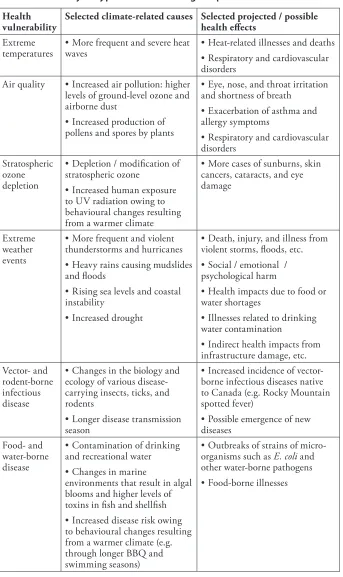
highlights six main health vulnerabilities for Canada: extreme temperatures; air quality; stratospheric ozone depletion; extreme weather events; vector- and rodent-borne infectious disease; and food- and water-borne disease.43 Consider water-borne disease,
which could be affected by climate change in various ways. Heavy precipitation could increase runoff, leading to water contamination by E. coli (similar to contamination by pesticide runoff, discussed above). Marine environments could experience increased algal blooms, such that fish and shellfish for human consumption contain increased levels of toxins. Water-borne disease may also be impacted indirectly by climate change—longer swimming seasons could increase exposure to poor water quality, increasing disease risk. These vulnerabilities are summarized in Table 1. Adaptation will be necessary to prevent, reduce, and manage these climate change-related risks.
37 Howard Epstein, “Case Comment: Spraytech v. Town of Hudson” (2001) 19 Municipal and Planning Law Reports 56 at 65 [Epstein 2001] (potential for omnibus provisions to address variety of issues); Swaigen, supra note 17 at 163 (potential for omnibus provisions to address variety of issues); Marcia Valiante, “Turf War: Municipal Powers, the Regulation of Pesticides and the Hudson Decision” (2001) 11 J Envtl L & Prac 327 at 339 (potential for omnibus provisions to address variety of issues).
38 Health adaptation is an incredibly broad, cross-cutting issue that could involve a wide range of government departments (see Part I). This paper is written primarily with a lens on environmental issues and climate change, rather than health care per se, to provide a more focused analysis of Hudson.
39 “IPCC, 2007: Summary for Policymakers” in S Solomon et al, eds, Climate Change 2007: The Physical Science Basis. Contribution of Working Group I to the Fourth Assessment Report of the Intergovernmental Panel on Climate Change (Cambridge: Cambridge University Press, 2007) at 5. 40 Klein et al, supra note 1.
Table 1: Summary of typical climate change impacts on health in Canada44
Health
vulnerability Selected climate-related causes Selected projected / possible health effects
Extreme
temperatures • More frequent and severe heat waves • Heat-related illnesses and deaths• Respiratory and cardiovascular disorders
Air quality • Increased air pollution: higher levels of ground-level ozone and airborne dust
• Increased production of pollens and spores by plants
• Eye, nose, and throat irritation and shortness of breath
• Exacerbation of asthma and allergy symptoms
• Respiratory and cardiovascular disorders
Stratospheric ozone depletion
• Depletion / modification of stratospheric ozone
• Increased human exposure to UV radiation owing to behavioural changes resulting from a warmer climate
• More cases of sunburns, skin cancers, cataracts, and eye damage
Extreme weather events
• More frequent and violent thunderstorms and hurricanes • Heavy rains causing mudslides and floods
• Rising sea levels and coastal instability
• Increased drought
• Death, injury, and illness from violent storms, floods, etc. • Social / emotional / psychological harm
• Health impacts due to food or water shortages
• Illnesses related to drinking water contamination
• Indirect health impacts from infrastructure damage, etc. Vector- and
rodent-borne infectious disease
• Changes in the biology and ecology of various disease-carrying insects, ticks, and rodents
• Longer disease transmission season
• Increased incidence of vector-borne infectious diseases native to Canada (e.g. Rocky Mountain spotted fever)
• Possible emergence of new diseases
Food- and water-borne disease
• Contamination of drinking and recreational water • Changes in marine
environments that result in algal blooms and higher levels of toxins in fish and shellfish • Increased disease risk owing to behavioural changes resulting from a warmer climate (e.g. through longer BBQ and swimming seasons)
• Outbreaks of strains of micro-organisms such as E. coli and other water-borne pathogens • Food-borne illnesses
Adaptation is a complex process, since adaptation can take many forms and involve various actors over time.45 Adaptation actions include: research, such as reports, maps, and
models; planning strategies to guide adaptation; networks between relevant stakeholders; legislation; awareness raising; and implementing adaptation infrastructure.46 Sustained
commitment to research and planning, for instance, is often required before adaptation infrastructure can be implemented successfully. It is necessary to appreciate these different types of actions to understand the diverse and complementary roles that may be played by actors at different levels of government.
It can be difficult to identify health adaptations. Health and climate change are broad subjects affected by a range of government roles and responsibilities. Often, initiatives not described as explicit health adaptation, like the Hudson By-law, have implications for adapting to the health effects of climate change.47 It is preferable to take a broad
view of health adaptation, rather than limit the analysis to measures that explicitly cite climate change as a motivation,48 because (1) a measure’s true motivation can be
difficult to ascertain, and (2) an action’s impact—rather than its stated motivation—is more relevant to Canadians’ actual health. Therefore, I adopt a broad concept of health adaptation for this paper.
II. LEGAL FRAMEWORK FOR ADAPTATION AND EXISTING
HEALTH ADAPTATIONS
To understand the legal framework for municipal health adaptation, it is necessary to understand the broader legal context at different levels of Canadian government.49
First, Subpart A will examine the federal and provincial division of powers and how this division of powers has played out for environmental issues in general, and adaptation in particular. Subpart B will examine municipalities’ evolving powers and roles, drawing principally from work by constitutional law expert and practitioner Eugene Meehan,50
and will provide a snapshot of adaptations occurring at the municipal level.
A. Federal and Provincial Governments
i. Federal and Provincial Division of Powers
The Constitution Act, 1867 sets out the legislative powers of the federal government and provincial governments in sections 91 and 92 respectively.51 The environment constitutes
45 Lindsay F Wiley, “Mitigation/Adaptation and Health: Health Policymaking in the Global Response to Climate Change and Implications for Other Upstream Determinants” (2010) 38:3 JL Med & Ethics 629 at 636 (interdisciplinary nature of adaptation).
46 Tompkins et al, supra note 15.
47 Carolyn Poutiainen et al, Civil Society Organizations and Adaptation to the Health Effects of Climate Change in Canada (2011) [in press].
48 Tompkins et al, supra note 15 at 630 (definition of adaptation that includes actions motivated by non-climate drivers as well as climate change).
49 This analysis does not consider: (1) actions taken by other actors (civil society organizations, businesses, individuals), which are important for adaptation (Poutiainen et al, supra note 47); or (2) the international legal context, since the United Nations Framework Convention on Climate Change (UNFCCC) (9 May 1992, 1771 UNTS 107) prioritizes adaptation in developing countries, rather than domestic adaptation in developed countries.
50 Supra note 24.
a cross-cutting, inter-sectoral matter that does not fit neatly into these legal categories.52
Many federal heads of power are potentially relevant to environmental issues, such as trade and commerce (section 91(2)) and fisheries regulation (section 91(12)).53 The federal
government also has the residual “peace, order and good government” (POGG) power.54
The POGG power has been applied to environmental issues such as marine pollution.55
Meanwhile, the provinces have jurisdiction over property and civil rights (section 92(13)), which has proved most relevant to environmental regulation.56
Under the classical federalism paradigm, jurisdictions are seen as “watertight compartments,” with strong exclusivity between federal and provincial powers.57
However, the prevailing modern paradigm features weaker exclusivity between federal and provincial powers, which permits complementary programs between levels of government and spillover effects of single-jurisdiction programs.58 For example, the SCC
has sanctioned the use of administrative inter-delegation,59 sometimes enthusiastically.60
Both paradigms have been associated with different stages of Canadian constitutional history—with the classical paradigm corresponding with the pre-World War II Privy Council period, and the modern paradigm gaining prominence post-World War II61—
and map onto different subject matters.62 The classical paradigm, with its deregulatory
bias, has been applied to legislation that is viewed as “interfering with the operation of free markets”; the modern paradigm has been applied to legislation seen as treating “issues of morality or social order.”63 The modern paradigm has also been useful for
legislation addressing complex issues that “do not fit so neatly into jurisdictional boxes” as envisioned by the classical paradigm.64
52 Friends of the Oldman River Society v Canada (Minister of Transport), [1992] 1 SCR 3, 88 DLR (4th) 1; Swaigen, supra note 17 at 182; Chalifour, supra note 14 at 173; Morton, supra note 17 at 37. Note that environmental issues will be examined here because they offer richer and more extensive jurisprudence than climate change, and environmental issues often have implications for health adaptation.
53 Morton, supra note 17 at 42.
54 Constitution Act, 1867, supra note 51 (Parliament may make laws “for the Peace, Order, and good Government of Canada, in relation to all Matters not coming within the Classes of Subjects by this Act assigned exclusively to the Legislatures of the Provinces” at s 91).
55 R v Crown Zellerbach Canada Ltd, [1988] 1 SCR 401, 49 DLR (4th) 161. 56 Morton, supra note 17 at 38.
57 Bruce Ryder, “The Demise and Rise of the Classical Paradigm in Canadian Federalism: Promoting Autonomy for the Provinces and First Nations” (1991) 36:2 McGill LJ 308 at 312, 323 (citing, e.g.,
Canada (AG) v. Alberta (AG), [1916] 1 AC 588, 26 DLR 288 (PC) Lord Haldane). 58 Ibid at 312.
59 Prince Edward Island (Potato Marketing Board) v HB Willis Inc, [1952] 2 SCR 392, 4 DLR 146; Reference Re Agricultural Products Marketing Act, [1978] 2 SCR 1198, 84 DLR (3d) 257; Coughlin v Ontario (Highway Transport Board), [1968] SCR 569, 68 DLR (2d) 384 [Coughlin]; Ryder, supra note 57 at 326 (citing these cases). Administrative inter-delegation refers to the delegating of power by the federal Parliament and the provincial legislatures “in furtherance of the administration of government” (CED (Administrative Law), II.1.(b) at §12).
60 Coughlin, supra note 59 (Cartwright J stated that “it is satisfactory to find that there is nothing which compels us to hold that the object sought by this co-operative effort is constitutionally unattainable” at 576 cited to SCR); Ryder, supra note 57 at 326 (citing permissive judicial attitude in Coughlin).
61 Ibid at 380. 62 Ibid at 327-28.
63 Ibid at 380. See e.g. Re Insurance Act of Canada, [1932] AC 41, [1932] 1 DLR 97 (PC) (striking down federal insurance regulation under classical paradigm, cited by Ryder, supra note 57 at 329),
Russell v R, (1882) 7 App Cas 829 (PC) (allowing regulation of liquor trade using principles of modern paradigm, cited by Ryder, supra note 57 at 329). Note that obviously, legislation does not “come pre-packaged with a markets or morality ‘tag.’ The characterization that is adopted is largely a matter of judicial discretion […]” (Ryder, supra note 57at 331).
Unsurprisingly, this modern trend is prevalent for environmental regulation. This regime has been shaped by jurisprudence and political forces to emerge as a province-dominated patchwork. Jurisprudence has recognized concurrent jurisdiction in most environmental areas, limiting federal unilateralism and allowing a strong provincial presence.65 In Friends of the Oldman River Society v Canada (Minister of Transport), Justice La Forest
acknowledged that the environment “does not comfortably fit within the existing division of powers without considerable overlap and uncertainty,”66 and that both the
federal and provincial levels of government can exercise authority in a way that affects the environment.67 The provinces became active in regulating environmental issues
in the 1960s-70s, principally based on section 92(13) powers relating to property and civil rights.68 By the late 1960s, when the federal government first became interested in
regulating environmental issues, much provincial regulation with a firm constitutional basis had already been established. This timing—in conjunction with a limited judicial interpretation of the federal POGG power up to that point—minimized federal unilateral powers on environmental matters.69 To summarize, the Canadian environmental policy
regime is a patchwork that could be described as province-dominated, with federal support in shared programs and limited federal unilateralism.70
ii. Federal and Provincial Climate Change Adaptation
Canadian climate change adaptation is described as an evolving patchwork or “mosaic” of actions at different levels of government.71 Canada still lacks a national adaptation plan
or strategy to provide top-down direction and cohesion to adaptation efforts.72 However,
the federal government has been active in developing climate models and scenarios73 and
undertaking national assessments.74 Regarding health in particular, the major research
group is the Climate Change and Health Office in Health Canada. This group published
Human Health in a Changing Climate in 2008,75 which assesses Canada’s vulnerability
and ability to adapt to the health effects of climate change. This group also conducts other research, such as response systems to address extreme heat events.76
Many provinces have provincial adaptation plans or strategies containing health-relevant components.77 For example, Ontario’s Climate Change Action Plan addresses climate
change impacts on source water protection.78 Provinces also participate in six Regional
Adaptation Collaboratives (RACs) in the North, British Columbia, the Prairies, Ontario,
65 Morton, supra note 17. 66 Supra note 52 at para 94. 67 Ibid at para 95.
68 See e.g. R v Lake Ontario Cement, [1973] 2 OR 247, 35 D.L.R. (3d) (Ont HC); Morton, supra note 17 at 38-40 (citing R v Lake Ontario Cement).
69 Ibid at 41. 70 Ibid at 50.
71 Thea Dickinson & Ian Burton, “Adaptation to Climate Change in Canada: A Multi-Level Mosaic” in James D Ford & Lea Berrang-Ford, eds, Climate Change Adaptation in Developed Nations: From Theory to Practice (Dordrecht: Springer, 2011) 104.
72 Ibid at 105-106, 116. 73 Ibid.
74 Canada, Environment Canada, The Canada Country Study: Climate Impacts and Adaptation
(Ottawa: Government of Canada, 1997); From Impacts to Adaptation, supra note 7. 75 Human Health, supra note 7.
76 Health Canada, “Developing Heat Resilient Communities and Individuals in Canada” (2010), online: Health Canada <http://www.hc-sc.gc.ca/ewh-semt/climat/adapt/heat-chaleur-eng.php>. 77 Dickinson & Burton, supra note 71 at 109.
Quebec, and the Atlantic, respectively.79 RACs were established in conjunction with
Natural Resources Canada and the provinces80 in order to address regional
decision-making and adaptation planning. Many areas of study are connected to health, such as water management and flood protection in the British Columbia RAC.81
In summary, adaptation efforts to date bear out the modern trend that allows concurrent jurisdiction and discards the watertight compartment paradigm. Adaptation efforts resemble the environmental policy regime in that adaptations are emerging ad hoc. However, it is unclear whether adaptation will end up dominated by the provinces as the general environmental regulation regime has been. Both levels of government must continue addressing adaptation, and in particular, a national plan or strategy is needed to guide efforts at all levels.
B. Municipal Governments
i. Municipal Powers: the Traditional View
Under the traditional view, municipal powers are quite limited. Municipal powers are derived from two fundamental sources: the Baldwin Act and section 92(8) of the
Constitution Act, 1867. The 1849 Baldwin Act set out the role, function, and structure
of local governments in what was to become Canada.82 The Baldwin Act places local
governments in a “secondary and subservient position” to higher levels of government.83
Section 92(8) of the Constitution Act, 1867 grants provinces the authority to pass laws establishing municipalities.84 Municipalities, as “creatures” of the provinces, are delegated
their authority from the provinces through provincial statutes.85 These provincial
statutes can only delegate powers to municipalities that are intra vires the provinces’ own authority under the Constitution.86
Broadly speaking, provinces delegate authority by enacting municipal enabling legislation. Provinces pass general municipal acts87 that provide for the “framework,
formation and operation” of municipalities.88 To incorporate a specific municipality, a
province may also enact an individual statute (e.g. City of Toronto Act).89 The general
municipal act plus any specific incorporating legislation comprise that municipality’s “enabling legislation.”90
79 Natural Resources Canada, “Regional Collaboratives: About the Collaboratives” (2011), online: Natural Resources Canada <http://www.nrcan.gc.ca/earth-sciences/climate-change/community-adaptation/regional-collaborative/657> [RACs].
80 Dickinson & Burton, supra note 71 at 107. 81 RACs, supra note 79.
82 Ian MacFee Rogers, The Law of Canadian Municipal Corporations, vol 1 (Toronto: Carswell, 1959) at 32.
83 Meehan et al, supra note 24 at 4.
84 Constitution Act, 1867, supra note 51 at s 92(8); Rogers, supra note 82 at 36 (explanation of provincial constitutional authority).
85 Meehan et al, supra note 24 at 5 (explanation of municipal status). 86 Rogers, supra note 82 at 36.
87 Ibid at 37; Mark Adkins, Len Griffiths & Shawna Parr, “The Hudson Decision: An ‘Over-Precautionary’ Approach?” (2002) 51 UNBLJ 231 at 232-33; Meehan et al, supra note 24 at 16. 88 Adkins et al, supra note 87 at 232.
89 City of Toronto Act, 2006, SO 2006, c 11, Sch A. See Rogers (supra note 82 at 37) for details on various modes by which incorporation may occur.
Using a basic framework, enabling legislation typically gives municipalities authority in two ways.91 First, this legislation may enumerate municipal authority within specific
subject areas,92 such as local tree planting. Second, enabling legislation may include
omnibus provisions that confer discretionary powers over broad issues that are not enumerated by the legislation.93 For example, recall that section 410(1) of the Quebec Cities and Towns Act, which was at issue in Hudson, states that “the council may make
by-laws: to secure peace, order, good government, health and general welfare in the territory of the municipality […].”94
The traditional principle, known as Dillon’s Rule, is that municipalities can only exercise powers that are explicitly conferred upon them by a provincial statute, construed narrowly.95 Any doubts are resolved against municipality authority.96 As summarized by
the Ontario Court of Appeal in Ottawa Electric Light Co v Ottawa (City):
It is a general and undisputed proposition of law that a municipal corporation possesses and can exercise the following powers and no others, first, those granted in express words; second, those necessarily or fairly implied in or incident to the powers expressly granted; third, those essential to the declared objects and purposes of the corporation, not simply convenient, but indispensable.97
This traditional view is also expressed in East York (Borough) v Ontario (Attorney General), in the following four principles:
(i) municipal institutions lack constitutional status;
(ii) municipal institutions are creatures of the legislature and exist only if provincial legislation so provides;
(iii) municipal institutions have no independent autonomy and their powers are subject to abolition or repeal by provincial legislation;
(iv) municipal institutions may exercise only those powers which are conferred upon them by statute.98
Overall, the traditional view has largely constrained municipal law-making powers and revenue-raising abilities.99 Municipal action has been “particularly susceptible” to
judicial inspection.100
ii. Increased Municipal Latitude: A Changing Paradigm
In spite of the traditional view of municipalities, jurisprudence and legislation have increasingly allowed some degree of deference to municipal decisions. Yet, despite their
91 Adkins et al, supra note 87 at 233. 92 Rogers, supra note 82 at 306. 93 Ibid at 313.
94 Cities and Towns Act, supra note 36.
95 Meehan et al, supra note 24 at 16, 26; Valiante, supra note 37 at 333. 96 Meehan et al, supra note 24 at 26.
97 Ottawa Electric Co v Ottawa (City) (1906), 12 OLR 290 (Ont CA), cited in Meehan et al, supra note 24 at 16.
98 (1997), 34 OR (3d) 789 at para 14, 45 CRR (2d) 237, (Ont Gen Div). 99 Meehan et al, supra note 24 at 15.
increasing importance, neither municipalities’ constitutional status nor revenue raising abilities have substantially changed.101 Municipalities today are therefore in a difficult
position: “[o]n the one hand the demands made upon municipalities have significantly grown, yet on the other hand, the law-making and financial tools have remained virtually unchanged.”102
Responding at least in part to this problem, progressive judicial interpretation of municipal authority has emerged. In Shell Canada Products Ltd v Vancouver (City) (“Shell
Canada Products”), the SCC assessed whether impugned municipal provisions were ultra
vires.103 Justice McLachlin (as she then was), dissenting, identified two approaches to
assessing municipal powers: (1) a “narrow confining approach” or (2) a “broader more deferential approach.”104 While the majority adopted the narrow approach, Justice
McLachlin argued that, except in cases where municipal actions are clearly ultra
vires, the deferential approach is preferable for four reasons. First, courts must respect
local decisions for the proper functioning of local democracy.105 Second, deference to
municipal decisions avoids the costs and uncertainty of excessive litigation.106 Third,
deference is more consistent with municipalities’ expanding range of responsibilities; a traditional interventionist approach would confine municipalities in the “straightjackets of tradition.”107 Finally, a deferential approach is more consistent with the SCC’s approach
to judicial review of administrative agencies.108 The deferential approach advocated here
has been quoted approvingly in recent SCC cases, including Hudson.109 Progressive
judicial interpretation may contribute to easing municipalities’ difficult position in the face of increasing responsibilities.
Some recent provincial legislation similarly adopts a progressive approach to municipal law making. Section 8 of the Ontario Municipal Act, 2001 dictates that municipal powers should be interpreted broadly to “confer broad authority on the municipality to enable the municipality to govern its affairs as it considers appropriate and to enhance the municipality’s ability to respond to municipal issues.”110 The Quebec Municipal Powers Act (“MPA”)—which replaced the Cities and Towns Act at issue in Hudson—has similar
interpretive provisions.111 The British Columbia Community Charter: A New Legislative Framework for Local Government (“Community Charter”) recognizes that municipalities
are an order of government that occupy a “central place” in the governmental system, and that they must have a relationship with the provinces based on “mutual respect.”112
101 Meehan et al, supra note 24 at 9. 102 Ibid at 10.
103 Shell Canada Products Ltd v Vancouver (City), [1994] 1 SCR 231, 88 BCLR (2d) 145 [Shell Canada Products].
104 Ibid at para 49; Meehan et al, supra note 24 at 28 (noting two approaches taken in Shell Canada Products).
105 Shell Canada Products, supra note 103 at para 64; Meehan et al, supra note 24 at 28 (noting benefits of deferential approach expounded by McLachlin J).
106 Shell Canada Products, supra note 103 at para 65; Meehan et al, supra note 24 at 28 (noting benefits of deferential approach expounded by McLachlin J).
107 Shell Canada Products, supra note 103 at para 66.
108 Ibid at para 67; Meehan et al, supra note 24 at 28 (noting benefits of deferential approach expounded by McLachlin J).
109 Hudson, supra note 11 at para 23; Meehan et al, supra note 24 at 28 (noting Supreme Court’s approval in Hudson).
110 Municipal Act, SO 2001, c 25, s 8. 111 RSQ 2009, c C-47.1, art 2.
112 British Columbia, The Community Charter: A New Legislative Framework for Local Government
In summary, a progressive approach to municipal regulation has emerged in the jurisprudence and some provincial legislation. This progressive approach, and especially the Quebec MPA, will be discussed in Part III. However, municipalities’ constitutional status remains formally unchanged, and their revenue raising abilities remain largely limited, despite being faced with increasing responsibilities.113
iii. Municipal Climate Change Adaptation
Many municipal responsibilities are potentially relevant for health adaptation,114 and
adaptations are occurring within these recognized spheres in conjunction with other levels of government.115 An example of national–municipal cooperation is the Natural
Resources Canada report Adapting to Climate Change: An Introduction for Canadian
Municipalities.116 This report provides information to municipal decision-makers,
primarily through case studies on municipal adaptations across Canada. For instance, the report highlights Metro Vancouver’s Stormwater Management Program, which addresses stormwater runoff quality and quantity. An example of provincial–municipal cooperation is the Ontario Climate Change Action Plan, which provides for the creation of Municipal Water Sustainability Plans under the provincial Water Opportunities and
Water Conservation Act.117 In this way, higher levels of government recognize and guide
municipal adaptation within spheres of established municipal responsibility.
To summarize Subpart B, the subordinate constitutional status of municipalities has not formally changed, although jurisprudence and provincial legislation are showing increased deference to municipal authority. Municipalities are currently engaging in adaptation initiatives, like stormwater management described above. These initiatives contribute to Canada’s adaptation patchwork and support the view that adaptation is occurring in the spirit of the modern federalism paradigm, with action being taken at different levels of government. The Hudson decision further suggests how municipalities may contribute to this adaptation patchwork.
III.
HUDSON:
CASE COMMENT
A. Descriptioni. Facts
The Town of Hudson, Quebec, adopted By-law 270 in 1991. The By-law restricted the use of cosmetic pesticides in the municipality. In 1992, two landscaping and lawncare companies, Spraytech and Chemlawn (“the appellants”), were charged with violating the By-law and summoned before the Municipal Court. The appellants held valid provincial
113 Meehan et al, supra note 24 at 30-31, 35-36. 114 Dickinson & Burton, supra note 71 at 108.
115 Municipal adaptations are also occurring in conjunction with non-governmental actors. Many municipalities participate in the Partners for Climate Protection program, which is run by the Federation of Canadian Municipalities and ICLEI Canada to support adaptation to local climate impacts (Federation of Canadian Municipalities, “Partners for Climate Protection: Municipal Resources for Adapting to Climate Change” (2009), online: Federation of Canadian Municipalities <http://www.fcm.ca/Documents/reports/PCP/Municipal_Resources_for_Adapting_to_ Climate_Change_EN.pdf >).
116 Canada, Natural Resources Canada, Adapting to Climate Change: An Introduction for Canadian Municipalities (Ottawa: Government of Canada, 2010) [Adapting to Climate Change].
licences and applied federally registered pesticides.118 The appellants pled not guilty to the
municipal charge and obtained a suspension of proceedings in order to bring a motion for a declaratory judgment before the Quebec Superior Court. The appellants sought a declaration that the By-law was ultra vires Hudson’s authority and inoperative due to conflict with provincial and federal regulation.119
ii. Legal History
At the Superior Court, Justice Kennedy first found that the By-law was valid under the omnibus section 410(1) of the Quebec Cities and Towns Act, which states that “the council may make by-laws: to secure peace, order, good government, health and general welfare in the territory of the municipality […].”120 Justice Kennedy also held that the By-law did
not conflict with federal or provincial regulation121 and was therefore valid and operable.
At the Court of Appeal, the appellants challenged Justice Kennedy’s ruling on two grounds. First, the appellants alleged that the By-law was enacted pursuant to section 412(32) of the Quebec Cities and Towns Act, which regulates toxic substances, rather than section 410(1). However, Justice Delisle held that the By-law was enacted under section 410(1), since the By-law’s definition of “pesticide” is identical to that found in the Pesticides Act,122 and does not refer to toxicity or terms used in section 412(32).123
Furthermore, the By-law was enacted in the public interest and in response to residents’ health concerns.124 Second, the appellants argued that the By-law conflicted with the
provincial Pesticides Act125 and was therefore inoperative. The court rejected this argument
and confirmed the Superior Court judgment.126
iii. Supreme Court of Canada Judgment
The SCC upheld the By-law and dismissed the appeal. The seven Justices were divided between two opinions. Justice L’Heureux-Dubé wrote for the majority (Justices Gonthier, Bastarache, and Arbour concurring), and Justice LeBel wrote a concurring judgment (Justices Iacobucci and Major concurring).
Justice L’Heureux-Dubé summarized the two issues raised by the appeal: (1) did Hudson have the statutory authority to enact the By-law; and (2) if Hudson had authority to enact it, was the By-law inoperative due to a conflict with federal or provincial legislation?127
Regarding the first issue, Justices L’Heureux-Dubé and LeBel agreed that the By-law was validly enacted since its purpose falls within the ambit of section 410(1). The Justices noted that by-laws are presumed valid;128 the party challenging the by-law has
the burden of proof;129 and courts should take care to avoid substituting their views of
118 Valiante, supra note 37 at 330. 119 Hudson, supra note 11at paras 6-7. 120 Cities and Towns Act, supra note 36. 121 Hudson, supra note 11 at para 11. 122 Pesticides Act, RSQ 1993, c P-9.3, s 1. 123 Hudson, supra note 11 at paras 12-13. 124 Ibid at para 14.
125 Pesticides Act, supra note 122. 126 Hudson, supra note 11 at paras 15-16. 127 Ibid at para 17.
what is best for citizens,130 in line with the principle of subsidiarity.131 Under this view,
the By-law was held to respond to residents’ concerns about alleged health risks of non-essential pesticides applied within the municipality, thus falling under section 410(1).132
While Justice LeBel rejected the relevance of international law,133 Justice
L’Heureux-Dubé noted that her reading of statutory authority is consistent with international law’s precautionary principle. This principle dictates:
Where there are threats of serious or irreversible damage, lack of full scientific certainty should not be used as a reason for postponing measures to prevent environmental degradation.134
Hudson’s concerns about pesticides fits within this “rubric of preventative action.”135
However, municipalities cannot enact any by-law whatsoever under omnibus provisions; omnibus provisions “do not confer unlimited power” and municipalities cannot use these provisions to enact by-laws that serve ulterior non-municipal objectives.136 Irrespective of
these general limits to omnibus provisions, the By-law was validly enacted.
Regarding the second issue—the By-law’s operability—Justices L’Heureux-Dubé and LeBel agreed that the By-law did not conflict with federal or provincial legislation and thus was operable. The Justices applied the “express contradiction”137 or “impossibility
of dual compliance”138 test to assess whether a conflict existed between legislation by
higher levels of government and the By-law. This test defines conflict as one regulation saying ‘yes’ while another says ‘no,’ such that “the same citizens are being told to do inconsistent things.”139 The federal Pest Control Products Act (“PCPA”)140 regulates the
importation, manufacturing, sale, and distribution of pesticides in Canada.141 As the PCPA is permissive, rather than exhaustive,142 the PCPA was found not to conflict with
the By-law.143 The provincial Pesticides Act establishes a permit and licensing system for
vendors and commercial applicators of pesticides.144 The SCC found no barrier to dual
compliance with the Pesticides Act and the By-law. The provincial legislation complements the federal and municipal legislation, creating a “tri-level regulatory regime”145 in which
the By-law was operable. This decision embodies several principles that are potentially relevant to municipal environmental regulation.
130 Ibid at para 23.
131 L’Heureux-Dubé J explained the principle of subsidiarity as the “proposition that law-making and implementation are often best achieved at a level of government that is not only effective, but also closest to the citizens affected and thus most responsive to their needs, to local distinctiveness, and to population diversity” (Ibid at para 3).
132 Hudson, supra note 11at paras 26-27, 53. 133 Ibid at para 48.
134 Ibid at para 31 (quoting para 7 of the Bergen Ministerial Declaration on Sustainable Development (1990)).
135 Ibid at para 32.
136 Ibid at para 20. Also note that there were no limitations on section 410(1) (Cities and Towns Act,
supra note 36), e.g. municipalities did not require ministerial approval when enacting by-laws pursuant to this section.
137 Ibid at para 34. 138 Ibid at para 46. 139 Ibid at para 34.
140 Pest Control Products Act, RSC 1985, c P-9. 141 Hudson, supra note 11 at paras 35, 46. 142 Ibid at para 35.
143 Ibid at para 46.
B. Analysis
i. Hudson and Implications for Municipal Environmental Regulation
Hudson exemplifies the emerging trend of judicial deference to municipal authority, and
seems to embody several principles for interpreting municipal laws, including: 1. The party challenging the by-law has the burden of proof to show it is
ultra vires.146 By-laws are generally presumed valid;
2. The principle of subsidiarity may be a useful lens for viewing municipal laws;147
3. Although they do not confer unlimited power, omnibus provisions can be a valid source of law.148 Omnibus provisions must be given meaning
to allow municipalities to address emerging or changing local issues;149
4. The precautionary principle can be invoked to support a by-law;150
5. A federal or provincial regulatory regime does not automatically invalidate a municipal by-law pertaining to the same matter; important matters can be addressed by all levels of government. The dual compliance test should be used to assess whether a conflict exists, and thus determine the by-law’s operability;151 and
6. In general, municipal powers should be interpreted generously.152
Immediately following the Hudson decision, commentators had conflicting views as to what the effects of the case might be. On the one hand, the municipal and environmental law scholar Howard Epstein argued that Hudson’s practical effect would be quite limited, and that municipalities would likely prefer to rely on enumerated powers rather than omnibus provisions for increased certainty.153 On the other hand, some commentators
hailed Hudson as a “turning point” for Canadian municipalities, with the potential to dramatically enhance municipalities’ abilities to respond to issues ranging from climate change mitigation to perfume bans to further restrictions on smoking.154
146 Hudson, supra note 11 at para 21; Epstein 2001, supra note 37 at 59 (highlighting important principles in Hudson).
147 Hudson, supra note 11 at paras 3, 10; Epstein 2001, supra note 37 at 59 (highlighting principles in Hudson); Meehan et al, supra note 24 at 44 (highlighting principles in Hudson). Recall the principle of subsidiarity enunciated in Hudson: the “proposition that law-making and implementation are often best achieved at a level of government that is not only effective, but also closest to the citizens affected and thus most responsive to their needs, to local distinctiveness, and to population diversity” (supra note 11at para 3).
148 Hudson, supra note 11 at para 20; Epstein 2001, supra note 37 at 59 (highlighting principles in
Hudson); Meehan et al, supra note 24 at 57-58 (highlighting principles in Hudson).
149 Hudson, supra note 11 at para 51; Epstein 2001, supra note 37 at 59 (highlighting principles in
Hudson); Meehan et al, supra note 24 at 58 (highlighting principles in Hudson).
150 Valiante, supra note 37 at 353. Recall the precautionary principle enunciated in Hudson: “Where there are threats of serious or irreversible damage, lack of full scientific certainty should not be used as a reason for postponing measures to prevent environmental degradation.” (supra note 11 at 31, quoting para 7 of the Bergen Ministerial Declaration on Sustainable Development (1990)). 151 Hudson, supra note 11 at paras 34, 46; Epstein 2001, supra note 37 at 59 (highlighting principles in
Hudson); Meehan et al, supra note 24 at 57 (highlighting principles in Hudson). Note that the dual compliance test has the effect of minimizing potential conflicts (Valiante, supra note 37 at 341). 152 Hudson, supra note 11 at para 23; Epstein 2001, supra note 37 at 59-60 (highlighting principles in
Hudson: Hudson continues and exemplifies the trend of a deferential judicial approach towards municipal powers, rejecting the restrictive approach adopted by the majority in Shell Canada Products, supra note 103); Meehan et al, supra note 24 at 44 (highlighting principles in Hudson). 153 Epstein 2001, supra note 37 at 59-60.
Empirically, the former view has prevailed, with most municipalities relying on enumerated powers—although isolated examples support the latter view as well. For example, some Quebec decisions have upheld municipalities’ role in regulating local environmental matters.155 In Wallot c Québec (Ville de) (“Wallot”) at the Quebec Court
of Appeal, the City of Quebec was permitted to enact regulations forcing landowners to maintain riparian vegetation in order to protect water quality.156 The regulations
were enacted under the omnibus provisions of the Municipal Powers Act,157 as well
as enumerated powers of the Charter of Ville de Québec relating to water quality.158
Notwithstanding these enumerated powers, the authority conferred under omnibus provisions was weighed heavily by the Court.159
Principles embodied in Hudson have also been cited in decisions about municipal regulation under enumerated powers. The principle of subsidiarity has been cited in certain Ontario decisions.160 For example, in Pub & Bar Coalition of Ontario v Ottawa (City) (“Pub & Bar Coalition”), the Pub and Bar Coalition (“Coalition”) argued that two
by-laws enacted by the City of Ottawa (“the City”), which banned smoking in certain locations, were ultra vires the City’s powers. The Court rejected the Coalition’s arguments, supporting its decision by citing the SCC’s invocation of the principle of subsidiarity in
Hudson. The Court also affirmed that the party challenging a by-law’s validity has the
burden of proving it is ultra vires, and adopted a generous view of the City’s authority.161
Therefore, while Hudson may not have dramatically increased municipal regulations under omnibus provisions, principles embodied in Hudson have proved nonetheless useful for assessing municipal regulations enacted under enumerated powers.
A generous view of municipal authority is also reflected in recent changes to Quebec’s legislative regime. The Municipal Powers Act,162 which replaced the Cities and Towns Act,
still contains an omnibus provision: “In addition to the regulatory powers under this Act, a local municipality may adopt a by-law to ensure peace, order, good government, and the general welfare of its citizens.”163 The MPA also contains other key articles that have
profoundly modified our conception of municipal powers with respect to environmental matters.164 Article 2 states:
[M]unicipalities are granted powers enabling them to respond to various changing municipal needs in the interest of their citizens. The provisions of the Act are not to be interpreted in a literal or restrictive manner.165
155 Jean-Francois Girard, « Dix ans de protection de l’environnement par les municipalitiés depuis l’arrêt Spraytech: constats et perspectives » in Service de la formation continue, Barreau du Québec, Développements récents en droit de l’environnement, vol 329 (Cowansville, Que : Yvon Blais, 2010) 49 at 55.
156 Wallot c Québec (Ville de), 2011 QCCA 1165 [Wallot]. 157 Supra note 111.
158 Charter of Ville de Québec, RSQ, c C-11.5, ss 147, 195; Wallot, supra note 156 at paras 29-34. 159 Ibid atparas 29-33.
160 Pub & Bar Coalition of Ontario v Ottawa (City) (2001), 23 MPLR (3d) 42 (Ont SCJ) [Pub & Bar Coalition], affirmed 2002 CarswellOnt 2079 (Ont CA) and 2002 CarswellOnt 2080 (Ont CA); Ben Gardiner Farms Inc v West Perth (Township), (2001) MPLR (3d) 43, 152 OAC 47, (Ont Div Ct); Goldlist Properties Inc v Toronto (City) (2002), 58 OR (3d) 232, 26 MPLR (3d) 25, (Ont Div Ct), additional reasons in 2002 CarswellOnt 1753 (Ont Div Ct), leave to appeal refused and reversed in part (2003) 232 DLR (4th) 298, 67 OR (3d) 441, (Ont CA); Meehan et al, supra note 24 at 45-46 (citing above cases).
161 Pub & Bar Coalition, supra note 160. 162 Supra note 111.
163 Ibid, s 85.
This interpretive provision foresees municipal action on new or emerging issues, including environmental. Article 4(4), a general provision on municipal powers, specifically grants municipalities jurisdiction in the environmental field.166 Article 19 elaborates that “[a]
local municipality may adopt by-laws on environmental matters”167—if it were not
already sufficiently clear. In this way, the MPA strengthens municipalities’ ability to regulate environmental issues.
The Municipal Powers Act does not confer municipal authority in all circumstances. In
Ferme l’Évasion inc c Elgin (Municipalité du canton d’) (“Ferme l’Évasion”), the namesake
farm was charged with violating a municipal by-law that prohibited spreading sewage sludge as agricultural fertilizer.168 The farm claimed the ban was ultra vires municipal
authority. The Superior Court decision echoed Hudson: Justice Reimnitz held that the by-law was valid under the MPA, and even invoked the precautionary principle, noting that lack of scientific certainty was not a barrier to the by-law’s validity.169 However,
this decision was reversed on appeal. Since provincial legislation set specific parameters for permissible municipal bans on sludge application, and the by-law did not respect these parameters, the by-law was struck down as invalid.170 Therefore, while the overall
trend in Quebec jurisprudence and legislation arguably points to a liberal conception of municipal authority, cases like Ferme l’Évasion show limits to municipal authority as well. Municipalities remain technically subordinate, and cannot regulate in a way that conflicts with specific regulation by higher levels of government.171
ii. Criticism of Hudson
Some commentators argue that Hudson is problematic. In this section, I will outline and respond to criticism focused on municipalities’ apparently limited capabilities to regulate environmental issues, in conjunction with the SCC’s treatment of the precautionary principle.
Hudson may arguably provide support for municipalities to regulate complex areas that
are beyond the experience, expertise, and resources of municipal councils. Municipalities may invoke the precautionary principle to pass by-laws regulating potentially harmful activities; this type of regulation could be a “major step backward” for scientifically sound environmental regulation.172 I concede that municipalities often lack financial resources
to conduct, for example, their own research on best practices.173 I also concede that the
criticism of the precautionary principle is serious, and will be discussed in Subpart C.iii. However, the notion that municipalities should not regulate in complex areas that are supposedly beyond local capabilities is suspect for three reasons. First, local governments may possess greater knowledge of certain aspects of local issues than higher levels of government. This rationale underpins the principle of subsidiarity, which recognizes that
166 Quebec Municipal Powers Act, supra note 11, s 4(4)(“In addition to the areas of jurisdiction conferred on it by other Acts, a local municipality has jurisdiction in the following fields: (4) the environment”).
167 Ibid, s 19.
168 Ferme l’Évasion inc. c Elgin (Municipalité du canton d’), 2009 QCCS 4386 [Ferme l’Évasion]. 169 Ferme l’Évasion, supra note 168 at paras 175-177.
170 Ferme l’Évasion inc. c Elgin (Municipalité du canton d’), 2011 QCCA 967.
171 Valiante, supra note 37 (“If federal or provincial governments want to exclude municipal action from particular subjects, or steer it in specific limited directions, they will have to do so expressly” at 343).
172 Adkins et al, supra note 87 at 232, 237-238.
local governments are more effective in responding to local needs.174 This rationale also fits
with local adaptation to local impacts of climate change, which will be discussed further below in Subpart C. Second, this criticism ignores interaction between municipalities and other actors. Municipal regulation does not occur in a vacuum; it can be supported by research (e.g. best practices guides) and financing from higher levels of government to combat resource deficits and to avoid duplication of effort where appropriate.175 Depending
on the municipality, even non-governmental organizations (NGOs) may play crucial roles.176 Third, municipal action can be critical when higher levels of government fail to
regulate effectively, as was arguably true for pesticide regulation at the time of Hudson. The federal government has acknowledged that pesticide registration is no guarantee that they are safe—it just means that pesticide risks were considered acceptable at the time of registration.177 According to an audit in 1999, the federal government failed to
re-evaluate the risks of pesticides that had been approved for use long ago, with many active ingredients in registered pesticides having been approved before 1960.178 This
pesticide regime demonstrates that municipal action may be needed to protect residents’ health when regulation at higher levels of government is inadequate. For these reasons, the argument that municipalities are ill-equipped to respond to complex environmental issues likely does not apply in all cases.
Overall, Hudson demonstrates the enormous potential for municipalities to regulate issues related to the environment and health. To what extent may this be true for adaptation to the health effects of climate change?
C. Hudson and Health Adaptation
This section will explore the possible implications of Hudson for health adaptations undertaken by Canadian municipalities, based on the following four points:
1. Adaptations will likely occur under the authority of existing enumerated powers, although omnibus provisions may provide support;
2. Municipal health adaptations may be supported by the principle of subsidiarity;
3. Municipal health adaptations may be supported by the precautionary principle; and
4. Municipal health adaptations may complement federal or provincial regulations related to the same matter.
i. Adaptations Will Likely Occur Under the Authority of Existing Enumerated Powers, Although Omnibus Provisions May Provide Support
Unlike in Hudson, enumerated powers will likely be used to implement municipal health adaptations. First, as discussed above, municipalities tend to rely on enumerated powers for certainty. Second, enumerated powers have great potential for implementing health
174 Meehan et al, supra note 24 at 44.
175 Paterson et al, supra note 173; Burch, supra note 173 at 293; John R Nolon & Patricia E Salkin,
Climate Change and Sustainable Development Law in a Nutshell (St. Paul: Thomson Reuters, 2011) at 52.
176 For example, Toronto has an active NGO community that conducts research on environmental issues (e.g. Clean Air Partnership, Pollution Probe). However, not all Canadian municipalities have access to this NGO support (Poutiainen et al, supra note 47).