LAN D SCA PE
R E V I E W
A S O U T H E R N H E M I S P H E R E J O U R N A L O F
L A N D S C A P E A R C H I T E C T U R E
T H E M E
Gardens as Laboratories
CONTRIBUTORS
Paul Fox, Architects and Garden Suburbs: The Politics of Melbourne’s Interwar
Suburban Landscapes
Fiona Harrisson, Garden as 1:1: Between Paper Thinking and Earth Moving in
Landscape Architectural Learning
Kris Scheerlinck and Yves Schoonjans, Garden Streetscapes: Front Yards as
Territorial Configurations
Julian Raxworthy, The Sitio Roberto Burle Marx: A Case Study in the Garden
as Scientific Laboratory or Vegetal Studio for a Moving Work of Art?
Adrian Marshall, Deb Reynolds’ Garden: Restoring the Unknown
Fiona Harrisson, Garden as Education: Learning the ‘Old Ways’ of Traditional
Mediterranean Food Practices
Georgia Jacobs, Putting Down Roots
Lucinda McLean, Garden as Habitat: Knitting Habitat through Public and
Private Land
Robin Tregenza, Gardening for Food and Community
L A N D S C A P E R E V I E W
A Southern Hemisphere Journal of Landscape Architecture
EDITOR — Jacky Bowring School of Landscape Architecture,
Faculty of Environment, Society and Design, PO Box 84, Lincoln University, Christchurch 7647, Canterbury, Aotearoa New Zealand
Telephone: +64–3–423–0466 Email: [email protected]
CONTRIBUTIONS — The editor welcomes contributions and will forward a style guide on request.
Landscape Review aims to provide a forum for scholarly writing and critique on topics, projects and research relevant to landscape studies and landscape architecture. Articles are considered and published in three categories. ‘Research’ articles report on recent examples of substantial and systematic research, using a conventional format that normally includes a review of relevant literature, description of research method, and presentation and interpretation of findings. ‘Reflection’ articles undertake a more discursive examination of contem porary issues or projects and may be more flexible in format to suit the subject matter.
All published contributions in the ‘Research’ and ‘Reflection’ categories are subject to double blind review. Criteria for acceptance are critical insight, originality, theoretical and methodological rigour, and relevance to the aims of the journal.
A third category is entitled ‘Reports’. This category is intended for shorter commentaries, reviews and reports on progress. Although not normally fully refereed, contributions in this categ ory are nonetheless subject to editorial review.
The editor is particularly interested in contributions that examine issues and explore the concepts and practices of special relevance to the southern hemisphere, but welcomes contributions from around the globe. Contributions are encouraged from both academics and practitioners.
C O N T E N T S
GUEST EDITORIAL Gardens as Laboratories Fiona Harrisson 1–2 FOREWORD Jacky Bowring 3
REFLECTION
Architects and Garden Suburbs: The Politics of Melbourne’s Interwar Suburban Landscapes Paul Fox 4–25
Garden as 1:1: Between Paper Thinking and Earth Moving in Landscape Architectural Learning
Fiona Harrisson 26–42
Garden Streetscapes: Front Yards as Territorial Configurations
Kris Scheerlinck and Yves Schoonjans 43–58
The Sitio Roberto Burle Marx: A Case Study in the Garden as Scientific Laboratory or Vegetal Studio for a Moving Work of Art?
Julian Raxworthy 59–70
REPORTS
Deb Reynolds’ Garden: Restoring the Unknown Adrian Marshall 71–73
Garden as Education: Learning the ‘Old Ways’ of Traditional Mediterranean Food Practices Fiona Harrisson 74–76
Putting Down Roots Georgia Jacobs 77–79
Garden as Habitat: Knitting Habitat through Public and Private Land
Lucinda McLean 80–85
Gardening for Food and Community Robin Tregenza 86–93
ISSN 2253–1440
Published September 2016
© Edition: School of Landscape Architecture, Lincoln University.
© Text and illustrations: individual contributors, unless otherwise noted.
Fiona Harrisson is Senior Lecturer in the Landscape Architecture Program, Faculty of Design and Social Context, RMIT University, Melbourne, Australia. She is also a gardener and design consultant on public projects and private gardens.
Email: [email protected]
guest editorial:
gardens as Laboratories
fiona harrisson
guest editorial
s
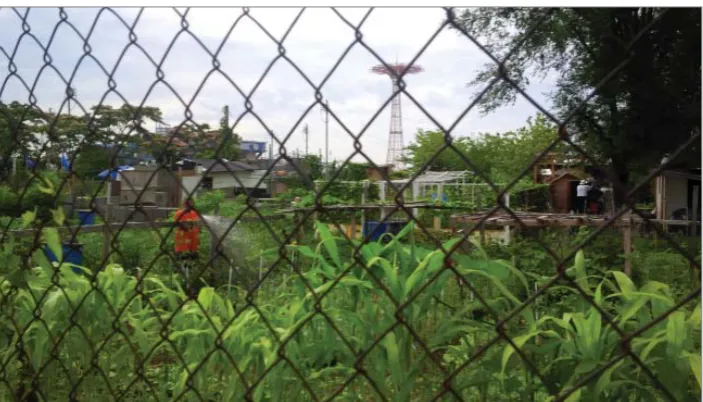
ince 1990, backyards in australia have been shrinking (Hall, 2010).residential gardens are disappearing under the footprint of bigger houses, dual occupancies and medium-density apartments. contemporary urban debates neglect the demise of the backyard, which has been a ubiquitous part of many western cities. discussion about city development is polarised between ‘sprawl’, the continual expansion of city limits into productive land, and its counterpart, ‘density’ housing and infrastructure centrally developed. in the popular culture of reality television make-over programmes and lifestyle magazines, gardens have become hard landscape for ‘outdoor living’, fashioned overnight according to the latest trend. in each case, the garden is divorced from human acts of cultivation, which does not do justice to the complex role of gardens as spaces of social integration, play, food production, habitat and permeable surfaces to absorb rainfall and provide heat sinks.
While I recognise densification is essential to city development, garden suburbs are nonetheless a significant spatial and social legacy to be carefully considered. Holmgren (2012) suggests the suburban subdivision offers the perfect scale for retrofitting for food production and water and energy collection, should unpredictable climates and economic times limit access to fossil fuels. Each housing block could be reconfigured as part of the larger suburban neighbourhood. In this scenario, the garden offers a flexible space that can be scaled up to operate within a bigger productive urban field.
This special issue explores the legacy of the garden suburb and gardens in their complexity, as they exist now. The word ‘laboratory’ is used to highlight people’s dedicated projects and experiments in their gardens, involving long-term observation, experimentation and testing but without the controls of the scientific laboratory. The privacy of residential gardens allows for different kinds of exploration and experimentation, also at risk in certain density scenarios. Human endeavours in the garden have agency for its occupants and, beyond the garden boundary, in society at large.
Two kinds of papers feature in this issue: research on the role of gardens in society across various scales and in different parts of the world, and shorter essays providing a kaleidoscopic view into ordinary and inspiring ‘citizen gardeners’ in Melbourne. all show the relationship between society and the garden. They move across scales, from the city to the street and to specific case studies of individual gardens and gardeners.
2 L a n d s c a p e r e v i e w 1 6 ( 2 ) p a g e s 2 – 2
garden suburb in post-war Australia. He traces the specific social development of the suburbs, not as an inevitable outcome of history, but to remedy the human ills as a consequence of war. Through an evaluation of streets in diverse socio-economic settings, including Tel aviv, Bratislava, new York and Melbourne, scheerlinck and schoonjans conclude gardens are important structural elements that contribute to their social possibilities. They use the term ‘collective space’ to identify a quality that can operate across the public and private boundary.
Julian raxworthy investigates the private garden of roberto Burle Marx, the sitio, in rio de Janeiro, which Burle Marx called his ‘landscape laboratory’, although Raxworthy offers a different reading. The Sitio was used to test plants Burle Marx had collected from the wild, which were later used in professional landscape projects. Tregenza discusses a garden where the gardeners experimented with sub-tropical plants, cramming 90 types into a meagre 35 square metres. The produce, seeds and ideas were shared through community events and a local community nursery.
georgia Jacobs discusses a red cross programme, ‘putting down roots’, where gardens were a platform connecting asylum seekers with the local community. By working side by side, participants learnt about each other’s culture and ways of life, while australian mentors discovered the consequences of government policies on the lives of asylum seekers. Harrisson discusses two models of garden for education. One is set in rural australia where undergraduate students of landscape architecture learnt about design in the microcosm of the garden. The other garden offered lessons about traditional Greek food practices to the community through the council for adult education.
Two gardeners working in different ecosystems use indigenous vegetation with environmental intent but towards different ends. McLean’s garden, set in a coastal holiday village, has been regenerated with indigenous vegetation to connect a larger wildlife corridor, whereas reynolds used hers to test the growing and cultivation of endangered species, having collected the seed from the adjacent volcanic grassland plains. although in a suburban setting, reynolds burnt the garden annually, to provide the necessary conditions for regeneration, an important part of the cycle often neglected. These tactics, while similar to those of Burle Marx at the sitio, were undertaken for the preservation of species rather than for aesthetic reasons.
while working in small lots, these gardeners are operating at a larger scale, as part of the broader community and/or the biosphere. The garden allows citizens to explore things in private that can aggregate to affect society. The rise of the productive garden is a contemporary example. in this sense, a kind of porosity happens between the private space of the garden and the community.
The editor wishes to thank Julian raxworthy and clare coburn for their support in crafting this special issue of Landscape Review.
reFerences
Jacky Bowring is Professor of Landscape Architecture, School of Landscape Architecture, Faculty of Environment, Society and Design, PO Box 84, Lincoln University, Christchurch 7647, Canterbury, Aotearoa New Zealand. Telephone: +64–3–423–0466 Email: [email protected]
Foreword
jacky bowring
G
ardens and suburbs are often marginalised in the discourse of landscape architecture. The small-scale and domestic connotations of gardens mean they tend to sit outside the academic sphere. The associations of suburbs with the bland and negative aspects of urban sprawl have also constrained the types of research in this area.This special issue on ‘Gardens as Laboratories’ highlights both gardens and suburbs as a rich vein of exploration for landscape architecture. The hybridising
of garden and laboratories amplifies the experimental nature of this research, demonstrating that it is not merely passive reflection.
Fiona Harrisson’s guest editorship has brought together a group of
complementary articles, ranging from the scholarly work of Paul Fox, Julian Raxworthy, Kris Scheerlinck and Yves Schoonjans – and Fiona’s own research – through to a refreshing and insightful series of reports on gardens as experimental settings. This gives a different rhythm to the issue, one that is full
of intriguing observations and ideas for extending this domain of investigation. I am very grateful for Fiona’s vision for this issue and her patience while we
negotiated the process of bringing it together, including overcoming some
unforeseen challenges.
4 L A N D S C A P E R E V I E W 1 6 ( 2 ) P A G E S 4 – 2 5
Paul Fox is author of Clearings: Six Colonial Gardeners and their Landscapes (2004). Carlton, VIC: Melbourne University Publishing.
KEY WORDS
Architects Conservatism Garden suburbs Melbourne, Australia
Architects and Garden Suburbs:
The Politics of Melbourne’s
Interwar Suburban Landscapes
PA
U
L
F
O
X
REFLECTION
This paper charts how architects, conservative businessmen and conservative politicians helped develop Melbourne’s interwar garden suburbs. It maps the ways in which architects transformed these suburban landscapes into highly charged political symbols that supported the values of the conservative Nationalist, United Australia and Liberal parties.
I
n 1942, the leader of the conservative United Australia Party, Robert Menzies, gave a radio talk called ‘The Forgotten People’. In his address, Menzies highlighted the importance of ‘one little piece of earth with a house and a garden’ in the formation of Australians (fi gure 1). It was the speaker’s fi rm conviction that owning a house and garden equated with the ‘best instincts’ of the Australian people (Menzies, 1942/1992). Over time, the speech gained a mythical status among members of the Liberal Party that Menzies founded and that he led to victory in 1949 (Brett, 1992).Today’s readers are probably surprised to learn a politician would bother to mention the garden in a landmark speech. In 1942, however, the garden was part of a much larger landscape comprising private suburban houses set in gardens on tree-lined streets with a public park nearby. At the time, Australians called this ensemble a garden suburb. John Dixon Hunt’s observation (1992, p 3) that gardens are ‘the most eloquent expressions of complex cultural ideas’ has particular relevance to understanding Menzies’ motivation in referring to the garden in his 1942 address. So too does Anne Birmingham’s (1986) framing of the British landscape in terms of ideology and Nigel Everett’s (1994) discussion of Tory representations of the English landscape. By contrast, Australian politically charged landscapes are rarely studied in terms of their ideology.
This paper departs from the extant scholarship approach that has produced a meticulously researched and catalogued development of garden suburbs throughout Australia (Freestone,2010). Instead, it focuses on Melbourne, the capital of the Australian state of Victoria, which until 1927 was the national capital and throughout the twentieth century had a disproportionate infl uence on Australian non-Labor politics. It charts how architects, conservative businessmen and conservative politicians helped develop the garden suburb. It also maps the ways in which interwar architects transformed Melbourne’s garden suburbs into highly charged political symbols.
representations of the city. Their religious backgrounds also attuned them to the blend of capitalism, state socialism and non-conformist values that distinguished Victorian non-Labor politics from the politics in other states (Blainey, 2013). Having been to war, they were also aware of the threats to peace and were well positioned to take advantage of the changes in relationships between the Australian state and capital that had occurred during the war. Moreover, the ability of architects to think in images, before popular movies were widely seen by Australians, equipped the profession to take advantage of the new media, especially the photographic magazine, to reach new suburban audiences.
Interwar architects synthesised these elements into a coherent metaphysical and political vision of what Melbourne’s garden suburbs stood for. Accordingly, they achieved a rare thing in a society as pragmatic as Australia’s: they endowed Melbourne’s suburbs with symbolic meanings that supported the values of the conservative Nationalist, United Australia and Liberal parties, and believed these values were shared by the whole of society.
Realising that their vision of architecture was political, they also became politicians and community leaders. As well as giving the profession a say in Melbourne and the nation, these roles allowed them to create an ideology centred on the suburban home and garden. Understanding that modern politics was about images and symbols, architects represented their profession as being concerned with democracy rather than having an elitist outlook. This perspective led architects to work with governments to develop new forms of housing in the 1920s, and during the 1930s to fi nd solutions regarding fl ats and the housing crisis caused by the Great Depression. Being politically adept, Melbourne’s architects re-invented the garden suburb to suit the times, and they were responsible for the spread of these suburbs, and their values, across Melbourne regardless of which political party was in power.
Sons of the manse spread the word about architecture
One of the particular characteristics of Victorian non-Labor politics was a rapprochement between capital and Labour and the tempering of capitalism
6 P AUL FOX
by progressive, Protestant, non-conformist values. Indeed, during the 1890s, Congregationalists and Methodists had been infl uential in the new Australian Labor Party. The increasing infl uence of Irish Catholics in the Labor Party, however, saw these Protestants turn to the non-Labor side of politics. These divisions widened with the conscription referenda that infl amed sectarian divisions during the First World War (Davison, 1983).
Many of Melbourne’s interwar architects came from non-conformist religious backgrounds. Among them were Marcus Barlow (1890–1954), Robert Hamilton (1892–1948), Henry Kingsley Henderson (1883–1942), Best Overend (1909–1977) and Arthur Stephenson (1890–1967). Hamilton was the son of a Presbyterian clergyman, Overend was the off spring of a Methodist minister and Stephenson’s father was a Congregational lay preacher. Henderson’s grandfather had been the fi rst incumbent of the infl uential Congregational church in Melbourne’s fashionable Collins Street. The father of architect and housing reformer Marcus Barlow was a parishioner of the Kew Congregational church for many years, and well known for being ‘very interested in church work’. These sons of the manse were consequently well placed to reconcile the non-conformist ideal of being a force for good with modern capitalism and believed Melbourne had a special role to play in the new Australian nation (Age, 22 April 1936, p 10;
Argus, 22 November 1927, p 13; 7 April 1942, p 2; Fisher, 1990; Goad, 1995). Having been raised within earshot of Sunday sermons, these architects understood the importance of the written and spoken word in reforming and improving society. Consequently, they all wrote and spoke with fervour about the moral duty of the profession to improve Australians’ living conditions. Kingsley Henderson, after becoming vice-chair of the conservative Melbourne newspaper
Argus in 1934, saw to it Overend was employed to write a regular column about architecture for the paper. Melbourne’s architects also took advantage of new newspapers and magazines that were the brainchild of Keith Murdoch, who in time would become the country’s pre-eminent press baron. Murdoch’s publications appealed to both male readers, for whom the suburbs were a retreat from ‘the cares of business’, and female readers, who saw architects as understanding their concerns about living in congenial, healthy, modern homes and the need for beauty in garden suburbs. Murdoch, like Hamilton, was the son of a Presbyterian minister (Younger, 2003; Zwar, 1980).
The soldier–architect in war and peace
The First World War was another important infl uence. Both Robert Hamilton and Arthur Stephenson served in the Australian Army. Other Melbourne architects who went to war included Arthur Blackett (1873–1962),John Gawler (1885–1978), Leighton Irwin (1892–1962), George Burridge Leith, Marcus Martin (1893–1981) and Percy Oakley (1884–1955) (Australian War Memorial, 1918; Butler, 1983; Lewis, 1996; Rayworth, 1986; Tibbits, 1979).
Melbourne, and Australia more generally, WL Baillieu (1859–1936), became a member of the Commonwealth Financial Council. On the advice of this captain of industry, the government authorised the Australian Wheat Board to compulsorily acquire and resell the nation’s wheat crop. This would have been inconceivable in conservative circles before the war.
Sir William McBeath (1865–1931) was another businessman whose talents the government drew on. His fi nancial expertise as chair of the government-owned State Bank of Victoria recommended him to the position of chair of the Australian Imperial Force’s Disposal Board in London after the war. This advice and expertise from the country’s leading businessmen and fi nanciers further strengthened the accommodation between government and capital that had been a hallmark of Victorian politics before the war. It also gave McBeath fi rst-hand knowledge of the challenges Australia faced in dealing with the social and economic dislocation arising from the war.
In London, McBeath met the soldier–architect Arthur Stephenson. To entice Stephenson to return to Australia, he promised to fi nd him work. Proving McBeath true to his word, Stephenson’s fi rm designed 14 state banks in Melbourne’s suburbs between 1921 and 1929 (Goad et al, 2004). The war also gave McBeath an appreciation of how his bank’s patronage of architects could bring order and stability to a world under threat from the anti-capitalist sentiments that the 1917 Russian revolution had unleashed.
Stephenson was just as profoundly infl uenced by the war. On the Western Front he had learnt how the morale among the men under his command was related to the supply of clothing, food, housing and munitions. After the war, he applied these wartime lessons to Australian society. He believed the responsibility of the architect in peacetime was to design ‘social amenities’, including housing, to maintain ‘a healthy (and peaceful) social state’ (Stephenson, 1921, p 29) (Fisher 1990; Goad et al, 2004; Vines, 1986).
On returning to Australia, Stephenson and partner PH Meldrum entered a design competition for a war memorial in the Melbourne suburb of Kew. Although this was a perfectly natural thing to do for a new architectural practice looking for work, Stephenson had another compelling reason to enter the competition. As an offi cer, he had written to the parents of the men who had died in action under his command. Designing the Kew war memorial allowed him to give physical expression to the emotions he and the recipients of his letters felt on learning the news that his men, and their sons, had died on battlefi elds far from home. Now he could set these dead men’s names in stone (Heritage Council of Victoria, 2004).
8 P AUL FOX
Harry Norris (Ward, 2001) – was a highly political gesture. Many of the diggers living in this suburb were radicalised by their time in the trenches, placing them at odds with members of the Returned Soldiers and Sailors Imperial League (RSSIL), an organisation established to contain the radicalism of returning soldiers. As the RSSIL met in the Soldiers and Sailors Memorial Hall, the hall was a means of defending the post-war order against the radical digger (Cathcart, 1988).
Historians have given considerable attention to the psychological eff ects of trench warfare in the creation of modern European memory. They have also charted the way modern artists represented soldiers, whose amputated limbs were replaced by prosthetics and crutches, as part human and part machine (Fussell, 1975). Despite this focus, little attention has been given to how Australians’ wartime experiences in the trenches infl uenced peacetime architectural practices of the likes of Stephenson. How the class and public school backgrounds of Melbourne’s soldier–architects – Stephenson and Oakley, for instance, had been educated at Melbourne and Brighton Grammars respectively – made them less likely to be radicalised by the war. How they took advantage of their pre-war Protestant upbringing to represent themselves to Melbourne businessmen and Nationalist politicians as dependable, professional men who could be relied on to defend society from Bolshevism. How Melbourne’s architects in peacetime built on the wartime cooperation between the Australian government and capital. And the ways in which their religious backgrounds made them both receptive to leading post-war politics toward a New (non-conformist) Jerusalem, and how this accorded with Nationalist Party narratives designed to blunt radical modernity in post-war Australian society.
Architects’ and government’s instrumentalities after the war
If war memorials, in working-class Northcote and middle-class Kew, illustrate the ways architects throughout Melbourne’s suburbs made sacred landscapes into community symbols, the profession was equally adept at endowing domestic architecture with symbolic meanings. The 1919 State Savings Bank Act and the 1920 Housing and Reclamation Act provided workers and ex-soldiers who earned less than £400 a year a chance to buy a home in the suburbs. In 1921 the bank employed the soldier–architect George Burridge Leith to design the houses.
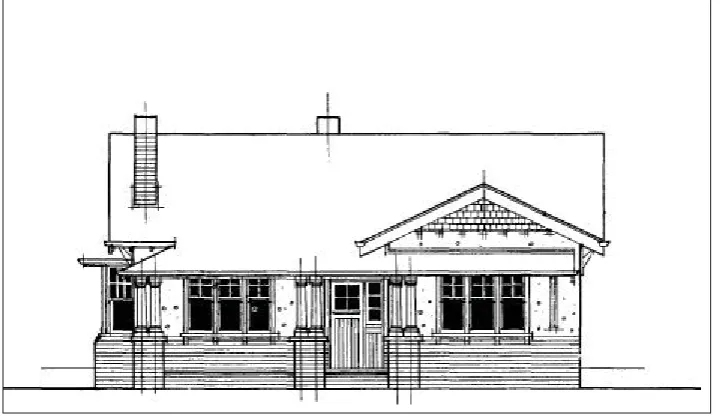
The State Savings Bank’s decision to employ an architect allowed a new class of Australians to aff ord architecturally designed houses in Melbourne’s post-war suburbs. Leith’s appointment accorded with the views of the chair of the bank, William McBeath, about the importance of architects in post-war Australian society. As a member of the Nationalist Party, he believed owning a house in the suburbs ‘made people take an interest in the Government and fi nance of the country’ (Argus, 10 March 1927, p 15). It has been estimated that one in seven of the houses built in Melbourne during the 1920s was a State Bank house designed by Leith (Murray and White, 1992; Priestley, 1984) (fi gure 2).
middle-class enclave, Protestants raised families in detached houses, tended their gardens, played in an abundance of public parks, walked and drove down tree-lined streets to church, and voted for the Nationalist Party.
McBeath applied what he had learnt in Camberwell to the whole of Melbourne. Through his involvement, an essential component of the garden suburb movement – well-designed houses – was available in working-class suburbs on the other side of the Yarra River. While the bank could not insist on local councils establishing parks and planting trees in streets, McBeath held fi rm to his, and his political party’s, vision of the ideal garden suburb. In 1927 the bank took a further step in realising its chair’s vision. Inspired by British and local garden suburbs, it laid out a new garden suburb, adjacent to the working-class suburb of Port Melbourne. In this way, as chair of the State Bank from 1918 to 1931, McBeath was able to achieve even more than in his 27 years as a Camberwell councillor (Argus, 10 March 1931, p 15; Blainey, 1964; Harris, 1988; Murray and White, 1992; Vines, 1986; Younger, 2003).
The Victorian government’s involvement in the private housing market was only one of its initiatives arising from the war that had consequences for the suburban landscape. The State Electricity Commission of Victoria (SEC) was another. Established in 1918, it developed the brown coal fi elds of Victoria’s La Trobe Valley to supply cheap electricity to Victorian households and industries and modernise the economy. Such an ambitious project demanded considerable expertise. After William McBeath sounded him out, General Sir John Monash agreed to be general manager of the SEC, bringing with him the skills he had acquired as the wartime commander of the Australian Army on the Western Front. Monash’s appointment demonstrates not only McBeath’s considerable personal infl uence but also how the war changed the perceptions of non-Labor politicians, businessmen and soldier–architects about the government’s role in modernising the economy. Part of this modernisation involved employing architects. In 1920, a year before the State Bank hired its architect, the SEC engaged the architect Alan La Gerche. In 1921 La Gerche, with Arthur Stephenson, prepared a plan on garden city lines for the new SEC town of Yallourn (Edwards, 1969; Fletcher, 2002; SEC, 1921; Serle, 1982).
10 P AUL FOX
While architects, like La Gerche and Leith, provided the technocratic and organisational skills post-war Australian governments required, they also defended middle-class interests. One of these interests was the right of the middle class to make choices about how they wanted to live at a time when government powers were increasing in daily life. Consequently the State Bank, under its Nationalist Party chair, off ered customers a range of house designs and protected the small builders who built its houses. The houses did have standard designs that could have been mass produced and assembled on site. It was inconceivable, however, for a Nationalist bank chair, who feared the spread of Bolshevism, to tell home owners how to live, or to destroy the livelihoods of small builders despite the enormous strides being made in mass production in the United States of America (Smith, 1993).
Crafting an image of the architect
The State Bank’s houses and the plan for Yallourn allowed architects to become involved in the lives of people who could never have aff orded an architect on their own. The houses represent the increasing democratisation of the profession during the interwar period. This change in architectural culture also saw architects establish service organisations where middle-class men could meet each other and serve the community. The fi rst of these was the United States organisation Rotary, which was brought to Australia in 1921 by Melbourne architect Walter Drummond, a partner of the soldier–architect John Gawler. Architects who joined Rotary included Thomas Buchan, principal of the Geelong fi rm of Laird & Buchan, and soldier–architect and Brighton councillor Percy Oakley, who in 1935 became president of the Melbourne branch of Rotary (Argus, 13 September 1930, p 20; Freeman, 1996).
Rotary, however, allowed only one member of any given profession in each of its branches. In response, 22-year-old John Buchan (1909–1998), who like his Rotarian father was an architect, founded Apex in 1931 to foster ‘the civic, commercial, social and moral welfare of the community’. In allowing multiple members of a profession to join a local branch, Apex was a much broader-based community organisation than Rotary. Both organisations provided a way for middle-class suburban men to fraternise with each other just as members of trade unions did. They also re-affi rmed the fundamental belief that capitalism and voluntary organisations were the bedrock of Australian middle-class society. Yet it was Apex’s Australian egalitarianism that helped bind Australians together during the Great Depression (Page, 1990).
In the 10 years between the founding of Rotary and Apex in Australia, architects tailored their image to a much wider audience than just the elite of Australian society who, in the Edwardian summer before 1914, had been among their most important clients. After the war, Melbourne’s architects transmitted the values of this elite to a mass audience. In this task, they were helped by the advent after the war of newspapers such as Keith Murdoch’s Herald and magazines such as
Australian Home Beautiful, whose cover and photographic spreads of homes by Melbourne architects appealed to women readers.
one of the fl agship newspapers in Murdoch’s stable, reviewed the exhibition. It declared ‘the ideal home is not a monopoly of the rich’, and went on to describe how ‘it is within the power of nearly all men, no matter what their calling, to own their own home’. Furthermore, ‘the disposition of all classes to buy a block of land and build a house’ and ‘the increasing number of depositors in the Savings Banks’ had changed the national character: ‘Australians had evolved beyond the restless and somewhat spendthrift blood of their pioneering fathers, and had settled down to the steady job’. The architect not only off ered homes that enshrined ‘beauty, hygiene and labour-saving devices and contrivances’ but just as importantly could ‘teach home owners what they can hope to do with the capital they command’ (Weekly Times, 31 March 1923, p 34).
Like other members of Melbourne’s establishment, Murdoch appreciated the role architects could play in his business and private life. In 1923 he engaged Harry Tompkins (who had designed the Kew war memorial) to design the
Herald’s new head offi ce in Melbourne’s central business district. Later Murdoch held an architectural competition to fi nd a suitable design for Newspaper House in Melbourne’s Collins Street. And he employed architect Desbrowe Annear to design his country retreat on the Mornington Peninsula. Signifi cantly, too, he was prepared to use his newspapers and magazines to promote the architect and domestic architecture to the new home-owning middle class created by the modern savings bank. All of these moves accorded with the cultural disposition and values of members of the Nationalist Party (Herald, 16 March 1923, p 1, 17 March 1923, p 1; Younger, 2003; Zwar, 1980).
Anxious to promote its profession’s role in post-war Australian society, the Royal Victorian Institute of Architects (RVIA) organised an Exhibition of Domestic Architecture in 1928. In metaphorical terms, the exhibition off ered diff erent classes of people the opportunity to meet each other in their houses and gardens. It also allowed them to see how the other half lived. Moreover, in showing how much people had in common with one other, the exhibition provided a narrative of social harmony in the suburbs rather than the story of class confl ict constructed by those on the political left. The exhibition’s motto makes this point abundantly clear: ‘it is better to build homes for the humble than to build palaces for kings’. It was a sign of just how much architects wished to promote themselves to the everyman and woman of Australia’s interwar suburbs (RVIA, 1928).
The RVIA’s exhibition included a design competition. Following the example of the 1923 Herald competition, diff erent budgets were allocated to diff erent house designs. A basic price of £1,000 was assigned to a modest timber home, with an additional £500 buying a brick dwelling. Up to £25,000 could be spent on a grand home. The cost of the land was included in the budget. With an eye to promoting the next generation of architects, the competition was open to members of the Victorian Architectural Students’ Society as well as Institute members.
12 P AUL FOX
1928, pp 8–9), and commended the winning entry in the fi nal category for the way in which the house and garden sat within its environment. The inclusion in the competition of a timber home costing £1,000 also showed architects were not just interested in housing the well-to-do who could aff ord Butler and Marcus Martin’s prize-winning designs. The prize awarded to Roy Grounds also announced to the public the next generation of architects were just as committed as the older generation to providing well-designed houses to people of modest means (Blackett and Inskip, 1928; Rayworth, 1986; RVIA, 1928).
Images of the three prize-winning awards were reproduced in the RVIA’s journal (Journal of the Royal Victorian Institute of Architects, JRVIA), popular illustrated magazines, and newspapers. This publicity brought the exhibition to a far greater audience than the 7,000-odd people who attended it. Realising that capital both owned the means of production and had the wherewithal to endlessly reproduce cultural, political and moral views throughout the nation’s suburbs, architects were keen to popularise in the media the view that ‘the ideal home is not a monopoly of the rich’. With the advent of both photographic magazines and radio, they were acutely aware domestic architecture was not just about bricks and mortar but also about images, symbols, identity and civic endeavour.
In 1928 the young Roy Grounds also won the RVIA’s annual war memorial scholarship. Recognising that modern architecture and Hollywood were both about creating images for the masses, Grounds travelled to the United States where he designed studio sets for Radio-Keith-Orpheum Pictures and Metro-Goldwyn-Mayer (Hamann, 2007). Melbourne’s newspapers also continued to promote architecture. In 1934 the conservative Melbourne Argus commissioned the 25-year-old modernist architect, Best Overend, to write about architecture (Goad, 1995). With access to the media, Melbourne’s architects were extraordinarily well placed to garner support for the idea that Australian identity was intimately linked to owning a home in a garden suburb, and to turn this idea into a potent conservative political force at local, state and national levels.
Architects and non-Labor politics
During the interwar period, architects were extremely active at all levels of Australian politics. They were on the local councils in many middle-class suburbs. They were active on the Melbourne Metropolitan Town Planning Commission. They created a new vision of the national capital Canberra, enshrining the interwar conservative belief that the national character was to be found in Australia’s suburbs. They were also active members of conservative political parties, rallying middle-class Australians they knew – through their participation in local councils, the service organisations they founded and the businesses on whose boards they sat – to defend (their) Australia from economic solutions the LaborParty proposed during the Great Depression. In brief, their political re-imagining of Melbourne’s suburbs created middle-class visions of the nation.
Robert Hamilton and Robert Henry Solly were councillors on Prahran and Melbourne City Councils respectively during the 1930s. Further afi eld, Thomas Buchan served from 1934 to 1951 on the Newtown and Chilwell Council, a well-heeled, residential area adjoining the port city of Geelong in rural Victoria.
This involvement in local government was extremely important at a time when the profession was nurturing the ideal that Australians of all classes should live in a home designed by an architect. In a society where ‘the disposition of all classes to buy a block of land and build a house’ had led to piecemeal suburban developments rather than the planned garden suburbs of the United States and England, architects on middle-class councils could create visually coherent suburbs by making and using municipal bylaws, planting street trees and developing public parks. By extolling the virtues of civic architecture, they helped create garden suburbs that, although diff erent to the much-lauded overseas examples, brought a sense of community and a shared vision to the individualistic suburbs. The presence of architects on democratically elected municipal councils also reinforced in the public’s mind that the profession actually believed what they said about the democratisation of architecture. As a result, when the architect spoke, people listened (Argus, 14 September 1925, p 14, 24 June 1938, p 6; Balderstone, 1983; Dunstan 1990; JRVIA, September 1934; Lewis, 1996).
Architects on suburban councils were also aware of the need to develop a master plan for the entire city. As a consequence, the Victorian government established the Melbourne Metropolitan Town Planning Commission in 1922. The profession played an important role in the commission, chaired by alderman Frank Stapley (1858–1944), a former president of the RVIA. Well acquainted with Melbourne’s problems, the commission’s 1929 master plan advocated zoning, transport planning and more open space as ways of enhancing the city. However, because of the 1929 Wall Street crash, Great Depression, and a Country Party government that lacked interest in Melbourne, the commission’s recommendations were not implemented (Dunstan, 1990).
Creating the new Australian capital, Canberra, was another undertaking in which Melbourne architects were infl uential. In the same year as the Melbourne Metropolitan Town Planning Commission was established, the Nationalist Party government, under Prime Minister Stanley Melbourne Bruce, announced an architectural competition to design Canberra’s suburbs along ‘modern, aesthetic and economic lines’. Soldier–architect and councillor Percy Oakley and his partner Stanley Oakes won the competition. This socially and politically conservative architectural duo set about re-casting American architect Walter Burley Griffi n’s pre-war plan for Canberra in the image of Melbourne’s suburban architecture. Their penultimate success came in 1925 when they were commissioned to design the Prime Minister’s offi cial residence in the national capital.
14 P AUL FOX
character and succeed electorally in Australia’s post-war suburbs. For this reason, Bruce urged ‘the architect and the people … to get closer together’(Age, 7 June 1927, pp 16–17; Freeman, 1996, pp 109–118; Nichols, 2002, pp 214–15; Plant, 1987, pp 111–13).
The defeat of Bruce’s government in 1929, and the subsequent onset of the Great Depression, however, challenged the conservative values enshrined in its images of the 1920s garden suburb. Architects responded by becoming involved in national politics. For instance, during the general election of 1931 Apex founder John Buchan rallied support for the United Australia Party candidate Richard Casey, who became a close friend. Casey went on to hold infl uential posts in the Lyons and Menzies governments.
Kingsley Henderson was even more infl uential in conservative politics. A former councillor, an architect who won commissions to design head offi ces, clubs and apartments in Collins Street, and a member of numerous company boards, Henderson exemplifi es the connections between architecture and the big end of town. In 1931 Henderson rallied conservative citizens from Melbourne’s garden suburbs to join the All for Australia League, a citizens’ organisation that opposed Labor’s unorthodox fi scal policies in the Depression. Intent on destroying Labor politically, Henderson, together with Robert Menzies and four infl uential Melbourne businessmen, persuaded Joseph Lyons to leave the Labor government and lead the new United Australia Party to victory at the 1931 general election. Henderson’s infl uence continued to grow. He became vice president in 1934, and president in 1940, of the Argus and Australasian board, newspapers that were the voice of conservative Melbourne (Argus, 7 April 1942, p 2; Balderstone, 1983; Henderson, 2011).
Some architects joined Menzies’ new Liberal Party. They included Bernard Evans (1905–1981) and Robert Henry Solly (1883–1968), who were members of Melbourne City Council in the 1950s. Robert Hamilton was a Liberal Party member of the Victorian parliament until his death in 1948. John Buchan became president of the Victorian branch of the Liberal Party, helping to create a close and harmonious relationship between Melbourne City Council and the Victorian Liberal government after it came to power in 1955. Buchan gained a reputation as ‘a manipulator of the nuts and bolts of the Liberal Party and a man of substantial infl uence’ (Page, 1990, p 108). His political contacts helped Buchan transform his father’s Geelong architectural practice into a national enterprise (Argus, May 1948p 5, 31 August 1953, p 1; Dunstan, 2007; Hobart Mercury, 1 September 1953, p 10; JRVIA, March 1930, p 3; Page, 1990).
Re-inventing overseas traditions
Australia’s leading industrialist and fi nancier WL Baillieu was an exception. His formidable business acumen led to the development of many new Australian industries, including the Electrolytic Zinc Company. In 1920 Baillieu courageously used his family’s fortune to underwrite the £1 million fl oat needed to build an electrolytic zinc smelter in Tasmania. Like William McBeath, Baillieu had encouraged the architect Arthur Stephenson to return to Australia after the war. And like McBeath, Baillieu became Stephenson’s patron, engaging him and Arts and Crafts architect Walter Butler to design the Electrolytic Zinc Company’s garden town of Lutana in Tasmania. Yet, despite the best of intentions, only 42 houses out of the proposed 200 were ever built (Fletcher, 2002; Freestone, 1989, 2010; Goad et al, 2004; Yule, 2012).
In the Victorian parliament (1901–1917), Baillieu supported the introduction of old-age pensions and championed legislation to secure industrial harmony. After the Armistice, he put together ‘a democratic programme to secure better conditions for working men’, hoping it might infl uence a new international order (Poynter, 1979, p 143). If even Baillieu could not build Lutana, there was little hope that other enlightened Australian industrialists would replicate the British garden cities developed by enlightened ‘captains of industry’ (Stephenson, 1921). For example, the American Ford Motor Company built an assembly line in Geelong but left it to the larger-than-life entrepreneur Clement John de Garis (1884–1926) to engage Arthur Stephenson, Leighton Irwin (1892–1962) and IG Anderson in 1924 to design a new garden suburb as a speculative venture (Freestone, 2010; Nichols, 2002).
It was such experiences that led architects to realise the piecemeal development of Australian suburbia, where subdivisions maximised the owner’s profi t, would continue. Consequently, Melbourne’s architects created distinctively Australian solutions that translated overseas models to suit local conditions, re-invented local traditions and endowed images of suburban homes with symbolic and political meanings.
Re-inventing local traditions: Flats in Toorak
The Great Depression threatened to undo the representation of the garden suburb as a place of social harmony, which architects and conservative businessmen and politicians had cultivated so assiduously during the 1920s. As discussed above, the middle-class suburbs were bulwarks against the social and political unrest of the Depression. Yet the anxiety over their future remained even after the United Australia Party won the 1931 general election. So in 1933, at the height of the Depression, the founder of the Toorak branch of the Nationalist Party, and First World War veteran, Sir James Barrett (1862–1945) led a campaign to stop fl ats being built in Toorak, the suburb where Melbourne’s social and business elite resided.
16 P AUL FOX
defend the values associated with owning a home in Melbourne’s garden suburbs (Murray-Smith, 1979).
This antipathy towards fl ats was widespread. In 1928 the Victorian Chief Secretary and former Labor Premier George Prendergast, in a speech at the opening of the RVIA Domestic Architecture Exhibition, observed ‘individual homes were far better than tenements where there was less individuality in family life and where the dwellings were so much alike’ (Argus, 2 May 1928, p 21; RVIA, 1928).
Although Robert Hamilton, who had helped organise the RVIA exhibition with Marcus Martin, heard Prendergast’s speech, he held a diff erent view. As a local councillor and an architect, he opposed Barrett’s campaign, believing instead that building double-storey fl ats that looked like neighbouring houses could be a way to accommodate Melbourne’s growing population. So while Barrett huff ed and puff ed about the arrival of fl ats in his neighbourhood, Hamilton, using his position on the local council, developed a new building code that ensured ‘only fi rst class buildings of sound design’ would be built in the suburb. These regulations limited each block of fl ats to four or fi ve dwellings of no more than two storeys, demanded each fl at have a separate entrance and paid attention to their garden settings (Hamilton, 1938).
By October 1933 Hamilton could point to his design of Moore Abbey in neighbouring South Yarra to prove well-designed fl ats need not undermine the existing neighbourhood. According to contemporary press reports, Moore Abbey looked like a Tudor village set around ‘a village green’. In marrying the best of Toorak with Tudor England, Hamilton had created a community in the fi nest of British traditions. In designing fl ats where none of the fl oor plans were the same and placing them around a village green, this architect – who made a living subdividing the grounds of Melbourne nineteenth-century mansions – distanced himself and his clients from the social experiments of modern British and European architects who saw houses as machines for living, and modern site design as privileging the public over the private garden (Argus, 19 October 1933, p 11, 14 December 1933, p 5).
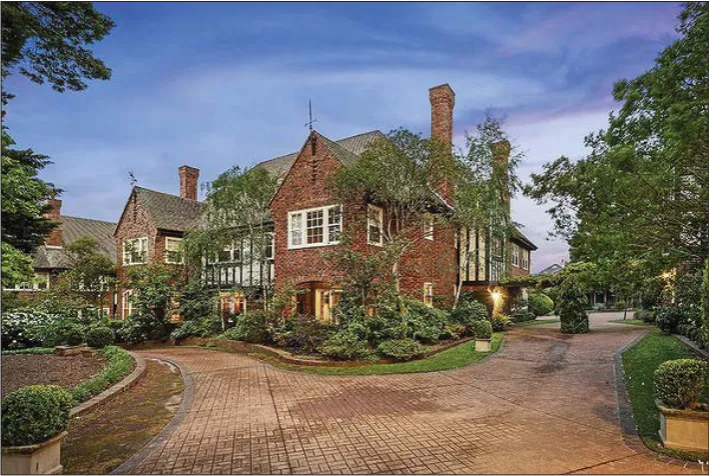
After the construction of Moore Abbey, it was far more diffi cult for the founder of the Toorak branch of the Nationalist Party to take the moral high ground about fl ats threatening Melbourne’s premier garden suburb or Melbourne’s suburbs in general, or to argue that fl ats would turn garden suburbs into slums. Having found a solution to the fl at question, Melbourne’s local councils adopted similar building codes. In 1938 Malvern City Council approved Hamilton’s design for Denby Dale, a group of Tudor-style fl ats set in gardens in Glenferrie Road, Kooyong (O’Hanlon, 2002) (fi gure 3).
safeguard the representation of the garden suburb as a place of social harmony (Argus, 14 September 1925, p 1; Corbett et al, 2002; Ferguson, 2003; Herbert, 1934.
Arts and Crafts ideas were highly infl uential in Melbourne during the interwar period (Martin, 1929; Edquist, 2008). Consider Best Overend’s choice of topic for his fi rst column in the Argus in 1934: a Toorak house and garden designed by Walter Butler. For Overend, Butler’s Arts and Crafts design exemplifi ed how a modern house needed to take account of ‘the possibilities inherent in the land and garden’ (Argus, 28 June 1934, p 13). As architectural historian Philip Goad sees it, in this article Overend was playing it safe before revealing his modernist hand to the readers of Melbourne’s conservative daily. This interpretation, however, disregards the way the young architect abstracts Butler’s Arts and Crafts design to make his point about modern site design (Goad, 1995).
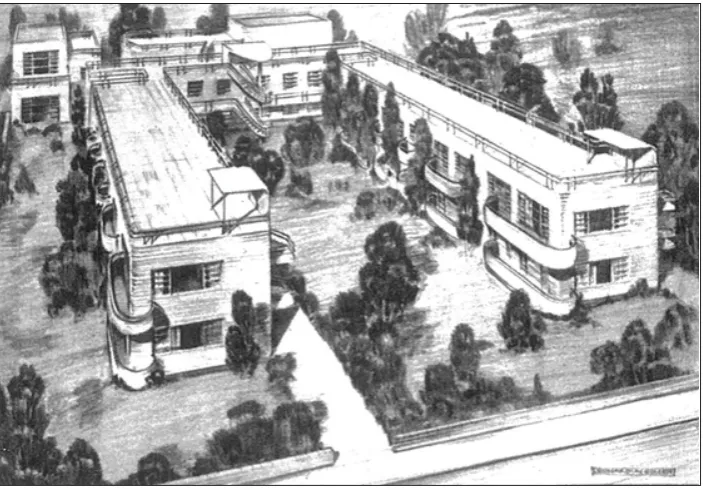
These insights infl uenced Overend’s 1936 design for Cairo, a block of modern, two-storey bachelor fl ats in working-class Fitzroy (fi gure 4). In this inner suburb, Overend paid particular attention to providing each apartment with views of the surrounding garden. For Goad (1995), Cairo expresses modernist ideas about setting high-rise blocks of fl ats in public parks. Given that Cairo replaced a large Victorian mansion, it can also be seen as addressing Barrett’s concerns that such replacements would result in barrack-like apartments with no gardens. Indeed, sheltered behind the high brick wall retained from the mansion, Cairo’s landscape could be mistaken for a large garden in Toorak. Overend abstracts ideas about the Arts and Crafts house and garden to focus on site design. As well as broadly conforming to Hamilton’s new fl at code, in a nod to public morality the design allowed every resident to keep an eye on who was visiting the bachelors’ apartments. In line with Overend’s fi rst article for the Argus, Cairo suggests the Arts and Crafts tradition need not be – as Hamilton believed – in opposition to modernism.
Hamilton’s fl at code was enormously infl uential in addressing the antipathy toward fl ats that crossed Melbourne’s class and political divides. In making a fl at look like a home, Hamilton re-invented a type of architecture disdained by the
18 P AUL FOX
likes of Barrett and Prendergast. His genius lay in getting suburban communities to accept well-designed fl ats could be a home as much as any suburban house and could enhance, rather than destroy, existing garden suburbs. In this way he safeguarded the conservative values enshrined in the suburban home that his party and profession had done so much to instil.
Re-imagining workers’ housing
While Toorak residents campaigned against barrack-like fl ats being built in the neighbourhood, 33 percent of Australian workers were unemployed. If architects had been successful in the 1920s in imbuing domestic architecture with symbolic meanings that both major political parties came to share, in the 1930s they set about fi nding solutions to the housing problems caused by the Depression. Whereas in the 1920s they and the State Bank had been able to house people who earned less than £400 a year, in the 1930s the unemployed and their families either had no homes at all or were living in substandard accommodation in Melbourne’s inner suburbs. Many architects were horrifi ed by these conditions. Alan Devereux, for example, on returning to Melbourne in 1934 after a long absence in London where he had been architect-in-charge of the Battersea Borough Council’s housing department, saw the inner suburbs as ‘blots on the face of civilisation’. To remedy the situation, he called for Melbourne’s workers to be ‘housed in settlements of the garden type’ well away from industry (Argus, 14 December 1934, p 5, 27 July 1935, p 21).
In the 1930s, overseas examples were again consulted in the hope they might provide solutions to Melbourne’s housing problems. In 1932 Marcus Martin attended the International Town Planning and Housing Congress hosted by modernist architect Mies van der Rohe in Berlin. At the same time, he visited ‘huge housing blocks … of extraordinary variation’ ‘carried out … on proper town-planning lines’ (Martin, 1932, p 173). Arthur Stephenson shared Martin’s interest in workers’ housing, touring Germany and Sweden and visiting Russian workers’ housing in 1933. As to be expected, the confi scation of ‘great and
beautiful mansions’ from their ‘lawful owners’ by the Communist government did not go down well with Sir William McBeath’s protégé (Argus, 29 April 1933, p 4; Stephenson, 1933, p 75). Best Overend was equally concerned about the housing problem. After working in the British modernist architect Wells Coates’ London practice, he returned to Melbourne in 1934 where he described the tall blocks of apartments in gardens and parklands seen on his travels (Argus, 20 December 1934, p 14).
All of this was a world away from Martin and Butler’s designs for Sir William McBeath’s new Toorak house (RVIA, 1928). Yet Martin had a social conscience. As he explained to JRVIA readers, he had travelled to Berlin believing the profession’s ‘fi rst consideration’ needed to be ‘the welfare of mankind’ (Martin, 1932, p 173). With similar views, Stephenson (1933) believed ‘an Architect should be a guiding force’ in solving the social problems of the Depression. As part of this interest in improving people’s lives, Martin supported the free kindergarten movement while Stephenson became the leading designer of the modern hospitals in the country.
However, after their success in creating the 1920s garden suburbs, architects and social reformers from the suburbs were not about to agree to the construction of European-style fl ats for workers. To do so would have diminished the very values they now regarded as the bedrock of Australian suburban society. These perceptions are apparent in the infl uential social reformer and devout Methodist, Oswald Barnett (1883–1972). During the 1930s, Barnett campaigned relentlessly to redress inadequate housing conditions in Melbourne’s inner suburbs that had been built in the nineteenth century. He was deeply troubled that the unemployed and the working class were not able to enjoy the same standard of living as those in Melbourne’s ‘better class [of] suburb’ such as Camberwell where he lived (JRVIA, July 1933, p 48).
Barnett enlisted the help of architect Marcus Barlow. Educated at Brighton Grammar, Barlow lived in a beautiful bungalow in Middle Camberwell, and designed grand city offi ces and English-style houses for the well-to-do. He also had a well-developed Christian social conscience, believing ‘it was not fair, in a land like Australia, that people should be compelled to live in slums’ (Age, 29 June 1937, p 10). In 1935 Barlow joined the study group that Barnett founded to persuade the government to establish a National Housing Board, a body composed of ‘experts with a thorough knowledge of slum conditions, architects, benevolent workers, surveyors and social workers’ (Age, 16 April 1935, p 12). Equally impassioned over the slum question was John Buchan, who in 1935 made a nine-month study tour investigating slum clearance in England and Europe (Age, 17 July 1936, p 10; Argus, 2 December 1935, p 10, 1 December 1954, p 10).
20 P AUL FOX
As well as enlisting their middle-class, church-going supporters, Barlow and Barnett gained the support of the Labor Party. In July 1935 Barlow, Barnett and Labor’s Slum Clearance and Better Housing Committee came up with the idea of building public housing next to the State Bank estate at Fisherman’s Bend. Barlow drew up a plan of the proposed subdivision. With an eye to publicity, the campaigners saw to it that the plan was unveiled in parliament and reproduced in the Age newspaper the next morning (Age, 25 July 1935, p 9).
Prompted by this campaign, Victoria’s Country Party government established a Housing Investigation and Slum Abolition Board in 1936 (Argus, 10 September 1936, p 11). Its terms of reference included determining the dwellings needed to accommodate people displaced by any housing reclamation schemes, and identifying the land where this housing could be built. Nothing, however, was said about whether the board needed to consider fl ats as an option. For their part, Barnett and Barlow, the two board members who hailed from Camberwell, refused to countenance overseas models for workers’ housing of the type Martin, Stephenson and Overend had seen on their travels. So in December 1936 the government announced that ‘fl ats of many storeys’ were not to be built in Melbourne. As the Honorary Minister in the Dunstan government, and chairman of the Housing Investigation and Slum Abolition Board, explained, fl ats would ‘become tenements and develop into slums’ (Argus, 11 December 1936, p 18). The suburban prejudices of the board’s Camberwell members had won the day.
On the day the government announced this decision, the surveyor Saxil Tuxen was appointed as the board’s town planner. Tuxen, a well-known supporter of the garden suburb, had visited the United States in 1925, laid out Griffi n’s Ranelagh estate on Melbourne’s Mornington Peninsula the following year, and been a member of the far-seeing but ineff ective Melbourne Metropolitan Commission. He was also responsible for innumerable garden subdivisions throughout Melbourne, including Camberwell and working-class Reservoir (Argus, 11 December 1936, p 11; Nichols, 2002).
In an address to the Anglican Social Questions Committee in 1937, Barlow described the magnitude of the housing problem: ‘During the Depression building had stood still, and although there had been a revival, practically no houses of the less expensive type had been built’ (Age, 29 June 1937, p 10). As a result, Melbourne faced a shortage of between 25,000 and 30,000 ‘low renting homes for workers’. Believing private enterprise was unable to solve the problem, Barlow pressed the government to establish a housing board to build well-designed houses and let them to tenants at aff ordable rents.
it supported communal social values and Bolshevism. On the other hand, if it built houses in gardens that mimicked the garden suburb, its activities would be seen to be similar to the suburban homes that had helped redefi ne the national character and, in the eyes of the Nationalist Party, had brought stability to Australian society in the aftermath of the Great War.
In requesting architects to design houses and landscapes for a new group of people who had no chance of owning their own home, the government once again asked the profession to create symbols that could be read, understood and shared across Australian society. Just as they did in the 1920s, architects endowed these new houses and suburbs with conservative meanings. This allowed the middle class who lived in garden suburbs to believe they had something in common with the Housing Commission’s tenants. So in April 1938 the commission paid Barlow a £100 stipend to provide it with architectural advice for six months. This arrangement, however, came to an end in September 1938 after questions in the Victorian parliament revealed the Victorian Premier was unaware of the arrangement (Age, 23 September 1938, p 14; Argus, 23 September 1938, p 14).
In October 1938 the commission began making plans to relocate people who were living in 800 insanitary homes in working-class South Melbourne and Port Melbourne, identifi ed by the Housing Investigation and Slum Abolition Board as slums (Construction & Local Government Journal, 12 October 1938). To rehouse these people, the commission acquired 22 hectares of land at Fisherman’s Bend in January 1939. Adjacent to the existing State Bank garden suburb, the site was pregnant with symbolism and meaning. Aware it needed to build an estate that was the equal of its neighbour, in February 1939, the commission announced a competition for a town plan for the entire site and an architectural competition for one-, two- and three- bedroom houses (Age, 13 April 1939, p 7).
The results of the architectural competition were announced in May 1939. The fi rst prize of £125 was awarded to EC Jackson of the Commonwealth Department of Works, Melbourne. Arthur C Leith, the son of the State Bank architect, and partner Bartlett received the £75 second prize, Sydney architect EW Andrew the £50 third prize and Frank Heath the fourth prize of £50 (Age, 5 May 1939, p 4). Saxil Tuxen, and Melbourne architects Ballantyne and Wilson, won the planning competition (Nichols, 2002).
22 P AUL FOX
Griffi n: Ballantyne as an employee in Griffi n’s Melbourne offi ce before going to the United States in 1922, and Tuxen, after visiting the United States in 1925, laid out Griffi n’s Ranelagh estate (Argus, 24 January 1939, p 4; Lewis and Aitken, 1992; Nichols, 2002).
To realise its ambitions, the commission enlisted a panel of architects to prepare plans and supervise the construction of the 380 houses it wanted to build at Fisherman’s Bend. This panel came into existence in June 1939 with members Frank Heath, Arthur C Leith, Best Overend and JFD Scarborough, all of whom had entered the competition. By July the panel’s designs – which were diff erent to the competition’s winning entries – were fi nished. The commission then proceeded to erect four pairs of houses to these new designs before calling for tenders to build the rest (Age, 20 May 1939, p 25; Argus, 2 June 1939, p 8, 12 July 1939, p 11).
A non-Labor government had once again turned to housing to defuse threats to the social order. After the First World War, the government had looked to the State Bank to provide aff ordable, well-designed housing. In the Depression, the unemployed were unable to own a house in the suburbs and the State Bank model was no longer viable. At the urging of social reformers and architects, the government developed a new housing model in which it would build houses and rent them out. And because Barlow had sat on the Housing Investigation and Slum Abolition Board, and a panel of architects advised the Housing Commission, these houses, like their State Bank counterparts, were designed by architects. Furthermore, because ‘individual homes were far better than tenements’ (Argus, 2 May 1928, p 21), no fl ats were built in Garden City. At a time of social and political unrest, the government continued to see well-designed homes in garden suburbs as bulwarks against revolution. In this way, the myth of the conservative
zeitgeist, the accommodation between capital and labour, was maintained during a time of economic calamity.
Mr Menzies’ ‘little piece of earth’
NOTE
Every effort has been made to establish the copyright status of the historic images included in this article. If you have information regarding the copyright of these images, please get in touch with the editor, Jacky Bowring,
[email protected], and we will respond appropriately.
REFERENCES
Australian War Memorial (1918) George Burridge Leith, First World War Embarkation Rolls. Baillie Scott, HM (1906) Houses and Gardens, London: G Newnes.
Balderstone, S (1983) Kingsley Anketell Henderson (1883–1942). In Australian Dictionary of Biography, vol 9, B Nairn and G Serle (eds), Carlton: Melbourne University Press, pp 257–258. Birmingham, A (1986) Landscape and Ideology: The English Rustic Tradition, 1740–1860, Berkley:
University of California Press.
Blackett, WAM and Inskip, JB (1929) Report on the Exhibition of Domestic Architecture, Journal of Proceedings of the Royal Victorian Institute of Architects 26 (May), pp 73–78.
Blainey, G (1964) A History of Camberwell, Melbourne: Jacaranda Press. ——(2013) A History of Victoria, Melbourne: Cambridge University Press.
Brett, J (1992) Robert Menzies’ Forgotten People, Sydney: Pan MacMillan Publishers. Butler, G (1983) Leighton Major Francis Irwin (1892–1962). In Australian Dictionary of Biography, vol 9, B Nairn and G Serle (eds), Carlton: Melbourne University Press, pp 443–444. Cathcart, M (1988) Defending the National Tuckshop: Australia’s Secret Army Intrigue of 1931,
Fitzroy: McPhee Gribble.
Corbett, DP, Ysanne, H and Russell, F (2002),The Geographies of Englishness: Landscape and the National Past, New Haven: Yale University Press.
Davison, G (1983) The City-bred child and Urban Reform in Melbourne 1900–1940. In Social Process and the City, P Williams (ed), Sydney: George Allen & Unwin.
Dixon Hunt, J (1992) Gardens and the Picturesque: Studies in the History of Landscape Architecture, Cambridge: MIT Press.
Dunstan, D (1990) Frank Stapley (1858–1944). In Australian Dictionary of Biography, vol 12, J Ritchie (ed), Carlton: Melbourne University Press, pp 52–53.
——(2007) Sir Bernard Evans (1905–1981). In Australian Dictionary of Biography, vol 17, C Cunneen (ed), Carlton: Melbourne University Press, pp 364–365.
Edquist, H (2008)Pioneers of Modernism: The Arts and Crafts Movement in Australia, Carlton: Miegunyah Press.
Edwards, C (1969) Brown Power: A Jubilee History of the State Electricity Commission of Victoria, Melbourne: State Electricity Commission of Victoria.
Everett, N (1994) The Tory View of Landscape, New Haven: Yale University Press.
Ferguson, N (2003) Empire: How Britain Made the Modern World, London: Allen Lane.
Fisher, JD (1990) Sir Arthur George Stephenson (1890–1967). In Australian Dictionary of Biography, vol 12, J Ritchie (ed), Carlton: Melbourne University Press, pp 71–72.
Fletcher, M (2002) Digging People Up for Coal: A History of Yallourn, Carlton: Melbourne
University Press.
Freeman, P (1996) The Early Canberra House: Living in Canberra 1911–1933, Canberra: Federal Capital Press.
Freestone, R (1989) The Garden City Movement in Australia, Melbourne: Thomas Nelson.
——(2010) Urban Nation: Australia’s Planning Heritage, Collingwood: CSIRO Publishing.
Fussell, P (1975) The Great War and Modern Memory, Oxford: Oxford University Press.
24 P AUL FOX
——, Wilken R and Willis J (2004) Australian Modern: The Architecture of Stephenson & Turner, Carlton: Miegunyah Press.
Hamilton, RB (1938) Modern Flat Development in Melbourne,Journal of the Royal Victorian Institute of ArchitectsXXXVI(2), pp 45–46.
Hamann, C (2007) Sir Roy Burman Grounds (1905–1981). In Australian Dictionary of Biography, vol 17, D Langmore (ed), Carlton: Melbourne University Press, pp 464–466.
Harris, D (1988) Not Above Politics: Housing Reform in Melbourne 1910–29. In New Houses for Old: Fifty Years of Public Housing in Victoria 1938–1988, R Howe (ed), Melbourne: Ministry of Housing and Construction, pp 1–19.
Henderson, A (2011) Joseph Lyons: The People’s Prime Minister, Sydney: University of New South Wales Press.
Herbert, H (1934) Robert Bell Hamilton, Art in Australia (August), pp 74–86.
Heritage Council of Victoria (2004) Kew War Memorial, Victorian Heritage Register H2035. Howe, R (1988) Reform and Social Responsibility: The Establishment of the Housing Commission. In New Houses for Old: Fifty Years of Public Housing in Victoria 1938–1988, R Howe (ed), Melbourne: Ministry of Housing and Construction, pp 20–44.
Lewis, M (1996) John Stevens Gawler (1885–1978). In Australian Dictionary of Biography, vol 14, J Ritchie (ed), Carlton: Melbourne University Press, pp 256–257.
Lewis, N and Aitken, R (1992) City of Malvern Heritage Study. Appendix 1: Architects of Malvern, South Yarra: City of Malvern.
Martin, M (1929) Garden Architecture,Journal of the Royal Victorian Institute of Architects XXVII(4), pp 73–79.
——(1932) Notes on the Development of Architecture on the Continent, Journal of the Royal Victorian Institute of ArchitectsXXIX(6), p 173.
Menzies, R (1942/1992) The Forgotten People. In Robert Menzies’ Forgotten People, J Brett, Sydney: Pan MacMillan Publishers Australia, pp 5–14.
Murray, R and White, K (1992) A Bank for the People: A History of the State Bank of Victoria, North Melbourne: Hargreen Publishing Company.
Murray-Smith, S (1979) Sir James Barrett (1862–1945). In Australian Dictionary of Biography, vol 7, B Nairn and G Serle (eds), Carlton: Melbourne University Press, pp 186–189.
Nichols, D (2002) Leading Lights: Garden Suburb Plans and Planners in Interwar Australia, PhD thesis, Deakin University, Geelong.
O’Hanlon, S (2002) Together Apart: Boarding House, Hostel and Flat Life in Pre-war Melbourne, Kew: Australian Scholarly Publishing.
Page, M (1990) An Architectural Apex, South Yarra: Buchan Laird International.
Plant, M (1987) The Lost Art of Federation: Australia’s Quest for Modernism, Art Bulletin of Victoria 28, pp 111–129.
Poynter, JR (1979) William Lawrence Baillieu (1859–1936). In Australian Dictionary of Biography, vol 7, B Nairn and G Serle (eds), Carlton: Melbourne University Press, pp 138–145.
Priestley, S (1984) The Victorians: Making Their Mark, McMahons Point: Fairfax, Syme & Weldon Associates.
Rayworth, B (1986) Marcus Martin: A Survey of His Life and Work, vol 1, Melbourne: Investigation Project, Architecture Faculty, University of Melbourne.
RVIA (1928) An Exhibition of Domestic Architecture, May 1–12 1928, Melbourne: Royal Victorian Institute of Architects.
SEC (State Electricity Commission of Victoria) (1921) Report on the Establishment of Township of Yallourn, Melbourne: Government Printer.
Serle, G (1982) Monash: A Biography, Carlton: Melbourne University Press.
Smith, T (1993) Making the Modern: Industry, Art, and Design in America, Chicago: University of Chicago Press.
Tibbits, G (1979) William Arthur Mordley Blackett (1873–1962). In Australian Dictionary of Biography, vol 7, B Nairn and G Serle (eds), Carlton: Melbourne University Press, p 134.
Vines, M (1986) Sir William McBeath (1865–1931). In Australian Dictionary of Biography, vol 10, B Nairn and G Serle (eds), Carlton: Melbourne University Press, pp 204–205.
Ward, A (2001) Darebin Heritage Review 2000, Burwood: City of Darebin.
Younger, RM (2003) Keith Murdoch: Founder of a Media Empire, Sydney: HarperCollins. Yule, P (2012) William Laurence Baillieu: Founder of Australia’s Greatest Business Empire, Melbourne: Hardie Grant Books.