Submittedin:June2013
Acceptedin:October2013 Publishedin:January2014
Recommended citation
Abstract
Theexperiencepresentedinthisarticlehighlightstheeducationalpotentialofusingmobilelearning
andQRcodesinasecondaryphysicaleducationclassroomtofosterhealthyphysicalactivity. The
experiencewasdesignedasacollaborativedidacticunitfor13/14year-oldcompulsorysecondary
educationpupilsfromtwoschoolsinBarcelona, Spain. ThemainobjectivewastosimulateaMount
Everestascentbyperformingcollaborativeresistancestrengthchallengesdesignedbythepupils
andconvertedintoQRcodes. Thetotalnumberofstrengthexerciserepetitionsthatthepupilsfrom
bothschoolsmanagedtodocollaborativelysimulatedthenumberofmetresclimbedtowardsthe
summitofMountEverest. Theexperiencewasbasedonqualitativeeducationalresearchandhada
multiplecase-studydesign. Moreover, itusedacollaborativemethodologytoaccomplishthecha
-llenge. Theresultsobtainedshowthepotentialofmobilelearningasanemergenteducationaltool
thatiscapableoffacilitatingandfosteringtheteaching-learningprocess.
Keywords
mobilelearning, physicaleducation, secondaryeducation
Mobile learning: una experiencia colaborativa mediante códigos QR
Resumen
La siguiente experiencia muestra las posibilidades educativas del uso del aprendizaje móvil y de códigos QR en el aula de Educación física de secundaria como herramienta para fomentar la práctica de activi-dad física saludable. La experiencia ha sido diseñada en forma de uniactivi-dad didáctica colaborativa para el alumnado de segundo curso de educación secundaria obligatoria de dos centros educativos de Barcelona. El objetivo principal ha sido simular el ascenso al Everest mediante la realización de retos colaborativos de fuerza resistencia diseñados por el alumnado y convertidos en códigos QR. La suma de repeticiones de fuerza conseguidas de forma colaborativa entre el alumnado de ambos centros ha simulado en metros la ascensión al Everest. La experiencia se ha basado en la investigación educativa cualitativa y bajo un diseño de casos múltiple y ha utilizado una metodología colaborativa para la consecución del reto. Los resultados obtenidos han demostrado el potencial del aprendizaje móvil como herramienta educativa emergente facilitadora y motivadora del proceso de enseñanza aprendizaje.
Palabras clave
aprendizaje móvil, Educación física, enseñanza secundaria
1. Introduction
Thetechnological, socialandculturalchangesbrought aboutbytheinformationandknowledge
societyhaveextendedbeyondthesphereofeducation, givingrisetoanewecologyoflearning
(Coll, 2013). Thesechangesareaffectingeveryleveloflearning–thewhat, why, how, where, when
andbywhomofteachingandlearning, thusmakingitnecessarytore-examinehowtheyshould
be incorporated into the school curriculum. In today’s society, the impact of information and
agentsandlearningopportunities. Consequently, waysofteachingandlearningareshiftingtowards
personalisedlearningandmovingawayfromtraditionaluniversalschooling(Coll, 2013).
The advent of technology in education has provided teachers with new opportunities and
resourcestocreatenewwaysofteaching(FundacióndelaInnovaciónBankinter. Accenture, 2011).
Thus, oneofthemajorchallengesthattoday’seducationfacesishowtoteachandeducateinthe
contextofadigitalcultureandsociety(Alonsoetal., 2012).
1.1. Mobile learning
Mobiledevicesandapplications(apps)areemergenttechnologiesthatwillbeincorporatedinto
educationinthenearterm(Informe Horizon, 2012).
“Mobilelearning involves the use of mobile technology…”, and one of the most important
featuresisthatitenables “… learninganytimeandanywhere” (UNESCO, 2013). AccordingtoCantillo
etal. (2012), thetechnologicalfeaturesofmobilelearningareportability, immediacy, connectivity,
ubiquityandadaptability.
Regardingtheteaching-learningprocess, theincorporationofmobiledevicesintoeducationhas
considerablebenefitsandenormouspotential. Itenablescollaborationamongpupils, information
searching, knowledge creationandimprovedinteractionandcommunicationamongthevarious
educationalagents. Inaddition, itfacilitatesaccesstolearninganytimeandanywherebyenabling
connectivityandtheuseofmultipleappsforeducationalpurposes(Fundación Telefónica, 2013)
Incontrasttotraditionallearning, whichiscentredonthe figureoftheteacherasabeaconof
standardknowledge, theuseoftechnologiesintheclassroomfosterslearningthatismoreactive,
dynamicandinteractive(FundacióndelaInnovaciónBankinter. Accenture, 2011).
Regarding the teaching-learning process, Naismith et al. (2006) have asserted that the
incorporationofmobilelearningintoeducationcanproduceconsiderablebenefits. Mobilelearning
enablestheconstructionofnewknowledgefrompriorknowledgeandthedesignofactivitiesthat
promotelearningsituatedinarealandmeaningfulcontextforpupils. Inaddition, itincreasesthe
potentialforcollaborationandsocialinteractionamongpupils, andgeneratesinformallearningand
activitiesoutsidethescopeofformalcurricularlearning, astoday’slearningcantakeplaceanytime
andanywhere. Finally, theuseofmobiledevicescanserveasasupportforexpandinganddelivering
resourcesandmaterialstopupils.
Theexperiencepresentedinthisarticlewasundertakenattwocompulsorysecondaryeducation
schoolsin Barcelona, Spain, wherecompulsorysecondaryeducationisgovernedbytheSpanish
OrganicLawonEducation(LOE/2006)andCatalanDecree143/2007. Thecurrentcompetency-based
curriculumproposesachangeofeducationalparadigm, asthegoalistoensurethatpupilsdevelop
andacquirebasiccompetencies. Oneofthecoreaspectsofthecurrentcurriculumisthepromotion
oflifelonglearning toprovidethepupils withtheknowledge andbasicskills required tolivein
societyandtosparktheirdesiretocarryonlearning. Theaimofthecompetency-basedcurriculumis
tointegratevarioustypesofformal, informalandnon-formallearningsothatpupilsareabletorelate
themtothecontentandusethemeffectivelyindifferentsituationsandcontexts.
ofeightbasiccompetencies, oneofwhichreferstoinformationprocessinganddigitalcompetency
(Guitertetal., 2008). Toattainthis competency, pupils shouldbeabletosearchfor, processand
communicateinformationandturnitintoknowledge, aswellasusetechnologyinaresponsible,
independent, reflectiveandcriticalmanner. Withinthiscontext, theuseoftechnologyintheclassroom
fostersandsupportsthenewteachingparadigmandhelpspupilstolearnbythemselves(Prensky, 2008).
The current curricular approach to physical education in compulsory secondary education
stressestheimportanceofacquiringandconsolidatinghealthy lifestylehabitsbydoing physical
activityandsport(González Arévalo, 2010). Lookingafterone’sbodyandhealth, improvingphysical
fitness and making an active, constructive use of spare time are competencies that physical
educationincompulsory secondaryeducationmustdevelop(Decree143/2007). In addition, the
competency-basedcurriculummustprovidepupilswiththeskills, knowledgeandexpertiserequired
toenablethemtosatisfactorilycopewiththeproblemsofdailylifeoncetheyhavecompletedtheir
compulsorysecondaryeducation.
Theexperiencepresentedinthisarticleisaboutapracticalapplicationdevelopedinasecondary
physicaleducationclassroom. ItcombinestheuseofmobilelearningandQRcodestofosterandget
thepupilsengagedinhealthyphysicalactivity.
2. Research method
2.1. Methodological overview
Theexperiencewasbasedonqualitativeeducationalresearchandhadamultiplecase-studydesign. Itwas
implementedthroughacollaborativephysicaleducationprojectundertakenattwocompulsorysecond
-aryeducationschoolsinBarcelona1. Theinstrumentusedtoevaluatetheexperiencewasaquestionnaire.
2.2. Sample
Thesamplewasformedby12813/14year-oldcompulsorysecondaryeducationpupilsfromtwo
schoolsinBarcelona.
2.3. Design of the experience
Learning objectives
The generalobjective of thedidacticunitwas toget the13/14year-oldcompulsory secondary
educationpupilsfromthetwoschoolstosimulateahealthy, collaborativeMountEverestascentby
performingresistancestrengthchallengesthatweresharedanddisplayedasQRcodes.
InaccordancewiththeProyecto Atlántida(AtlantisProject)(2008), whichfocusesonsavingthe
democratic values of education and developing innovation experiences in the curriculum and
organisation of schools (http://www.proyectoatlantida.net), the curricular assessment criteria –
consistingofastatementandashortexplanationofit–showthetypeandleveloflearningthat
pupilsmustachieveataparticulartimewithregardtotheskillsspecifiedinthegeneralobjectives.
The starting point of the experience was the prescriptive assessment criterion for physical
educationapplicableto13/14year-oldcompulsorysecondaryeducationpupils(Decree143/2007):
To raise the individual level of physical fitness to improve health.
Competencies
Theexperienceplacedemphasisoncertainbasiccompetencies. Theinteractionwiththephysical
worldcompetencywasparticularlyimportantbecausethepupilslearnttoworkonstrengthtolook
aftertheirhealth. Inaddition, theexperiencereinforcedthelearningtolearncompetencybecause
thepupilswereabletoperformself-assessmentandco-assessmentthroughouttheprocess, aswell
asdesigntheirownchallengestoworkonstrength. Thecitizenshipandsocialcompetencywasalso
developedthroughthecollaborativeworkdonetoaccomplishthechallenge. Finally, theinformation
processinganddigitalcompetencywasdevelopedusingtoolstoconstructQRcodes, mobileapps
toreadthem, musiceditingsoftwareandGoogleForms.
Theexperiencealsodevelopedspecificphysicaleducationcompetencies. Inparticular, thecompe
-tenciesrelatingtotheacquisitionofhealthyhabitsbydoingphysicalexercisetaskstodevelopstrength.
Content
ThePhysical fitness and health contentblockservedas atooltoattain thelearning objectives. To
beprecise, workwasdoneoncontentrelatingtothedevelopmentofstrengthasahealthy, basic
physicalquality, andondoingdifferentexercisesandusingthetabatamethodtoimprovestrength.
Thetabatamethodiscurrentlyusedalotinthespheresof fitnesstrainingandhealth, andinvolves
exercisingfor20secondsandrestingfor10secondsinconsecutiveintervalsforatotalof4minutes.
Inaddition, workwasdoneoncontentrelatingtotheuseofdifferentWeb2.0toolsandmobileapps,
whicharedetailedfurtherbelow.
Didactic strategies
Thecollaborativetechniqueusedtoaccomplishthechallengewas acollectivemarkerbasedon
addingtogetherthenumberofpointsachievedbyeveryparticipantinacertainphysicalexercise
task(Orlick, 1990, citedinVelázquezCallado, 2012). Inthiscase, thecollectivemarkerthathadtobe
reachedwas8,850metres, representingthesummitofMountEverest. Aninclusiveandparticipatory
methodologywasalsoused, asallthepupilscollaboratedtoaccomplishthechallengeirrespective
Planning and implementation
Theexperiencewasimplementedasadidacticunitandwascarriedoutinthethirdtermofthe
academicyear. Itlastedfor12hoursandwasdividedinto12face-to-facesessionsforeachschool
andyear.
Toaccomplishthechallenge, thepupilswereorganisedintogroupsoffour, andtheascentwas
simulatedbyaddingtogetherthenumberofindividualandgroupstrengthexerciserepetitions
(reps)doneineachsession. Eachgroupdesignedfourstrengthexercisesandconvertedthem
intoQRcodes, whichitthenexchangedwith the pupilsfrom bothschools. TodesigntheQR
codes, the pupilsusedthe QRStuff andQRVoice tools, andto readthem, they usedvarious
mobileapps.
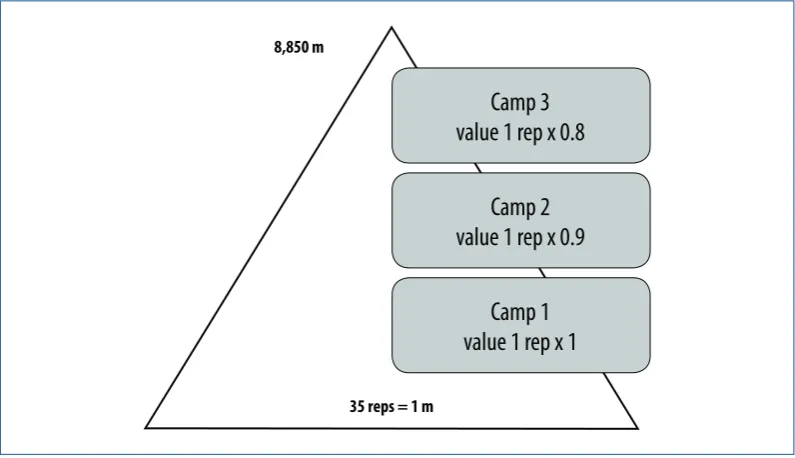
Inordertoaddtogetherthenumberofstrengthexerciserepsandearnascentmetres, thetabata
methodwasused. Ineachsession, thepupilsdidamaximumoftwotabataseries. Inaddition, to
maketheexerciseasrealisticaspossible, theincreasingdifficultyofdoingphysicalexerciseatan
altitudewassimulated, sotherepsachievedateachcamphadadifferentvalue, asshown inthe
following figure:
8,850 m
35 reps = 1 m
Camp 3
value 1 rep x 0.8
Camp 2
value 1 rep x 0.9
Camp 1
value 1 rep x 1
Figure 1. Rep, value and ascent metre details.
Forexample, agroupachieving350strengthexercisereps atCamp1effectivelymanagedto
climb10metres.
FortheCamp1andCamp2ascents, twosessionswereused, respectively. FortheCamp3and
Camp4ascents, threesessionswererequiredbecausethevalueoftherepswaslowerowingtothe
Assessment
Theassessmentcriteriaandtheirrelationshiptothelearningobjectiveswereasfollows:
R Designing4healthy, collaborativeresistancestrengthchallengesingroupsof4. (Objective1)
20%.
R Puttingeffortintoaccomplishingallthehealthy, collaborativeresistancestrengthchallenges.
(Objective2)20%.
R Designing4healthy, collaborativeresistancestrengthchallengesinQRformatforpupilsfrom
anotherschool. (Objectives3and4)30%.
R PerformingthefinalevaluationoftheunitbysubmittingtheGoogleFormsform. (Objective5)
10%.
R UsingdifferentWeb2.0toolstodeveloptheunit. (Objective5)5%.
R Enteringtherecordofrepsachievedontheform. (Objective5)5%.
R SimulatingaMount Everestascentbyperforminghealthy, collaborativeresistance strength
challengesconvertedintoQRcodes. (Generalobjective)10%.
Assessment procedures
A competency-basedcurriculumplacesthepupilsatthecentreoftheteaching-learningprocess;
theybecomethetrueprotagonists, whereastheteacherstakeontherolesofprocessfacilitators
andguides. Withinthiscontext, assessmenttakesonanewmeaning. Farfrombeingpenalisingor
qualifying, itbecomesprocessual, regulatory, instructionaland formative(Sanmartí, 2010). In this
experience, boththeteachersandthepupilstookpartintheprocessusingthreetypesofassessment:
hetero-assessmentperformedbytheteachers, co-assessmentamongthepupilsandself-assessment
bythepupils.
In addition, theexperiencetookintoaccountthethreeassessmentstagesandusedinitialor
diagnosticassessment, formativeorcontinuingassessmentand finalorsummativeassessment.
Several assessment instrumentswere used in the course of the experience. These provided
theteachersandpupils withinformationandallowedthelearningprocesstobemonitoredand
regulated. Theinstrumentsusedwerechecklists, questionnaires(onlineforms)andrubrics.
Web 2.0 tools
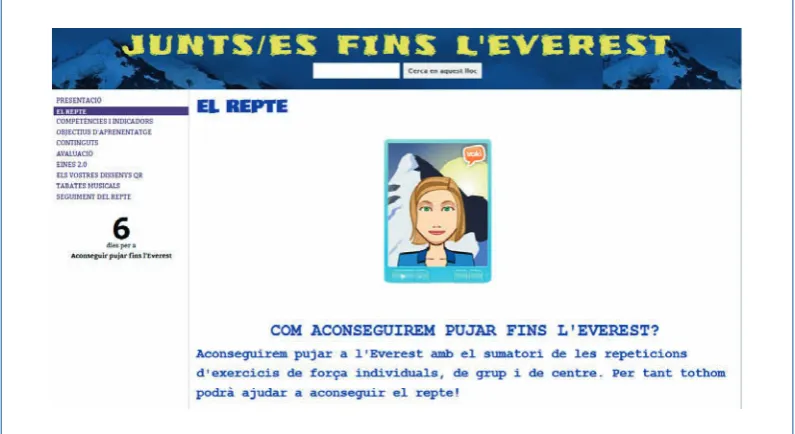
Thevirtual learningenvironmentthatservedasameetingpointfor bothschoolsandfacilitated
theexperiencefollow-upwasaGoogleSiteswebsitecalledJunts/es fins l’Everest (Togethertothe
top ofMount Everest). It was organised into different pages as follows: presentation, challenge,
competenciesandindicators, learningobjectives, content, assessment, Web 2.0tools, QRdesigns,
musicaltabatas, challengemonitoringand amarker that, like acountdown timer, indicatedthe
Figure 2. Experience website (Google Sites)
ThefollowingtableshowstheWeb2.0toolsusedintheexperience:
Table 1. Web 2.0 tools used in the experience.
Web 2.0 tools
Voki Voki was used to present the challenge to the pupils.
Tools for designing QR codes
QR Stuff http://www.qrstuff.com/ QR Voice http://qrvoice.net/
Mobile apps for reading QR codes
QR Droid for Android, QR Reader or Qrafter for iPhone, BIDI: Lector de Códigos QR for Blackberry, QR Code Reader for Windows 7.
Audacity The pupils used Audacity to design their own musical tabatas for strength work.
Google Forms
Two Google Forms forms were used: one for daily monitoring of reps done by each group and school to note the metres achieved in each session, and another for gathering the pupils’ final
evaluations of the experience.
Tomonitorthechallenge, anExcelspreadsheetwasdesignedandsharedonGoogleDrive. Itwas
alsoembeddedintheGoogleSiteswebsitesothattheresultsobtainedbyeachgroupandschoolin
eachsessioncouldbedisplayed.
3. Results
The learning results obtained from the ICT-mediated experience were satisfactory. Particularly
noteworthywerehowmuchthepupilslikedusingthecollaborativemethodologies, theusefulness
ofmobilephonesasmotivationaltoolsthatcreateandfosterlearningcircumstances, andthetransfer
oflearningconnectedwithhealthandtechnologicalappstothepupils’reallives.
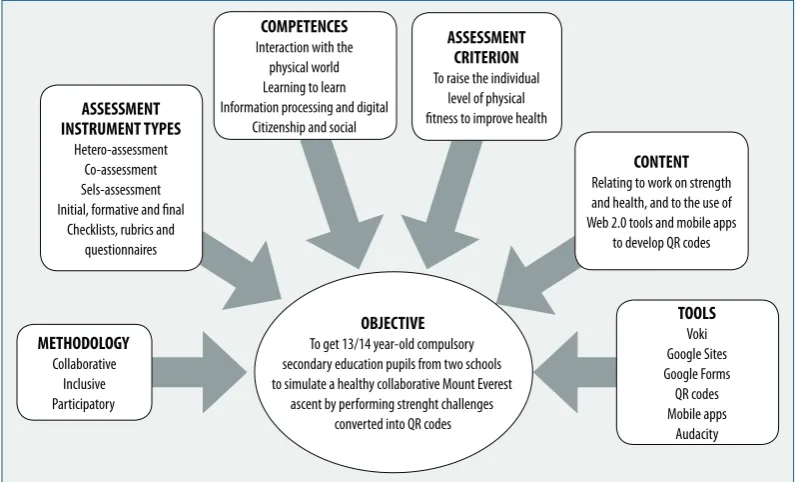
Theresultswereorganisedintothefollowingcategories:
METHODOLOGY Collaborative Inclusive Participatory ASSESSMENT INSTRUMENT TYPES Hetero-assessment Co-assessment Sels-assessment Initial, formative and final
Checklists, rubrics and questionnaires
COMPETENCES
Interaction with the physical world Learning to learn Information processing and digital
Citizenship and social
ASSESSMENT CRITERION
To raise the individual level of physical fitness to improve health
CONTENT
Relating to work on strength and health, and to the use of Web 2.0 tools and mobile apps
to develop QR codes
TOOLS Voki Google Sites Google Forms QR codes Mobile apps Audacity OBJECTIVE
To get 13/14 year-old compulsory secondary education pupils from two schools to simulate a healthy collaborative Mount Everest
ascent by performing strenght challenges converted into QR codes
Figure 3.Curricular elements of the didactic unit.
Evaluation of the experience
Transfer of learning to real life
Healthy, useful learning
Motivation, collaboration and
engagement Usefulness of mobile
phones and QR codes in learning RESULTS
Î
Î
Î
Î
Î
Usefulness of mobile phones and QR codes in learning
Sixty-sixpercentofthepupilspositivelyratedtheusefulnessofmobilephonesintheclassroombecause
theyhadenabledthemtodosomeactivities, tolearnnewandusefulthings, tousemobileappsthat
theyhadbeenunawareof, andtocombineandlearntechnologicalandphysicalactivityconcepts.
ThepupilssatisfactorilyratedtheuseanddesignofQRcodesinthedesiredformat(voice, video
andtext)tolearnnewandhealthystrengthexercisesandtoexchangethemwithpupilsfromanother
school. Inaddition, theypointedoutthatdiscoveringwhatstrengthchallengewashiddenbehind
eachQRcodehadsparkedtheirinterestandmotivation.
Chart 1. Evaluation of mobile phone use in the physical education classroom.
Eighty-sevenpercentofthepupilssaidthattheyhadnotpreviouslyusedanytoolstodesignQR
codes, andthatlearningaboutthemhadbeenverypositiveandrelevant. Onepupilsaid2: “I think that
QR codes will be very useful in the future, and we need to know how to use them.”
Thepupilsratedmobilephoneuseintheclassroomwithcommentslike:“this is the first time we’ve
been asked to bring our mobiles into the classroom”,“it’s much easier to do the lesson with a mobile”, “it was
different from other classes”, “it was fun”, “I’d rather use new ways of learning than pens and notepads”, “I
liked it because I didn’t know how to design QRs” and “I liked it because I’d never have thought that they’d
make us use a mobile in a lesson, especially not in PE lesson.”
Healthy, useful learning
Thepupilspositivelyratedthefactthattheyhadworkedonthestrengthofdifferentmusclegroups
bydoingnewexercisesandusingvariousmaterials. Ninety-eightpercentofthepupilssaidthatthey
hadlearnttodoresistancestrengthexercisesinahealthyway, andcommented: “this unit was really
useful because I’ve learnt to do physical activity and look after my body, and that’s important because we’ll
only have one body in this life.”
Motivation, collaboration and engagement
Thepupilspositivelyratedthecollaborativeworkdoneandthechancetointeractwithpupilsfrom
anotherschoolbyexchangingQRcodes. Thepupilspointedoutthehighlevelsofparticipationand
engagementinthechallengebecauseeveryone, throughtheirstrengthexercisecontributions, had
helpedtoaccomplishthechallengeirrespectiveoftheirindividuallevelsof fitnessand/orphysicalability.
Thepupilssaid:“we all did the activities, and even though you weren’t putting in that many reps, you felt that
they were important”, “this unit has been a new experience as we’ve never worked with other schools before.”
In addition, 89%ofthe pupilsconsideredthat workingwiththeirownmusicincreased their
motivation.
Transfer of learning to real life
Eighty-one percent of the pupils satisfactorily rated the usefulness and the transfer of learning
acquiredtotheirreallives:health, bodycare, mobileappuseandQRcodedesign.
Thepupilssaid:“it’ll be very useful to me, in a job where QR codes need to be used”, “for health”, “when I
want to do sport” and “to know how to look after my body.”
The pupils’
evaluations of the experience
Thepupilspositivelyratedtheexperience, particularlybecauseithadgiventhemtheopportunityto
workjointlywithanotherschooltoaccomplishacommonchallenge, tolearntodohealthystrength
Chart 2.Usefulness of learning acquired to real life.
No (22)
YES (91)
Yes 91 81%
exercises, todesignQRcodesandtousemobileappsthattheyhadbeenunawareofatthestartof
theexperience. Inaddition, theysaidthattheyhadhadfun, hadmadeaneffortandhadworkedin
teamstoaccomplishthechallenge.
Eighty-ninepercentofthepupilsratedtheunitwithascorebetween7and10, while12%ofthe
pupilsrateditwithascoreof6orlower.
Ninety-fourpercentofthepupilsratedtheteachers’actionswithascorebetween7and10, while
8%ofthepupilsratedthemwithascoreof6orlower.
Finally, continuingonfromthesentence “This unit was like a/an… because…”,thepupilsratedthe
experiencewithcommentslike:“its was very interesting because we mixed cooperation, technology and
music in the classroom”, “it was a surprise because we did it with another school”, “it was like an explosion of
creativity because I learnt loads of new things”, “this unit was a new experience in technology and PE, it was
my favourite unit of the year”, “this unit was a new activity because we did activities that we hadn’t done
before in other subjects (QR).”
Evaluation of the learning results
Theresultsobtainedinthepupils’learningwereverysatisfactory. Thepupilslearnttousedifferent
technological tools while self-managing the development of strength in a healthy way using
a collaborative working methodology. The pupils demonstrated high levels of motivation and
engagementinthevariousactivitiesandintheaccomplishmentofthechallenge. Infact, 94%ofthe
pupilspassedthedidacticunit.
Chart 3.The pupils’ evaluations of the unit
1 2 3 4 5 6 7 8 9 10
0 8 16 24 32
40 1 2 2%
4. Conclusions
“In the 21st century almost all work will be done in groups, most often facilitated by technology.” (Marc Prensky (2011). Teaching Digital Natives, p. 68)
Theresultsobtainedfromtheexperienceopenupabroadrangeofopportunitiesforincorporating
mobile learningintothephysical educationclassroom as aneducationaltoolandan emergent,
potential methodology, thus coinciding withthe resultsofthe study conductedby Ibáñez and
Asensio(2012)inthesecondaryeducationsphere.
The experience presentedinthis articleisframedwithin thecurrent conceptthat Adelland
Castañeda(2012)term ‘emergentpedagogy’.Educationalpracticesbasedonthispedagogy have
certainfeaturesthatweretakenaspointsofreferenceforthisexperience. Forexample, thedidactic
unitwasimplementedasanopencollaborativeprojectthatencouragedseveralteachersandschools
toparticipate;itstrengthened skillsandattitudestowards learningtolearnandanengagement
inlearningbeyondtheclassroom;itsurpassedphysicalandorganisationalboundariesbyuniting
formalandinformalcontexts, thusshapingnewecologiesoflearning(Sangrà, 2012).
CoincidingwiththeresultsofthestudyconductedbyIbáñezand Asensio(2012), thisexperience
hasshownhowimportantmobilephoneuseisasapositiveandmotivationaltooltoimprovethe
learningcircumstancesofpupilsstudyingphysicaleducation. Inaddition, thepupilsratedmobile
phoneuseinthephysicaleducationclassroomasafun, enjoyableexperience, coincidingonceagain
withthestudybyIbáñezand Asensio(2012).
AccordingtoCantilloetal. (2012), theincorporationofmobilephonesintotheclassroomhasenabled
anumberofbenefitstobegainedinrelationtothedevelopmentofcertainbasiccompetencies, skills
andabilitiesamongpupils. Forexample, intheexperiencepresentedhere, activeparticipationskills
weredevelopedthroughtheexchangeofchallengesconvertedintoQRcodeswithclassmatesorwith
pupilsfromanotherschool, throughtheproper, responsibleuseofmobilephonesintheclassroom,
throughlearningaboutconceptsandtechnologicaltoolsthatcouldbetransferredtoothercurricular
subjectsorreal-lifesituations, andthroughthedesignofbasicmusicalsequencestoself-managetheir
ownstrengthtrainingforhealth. Itwasthereforefoundthatmobilelearningcombinedwiththeuseof
collaborative, inclusivestrategiesenabledthepupilstoimprovetheirphysical fitnessinafun, healthyway.
AccordingtoNaismithetal. (2006), theincorporationofmobilelearningandtechnology into
educationalprocessesfosterscollaborationandsocialinteraction, andbothofthesewereobserved
intheexperiencethroughtheexchangeofQRcodeswithpupilsfromdifferentschools.
Various studies have highlighted the benefits of mobile learning for teaching, learning and
educationalchange. Giventheaccessibilityandenormouspotentialofmobiledevices, theyenable
learningtobetakenoutsidetheclassroomandpupilstocreateandsharetheirknowledge(Fundación
Telefónica, 2013). Tosumup, theexperiencehasenabledareflectiononthebenefitsofusingmobile
learningasaneducationaltoolandanemergentmethodologyinthephysicaleducationclassroom,
aswellasanobservationofitsenormouspotentialforlearningandforfosteringahealthylifestyle
References
Adell, J., & Castañeda, L. (2012). Tecnologías emergentes, ¿pedagogías emergentes? [Emergent
technologies: emergent pedagogies?] In J. Hernández, M. Pennesi, D. Sobrino, & A. Vázquez
(Coords.). Tendencias emergentes en educación con TIC [Emergent trends in ICT-mediated
education](pp. 13-32).Barcelona, Spain: AsociaciónEspiral, Educacióny Tecnología.
Alonso, C., Area, M., Guitert, M., & Romeu, T. (2012). Un ordenador por alumno: reflexiones del
profesorado deCataluñasobre losentornos1×1 [Onecomputer perpupil:theteachingstaff
of Catalonia’sreflectionson 1x1environments]. In J. Hernández, M. Pennesi, D. Sobrino, & A.
Vázquez(Coords.). Tendencias emergentes en educación con TIC [EmergenttrendsinICT-mediated
education](pp. 83-101). Barcelona, Spain: AsociaciónEspiral, Educacióny Tecnología.
Cantillo, C., Roura, M., & Sánchez, A. (2012). Tendenciasactualesenel usodedispositivosmóviles
eneducación [Currenttrendsintheuseofmobiledevicesineducation]. La Educ@ción Digital
Magazine, 147, 1-20. Retrieved from http://educoas.org/portal/la_educacion_digital/147/pdf/
ART_UNNED_EN.pdf
Coll, C. (2013). Elcurrículoescolarenel marcode lanuevaecologíadelaprendizaje [The school
curriculuminthecontextofthenewecologyoflearning]. Aula de innovación educativa,219,31-36.
Retrievedfromhttp://www.academia.edu/3172409/Coll_C._2013_._El_curriculo_escolar_en_el_
marcode_la_nueva_ecologia_del_aprendizaje._Aula_de_innovacion_educativa_219_31-36
Decret143/2007, de 26dejuny, pelquals’estableixl’ordenaciódels ensenyamentsde l’educació
secundàriaobligatòria [Decree143/2007, of26June, establishingtheorganisationofcompulsory
secondaryeducationteaching]. Diari Oficial de la Generalitat de Catalunya [OfficialGazetteofthe
Government of Catalonia], 4915, 21870-21946. Retrieved from http://portaldogc.gencat.cat/
utilsEADOP/PDF/4915/914193.pdf
Durall, E., Gros, B., Maina, M., Johnson, L., & Adams, S. (2012). Perspectivastecnológicas:educación
superior en Iberoamérica 2012-2017 [Technology Outlook. Iberoamerican Tertiary Education
2012-2017]. Austin, TX: TheNewMediaConsortium. Retrievedfromhttp://openaccess.uoc.edu/
webapps/o2/bitstream/10609/17021/6/horizon_iberoamerica_2012_ESP.pdf
Fundación de la Innovación Bankinter. Accenture (2011). La educación del siglo XXI. Una apuesta
de futuro [21st centuryeducation. A commitment tothe future]. Retrievedfrom http://www.
fundacionbankinter.org/system/documents/8498/original/FTFXVI_Educacion_FINAL.pdf
Fundación Telefónica (2013). Guía Mobile Learning [MobileLearningGuide]. Retrievedfrom http://
curalia.fundaciontelefonica.com/wp-content/uploads/2013/01/Guia_MobLearning.pdf
GeneralitatdeCatalunya. Departamentd’Educació. DireccióGeneraldel’EducacióBásicaielBatxillerat
(2010). Del currículum a les programacions. Una oportunitat per a la reflexió pedagógica a l’Educació
Bàsica [From thecurriculum toplanning. An opportunityfor pedagogicalreflection onBasic
Education]. Retrievedfromhttp://www.xtec.cat/alfresco/d/d/workspace/SpacesStore/1bc9a04d
-7d32-4027-a1c0-fdd779a6e2f9/del_curriculum_a_les_programacions.pdf
González Arévalo, C. (2010). ContextosysituacionesenEducaciónfísica [Contextsandsituationsin
física. Formacióndelprofesorado. EducaciónSecundaria (Vol. 1, pp. 75-87). Barcelona, Spain:
Graó.
Guitert, M., Guerrero A. E., Ornellas, A., Romeu, T., & Romero, M. (2008). Implementación de la
competenciatransversal “Usoyaplicacióndelas TICenelámbitoacadémicoyprofesional” en
el contextouniversitario de la UOC [Implementation of thetransversecompetence “useand
applicationofICT intheacademicandprofessionalarea” intheuniversitycontextoftheUOC].
Revista Latinoamericana de Tecnología Educativa,7(2), 81-89. Retrievedfromhttp://dialnet.unirioja.
es/servlet/articulo?codigo=2860446
Ibáñez, A., Vicent, N., & Asensio, M. (2012). Aprendizajeinformal, patrimonioydispositivosmóviles.
evaluacióndeunaexperienciaeneducaciónsecundaria. Didáctica de las Ciencias Experimentales y
Sociales, 26,3-18. doi:10.7203/DCES.26.1937
LeyOrgánica2/2006, de3demayo, deEducación [OrganicLaw2/2006, of3May, onEducation].
Boletín Oficial del Estado [OfficialGazetteoftheGovernmentofSpain], 106, 17158-17207. Retrieved
fromhttp://www.boe.es/boe/dias/2006/05/04/pdfs/A17158-17207.pdf
Moya, J. (Coord.) (2008). Proyecto Atlántida. De las competencias básicas al currículo integrado.
Ministerio de Educación Política Social y Deportes. Gobierno de Canarias. Consejería de
Educación, Universidades, CulturayDeportesdeCanarias. Madrid. Retrievedfromhttp://www.
redes-cepalcala.org/inspector/DOCUMENTOS%20Y%20LIBROS/COMPETENCIAS/DE%20LAS%20
COMPETENCIAS%20BASICAS%20AL%20CURRICULO%20INTEGRADO.pdf
Moya, J., & Luengo, F. (2010). Laconcreción curricular de lascompetencias básicas:un modelo
adaptativointegrado [Thecurricularspecificationofbasiccompetencies:anintegratedadaptive
model].CEE Participación Educativa, 15, 127-141.
Naismith, L., Lonsdale, P., Vavoula, G., & Sharples, M. (2006). LiteratureReviewinMobile Technologies
andLearning. FutureLab Series. Report:11. UniversityofBirmingham. Retrievedfromhttp://telearn.
archives-ouvertes.fr/docs/00/19/01/43/PDF/Naismith_2004.pdf
Prensky, M. (2008). Elpapeldelatecnologíaenlaenseñanzayenelaula [TheRoleof Technologyin
teachingandtheclassroom]. Educational Technology, Nov-Dec. TranslationintoSpanishbywww.
aprenderapensar.net. Retrieved from http://issuu.com/aprenderapensar/docs/el_papel_de_la_
tecnolog_a-marc-prensky
Prensky, M. (2011). Enseñar a nativos digitales [Teachingdigitalnatives:partneringforreallearning].
Madrid, Spain:EdicionesSM.
Proyecto Atlántida(n.d.). Retrievedfromhttp://www.proyectoatlantida.net
Sangrà, A. (2012). Crear y gestionar ecologías de aprendizaje: tendencias educativas en la sociedad
que viene [Creating and managing ecologies of learning: educational trends in the coming
society]. Xornadas Autonómicas “A Sociedad en Rede”. Santiagode Compostela, Spain, 23-24
November 2012. Retrieved from http://www.slideshare.net/asangra/ecologias-de-aprendizaje
-cafi-santiagonov2012
Sanmartí, N. (2010). Avaluar per aprendre. L’avaluació per millorar els aprenentatges de l’alumnat en el marc
del currículum per competències [Assessingtolearn. Assessmenttoimprovepupils’learninginthe
contextofthecompetency-basedcurriculum].Retrievedfromhttp://www.xtec.cat/alfresco/d/d/
UNESCO (2013). Policy guidelines for mobile learning. Retrieved from http://unesdoc.unesco.org/
images/0021/002196/219641e.pdf
Velázquez, C. (2012). Comprendiendo yaplicandoel aprendizajecooperativo enEducación física
[Understanding andapplying cooperative learningin Physical Education]. Revista Española de