209
Volume LIX 25 Number 5, 2011
THE EVALUATION OF FOREST
SMALL-SCALE SPECIALLY PROTECTED AREAS AND
THEIR BUFFER ZONES IN EXAMPLES OF
THE REGION TIŠNOV, CZECH REPUBLIC
K. Rebrošová, M. Honzová
Received: April 7, 2011
Abstract
REBROŠOVÁ, K., HONZOVÁ, M.: The evaluation of forest small-scale specially protected areas and their buff er zones in examples of the region Tišnov, Czech Republic. Acta univ. agric. et silvic. Mendel. Brun., 2011, LIX, No. 5, pp. 209–216
This study evaluates the eight forest small-scale specially protected areas (nature reserves: Babí lom, Břenčák, Krnovec, Slunná, Sokolí skála, and Nature monuments: Březina, Květnice, Zlobice) of the total area of 382 ha of the region Tišnov. The evaluation used two methodologies and results of were compared. From the outcomes obtained show that almost all the territories are in good (50%) or moderate (37.5%) status and quality of care is good in most cases (75%). The highest degree of care achieves is in a nature reserve Břenčák, which is generally excellent. The lowest recorded level of care, average, is in a natural monument Slunná. The poor condition or unsatisfactory of care were not found. Of the total area of protected areas and their areas of buff er zones is an average 24% aff ected by negative events. The most common reason for this eff ect is a landscape managed by intensive agriculture. Among the most invasive species belongs to Impatiens parvifl ora DC.; Impatiens glandulifera Royle. These are forming a continuous herb stand. In the trees stand is the most occurrences from invasive species Robinia pseudoacacia L. A er comparing the summary results of the two methodologies can be concluded that the fi ndings of both evaluate are very similar. The best current state is in natural reserve Břenčák and the worst state is in natural monument Květnice. Methodologies are diff erent from each other. The methods for evaluate of forest small-scale protected areas were tested as suitable. One method, but should be somewhat modifi ed.
buff er zone, protected areas, evaluation method, Tišnov region, Impatiens parvifl ora DC., Impatiens glandulifera Royle, Robinia pseudoacacia L.
The objective evaluation of the buff er zone of small-scale specially protected area, subject to the protection of forest communities, it is objectively capture buff er zone that actually fulfi ls its function, provides a protected area before the disturbance from the surrounding environment and mitigating the negative eff ects of external infl uences on the object of protection. It should be kept in mind that the protection zones usually do not have higher natural scientifi c or aesthetic value, and do not contain important ecosystems for a given
The priority of the protection zone should be protection (protection – the transition zone between ecosystems) of the protected area. But it can function as ecotone and also corridors.
Secondary function of the protection zone is a friendly use of renewable resources.
The establishing and maintaining a protection zone is considered one of the appropriate strategies to address existing or potential confl icts in nature conservation.
These three functions of buff er zones are basically the same in small-and large protected areas. The only diff erence is the mechanisms of their functioning within the scale. While small-SPA is mostly the level of communities. The large protected areas work almost always a segment of the country and all its elements, links and fl ows. The basic input documents for the evaluation are valid plans for specially protected areas. The all documentation relating to the locality; maps (preferably in digital form), or inventory surveys, forest management plans (forest management scheme).
The aim of this study is to evaluate the current status of forest small-scale specially protected areas and theirs buff er zones (including state and care about them) in the region of Tišnov.
These areas were chosen: nature reserves: “Babí lom”, “Břenčák”, “Krnovec”, “Slunná”, “Sokolí skála”, and Nature monuments: “Březina”, “Květnice”, “Zlobice”.
For evaluation were used these methodologies: Methodology of assessments of state and care about in small-scale specially protected areas (Svátek, Buček, 2005) and Design of methodology for evaluation of forest small-scale specially protected areas and theirs buff er zones (Rebrošová, Schneider, 2009) – Special Report project IGA Faculty of Forestry and Wood Technology, Mendel University in Brno No. 18/2009 – “Design of method of evaluation of buff er zones of forest small-scale specially protected areas”.
Using these methods in selected areas such methodologies to compare, to analyse and compare the results obtained. Another objective of this study is to verify the practical applicability of these methodologies for selected forest small-scale specially protected areas. The results may also serve as a suitable basis to correct the defi ciencies in the management of these areas, which may be accompanied by assessment (refl ected).
This learning framework aims to develop a methodology that could be applicable to:
Objective evaluation of the status of the protected area and in particular the functionality and the need to safeguard forest small-scale specially protected areas and theirs buff er zones, where the prevailing or sole purpose of protecting the forest communities, or a combination of subject matter: the protection of forest communities and species (plants, animals, fungi), forest communities and the pieces of inanimate nature etc.
Collect of documents such as the basic source of information on the achievement of eff ectiveness of care for forest small-scale specially protected area, with all the conditions of protection, including buff er zone.
Data processing for forest management plans for forest small-scale specially protected areas in Czech Republic.
The methodology should be applicable for protection of areas where forest communities are. The proposed methodology should be based on the regulations of nature conservation and landscape of Czech Republic.
MATERIALS AND METHODS
To address this study were used two methodological approaches:
Methodology of assessments of state and care about in small-scale specially protected areas (Svátek, Buček, 2005).
Design of methodology for evaluation of forest small-scale specially protected areas and theirs buff er zones (Rebrošová, Schneider, 2009) – Special Report project IGA Faculty of Forestry and Wood Technology, Mendel University in Brno No. 18/2009 – “Design of method of evaluation of buff er zones of forest small-scale specially protected areas”.
In year 2009 was run the collection of data and information on the areas, fi eld investigation and processing.
The Tišnov region has been studied eight forest small scale specially protected areas (under the Act of nature and landscape protection No. 114/1992 Coll., Czech Republic). These area were chosen to cover a wide range of environmental conditions, among them forest communities, natural forests, coppice forest and pine relict habitats in the extreme. When choosing to take into account diversity (biodiversity) in buff er zones and the related external infl uences. For this reason, was chosen as the complex of forests, the area surrounded by agricultural land or in contact with the water fl ow. Select the application and therefore allows comparison of the results of methodologies for diff erent types of forest ecosystems.
Study areas
According to Mackovčin (2007) is basic geomor-phological structure of Tišnov region – the territory divided into two areas: the Brno Highlands (with units: Boskovic Wake, Bobrav Highlands, Highlands and Drahan-Brno Basin, and the Bohemian-Moravian Highlands (with units: Křižanov Highlands and Hornosvratec Highlands). The relief of studing area is varied, in the northwest reaches of upland Sykorsk fragmentation of the territory to levels with diff erence in altitude 400 m.km−2, while
Tišnov region takes the typical Cambisol acidic and neutral intrusive gneisses and granulites. The Tišnov region, which is part of the river basin Svratka, belongs to the drainage area of the Black Sea. The main watercourse is the le -hand tributary of the River Thaya Svratka (Vlček, 1984). According to Quitt (1975) it is in moderately warm climate, characterized by average air temperature in July 16 to 18 ° C in January from −2 to −5 ° C. Biogeographic description is possible to read in monograph Culek et al. (1995).
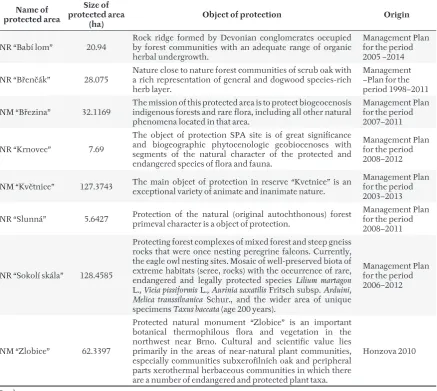
Table I shows the characteristics of the objects of nature conservation for individual protected areas and there are the sizes of chosen areas.
The main and only source of information on the areas reviewed were used care plans and in some cases, inventory surveys. These documents were obtained by contacting and visiting the Department of Environment Regional Offi ce Southern Moravian Region. From these materials it was possible to obtain
identifying data, location information, ecotopes, biota, and of course the objective of safeguarding the protected area, a survey carried out by the care and proposed interventions and actions. It was used a digital register too of the Central List of Nature Protection from Agency of Nature Conservation and Landscape protection of the Czech Republic. Assessment was based on a quick fi eld survey focused on obtaining recent information about the realities and outcomes of care. All fi eldwork took place in August and the fall of 2009. The exact location was determined using the GPS. First, we found where is situated the boundary of protected area; we controlled too the control bar marking the border, the state board with a small sign and evaluation of the buff er zone. A er them it followed directly in the survey focused on the evaluation of other criteria of protected area. During the fi eldwork notes were made on individual squares on the map according to the current position (Methodology I: Characteristics of the objects and the size of the areas
Name of protected area
Size of protected area
(ha)
Object of protection Origin
NR “Babí lom” 20.94
Rock ridge formed by Devonian conglomerates occupied by forest communities with an adequate range of organic herbal undergrowth.
Management Plan for the period 2005 –2014
NR “Břenčák” 28.075
Nature close to nature forest communities of scrub oak with a rich representation of general and dogwood species-rich herb layer.
Management –Plan for the period 1998–2011
NM “Březina” 32.1169
The mission of this protected area is to protect biogeocenosis indigenous forests and rare fl ora, including all other natural phenomena located in that area.
Management Plan for the period 2007–2011
NR “Krnovec” 7.69
The object of protection SPA site is of great signifi cance and biogeographic phytocenologic geobiocenoses with segments of the natural character of the protected and endangered species of fl ora and fauna.
Management Plan for the period 2008–2012
NM “Květnice” 127.3743 The main object of protection in reserve “Kvetnice” is an exceptional variety of animate and inanimate nature.
Management Plan for the period 2003–2013
NR “Slunná” 5.6427 Protection of the natural (original autochthonous) forest primeval character is a object of protection.
Management Plan for the period 2008–2011
NR “Sokolí skála” 128.4585
Protecting forest complexes of mixed forest and steep gneiss rocks that were once nesting peregrine falcons. Currently, the eagle owl nesting sites. Mosaic of well-preserved biota of extreme habitats (scree, rocks) with the occurrence of rare, endangered and legally protected species Lilium martagon
L., Vicia pissiformis L., Aurinia saxatilis Fritsch subsp. Arduini,
Melica transsilvanica Schur., and the wider area of unique specimens Taxus baccata (age 200 years).
Management Plan for the period 2006–2012
NM “Zlobice” 62.3397
Protected natural monument “Zlobice” is an important botanical thermophilous fl ora and vegetation in the northwest near Brno. Cultural and scientifi c value lies primarily in the areas of near-natural plant communities, especially communities subxerofi lních oak and peripheral parts xerothermal herbaceous communities in which there are a number of endangered and protected plant taxa.
Honzova 2010
according to Rebrošová, Schneider, 2009). During the investigation it was also taken photographs. Time-consuming fi eld evaluations will depend on the size and complexity of the area, its accessibility and other factors. The selected area does not exceed the length of the assessment for one day, as the authors stated in methodologies so. The other time is needed for both methods for completing the trial data and processing of complex outputs.
RESULTS AND DISCUSSION
The evaluation results obtained by methodology according to Svátek, Buček
(2005)
The current state of most investigational selected protected areas of Tišnov region was rated as good in 50% of the all assessed areas. On the 37.5% of the assessed areas was state evaluated as average. Only one area is in excellent condition, it is a natural reserve Břenčák. The positive fact is that in any area there is not a bad or very bad condition. On most of evaluated areas are maintained subject of protection, which has been published, including the optimal structure of biota. The studying areas are not signifi cantly aff ected by the presence of black garbage dumps and litter. The lowest level was the most frequently evaluated criteria “expansive and
invasive species”. Among the most unwanted species that were identifi ed during fi eld surveys include Impatiens parvifl ora DC; forming a continuous growth in the herb Impatiens glandulifera Royle; Robinia pseudoacacia L. and others. The invasive species are mainly Fraxinus excelsior L.
On the evaluated areas are mostly contain this kind of type forest: relict pine forest, forest communities, forest management resulting of stool shoot; forests with natural species composition. Highest degree of preservation of the subject matter has been found in “Břenčák”, “Babí lom” and “Sokolí skala”. The lowest proportion of the area with optimal conditions for preservation of the subject matter is in areas “Březina”, “Slunná” and “Květnice”. The structure of biota in selected areas is mainly infl uenced by the way of agriculture, which was previously applied. The optimal structure of the approximating to nature or natural condition has been detected in nature reserves “Babí lom” and “Břenčák”. The least satisfactory structure of vegetation and natural heritage are in areas “Březina” and “Květnice”. There is a signifi cant problem non-native species composition of certain parts of the stands. Sozology protected and important species was assessed in three areas, which have used information from surveys, inventories and management plans. The highest ratings of this criteria obtained natural reserve “Břenčák”. O en,
II: Criteria and reasons for declining values of point
Criterion Reason of X degreesReduction
A occurrence of invasive species under 100 m2 surface coverage −1
B occurrence of invasive species over 100 m2 surface coverage −2
C non-native species composition of mixed −1
D non-native species composition – monoculture −2
E buildings, railways, houses, broadcasters, el. management, gardening colony −1 F industrial buildings (companies, warehouses, factories) −2 G landfi ll and waste, debris and landfi ll – the type and scale –and major character −2 H landfi ll and waste, debris and landfi ll - the type and scale – a minor nature - only in places −1 CH occurrence of paths - the width of 4 m (hiking trails, forest roads) −1 I occurrence of paths - more or equal to 4 meters asphalt road, traffi c −2
J highways and motorways −3
K tourism impact – a signifi cant movement of people on bikes or other means – limited peace, space, growth, development, etc. −2
L evident by the increased movement of people outside the protected paths −1
M recreational facilities −1
N game management buildings – such as racks, pulpits, seats, other equipment −1 O damage of nature by wild beasts in gradation on area to 100 m2 −1
P damage of nature by wild beasts in gradation on area over 100 m2 −2
Q removal of the wall and stands forest – the emergence of sun scorch, support forest weed, destructive penetration wind −2
R clear large-scale silviculture cutting −2
S clear small-scale silviculture cutting −1
this type of evaluation was not signifi cant, because it would require a longer time-tracking site, or would not be up to date inventory surveys. On the majority of selected areas was suffi cient reproduction of the species. Conditions allowing adequate reproduction of populations to ensure their continued existence, are the most negatively aff ected by shading, dense undergrowth and herb spread of aggressive alien species, which prevents the natural development of new species. Quality of care for selected forest small-scale specially protected areas is generally rated as good (75% of the studying areas). The highest degree of care achieves a natural reserve “Břenčák”, which is generally excellent. The lowest recorded level of care, the average, is in a natural monument “Slunná”. The criterion with the highest rating ever is the “documentation” is all selected areas reached the maximum number of points denoting excellent condition. Documentation was complete in most areas, not just in some processed inventory survey. On the contrary, the worst rating criterion was “buff er zone”, which is usually not respected and o en does not fulfi l its protective function. The evaluation of quality of care about protected area is a criterion “buff er zone” the lowest rated criterion. Common side eff ects and activities in buff er zones is the presence of cabana’s areas and allotment gardener areas, landfi ll waste, the population of invasive species and intensive agricultural activities causing damage ecotone parts, hunting equipment and not least the presence of clear cutting.
Signifi cant shortcomings in achieving conservation objectives have been discovered in the care about the natural reserve “Slunná”, the most valuable part (the primeval beech stand) is in the process of decay, without ensuring their adequate
regeneration. This criterion was common rated grade 4, less than 5.
The fi nal evaluation of the current situation (state) in forest small-scale specially protected areas evaluated using by the methodology according to Svátek, Buček (2005) shows in Table III.
The evaluation results obtained by methodology according to Rebrošová,
Schneider (2009)
The most of the reviewed by methodology Rebrošová, Schneider (2009) has not the ideal shape considering to its subject of protection, it is elongated rectangle or lines (50% of the studying areas). Triangular and rectangular shape, which is always preferable, has only one territory. The most ideal shape close to a square or a circle is represented by only one evaluated area. A size category in most cases (62.5%) exceeds the minimum size for the type of vegetation by Vacek (2003). These minimum surfaces of areas are not reaching three territories, namely: “Babí lom”, “Slunná” and “Krnovec” (for the reservation, it is likely the extension).
The situation in the landscape of forest small-scale specially protected areas is aff ected by the associated ecotones of diff erent widths and species diversity is usually a combination of several options (o en the surrounding agricultural land adjacent to forests with him, in some cases near the settlement), only two areas (“Babí lom” and “Slunná”) are situated in a complex of forest. A er the assessment of interest areas was found that on average 76% of the excavated areas are not aff ected. Least aff ected areas are in the forest complex (88% surface of area “Babí lom”, 84% surface of “Slunná”). Conversely, the biggest proportion of the areas of infl uence of one factor,
III: The fi nal evaluation of the current status and treatment in selected Tišnov region specially protected areas (according to the methodology Svátek, Buček, 2005)
Evaluation of current state and management
in protected areas and its buff er zone fi nal assessment of the state
fi nal assessment of the management
code cat. name of area ∑ (%) state ∑ (%) management
1130 NR “Břenčák” 91 EX 96 EX
403 NR “Sokolí skála” 89 G 90 G
189 NR “Babí lom” 83 G 82 G
1129 NR “Krnovec” 77 G 81 G
883 NM “Zlobice” 75 G 81 G
1015 NR “Slunná” 68 A 77 G
1438 NM “Březina” 66 A 71 G
204 NM “Květnice” 63 A 66 A
Arithmetic average 76,5 G 80 G
Explanatory notes: EX – Excellent G – Good A – Average
Cat. – Categories of protection NR – Natural Reserve NM – Natural Monument
the area surrounded by intensively farmed land near settlements or in contact with gardening colonies (“Březina” 64%, “Květnice” 68% and “Zlobice” 68%). Interestingly, this group includes all the categories of natural monument.
The most commonly occurring adverse phenomenon operating in the buff er zones is an intensive agriculture. Intensive farming can cause plowing valuable stand borders, changes in soil nutrients due to fertilization, etc. The second most common phenomenon is the presence of buildings, railways buildings, electric line transmitters and other leadership. It is important to precise defi nition and demarcation of borders and prevents the dumping of property owners within the buff er zone, or directly into the area. Relatively o en has been reported with non-native vegetation species composition, mixed or monoculture. Monocultures should be transferred to appropriate silvicultural interventions on this area, which corresponds to the natural conditions. Places aff ected by the occurrence of invasive species reduce the protective function of buff er zone and infl uenced to object of protection. Another negative eff ect is large-scale silviculture cutting found mainly in protected areas. The fact that even a small percentage of the protection zone with a signifi cant negative infl uence can have on the status of protected areas and critical impact, the protected area “Slunná” shows, whose status was disrupted because silviculture cutting in the northern part of the buff er zone and the subsequent eff ect destructive winds. The role of the protection zone is the territory also depends on
the size and shape of small-scale special protected areas. An example might be a protected area “Sokolí skála”, the buff er zone and territories in its vicinity is infl uenced by a number of diff erent phenomena (rail track, asphalt roads, invasive species, recreational facilities …), but the overall condition of the area is positive. It was found that 76% of the total area evaluate selected specially protected areas of Tišnov region are not aff ected. The remaining 24% of the area aff ected is registered, which is defi ned in Table II. Tabularly the most common reason of interference of assessed protected areas and their buff er zones expresses the Figure 1.
Comparing the results of both methods
“Methods” according to Rebrošová, Schneider (2009) is not designed to create a universal comprehensive evaluation. It is therefore quite diffi cult to clearly determine which evaluated areas are in the best and in worst of the state. A er considering the nature, intensity and type of infl uence can be described as the best state in the “Babí lom” and “Břenčák” fracture. This result corresponds to the output of the methodology developed under Svátek, Buček (2005), where the highest ranking has protected area “Břenčák”. According to the methodology under Svátek, Buček (2005) Current status of at least not corresponds to the optimum condition for protected area “Květnice”. Also according to the method established Rebrošová, Schneider (2009) are in the worst condition protected areas: “Květnice”, “Březina” and “Krnovec”. Based on the above
comparison we can say that although their approach diff ers both methods, the resulting assessment of the state interest is broadly similar.
CONCLUSIONS
The results of this study should enable the identifi ed gaps and determine optimal management guidelines. Draw attention to the issue of management of the buff er zones, it si necessary to be further addressed. Comparison of the both
methodologies can be used to their potential improving. The main purpose of this study was to apply and try on the set of areas to set the method according to Rebrošová, Schneider (2009) – Special Report project IGA Faculty of Forestry and Wood Technology, Mendel University in Brno No. 18/2009 – “Design of method of evaluation of buff er zones of forest small-scale specially protected areas”.
A further aim was to identify shortcomings of this proposal and fi nd other possible solutions for improvement.
SUMMARY
In summer, in autumn 2009 and spring 2010 assessment have been conducted eight forest small-scale specially protected areas in the Tišnov region. Once collected and examined the necessary information and material (eff ective management plans, inventory surveys) was conducted fi eld research. Based on these surveys has been reviewed the current status and quality of care for each territory according to methodologies: a. according to Svátek, Buček (2005) and b. according to Rebrošová, Schneider (2009). The results obtained revealed that 50% of the assessed protected areas and theirs buff er zones are in good condition and 37.5% are in average condition. Some of the protected areas are characterized by the presence of part of the alien woody species composition and presence of invasive species. Frequent negative eff ect the damage caused by browsing of cloven browsing animals and the presence of garbage dumps and increased tourist traffi c. The quality of care for selected protected areas of Tišnov region can generally be characterized as good (75% of evaluated areas). The excellent care was observed only in protected area “Břenčák”. Highly evaluated is the documentation of the areas (in all cases, the highest level). The worst was assessed criterion “buff er zone”, which is o en not respected or fails to fulfi ll its purpose. In terms of the evaluation of care were not identifi ed serious defi ciencies in respect of nature conservation. There are as average 24% of the evaluation of total protected areas and their buff er zone. The most common reason for this eff ect is intensive agriculture. A er comparing the summary results of the two methodologies can be concluded that the fi ndings of both reviews are similar. The best current state is in a natural reserve “Brencak” and vice versa for the worst is in “Květnice”. The results of this work should enable the identifi ed gaps and determine optimal management in protected areas. Moreover, it highlighted the issue of management of the buff er zones to be further addressed. Comparison of the two methodologies can be used for improvement, particularly the right emerging methodology for assessing the status and the methods of management in buff er zones of forest small-scale specially protected areas.
Acknowledgements
The paper is presented as output of the project IGA Faculty of Forestry and Wood Technology, Mendel University in Brno No. 18/2009 – “Design of method of evaluation of buff er zones of forest small-scale specially protected areas”. Solution of the project methodology and ideologically linked to the research project Ministry of Education, Youth and Sports 6215648902 – “Forest and Wood – Support functionally integrated forest management and use of wood as a renewable resource” Partial intention 04th.
REFERENCES
CULEK, M. et al., 1995: Biogeografi cké členění České republiky. 1.vyd. Praha: Enigma, ISBN 80-85368-80-3.
HONZOVÁ, M., 2010: Zhodnocení stavu a ochranných pásem vybraných lesních maloplošných zvláště chráněných území Tišnovska. Diplomová práce. Brno. Mendelova univerzita. 70 str.
LACINA, J., SCHNEIDER J., 1998: Plán péče pro PP Květnice na období 1999–2008.
MACKOVČIN P. et al., 2007: Chráněná území ČR, Brněnsko. Svazek IX. Praha, Brno. EkoCentrum. 932 s. ISBN 978-80-86305-02-8.
MARTINO, D., 2001: Buff er Zones Around Protected Areas: A Brief Literature Review. Electronic Green Journal., Issue 15. Idaho, USA. ISSN: 1076–7975. MARTIŠKO, J., 1997: Plán péče pro PR Břenčák na období
1998–2011.
PETŘÍČEK, V. et al., 1999: Péče o chráněná území, I. Nelesní společenstva. Praha. Agentura ochrany přírody a krajiny ČR, 450 s. ISBN 80-86305-01-5. PIŠTĚK, J., 2006: Plán péče pro PP Březina na období
2007–2011.
PIŠTĚK, J., 2008: Plán péče pro PR Krnovec na období 2008–2012.
PIŠTĚK, J., 2007: Plán péče pro PR Slunná na období 2008–2011.
PIŠTĚK, J., 2005: Plán péče pro PR Sokolí skála na období 2006–2012.
QUITT, E., 1975: Klimatické oblasti ČSR. Brno. Geografi cký ústav ČSAV.
REBROŠOVÁ, K., SCHNEIDER, J., 2009: Hodnocení stavu a návrh metodiky hospodaření v ochranných pásmech lesních maloplošných zvláště chráněných území. Projekt IGA, MZLU v Brně, 80 s.
RUSTAGI, D., 2005: Tanzania Wildlife Discussion Paper No. 45, What the Kidunda Dam will Destroy: Ecological
and Socio-economic Value of Gonabis, Selous Game Reserve, Tanzania.
SCHNEIDER, J., 1997: Plán péče na období 1998–2007, návrh na rozšíření ZCHÚ PR Slunná.
SCHNEIDER, J., 2004: Plán péče pro PR Babí lom na období 2005–2014.
SVÁTEK, M., BUČEK, A., 2005: Metodika hodnocení stavu a péče v maloplošných zvláště chráněných územích. MZLU v Brně, 24 s.
ÚHÚL Brno kolektiv, 2001: Oblastní plán rozvoje lesů pro lesní oblast 33. ÚHÚL Brandýs nad Labem. VACEK, S., 2003: Minimum area of forests le to
spontaneous development in protected areas. Journal of Forests Science, 49, No (8). 349–358.
VLČEK, V., 1984: Vodní toky a nádrže. Academia, Praha. 558 s.
Vyhláška č. 395/1992 Sb., kterou se provádějí některá ustanovení zákona č. 114/1992 Sb.
Zákon č. 114/1992 Sb., o ochraně přírody a krajiny, aktuální znění.
Address