T H E CO N STR U C TIV IST C O N C E P T IO N O F LA N G U A G E AND ITS F U N C T IO N S
IN S C IE N C E
A l e x a n d e r Z a h a r 1 9 9 5
Thesis submitted in partial fulfilment of the requirements for the degree of Doctor of Philosophy (Ph.D.)
Department of Philosophy
ProQuest Number: 10046066
All rights reserved
INFORMATION TO ALL USERS
The quality of this reproduction is dependent upon the quality of the copy submitted.
In the unlikely event that the author did not send a complete manuscript and there are missing pages, these will be noted. Also, if material had to be removed,
a note will indicate the deletion.
uest.
ProQuest 10046066
Published by ProQuest LLC(2016). Copyright of the Dissertation is held by the Author.
All rights reserved.
This work is protected against unauthorized copying under Title 17, United States Code. Microform Edition © ProQuest LLC.
ProQuest LLC
789 East Eisenhower Parkway P.O. Box 1346
Ab s t r a c t
The main task of this thesis is to co n tra t two philosophical conceptions of ‘language- and-its-functions’ in science. The first, which I call the dualist conception, has dominated history and philosophy of science. There are two constituents of dualism: the disjunction of ‘language’ and ‘world’ (the latter term encompassing the supposed non-linguistic subject matter of science); and the assumption that the philosophically primary function of language in science is to be ‘about’ the world (thus language may be ‘about’ — or fail to be about — mind-dependent phenomena or mind-independent facts, depending on how a dualist conceives the world).
In Part 1 1 examine a wide spectrum of formulations of the dualist conception and show that it has influenced philosophers of science of almost every persuasion. I argue that language/world dualism has been presupposed without justification, and (besides being implausible) has remained ill-developed as a philosophical thesis. At the end of Part 1, I look at a body of medical publications from the early nineteenth century that are evidence of a crisis in the use of the ‘formal’ language of medicine — here language appears to be plainly differentiated from the subject matter of science by scientists themselves. I use the case study to argue that crises of language in pre-consensual science are commonplace, but provide no support for the dualist conception.
The refutation of dualism is attempted in Part 2 where the constructivist conception of language is presented. I begin with an examination of recent scholarship in the history of science, laboratory studies, and the sociology of knowledge. In particular, I defend Gooding’s ‘theory’ of the making of meaning in experiment, and argue that philosophy of science requires a much richer conception of language than that found in dualism. The conception I propose makes out language to be not a reference or symbolic device, but a resource of metaphysics, skills, and activities by way of which scientists commu nally make sense of their experimental experience. Functions of language considered basic by dualists (such as description and reference) are shown to be made functions, convention-bound, and historically contingent. Because language is an integral aspect of scientific knowledge from its most exploratory to its most accomplished levels, and because through uses of language human agency constitutes what natural knowledge and facts are, there can be no good argument for drawing a metaphysical distinction between language and that which it is ‘about’ in science, or for dissociating knowledge from that which it is knowledge ‘o f . Consequently dualism is rejected.
Co n t e n t s
A b s t r a c t 2
A c k n o w le d g m e n ts 4
INTRODUCTION A philosophical non-issue: language and its
functions in science 5
Pa r t I The dualist conception o f language and its functions in
science 22
1.1 Popper on language 22
1.2 Kuhn on language 35
1.3 Other formulations of dualism 48
1.4 Dualism in pre-consensual uses of language 71
Part 2 The constructivist conception of language and its functions
in science 94
2.1 Scientific language in history and the laboratory:
matters o f fact and ‘out-thereness’ 95
2.2 Gooding on the experimental making of
meaning 124
2.3 Realist, anti-realist, and other objections to the
proposed conception 160
Co n c l u s io n Some unresolved philosophical issues o f language in
science 189
BlEUOGRAFHY 202
A. General works 202
A C K N O W L E D G M E N T S
It would have been impossible for me to write this thesis without the help of Tom Bestor (my first philosophy teacher), and Glenda Sluga.
To New Zealand, the Association of Conunonwealth Universities, the British Council, and the Wellcome Institute for the History of Medicine, I am for ever indebted.
In particular, from the ACU, I wish to thank Michael Pearce for his personal attention, and Betty Wamock. From the British Council, I am grateful to Veronica Onuora and her colleagues at the Commonwealth Awards Section.
From the Wellcome Institute I wish to thank Bill Bynum for his kind and unconditional hospitality, and Vivian Nutton for his inspiring scholarship and good humour. New Zealand offered me freedoms and opportunities that I never imagined in Greece.
IN T R O D U C T IO N
A Ph i l o s o p h i c a l No n-i s s u e:
La n g u a g e a n d i t s Fu n c t io n s in Sc i e n c e
His is a philosophy founded upon reflections on language, and no such philosophy can teach anything positive about natural science.* (Hacking on Putnam)
Twentieth-century science, commonly regarded as a source of knowledge p a r
excellen ce, has attracted the scholarly attention of historians, sociologists,
anthropologists, and cultural critics, and has thereby become the focus of many relatively new industries in the humanities. Twentieth-century philosophy of science has also, of course, enjoyed a rapid growth, reflecting the growth in importance and status of science itself. Discussions of scientific rationality have been wide-ranging.
At the same time, competing philosophical notions of rationality have kept discussions from focusing on the study of actual scientific practice, with the result that philosophers of science in the analytic tradition have not comprehensively furthered our under standing of what scientific knowledge is or how it comes to be. Only in recent years, under the influence primarily of historians of science, have philosophers looked more closely at scientific practice and its history. This redirection has been at the root of much reworked and new p h i l o s o p h y . ^
The thesis set out in these pages is about an aspect of scientific practice that has had little or no influence on contemporary philosophy. It is about language in science. Of course, asking after language in philosophy is hardly a novelty. It has been discussed extensively at least since Plato, and philosophy of language of one sort or another is part of every philosopher’s basic education. Yet language has not figured prominently as a topic in philosophy of science. Given the centrality of language to philosophy throughout its history, it might come as a surprise to find it discussed sparingly in the considerable quantities of new philosophy that twentieth-century science has given rise to in its wake.
'Hacking, Representing and intervening, p. 92.
^For historical accounts of the development of the philosophy of science see Losee, A historical
introduction to the philosophy o f science', and idem. The philosophy o f science and historical enquiry.
On the relatively recent philosophical uses of history see, for example, Finocchiaro, ‘The uses of
Two objections to what I have just said, coming from two quite different directions, I acknowledge immediately. In the first case, the objection might be raised that we are not normally inclined to think of language as a distinct ‘aspect’ of science. ‘Language as opposed to what?’, one might ask. Scientific theories? — but theories are only ever encountered in a language of one kind or another, familiar or not. Laboratories? — but, again, laboratories contain conversing scientists, word processors, notebooks in continuous use, libraries and archives, document-inscribing instruments, labelled samples and labelled Petri dishes. Bacterial cultures? At first they might seem a possibility — yet the fact that no one would dream of calling a bacterial culture an ‘item of language’ does not normally lead anyone to think that bacterial cultures stand
opposed, in some fashion, to language. Nor does it follow that everything in science
either is or isn’t an item of language. Bacterial cultures, for example, although obvi ously not items of language, would not be in the laboratory were they not contributing to the articulation of new facts, were they not an object of interest to a particular group of note-taking technicians and paper-writing scientists, were they not a part of the outlook of some research programme. Every characterisation ever given of a bacterial culture has, of course, been in terms of some language.
This ‘common-sense’ objection to the suggestion that language is a distinct ‘aspect’ of science springs from an entirely respectable instinct which I myself develop in opposition to the language/world distinction in the philosophy of science. However, it is also my view is that we can speak properly and innocently of language as an aspect of science, not in the course of contrasting it with something non-linguistic or physical, but in the course of highlighting and clarifying its role as a knowledge-making device. Language is of assistance to scientists not as a passive medium for the articulation of empirical knowledge, but as a complex resource by means of which a convincing understanding of the world may be built. Identifying language as an ‘aspect’ of science is useful just insofar as it helps us to gain a better understanding of the making and nature of scientific knowledge.
The second objection to my opening claim is that, in fact, it is quite possible to name philosophers of science in whose writings remarks about language occur in relatively high concentration (Rudolf Carnap, Moritz Schlick, and fellow logical positivists come to mind). My reply is that practically in all such cases the remarks demonstrably derive from preconceptions about what language in science ideally ought to be like and not from a close examination of what that language is or how it is used.^ Such
discus-^Schlick believed that ‘the languages employed in the sciences are designed to make possible the
sions, even if exhaustive, have had too narrow a focus. In a well-known review o f the discipline, Larry Laudan and associates listed and categorised all major philosophical theses on scientific change and related topics proposed up until the early 1980s: of the hundreds of theses identified not one was about language and its functions.'*
It is necessary, of course, to distinguish the rarity of philosophical discussion of language in science from the demonstrable presence of assum ptions about it in philosophical writings on science. The drawing of this distinction enables the rather vague expression ‘language in science’ to become associated with concrete and clear philosophical issues. Once the distinction between overt acknowledgment (or the lack of it) and covert reliance on certain assumptions about language is emphasised, two questions arise. One concerns the assumptions themselves: what are they (how might
This is an idealisation — see Popper’s remarks in the introduction to The logic o f scientific discovery,
where he states that ‘the models of “the language o f science” which [philosophers such as Schlick]
construct have nothing to do with the language of modem science’, but are driven rather by the
‘spiritual consolations offered by the hope for knowledge that is “exact” or “precise” or “formalised”’
(pp. 20-21). Popper offers an example elsewhere: ‘By 1931 Carnap ... under Neurath’s influence ... had
adopted the thesis of physicalism, according to which there was one unified language which spoke
about physical things and their movements in space and time. Everything was to be expressible in this
language, or translatable into it’ {Conjectures and refutations, p. 265). That unified uieal language was
the preferred end of philosophers of science at the time, not the language of science in use. On the
‘idealisations’ of science by philosophers such as Hempel, Feigl, Frank, and others, see Toulmin,
‘From form to function’, p. 146. Danto’s claim that ‘the marked linguistic bias of [Henri Poincaré’s]
philosophising has been influential in directing philosophers’ attention to the language in which
scientific discoveries are expressed and theories formulated’ (‘Problems of the philosophy of science’, p.
293), has remained, as I maintain in Part 1, largely untrue.
^See Laudan et al., ‘Scientific change’. Hull’s Science as a process (1988), whose enormous index
contains not one reference to language, illustrates the neglect of language in contemporary works on
the philosophy of science. I have mentioned above, and I argue in Part 2 of this thesis, that in all of
the literature that has had science as its focus, language will be found observed and discussed in the
writings not o f philosophers but o f historians and sociologists. Recent examples o f this literature
include Anderson, Between the library and the laboratory', Bazerman, Shaping written knowledge’,
articles in Dear (ed.). The literary structure o f scientific argument, Gilbert and Mulkay, Opening
Pandora’s box’, Gooding, Experiment and the making o f meaning; Gross, The rhetoric o f science;
Latour, Science in action; Latour and Woolgar, Laboratory life; Lynch, Art and artifact in laboratory
science; Myers, Writing Biology; and Shapin and Schaffer, Leviathan and the air-pump. For
bibliographies of fundamental work in the sociology o f science and scientific knowledge see Brown,
they be spelt out?) and what are their consequences for the ways in which philosophy of science has been written? The second concerns the adequacy of the assumptions: can they be justified? — have they been justified? — and what, if anything, can be said about language and its functions in addition to or instead of existing assumptions?
Guided by these questions, the purpose of the present thesis is two fold. First, in Part 1 ,1 attempt a survey and clarification of assumptions about language in science found in writings of contemporary philosophers of science. Second, in Part 2 , 1 present a critique of these assumptions and discuss alternative assumptions that have either remained marginal in philosophy or have not been discussed at all or have been explored to some extent by historians, sociologists and anthropologists of scientific knowledge. The intended result is a revised and improved philosophical conception of scientific language and its functions.
At the end of Part 1 there is a brief section on medical history. It is, more accurately, a very compressed case study of some problems of language in the history of medicine. It gives an indication (and no more) of the kinds of problems that language has given rise to in the course of scientific inquiry by looking at a period in medical history when such problems were particularly exaggerated. Specifically, I have used a selection of examples from medical writings published in the early British medical periodicals (early in the nineteenth century) to illustrate the ways in which medical language had become a frustrating obstacle to those who chose to participate in the debates, raging at the time, on the nature of disease (in particular, epidemic disease). A remarkable feature of the nineteenth-century texts — and of other writings from ‘pre-consensual’ periods in science — is that the formal language o f medicine (or, more specifically, the meanings of many words, the structures of arguments, the very act of writing, of ‘putting it all into words’, the printed text, the reflections that went into its preparation, and the ways in which contemporaries read it and responded to it) was fraught with difficulties, difficulties widely acknowledged and remarked upon at the time.
dispense with the rest (for only this could lead to shared knowledge and a more unified medicine). I also considered the possibility that an ever-changing language presented doctors — natural philosophers, scientists, or in any case its users — with challenges not unlike those more material and technical challenges repeatedly experienced in the history of science with the introduction of novel scientific instruments, the setting up of new experiments, the articulation of theories, the implementation of unorthodox measures against diseases, etc.^ The problems of language I came across in nineteenth- century medical journals were, according to my initial reaction, a part — a neatly distinguishable part — of the general problem of determining ‘what the world is like’. I thought, in other words, that the set of problems scientists faced at any particular time always included a subset of problems to do with language.
With these assumptions about language in science I turned to the better-known philo sophical writings on science in search of analyses of both the ‘world-to-word conversion’ (as I called it) and the emergence of shared scientific expressions. But instead of analyses of these particular issues I found many mostly veiled assumptions about language in science resembling my own assumptions at the time, in particular the assumption that science converts methodical observations of natural facts into methodical discourse. All such assumptions, I realised, relied heavily on what I shall henceforth refer to as the disjunction o f 'language' and 'world'. Otherwise, as I have already indicated, language was rarely an issue in mainstream philosophy of science.
Manifestations of the philosophical assumption that ‘language’ and ‘world’ (more precisely the physical world, the paramount subject matter of science) are disjointed, and that the primary function of language is to ‘represent’ or ‘refer’ to aspects of the world lying outside language, are surveyed in Part 1. In Part 2 I argue that the disjunction is unjustifiable: philosophical considerations and scientific history and practice unequivocally testify against it. Language has mistakenly been assumed to function in a relationship of correspondence to the world from which it is distinguish able at will, in practice or in principle. Close attention to the making of scientific knowledge leads to the identification of rhetorical disjunctions of language and world that are useful in practice, but renders metaphysical counterparts untenable. My aforesaid assumptions concerning the distinguishability of the language of science from the subject matter of science (or the discourse/object-of-observation distinction) were subsequently, as a consequence, quite drastically revised.
^On these problems see, respectively, Hackmann, ‘Scientific instruments’; Hacking, Representing and
intervening, part 2; Kuhn, The structure o f scientific revolutions’, and Riley, The eighteenth-century
The assumed disjunction of language and world is the core constituent of what I call the
dualist conception o f language. Other constituents of the conception vary some what. On the one hand, realist philosophers have argued that the physical world is mind-independent and naturally pre-structured, yet responsive to scientific inquiry and epistemically accessible. The philosophically primary function of language, they have assumed, is to be ‘about’ these structures and other such non-linguistic contents of the world. At the very least, language lends itself to the formulation of ‘true statements’ about the world’s contents. Anti-realist philosophers, on the other hand, have denied that the non-linguistic physical world, if mind-independent, is epistemically accessible. The primary function of language according to them is to be about phenomena (appearances) and observations — these mind-dependent experiences constitute the genuine and epistemically accessible subject matter of science according to anti-realists.
Briefly put, both realists and anti-realists have assumed that the language/world disjunction is bridged by an ‘aboutness’ relationship of language to world. For both parties the primary function of language in science is to be about the world, even though realist and anti-realist notions of ‘world’ (and the subject matter of science) are very different. It will be seen that the core constituent of the dualist conception of language (namely the language/world disjunction assumption) is almost always accompanied by the aboutness assumption predicated on some notion of the world with respect to which language — in the hands of scientists — exercises its primary function.^
^The following unattributed philosophical statements, covering the spectrum from realism to anti
realism and idealism, all depend on the presuppositions of what I have called dualism;
(i) There is a world: there exists a physical world entirely independent of us (nothing about it
hinges on how we perceive it, what we think is true of it or how we represent it) which we call
‘reality’. Exact details about this world are accessible and often revealed to us in the course of scientific
inquiry. Scientists aim to reveal the world as it is and in as much detail as possible.
(ii) There is a world but we cannot know it. there exists a physical world entirely independent of us
(nothing about it hinges on how we perceive it, what we think is true of it or how represent it) but
also inaccessible to us that we call ‘reality’. Scientists construct and work within a ‘scientific reality’
of their own, although any correspondence between this and ‘reality’ is unknowable.
(iii) There might be a world (for philosophers): ‘reality’ is always an interpretation of experience
beyond which it is not the business o f scientists to go, although it is open to philosophical
speculation. ‘Scientific reality’ is constituted of those interpretations that seem unshakeable. That
they are unshakeable is not a problem for scientists, but it is likely to be one for philosophers who
Karl Popper once wrote that ‘language itself, like a bird’s nest, is an unintended by product of actions which were directed at other aims’, adding that ‘language, at first merely a means of communicating descriptions of prelinguistic objects, becomes an essential part of the scientific enterprise’, essential, that is, to the formulation of theories^ But as I shall attempt to show in Part 1, besides communicating descriptions of prelinguistic objects and formulating theories, few other significant functions have accrued to language in the philosophy of science. One may wish for an indication, even at this early stage, of why that has come about.
Philosophers discover science largely through a series of texts. They do not often visit laboratories or practice science.^ Scientific pubhcations cited in philosophical writings conventionally represent a late stage in scientific inquiry, in the sense that a lot precedes and goes into a pubhcation while even more is left out. In many ways publications are central to scientific practice, yet reading or drafting papers is not what scientists do most of the time, nor is it normally a task that draws on skills they value and are valued for most. One historian of science writes that the published narrative ‘is the outcome of a complex process whereby an extended series of experiments is translated and condensed into prose’. It is a highly artificial product — the ‘literary remains’ of
(iv) I f there were a world we could not know it (there isn’t one): ‘reality’ is always an interpretation
of experience and scientists and philosophers are bound within that reality. It makes no sense to want
to know anything whatever about the physical world stipulated by some. A number of scientific
interpretations seem unshakeable, however. It makes no sense to ask why they are unshakeable,
nevertheless they constitute reality.
The dualist conception of language is present in all four accounts of ‘reality’ despite the fact that
they are so different. In (i) language is assumed to be transparent and the real world in principle
visible. In (ii) the language used to construct ‘scientific reality’ cannot be known to access the real
world. In (iii) reality has been reduced to an object of speculation, and language (which now
constitutes ‘reality’) is distinguished from experience which it serves to interpret. In (iv) reality has
been reduced to nonsense and language is again distinguished from experience as in (iii).
^Popper, Objective knowledge, pp. 117 and 136.
*Cf. Hacking, Representing and intervening, pp. 149-150. Popper occasionally writes as if science
were nothing but a text: ‘what is relevant for epistemology is the study of scientific problems and
problem situations, of scientific conjectures, of scientific discussions, o f critical arguments, and of the
role played by evidence in arguments; and therefore of scientific journals and books, and of experiments
and their evaluation in scientific arguments’ (Objective knowledge, p. I l l ) , which are all imagined to
experimental life.^ Another observes that ‘at its lapidary best, scientific prose is a most effective instrument of communication: it bears no relationship, however, to any form of speech that ever passed a scientist’s lips’.
Crucially, of course, publications endure and are relatively accessible. Philosophers experience science predominantly in print, and it is perhaps for this reason that no other product of science has had as much value attached to it in day-to-day philosophy as scientific publications and their epistemic content. That content has stood for completed or rational science, and has been contrasted with ‘science in the making’, which few philosophers have been concerned to characterise. It is in the printed products of science that scientific arguments, debates, theories, experiments, observations, methodology, and rationality have been thought by many to rest in the most unclouded and accessible form. As I shall argue in Part 2, a peculiar rhetoric is operative in published science (the rhetoric of ‘out-thereness’), which renders language transparent and unworthy of comment. My impression is that the traditional focus on printed
science goes some way towards explaining why Popper and others have tended to regard scientific language as primarily an instrument for the communication of natural facts and the expression of theories (see Part 1.3.2 for more on the origins of that tendency). 12
Three other factors may be put forth at this stage as likely explanations of the relative neglect of language in philosophy of science. First, many philosophers have trodden a separate path from historians of science. Genuine history and philosophy of science is only a very recent phenomenon. Most philosophers have understood the separation of paths in terms of the distinction between the context of discovery and the context of justification. They have chosen to leave matters of language to chroniclers of the
^Cantor, ‘The rhetoric o f experiment’, pp. 159 and 160.
*°Porter, ‘Introduction’, p. 8. On the ‘official’ view of scientific language see also Weininger, ‘The
evolution of literature and science as a discipline’, pp. xv-xvi.
’*Many philosophers still uphold a distinction between the so-called ‘context of discovery’ and the
‘context of justification’. The context of discovery tells the history of a particular piece of knowledge,
whereas the context o f justification explains its ‘content’ and the reasons for accepting it. On these
matters see especially Reichenbach, The rise o f scientific philosophy, p. 231, and Popper, The logic o f
scientific discovery, p. 31. For a more recent exposition see Lakatos, ‘History of science and its
rational reconstructions’, section IE. Traditionally philosophers have avoided venturing into the
context o f discovery — although that is less true now than it was twenty years ago. For a strong
criticism of the distinction see Feyerabend, Against method, pp. 152 f.
former context because they do not see them as pertaining to the ‘rationahty’ of science. Alternatively they have seen them as too theoretically peripheral, historical, or social.
Second, philosophers of science have traditionally written and read what is often referred to as ‘history of ideas’. An assumption of this kind of history is that ‘ideas’ can be followed through history by following the language (‘epidemic’, ‘evolution’) in which they are expressed. That is, an idea maintains its identity through time by virtue of a standard set of terms that express it. The ‘referents’ of these terms change with time, but because the terms themselves do not change, the idea they represent outlasts many generations of scientists and survives different contexts of employment Unlike philosophers, contemporary historians of science have shunned the history of ideas and questioned the de-contextualised and ahistorical view of language implicit in it.^"*
Third, some philosophers have argued that in the discipline of social science the nature of the observed object is such that social scientists are seldom free to bestow language (and meaning) on that which they observe because their observations take in situations and relations that are already meaningful to people and communities. This is suppos edly in contrast to natural scientists who deal with events that have no linguistic character prior to it being bestowed on them.^^ The acceptance of this contrast in philosophy renders uses of language in science unproblematic.
Scientists create new language and technologies of language: the stream of novel scientific jargon, mathematical and other notations and the information channels and processing systems that underlie impressive scientific publications such as Nature or
The Lancet testify to this. Of course, science, or natural philosophy, has always been
a highly literate activity, an activity enmeshing literary and practical reasoning. Philosophers interested in the nature of knowledge acquisition need ways of taking the
the discovery/justification distinction see note 11 above. On the relation of history and
philosophy of science, see Finocchiaro, ‘The uses of history in the interpretation of science’; Giere,
‘History and philosophy of science’; McMullin, ‘History and philosophy of science’; Wartofsky, ‘The
relation between philosophy o f science and history of science’; Burian, ‘More than a marriage of
convenience’; and Kuhn, The essential tension, pp. 3-20.
*‘*For an example in the history of ideas see McMullin, ‘From matter to mass’. For a vitriolic attack
on this kind of history, see Williams, ‘Should philosophers be allowed to write history?’. See also
Cantor, ‘The rhetoric of experiment’, especially p. 162; Fleck, Genesis and development o f a scientific
fact, pp. 38 f.; and Kelley, ‘What is happening to the history of ideas?’. For a philosopher’s criticism
see Feyerabend, ‘How to be a good empiricist’, pp. 183 f.
literary aspects of science into account. I argue in this thesis that sophisticated uses of language in science should have a counterpart in philosophical theory and characterisations of science. It is within the scope of philosophy of science to ask how the scientific article and its knowledge claims are put together — where do they come from? How does something that started off as an experiment, colour changes in a test tube, a series of instrument readings — an ‘experience’ even? — etc., end up as a handsome page in Nature.
It would be misguided, of course, to üst everything one is prepared to identify as language and its functions in science and expect this to lead to a philosophically interesting result. Printed words in a scientific journal become philosophically inter esting only after it is said of them that they are a ‘means of representation’, an ‘instrument’ enabling us to communicate experience or ‘express knowledge linguisti cally’,^^ a way of ‘making sense’ of natural facts or experiments, a ‘system of signs and symbols’,^* or that ‘empirical scientific statements speak o f our experiences\^^
that language records the ‘objective contents of thought’ ,20 that ‘terms in a mature
scientific theory typically refer’,2^ that ‘terms carry with them an ontology’ ,22 that
languages employed in the sciences ‘are designed to make possible the construction of unambiguous expressions that can be true or false’,23 that a particular language might
be ^appropriate to the subject matter of science’,24 that ‘within science observational
vocabulary enjoys a certain ultimacy’,25 or some other claim of this order.26 For it
*^See, for instance, Feyerabend, Farewell to reason, p. 107.
'^Juhos, ‘Moritz Schlick’, p. 321.
'^Popper, The logic o f scientific discovery, p. 59. See also idem. Objective knowledge, p. 235; and
Kuhn, The essential tension, pp. 300-301 and 312.
'^Popper, The logic o f scientific discovery, p. 94, my emphasis.
^°Popper, Objective knowledge, pp. 106-107
^’Putnam, ‘Language and reality’, p. 290.
^^McMuUin, ‘A case for scientific realism’, p. 9.
^^Juhos, ‘Moritz Schlick’, p. 321.
^‘‘Rudwick, ‘The emergence of a visual language for geological science’, p. 177.
^^Danto, ‘Problems o f the philosophy of science’, p. 297.
^^For other examples see Popper, The logic o f scientific discovery, p. 59; and Bazerman, Shaping
written knowledge, pp. 13, 26, 32, and 188 (scientists engage in ‘symbolic processing’, p. 190). Sapir
talks about ‘the nature of language as a symboUc system, a method of referring to all possible types of
experience’ (Mandelbaum, Selected writings o f Edward Sapir, p. 158). Note also Langer’s claim (in
Philosophy in a new key) that human beings are symbolising creatures, constantly engaged in the
then becomes an issue whether it is correct to say that a scientific publication that emerges out of scientific practice represents', that the experience of scientists is in need of an instrument to make it communicable; that natural facts or experiments exist prior to a language that makes sense of them; and so on. It is when language is presented as a distinguishable feature of scientific activity (distinguishable from scientific experi ence, facts, experimental procedures, the evaluation of procedures, manipulations of instruments and figures, the consideration of objections, the acquisition of skills, the extension of skills to new areas of research, the development of models, imagination, and thought), that room is created for philosophical discussion: for in all these cases the world is distinguished from the making of our conceptualisations of it.
In Parts 1 and 2 I argue there is no defensible version of the view that the world as constituted by scientific inquiry is independent of language and actions taken with l a n g u a g e . 2 7 New scientific terms gain currency not by establishing a descriptive or referential relationship to a non-linguistic world, but through argument, negotiation, and skilled laboratory practice. Rather like a pure sample of thyrotropin in a test tube, language is better thought of not as ‘symbolic representation’, as many have claimed, but as a device on or by which science is done. It creates new ways of thinking about and viewing things. It creates new experience (or extends the old). If as Popper says it is a ‘system of signs and symbols’, it is so only in the most superficial sense (in the sense that all printed words are human artefacts, and most human artefacts can be viewed as signs and s y m b o l s ) . ^ ^
Some philosophers are bound to suspect that too much attention to language inevitably leads to the illusion that, in some sense, language is all there is — to a ‘philosophy
^^There is no presumption here that language (‘words’, ‘meanings’, whatever) functions in science in a
philosophically unique way. There are no substantial differences between scientific and non-scientihc
practices of interpretation and reasoning. The issues this thesis concentrates on are discussed with
reference to works by philosophers and historians of science. Similar issues have been discussed in
relation to other disciplines. In recent literary criticism, for example, ‘language’, ‘representation’, and
‘reality’ are notions whose problematisation is of primary importance. But whereas in discussions
about literature the representability o f language is always problematical, a source of tension and
metaphor, in writings about science it is supposedly a settled affair. Here the dualist picture is
dominant (cf. Rorty, Philosophy and the mirror o f nature, p. 333). It is in order to counteract this train
of thought that I concentrate on language in science in this thesis.
which cares only about language, and not about the world’.29 But they would be wrong: there’s no reason to doubt the existence of the substance thyrotropin, or find interest in such a doubt. The interest lies elsewhere — for example, in how the existence of thyrotropin (from a point in time when it was not a substance but a hypothesis associated with a series of experiments, piles of printout alongside notebooks and draft graphs and papers on a bench in a particular laboratory) came to be regarded as a fact; how the meaning of ‘thyrotropin’ became fixed and public (independent of any laboratory, of any social context); and how the fact, the negoti ations that led to it and all its uses have been dependent upon conventional uses of language and compositional traditions. Similarly, there’s no reason to doubt the existence of a kind of physical world — what is interesting instead is that our understanding of and action upon that world appears possible in large measure because of our ability to use language (in speaking, thinking, writing, acting) in complex ways. To ask about our understanding of and action upon the physical world is at least in part to ask about the uses to which scientists put language — it is to ask about how mice and chemicals are transformed into words and graphs on paper, about the ‘process of construction of s e n s e ’ . For historians and philosophers these questions are answer- able without resort to the dualist conception of language, as I shall attempt to show in Part 2 of this thesis.
Before moving on to consider manifestations of dualism in Anglo-American philosophy of science, I would like to suggest the existence of two worlds. The postulation of these worlds will serve to sharpen my definition of duahsm and help expose (in Part 1) the proponents of the dualist conception of language, both realists and anti-realists.
I distinguish between the physical world as understood and interacted with by scientists — which I call ‘physical world A ’ (the history of science has been a succession of physical worlds of this kind) — and the world as it exists independently of scientific (or any) understanding and interaction — which I call ‘physical world B’. By definition, I have no intellectual familiarity with world B, even though I believe in (or postulate) its existence.
^^Russell, in foreword to Gellner, Words and things, p. xv. In a similar fashion, Popper is concerned
that ‘the study o f the growth of knowledge can be replaced by the study of linguistic usages' {The logic
o f scientific discovery, p. 16). These fears have been given foundation by anti-realists for whom it is
possible to debate whether understanding science entails anything more than analysing discourse. See,
for example, Gregory, Inventing reality, and Gilbert and Mulkay, ‘Experiments are the key’.
World A is best thought of as an interpreted physical world. It involves all the results of scientific investigations up to some point in time, results generally accepted as plausible or correct at the time. Presently, for example, world A contains atoms. From an alternative, complementary point of view, world A is the physical world as understood and interacted with by individual scientists — as it is expressed in their imaginations, conversations, written and published work, and as it is manifested to them in laboratories, observatories, and elsewhere. Scientists sharing the same speciality will generally have much of their world As in common, whereas scientists from different specialities will have less. (That is to say, their world As will be developed and overlap to a different extent. Practically all of them, however, will contain atoms of some degree of complexity.) Because the defining mark of physical world A is that it is interpreted, one may speak of world A without distinguishing individual from more comprehensive (collective, communal) levels of interpretation.
Although world A is a physical world, not everything that is part of it exists in the way atoms do (for example, hypothetical but as yet unconstructed instruments, black holes, thought experiments, etc., do not exist as atoms do). As a physical world, it is entirely unrelated to Popper’s third world of ‘objective contents of thought’ (see Part 1.1.3, below). It is not reducible to ‘concepts’ or ‘pictures’ existing in scientists’ minds, or to a world view. In world A lasers bum holes in the coats of forgetful experimenters, and when properly incorporated into polarising electron guns cause the release of polarised electrons.
Whereas physical world A involves scientists and their achievements, world B does not depend on scientists, or human beings in general. It is not a physical world from
anyone’s point of view or mode of interaction. If humankind were to meet its end tomorrow, world B would carry on unaffected. In particular, there are no atoms (no
planets, forces, orbits, etc.) in world B. Atoms (and the rest) belong to world A.
Unlike world B, world A would cease to exist were humankind to meet its end tomorrow, and so would atoms. Although this view may seem outrageous, it should be noted that at least in its consequences for atoms it differs both from philosophical realism and anti-realism. Atoms physically exist and do not exist, in my view, depending on the world in question. (Worlds A and B are both ‘physical’, but in different senses of the word: the former is physical in the stone-kicking sense; the latter is physical as opposed to ‘interpreted’ or ‘mental’.)
in world B. For example, they might say that atoms existing in world A are very much like atoms existing in world B, and that in this day and age scientists who manipulate atoms in world A can with near-certainty be said to be manipulating very similar (or the same) entities in world B. In other words, these philosophers will claim a relation
between worlds A and B, the relation being one of similarity of world A to aspects of world B, the former physical world being an approximate (idealised) version of the latter. Realists such as Popper will defend the sense of that relation while rejecting the supposition that ençirical knowledge can be certain.
Anti-realists (again, if they feel happy with the initial distinction) will deny the relation of similarity claimed by realists, either by denying that scientists intend world A to be like world B, or by denying that there is any sense in believing that world A is like world B, or by denying the existence of world B. Of course, anti-realists need not adopt the third, more radical, course; their claim might be only that world A (being for them a world of physical phenomena, perceptions, or sense data) is categorically different from world B, and the two worlds are not, therefore, comparable. At most, in their view, a relation exists between worlds A and B only insofar as the former ‘saves the phenomena’ as they appear to us from our situation within the latter.
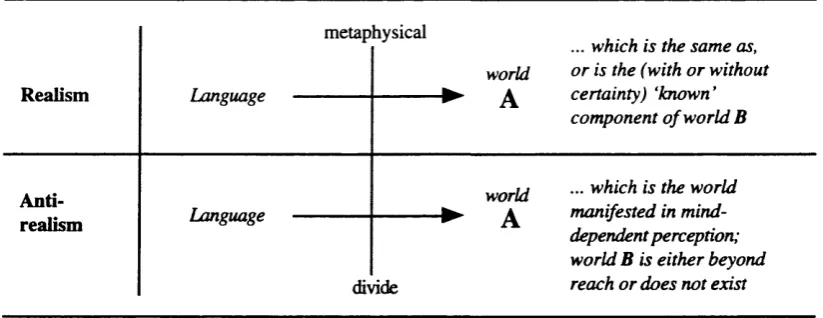
Table 1. Language/world dualism from realist and anti-realist perspectives against the background of worlds A and B (the arrows represent an ‘aboutness’ relationship).
Realism
metaphysical
... which IS the same as, world or is the (with or without
component o f world B
A nti realism
world •" world
di^
dependent perception; world B is either beyond
fide. reach or does not exist
See Table 1 for a summary representation of realist and anti-realist views on language as so far discussed.
As for what scientists might say about the two-world distinction, it is difficult to say. Perhaps it would be fair to attribute a position to them as follows. Along with almost everybody else, scientists believe in world B to the extent only that it denotes a physical world that does not depend on human existence; but for them there is very likely no relation and no distinction between worlds B and A. What I am calling world A for them is the sum of aspects of world B that have so far been investigated, whether successfully (DNA structure), approximately (viral actions), or speculatively (black holes).
According to the view I am advocating, however, world B is not the place where atoms do, or could conceivably exist. When I say that atoms exist in world A, I mean that full-blooded atoms exist, not just atoms in the mind or on paper. I have already stressed that world A is a physical world. Scientists, especially in the second half of our century, have employed (world A) atoms to get a variety of physical tasks done. That world A would cease to be — that it would ‘pop out of existence’ — were humankind to, does not make it less physical while it exists. As an interpreted physical world, world A s continued existence depends on the continued existence of a scientific community and perspective. Once these are gone, world A, like much else that is dependent on human agency and organisation, will disappear too. So will atoms. Only world B will remain.
It will be said: why can’t atoms exist in world B? To which the short answer is: they were never discovered in world B. They were discovered in world A — in the physical world that has been constructed and reconstructed over the centuries by human beings pursuing scientific interests in world B. To put the answer differently: the ways we imagine atoms, the ways we characterise them and bring them into our calculations, our understanding of the practical uses we make of them, and so on, are all features of world A. We have no conception, as I have said, of atoms beyond that world. All our atomic conceptions are world-A conceptions, and ‘atom’ gets its sense in that world.
about the contents of world B that would not constitute an interpretation. It does not matter how certain we may feel about a process or thing existing in world A: that (or a similar) process or thing cannot sensibly be said to exist in world B (processes and things are world A notions). We cannot, without undermining our conceptual grasp on world B, attempt to think of it in terms similar to those we use to think of world A.^^
Is world B, therefore, a mystery? It would be a mystery if it were an interpreted,
ontology-endowed world, which was inaccessible to us. Once we see that the differ ence between world A (A', A", etc.) and world B is more than just a matter of access, it might be easier to come to terms with my characterisation — and indeed the existence — of world B. (An imperfect analogy: we may think of an unworked block of clay, and then of a row of pots made from it. To think that the latter existed in the former would be to add at least a touch of mystery to the block of clay.) World B is of no interest to us as scientists and of marginal interest to us as philosophers.
Yet, it will be said: world A depends on world B. This is true: in my view the former is the result of a special brand of human agency and organisation exercised in the latter. It depends, therefore, on the latter, as much as it depends on human beings. But if so, doesn’t world B need to be in some manner? — how are we to explain our sense that the world A of modem science is not just an arbitrary world, replaceable in principle or at whim with a radically different world A', if world A cannot be said to be constrained by what world B is like? Physical world A certainly is not arbitrary; our sense of its non-arbitrariness arises from our recurrent and largely predictable interactions with it, not from what we believe world B to be like. We are normally able to explain predictability sufficiently well in world-A terms, without resorting to world B ’s supposed make-up. World A is self-contained in this respect. However, even though no world A has been constrained by what world B is like, every world A has been
constrained by world B — although nothing can be said about the contents of world B,
at the interface with world A it often appears stubborn and resistant.
The questions and issues raised above are addressed more fully in Part 2. Here is not the place to embark on a defence of the distinction between the interpreted and uninterpreted worlds. The framework they provide will become clearer as other arguments are developed. One final remark on the proper place of language in my bifurcated cosmos: the uninterpreted world B is not in any sense the object of language
^‘As Goodman notes, ‘Talk of unstructured content or an unconceptualised given or a substratum
without properties is self-defeating; for the talk imposes structure, conceptualises, ascribes properties’
PART 1
Th e DUALIST Co n c e p t io n
OF La n g u a g e a n d it s Fu n c t io n s in Sc i e n c e
The old language-world bipartition: the simplest, most trivial element at the basis of every sane account of the nature of knowledge.' (Coffa)
I th in k ... in terms o f language and the world.^ (Quine)
Philosophers and other writers on science have often made assumptions or included remarks about language in their writings while not engaging with issues of language — or rather without recognising that there is a set of philosophically relevant issues with which they have to some extent engaged. In order to discuss assumptions and remarks of this kind it would seem reasonable, as a first step, to assemble a cross-section of actual examples from writings in the philosophy of science. That is the primary task of Part 1. The secondary, though still important task, is to argue, first, that philosophers of science do regularly make metaphysical assumptions about language, and that these assumptions are as a rule left unclarified, under-developed, or unjustified; and, second, that their assumptions about language in science are not isolated occurrences, but significant components of philosophical doctrines they espouse.
1 .1 Popper on language
To say that philosophers of science have engaged with a philosophically relevant set of issues about language but seldomly recognised that engagement might seem a bold claim. It is proper, then, to begin with a striking example of one such case.
1
.
1.1In the preface to the first English edition (1959) of The logic o f scientific discovery,
Karl Popper undertakes to explain his attitude towards linguistic philosophy. He regards the work of ordinary language philosophers uninteresting because it holds no hope of teaching us anything new about the ‘advance’ of scientific knowledge; and it does not aspire to contribute to it.^ He finds that the same criticism applies to those philosophers who from an analysis of the language of science construct ‘miniature
'Coffa, The semantic tradition from Kant to Carnap, p. 357.
^Quine, Theories and things, p. 41.
model languages’ for the purpose of expressing knowledge ‘precisely’.^ Both groups, he believes, miss what is most exciting about the theory of knowledge.
Popper states in the same preface that if there is one philosophical problem that is self- evidently interesting it is ‘the problem of understanding the world — including ourselves, and our knowledge, as part of the world’. The central problem of epistemo logy, he adds, is the problem of the growth of knowledge.^ The best way to solve it is to study the ‘growth’ of scientific knowledge. It is the ‘logic’ of growth that he intends to explore in the body of the book.
Written twenty-five years after Logik der Forschung first appeared, the attack on linguistic philosophy in the English preface exemplifies Popper’s disapproval of the language-oriented efforts of positivists to discover a level of certainty in science, and his dislike for Wittgenstein’s later philosophy. The attack naturally leads Popper’s readers to expect that ‘the language of science’ is for him a relatively uninteresting object of study, and one that will not feature in his philosophical inquires.
In this respect, however. Popper’s attack on linguistic philosophy is misleading. In
Logik der Forschung and later books assumptions about the language of science (and
about language in general) not only abound but can be shown to underpin some of Popper’s central arguments and convictions. What is unusual is that he more than most philosophers of science makes his views on language and its functions explicit. He is typical, however, in abstaining from critical engagement with them.
Part 1 of The logic o f scientific discovery opens with the following assertion: A scientist, whether theorist or experimenter, puts forward statements, or systems of statements, and tests them step by step. In the field of the empirical sciences, more particularly, he constructs hypotheses, or systems of theories, and tests them against experience.^
Noteworthy here are, first. Popper’s conception of experiment as theory-testing, and, second, his idea that scientists deal in statements or systems of statements. These statements, he says, add up to what are better known as hypotheses or systems of theories: ‘Science’, he emphasises again later, ‘is ... a system of statements' J State ments are the ‘constructs’ of scientists and their fate is to be tested against experience.
^Ibid., p. 21. He has in mind Carnap, among others.
5lbid., p. 15.
^Ibid., p. 27.
So commonplace is this idea in Popper’s writings (and in post-Logik der Forschung
works in the philosophy of science generally) that it may seem almost unremarkable today.8
Popper has in mind nothing out of the ordinary when he talks about ‘statements’. Here is an example of what he calls a singular statement: ‘There is a raven in the space-time region k \ ^ We could just as well call this a sentence describing or asserting — or being used to describe or assert — a fact. Popper does not appear to have anything more arcane or restrictive in mind than this.
Let us return then to the claim that scientists put forward statements and test them against experience. Its position at the beginning of the book is not accidental: it is an assumption, an axiom, for which no argument is offered there or elsewhere. But what kind of assumption is it? Two readings suggest themselves: first. Popper is expressing an anthropological view about what scientists (theoreticians and experimentalists alike) actually do at their places of work. Second, he is making a philosophical claim that distinguishes between statements and experience, and holds that the former can be related to the latter by a procedure called ‘testing’. In philosophical context, the second reading seems more relevant, although there is no reason to believe that Popper would expect a laboratory observer to notice that scientists do not in general test statements against experience.^® Philosophy of science has never been free of references to actual or imaginary scientific practices, which are used to support philosophical claims. Popper’s following remark is an example of such a reference:
*For similar claims about the role of statements see, for example, Hacking, Why does language matter
to philosophy?, pp. 160-161, and 177 f.; and Hanson (who claims that ‘knowledge of the world is a
system of propositions’). Patterns o f discovery, p. 26. Cf. Quine, Theories and things, pp. 24-25.
Popper’s student, Musgrave, defending objectivism (or ‘impersonal’, non-psychologistic knowledge),
writes: ‘Knowledge is always possessed by some person; the verb “know” requires a subject, the
“knower” ... [it] also requires an object, the statement or proposition which is known’ {Impersonal
knowledge, p. 10). Also Tarski gives prominence to statements: ‘Independent of whether a science is
conceived merely as a system of statements or as a totality of certain statements and human activities,
the study of scientific language constitutes an essential part of the methodological discussion of a
science’ ( ‘The semantic conception of truth’, p. 65).
^Popper, The logic o f scientific discovery, p. 101. An example of a ‘universal statement’ is the
following: ‘All planets move in ellipses with an eccentricity other than zero’ (p. 376).
•°This is so even though Popper tries to distance his interests from those of a ‘naturalistic
methodology’ (ibid., p. 52). He does, in any case, believe that the logic of scientific discovery he
What is the general problem situation in which the scientist finds himself? He has before him a scientific problem: he wants to find a new theory capable of explaining certain experimental facts; facts which the earlier theories successfully explained; others which they could not explain; and some by which they were actually falsified.”
This kind of ‘thought experiment’ is used to lend credibility to philosophical considerations by tying them to a supposed scientific reality. Popper’s assumption that scientists deal in statements, or that ‘scientific theories are universal s t a t e m e n t s ’ ,^2 early confirmation of my contention that assumptions about language and its functions in science play an important role in Popper’s philosophy. Statements as we have seen are items of language. The formulation of hypotheses and the testing of such state ments are supposedly significant uses of language in science. The claim that scientists as a matter of course construct and then test statements against experience suggests a kind of function for language in science. The claim presupposes a disjunction of the language used to construct statements and the experience against which they are ultimately tested.
The following quotation, in which Popper explains how a new theory is tested, provides further illustration of these points:
Deductive testing of theories ... always proceeds on [these] lines ... With the help of other statements ... certain singular statements [predictions] are deduced from the theory; especially predictions that are easily testable or applicable. From among these statements, those are selected ... which the current theory contradicts. Next we seek a decision as regards these ... derived statements by comparing them with the results of practical applications and experiments.’^
Because this is a generalised account of deductive testing (which itself is central to the logic of discovery, as Popper sees it), it is reasonable to conclude that the assumptions it contains about language are assumptions about important (if not the most important) functions of language in science: the construction of systems of statements, the derivation of other statements from them, and the comparison of these to ‘the results of practical applications and experiments’. If we ask what the nature of such results might be (what do experimenters ultimately produce), we come across more talk about
state-” Popper, Conjectures and refutations, p. 241. For another example of imaginary practices attributed
by Popper to scientists, see Hacking, Representing and intervening, pp. 243-244.
’^Popper, The logic o f scientific discovery, p. 59.
ments (‘basic statements’; and also: ‘primitive propositions’^'^). We also come across assumptions about ‘the world’ that lies beyond statements (‘observable events’), and so of ‘facts’ that have been split off from interpretations and conceptualisations. In other words, we come across a disjunction of language and world.
1 . 1 . 2
The language/world disjunction is emphasised in the course of a complication to which Popper turns his attention: if for the purposes of testing statements and ‘the results of practical applications and experiments’ are to be compared to be tested they have to be of a comparable nature. On some occasions Popper writes as if ‘experience’ or ‘empirical tests’ can bear directly on a ‘scientific system’ (which, of course, is a system of statements): ‘it must be possible for an empirical scientific system to be refuted by experience ... [to] be singled out, by means of empirical tests, in a negative sense’. Elsewhere he writes that in the process of testing ‘it is ... basic statements which we try to compare with the “facts” and ... we choose these statements, and these facts, be cause they are most easily comparable’.
How can experience refute statements? Popper is aware of Carnap’s argument that in the ‘logic of science’ we must not say ‘that sentences are tested by comparing them with states of affairs or with experiences: we may only say that they can be tested by comparing them with other sentences\^^ Yet Popper does not want the requirement of falsifiability that he is promoting to be merely a logical relation among statements (the theory and the basic statements). ‘Theories’, after all, ‘are nets cast to catch what we call "the world"’. To overcome the problem. Popper expresses himself in what he calls the ‘realistic mode of speech’:
In this ‘realistic’ mode of speech we can say that a singular statement (a basic statement) describes an occurrence. Instead of speaking of basic statements which are ruled out or prohibited by a theory, we can say that the theory rules out certain possible occurrences, and that it will be falsified if these possible occurrences do in fact occur ... It is easy enough to define [the use of
*'^In Popper, Objective knowledge, p. 124, the right hand side of the displayed table reads: ‘Ideas, that
is statements or propositions or theories, may be formulated in assertions, which may be true, and their
truth may be reduced, by way of derivations, to that o f primitive propositions' (my emphasis).
’^Popper, The logic o f scientific discovery, p. 41.
'^Popper, Conjectures and refutations, p. 267.
'^Popper, The logic o f scientific discovery, p. 96; on the restriction that statements can be justified
only by statements, see ibid., pp. 43, 93, and 95. See also, Lakatos, ‘Falsification and the metho
dology of scientific research problems’, p. 99.
‘occurrence’] so that it is unobjectionable. For we may use it in such a way that whenever we speak of an occurrence, we could speak instead of some of the singular statements which correspond to it.*^
The notion of correspondence plays a key role here: we may speak as if theories are checked against happenings in the world (occurrences) because what we mean in fact is that theories are checked by basic statements that correspond to happenings in the world. This relation of basic statements to the physical world is brought into sharper relief by the following requirement:
a basic statement must also satisfy a material requirement — a requirement concerning the event which, as the basic statement tells us, is occurring at the place k. This event must be an ‘observable’ event; basic statements must be testable, inter-subjectively, by ‘observation’ ... Admittedly, it is possible to interpret the concept of an observable event in a psychologistic sense. But I am using it in such a sense that it might just as well be replaced by ‘an event involving position and movement of macroscopic physical bodies’ ... Basic
statements are therefore ... statements asserting that an observable event is
occurring in a certain region o f space and timeP^
This last sentence (with its non-psychologistic rendering of ‘observable’) presents us with a clear-cut disjunction of language and world.
In the Logic o f scientific discovery we find Popper’s ‘epistemological theory of experiment’ : ‘the theoretician puts certain definite questions to the experimenter, and the latter, by his experiments, tries to elicit a decisive answer to these questions’. B u t how is that answer ‘elicited’? How does the experimenter move between experience and statement, or between question, ‘practical application’, and answer? Popper does not consider these questions. He objects instead to the aim of philosophers of the period to explain how statements are ju stifie d by observation (what he calls ‘psychologism’), because one can rationally only criticise theories. ‘The decision to accept a basic statement’. Popper writes, ‘is causally connected with our experiences — especially with our perceptual experiences. But we do not attempt to justify basic statements by these e x p e r i e n c e s ’ .22 Apart from the passing reference to a ‘causal
connection’, there is no explanation here or elsewhere of how statements and experiences are bridged in practice. That they are is taken for granted (and left to psychology to e x p l a i n ) . 2 3 I n the battle against psychologism in philosophy Popper
'% id ., p. 88, final emphasis added.
2°Ibid., pp. 102-103, enq)hasis added.
^‘Popper, The logic o f scientific discovery, p. 107.
22lbid., p. 105.
^^Popper claims that ‘Fries, and with him almost all epistemologists who wished to account for our