961
Face Recognition By Using Eigen Face Method
V. Jalaja, G.S.G.N. Anjaneyulu
Abstract: In this paper, a methodology for face recognition using Eigen faces is being discussed. The key idea of the proposal we consider a set of images then we applied Eigen faces on that set for recognition of faces. First a set of images has been considered as a training set. Then calculations were performed on training set, finally the images have been concluded by computing the Euclidian distance between the image in the training set and newly computed image. Test results for various number of faces are appeared to confirm the suitability of the proposed technique and also we discussed some image metrics. Finally we demonstrated the security analysis like time complexity.
Index Terms: Face Recognition, Eigen values , Eigen Vectors, Image Quality Metrics, Euclidean Distance and Mean Square Error. —————————— ——————————
1 INTRODUCTION
1.1 Face Recognition Introduction
Normally, recognition of human faces has been examined for over twenty years. Faces are characteristic class of items. Face acknowledgment is a biometric framework used to distinguish or confirm an individual from an advanced picture. It will consequently identify a face in a picture. Face recognition is difficult task to build up a computational model for acknowledgment of faces. Since, in which many early vision procedures can be involved. Recognition of faces plays a vital role in many applications such as the area of biometrics, security systems, credit card verification, access control, image and film processing and criminal identification. Good computing methods are required to recognize a face. Facial features are removed and implemented through algorithms which are proficient and some notifications are done to improve the existing algorithm models. We can recognize various faces learned for the duration of our life span and identify that faces initially even after years. The face recognition scheme depends on a data hypothesis, it decomposes face images into an Eigen faces like a small set of characteristic feature images. Recognition is done by comparing it‟s position in the face space with the places of known people. This methodology has advantages when compare to other face recognition schemes because the approach is speed and simple, learning capacity and due insensitivity to small or gradual changes in the face image.
1.2. Related Work
In 1960‟s work on face recognition has been started, the consequences of which are being utilized for security in different organizations and firms all through the world. By utilizing different procedures we can recognize face. The first method for face recognition is principal component analysis and is proposed by Karl Pearson in 1991. PCA is variable decline technique and it is useful when obtained data have some redundancy.
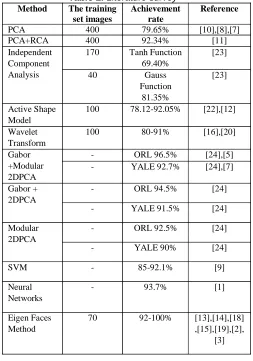
The main advantage of PCA is utilizing it in Eigen face approach which helps in decreasing the size of the database for recognition of a test images. This strategy is applied on Eigen face way to deal with decrease the element of a huge data set. The basis of the Eigen faces method is the PCA. In 1991, Turk and Pentland [15] developed the Eigen faces method for recognition of faces by taking 70 images in the training set with success rate of 92% to 100%.In 2004, V. Perlibakas [20] suggested a technique for recognizing face by using Principal Component Analysis and Wavelet decomposition. By applying Wavelet transform with 100 images in the training set a success rate of 80% to 91% has been attained. In 2007 A. Ozdemir [16] suggested object recognition by using Eigen vectors. The approach which is discussed is a variant on current approaches to Eigen image analysis. Compared to traditional approach this approach gives best recognition rate. In this recognition process the Eigen values and Eigen vectors of the image set is calculated. The image set is nothing but the different positions of the object. In our approach also the above process has been followed. When compared to other methods it is a simple implementation and double-quick recognition. In 2008, F. Kraduman [9] explained face finding method by using Support Vector Machines. In his contribution he achieved 85% to 92.1% as a success rate. Later Neural systems [1] have been proposed by Anjana Mall et al. In this article the frame work works in two phases. The main part is a neural system that gets as information a 20X20 pixel region of the image, and generates an output ranging from 1 to -1. It decides whether face is presented or not. In 2008, K. Kim et al. [10] showed the success rate as 79.65% by using principal component analysis in authentication technique for faces. B. Kraduman [11] presented a face recognition by using relevant component analysis by taking 400 images in the training set with success rate of 92.34%. In 2009, the general proposal of I. Yazar et al.[23] on face recognition by using Independent Component Analysis. The independent component analysis has two functions. One is Tanh function and other is Gauss function. By using Tanh function and by taking 170 images in the training set they achieved 69.40% as a success rate. 81.35% is the success rate for Gauss function with 40 images in the training set. In 2009, C.Tirkaz et al. [22] and F. Kahrman et al. [12] presented a face recognition by using Active shape model by taking 100 images in the training set with success rate of 78.12% to 92.05%. In 2012, Muge Carikci et al. [13] proposed a new method for recognition of faces by suing Eigen faces. In his contribution the faces are identified by using principal component analysis. In 2015, Imran et al.[7] proposed a methodology for face recognition by using Eigen faces. In this article, they attempted to develop a continuous face ________________________________________
• V. Jalaja, Research Scholar of Mathematics, SAS, Vellore Institute of Technology, Vellore. E-mail: [email protected]
recognition frame work by utilizing appearance based methodology. For recognition of faces they utilized Viola Jones calculation and principal component analysis. In 2017, Chung-Hua et al. [4] proposed an eye blinking detection for screen unlock on mobile services. They proposed an eye blink scheme for face recognition on mobile screen unlocking. In 2018, Priya Gupta et al.[17] developed a recognition of human face by using deep neural network. In this article, they used Deep Neural Network instead of covets and makes the process higher and faster. This technique is suits for small datasets. Finally, we demonstrated the results by using R studio and also we discussed the image metrics.
1.3. Our Contributions
The remaining paper is structured as follows. In section2, we introduced the required mathematical background for Eigen faces. In section3, we propose a method for face recognition by using Eigen faces method. In section 4, we discuss the strength of the algorithm. In section5, we demonstrated the simulation results with modified Eigen faces method and also we discussed some image metrics. Also we identified the time and space complexity of our proposed algorithm. In section6, we emphasis the main conclusions of the paper.
Table 1. Literature survey
Method The training
set images
Achievement rate
Reference
PCA 400 79.65% [10],[8],[7] PCA+RCA 400 92.34% [11] Independent
Component Analysis
170 Tanh Function 69.40%
[23]
40 Gauss Function
81.35%
[23]
Active Shape Model
100 78.12-92.05% [22],[12]
Wavelet Transform
100 80-91% [16],[20]
Gabor +Modular 2DPCA
- ORL 96.5% [24],[5] - YALE 92.7% [24],[7]
Gabor + 2DPCA
- ORL 94.5% [24]
- YALE 91.5% [24]
Modular 2DPCA
- ORL 92.5% [24]
- YALE 90% [24]
SVM - 85-92.1% [9]
Neural Networks
- 93.7% [1]
Eigen Faces Method
70 92-100% [13],[14],[18] ,[15],[19],[2],
[3]
2
EIGEN
FACES
The principal component analysis (PCA) is a strategy for projection to a subspace and it is utilized in pattern
recognition. Main advantages of the “PCA are it‟s low sensitivity to noise”. It will reduce memory, capacity and also efficiency because calculations are performed in smaller dimensions. In 1987, Sirovich and Kirby [21] built up a system for face recognition by applying principal component analysis. In this mechanism each arrangement is really an image however they call it as Eigen picture. Each face weight is found by projecting it onto the Eigen picture. They recognized a face by applying the approach. By taking largest Eigen values of M images in the training set, calculated Eigen faces. The Eigen faces were recalculated for a new faces. Then the new face image is recognized by calculating a set of weights which are based on the input image and the M Eigen faces by anticipating the input image onto every one of the Eigen faces. If an image is nearer to faces space then the image is a face. Later in 1991, designed a face recognition technique by using Eigen faces and principle component analysis. The system of the Eigen faces technique comprises of extracting the characteristic features of the face. The framework capacities by anticipating face pictures onto a feature space that traverses the significant variations among known face images. “These significant features are known as Eigen faces, since Eigen faces are formed by the Eigen vectors of the set of faces”. In view of these facts, the present study focuses on new fingerprint recognition by using Eigen face. For this, firstly a set of fingerprint images were considered as training set. Then the Eigen face was calculated. Later, the random image was anticipated on the Eigen face and then the image was identified by calculating the Euclidean distance between random image and the images on the Eigen face.
3
PROPOSED
METHOD:
FACE
RECOGNITION
BY
USING
MODIFIED
EIGEN
FACES
Choose an image of face
I x y
( , )
in two dimensional*
N N
arrangements. Then convert the image into the dimension ofN2*1. Treat initially a training set of*
N N
images and it can be converted into N2*1dimensions. Now a training set of N2*M dimensions is
created. Here the number of samples is
M
. Let, , , ...,
1 2 3 M
be the face images in the training set.
Next, compute the mean for the images in the training set. Then, average face of the set is defined by
i.e., 1
n i i
M
In this paper, i is the AJ ( Anjaneyulu and Jalaja) Normalized Image Coefficient introduced to improve verification chances even for lowest matching of random image with Eigen face image and is well-defined as square root of the sum of the squares of difference between images and average face image divided by i.
2
, 1, 2, 3, ..., 1
i k
i M
i k
k
963
By using the results of the above step the matrix A is computed.
i.e., A
1 2...
M
The matrix C (co-variance matrix) is formed by multiplying A by it‟s transpose.
i.e., C A A T
Therefore the “dimension of the matrix C is N2*N2 and determining the N2Eigen vectors and Eigen values is an intractable task for typical image sizes”. In the event that the quantity of information focuses in the picture space is not
exactly the element of the space
MN2
. There will be just1
M
, as opposed toN2 important Eigen vectors. In this way, consider a matrix Q A A T of dimensionN N
*
. Next compute the Eigen values and Eigen vectors of the matrixQ
. Consider Eigen values
iand Eigen vectorsv
iofQ
such that
.
T
i i i
T
i i i
i i i
A Av
v
A A Av
Av
C Av
Av
The Eigen vectors of co-variance matrixC
isAv
iExpress the Eigen vectors
v
i as a linear combination ofM
training set face images to compute the Eigen faces
u
i, where, 1, 2, 3,...., 1
M
ui vik k i M
k
, in particular
1 1 1 2 2 3 3 ...
u vM vM vM vMM M
2 21 1 22 2 23 3 ... 2
u v v v v M M . . . . . .
. . .
...
1 1 2 2 3 3
M
u vM vM vM vMM M
Once the Eigen faces have been acquired, the pictures in the database are anticipated into the Eigen faces space and loads of the picture in that space are put away.
The weights of the image on the Eigen face space are
calculated by using the formula WiuiT
. To recognize the face first calculate the Euclidean distance between the Eigen face of the image and Eigen faces stored previously.
For an unknown image
, calculate
andi k
i i
u
w
1 ^
where wi uiT
. Finally calculate theEuclidean distance between and
^. If the Euclidean distance is minimum and it is below the threshold value, then the unknown image will be
identified. Otherwise the unknown image will not be recognized.
4
STRENGTH
AND
SOUNDNESS
OF
THE
ALGORITHM
In the existing techniques,
is designed by subtracting average image from each image. The purpose of subtracting mean image from each image vector is to identifying the similarities in both the images. In this technique, Euclidean distance and Mean Square Error coming considerably more. In our proposed algorithm, we have formulated
in many different ways as follows.Formula
Description
1 i
k k k
-
The sum of the ratio of the differences between mean image &each image Eliminating the core similarities by subtracting mean image and minimizing the non-similarities by dividing with k.
2
( )
1
i k
k
k
-
The square root of the sum of the ratio of the squares of difference between mean image & each image. Eliminating the core similarities by subtracting
mean image and
magnification of the non-similarities and taking core part of this by the non-similarities and taking core part of this by dividing with k.
2
( )
1 2
i k
k k
-
The square root of the sum of ratio of the squares of difference between mean image and each image and eliminating the core similarities by subtracting
mean image and
magnification of the non-similarities and taking minimal core part of this by dividing with 2k.
2
1
i k
k
k
-The square root of the sum of squares of the difference between the mean Image. Eliminating the core similarities by subtracting
mean image and
magnification of the non-similarities and taking significant more minimal core part of this by dividing with k.
image identification over the data base. The distinct image processing formulae has been framed and tested with small sample of images. Finally we concluded last one is the best for identification of random image, even it is having very less common features with mean/original image. So we concentrated and continued on the last one i.e.,
2
1
i k
k
k
to prove the image metrics using thisparameter
. This will give better Euclidean distance and Mean square error to match the random image with Eigen face image. Random image is the image of particular person at any moment. By using this formula, we can trim down the error values like Euclidean distance and Mean square error. These results are shown in section 5.1.4 using R Studio.5.
SIMULATION
RESULTS:
PROPOSED
MODIFIED
EIGEN
FACES METHOD
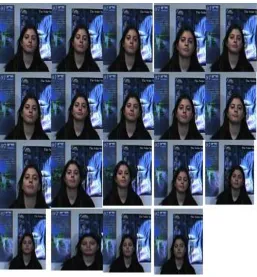
By using Eigen faces method we can increase speed of recognition. Compare to other methods this method will give high success rate. In this approach recognition is very simple and efficient compare to other approaches. To evaluate the reasonability of this way to deal with face recognition, we created an example set of face pictures with certain varieties of lighting and direction. The face images are used in this work as 3040 [6], for 19 different variation images of 152 people and one another variation of images for testing purpose. Since the data base is large. So instead of 2888 images some of the images in the training set are shown in Fig.1.
Figure 1. Sample Training set
In Fig. 2, images having a place with a similar individual with nineteen different facial expressions, distances and lighting conditions are shown.
Figure2. Test for the nineteen pictures of one person
We identified a system for recognition of faces by conducting the experiments with stored face images (by using R Studio). For this, first we created average face for the training set.
Figure 3 Figure 4
Figure 3 is mean image and Eigen face of the person in fig.2 respectively and computed based modified Eigen face method using the images in the training set given in figure 2. Figure 4 is the random image of the above person at any time or one different image from fig.2 in the sample space in the training set. This will be used for verification and correctness of the algorithm.Then we implemented the approach which is discussed in the above. The Eigen faces are calculated by using the highest Eigen values of co-variance matrix. Then we express each face as a linear combination of the Eigen faces. Each face can be assessed with the Eigen face space. For each unknown image we calculated
and weights of an965 error between and
^is below a threshold value.5.1 Image Quality Metrics
The image quality valuation has been very dynamic and many related works can be found. These metrics will demonstrate the efficiency of the designed algorithm. Some of the image metrics are discussed below.
5.1.1 Euclidean Distance
Euclidean distance of two images is the distance between two corresponding pixels of the images. Let two pixels be A and B with co-ordinates (x1,,y1) &(x2,y2). Then the Euclidean distance is
d(A,B)=
2 ) 1 2 ( 2 ) 1 2
(x x y y
The Euclidean distance between the random image(fig.4) and Eigen face image(fig.3) is 18.30788.
5.1.2 Mean Square Error (MSE)
It measures the normal squared difference among original and ideal pixel values. This measurement is easy to compute however probably won‟t adjust well to the human view of value.
Let y( i, j) and y^( i, j) are two images of a same person then the mean square error is calculated by using the formula
21 ^
( , ) ( , )
1 1
M N
eMSE y i j y i j
i j
MN
The MSE of the random image (Fig.4) and Eigen face image (fig.3) is 0.134. Therefore the tested image is verified.
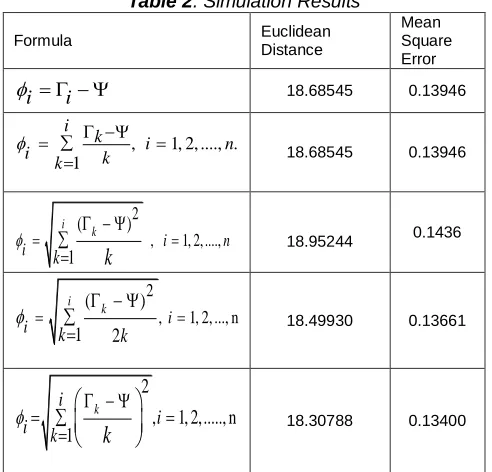
5.1.4 Results of Simulation
The Euclidean distance and Mean square error values of an image which is in fig.3& 4 by using the above mentioned formulas (i.e., in section 4) are calculated by using R studio.
Table 2. Simulation Results
Formula Euclidean
Distance
Mean Square Error
i i
18.68545 0.13946
, 1, 2, ...., . 1
i
k i n
i k
k
18.68545 0.13946
2
, 1, 2,....,
( )
1
i k
i n
i k
k
18.95244
0.1436
2
, 1, 2, ..., n
( )
1 2
i k
i i k
k
18.49930 0.13661
2
, 1, 2,..., n 1
k
i
i
i k
k
18.30788 0.13400By analyzing the Euclidean distance and MSE for fig.3 & 4 we can conclude that our approach gives better results when
compare to existing approach.
5.2. Time Complexity
Analyzing the best algorithm depends on the time complexity.
Time complexity of an algorithm is the measure of time taken
by a calculation to keep running as a component of the length
of the input. The time complexity of the proposed algorithm is
O(n3/2). Existing formula i.e.,
2
( )
1 i k
i k
k
will take
O(n2) time. When compared to previous existing algorithm the
proposed algorithm takes less time to run the program.
6. CONCLUSION
Efficient face recognition by using Eigen face approach is presented. The proposed protected system is able to perform user recognition. A very large data base of 2888 images was considered. Eigen faces method was applied on this database and by taking simulation results the success rate was calculated to be 95%. Also the image metrics have been discussed. The time complexity of the proposed algorithm was calculated as O(n3/2). The future work will concentrate on expanding achievement rate for exceptionally enormous databases.
7
REFERENCES
[1] Anjana Mall, Mrs. Shusmita Ghosh, “A Neural Network Based Face Detection Approach”, International Journal of Computer Technology and Applications, July 2010.
[2] Atalay I and Gokmen M,” Face Recognition Using Eigen faces”, Siu
[3] 1996, Antalya, Turkey,1996.
[4] Bledsoe W, The model method in facial recognition, Panoramic Research Inc.,Palo Alo, CA, Rep.PRI:15,Aug.1996.
[5] Chung- Hua Chu, Yu-Kai Feng, “Study of Eye Blinking to Improve
[6] Face Recognition for Screen Unlock on Mobile Services”, in „ Journal of Electrical Engineering Technology‟, 2017, pp. 1921- 1928.
[7] Ergezer. H, “Face Recognition: Eigenfaces, Neural Networks, Gabor
[8] Wavelet Transform Methods”, M. S. Thesis, Başkent University, Turkey, 2003.
[9] http://cswww.essex.ac.uk/mv/allfaces/faces96.html
[10]Imran M.A, Miah M. S. U, Rahman. H , Bhowmik A, Karmaker D,
[11]“Face Recognition Using Eigenfaces”, in International Journal of
[12]Computer Applications, 2015.
[13]Janarthany Nagendrajah, “Recognition of Expression Variant Faces- A Principle Component Analysis Based Approach for Access Control” IEEE International Conference On Information Theory and [14]Information Security, 2010.
Machines”, M.S.
[16]Thesis, Trakya university, Turkey, 2008.
[17]Kim. K, “Face Recognition using principal Component Analysis”,
[18]National Institute of Technology, Rourkela, 2008. [19]Kraduman. B, “Relevant component Analysis”,
M.S.Thesis, Yildiz
[20]Technical University, Turkey, 2008.
[21]Kahraman. F, Kurt. B and Gokmen. M, “Face Recognition Based on
[22]Active shape Model”, SIU 2005, Antalya, Turkey, 2005.
[23]Muge Carikci, Figen Ozen, “A Face Recognition System Based on
[24]Eigen faces Method”, Procedia Technology, Sci Verse Science Direct, 2012.
[25]Marijeta Slavkovie, Dubravka Jevtic, “Face Recognition Using Eigen
[26]face approach”, Serbian Journal of Electrical Engineering, Feb. 2012.
[27]M. Turk and A. Pentland, “Eigen faces for Recognition, in: Journal of
[28]Cognitive Neuroscience”, March , 1991.
[29]Ozdemir. A, “Recognition of Frontal Face images by applying the
[30]Wavelet transform”, M.S. Thesis, Kahramnmaras, Sutcu Imam University, Turkey, 2007.
[31]Priya Gupa, Nidhi Saxena, Meetika Sharma, Jagriti Tripathi “Deep Nueral Network for Human Face Recognition”, in „ International Journal of Engineering and Manufacturing‟, 2018 .
[32]Perlibakas V, “Distance Measures for PCA-based Face Recognition”, Pattern Recognition Letters, April, 2004.
[33]Pentland P, “Face Recognition using Eigen faces”, Proc. Of IEEE Conf. on Computer Vision and Pattern Recognition, 1991.
[34]Perlibakas V, “Face Recognition using Prinicipal Component Analysis and Wavelet Packet Decomposition”, Informatica, 2004.
[35]Sirovich L and Kirby M, “Low-Dimensional Procedure for the Characterization of Human Faces”, Journal of the Optical Society of
[36]America, 1987.
[37]Tirkaz. C and Albayrak. S, “Face Recognition using Active Shape Model”, SIU 2009, Kyseri, Turkey, 2009.
[38]Yazar. I, Yvuz. H. S, and Cay. M. A, “Face Recognition Performance Comparisons by using Tanh and Gauss Functions in the ICA Method”, IATS‟09, Karabuk, Turkey, 2009.
[39]Yan. H, Wang. P, Chen. W.D, Liu. J, “Face Recognition Based on Global Wavelet Transform and Modular 2DPCA”, in International Conference on Power Electronics and Energy Engineering, 2015.