Intermediate Structures in Fission and Consequences on
Average Partial Cross Sections
Olivier H. Bouland1,a
1
Abstract. This paper is willing to illustrate and quantify the impact of a double fission barrier in terms of average fission cross section and in particular, to status on both the additional class-II width correction factor and the degree of freedom of the overall double fission barrier which is a key parameter in the calculation of the standard Wn,f factor of Hauser-Feshbach theory.
1 Problematic related to average fission cross section simulation
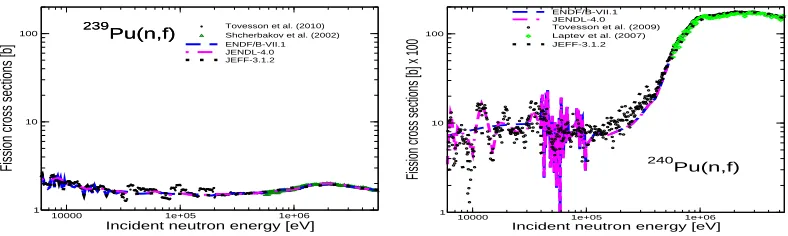
The purpose of this communication is to both recall and emphasize the existence of the class-II state width fluctuation factor, WII, whose treatment is usually disregarded in standard average cross section evaluation codes. The impact of fission channel Intermediate Structures (IS) is well pictured by Fig. 1 which displayed the observed and current evaluated fission cross sections within the neutron-incident Unresolved Resonance energy Range (URR) for a fissile and a fertile isotope borrowed from the
plutonium family. Below the fission threshold energy (En<500keV), we observe large manifestations
of the IS (Fig. 1- right side), relatively to the fission cross section magnitude, although IS effects show up as well for fissile isotopes (Fig. 1- left side). We guess that more complexity in the classically [1] used URR fission cross section model will be required for a fertile isotope but are we allowed to make some approximations for a fissile isotope without collateral damage? This is the question raised by
this paper. In the next sections, the impact of both the barrier tunneling and WII factor for fissile
and fertile isotopes is clarified using a new way of calculating the inextricably admixed IS and WII
effects based on accurate formal R-matrix Monte-Carlo-fashion calculations which have been recently
applied to the whole plutonium family in a consistent and macro-microscopic approach [2].
2 Standard Hauser-Feshbach formalism
Reaction cross-sections in the URR are commonly calculated using standard Hauser-Feshbach the-ory [7]. The average fission cross section ¯σc f for the entrance channel c at neutron energy Enreads
¯
σJc fπ(En)=
X
J
σcJπ(En)×P¯f×Wc f =
X
J
σJcπ(En)
|I′+i′| X
s′=|I′−i′|
|J+s′| X
l′=|J−s′|
TJπ(l′s′)
f (Ec′)
P
c′′TJ π(l”s”)
c′′ (Ec′′)
×Wc f (1)
whereσcJπis the compound nucleus formation cross section for a given (J, π), ¯Pfis the average fission probability and Wc f, the customary in-outgoing channel width fluctuation correction factor.
a
e-mail: [email protected]
C
Owned by the authors, published by EDP Sciences, 2013
10000 1e+05 1e+06
Incident neutron energy [eV]
1 10 100
Fission cross sections [b]
Tovesson et al. (2010) Shcherbakov et al. (2002) ENDF/B-VII.1 JENDL-4.0 JEFF-3.1.2
239 Pu(n,f) 239
Pu(n,f)
10000 1e+05 1e+06
Incident neutron energy [eV]
1 10 100
Fission cross sections [b] x 100
ENDF/B-VII.1 JENDL-4.0 Tovesson et al. (2009) Laptev et al. (2007) JEFF-3.1.2
240 Pu(n,f)
Figure 1. (Color online) Current evaluations (ENDF/B-VII.1, JEFF-3.1.2 and JENDL-4.0) compared to recent measurements by Tovesson et al. [3] and Shcherbakov et al. [4] or by Tovesson et al. [5] and Laptev et al. [6] respectively for the239Pu and240Pu target nuclides.
3 Formal R-matrix and eigenstate classification
A variableβ, which governs the collective elongation of the system along the fission path, was
intro-duced by Lynn [8]. The Hamiltonian operator is split such that
H=Hβ+Hint(ζ;β0)+Hc(β, ζ;β0), (2)
where Hint is the term that governs the excitation of all other degrees of freedom, notedζ, at a fixed
deformationβ0and Hc, the coupling Hamiltonian describing the interaction between theβmode and
the other modes of excitation. The eigenfunctions and eigenvalues of Hintand Hβare respectively the
(χµandεµ) and (φν(β) andεν) couples. It is convenient to expand the eigenstates Xλof the formal
R-matrix statesλof the internal region in terms of product pairs of the quasi-vibrational functions
φν(β) with the intrinsic functionsχµdefined at some special deformationsβ0such that
Xβ0
λ =
X
νµ
Cλ(νµ)φ
β0
ν(µ)χµ. (3)
The formal R-matrix compound nucleus eigenstates Xλ, which can be qualified asymptotically as
either of quasi-class-I (corresponding to ground-state) or quasi-class-II (fission isomer) depending on the location of the largest vibrational amplitude, contain a mixture of the auxiliary class-I and class-II states (with Cλ(νµ), the admixture coefficients into the formal statesλ). The Xλare to be obtained from
the diagonalization of H (Eq. 2), which implies the determination of the sub-matrix mixing elements
hX(I)λ
I|Hc|X (II)
λIIi(or the reciprocal elements) characterizing the residual interaction between theλI and
λIIcompound nucleus state sets. These elements have the following form
hXλ(I)
I|Hc|X (II)
λII i ≡ hλI|Hc|λIIi=
X
µ′′ν II
X
µ′ν I
hλI|µ′νIihµ′νI|Hc|µ′′νIIihµ′′νII|λIIi. (4)
3.1 Nature of class-I and class-II compound nucleus states
By nature the class-I states exhibit very small fission widths,ΓλI( f ), and are characterized by a small mean spacing (noted DI; usually of about a few eV or a tens of eV respectively for a fissile and a fertile heavy isotope at neutron emission energy). By contrast class-II states exhibit much larger fission
widths as well as a larger mean spacing of about 50×DI at the same excitation energy. The
class-II neutron width can be neglected since the compound nucleus is originally formed in the ground-state (first well) and because neutron emission from second well is highly contested by fission decay. Thereof, class-I and class-II total widths, noted respectivelyΓλI(tot) andΓλII(tot), are established as follow
ΓλI(tot) ≈ΓλI(n)+ ΓλI(n′)+ ΓλI(γ) (5)
ΓλII(tot)≈ΓλII(↓)+ ΓλII(↑)+ ΓλII(γ) (6)
whereΓλII(↑) andΓλII(↓) are respectively the class-II fission and coupling widths which definition is given in the paragraph below.
3.2 FormalR-matrix concept of class-II partial widths
On the basis of the classic narrow resonance approximation applied to the transmission coefficient
established by Moldauer [9],ΓλII(↓) is obtained by an average over neighboring class-II states and is related to the inner barrier transmission coefficient, TA, and similarly, the average class-II fission width is related to the outer fission barrier transmission coefficient, TB. It follows
2πhΓλII↓iII/DII=TA, 2πhΓλII↑iII/DII =TB. (7)
The concept of class-II state coupling width connects a selected class-II state (eventually several),
λII, with its neighboring class-I levels,λIi, across the inner fission barrier by average of the squared coupling matrix mixing elements,hλII|Hc|λIi, such that
ΓλII↓(α)=2π hλ
II|Hc|λIi2I/DI . (8)
4 Formal R-matrix average fission cross section
In presence of a double-humped fission barrier, two main cases are generally assumed for calculating either the average fission probability, ¯Pf or equivalently the effective fission transmission coefficient,
Tf, of Eq.1. At excitation energies well above the fission barrier energy, we can assume that there is a statistical equilibrium among all degrees of freedom in the compound nucleus. Under this hypothesis, the effective fission transmission coefficient across a specified Bohr [10] outer fission barrier channel
µis
Tµf =(TAT
µ
B)/(TA+TB+TII(γ)+TII(x)) , (9)
and class-II level spacings (so-called ’picket fence model’), Lynn and Back [12] have worked out the formulation of the average fission probability ( ¯Pf) corresponding to barrier tunneling with moderately weak class-I class-II coupling such that
¯
Pf =
1+
TI
Tf
!2
+ 2TI
Tf
!
coth
TA+TB
2
−1/2
, (10)
with TI, being the total class-I transmission coefficient including all open reactions within first well.
4.1 Coupling and fission width distribution correlations: theWIIfactor
Under both the hypothesis of Eq. 9 and the concept developed in section 3.2, we can express the average over neighboring class-II states of the overall fission transmission coefficient, Tf, in terms of individual class-II coupling and fission widths such that,
hTfiλII ≈ h(TATB)/(TA+TB)iλII =(2π/DII)
(Γ
λII↓ΓλII↑)/ΓλII
λII (11)
where,ΓλII represents the total width of a single class-II state. Since we intuitively expect that the statistical fluctuations of the class-II partial fission widths exhibit an independent Porter-Thomas [13]
(ν=1) distribution across each fully open Bohr fission channel and, the coupling width distribution
across the inner Bohr fission channels (considered as a whole - meaning an aggregate of channels) to belong to the chi-squared family (withνe f f the effective value of the number of Degrees of Freedom (DoF)), we anticipate that correlations between coupling and fission class-II width distributions will be acting similarly to the correlations between the incident-neutron channel and the overall fission decay channel width distributions. Thus we equate
(Γ
λII↓ΓλII↑)/ΓλII
λII =
X
µ
WII(µ)(ΓλII↓
hΓ
λII↑(µ)i)/hΓλIIi , (12)
where WII(µ) is introduced as the width fluctuation correction factor, related to a selected fully open Bohr fission channel (µ), raised by the presence of the class-II states.
Finally, the standard average fission cross section formulation supplied by Eq. 1 must be weighted
by the above WIIcontribution
¯
σJc fπ(En) =
X
J
σcJπ(En)×P¯f ×Wc f ×WII (13)
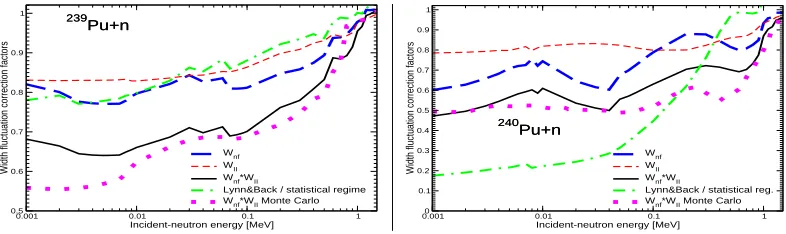
From Fig. 2 we can verify that both the IS (Lynn and Back formulation of ¯Pf - Eq. 10 - normalized to
the value obtained assuming statistical regime - Eq. 9) and overall width fluctuation correction factor (Wn,f∗WIIproduct) exert a strong influence on the average fission cross section magnitude. Depending on fission barrier heights relatively to the neutron threshold energy, the IS effect is either much smaller than the overall width statistical fluctuation correction as for the239Pu fissile target nucleus (left-side Figure) or much larger for a non-fissile target nucleus as for240Pu (right-side Figure).
5 Nested Monte carlo fission cross section calculations
A powerful alternative to analytical expressions valid under specific conditions, such as the statistical
0.001 0.01 0.1 1
Incident-neutron energy [MeV]
0.5 0.6 0.7 0.8 0.9 1
Width fluctuation correction factors
Wnf WII Wnf*WII
Lynn&Back / statistical regime Wnf*WII Monte Carlo 239
Pu+n 239
Pu+n
0.001 0.01 0.1 1
Incident-neutron energy [MeV]
0 0.1 0.2 0.3 0.4 0.5 0.6 0.7 0.8 0.9 1
Width fluctuation correction factors
Wnf WII Wnf*WII
Lynn&Back / statistical reg. Wnf*WII Monte Carlo 240
Pu+n 240
Pu+n
Figure 2. (Color online) Wn,f and WIIwidth fluctuation correction factors (and product - black-solid line) cal-culated as function of neutron energy respectively for the239Pu and240Pu target nuclides. For comparison, the
reduction of the average fission barrier probability due to barrier tunneling (estimated from the Lynn and Back formula - Eq. 10 - normalized to the statistical regime - Eq. 9) is plotted (red-short-dashes) as well as the fluctua-tion factor product extracted from the accurate Monte Carlo procedure (purple-dotted line).
the Monte Carlo-type (MC) method. Our MC procedure [2] presents the advantage of providing average cross sections taking full account of all statistical nuclear data parameter fluctuations under in-situ IS coupling conditions. Our present approach simulates the R-matrix resonance properties of a selected class-II state and those of the overlapped neighboring class-I states over at least a full class-II energy spacing, using a chain of pseudo-random numbers for a fine-tuned selection process based on both level width and spacing statistical distributions with suitable averages and in particular the Porter-Thomas width distributions of the dedicated elements (hλI|Hc|λIIi2,ΓλII↓andΓλII↑as introduced by Eqs. 8 and 7), were simulated to model the full extent of IS fluctuations. The extraction of
the Wn,f ∗WII undecoupled product from the more accurate MC procedure can be compared to the
analytical estimate obtained previously (Fig. 2). We observe that the effect of the Wn,f ∗WII MC
product is still larger than the one given by the analytical estimate. The effect on the simulated
average cross section will be to lower it still below the magnitude it would have using the analytical estimate.
5.1 Overall fission barrier effective degree of freedom
A collateral damage of the IS, usually poorly addressed, is the reduction of the effective degree of
freedom,νfe f f, of the overall fission barrier. The precise value is crucial because this latter has to
be input into the calculation of the standard Wn,f factor. For standard Hauser-Feshbach statistical
theory with adequate width fluctuation correction factor,νfe f f should be equal to the number of open channels at the outer barrier. However the plausible restriction of the fission transmission across the outer fission channels, due to the IS, will reduceνfe f f significantly. Hopefully, the correct value ofνfe f f can be estimated from thousand MC calculations with the assumption that, at near-barrier energy, the class-II total width is large and that its strength is meanly spread through its coupling width over many class-I states (ΓλII↓ >> ΓλII↑). The mixing elements are then somewhat large (so-called moderately weak coupling) and the class-II state fission width is mixed in a Lorentzian pattern into the formal
R-matrix states. From those MC calculations, the effective degree of freedom of the overall barrier
fission width can be retrieved from means and variances. An example of reduction ofνfe f f is given
representative of the URR. We can guess that the resulting standard Wn,f factor will be significantly altered.
νe f f 240Pu* (Jπ=0+) 241Pu* (Jπ=0.5+)
1 keV 0.72 0.66
100 keV 0.74 0.66
Table 1. IS impact in terms of degree of freedom respectively for the239Pu and240Pu target nuclides normalized
to a single fully open outer barrier channel. Without IS (such that the single hump picture), the distribution of the formal R-matrix eigenstate fission widths is expected to follow a Porter-thomas distribution withνf =1.
6 Conclusions
The purpose here was to recall and emphasize the existence of the class-II width fluctuation correction factor which lowers the average fission cross section of about 20% for a fertile isotope over the URR. This paper also demonstrates that its effect is also non negligible (>10%) for a fissile isotope. Another goal was to enlighten a collateral damage of the IS, usually poorly addressed, which is the drastic reduction of the degree of freedom of the overall fission barrier to be input in the calculation of the
standard Wn,f factor. Its value will be strongly modified. Although standard evaluation works can
by-pass the latter corrections by playing on other parameter types (e.g; fundamental fission barrier heights), those short-cuts will be an additional source of uncertainties on predictions to be made for nuclides which cross sections can not be measured.
7 Acknowledgment
This work is made in collaboration with Dr. Patrick Talou and Dr. J. Eric Lynn from the T-2 group of LANL. O. Bouland expresses his deep gratitude for enlightening discussions with those fellows and to Dr. Olivier Serot from CEA Cadarache for paper review.
References
[1] F. H. Froehner, Nucl. Sci. Eng. 111, 404 (1992).
[2] O. Bouland, J. E. Lynn and P. Talou, EPJ Web of Conf. DOI: 10.1051, 2108004 (2012). [3] F. Tovesson and T. S. Hill, Nucl. Sci. Eng. 165, 224 (2010).
[4] O. A. Shcherbakov et al., Proc. of ASAP 2002, Ed. P. E. Koehler, 123 (2002). [5] F. Tovesson et al., Phys. Rev. C 79, 014613 (2009).
[6] A. Laptev et al., Proc. of 3rdInternational Conf. on Fis. and Properties of Neutron-Rich Nuclei,
Sanibel Island, FL (2002).
[7] W. Hauser and H. Feshbach, Phys. Rev. 87, 366 (1952). [8] J. E. Lynn, J. Phys. A: Math. Nucl. Gen., 6, 542 (1973). [9] P. A. Moldauer, Phys. Rev. 123, 3, 968 (1961).
[10] A. Bohr, Peaceful Uses of Atomic Energy, 2, 220, United Nations (1955). [11] D. L. Hill and J. A. Wheeler, Phys. Rev. 89, 1102 (1953).