SUPPLEMENT ARTICLE
Optimizing the Management of Peripheral Venous
Access Pain in Children: Evidence, Impact,
and Implementation
William T. Zempsky, MD
Department of Pediatrics, University of Connecticut School of Medicine, Farmington, Connecticut; Pain Relief Program, Connecticut Children’s Medical Center, Hartford, Connecticut
Financial Disclosure: Dr Zempsky serves as a consultant to Anesiva, Inc, and Endo Pharmaceuticals and has received research support from Anesiva, Inc, Sontra Medical Corporation, and Vyteris, Inc.
V
ENIPUNCTURE AND INTRAVENOUS(IV) cannulation procedures are a routine part of modern clinical practice. Unfortunately, these procedures also cause pain and distress, which can have a significant impact on children. Pediatric inpatients report IV line placement as the leading cause of procedure-related pain in the hospital, on par with postsurgical pain.1A significant proportion of children undergoing veni-puncture also experience moderate or severe pain2and elevated levels of preproce-dural and procepreproce-dural distress.2,3 Clinical practice guidelines advocate the use of strategies to ameliorate the pain and distress of venous access procedures in chil-dren4–7; evidence to date, however, has suggested that implementation of such strategies often remains inadequate.8,9A multidisciplinary roundtable of experts met in the summer of 2007 to discuss the problem of venous access pain in children. All participants were practicing health care providers and were local or international leaders in the field of pediatric pain manage-ment. The roundtable covered 3 broad topics: (1) the biology of the pain-response system in general and, specifically, the immediate and long-term effects of venous access pain on children; (2) behavioral and pharmacologic treatment modalities for pediatric venous access pain; and (3) practical recommendations for institutions that wish to improve systematically their treatment of pediatric pain, including venous access pain. To address
the last topic, several centers of excellence in the area of venous access pain management presented their innovative systematic approaches for reducing pain associated with peripheral venous access. Although more anecdotal in nature, these efforts were intended to provide a framework from which other institutions might develop their own programs.
The ultimate goal of the roundtable was to produce a single, comprehensive, and convenient resource that contains up-to-date information on venous access pain in children. The articles in this supplement to Pediatrics
represent the panel’s deliberations and shared expertise regarding this common cause of pediatric pain.
The biology of the pain-response system and how venous access procedures impinge on this system in children is the subject of the first 2 articles in the supplement. The first article, by Walco,10focuses on the complex interplay between developmental, genetic, and experiential factors in the functioning of pain-response systems. The devel-opment of the nociceptive system is discussed, and how an individual’s unique sensitivity to pain arises from a complex interaction of genetics, temperament, coping behaviors, and memories of past painful events is described. Walco also describes how classical conditioning in children during venous access procedures may have the potential to lead to maladaptive pain responses in adults.
In the second article, Kennedy et al11explore the impact of painful procedures on children. After reviewing studies that have shown that young children, even neonates, have highly refined pain-sensing systems, they summarize literature that has demonstrated how the memory of previous painful events, including venous access procedures, can have significant psychological and physiological ramifications on later painful episodes. Finally, the impact of venous access pain on procedural success rates and times, and on nursing satisfaction, is discussed.
The next article, by Cohen,12summarizes available behavioral approaches for managing the anxiety and pain of venous access procedures in children. Techniques to prepare a child emotionally for a needle-stick procedure are described, including the optimal timing, format, and content of such preparation. The author also discusses the integration of parents into the procedural process and assesses the role of correct positioning and distraction. A number of simple and cost-effective behavioral strategies are presented that are appropriate in most health care settings.
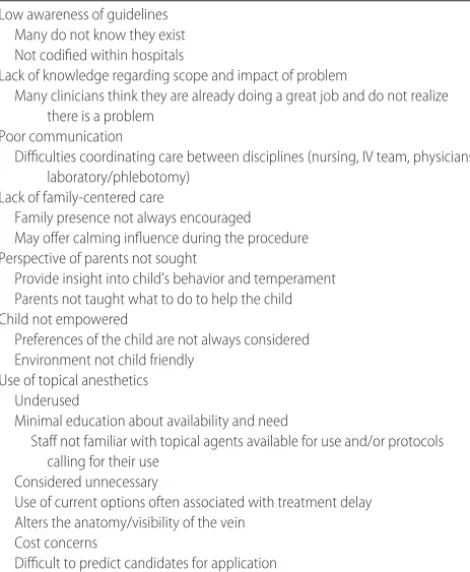
A comprehensive review of pharmacologic approaches to venous access pain is presented by me in the next article.13 A wide variety of pharmacologic agents and devices have been developed and examined over the last 2 decades, and this article provides an overview of many of these options. Studies have suggested that local anesthetics are underused for venous access procedures,8,9which likely reflects several underlying causes (Table 1). One key
www.pediatrics.org/cgi/doi/10.1542/ peds.2008-1055c
doi:10.1542/peds.2008-1055c
Key Words
venipuncture, peripheral cannulation, pain, pediatrics
Abbreviation
IV—intravenous
Accepted for publication Jun 4, 2008 Address correspondence to William T. Zempsky, MD, Pain Relief Program, Connecticut Children’s Medical Center, 282 Washington Street, Hartford, CT 06106. E-mail: [email protected]
FIGURE
1
Behavioral
approaches
and
pharmacologic
options
for
pediatric
peripheral
venous
access
(venipuncture
and
IV
cannulation)
procedures.
aThis
is
not
an
exhaustive
list
of
available
agents.
S122 ZEMPSKY
at Viet Nam:AAP Sponsored on August 29, 2020 www.aappublications.org/news
evolution over the last decade, and products are now available that allow administration to occur nearly con-temporaneously with the venous access procedure.
The final 2 articles in this supplement address pain management in children from a more systematic per-spective. A number of centers around the country have developed integrated, multidisciplinary, institution-wide programs for pediatric pain management, including the pain of venous access procedures. Schechter14describes one of the oldest and most successful of these programs, which was initially described⬎10 years ago in a previ-ousPediatricspublication.15He presents a historical over-view of pediatric pain management and reover-views the fundamental and profound change in outlook that took place in the 1980s and 1990s. He then describes how an institution converted information from basic research on pediatric pain into a practical, institution-wide, pain-management program for children. Drawing on long experience with this program, the article updates his previous one15 by recounting interim challenges that have arisen and how they were overcome. It ends with a series of practical recommendations for creating similar programs in other institutions.
Building on the information in Schechter’s article, the final article in the supplement, by Leahy et al,16takes the form of case studies to illustrate how multidisciplinary pro-grams to manage needle pain have been developed suc-cessfully in a number of other institutions. The case studies provide another important link for translating research into clinical practice by reflecting the perspectives of different
whole, this contribution clearly highlights the importance of a multidisciplinary approach in the management of pe-ripheral venous access pain in children.
To synthesize the clinical information in this supple-ment, a simplified and general algorithm with behav-ioral and pharmacologic treatment options for managing venous access pain has been provided (Fig 1). This algo-rithm should serve as a starting point for program man-agers who are interested in developing institutional pro-tocols for treating pediatric venous access pain.
New research continues to demonstrate the impor-tance of managing the pain and distress of pediatric venipuncture and IV cannulation procedures. A variety of behavioral and pharmacologic interventions are avail-able to ameliorate venous access pain in children, but too often these options are underused. Implementation of successful treatment strategies in health care centers requires broad institution-wide commitment and a mul-tidisciplinary approach that is embraced at all levels. We hope that this supplement will provide the theoretical and practical information necessary to help centers that are committed to managing this important source of pain and distress in children.
REFERENCES
1. Cummings EA, Reid GJ, Finley GA, McGrath PJ, Ritchie JA. Prevalence and source of pain in pediatric inpatients. Pain.
1996;68 (1):25–31
2. Fradet C, McGrath PJ, Kay J, Adams S, Luke B. A prospective survey of reactions to blood tests by children and adolescents.
Pain.1990;40 (1):53– 60
3. Humphrey GB, Boon CM, van Linden van den Heuvell GF, van de Wiel HB. The occurrence of high levels of acute behavioral distress in children and adolescents undergoing routine veni-punctures.Pediatrics.1992;90 (1 pt 1):87–91
4. American Academy of Pediatrics, Committee on Psychosocial Aspects of Child and Family Health; American Pain Society Task Force on Pain in Infants Children and Adolescents. The assessment and management of acute pain in infants, children, and adolescents.Pediatrics.2001;108 (3):793–797
5. Finley GA, Franck LS, Grunau RE, von Baeyer CL. Why chil-dren’s pain matters.Pain Clin Updates.2005;XIII(4):1– 6 6. Infusion Nurses Society. Infusion nursing standards of practice:
local anesthesia.J Infus Nurs.2006;29(1 suppl):S1–S92 7. Zempsky WT, Cravero JP; American Academy of Pediatrics,
Committee on Pediatric Emergency Medicine and Section on Anesthesiology and Pain Medicine. Relief of pain and anxiety in pediatric patients in emergency medical systems.Pediatrics.
2004;114(5):1348 –1356
8. Bhargava R, Young KD. Procedural pain management patterns in academic pediatric emergency departments.Acad Emerg Med.
2007;14(5):479 – 482
9. MacLean S, Obispo J, Young KD. The gap between pediatric emergency department procedural pain management treat-ments available and actual practice.Pediatr Emerg Care.2007;23 (2):87–93
10. Walco GA. Needle pain in children: contextual factors. Pediat-rics.2008;122(3 suppl):S125–S129
11. Kennedy RM, Luhmann J, Zempsky W. Clinical implications of unmanaged needle-insertion pain and distress in children. Pe-diatrics.2008;122(3 suppl):S130 –S133
12. Cohen LL. Behavioral approaches to anxiety and pain man-TABLE 1 Challenges to the Implementation of Pain-Management
Strategies for Pediatric Venous Access Procedures Low awareness of guidelines
Many do not know they exist Not codified within hospitals
Lack of knowledge regarding scope and impact of problem
Many clinicians think they are already doing a great job and do not realize there is a problem
Poor communication
Difficulties coordinating care between disciplines (nursing, IV team, physicians, laboratory/phlebotomy)
Lack of family-centered care
Family presence not always encouraged May offer calming influence during the procedure Perspective of parents not sought
Provide insight into child’s behavior and temperament Parents not taught what to do to help the child Child not empowered
Preferences of the child are not always considered Environment not child friendly
Use of topical anesthetics Underused
Minimal education about availability and need
Staff not familiar with topical agents available for use and/or protocols calling for their use
Considered unnecessary
Use of current options often associated with treatment delay Alters the anatomy/visibility of the vein
Cost concerns
13. Zempsky WT. Pharmacologic approaches for reducing venous access pain in children. Pediatrics. 2008;122(3 suppl):S140 – S153
14. Schechter NL. From the Ouchless Place to Comfort Central: the evolution of a concept. Pediatrics. 2008;122(3 suppl):S154 – S160
15. Schechter NL, Blankson V, Pachter LM, Sullivan CM, Costa L.
The Ouchless Place: no pain, children’s gain.Pediatrics.1997; 99(6):890 – 894
16. Leahy S, Kennedy RM, Hesselgrave J, Gurwitch K, Barkey M, Millar T. On the front lines: lessons learned in implementing multidisciplinary peripheral venous access pain-management programs in pediatric hospitals.Pediatrics.2008;122(3 suppl): S161–S170
S124 ZEMPSKY
at Viet Nam:AAP Sponsored on August 29, 2020 www.aappublications.org/news
DOI: 10.1542/peds.2008-1055c
2008;122;S121
Pediatrics
William T. Zempsky
Evidence, Impact, and Implementation
Optimizing the Management of Peripheral Venous Access Pain in Children:
Services
Updated Information &
http://pediatrics.aappublications.org/content/122/Supplement_3/S121
including high resolution figures, can be found at:
References
#BIBL
http://pediatrics.aappublications.org/content/122/Supplement_3/S121
This article cites 16 articles, 10 of which you can access for free at:
Subspecialty Collections
edicine_sub
http://www.aappublications.org/cgi/collection/anesthesiology:pain_m
Anesthesiology/Pain Medicine following collection(s):
This article, along with others on similar topics, appears in the
Permissions & Licensing
http://www.aappublications.org/site/misc/Permissions.xhtml
in its entirety can be found online at:
Information about reproducing this article in parts (figures, tables) or
Reprints
http://www.aappublications.org/site/misc/reprints.xhtml
DOI: 10.1542/peds.2008-1055c
2008;122;S121
Pediatrics
William T. Zempsky
Evidence, Impact, and Implementation
Optimizing the Management of Peripheral Venous Access Pain in Children:
http://pediatrics.aappublications.org/content/122/Supplement_3/S121
located on the World Wide Web at:
The online version of this article, along with updated information and services, is
by the American Academy of Pediatrics. All rights reserved. Print ISSN: 1073-0397.
the American Academy of Pediatrics, 345 Park Avenue, Itasca, Illinois, 60143. Copyright © 2008 has been published continuously since 1948. Pediatrics is owned, published, and trademarked by Pediatrics is the official journal of the American Academy of Pediatrics. A monthly publication, it
at Viet Nam:AAP Sponsored on August 29, 2020 www.aappublications.org/news