Reducing Peak to Average Power Ratio of
OFDM by Using Selected Mapping
Technique
1
S. ARUNA,
2Y.MALLIKA
1Assistant Professor, ECE Department, Andhra University, Visakhapatnam, India, 2 ECE Department, Andhra University, Visakhapatnam, India,
ABSTRACT: In the last decade, wireless communications
have become increasingly popular as powerful and cost-effective platforms for mobile communications. According to the demand of wireless communications field there should be high data rate in addition to both power efficiency and lower bit error rate. This demand of high data rate can be fulfilled by the single carrier modulation with compromising the tradeoff between the power efficiency and bit error rate. Again in the presence of frequency selective fading environment, it is very difficult to achieve high data rate for this single carrier modulation with a lower bit error rate performance. With considering an advance step towards the multi carrier modulation scheme it is possible to get high data rate in this multipath fading channel without degrading the bit error rate performance. To achieve better performance using multi carrier modulation we should make the subcarriers to be orthogonal to each other i.e. known as the Orthogonal Frequency Division Multiplexing (OFDM) most popular technique. However, high peak to average power ratio (PAPR) is a major drawback of this modulation technique. Because high peak reduces the power efficiency of the RF power amplifier at transmitter. This can be avoided with increasing the dynamic range of power amplifier which leads to high cost and high consumption of power at the base station. This paper presents a Selected Mapping (SLM) technique for reducing the peak to average power ratio (PAPR) of OFDM .The proposed scheme overcomes the disadvantages of existing reduction techniques. Because of the scramble an input data block of the OFDM symbols and transmit one of them with the minimum PAPR, this scheme has the probability of incurring high PAPR can be reduced. Moreover, the proposed scheme does not suffer from the out-of-band power, spectral efficiency and the complexity of subcarriers.
Index Terms: OFDM, PAPR, SLM, IDFT I.INTRODUCTION
The demand of high data rate services has been increasing very rapidly. In wireless medium. Wireless communications has many advantages, such as speed, simplicity, mobility and flexibility, but in the same time it suffers from, inter-symbol interference (ISI) and multipath propagation (frequency selective fading). One physical layer technique that has gained a lot of popularities due to its robustness in dealing with these
impairments is multi-carrier modulation technique. In multi-carrier modulation, the most commonly used technique is Orthogonal Frequency Division Multiplexing (OFDM); it has recently become very popular in wireless communication. On the other hand, OFDM suffers large envelope fluctuation which is quantified as Peak to Average Power Ratio (PAPR). Since power amplifier is used at the transmitter, for reduction of this PAPR lot of algorithms have been developed. All of the techniques have some sort of advantages and disadvantages [1]. A high PAPR makes the signal peaks move into the non-linear region of the RF power amplifier which causes signal distortion. A large PAPR increases the complexity of the analog-to-digital and digital-to-analog converters and reduces the efficiency of the RF power amplifier. Recently, researchers have discovered many techniques on PAPR reduction, for instances, clipping, coding, and selected mapping (SLM) [2]
II. ORTHOGONAL FREQUENCY DIVISION MULTIPLEXING (OFDM)
Orthogonal frequency division multiplexing (OFDM) [3],[4] transmission scheme is a type of multichannel system which avoids the usages of the oscillators and band limited filters for each sub channel. The OFDM technology was first conceptualized in the 1960s and 1970s. The main idea behind the OFDM is that since low-rate modulations are less sensitive to multipath, the better way is to send a number of low rate streams in parallel than sending one high rate waveform. It divides the frequency spectrum into sub-bands small enough so that the channel effects are constant (flat) over a given sub-band. Then a classical IQ (In phase quadrature phase) modulation (BPSK, QPSK, M-QAM, etc) is sent over the sub-band. If it designed correctly, all the fast changing effects of the channel disappear as they are now occurring during the transmission of a single symbol and are thus treated as flat fading at the receiver. A large number of closely spaced orthogonal
subcarriers are used to carry data. The data is divided into several parallel data streams or channels, one for each subcarrier. Each subcarrier is modulated with a conventional modulation scheme such as quadrature Amplitude Modulation (QAM) or Phase Shift Keying (PSK) at a low symbol rate. The total data rate is to be maintained similar to that of the conventional single carrier modulation scheme with the same bandwidth. Orthogonal Frequency Division Multiplexing (OFDM) is a promising technique for achieving high data rate and combating multipath fading in Wireless Communications. Orthogonal Frequency Division Multiplexing is a special form of multicarrier modulation which is particularly suited for transmission over a dispersive channel. Here the different carriers are orthogonal to each other, that is, they are totally independent of one another. This is achieved by placing the carrier exactly at the nulls in the modulation spectra of each other as shown in Fig.1 and it can be seen that at the center frequency of each subcarrier there is no cross talk. The orthogonality of the carriers means that each carrier has an integer number of cycles over a symbol period. Due to this integer number of cycles, the spectrum of each carrier has a null at the center frequency of each of the other carriers in the system that results in no interference between the carriers, allowing them to be spaced as close as possible. The problem of overhead carrier spacing required in Frequency Division Multiplexing (FDM) can be recovered. So this multicarrier transmission scheme allows the overlapping of the spectra of subcarriers for bandwidth efficiency [5].
Fig -1: OFDM Spectrum
III. RELATED WORK
Many techniques have been proposed to reduce the PAPR, Clipping scheme [6] is covered in signal distortion technique i.e. parts of signal is clipped that are outside the allowed region to reduce the PAPR. Coding schemes [7] are also used but these have drawbacks of using special decoders in receiver side.. Among the techniques, SLM technique is one of the effective methods, where the OFDM subcarriers are
partitioned into several subgroups and each group of subcarriers is multiplied by a phase factor to reduce the PAPR.
IV. PEAK TO AVERAGE POWER RATIO The transmit signals in an OFDM system can have high peak values in the time domain since many subcarrier components are added via an IFFT operation. Therefore, OFDM systems are known to have a high PAPR (Peak-to-Average Power Ratio), compared with single-carrier systems. In fact, the high PAPR is one of the most detrimental aspects in the OFDM system, as it decreases the SQNR (Signal-to-Quantization Noise Ratio) of ADC (Analog-to-Digital Converter) and DAC (Digital-to-Analog Converter) while degrading the efficiency of the power amplifier in the transmitter. The PAPR problem is more important in the uplink since the efficiency of power amplifier is critical due to the limited battery power in a mobile terminal. Low PAPR makes the transmit power amplifier works efficiently, Any non-linearity in the signal will cause distortion such as inter-carrier interference (ICI) and inter symbol interference (ISI) [8].The peak to average power ratio (PAPR) of a continuous time signal is given by [8]
2 2 max ( ) ( ) t t x t PAPR E x t (1)
And for the discrete time signal 2 2 max ( ) ( ) n n x n PAPR E x n (2)
The input signal to the amplifier in the OFDM system is an analog signal and the time domain samples of the output from the inverse fast Fourier transform (IFFT) is [8] 2 1 0
1
[ ]
N[ ]
j Nin,0
1
ix n
X i e
n N
n
(3)If the number of subcarriers (N) is large x[n]are zero mean Gaussian random variables. And for x[n] complex Gaussian the OFDM signal is Rayleigh distributed with variance 2
n
, and the phase of the signal is uniform. The peak value of the signal that has Rayleigh distribution will exceed any values with nonzero probability. Thus the probability of the PAPR of the discrete signal exceeds a threshold2 0 0 2 n
P
is given by [8].
0
0(
)
1 (1
P)
NP PAPR P
e
(4) Let us show how PAPR increases by increasing the number of subcarriers N. Assume N Gaussian independent and identically distribute (i.i.d) randomvariables Xn,
0 n
N
1
with zero mean and unitpower. The average signal power
( [ ] )
2n
E
x n
is then 1 ) ( 1 ) ( 1 2 1 2 0 2 0 2 1 1 0 2 1 1 0 N x E N x E N x E x x x E N x x x N E N N N (5)The maximum value occurs when all
x
i theaddcoherently, which is
2 2 0 1 1 1 max x x xN N N N N (6) Thus, the maximum PAPR is N for N subcarriers.V. SELECTED MAPPING (SLM)
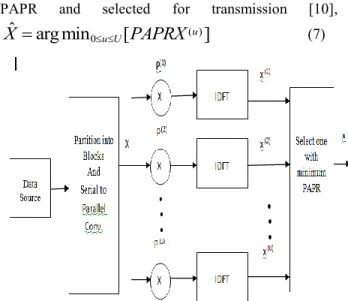
This is most promising reduction technique used for the PAPR reduction in OFDM. This technique indicates that one sequence has to be selected out of a number of sequences. According to the concept of discrete time OFDM transmission we should make a data block considering N number of symbols from the constellation plot. Where N is the number of subcarriers to be used. Then using that data block U number of independent candidate vectors are to be generated with the multiplication of independent phase vectors. The first SLM scheme was introduced by Bauml, Fischer and Huber in 1996 [9].The basic idea of this technique is based on the phase rotation. The lowest PAPR signal will be selected for transmission from a number of different data blocks (independent phase sequences) that have the same information at the transmitter. Fig. 2 shows a block diagram of SLM scheme [10].Let us assume that the original input data
T N X X X X 0, 1, 1 phase sequences ( ) ( ) ( ) 0 , 1 ,... 1 T u u u u N P P P P (u =0,1, u-1) Afterreceiving the acknowledgement it will be sent for the validation. U is the number of phase sequences Both the input data and phase sequences have the same length N (U = 0, 1…, U-1). .original input data multiplied with independent phase sequences inverse fast Fourier transform (IFFT) will be applied on each sequence to convert the signal from frequency domain to the time domain. The result from multiplication will generate the data block of an OFDM system that has different time domain signals, with length of U, and different PAPR values,
( ) ( ) ( ) 0 , 1 ,... 1 T u u u u N X X X X
.The last step is comparing the PAPR among the independent data blocks and the candidate with the lowest PAPR will be selected for transmission. The following equation expresses the optimal candidate
X
ˆ
that has the lowestPAPR and selected for transmission [10], ( )
0
ˆ
arg min
[
u]
u U
X
PAPRX
(7)Fig -2: Block diagram of SLM technique Threshold Selected Mapping
The complex baseband of an OFDM signal that has N subcarriers with Nyquist sample rate can be expressed as [11], 2 1 0
1
[ ]
N[ ]
j Nin,0
1
ix n
X i e
n N
n
(8)Where
x
i are the modulation symbols. The centrallimit theorem shows that, if the number of subcarriers N is large
x t
( )
, are zero mean Gaussian random variables. And forx t
( )
complex Gaussian the OFDM signal is Rayleigh distributed with a variance of 0.5, and the phase of the signal is uniform. The peak value of the signals that have Rayleigh distribution will exceed any values with nonzero probability. Let us assume that the average power ofx t
( )
is equal to 1, and is the independently and identically distributed (i.i.d) Rayleigh random variables. The probability density function ofZ
nis given by [11],max
(
)
( )
N(1
Z N)
Z
P PAPR z F
z
e
(9)The complementary cumulative distribution function (CCDF) is used when PAPR value exceeds the threshold. To find the probability that PAPR of an OFDM signal exceeds the threshold Z, assume the following complementary cumulative distribution function (CCDF) [11], N z
e
z
PAPR
P
(
)
1
(
1
)
(10)In SLM technique each data block will create U times phase sequences, if each mapping considered statistically independent, then CCDF of the Peak to
Average Power Ratio (PAPR) in Selected Mapping (SLM) will be, U N z
e
z
PAPR
P
(
)
(
1
(
1
)
)
(11)Where U is the number of phase sequences, N is the number of subcarriers, and z is threshold.
As it can be seen from equations (10) and (11), they derived when the number of subcarriers N is large and the samples are independent with Nyquist sampling rate. But, both equations don’t mention the oversampled and band limited. It is because the fact that the sampled signal does not need to have the maximum point of the original signal. On other hand, it is important to oversamples OFDM signals by oversampling factor L to obtain better value of PAPR. Tellado indicates that an oversampling of four is adequate to reach the real PAPR values [12]. And it is quite difficult to derive the solution of the peak power distribution; therefore, Nee and Prasad show an approximation to explain the probability of PAPR by approximated N subcarriers and oversampling distribution by α· N subcarriers without oversampling, and they mention that when α =2.8 is the best value to reach better PAPR when subcarriers N >64. The approximation is shown below,
.
(
)
( )
N1 (1
z)
NP PAPR Z
F z
e
(11) When PAPR value exceeds the threshold z, the probability of PAPR for oversampling case can be written as
.
(
)
1 (1
z)
NP PAPR Z
e
(12)
.
(
)
1 (1
z)
N UP PAPR Z
e
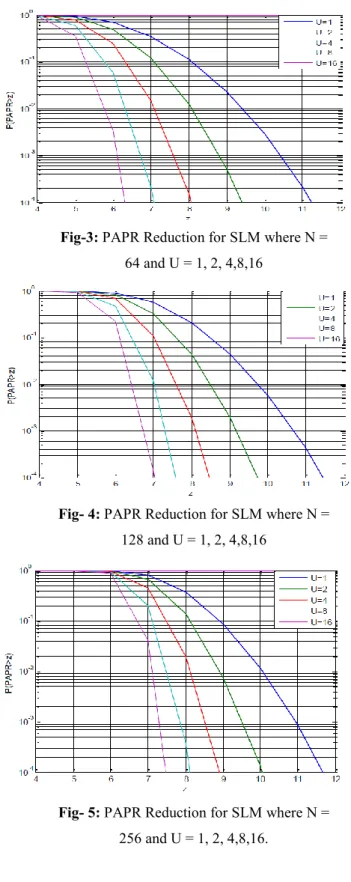
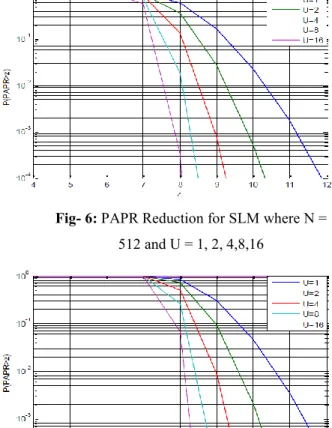
(13) VI.RESULTS AND DISCUSSIONSThis section discusses PAPR reduction and it indicates that large PAPR reduction is possible with selected mapping scheme [13]. Figures 3, 4, 5, 6, and 7 respectively show the performance of peak to average power ratio (PAPR) reduction of Selected Mapping (SLM) schemes by using equation 11 for different values of phase sequences U and subcarriers N. It is clear from the figures that by increasing the number of phase sequences U better PAPR reduction can be obtained. For instance, figure 3 is a plot of PAPR reduction curves for OFDM symbol where N=62. From the figure it can be seen that when there is no SLM which is at U=1 threshold needed to get good PAPR reduction performance is 11.5, while for U = 16, only 6.5 is needed to get good PAPR reduction performance 10-3 , by assuming that probability of clipping is for both cases. Table 1 gives an overview of several PAPR reduction performances corresponding to10-4
probability of clipping for different values of phase
sequences U and subcarriers N. PAPR reduction performances corresponding to10-3 probability of
clipping for different values of phase sequences U and subcarriers N [13] has better PAPR reduction performances corresponding to 10-4 .
Fig-3: PAPR Reduction for SLM where N =
64 and U = 1, 2, 4,8,16
Fig- 4: PAPR Reduction for SLM where N =
128 and U = 1, 2, 4,8,16
Fig- 5: PAPR Reduction for SLM where N =
Fig- 6: PAPR Reduction for SLM where N =
512 and U = 1, 2, 4,8,16
Fig- 7: PAPR Reduction for SLM where N =
1024 and U = 1, 2, 4,8,16
PEAK TO AVERAGE POWER RATIO
N 64 128 256 512 1024 U=1 ( No SLM) 11.5 11.6 11.6 11.8 12 U=2 9.5 9.7 10.2 10.5 10.8 U=4 8.1 8.4 8.9 9.0 9.5 U=8 7.1 7.4 7.9 8.5 8.9 U=16 6.5 7.0 7.5 8.0 8.4
Table -1: PAPR Reduction of Phase Sequences for
Different Number of Subcarriers
VII. CONCLUSION
OFDM system has been discussed in this paper, however high peak to average power ratio (PAPR) is a major disadvantage of this modulation technique. There were numerous reduction techniques presented to solve high peak to average power ratio (PAPR) such as, Signal distortion techniques, Coding Schemes, and Symbol-scrambling techniques these has draw backs in avoiding Side Information (SI) index along with the selected OFDM signal.. Selected Mapping (SLM) technique was the main focus of the paper. SLM is the most promising reduction technique. It was also mentioned that power saving could be achieved through selected mapping. This paper also showed the simulation results of OFDM symbol with and without SLM. Results have shown that the proposed Selected mapping (SLM) has better power saving can be achieved when compared with existing techniques. It is concluded that selected mapping (SLM) technique reduces the PAPR by increasing the number of phase sequences U and subcarriers N
REFERENCES
[1] Seung Hee Han and Jae Hong Lee. An overview of peak-to-average power ratio reduction techniques for multicarrier transmission. IEEE Wireless Communications, 12(2):56 – 65, 2005
[2] Adarsh B. Narasimhamurthy, Mahesh K. Banavar, and Cihan Tepedelenlio˘glu, “OFDM Systems for Wireless Communications”,2010, ISBN: 9781598297010 Randal, B.; Derek, K.; Morgan,
[3] S.B. Weinstein and P.M. Ebert. Data transmission by frequency-division multiplexing using thediscrete fourier transform. IEEE Transactions on Communication Technology, CM-19(5):628 – 34, 1971/10/.
[4] Jr. L. J. Cimini. Analysis and simulation of a digital mobile channel using orthogonal frequencydivision multplexing. IEEE Trans. Commun., 33(7):66575, July 1985.
[5] Won Young Yang Chung-Gu Kang Yong Soo Cho, Jaekwon Kim. MIMO-OFDM WirelessCommunications With Matlab. John Wiley & Sons, illustrated edition, 2010.
[6] X. Li and L. J. Cimini Jr, “Effects of clipping and filtering on the performance of OFDM,” IEEE Commun. Lett., vol. 2, no. 5, pp. 131–133,May 1998.
[7] A. E. Jones et.al, “Block coding scheme for reduction of peak to mean envelope power ratio of multicarrier transmission schemes,” Electronics Letters, vol. 30, no. 25, pp. 2098–2099, 1994
[8] Andrea,Goldsmith, “ Wireless Communications”, Cambridge University,2005, ISBN 978-0-521-83716-3
[9] Bauml, R., Fischer, R., and Huber, J,”R Guangyue Lu1, Ping Wu and Catharina Carlemalm-Logothetis,” Reducing the peak-to-average power ratio of multicarrier modulation by selected mapping" IEE Electronics Letters, vol. 32,pp. 2056-2057, 1996 [10] Pankaj Kumar Sharma,” Power Efficiency Improvement in
World Applied Sciences Journal 7 (Special Issue of Computer & IT): 145-151, 2009, ISSN 1818.4952
[11] Cho, Yong Soo; Kim, Jaekwon; Yang, Won Young; Kang, Chung G. ” MIMO-OFDM Wireless Communications with MATLAB “Wiley, Hoboken, 2010,ISBN: 9780470825624 [12] J. Tellado,” Multicarrier Modulation with Low
PAR:Applications to DSL and Wireless” Norwell, MA:Kluwer, 2000
[13] Dr. Bekir Nagwa, Dr. Amini Ali et.al “ Reducing PAPR of OFDM by Using Selected Mapping” degree of Master of Science In Electrical Engineering Project Book, CALIFORNIA STATE UNIVERSITY, NORTHRIDGE,2012
S.Aruna , born in Pithapuram, Andhra Pradesh, India. Joined as an Assistant Professor in Andhra University 2006. She has completed Master’s degree in Electronic and Instrumentation from JNTU , Kakinada in 2004. She has done her B.E (ECE) from SRKR Engineering College Bhimavaram. She has presented many technical papers in national & international Conferences at Canada, Jodhpur and Visakhapatnam etc., attended many Workshops. She is member of IETE & IST. She is pursuing PhD in Andhra University, Visakhapatnam. Areas of interest are electronics, antennas, and communications
Yarrakula Mallika has received
her B. Tech. degree in Electronics and Communication Engineering from Jawaharlal Technological University, Kakinada, India in 2012. Pursuing M.Tech degree in Radar & Microwave, Andhra University, Visakhapatnam, India. Her research interest in mobile communication and Radio wave Propagation