1896
Did the Model Understand the Question?
Pramod K. Mudrakarta University of Chicago [email protected]
Ankur Taly
Google Brain Mukund SundararajanGoogle
{ataly,mukunds,kedar}@google.com
Kedar Dhamdhere Google
Abstract
We analyze state-of-the-art deep learning models for three tasks: question answer-ing on (1) images, (2) tables, and (3) pas-sages of text. Using the notion of at-tribution(word importance), we find that these deep networks often ignore impor-tant question terms. Leveraging such be-havior, we perturb questions to craft a vari-ety of adversarial examples. Our strongest attacks drop the accuracy of a visual ques-tion answering model from61.1% to19%,
and that of a tabular question answering model from33.5% to3.3%. Additionally,
we show how attributions can strengthen attacks proposed byJia and Liang(2017) on paragraph comprehension models. Our results demonstrate that attributions can augment standard measures of accuracy and empower investigation of model per-formance. When a model is accurate but for the wrong reasons, attributions can sur-face erroneous logic in the model that in-dicates inadequacies in the test data. 1 Introduction
Recently, deep learning has been applied to a va-riety of question answering tasks. For instance, to answer questions about images (e.g. (Kazemi and Elqursh,2017)), tabular data (e.g. (Neelakan-tan et al., 2017)), and passages of text (e.g. (Yu et al.,2018)). Developers, end-users, and review-ers (in academia) would all like to undreview-erstand the capabilities of these models.
The standard way of measuring the goodness of a system is to evaluate its error on a test set. High accuracy is indicative of a good model only if the test set is representative of the underlying real-world task. Most tasks have large test and training sets, and it is hard to manually check that they are representative of the real world.
In this paper, we propose techniques to analyze the sensitivity of a deep learning model to ques-tion words. We do this by applyingattribution(as discussed in section 3), and generating adversar-ial questions. Here is an illustrative example: re-call Visual Question Answering (Agrawal et al., 2015) where the task is to answer questions about images. Consider the question “how symmetrical are the white bricks on either side of the build-ing?” (corresponding image in Figure1). The sys-tem that we study gets the answer right (“very”). But, we find (using an attribution approach) that the system relies on only a few of the words like “how” and “bricks”. Indeed, we can construct ad-versarial questions about the same image that the system gets wrong. For instance, “how spherical are the white bricks on either side of the build-ing?” returns the same answer (“very”). A key premise of our work is that most humans have ex-pertise in question answering. Even if they cannot manually check that a dataset is representative of the real world, they can identify important tion words, and anticipate their function in ques-tion answering.
1.1 Our Contributions
We follow an analysis workflow to understand three question answering models. There are two steps. First, we apply Integrated Gradients (hence-forth, IG) (Sundararajan et al., 2017) to attribute the systems’ predictions to words in the questions. We propose visualizations of attributions to make analysis easy. Second, we identify weaknesses (e.g., relying on unimportant words) in the net-works’ logic as exposed by the attributions, and leverage them to craft adversarial questions.
such overstability also applies to questions. Fur-thermore, this behavior can be seen in visual and tabular question answering networks as well. We use attributions to a define a general-purpose test for measuring the extent of the overstability (sec-tions 4.3 and5.3). It involves measuring how a network’s accuracy changes as words are system-atically dropped from questions.
We emphasize that, in contrast to model-independent adversarial techniques such as that of Jia and Liang(2017), our method exploits the strengths and weaknesses of the model(s) at hand. This allows our attacks to have a high success rate. Additionally, using insights derived from attribu-tions we were able to improve the attack success rate of Jia and Liang(2017) (section 6.2). Such extensive use of attributions in crafting adversarial examples is novel to the best of our knowledge.
Next, we provide an overview of our results. In each case, we evaluate a pre-trained model on new inputs. We keep the networks’ parameters intact.
Visual QA (section4): The task is to answer questions about images. We analyze the deep net-work inKazemi and Elqursh(2017). We find that the network ignores many question words, rely-ing largely on the image to produce answers. For instance, we show that the model retains more than 50% of its original accuracy even when ev-ery word that is not “color” is deleted from all questions in the validation set. We also show that the model under-relies on important ques-tion words (e.g. nouns) and attaching content-free prefixes (e.g., “in not many words, . . .”) to
questions drops the accuracy from61.1% to 19%.
QA on tables (section5): We analyze a sys-tem called Neural Programmer (henceforth, NP) (Neelakantan et al.,2017) that answers ques-tions on tabular data. NP determines the answer to a question by selecting a sequence of opera-tions to apply on the accompanying table (akin to an SQL query; details in section5). We find that these operation selections are more influenced by content-free words (e.g., “in”, “at”, “the”, etc.) in questions than important words such as nouns or adjectives. Dropping all content-free words reduces the validation accuracy of the network from33.5%1to28.5%. Similar to Visual QA, we
1This is the single-model accuracy that we obtained on
training the Neural Programmer network. The accuracy re-ported in the paper is 34.1%.
show that attaching content-free phrases (e.g., “in not a lot of words”) to the question drops the net-work’s accuracy from 33.5% to3.3%. We also
find that NP often gets the answer right for the wrong reasons. For instance, for the question “which nation earned the most gold medals?”, one of the operations selected by NP is “first” (pick the first row of the table). Its answer is right only because the table happens to be arranged in order of rank. We quantify this weakness by eval-uating NP on the set of perturbed tables generated byPasupat and Liang(2016) and find that its ac-curacy drops from 33.5% to 23%. Finally, we
show an extreme form of overstability where the table itself induces a large bias in the network re-gardless of the question. For instance, we found that in tables about Olympic medal counts, NP was predisposed to selecting the “prev” operator.
Reading comprehension (Section6): The task is to answer questions about paragraphs of text. We analyze the network by Yu et al. (2018). Again, we find that the network often ignores words that should be important. Jia and Liang (2017) proposed attacks wherein sentences are added to paragraphs that ought not to change the network’s answers, but sometimes do. Our main finding is that these attacks are more likely to succeed when an added sentence includes all the question words that the model found important (for the original paragraph). For instance, we find that attacks are 50% more likely to be successful when the added sentence includes top-attributed nouns in the question. This insight should allow the construction of more successful attacks and better training data sets.
In summary, we find that all networks ignore important parts of questions. One can fix this by either improving training data, or introducing an inductive bias. Our analysis workflow is helpful in both cases. It would also make sense to expose end-users to attribution visualizations. Knowing which words were ignored, or which operations the words were mapped to, can help the user de-cide whether to trust a system’s response.
2 Related Work
(2017) and our work is instructive. Their main contribution is to fix the evaluation of reading comprehension systems by augmenting the test set with adversarially constructed examples. (As they point out in Section 4.6 of their paper, this does not necessarily fix the model; the model may simply learn to circumvent the specific attack underlying the adversarial examples.) Their method is inde-pendent of the specification of the model at hand. They use crowdsourcing to craft passage perturba-tions intended to fool the network, and then query the network to test their effectiveness.
In contrast, we propose improving the analy-sis of question answering systems. Our method peeks into the logic of a network to identify high-attribution question terms. Often there are sev-eral important question terms (e.g., nouns, adjec-tives) that receive tiny attribution. We leverage this weakness and perturb questions to craft targeted attacks. WhileJia and Liang (2017) focus exclu-sively on systems for the reading comprehension task, we analyze one system each for three differ-ent tasks. Our method also helps improve the ef-ficacyJia and Liang(2017)’s attacks; see table4 for examples. Our analysis technique is specific to deep-learning-based systems, whereas theirs is not.
We could use many other methods instead of Integrated Gradients (IG) to attribute a deep net-work’s prediction to its input features (Baehrens et al., 2010; Simonyan et al., 2013; Shrikumar et al., 2016; Binder et al., 2016; Springenberg et al., 2014). One could also use model agnos-tic techniques like Ribeiro et al. (2016b). We choose IG for its ease and efficiency of imple-mentation (requires just a few gradient-calls) and its axiomatic justification (see Sundararajan et al. (2017) for a detailed comparison with other attri-bution methods).
Recently, there have been a number of tech-niques for crafting and defending against adver-sarial attacks on image-based deep learning mod-els (cf.Goodfellow et al.(2015)). They are based on oversensitivity of models, i.e., tiny, impercepti-ble perturbations of the image to change a model’s response. In contrast, our attacks are based on models’ over-reliance on few question words even when other words should matter.
We discuss task-specific related work in corre-sponding sections (sections4to6).
3 Integrated Gradients (IG)
We employ an attribution technique called Inte-grated Gradients (IG) (Sundararajan et al.,2017) to isolate question words that a deep learning sys-tem uses to produce an answer.
Formally, suppose a function F : Rn ! [0,1]
represents a deep network, and an input x = (x1, . . . , xn) 2 Rn. An attribution of the predic-tion at inputx relative to a baseline input x0 is a
vectorAF(x, x0) = (a1, . . . , an) 2 Rnwhere ai is the contribution of xi to the predictionF(x). One can think ofFas the probability of a specific response. x1, . . . , xn are the question words; to be precise, they are going to be vector represen-tations of these terms. The attributionsa1, . . . , an are the influences/blame-assignments to the vari-ablesx1, . . . , xnon the probabilityF.
Notice that attributions are defined relative to a special, uninformative input called thebaseline. In this paper, we use an empty question as the base-line, that is, a sequence of word embeddings cor-responding to padding value. Note that the context (image, table, or passage) of the baselinex0 is set
to be that ofx; only the question is set to empty. We now describe how IG produces attributions.
Intuitively, as we interpolate between the base-line and the input, the prediction moves along a trajectory, from uncertainty to certainty (the final probability). At each point on this trajectory, one can use the gradient of the functionFwith respect
to the input to attribute the change in probability back to the input variables. IG simply aggregates the gradients of the probability with respect to the input along this trajectory using a path integral.
Definition 1 (Integrated Gradients) Given an input x and baseline x0, the integrated gradient
along theithdimension is defined as follows.
IGi(x, x0) ::= (xi x0i)⇥
Z 1
↵=0
@F(x0+↵⇥(x x0))
@xi d↵
(here @F(x)
@xi is the gradient ofF along the i
th di-mension atx).
Sundararajan et al.(2017) discuss several prop-erties of IG. Here, we informally mention a few desirable ones, deferring the reader to Sundarara-jan et al.(2017) for formal definitions.
the input and the baseline. We call a variable unin-fluential if all else fixed, varying it does not change the output probability. IG satisfies the property that uninfluential variables do not get any attribu-tion. Conversely, influential variables always get some attribution. Attributions for a linear com-bination of two functions F1 and F2 are a
lin-ear combination of the attributions forF1 andF2.
Finally, IG satisfies the condition that symmetric variables get equal attributions.
In this work, we validate the use of IG em-pirically via question perturbations. We observe that perturbing high-attribution terms changes the networks’ response (sections 4.4 and5.5). Con-versely, perturbing terms that receive a low attribu-tion does not change the network’s response (sec-tions 4.3 and5.3). We use these observations to craft attacks against the network by perturbing in-stances where generic words (e.g., “a”, “the”) re-ceive high attribution or contentful words rere-ceive low attribution.
4 Visual Question Answering
4.1 Task, model, and data
The Visual Question Answering Task (Agrawal et al., 2015; Teney et al., 2017; Kazemi and Elqursh,2017;Ben-younes et al.,2017;Zhu et al., 2016) requires a system to answer questions about images (fig. 1). We analyze the deep network from Kazemi and Elqursh (2017). It achieves
61.1% accuracy on the validation set (the state of
the art (Fukui et al., 2016) achieves66.7%). We
chose this model for its easy reproducibility. The VQA 1.0 dataset (Agrawal et al., 2015) consists of 614,163 questions posed over 204,721 images (3 questions per image). The images were taken from COCO (Lin et al.,2014), and the ques-tions and answers were crowdsourced.
The network in Kazemi and Elqursh (2017) treats question answering as a classification task wherein the classes are 3000 most frequent an-swers in the training data. The input question is tokenized, embedded and fed to a multi-layer LSTM. The states of the LSTM attend to a featur-ized version of the image, and ultimately produce a probability distribution over the answer classes.
4.2 Observations
We applied IG and attributed the top selected an-swer class to input question words. The base-line for a given input instance is the image and an
Question: how symmetrical are the white bricks on either side of the
building
Prediction: very Ground truth: very
Figure 1: Visual QA (Kazemi and Elqursh,2017): Visual-ization of attributions (word importances) for a question that the network gets right. Red indicates high attribution, blue negative attribution, and gray near-zero attribution. The col-ors are determined by attributions normalized w.r.t the maxi-mum magnitude of attributions among the question’s words.
empty question2. We omit instances where the top
answer class predicted by the network remains the same even when the question is emptied (i.e., the baseline input). This is because IG attributions are not informative when the input and the baseline have the same prediction.
A visualization of the attributions is shown in fig. 1. Notice that very few words have high tribution. We verified that altering the low at-tribution words in the question does not change the network’s answer. For instance, the following questions still return “very” as the answer: “how spherical are the white bricks on either side of the building”, “how soon are the bricks fading on ei-ther side of the building”, “how fast are the bricks speaking on either side of the building”.
On analyzing attributions across examples, we find that most of the highly attributed words are words such as “there”, “what”, “how”, “doing”– they are usually the less important words in ques-tions. In section4.3we describe a test to measure the extent to which the network depends on such words. We also find that informative words in the question (e.g., nouns) often receive very low attri-bution, indicating a weakness on part of the net-work. In Section4.4, we describe various attacks that exploit this weakness.
4.3 Overstability test
To determine the set of question words that the net-work finds most important, we isolate words that most frequently occur as top attributed words in questions. We then drop all words except these and compute the accuracy.
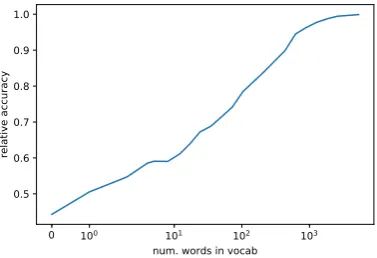
Figure2shows how the accuracy changes as the size of this isolated set is varied from 0 to 5305.
2We do not black out the image in our baseline as our
We find that just one word is enough for the model to achieve more than 50% of its final accuracy. That word is “color”.
Figure 2:VQA network (Kazemi and Elqursh,2017): Ac-curacy as a function of vocabulary size, relative to its original accuracy. Words are chosen in the descending order of how frequently they appear as top attributions. The X-axis is on logscale, except near zero where it is linear.
Note that even when empty questions are passed as input to the network, its accuracy remains at about 44.3% of its original accuracy. This shows that the model is largely reliant on the image for producing the answer.
The accuracy increases (almost) monotonically with the size of the isolated set. The top 6 words in the isolated set are “color”, “many”, “what”, “is”, “there”, and “how”. We suspect that generic words like these are used to determine the type of the an-swer. The network then uses the type to choose between a few answers it can give for the image.
4.4 Attacks
Attributions reveal that the network relies largely on generic words in answering questions (sec-tion 4.3). This is a weakness in the network’s logic. We now describe a few attacks against the network that exploit this weakness.
Subject ablation attack
In this attack, we replace the subject of a ques-tion with a specific noun that consistently receives low attribution across questions. We then deter-mine, among the questions that the network orig-inally answered correctly, what percentage result in the same answer after the ablation. We repeat this process for different nouns; specifically, “fits”, “childhood”, “copyrights”, “mornings”, “disor-der”, “importance”, “topless”, “critter”, “jumper”, “tweet”, and average the result.
Prefix Accuracy in not a lot of words 35.5% in not many words 32.5% what is the answer to 31.7%
Union of all three 19%
Baseline prefix
tell me 51.3% answer this 55.7% answer this for me 49.8%
[image:5.595.81.270.130.259.2]Union of baseline prefixes 46.9%
Table 1: VQA network (Kazemi and Elqursh,2017): Ac-curacy for prefix attacks; original acAc-curacy is61.1%.
We find that, among the set of questions that the network originally answered correctly, 75.6% of the questions return the same answer despite the subject replacement.
Prefix attack
In this attack, we attach content-free phrases to questions. The phrases are manually crafted us-ing generic words that the network finds impor-tant (section 4.3). Table 1 (top half) shows the resulting accuracy for three prefixes —“in not a lot of words”, “what is the answer to”, and “in not many words”. All of these phrases nearly halve the model’s accuracy. The union of the three attacks drops the model’s accuracy from 61.1% to 19%.
We note that the attributions computed for the network were crucial in crafting the prefixes. For instance, we find that other prefixes like “tell me”, “answer this” and “answer this for me” do not drop the accuracy by much; see table 1 (bottom half). The union of these three ineffective prefixes drops the accuracy from61.1% to only 46.9%. Per attributions, words present in these prefixes are not deemed important by the network.
4.5 Related work
attri-bution nouns. Ribeiro et al. (2016a) use a model explanation technique to illustrate overstability for two examples. They do not quantify their anal-ysis at scale. Kafle and Kanan (2017); Zhang et al.(2016) examine the VQA data, identify de-ficiencies, and propose data augmentation to re-duce over-representation of certain question/an-swer types. Goyal et al.(2016) propose the VQA 2.0 dataset, which has pairs of similar images that have different answers on the same question. We note that our method can be used to improve these datasets by identifying inputs where models ig-nore several words. Huang et al. (2017) evalu-ate robustness of VQA models by appending ques-tionswith semantically similar questions. Our pre-fix attacks in section4.4are in a similar vein and perhaps a more natural and targeted approach. Fi-nally,Fong and Vedaldi(2017) use saliency meth-ods to produce image perturbations as adversarial examples; our attacks are on the question.
5 Question Answering over Tables
5.1 Task, model, and data
We now analyze question answering over ta-bles based on theWikiTableQuestionsbenchmark dataset (Pasupat and Liang,2015). The dataset has
22033 questions posed over 2108 tables scraped
from Wikipedia. Answers are either contents of ta-ble cells or some tata-ble aggregations. Models per-forming QA on tables translate the question into a structured program (akin to an SQL query) which is then executed on the table to produce the an-swer. We analyze a model called Neural Program-mer (NP) (Neelakantan et al., 2017). NP is the state of the art among models that are weakly su-pervised, i.e., supervised using the final answer in-stead of the correct structured program. It achieves
33.5% accuracy on the validation set.
NP translates the input into a structured pro-gram consisting of four operator and table column selections. An example of such a program is “reset (score),reset(score),min (score),print(name)”, where the output is the name of the person who has the lowest score.
5.2 Observations
We applied IG to attribute operator and column selection to question words. NP preprocesses inputs and whenever applicable, appends
sym-bols tm token,cm token to questions that
sig-nify matches between a question and the
[image:6.595.312.523.174.303.2]accom-panying table. These symbols are treated the same as question words. NP also computes priors for column selection using question-table matches. These vectors, tm and cm, are passed as addi-tional inputs to the neural network. In the baseline for IG, we use an empty question, and zero vectors for column selection priors3.
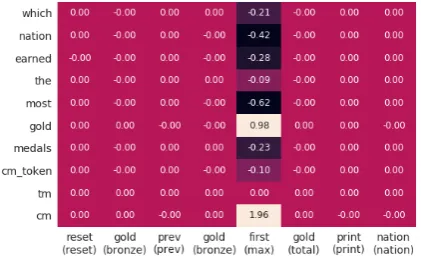
Figure 3: Visualization of attributions. Question words, preprocessing tokens and column selection priors on the Y-axis. Along the X-axis are operator and column selections with their baseline counterparts in parentheses. Operators and columns not affecting the final answer, and those which are same as their baseline counterparts, are given zero attribution.
We visualize the attributions using an alignment matrix; they are commonly used in the analysis of translation models (fig.3). Observe that the oper-ator “first” is used when the question is asking for a superlative. Further, we see that the word “gold” is a trigger for this operator. We investigate impli-cations of this behavior in the following sections.
5.3 Overstability test
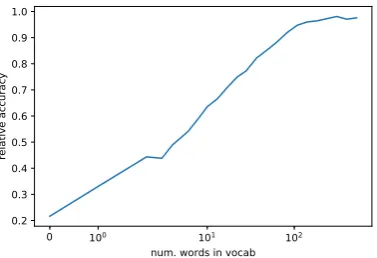
Similar to the test we did for Visual QA (sec-tion4.3), we check for overstability in NP by look-ing at accuracy as a function of the vocabulary size. We treat table match annotationstm token,
cm token and the out-of-vocab token (unk) as
part of the vocabulary. The results are in fig.4. We see that the curve is similar to that of Visual QA (fig.2). Just 5 words (along with the column se-lection priors) are sufficient for the model to reach more than 50% of its final accuracy on the valida-tion set. These five words are: “many”, “number”,
“tm token”, “after”, and “total”.
5.4 Table-specific default programs
We saw in the previous section that the model re-lies on only a few words in producing correct an-swers. An extreme case of overstability is when
Operator sequence # Triggers Insights
reset,reset,max,print 109 [unk, date, position, points, name, competition, notes, no, year, venue] sports reset,prev,max,print 68 [unk, rank, total, bronze, gold, silver, nation, name, date, no] medal tallies
reset,reset,first,print 29 [name,unk, notes, year, nationality, rank, location, date, comments, hometown] player rankings
reset,mfe,first,print 25 [notes, date, title,unk, role, genre, year, score, opponent, event] awards
reset,reset,min,print 17 [year, height,unk, name, position, floors, notes, jan, jun, may] building info.
reset,mfe,max,print 14 [opponent, date, result, location, rank, site, attendance, notes, city, listing] politics
[image:7.595.326.508.203.337.2]reset,next,first,print 10 [unk, name, year, edition, birth, death, men, time, women, type] census
Table 2: Attributions to column names for table-specific default programs (programs returned by NP on empty input ques-tions). See supplementary material, table6for the full list. These results are indication that the network is predisposed towards picking certain operators solely based on the table.
Figure 4: Accuracy as a function of vocabulary size. The words are chosen in the descending order of their frequency appearance as top attributions to question terms. The X-axis is on logscale, except near zero where it is linear. Note that just 5 words are necessary for the network to reach more than 50% of its final accuracy.
the operator sequences produced by the model are independent of the question. We find that if we supply an empty question as an input, i.e., the out-put is a function only of the table, then the dis-tribution over programs is quite skewed. We call these programs table-specific default programs. On average, about36.9%of the selected operators
match their table-default counterparts, indicating that the model relies significantly on the table for producing an answer.
For each default program, we used IG to at-tribute operator and column selections to column names and show ten most frequently occurring ones across tables in the validation set (table2).
Here is an insight from this analysis: NP uses the combination “reset, prev” to exclude the last row of the table from answer computation. The de-fault program corresponding to “reset,prev,max, print” has attributions to column names such as “rank”, “gold”, “silver”, “bronze”, “nation”, “year”. These column names indicate medal tal-lies and usually have a“total” row. If the table happens not to have a“total”row, the model may
‘
Attack phrase Prefix Suffix in not a lot of words 20.6% 10.0% if its all the same 21.8% 18.7% in not many words 15.6% 11.2% one way or another 23.5% 20.0%
Union of above attacks 3.3%
Baseline
please answer 32.3% 30.7% do you know 31.2% 29.5%
Union of baseline prefixes 27.1%
Table 3: Neural Programmer (Neelakantan et al.,2017): Left: Validation accuracy when attack phrases are concate-nated to the question. (Original:33.5%)
produce an incorrect answer.
We now describe attacks that add or drop content-free words from the question, and cause NP to produce the wrong answer. These attacks leverage the attribution analysis.
5.5 Attacks
Question concatenation attacks
In these attacks, we either suffix or prefix content-free phrases to questions. The phrases are crafted using irrelevant trigger words for operator selec-tions (supplementary material, table5). We man-ually ensure that the phrases are content-free.
Table3describes our results. The first4phrases
use irrelevant trigger words and result in a large drop in accuracy. For instance, the first phrase uses “not” which is a trigger for “next”, “last”, and “min”, and the second uses “same” which is a trig-ger for “next” and “mfe”. The four phrases com-bined results in the model’s accuracy going down from33.5% to3.3%. The first two phrases alone
drop the accuracy to5.6%.
[image:7.595.82.271.217.346.2]low. Combined, they result in the model’s accu-racy dropping from33.5%to27.1%.
Stop word deletion attacks
We find that sometimes an operator is selected based onstop wordslike: “a”, “at”, “the”, etc. For instance, in the question, “what ethnicity is at the top?”, the operator “next” is triggered on the word “at”. Dropping the word “at” from the question changes the operator selection and causes NP to return the wrong answer.
We drop stop words from questions in the val-idation dataset that were originally answered cor-rectly and test NP on them. The stop words to be dropped were manually selected4 and are shown
in Figure5in the supplementary material.
By dropping stop words, the accuracy drops from33.5% to28.5%. Selecting operators based
on stop words is not robust. In real world search queries, users often phrase questions without stop words, trading grammatical correctness for con-ciseness. For instance, the user may simply say “top ethnicity”. It may be possible to defend against such examples by generating synthetic training data, and re-training the network on it.
Row reordering attacks
We found that NP often got the question right by leveraging artifacts of the table. For instance, the operators for the question “which nation earned the most gold medals” are “reset”, “prev”, “first” and “print”. The “prev” operator essentially ex-cludes the last row from the answer computation. It gets the answer right for two reasons: (1) the an-swer is not in the last row, and (2) rows are sorted by the values in the column “gold”.
In general, a question answering system should not rely on row ordering in tables. To quantify the extent of such biases, we used a perturbed ver-sion of WikiTableQuestionsvalidation dataset as described inPasupat and Liang(2016)5and
eval-uated the existing NP model on it (there was no re-training involved here). We found that NP has only23%accuracy on it, in constrast to an
accu-racy of33.5% on the original validation dataset.
One approach to making the network robust to row-reordering attacks is to train against perturbed tables. This may also help the model generalize
4We avoided standard stop word lists (e.g. NLTK) as they
contain contentful words (e.g “after”) which may be impor-tant in some questions (e.g. “who ranked right after turkey?”)
5based on data at https://nlp.stanford.edu/ software/sempre/wikitable/dpd/
better. Indeed,Mudrakarta et al.(2018) note that the state-of-the-art strongly supervised6 model on
WikiTableQuestions (Krishnamurthy et al.,2017) enjoys a7%gain in its final accuracy by leverag-ing perturbed tables durleverag-ing trainleverag-ing.
6 Reading Comprehension
6.1 Task, model, and data
The reading comprehension task involves identi-fying a span from a context paragraph as an an-swer to a question. The SQuAD dataset (Ra-jpurkar et al., 2016) for machine reading com-prehension contains 107.7K query-answer pairs, with 87.5K for training, 10.1K for validation, and another 10.1K for testing. Deep learning meth-ods are quite successful on this problem, with the state-of-the-art F1 score at 84.6 achieved by Yu et al.(2018); we analyze their model.
6.2 Analyzing adversarial examples
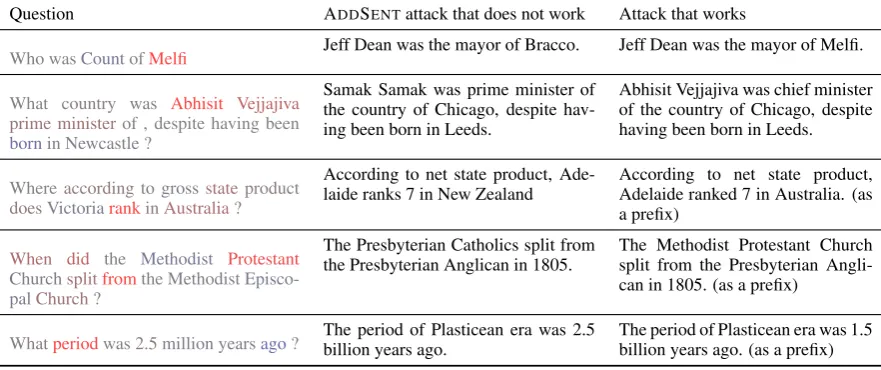
Recall the adversarial attacks proposed byJia and Liang(2017) for reading comprehension systems. Their attack ADDSENT appends sentences to the paragraph that resemble an answer to the question without changing the ground truth. See the second column of table4for a few examples.
We investigate the effectiveness of their attacks using attributions. We analyze100examples
gen-erated by the ADDSENTmethod inJia and Liang (2017), and find that an adversarial sentence is successful in fooling the model in two cases:
First, a contentful word in the question gets low/zero attribution and the adversarially added sentence modifies that word. E.g. in the question, “Who did Kubiak take the place of after Super Bowl XXIV?”, the word “Super” gets low attribu-tion. Adding “AfterChampBowl XXV, Crowton took the place of Jeff Dean” changes the prediction for the model. Second, a contentful word in the question that is not present in the context. For e.g. in the question “Where hotel did the Panthers stay at?”, “hotel”, is not present in the context. Adding “The Vikings stayed at Chicago hotel.” changes the prediction for the model.
On the flip side, an adversarial sentence is un-successful when a contentful word in the question having high attribution is not present in the added sentence. E.g. for “Where according to gross state product does Victoria rank in Australia?”, “Aus-tralia” receives high attribution. Adding
Question ADDSENTattack that does not work Attack that works
WhowasCountofMelfi Jeff Dean was the mayor of Bracco. Jeff Dean was the mayor of Melfi.
What country was Abhisit Vejjajiva
primeministerof , despitehavingbeen borninNewcastle?
Samak Samak was prime minister of the country of Chicago, despite hav-ing been born in Leeds.
Abhisit Vejjajiva was chief minister of the country of Chicago, despite having been born in Leeds.
Whereaccordingtogrossstateproduct
doesVictoriarankinAustralia?
According to net state product,
Ade-laide ranks 7 in New Zealand According to net state product,Adelaide ranked 7 in Australia. (as a prefix)
When did the Methodist Protestant ChurchsplitfromtheMethodist Episco-palChurch?
The Presbyterian Catholics split from
the Presbyterian Anglican in 1805. The Methodist Protestant Churchsplit from the Presbyterian Angli-can in 1805. (as a prefix)
[image:9.595.78.519.64.249.2]Whatperiodwas2.5millionyearsago? The period of Plasticean era was 2.5billion years ago. The period of Plasticean era was 1.5billion years ago. (as a prefix)
Table 4: ADDSENTattacks that failed to fool the model. With modifications to preserve nouns with high attributions, these are successful in fooling the model. Question words that receive high attribution are colored red (intensity indicates magnitude).
ing to net state product, Adelaide ranks 7 in New Zealand.” does not fool the model. However, retaining “Australia” in the adversarial sentence does change the model’s prediction.
6.3 Predicting the effectiveness of attacks
Next we correlate attributions with efficacy of the ADDSENT attacks. We analyzed 1000 (question, attack phrase) instances7 where Yu et al. (2018)
model has the correct baseline prediction. Of the 1000 cases, 508 are able to fool the model, while 492 are not. We split the examples into two groups. The first group has examples where a noun or adjective in the question has high attribu-tion, but is missing from the adversarial sentence and the rest are in the second group. Our attri-bution analysis suggests that we should find more failed examples in the first group. That is indeed the case. The first group has63%failed examples,
while the second has only40%.
Recall that the attack sentences were con-structed by (a) generating a sentence that answers the question, (b) replacing all the adjectives and nouns with antonyms, and named entities by the nearest word in GloVe word vector space (Pen-nington et al., 2014) and (c) crowdsourcing to check that the new sentence is grammatically cor-rect. This suggests a use of attributions to improve the effectiveness of the attacks, namely ensuring that question words that the model thinks are im-portant are left untouched in step (b) (we note that other changes in should be carried out). In table4,
7data sourced from https:// worksheets.codalab.org/worksheets/
0xc86d3ebe69a3427d91f9aaa63f7d1e7d/
we show a few examples where an original attack did not fool the model, but preserving a noun with high attribution did.
7 Conclusion
We analyzed three question answering models us-ing an attribution technique. Attributions helped us identify weaknesses of these models more ef-fectively than conventional methods (based on val-idation sets). We believe that a workflow that uses attributions can aid the developer in iterating on model quality more effectively.
While the attacks in this paper may seem un-realistic, they do expose real weaknesses that af-fect the usage of a QA product. Under-reliance on important question terms is not safe. We also be-lieve that other QA models may share these weak-nesses. Our attribution-based methods can be di-rectly used to gauge the extent of such problems. Additionally, our perturbation attacks (sections4.4 and5.5) serve as empirical validation of attribu-tions.
Reproducibility
Code to generate attributions and reproduce our results is freely available athttps://github. com/pramodkaushik/acl18_results.
Acknowledgments
References
Aishwarya Agrawal, Dhruv Batra, and Devi Parikh. 2016. Analyzing the behavior of visual question an-swering models. arXiv preprint arXiv:1606.07356.
Aishwarya Agrawal, Jiasen Lu, Stanislaw Antol, Mar-garet Mitchell, C Lawrence Zitnick, Dhruv Batra, and Devi Parikh. 2015. Vqa: Visual question an-swering. arXiv preprint arXiv:1505.00468.
David Baehrens, Timon Schroeter, Stefan Harmel-ing, Motoaki Kawanabe, Katja Hansen, and Klaus-Robert M¨uller. 2010. How to explain individual classification decisions. Journal of Machine Learn-ing Research, pages 1803–1831.
Hedi Ben-younes, R´emi Cadene, Matthieu Cord, and Nicolas Thome. 2017. Mutan: Multimodal tucker fusion for visual question answering. arXiv preprint arXiv:1705.06676.
Alexander Binder, Gr´egoire Montavon, Sebastian Bach, Klaus-Robert M¨uller, and Wojciech Samek. 2016. Layer-wise relevance propagation for neural networks with local renormalization layers. CoRR.
Ruth C Fong and Andrea Vedaldi. 2017. Interpretable explanations of black boxes by meaningful pertur-bation. In Proceedings of the IEEE Conference on Computer Vision and Pattern Recognition, pages 3429–3437.
Akira Fukui, Dong Huk Park, Daylen Yang, Anna Rohrbach, Trevor Darrell, and Marcus Rohrbach. 2016. Multimodal compact bilinear pooling for visual question answering and visual grounding. arXiv preprint arXiv:1606.01847.
Ian Goodfellow, Jonathon Shlens, and Christian Szegedy. 2015. Explaining and harnessing adversar-ial examples. InInternational Conference on Learn-ing Representations.
Yash Goyal, Tejas Khot, Douglas Summers-Stay, Dhruv Batra, and Devi Parikh. 2016. Making the v in vqa matter: Elevating the role of image un-derstanding in visual question answering. arXiv preprint arXiv:1612.00837.
Jia-Hong Huang, Cuong Duc Dao, Modar Alfadly, and Bernard Ghanem. 2017. A novel framework for robustness analysis of visual qa models. arXiv preprint arXiv:1711.06232.
Robin Jia and Percy Liang. 2017. Adversarial ex-amples for evaluating reading comprehension sys-tems. In Proceedings of the 2017 Conference on Empirical Methods in Natural Language Process-ing, EMNLP 2017, Copenhagen, Denmark, Septem-ber 9-11, 2017.
Kushal Kafle and Christopher Kanan. 2017. An analy-sis of visual question answering algorithms. In2017 IEEE International Conference on Computer Vision (ICCV), pages 1983–1991. IEEE.
Vahid Kazemi and Ali Elqursh. 2017. Show, ask, at-tend, and answer: A strong baseline for visual ques-tion answering. arXiv preprint arXiv:1704.03162. Jayant Krishnamurthy, Pradeep Dasigi, and Matt
Gard-ner. 2017. Neural semantic parsing with type con-straints for semi-structured tables. InProceedings of the 2017 Conference on Empirical Methods in Nat-ural Language Processing, pages 1516–1526.
Tsung-Yi Lin, Michael Maire, Serge Belongie, James Hays, Pietro Perona, Deva Ramanan, Piotr Doll´ar, and C Lawrence Zitnick. 2014. Microsoft coco: Common objects in context. In European confer-ence on computer vision, pages 740–755. Springer. Pramod Kaushik Mudrakarta, Ankur Taly, Mukund
Sundararajan, and Kedar Dhamdhere. 2018. It was the training data pruning too! arXiv preprint arXiv:1803.04579.
Arvind Neelakantan, Quoc V. Le, Mart´ın Abadi, An-drew McCallum, and Dario Amodei. 2017. Learn-ing a natural language interface with neural pro-grammer.
Arvind Neelakantan, Quoc V Le, and Ilya Sutskever. 2016. Neural programmer: Inducing latent pro-grams with gradient descent. InInternational Con-ference on Learning Representations ICLR.
Panupong Pasupat and Percy Liang. 2015. Composi-tional semantic parsing on semi-structured tables. In In Proceedings of the Annual Meeting of the Associ-ation for ComputAssoci-ational Linguistics.
Panupong Pasupat and Percy Liang. 2016. Infer-ring logical forms from denotations. arXiv preprint arXiv:1606.06900.
Jeffrey Pennington, Richard Socher, and Christo-pher D. Manning. 2014. Glove: Global vectors for word representation. In Proceedings of the 2014 Conference on Empirical Methods in Natural Lan-guage Processing, EMNLP 2014, October 25-29, 2014, Doha, Qatar, A meeting of SIGDAT, a Special Interest Group of the ACL, pages 1532–1543. Pranav Rajpurkar, Jian Zhang, Konstantin Lopyrev, and
Percy Liang. 2016. Squad: 100, 000+ questions for machine comprehension of text. InProceedings of the 2016 Conference on Empirical Methods in Nat-ural Language Processing, EMNLP 2016, Austin, Texas, USA, November 1-4, 2016, pages 2383–2392. Marco Tulio Ribeiro, Sameer Singh, and Carlos Guestrin. 2016a. Nothing else matters: model-agnostic explanations by identifying prediction in-variance. arXiv preprint arXiv:1611.05817. Marco Tulio Ribeiro, Sameer Singh, and Carlos
Avanti Shrikumar, Peyton Greenside, Anna Shcherbina, and Anshul Kundaje. 2016. Not just a black box: Learning important features through propagating activation differences. CoRR.
Karen Simonyan, Andrea Vedaldi, and Andrew Zisser-man. 2013. Deep inside convolutional networks: Vi-sualising image classification models and saliency maps. CoRR.
Jost Tobias Springenberg, Alexey Dosovitskiy, Thomas Brox, and Martin A. Riedmiller. 2014. Striving for simplicity: The all convolutional net. CoRR.
Mukund Sundararajan, Ankur Taly, and Qiqi Yan. 2017. Axiomatic attribution for deep networks. In Proceedings of the 34th International Conference on Machine Learning, ICML 2017, Sydney, NSW, Aus-tralia, 6-11 August 2017, pages 3319–3328.
Damien Teney, Peter Anderson, Xiaodong He, and An-ton van den Hengel. 2017. Tips and tricks for visual question answering: Learnings from the 2017 chal-lenge. arXiv preprint arXiv:1708.02711.
Adams Wei Yu, David Dohan, Quoc Le, Thang Luong, Rui Zhao, and Kai Chen. 2018. Fast and accurate reading comprehension by combining self-attention and convolution. In International Conference on Learning Representations.
Peng Zhang, Yash Goyal, Douglas Summers-Stay, Dhruv Batra, and Devi Parikh. 2016. Yin and yang: Balancing and answering binary visual questions. In Computer Vision and Pattern Recognition (CVPR), 2016 IEEE Conference on, pages 5014–5022. IEEE.