Proceedings of the 56th Annual Meeting of the Association for Computational Linguistics (Long Papers), pages 252–262 252
LinkNBed: Multi-Graph Representation Learning with Entity Linkage
Rakshit Trivedi∗
College of Computing Georgia Tech
Christos Faloutsos
SCS, CMU and Amazon.com
Bunyamin Sisman
Amazon.com
Hongyuan Zha
College of Computing Georgia Tech
Jun Ma
Amazon.com
Xin Luna Dong
Amazon.com
Abstract
Knowledge graphs have emerged as an im-portant model for studying complex multi-relational data. This has given rise to the construction of numerous large scale but incomplete knowledge graphs encod-ing information extracted from various re-sources. An effective and scalable ap-proach to jointly learn over multiple graphs and eventually construct a unified graph is a crucial next step for the success of knowledge-based inference for many down-stream applications. To this end, we pro-poseLinkNBed, a deep relational learning framework that learns entity and relation-ship representations across multiple graphs. We identifyentity linkageacross graphs as a vital component to achieve our goal. We design a novel objective that leverage en-tity linkage and build an efficient multi-task training procedure. Experiments on link prediction and entity linkage demonstrate substantial improvements over the state-of-the-art relational learning approaches.
1 Introduction
Reasoning over multi-relational data is a key con-cept in Artificial Intelligence and knowledge graphs have appeared at the forefront as an effective tool to model such multi-relational data. Knowledge graphs have found increasing importance due to its wider range of important applications such as information retrieval (Dalton et al.,2014), natural language processing (Gabrilovich and Markovitch,
2009), recommender systems (Catherine and Co-hen,2016), question-answering (Cui et al.,2017)
∗
Correspondence: [email protected] and
[email protected]. Work done when Rakshit Trivedi interned at Amazon.
and many more. This has led to the increased ef-forts in constructing numerous large-scale Knowl-edge Bases (e.g. Freebase (Bollacker et al.,2008), DBpedia (Auer et al.,2007), Google’s Knowledge graph (Dong et al.,2014), Yago (Suchanek et al.,
2007) and NELL (Carlson et al.,2010)), that can cater to these applications, by representing infor-mation available on the web in relational format.
All knowledge graphs share common drawback ofincompletenessandsparsityand hence most ex-isting relational learning techniques focus on using observed triplets in an incomplete graph to infer unobserved triplets for that graph (Nickel et al.,
2016a). Neural embedding techniques that learn vector space representations of entities and relation-ships have achieved remarkable success in this task. However, these techniques only focus on learning from a single graph. In addition to incompleteness property, these knowledge graphs also share a set of overlapping entities and relationships with varying information about them. This makes a compelling case to design a technique that can learn over mul-tiple graphs and eventually aid in constructing a unified giant graph out of them. While research on learning representations over single graph has pro-gressed rapidly in recent years (Nickel et al.,2011;
Dong et al.,2014;Trouillon et al.,2016;Bordes et al.,2013;Xiao et al.,2016;Yang et al.,2015), there is a conspicuous lack of principled approach to tackle the unique challenges involved in learning across multiple graphs.
One approach to multi-graph representation learning could be to first solve graph alignment problem to merge the graphs and then use exist-ing relational learnexist-ing methods on merged graph. Unfortunately, graph alignment is an important but still unsolved problem and there exist several tech-niques addressing its challenges (Liu and Yang,
2016; Pershina et al., 2015;Koutra et al., 2013;
The key challenges for the graph alignment prob-lem emanate from the fact that the real world data are noisy and intricate in nature. The noisy or sparse data make it difficult to learn robust align-ment features, and data abundance leads to com-putational challenges due to the combinatorial per-mutations needed for alignment. These challenges are compounded in multi-relational settings due to heterogeneous nodes and edges in such graphs.
Recently, deep learning has shown significant impact in learning useful information over noisy, large-scale and heterogeneous graph data (Rossi et al., 2017). We, therefore, posit that combin-ing graph alignment task with deep representation learning across multi-relational graphs has poten-tial to induce a synergistic effect on both tasks. Specifically, we identify that a key component of graph alignment process—entity linkage—also plays a vital role in learning across graphs. For instance, the embeddings learned over two knowl-edge graphs for an actor should be closer to one another compared to the embeddings of all the other entities. Similarly, the entities that are already aligned together across the two graphs should pro-duce better embeddings due to the shared context and data. To model this phenomenon, we propose
LinkNBed, a novel deep learning framework that jointly performs representation learning and graph linkage task. To achieve this, we identify key chal-lenges involved in the learning process and make the following contributions to address them:
• We propose novel and principled approach to-wards jointly learning entity representations and entity linkage. The novelty of our frame-work stems from its ability to support linkage task across heterogeneous types of entities.
• We devise a graph-independent inductive framework that learns functions to capture contextual information for entities and rela-tions. It combines the structural and semantic information in individual graphs for joint in-ference in a principled manner.
• Labeled instances (specifically positive in-stances for linkage task) are typically very sparse and hence we design a novel multi-task loss function where entity linkage task is tack-led in robust manner across various learning scenarios such as learning only with unlabeled instances or only with negative instances.
• We design an efficient training procedure to perform joint training in linear time in the number of triples. We demonstrate superior performance of our method on two datasets cu-rated from Freebase and IMDB against state-of-the-art neural embedding methods.
2 Preliminaries
2.1 Knowledge Graph Representation
A knowledge graph G comprises of set of facts represented as triplets (es, r, eo) denoting the re-lationshiprbetween subject entityes and object entityeo. Associated to this knowledge graph, we have a set of attributes that describe observed char-acteristics of an entity. Attributes are represented as set of key-value pairs for each entity and an at-tribute can have null (missing) value for an entity. We followOpen World Assumption - triplets not observed in knowledge graph are considered to be missing but not false.We assume that there are no duplicate triplets or self-loops.
2.2 Multi-Graph Relational Learning
Definition. Given a collection of knowledge graphsG, Multi-Graph Relational Learning refers to the the task of learning information rich represen-tations of entities and relationships across graphs. The learned embeddings can further be used to in-fer new knowledge in the form of link prediction or learn new labels in the form of entity linkage. We motivate our work with the setting of two knowl-edge graphs where given two graphsG1, G2 ∈ G, the task is to match an entityeG1 ∈G1to an entity eG2 ∈ G2 if they represent the same real-world entity. We discuss a straightforward extension of this setting to more than two graphs in Section 7.
Notations. LetXandY represent realization of two such knowledge graphs extracted from two dif-ferent sources. LetnXe andnYe represent number of entities inXandY respectively. Similarly,nXr andnYr represent number of relations inXandY. We combine triplets from bothXandY to obtain set of all observed tripletsD ={(es, r, eo)p}Pp=1 whereP is total number of available records across from both graphs. LetEandRbe the set of all enti-ties and all relations inDrespectively. Let|E|=n and|R|=m. In addition toD, we also have set of linkage labelsLfor entities betweenXandY. Each record inLis represented as triplet (eX ∈X,
3 Proposed Method: LinkNBed
We present a novelinductive multi-graphrelational learning framework that learns a set of aggregator functions capable of ingesting various contextual information for both entities and relationships in multi-relational graph. These functions encode the ingested structural and semantic information into low-dimensional entity and relation embeddings. Further, we use these representations to learn a relational score function that computes how two entities are likely to be connected in a particular relationship. The key idea behind this formulation is that when a triplet is observed, the relationship between the two entities can be explained using various contextual information such as local neigh-borhoodfeatures of both entities,attributefeatures of both entities andtypeinformation of the entities which participate in that relationship.
We outline two key insights for establishing the relationships between embeddings of the entities over multiple graphs in our framework:
Insight 1 (Embedding Similarity): If the two en-tities eX ∈ X andeY ∈ Y represent the same real-world entity then their embeddingseXandeY
will be close to each other.
Insight 2 (Semantic Replacement): For a given triplett= (es, r, eo)∈X, denoteg(t)as the func-tion that computes a relafunc-tional score for tusing entity and relation embeddings. If there exists a matching entity es0 ∈ Y for es ∈ X, denote t0 = (es0, r, eo)obtained after replacingeswithes0. In this case,g(t)∼g(t0)i.e. score of tripletstand t0will be similar.
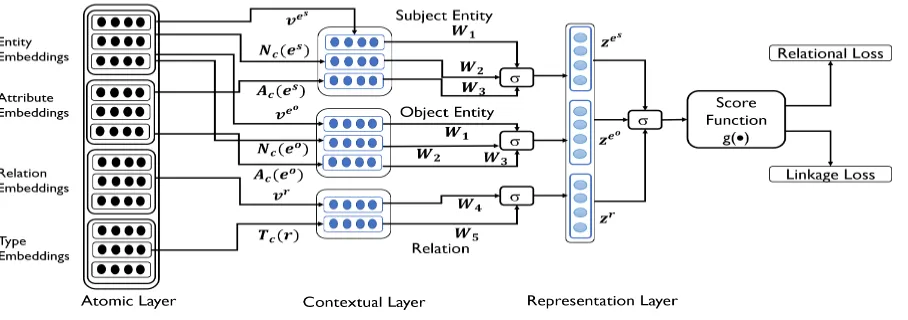
For a triplet (es, r, eo) ∈ D, we describe en-coding mechanism of LinkNBed as three-layered architecture that computes the final output represen-tations ofzr,zes,zeo for the given triplet. Figure1
provides an overview of LinkNBed architecture and we describe the three steps below:
3.1 Atomic Layer
Entities, Relations, Types and Attributes are first encoded in its basic vector representations. We use these basic representations to derive more complex contextual embeddings further.
Entities, Relations and Types. The embedding vectors corresponding to these three components are learned as follows:
ves =f(WEes) veo =f(WEeo) (1)
vr=f(WRr) vt=f(WTt) (2)
whereves,veo ∈ Rd. es, eo ∈
Rnare “one-hot”
representations of es and eo respectively. vr ∈ Rkandr ∈ Rm is “one-hot” representation ofr. vt ∈ Rq andt ∈
Rz is ”one-hot” representation
oft . WE ∈ Rd×n, WR ∈ Rk×m and WT ∈ Rq×z are the entity, relation and type embedding
matrices respectively. f is a nonlinear activation function (Relu in our case). WE,WRandWT
can be initialized randomly or using pre-trained word embeddings or vector compositions based on name phrases of components (Socher et al.,2013).
Attributes. For a given attribute a represented as key-value pair, we use paragraph2vec (Le and Mikolov,2014) type of embedding network to learn attribute embedding. Specifically, we represent attribute embedding vector as:
a=f(Wkeyakey+Wvalaval) (3)
where a ∈ Ry, a
key ∈ Ru and aval ∈ Rv.
Wkey ∈ Ry×u andWval ∈
Ry×v. akey will be
“one-hot” vector andaval will be feature vector.
Note that the dimensions of the embedding vectors do not necessarily need to be the same.
3.2 Contextual Layer
While the entity and relationship embeddings de-scribed above help to capture very generic latent features, embeddings can be further enriched to capture structural information, attribute informa-tion and type informainforma-tion to better explain the exis-tence of a fact. Such information can be modeled as context of nodes and edges in the graph. To this end, we design the following canonical aggregator function that learns various contextual information by aggregating over relevant embedding vectors:
c(z) =AGG({z0,∀z0 ∈C(z)}) (4)
Figure 1: LinkNBed Architecture Overview - one step score computation for a given triplet (es, r, eo). The Attribute embeddings are not simple lookups but they are learned as shown in Eq3
to weight components based on their impact before aggregating them. We modify Eq.4as:
c(z) =AGG(q(z)∗ {z0,∀z0 ∈C(z)}) (5)
where
q(z) = Pexp(θz)
z0∈C(z)
exp(θz0) (6)
andθz’s are the parameters of attention model.
Following contextual information is modeled in our framework:
Entity Neighborhood Context Nc(e) ∈ Rd.
Given a triplet (es, r, eo), the neighborhood context for an entityes will be the nodes located nearesother than the nodeeo. This will capture the effect of local neighborhood in the graph surroundingesthat drivesesto participate in fact (es, r, eo). We use Mean as aggregator function. As there can be large number of neighbors, we collect the neighborhood set for each entity as a pre-processing step using a random walk method. Specifically, given a nodee, we runkrounds of random-walks of length l following (Hamilton et al., 2017) and create set N(e) by adding all unique nodes visited across these walks. This context can be similarly computed for object entity.
Entity Attribute Context Ac(e) ∈ Ry. For
an entity e, we collect all attribute embeddings for e obtained from Atomic Layer and learn aggregated information over them using Max operator given in Eq.4.
Relation Type ContextTc(r)∈Rq.We use type
context for relation embedding i.e. for a given relationshipr, this context aims at capturing the effect of type of entities that have participated in this relationship. For a given triplet(es, r, eo), type context for relationship r is computed by aggregation with mean over type embeddings corresponding to the context of r. Appendix C provides specific forms of contextual information.
3.3 Representation Layer
Having computed the atomic and contextual em-beddings for a triplet(es, r, eo), we obtain the final embedded representations of entities and relation in the triplet using the following formulation:
zes =σ( W1ve
s
| {z }
Subject Entity Embedding
+ W2Nc(es)
| {z }
Neighborhood Context
+ W3Ac(es))
| {z }
Subject Entity Attributes
(7)
zeo =σ( W1ve
o
| {z }
Object Entity Embedding
+ W2Nc(eo)
| {z }
Neighborhood Context
+ W3Ac(eo))
| {z }
Object Entity Attributes
(8)
zr=σ( W4vr
| {z }
Relation Embedding
+ W5Tc(r))
| {z }
Entity Type Context (9)
where W1,W2 ∈ Rd×d, W3 ∈ Rd×y, W4 ∈
Rd×kandW5 ∈ Rd×q. σ is nonlinear activation
Following is the rationale for our formulation: An entity’s representation can be enriched by encoding information about the local neighborhood features and attribute information associated with the en-tity in addition to its own latent features. Parame-tersW1,W2,W3learn to capture these different
aspects and map them into the entity embedding space. Similarly, a relation’s representation can be enriched by encoding information about entity types that participate in that relationship in addi-tion to its own latent features. ParametersW4,W5
learn to capture these aspects and map them into the relation embedding space. Further, as the ulti-mate goal is to jointly learn over multiple graphs, shared parameterization in our model facilitate the propagation of information across graphs thereby making it a graph-independent inductive model. The flexibility of the model stems from the ability to shrink it (to a very simple model considering atomic entity and relation embeddings only) or ex-pand it (to a complex model by adding different contextual information) without affecting any other step in the learning procedure.
3.4 Relational Score Function
Having observed a triplet(es, r, eo), we first use Eq. 7, 8 and 9 to compute entity and relation represen-tations. We then use these embeddings to capture relational interaction between two entities using the following score functiong(·):
g(es, r, eo) =σ(zrT ·(zeszeo)) (10)
wherezr,zes,zeo ∈ Rdare d-dimensional
repre-sentations of entity and relationships as described below.σis the nonlinear activation function and
represent element-wise product.
4 Efficient Learning Procedure
4.1 Objective Function
The complete parameter space
of the model can be given by:
Ω={{Wi}5i=1,WE,WR,Wkey,Wval,Wt,Θ}.
To learn these parameters, we design a novel multi-task objective function that jointly trains over two graphs. As identified earlier, the goal of our model is to leverage the available linkage information across graphs for optimizing the entity and relation embeddings such that they can explain the ob-served triplets across the graphs. Further, we want to leverage these optimized embeddings to match
entities across graphs and expand the available link-age information. To achieve this goal, we define following two different loss functions catering to each learning task and jointly optimize over them as a multi-task objective to learn model parameters:
Relational Learning Loss. This is conven-tional loss function used to learn knowledge graph embeddings. Specifically, given a p-th triplet(es, r, eo)p from training setD, we sample
C negative samples by replacing either head or tail entity and define a contrastive max margin function as shown in (Socher et al.,2013):
Lrel = C X
c=1
max(0, γ−g(esp, rp, eop)
+g0(esc, rp, eop))
(11)
where,γ is margin,esc represent corrupted entity andg0(esc, rp, eop)represent corrupted triplet score.
Linkage Learning Loss: We design a novel loss function to leverage pairwise label set L. Given a triplet (esX, rX, eoX) from knowledge
graphX, we first find the entitye+Y from graphY that represent the same real-world entity as esX. We then replace esX withe+Y and compute score g(e+Y, rX, eoX). Next, we find set of all entitiesE
−
Y
from graphY that has a negative label with entity esX. We consider them analogous to the negative samples we generated for Eq.11. We then propose the label learning loss function as:
Llab = Z X
z=1
max(0, γ−g(e+Y, rX, eoX)
+ (g0(e−Y, rX, eoX)z))
(12)
where, Z is the total number of negative labels for eX. γ is margin which is usually set to 1
ande−Y ∈EY−represent entity from graphY with which entityes
X had a negative label. Please note
that this applies symmetrically for the triplets that originate from graphY in the overall dataset. Note that if both entities of a triplet have labels, we will include both cases when computing the loss. Eq.12
is inspired byInsight 1andInsight 2defined earlier in Section 2. Given a setDofN observed triplets across two graphs, we define complete multi-task objective as:
L(Ω) =
N X
i=1
Algorithm 1LinkNBed mini-batch Training
Input: Mini-batch M, Negative Sample Size C, Negative Label Size Z, Attribute data att data, Neighborhood datanhbr data, Type data type data, Positive Label Dict pos dict, Negative Label Dictneg dict
Output: Mini-batch LossLM.
LM= 0
score pos = []; score neg = []; score pos lab = []; score neg lab = []
fori= 0tosize(M)do
input tuple =M[i]= (es, r, eo)
sc = compute triplet score(es, r, eo) (Eq.10) score pos.append(sc)
forj = 0toCdo
Selectescfrom entity list such thatesc6=es andes
c 6=eoand(esc, r, eo)∈ D/
sc neg = compute triplet score(esc, r, eo) score neg.append(sc neg)
end for
ifesinpos dictthen
es+= positive label fores
sc pos l = compute triplet score(es+, r, eo)
score pos lab.append(sc pos l)
end if
fork= 0toZ do
Selectes−fromneg dict
sc neg l = compute triplet score(es−, r, eo) score neg lab.append(sc neg l)
end for end for
LM += compute minibatch loss(score pos, score neg, score pos lab, score neg lab) (Eq.13)
Back-propagate errors and update parametersΩ returnLM
where Ωis set of all model parameters andλis regularization hyper-parameter.bis weight hyper-parameter used to attribute importance to each task. We train with mini-batch SGD procedure (Algo-rithm1) using Adam Optimizer.
Missing Positive Labels. It is expensive to ob-tain positive labels across multiple graphs and hence it is highly likely that many entities will not have positive labels available. For those en-tities, we will modify Eq. 12to use the original triplet (esX, rX, eoX) in place of perturbed triplet
g(e+Y, rX, eoX)for the positive label. The rationale
here again arises fromInsight 2wherein embed-dings of two duplicate entities should be able to
replace each other without affecting the score.
Training Time Complexity. Most contextual in-formation is pre-computed and available to all train-ing steps which leads to constant time embeddtrain-ing lookup for those context. But for attribute network, embedding needs to be computed for each attribute separately and hence the complexity to compute score for one triplet isO(2a) whereais number of attributes. Also for training, we generate C negative samples for relational loss function and useZ negative labels for label loss function. Let k=C+Z. Hence, the training time complexity for a set ofntriplets will beO(2ak∗n)which is linear in number of triplets with a constant factor as ak << nfor real world knowledge graphs. This is desirable as the number of triplets tend to be very large per graph in multi-relational settings.
Memory Complexity. We borrow notations from (Nickel et al., 2016a) and describe the pa-rameter complexity of our model in terms of the number of each component and corresponding embedding dimension requirements. Let Ha =
2∗NeHe+NrHr+NtHt+NkHk+NvHv. The
pa-rameter complexity of our model is:Ha∗(Hb+ 1).
Here,Ne,Nr,Nt,Nk,Nv signify number of
enti-ties, relations, types, attribute keys and vocab size of attribute values across both datasets. HereHb is
the output dimension of the hidden layer.
5 Experiments
5.1 Datasets
We evaluate LinkNBed and baselines on two real world knowledge graphs: D-IMDB (derived from large scale IMDB data snapshot) and D-FB (de-rived from large scale Freebase data snapshot). Ta-ble5.1provides statistics for our final dataset used in the experiments. Appendix B.1 provides com-plete details about dataset processing.
Dataset # Entities # Relations # Attributes # Entity # Available Name Types Triples D-IMDB 378207 38 23 41 143928582
D-FB 39667 146 69 324 22140475
Table 1: Statistics for Datasets: D-IMDB and D-FB
5.2 Baselines
RESCAL (Nickel et al.,2011) as basic matrix fac-torization method, DISTMULT (Yang et al.,2015) as simple multiplicative model good for capturing symmetric relationships, and Complex (Trouillon et al.,2016), an upgrade over DISTMULT that can capture asymmetric relationships using complex valued embeddings. We also compare against translational model of STransE that combined original structured embedding with TransE and has shown state-of-art performance in benchmark test-ing (Kadlec et al.,2017). Finally, we compare with GAKE (Feng et al.,2016), a model that captures context in entity and relationship representations.
In addition to the above state-of-art models, we analyze the effectiveness of different compo-nents of our model by comparing with various versions that use partial information. Specifically, we report results on following variants:
LinkNBed - Embed Only. Only use entity embeddings, LinkNBed - Attr Only. Only use Attribute Context,LinkNBed - Nhbr Only. Only use Neighborhood Context,LinkNBed - Embed + Attr. Use both Entity embeddings and Attribute Context,LinkNBed - Embed + Nhbr. Use both Entity embeddings and Neighbor Context and
LinkNBed - Embed All. Use all three Contexts.
5.3 Evaluation Scheme
We evaluate our model using two inference tasks:
Link Prediction. Given a test triplet (es, r, eo), we first score this triplet using Eq. 10. We then replace eo with all other entities in the dataset and filter the resulting set of triplets as shown in (Bordes et al.,2013). We score the remaining set of perturbed triplets using Eq.10. All the scored triplets are sorted based on the scores and then the rank of the ground truth triplet is used for the evaluation. We use this ranking mechanism to compute HITS@10 (predicted rank ≤ 10) and reciprocal rank (rank1 ) of each test triplet. We report the mean over all test samples.
Entity Linkage. In alignment with Insight 2, we pose a novel evaluation scheme to perform entity linkage. Let there be two ground truth test sample triplets:(eX, e+Y,1)representing a positive
duplicate label and (eX, e−Y,0) representing a
negative duplicate label. Algorithm 2 outlines the procedure to compute linkage probability or score q (∈ [0,1]) for the pair (eX, eY). We use
L1 distance between the two vectors analogous
Algorithm 2Entity Linkage Score Computation
Input:Test pair –(eX ∈X, eY ∈Y). Output: Linkage Score –q.
1. Collect all triplets involvingeX from graph
X and all triplets involvingeY from graphY
into a combined setO. Let|O|=k.
2. ConstructSorig ∈Rk.
For each tripleto∈ O, compute scoreg(o)using Eq.10and store the score inSorig.
3. Create triplet setO0 as following:
ifo∈ OcontaineX ∈Xthen
ReplaceeXwitheY to create perturbed triplet o0and store it inO0
end if
ifo∈ OcontaineY ∈Y then
ReplaceeY witheX to create perturbed triplet o0and store it inO0
end if
4. ConstructSrepl ∈Rk.
For each tripleto0 ∈ O0, compute score g(o0) using Eq.10and store the score inSrepl. 5. Computeq.
Elements inSorigandSreplhave one-one
corre-spondence so take the mean absolute difference: q=|Sorig-Srepl|1
returnq
to Mean Absolute Error (MAE). In lieu of hard-labeling test pairs, we use scoreqto compute Area Under the Precision-Recall Curve (AUPRC). For the baselines and the unsupervised version (with no labels for entity linkage) of our model, we use second stage multilayer Neural Network as classifier for evaluating entity linkage. Appendix B.2 provides training configuration details.
5.4 Predictive Analysis
Link Prediction Results. We train LinkNBed model jointly across two knowledge graphs and then perform inference over individual graphs to re-port link prediction rere-ports. For baselines, we train each baseline on individual graphs and use parame-ters specific to the graph to perform link prediction inference over each individual graph. Table5.4
Method D-IMDB-HITS10 D-IMDB-MRR D-FB-HITS10 D-FB-MRR
RESCAL 75.3 0.592 69.99 0.147
DISTMULT 79.5 0.691 72.34 0.556
Complex 83.2 0.752 75.67 0.629
STransE 80.7 0.421 69.87 0.397
GAKE 69.5 0.114 63.22 0.093
LinkNBed-Embed Only 79.9 0.612 73.2 0.519 LinkNBed-Attr Only 82.2 0.676 74.7 0.588 LinkNBed-Nhbr Only 80.1 0.577 73.4 0.572 LinkNBed-Embed + Attr 84.2 0.673 78.39 0.606 LinkNBed-Embed + Nhbr 81.7 0.544 73.45 0.563 LinkNBed-Embed All 84.3 0.725 80.2 0.632 LinkNBed-Embed All (Attention) 86.8 0.733 81.9 0.677
Improvement (%) 4.15 1.10 8.23 7.09
Table 2: Link Prediction Results on both datasets
learn as it has a large set of sparse relationships, types and attributes and it has an order of magni-tude lesser relational evidence (number of triplets) compared to D-IMDB. Hence, LinkNBed’s pro-nounced improvement on D-FB demonstrates the effectiveness of the model. The simplest version of LinkNBed with only entity embeddings resembles DISTMULT model with different objective func-tion. Hence closer performance of those two mod-els aligns with expected outcome. We observed that the Neighborhood context alone provides only marginal improvements while the model benefits more from the use of attributes. Despite being marginal, attention mechanism also improves accu-racy for both datasets. Compared to the baselines which are obtained by trained and evaluated on in-dividual graphs, our superior performance demon-strates the effectiveness of multi-graph learning.
Entity Linkage Results. We report entity link-age results for our method in two settings: a.) Su-pervised case where we train using both the objec-tive functions. b.) Unsupervised case where we learn with only the relational loss function. The latter case resembles the baseline training where each model is trained separately on two graphs in an unsupervised manner. For performing the entity linkage in unsupervised case for all models, we first train a second stage of simple neural network classifier and then perform inference. In the super-vised case, we use Algorithm2for performing the inference. Table5.4demonstrates the performance of all methods on this task. Our method signifi-cantly outperforms all the baselines with33.86% over second best baseline in supervised case and 17.35%better performance in unsupervised case. The difference in the performance of our method in two cases demonstrate that the two training objec-tives are helping one another by learning across the graphs. GAKE’s superior performance on this task compared to the other state-of-the-art relational baselines shows the importance of using
contex-Method AUPRC (Supervised) AUPRC (Unsupervised)
RESCAL - 0.327
DISTMULT - 0.292
Complex - 0.359
STransE - 0.231
GAKE - 0.457
LinkNBed-Embed Only 0.376 0.304
LinkNBed-Attr Only 0.451 0.397
LinkNBed-Nhbr Only 0.388 0.322
LinkNBed-Embed + Attr 0.512 0.414
LinkNBed-Embed + Nhbr 0.429 0.356
LinkNBed-Embed All 0.686 0.512
LinkNBed-Embed All (Attention) 0.691 0.553
Improvement (%) 33.86 17.35
Table 3: Entity Linkage Results - Unsupervised case uses classifier at second step
tual information for entity linkage. Performance of other variants of our model again demonstrate that attribute information is more helpful than neigh-borhood context and attention provides marginal improvements. We provide further insights with examples and detailed discussion on entity linkage task in Appendix A.
6 Related Work
6.1 Neural Embedding Methods for Relational Learning
Compositional Models learn representations by various composition operators on entity and rela-tional embeddings. These models are multiplica-tive in nature and highly expressive but often suf-fer from scalability issues. Initial models include RESCAL (Nickel et al.,2011) that uses a relation specific weight matrix to explain triplets via pair-wise interactions of latent features, Neural Tensor Network (Socher et al., 2013), more expressive model that combines a standard NN layer with a bi-linear tensor layer and (Dong et al.,2014) that em-ploys a concatenation-projection method to project entities and relations to lower dimensional space. Later, many sophisticated models (Neural Associa-tion Model (Liu et al.,2016), HoLE (Nickel et al.,
2016b)) have been proposed. Path based composi-tion models (Toutanova et al.,2016) and contextual models GAKE (Feng et al., 2016) have been re-cently studied to capture more information from graphs. Recently, model like Complex ( Trouil-lon et al., 2016) and Analogy (Liu et al., 2017) have demonstrated state-of-the art performance on relational learning tasks. Translational Models
( (Bordes et al.,2014), (Bordes et al.,2011), ( Bor-des et al.,2013), (Wang et al.,2014), (Lin et al.,
employing translational operators on the embed-dings and optimizing based on their score. They of-fer an additive and efficient alternative to expensive multiplicative models. Due to their simplicity, they often loose expressive power. For a comprehensive survey of relational learning methods and empiri-cal comparisons, we refer the readers to (Nickel et al.,2016a), (Kadlec et al.,2017), (Toutanova and Chen,2015) and (Yang et al.,2015). None of these methods address multi-graph relational learning and cannot be adapted to tasks like entity linkage in straightforward manner.
6.2 Entity Resolution in Relational Data
Entity Resolution refers to resolving entities avail-able in knowledge graphs with entity mentions in text. (Dredze et al., 2010) proposed entity disambiguation method for KB population, (He et al.,2013) learns entity embeddings for resolu-tion, (Huang et al.,2015) propose a sophisticated DNN architecture for resolution, (Campbell et al.,
2016) proposes entity resolution across multiple social domains, (Fang et al.,2016) jointly embeds text and knowledge graph to perform resolution while (Globerson et al.,2016) proposes Attention Mechanism for Collective Entity Resolution.
6.3 Learning across multiple graphs
Recently, learning over multiple graphs have gained traction. (Liu and Yang, 2016) divides a multi-relational graph into multiple homoge-neous graphs and learns associations across them by employing product operator. Unlike our work, they do not learn across multiple multi-relational graphs. (Pujara and Getoor,2016) provides logic based insights for cross learning, (Pershina et al.,
2015) does pairwise entity matching across multi-relational graphs and is very expensive, (Chen et al.,
2017) learns embeddings to support multi-lingual learning and Big-Align (Koutra et al.,2013) tackles graph alignment problem efficiently for bipartite graphs. None of these methods learn latent rep-resentations or jointly train graph alignment and learning which is the goal of our work.
7 Concluding Remarks and Future Work
We present a novel relational learning framework that learns entity and relationship embeddings across multiple graphs. The proposed representa-tion learning framework leverage an efficient learn-ing and inference procedure which takes into ac-count the duplicate entities representing the same
real-world entity in a multi-graph setting. We demonstrate superior accuracies on link predic-tion and entity linkage tasks compared to the exist-ing approaches that are trained only on individual graphs. We believe that this work opens a new research direction in joint representation learning over multiple knowledge graphs.
Many data driven organizations such as Google and Microsoft take the approach of constructing a unified super-graph by integrating data from multi-ple sources. Such unification has shown to signifi-cantly help in various applications, such as search, question answering, and personal assistance. To this end, there exists a rich body of work on linking entities and relations, and conflict resolution (e.g., knowledge fusion (Dong et al.,2014). Still, the problem remains challenging for large scale knowl-edge graphs and this paper proposes a deep learning solution that can play a vital role in this construc-tion process. In real-world setting, we envision our method to be integrated in a large scale system that would include various other components for tasks like conflict resolution, active learning and human-in-loop learning to ensure quality of con-structed super-graph. However, we point out that our method is not restricted to such use cases—one can readily apply our method to directly make infer-ence over multiple graphs to support applications like question answering and conversations.
For future work, we would like to extend the current evaluation of our work from a two-graph setting to multiple graphs. A straightforward ap-proach is to create a unified dataset out of more than two graphs by combining set of triplets as described in Section 2, and apply learning and in-ference on the unified graph without any major change in the methodology. Our inductive frame-work learns functions to encode contextual informa-tion and hence is graph independent. Alternatively, one can develop sophisticated approaches with it-erative merging and learning over pairs of graphs until exhausting all graphs in an input collection.
Acknowledgments
References
S¨oren Auer, Christian Bizer, Georgi Kobilarov, Jens Lehmann, Richard Cyganiak, and Zachary Ives. 2007. DBpedia: A nucleus for a web of open data. InThe Semantic Web.
Kurt Bollacker, Colin Evans, Praveen Paritosh, Tim Sturge, and Jamie Taylor. 2008. Freebase: a col-laboratively created graph database for structuring human knowledge. InSIGMOD Conference.
Antoine Bordes, Xavier Glorot, Jason Weston, and Yoshua Bengio. 2014. A semantic matching energy function for learning with multi-relational data. Ma-chine Learning.
Antoine Bordes, Nicolas Usunier, Alberto Garcia-Duran, Jason Weston, and Oksana Yakhnenko. 2013. Translating embeddings for modeling multi-relational data. In Advances in neural information processing systems, pages 2787–2795.
Antoine Bordes, Jason Weston, Ronan Collobert, and Yoshua Bengio. 2011. Learning structured embed-dings of knowledge bases. InAAAI.
Peter Buneman and Slawek Staworko. 2016. Rdf graph alignment with bisimulation. Proc. VLDB Endow.
W. M. Campbell, Lin Li, C. Dagli, J. Acevedo-Aviles, K. Geyer, J. P. Campbell, and C. Priebe. 2016. Cross-domain entity resolution in social me-dia. arXiv:1608.01386v1.
Andrew Carlson, Justin Betteridge, Bryan Kisiel, Burr Settles, Estevam R. Hruschka Jr., and Tom M. Mitchell. 2010. Toward an architecture for never-ending language learning. In Proceedings of the Twenty-Fourth Conference on Artificial Intelligence (AAAI 2010).
Rose Catherine and William Cohen. 2016. Personal-ized recommendations using knowledge graphs: A probabilistic logic programming approach. In Pro-ceedings of the 10th ACM Conference on Recom-mender Systems.
Muhao Chen, Yingtao Tian, Mohan Yang, and Carlo Zaniolo. 2017. Multilingual knowledge graph em-beddings for cross-lingual knowledge alignment.
Wanyun Cui, Yanghua Xiao, Haixun Wang, Yangqiu Song, Seung-won Hwang, and Wei Wang. 2017. Kbqa: Learning question answering over qa corpora and knowledge bases. Proc. VLDB Endow.
Jeffrey Dalton, Laura Dietz, and James Allan. 2014. Entity query feature expansion using knowledge base links. InProceedings of the 37th International ACM SIGIR Conference on Research & Devel-opment in Information Retrieval.
Xin Dong, Evgeniy Gabrilovich, Geremy Heitz, Wilko Horn, Ni Lao, Kevin Murphy, Thomas Strohmann, Shaohua Sun, and Wei Zhang. 2014. Knowledge
vault: A web-scale approach to probabilistic knowl-edge fusion. In Proceedings of the 20th ACM SIGKDD International Conference on Knowledge Discovery and Data Mining, pages 601–610.
Mark Dredze, Paul McNamee, Delip Rao, Adam Ger-ber, and Tim Finin. 2010. Entity disambiguation for knowledge base population. In Proceedings of the 23rd International Conference on Computa-tional Linguistics.
Wei Fang, Jianwen Zhang, Dilin Wang, Zheng Chen, and Ming Li. 2016. Entity disambiguation by knowl-edge and text jointly embedding. InCoNLL.
Jun Feng, Minlie Huang, Yang Yang, and Xiaoyan Zhu. 2016. Gake: Graph aware knowledge embedding. InCOLING.
Evgeniy Gabrilovich and Shaul Markovitch. 2009. Wikipedia-based semantic interpretation for natural language processing. J. Artif. Int. Res.
Amir Globerson, Nevena Lazic, Soumen Chakrabarti, Amarnag Subramanya, Michael Ringaard, and Fer-nando Pereira. 2016. Collective entity resolution with multi-focal attention. In Proceedings of the 54th Annual Meeting of the Association for Compu-tational Linguistics.
William L. Hamilton, Rex Ying, and Jure Leskovec. 2017. Representation learning on graphs: Methods and applications. arXiv:1709.05584.
Zhengyan He, Shujie Liu, Mu Li, Ming Zhou, Longkai Zhang, and Houfeng Wang. 2013. Learning entity representation for entity disambiguation. In Pro-ceedings of the 51st Annual Meeting of the Associ-ation for ComputAssoci-ational Linguistics.
Hongzhao Huang, Larry Heck, and Heng Ji. 2015. Leveraging deep neural networks and knowledge graphs for entity disambiguation. arXiv:1504.07678v1.
Rudolph Kadlec, Ondrej Bajgar, and Jan Kleindienst. 2017. Knowledge base completion: Baselines strike back. InProceedings of the 2nd Workshop on Rep-resentation Learning for NLP.
Danai Koutra, HangHang Tong, and David Lubensky. 2013. Big-align: Fast bipartite graph alignment. In 2013 IEEE 13th International Conference on Data Mining.
Quoc Le and Tomas Mikolov. 2014. Distributed repre-sentations of sentences and documents. In Proceed-ings of the 31st International Conference on Ma-chine Learning.
Hanxiao Liu, Yuexin Wu, and Yimin Yang. 2017. Ana-logical inference for multi-relatinal embeddings. In Proceedings of the 34th International Conference on Machine Learning.
Hanxiao Liu and Yimin Yang. 2016. Cross-graph learn-ing of multi-relational associations. InProceedings of the 33rd International Conference on Machine Learning.
Quan Liu, Hui Jiang, Andrew Evdokimov, Zhen-Hua Ling, Xiaodan Zhu, Si Wei, and Yu Hu. 2016. Prob-abilistic reasoning via deep learning: Neural associ-ation models.arXiv:1603.07704v2.
Maximilian Nickel, Kevin Murphy, Volker Tresp, and Evgeniy Gabrilovich. 2016a. A review of relational machine learning for knowledge graphs. Proceed-ings of the IEEE.
Maximilian Nickel, Lorenzo Rosasco, and Tomaso Poggio. 2016b. Holographic embeddings of knowl-edge graphs.
Maximilian Nickel, Volker Tresp, and Hans-Peter Kriegel. 2011. A three-way model for collective learning on multi-relational data. In Proceedings of the 28th International Conference on Machine Learning (ICML-11), pages 809–816.
Maria Pershina, Mohamed Yakout, and Kaushik Chakrabarti. 2015. Holistic entity matching across knowledge graphs. In2015 IEEE International Con-ference on Big Data (Big Data).
Jay Pujara and Lise Getoor. 2016. Generic statisti-cal relational entity resolution in knowledge graphs. InSixth International Workshop on Statistical Rela-tional AI.
Ryan A. Rossi, Rong Zhou, and Nesreen K. Ahmed. 2017. Deep feature learning for graphs. arXiv:1704.08829.
Richard Socher, Danqi Chen, Christopher D Manning, and Andrew Ng. 2013. Reasoning with neural ten-sor networks for knowledge base completion. In Advances in Neural Information Processing Systems, pages 926–934.
Fabian M. Suchanek, Gjergji Kasneci, and Gerhard Weikum. 2007. Yago: A core of semantic knowl-edge. InProceedings of the 16th International Con-ference on World Wide Web.
Kristina Toutanova and Danqi Chen. 2015. Observed versus latent features for knowledge base and text inference. InACL.
Kristina Toutanova, Xi Victoria Lin, Wen-tau Yih, Hoi-fung Poon, and Chris Quirk. 2016. Compositional learning of embeddings for relation paths in knowl-edge bases and text. InProceedings of the 54th An-nual Meeting of the Association for Computational Linguistics, volume 1, pages 1434–1444.
Theo Trouillon, Johannes Welbl, Sebastian Riedel, Eric Gaussier, and Guillaume Bouchard. 2016. Complex embeddings for simple link prediction. In Proceed-ings of the 33rd International Conference on Ma-chine Learning.
Zhen Wang, Jianwen Zhang, Jianlin Feng, and Zheng Chen. 2014. Knowledge graph embedding by trans-lating on hyperplanes.
Han Xiao, Minlie Huang, and Xiaoyan Zhu. 2016. Transg: A generative model for knowledge graph embedding. In Proceedings of the 54th Annual Meeting of the Association for Computational Lin-guistics.