156
Exploring Transfer Learning and Domain Data Selection for the
Bio-medical translation
Noor-e-Hira1, Sadaf Abdul Rauf1,2, Kiran kiani1, Ammara Zafar1 and Raheel Nawaz3 1 Fatima Jinnah Women University, Pakistan
2LIMSI-CNRS, France
3 Manchester Metropolitan University, UK
{noorehira94,kianithe1,ammarazafar11}@gmail.com
Abstract
Transfer Learning and Selective data training are two of the many approaches being exten-sively investigated to improve the quality of Neural Machine Translation systems. This pa-per presents a series of expa-periments by apply-ing transfer learnapply-ing and selective data train-ing for participation in the Bio-medical shared task of WMT19. We have used Informa-tion Retrieval to selectively choose related sen-tences from out-of-domain data and used them as additional training data using transfer learn-ing. We also report the effect of tokenization on translation model performance.
1 Introduction
This paper describes the first system submis-sion by Fatima Jinnah Women University un-der the NRPU project (NRPU-FJ) for the Bio-medical task. We have built our systems using the paradigm of Neural Machine Translation. We worked on translation between French and En-glish (in both directions) and incorporated domain adaption by using selective data training utiliz-ing information retrieval to retrieve domain related sentences from out-of-domain corpus.
Neural Machine Translation (NMT) ( Kalch-brenner and Blunsom, 2013; Sutskever et al.,
2014;Cho et al.,2014), is the current state-of-the-art in Machine Translation. Since its arrival, active research is being done to investigate the field and exploit its benefits to produce quality translations. These efforts have resulted in state of the art trans-lation architectures (Vaswani et al.,2017;Gehring et al.,2017). Despite the winning results of NMT over it’s counter part Statistical Machine Transla-tion (SMT) for large training corpora; the qual-ity of NMT systems for low resource languages and smaller corpora is still a challenge (Koehn and Knowles,2017).
To overcome this challenge various studies ex-plore numerous techniques to improve NMT qual-ity especially in low resource settings. Domain adaptation (Freitag and Al-Onaizan,2016), trans-fer learning (Zoph et al.,2016;Khan et al.,2018), fine tuning (Dakwale and Monz,2017;Huck et al.,
2018) and data selective training (van der Wees et al.,2017); are few terms being interchangeably used for such techniques as reported in the litera-ture.
As is common in machine learning approaches, the quality of the system being built depends on the data used to train the system. This was true for SMT systems and still holds significance for NMT based systems (Sajjad et al., 2017; Chu et al.,
2017). The domain of the training data is crucial to get quality translations. MT performance quickly degrades when the testing domain is different from the training domain. The reason for this degra-dation is that the learning models closely approx-imate the empirical distributions of the training data (Lambert et al.,2011). An MT system trained on parallel data from the news domain may not give appropriate translations when used to trans-late articles from the medical domain.
The availability of language resources has in-creased over the last decade, previously this was mainly true only for monolingual corpora, whereas parallel corpora were a limited resource for most domains. Most of the parallel data available to the research community was lim-ited to texts produced by international organiza-tions, parliamentary debates or legal texts (pro-ceedings of the Canadian or European Parliament (Koehn, 2006), or of the United Nations,1 Mul-tiUN.2These only covered specific languages and domains which posed a challenge for the
porta-1
https://cms.unov.org/UNCorpus/
bility of MT systems across different application domains and also its adaptability with respect to language within the same application domain.
Translation quality of medical texts also suffers due to fewer resources available to train a quality NMT system. Though, medical domain is a grow-ing domain with respect to availability of paral-lel corpora like scielo (Neves et al.,2016), EMEA (Tiedemann, 2012), Medline (Yepes et al.,2017) and others in making are being made available to the research community.
In this paper we present an approach which aims at increasing the training corpus by mining similar in domain (Bio Med) sentences from out of domain data. We have developed NMT system for English-French language pair, for translation in both directions. Data selective training over cas-caded transfer learning, approach has been used to train the model for English to French translation direction; whereas for French to English trans-lation, data selective training approach was used over the whole corpus.
The systems were built with tokenized and un-tokenized data to study the affect of tokenization in NMT. Tokenization is an important prepossess-ing step to build MT system. It benefits the MT system by splitting the words into sub-word units, removing punctuations and any other unnecessary tags from the corpus; thus decreasing the vocabu-lary and helping to translate the unknown words. Tokenization, where, improves the MT system quality it also raises a challenge of developing good quality tokenizers for each language. Stud-ies are performed to investigate tokenization for SMT systems (Zalmout and Habash,2017;Chung and Gildea,2009), the question arises how impor-tant tokenization is for NMT? Could tokenization be ignored in NMT? (Domingo et al., 2018) in-vestigate tokenization in NMT, to explore the im-pact of tokenization scheme selected for building NMT, but do not report that, if tokenization is not done, how much will it affect the quality of the NMT system. We present an answer to this ques-tion along with other exploraques-tions.
The rest of the paper structured as follows; Sec-tion 2 provides a brief overview of the related work and background. Section3discusses the ex-perimental setup. Results for the different systems are presented in section3.3. The paper concludes with a brief conclusion.
2 Related Work
This section reports a brief review of the existing literature for machine translation in bio-medical domain. The literature for neural machine transla-tion with the focus of bio-medical domain data is not in abundance. Few studies which we found are discussed followed by a brief overview of trans-fer learning, domain adaptation and data selective training methods
The system by (Huck et al.,2017) ranked high-est in human evaluation in WMT17. They used linguistically informed cascaded word segmenta-tion at the target language side using suffix and compound splitting and BPE. The system was built using attention based gated recurrent units (GRUs).
The techniques used to improve machine lation quality also include selection of best trans-lation among various candidate transtrans-lations from different translation models. (Grozea, 2018) fo-cuses the mentioned dimension for bio-medical domain NMT system for English Romanian lan-guage pair. Percentages were computed for source words which have correspondence in the transla-tion, to select the quality translation. The resultant BLEU scores did not improve more than 0.5.
Khan et al. (2018) trained three NMT systems with different corpus grouping. One experiment included only in-domain corpus, whereas two ex-periments were performed to train in-domain cor-pus by initializing the training parameters from general domain system. Learning rate was ad-justed to 0.25 and dropout to 0.2, for all the train-ing experiments. The study reveals that traintrain-ing in-domain corpus by transfer learning from gen-eral domain corpus increase the MT system qual-ity. The study reports a gain of 4.02 BLEU points over the baseline through transfer learning.
2.1 Transfer Learning
Transfer learning is a process of training a model by utilizing the learned parameters of an already trained model. Learned knowledge of one model is transferred to initiate the training process of a new model for some related models. (Zoph et al.,
as child model.
Jointly training both source-target and target-source models minimizes reconstruction errors of monolingual sentences as proposed in the dual learning framework by (He et al., 2016) where two translation models teach each other through a reinforcement learning process. (Wang et al.,
2018) also proposed dual transfer learning by sam-pling several most likely source sentences (target-to-source) to avoid enumerating all source sen-tences, thus transferring the knowledge from the dual model to boost the training of the primal source-to-target translation.
2.2 Domain adaptation using selective data training
Adaptation using existing parallel texts has shown to be beneficial for translation quality by distribut-ing the probability mass associated with the exist-ing translation phrases. Our method also mostly distributes the probability mass of existing trans-lation phrases and has shown improved results in the paradigm of SMT systems(Abdul-Rauf et al.,
2016,2017). In this study we show the effective-ness of the method in NMT systems. Information retrieval has been previously used in the context of translation model adaptation by (Hildebrand et al.,
2005), who use IR to find sentences similar to the test set from the parallel training data. They use the source side of the test data to find related sen-tences from the parallel corpora. (Lu et al.,2008) use a similar technique of using IR to select and weight portions of existing training data to im-prove translation performance.
3 Experiments
We have studied two approaches being used to im-prove NMT in low resource settings. A detailed description of our experiments is provided in this section.
3.1 Corpus
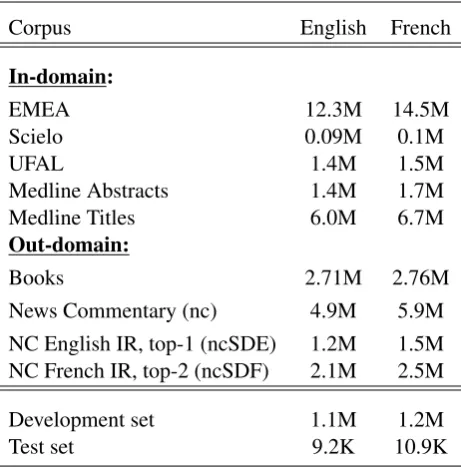
We used in-domain and general domain corpora to train our systems. News-Commentary ( Tiede-mann, 2012) was used as general domain corpus to perform Information Retrieval for selective data selection. The books corpus was used as the main out-domain corpus. For in-domain corpus we used Medline abstracts training corpus, subset of scielo corpus (Neves et al.,2016), EMEA corpus (Tiedemann,2012), Medline titles training corpus
Corpus English French
In-domain:
EMEA 12.3M 14.5M
Scielo 0.09M 0.1M
UFAL 1.4M 1.5M
Medline Abstracts 1.4M 1.7M Medline Titles 6.0M 6.7M
Out-domain:
Books 2.71M 2.76M
News Commentary (nc) 4.9M 5.9M NC English IR, top-1 (ncSDE) 1.2M 1.5M NC French IR, top-2 (ncSDF) 2.1M 2.5M
Development set 1.1M 1.2M
[image:3.595.309.540.62.296.2]Test set 9.2K 10.9K
Table 1: Train, Development and Test set details in terms of number of words (tokenized).
provided by WMT17 (Yepes et al.,2017), UFAL Medical corpus and Khresmoi corpus. Medline titles corpus was used as test set. Table1 summa-rizes the details of our training, development and test corpora.
3.2 Data Selection Procedure
We adopted the technique reported in (Abdul-Rauf and Schwenk,2011) for our data selection proce-dure. In-domain Medline titles corpus were used as queries to retrieve related sentences from News Commentary corpus. We had a total of 627,576 queries for data selection. Top n( 1 < n < 10) relevant sentences were ranked against each query. We used just the unique samples to train the sys-tems.
ID Train Set Detail Test
English to French Un-tokenized tokenized
Adding in-domain data toIn-domainbaseline:
M1 em+sc+medAbs+uf Baseline-in-domain 12.68 15.65
M2 em+sc+medAbs+uf+ncSDF M1⇒M2 14.57 19.56
M3 em+sc+medAbs+uf+ncSDE M1⇒M3 14.71 19.76
M4 em+sc+medAbs+uf+NewsComentary M1⇒M4 14.54 17.75
Adding in-domain data toOut-domainbaseline:
M5 books Baseline-outdomain - 4.53
M6 books+em+sc+medAbs+uf M5⇒M6 - 14.48
M7 books+em+sc+medAbs+uf+ncSDF M6⇒M7 - 16.12
M8 books+em+sc+medAbs+uf-ncSDF+ncSDE+medTitle M5⇒M8 - 21.97
French to English Un-tokenized tokenized
[image:4.595.83.514.60.283.2]FE em+sc+medAbs+uf+ncSDF+ncSDE+medTitle - 15.94
Table 2: BLEU scores for English to French Models and English to French. ⇒shows the direction of transfer learning while building the models. The best model from IR was chosen which was top2 for French IR and top1 for English IR.
3.3 Training Parameters
We used OpenNMT-py (Klein et al., 2017) to train the models. For English to French trans-lation direction we adopted transfer learning ap-proach along with selective data training. A se-ries of experiments were performed to train a two layer RNN (Recurrent Neural Network) encoder decoder model, having 500 LSTM (Long Short Term Memory) units in each layer. Training was optimized via Adam optimizer and 0.001 learning rate fixed for all the experiments. Whereas for ini-tial experiments we kept the batch size to 64 sam-ples, and afterwards we increased the batch size to 128 samples. Validation was applied after every 10000 steps.
For training NMT system for French to En-glish direction, we followed simple training pro-cess. The training model architecture and training parameters were same as for English to French ex-periments, except that the batch size was set to 128 through out the training process.
4 Results
This section describes the procedure and results of all experiments done by using tokenized and un-tokenized corpora in the training pipeline. Table2
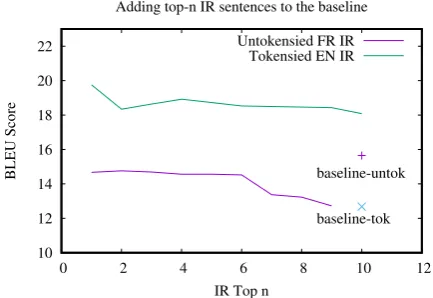
and Figure 1 show our results in values as well as graphically for English to French. The section is further sub-divided in two sub-sections, Adding in-domain data toIn-domainbaseline (section4.1)
and Adding in-domain data toOut-domain base-line (section4.2), in which we discuss the results the results on tokenized data following the gen-eral MT convention. Effect of tokenization is dis-cussed in the corresponding section4.3. Experi-ments were performed with the aim to answer the following research questions:
• How important is the decision for selection of parent model for transfer learning.
• What is the effect of transfer learning when selective data training is initialized from an already trained in-domain model.
• Does selective data training has any benefit over simple training with out-domain corpus.
• How the source or target side data selection affects the translation performance.
• How the performance of a system is affected, if the corpus is not tokenized before starting the training pipeline.
4.1 Adding in-domain data toIn-domain baseline
sentences from both English and FrenchN C cor-pus (section3.2) and built NMT systems to choose the best system. The results of these experiments are graphically depicted in Figure 1. As is evi-dent, selected data training always outperforms the baseline as well as the system built by adding the wholeN Ccorpus to the baseline (row 4 Table2). We then selected the best systems from both IR pipelines, which weretop−1(ncSDE) for English IR yielding 1.2M and 1.5M English and French to-kens respectively. For the IR in French direction the best system wastop−2(ncSDF) having 2.1M and 2.5M English and French tokens respectively. Table 2, summarizes the results of all the ex-periments. We have used short representations to name the corpora used for training. We repre-sentedEM EAasem,Scieloassc,M edline ab-stracts as medAbs, U F AL as uf, selected data of News Commentary using French queries as
ncSDF, selected data of News Commentary us-ing English queries as ncSDE. Right arrow is used to show the application of transfer learning.
For our experiments on transfer learning and selective data training, we first trained a baseline system (M1), by concatenating in-domain EMEA corpus,M edlineabstracts corpus,Scielo corpus andU F ALcorpus. We didn’t add Medline titles corpus in our baseline training pipeline, to get a clear picture of the results of data selective train-ing over transfer learntrain-ing (as Medline titles were used as a key to select the data from general do-main). The BLEU scores of the baseline system, calculated over test set from Medline titles corpus were 15.65.
In the second experiment we applied transfer learning to initialize the selective data training over sentences found by IR from News Com-mentary French corpus (ncSDF) from baseline model. For this experiment data selection was done using the French queries which is the tar-get language in our case. Transfer learning over selective data training improved the system (M2) performance by 4 BLEU points from the baseline. Which is a significant improvement.
The third experiment was done by applying transfer learning to initialize the selective data training from baseline model, but this time data selection was performed using English queries
(ncSDE). The resulting model (M3) performed better than the baseline with gain of 4.11 BLEU points. Comparing the resulting BLEU scores of
10 12 14 16 18 20 22
0 2 4 6 8 10 12
baseline-untok
baseline-tok
BLEU Score
IR Top n
Adding top-n IR sentences to the baseline
[image:5.595.309.526.71.220.2]Untokensied FR IR Tokensied EN IR
Figure 1: Effect of adding our IR selected data to base-line. In this figure we also show the difference between the the use of tokenized vs untokenized data
both the selective data training experiments, no obvious difference is observed by the change in language to select data.
To explore if selective data training gives any benefit over simple training using wholeN C cor-pus; we built M5. In this experiment we continue to train the baseline system with full News Com-mentary corpus, which was used for finding do-main related sentences for selective data training in above mentioned experiments (M2 and M3). Note thatN Ccorpus is more than double the size ofncSDEandncSDF (see table1). The result-ing model (M5) only achieved an improvement of 2.1 BLEU points. This clearly demonstrates the efficiency and performance of IR based data se-lection method.
4.2 Adding in-domain data toOut-domain baseline
Table 2 shows the detailed results of our exper-iments on building NMT systems for English to French translation focusing on the above stated re-search questions. We first trained the out-domain baseline system (M5) on 2.7M French words of
bookscorpus and getting a baseline score of 4.53 BLEU. We applied transfer learning to initialize the training of 17.2M French words of in-domain
em+sc+medAbs+uf corpus to train a new model (M6).
We see that starting from an out-domain base-linebookscorpus, the addition of in-domain data drastically improves system performance, giving a total gain of around 10 BLEU points (Table 2
when domain IR selected data was added to in-domain medical corpora.
Then, we evaluate the performance of cascaded transfer learning over selective data training. We applied transfer learning over the model which was first trained by transferring the parameters of baseline-out-domain to train over major in-domain corpus (M6). However, here we see a similar trend when we apply selective data training using
ncSDF (M6 ⇒M7) and resulting improvement is of 1.64 BLEU points. Here, domain data selec-tion exhibited the same trend as we observed in previous section.
In the last experiment we concatenated all the in-domain corpus and trained a model (M8) ini-tiating from out-domain books corpus. Interest-ingly, this is the best result achieved, giving a total improvement of 17.44 BLEU points from the out-domain books corpus baseline (4.53 ⇒ 21.97). The improvement of 1.64 BLEU points (M6 ⇒
M7) achieved with a rather stronger baseline as in the previous section, strengthens our claim of effi-ciency of our IR based data selection method using selective data training.
4.3 Effect of Tokenization on translation quality
To study the effect of tokenization on perfor-mance of NMT systems, we built four models (from M1 to M4) with both tokenized and unto-kenized corpora. For the experiments done with tokenized corpora we used M ossesT okenizer
(Koehn et al., 2007), which is reported to yield best results as compared to other tokenizers (Domingo et al.,2018).
Table 2 lists the results of our findings. All the models built using tokenized corpora signifi-cantly out-performed their corresponding counter-parts built using untokenized corpora.
M1 dropped in performance, by 2.97 BLEU points when trained with untokenized corpora, than its corresponding system trained with tok-enized corpora (12.68 ⇔ 15.65). Same trend is observed in M2 which showed a decline of 4.99 BLEU points by using untokenized corpora dur-ing traindur-ing, in comparison to its traindur-ing usdur-ing tokenized corpora (14.57⇔ 19.56). The decline in performance of M3, when trained with unto-kenized corpora is highest. Its performance de-creased by 5.05 BLEU points as compared to training using tokenized corpora. M4 maintained
the trend of decrease in performance when trained with untokenized corpora. It lost 3.21 BLEU points with respect to its corresponding system trained using tokenized corpora. The trend of de-cline in performance for untokenized corpora can also be observed from Figure 1.
On average the decline in performance of the systems is around 4 BLEU points, which reveals the importance of tokenization of corpora in NMT. This concludes that tokenization of corpora is an important pre-processing step when building NMT systems.
It must be noted here that the selective data training maintained its trend to perform better than the baseline as well as the system built by adding
ncSDE,ncSDF and the wholeN Ccorpus to the baseline for the systems built using untokenized corpora. Our IR based data selection method still holds it’s efficiency claim here (see M2 andM3
vsM4). This adds to the efficacy of the data se-lective training approach we adapted to build our systems for domain adaptation.
4.4 French to English
To train the system for French to English direc-tion, we followed simple training pipeline with se-lective data training using both source and target language as selection queries. We concatenated all the in-domain corpus and trained the system with selective data training from News Commen-tary. This model (FE) gave 15.94 BLEU score on the test set. The reported BLEU scores from WMT official results are 0.1972 and 0.2105 for all and OK sentences respectively.
5 Conclusion
In this paper, we have described our submission to the Bio Medical task based on the sequence-to-sequence NMT architecture for the WMT2019 shared task. In the Bio-medical task we worked on translation between French and English (in both directions). We used transfer learning approach to train our systems along with selective data training using information retrieval techniques.
pre-processing step for NMT and it helps significantly improve the system performance.
Over all our system achieved an improvement of 17.44 BLEU points from the out-domainbooks
corpus baseline (4.53⇒ 21.97) by adding all in-domain data. The improvement of 4.11 and 1.64 BLEU points in selective data training from in-domain to in-in-domain and out-in-domain to in-in-domain respectively show the efficiency of our IR based data selection method using selective data training methods.
Acknowledgments
This study is funded by the projects: Na-tional Research Program for Universities (NRPU) by Higher Education Commission of Pakistan (5469/Punjab/NRPU/R&D/HEC/2016) and the project Alector (ANR-16-CE28-0005) by Agence National de la Recherche, France.
References
Sadaf Abdul-Rauf and Holger Schwenk. 2011. Paral-lel sentence generation from comparable corpora for improved SMT. Machine Translation, pages 1–35.
Sadaf Abdul-Rauf, Holger Schwenk, Patrik Lambert, and Mohammad Nawaz. 2016. Empirical use of in-formation retrieval to build synthetic data for smt domain adaptation. IEEE/ACM Transactions on Audio, Speech and Language Processing (TASLP), 24(4):745–754.
Sadaf Abdul-Rauf, Holger Schwenk, and Moham-mad Nawaz. 2017. Parallel fragments: Measuring their impact on translation performance. Computer Speech & Language, 43:56–69.
Kyunghyun Cho, Bart Van Merri¨enboer, Dzmitry Bah-danau, and Yoshua Bengio. 2014. On the properties of neural machine translation: Encoder-decoder ap-proaches. arXiv preprint arXiv:1409.1259.
Chenhui Chu, Raj Dabre, and Sadao Kurohashi. 2017. An empirical comparison of simple domain adapta-tion methods for neural machine translaadapta-tion. arXiv preprint arXiv:1701.03214.
Tagyoung Chung and Daniel Gildea. 2009. Unsuper-vised tokenization for machine translation. In Pro-ceedings of the 2009 Conference on Empirical Meth-ods in Natural Language Processing: Volume 2-Volume 2, pages 718–726. Association for Compu-tational Linguistics.
Praveen Dakwale and Christof Monz. 2017. Fine-tuning for neural machine translation with limited degradation across in-and out-of-domain data. Pro-ceedings of the XVI Machine Translation Summit, page 117.
Miguel Domingo, Mercedes Garcıa-Martınez, Alexan-dre Helle, and Francisco Casacuberta. 2018. How much does tokenization affect in neural machine translation? arXiv preprint arXiv:1812.08621.
Markus Freitag and Yaser Al-Onaizan. 2016. Fast domain adaptation for neural machine translation.
arXiv preprint arXiv:1612.06897.
Jonas Gehring, Michael Auli, David Grangier, Denis Yarats, and Yann N Dauphin. 2017. Convolutional sequence to sequence learning. In Proceedings of the 34th International Conference on Machine Learning-Volume 70, pages 1243–1252. JMLR. org.
Cristian Grozea. 2018. Ensemble of translators with automatic selection of the best translation–the sub-mission of fokus to the wmt 18 biomedical transla-tion task–. InProceedings of the Third Conference on Machine Translation: Shared Task Papers, pages 644–647.
Di He, Yingce Xia, Tao Qin, Liwei Wang, Nenghai Yu, Tieyan Liu, and Wei-Ying Ma. 2016. Dual learn-ing for machine translation. InAdvances in Neural Information Processing Systems, pages 820–828.
Almut Silja Hildebrand, Matthias Eck, Stephan Vo-gel, and Alex Waibel. 2005. Adaptation of the translation model for statistical machine translation based on information retrieval. In Proceedings of the Meeting of the European Association for Ma-chine Translation (EAMT), Budapest, Hungary.
Matthias Huck, Fabienne Braune, and Alexander Fraser. 2017. Lmu munichs neural machine trans-lation systems for news articles and health informa-tion texts. InProceedings of the Second Conference on Machine Translation, pages 315–322.
Matthias Huck, Dario Stojanovski, Viktor Hangya, and Alexander Fraser. 2018. Lmu munichs neural ma-chine translation systems at wmt 2018. In Proceed-ings of the Third Conference on Machine Transla-tion: Shared Task Papers, pages 648–654.
Nal Kalchbrenner and Phil Blunsom. 2013. Recurrent continuous translation models. In Proceedings of the 2013 Conference on Empirical Methods in Nat-ural Language Processing, pages 1700–1709.
Abdul Khan, Subhadarshi Panda, Jia Xu, and Lam-pros Flokas. 2018. Hunter nmt system for wmt18 biomedical translation task: Transfer learning in neural machine translation. In Proceedings of the Third Conference on Machine Translation: Shared Task Papers, pages 655–661.
Guillaume Klein, Yoon Kim, Yuntian Deng, Jean Senellart, and Alexander M Rush. 2017. Opennmt: Open-source toolkit for neural machine translation.
arXiv preprint arXiv:1701.02810.
Philipp Koehn, Hieu Hoang, Alexandra Birch, Chris Callison-Burch, Marcello Federico, Nicola Bertoldi, Brooke Cowan, Wade Shen, Christine Moran, Richard Zens, et al. 2007. Moses: Open source toolkit for statistical machine translation. In Pro-ceedings of the 45th annual meeting of the associ-ation for computassoci-ational linguistics companion vol-ume proceedings of the demo and poster sessions, pages 177–180.
Philipp Koehn and Rebecca Knowles. 2017. Six challenges for neural machine translation. arXiv preprint arXiv:1706.03872.
Patrik Lambert, Holger Schwenk, Christophe Ser-van, and Sadaf Abdul-Rauf. 2011. Investigations on translation model adaptation using monolingual data. InProceedings of the Sixth Workshop on Sta-tistical Machine Translation, pages 284–293, Edin-burgh, Scotland. Association for Computational Lin-guistics.
Yajuan Lu, Jin Huang, and Qun Liu. 2008. Improving statistical machine translation performance by train-ing data selection and optimization. InProceedings of the 2007 Joint Conference on Empirical Methods in Natural Language Processing and Computational Natural Language Learning (EMNLP-CoNLL).
Mariana Neves, Antonio Jimeno Yepes, and Aurlie Nvol. 2016. The scielo corpus: a parallel corpus of scientific publications for biomedicine. In Pro-ceedings of the Tenth International Conference on Language Resources and Evaluation (LREC 2016), Paris, France. European Language Resources Asso-ciation (ELRA).
Hassan Sajjad, Nadir Durrani, Fahim Dalvi, Yonatan Belinkov, and Stephan Vogel. 2017. Neural ma-chine translation training in a multi-domain sce-nario. arXiv preprint arXiv:1708.08712.
Ilya Sutskever, Oriol Vinyals, and Quoc V Le. 2014. Sequence to sequence learning with neural net-works. InAdvances in neural information process-ing systems, pages 3104–3112.
Jrg Tiedemann. 2012. Parallel data, tools and inter-faces in opus. InProceedings of the Eight Interna-tional Conference on Language Resources and Eval-uation (LREC’12), Istanbul, Turkey. European Lan-guage Resources Association (ELRA).
Ashish Vaswani, Noam Shazeer, Niki Parmar, Jakob Uszkoreit, Llion Jones, Aidan N Gomez, Łukasz Kaiser, and Illia Polosukhin. 2017. Attention is all you need. InAdvances in neural information pro-cessing systems, pages 5998–6008.
Yijun Wang, Yingce Xia, Li Zhao, Jiang Bian, Tao Qin, Guiquan Liu, and T Liu. 2018. Dual transfer learn-ing for neural machine translation with marginal distribution regularization. In Proceedings of the Thirty-Second AAAI Conference on Artificial Intel-ligence.
Marlies van der Wees, Arianna Bisazza, and Christof Monz. 2017. Dynamic data selection for neural ma-chine translation. arXiv preprint arXiv:1708.00712.
Antonio Jimeno Yepes, Aur´elie N´ev´eol, Mariana Neves, Karin Verspoor, Ondrej Bojar, Arthur Boyer, Cristian Grozea, Barry Haddow, Madeleine Kittner, Yvonne Lichtblau, et al. 2017. Findings of the wmt 2017 biomedical translation shared task. In
Proceedings of the Second Conference on Machine Translation, pages 234–247.
Nasser Zalmout and Nizar Habash. 2017. Optimizing tokenization choice for machine translation across multiple target languages. The Prague Bulletin of Mathematical Linguistics, 108(1):257–269.