Proceedings of the 57th Annual Meeting of the Association for Computational Linguistics: Student Research Workshop, pages 162–168 162
Towards incremental learning of word embeddings using context
informativeness
Alexandre Kabbach Dept. of Linguistics University of Geneva Center for Mind/Brain Sciences
University of Trento
Kristina Gulordava Dept. of Translation and Language Sciences Universitat Pompeu Fabra
{firstname.lastname}@{unige.ch;upf.edu;unitn.it} Aur´elie Herbelot
Center for Mind/Brain Sciences, Dept. of Information Engineering
and Computer Science University of Trento
Abstract
In this paper, we investigate the task of learn-ing word embeddlearn-ings from very sparse data in an incremental, cognitively-plausible way. We focus on the notion ofinformativeness, that is, the idea that some content is more valuable to the learning process than other. We fur-ther highlight the challenges of online learn-ing and argue that previous systems fall short of implementing incrementality. Concretely, we incorporate informativeness in a previously proposed model of nonce learning, using it for context selection and learning rate modulation. We test our system on the task of learning new words from definitions, as well as on the task of learning new words from potentially unin-formative contexts. We demonstrate that infor-mativeness is crucial to obtaining state-of-the-art performance in a truly incremental setup.
1 Introduction
Distributional semantics models such as word em-beddings (Bengio et al., 2003; Collobert et al.,
2011;Huang et al.,2012;Mikolov et al.,2013b) notoriously require exposure to a large amount of contextual data in order to generate high quality
vector representations of words. This poses prac-tical challenges when the available training data is scarce, or when distributional models are in-tended to mimic humans’ word learning abilities by constructing reasonable word representations from limited observations (Lazaridou et al.,2017). In recent work, various approaches have been pro-posed to tackle these problems, ranging from task-specific auto-encoders generating word embed-dings from dictionary definitions only (Bosc and Vincent,2017,2018), to Bayesian models used for acquiring definitional properties of words via one-shot learning (Wang et al.,2017), or recursive neu-ral network models making use of morphological structure (Luong et al.,2013).
Arguing that the ideal model should rely on an all-purpose architecture able to learn from
anyamount of data, Herbelot and Baroni (2017) proposed a model called Nonce2Vec (N2V), de-signed as a modification of Word2Vec (W2V;
Mikolov et al., 2013b), refactored to allow in-cremental learning. The model was tested on two datasets: a) the newly introduced defini-tional dataset, where the task is to learn a nonce word from its Wikipedia definition; and b) the
chimeradataset ofLazaridou et al.(2017), where the task is to reproduce human similarity judge-ments related to a novel word observed in 2-6 ran-domly extracted sentences. The N2V model per-formed much better than W2V on both datasets but failed to outperform a basic additive model on the chimera dataset, leading the authors to hypoth-esise that their system would need to perform con-tent selection to deal with the pocon-tentially uninfor-mative chimera sentences.
There are two motivations to the present work. The first is to provide a formal definition of the notion ofinformativenessapplied to both senten-tial context (as a whole) and context words (taken individually). To do so, we rely on the intuition that aninformativecontext is a context that is more
specific to a given target, and that this notion of
context specificitycan be quantified by computing the entropy of the probability distribution gener-ated by a language model over a set of vocabulary words, given the context.
is an essential part of retaining acceptable perfor-mance in such a challenging setting.
2 Related work
The original Nonce2Vec (N2V) model is designed to simulate new word acquisition by an adult speaker who already masters a substantial vocab-ulary. The system uses some ‘background’ lexical knowledge in the shape of a distributional space acquired over a large text corpus. A novel word is then learnt by using information present in its con-text sentence. To achieve its goal, N2V proposes some modifications to the original Word2Vec ar-chitecture to make it suitable for novel word learn-ing. Three main changes are suggested: a) the learning rate should be greatly heightened to allow for learning via backpropagation using only the limited amount of data; b) random subsampling should be reduced to a minimum so that all avail-able data is used; and c) embeddings in the back-ground should be ‘frozen’ so that the high learn-ing rate is prevented from ‘unlearnlearn-ing’ old lexical knowledge in favour of the scarce, and potentially uninformative, new context information.
Recent work outperforms N2V on the chimera (Khodak et al., 2018; Schick and Sch¨utze, 2019a) and the definitional (Schick and Sch¨utze, 2018) datasets (see §1 for a description of the datasets). However, they both deviate from the original motivation of N2V which is to learn word representations incrementally from any
amount of data. Instead, those state-of-the-art models rely—at least in part—on a learned linear regression matrix which is fixed for a given corpus and thus does not lend itself well to incremental learning.
Our work follows the philosophy of N2V but pushes the notion of incrementality further by identifying aspects of the original system that in fact do not play well with true online learning. For a start, the original model is not fully incremental as it adopts aone-shotevaluation setup where each test instance is considered individually and where the background model is reloaded from scratch at each test iteration. This does not test how the sys-tem would react to learning multiplenonces one after the other (as humans do in the course of their lives). Related to this, whilst ‘freezing’ back-ground vectors makes sense as a safety net when using very high learning rates, it similarly goes against the notion of incrementality. In any
re-alistic setup, indeed, we would like newly learnt words to inform our background lexical knowl-edge and become part of that background them-selves, being refined over time and contributing to acquiring the next nonce. Following this phi-losophy, the system we present in this paper does away with freezing previously learnt embeddings and does not reload the background model at each test iteration.
We should further note that our work on in-formativeness echoes recent research on the use ofattention mechanisms. Vaswani et al. (2017), followed by Devlin et al. (2018) andSchick and Sch¨utze (2019b), have shown that such mecha-nisms can provide very powerful tools to build sentence and contextualised word embeddings which are amenable to transfer learning tasks. However, we note that from our point of view, these systems suffer from the same problem as the previously mentioned architectures: the underly-ing model consists of a large set of parameters which can be used to learn a task-specific regres-sion. It is not designed to be updated with each new encountered experience.
3 Model
Let us consider context to be defined as a win-dow of±nwords around a giventarget. We de-fine two specific functions: context informative-ness(CI) which characterises how informative an entire context is with respect to its corresponding target; and context word informativeness (CWI) which characterises how informative aparticular context item is with respect to the target. For in-stance, if targetchasesis seen in contextc={the, cat, the, mouse}, the context informativeness is the informativeness ofc, and the context word infor-mativeness can be computed for each element inc, with the expectation, in this case, thatthemight be less informative thancatormouse. The CWI mea-sure is dependent on CI, as we proceed to show.
3.1 Context informativeness
Let us consider a sequence c of n context items c = c1. . . cn. We define the context informative-nessof a context sequencecas:
CI(c) = 1 + 1 ln(|V|)
X
w∈V
p(w|c) lnp(w|c) (1)
CI is a slight modification of the Shannon en-tropyH=−P
over the cardinality of the vocabulary |V| to out-put values in[0,1]. In this work, we use a CBOW model (Mikolov et al.,2013a) to obtain the proba-bility distributionp(w|c). We use CBOW because it is the simplest word-generation model which takes the relation between context words into ac-count, i.e., in contrast to skipgram.
A context will be considered maximally infor-mative (CI = 1) if only a single vocabulary item is predicted to occur in contextcwith a non-null probability. Conversely, a context will be consid-ered minimally informative (CI = 0) if all vocab-ulary items are predicted to occur in contextcwith equal probability. CI should therefore quantify howspecific a given context is regarding a given target.
3.2 Context word informativeness
Let us consider c6=i = c1. . . ci−1, ci+1. . . cn to be the sequence of context items taken fromc to which theith item has been removed. We define thecontext word informativenessof a context item ciin a context sequencecas:
CW I(ci) =CI(c)−CI(c6=i) (2)
CWI outputs values in [−1,1]: a context word ci will be considered maximally informative (CW I = 1) if removing it from a maximally in-formative context leads to a minimally inin-formative one. Conversely, a context word ci will be con-sidered minimally informative (CW I = −1) if removing it from a minimally informative context leads to a maximally informative one.
3.3 CWI-augmented Nonce2Vec
As explained in§2, N2V introduces several high-level changes to the W2V architecture to achieve learning from very sparse data. In practice, this translates into the following design choices: a) nonces are initialised by summing context word embeddings (after subsampling); and b) nonces are trained with an adapted skipgram function in-corporating decaying window size, sampling and learning rates at each iteration, while all other vec-tors remain frozen. The learning rate is computed viaα=α0e−λtwith a highα0.
The modifications we propose are as follows: i) we incorporate informativeness into the initial-isation phase by summing over the set of context words with positive CWI only; ii) we train on the entire context without subsampling and window
decay; and iii) we remove freezing and compute the learning rate as a function of CWI for each context itemcivia:
α(ci) =αmax
etanh(β∗CW I(ci))+1−1 e2−1 (3)
The purpose of equation3is to modulate the learn-ing rate dependlearn-ing on the context word informa-tiveness for a context–target pair: α should be maximal (α = αmax, where αmax is a hyper-parameter) when context is maximally informa-tive (CW I = 1) and minimal (α= 0) when con-text is minimally informative (CW I =−1). The functionx7→ ex+1−1
e2−1 is therefore designed as a
lo-gistic “S-shape” function with domain[−1,1] →
[0,1]. In practice, CWI values are highly depen-dant on the language model used and may end up all being close to0(±0.01with our CBOW model for instance). Thetanhfunction and theβ param-eter are therefore added to compensate for this ef-fect that would otherwise produce identical learn-ing rates for all target-context pairs, regardless of CWI values.
4 Experimental setup and evaluation
To test the robustness of the results of Herbelot and Baroni (2017), we retrain a skipgram back-ground model with the same hyperparameters but from the more recent Wikipedia snapshot of Jan-uary 2019, and obtain a similar correlation ratio on the MEN similarity dataset (Bruni et al.,2014): ρ = 0.74 vs ρ = 0.75 for Herbelot and Baroni
(2017). Probability distributions used for com-puting CI and CWI are generated with a CBOW model trained with gensim (Reh˚uˇrek and Sojkaˇ ,
2010) on the same Wikipedia snapshot as our skip-gram background model, and with the same hy-perparameters. For the CWI-based learning rate computation, we setαmax = 1, chosen according toα0in the original N2V for fair comparison; and β = 1000, chosen given min and max CWI val-ues output by CBOW to producetanh(β∗x) val-ues distributed across[−1,1]and apply a learning rateαmax = 1to maximally informative context words.
We report results on the definitional and the
the task is to learn the nonce insulin. Evalua-tion is performed on 300 test instances in terms of Median Rank (MR) and Mean Reciprocal Rank (MRR). That is, for each instance, the Recip-rocal Rank of thegoldvector (the one that would be obtained by training standard W2V over the entire corpus) is computed over the sorted list of neighbours of thepredictedrepresentation.
The chimera dataset simulates a nonce situation where speaker encounters words for the first time in naturally-occurring (and not necessarily infor-mative) sentences. Eachnonceinstance in the data is associated with 2 (L2), 4 (L4) or 6 (L6) sen-tences showing the nonce in context, and a set of six word probes human-annotated for similarity to the nonce. For instance, the nonce VALTUOR
is shown in Canned sardines and VALTUOR be-tween two slices of wholemeal bread and thinly spread Flora Original [...], and its similarity as-sessed with respect torhubarb, onion, pear, straw-berry, limousine and cushion. Evaluation is per-formed on 110 test instances by computing the Spearman correlation between the similarities out-put by the system for each nonce-probe pair and the similarities from the human subjects.
We evaluate both datasets using a one-shot
setup, as per the original N2V paper: each nonce word in considered individually and the back-ground model is reloaded at each test iteration. We further propose an incremental evaluation setup where the background model is loaded only once at the beginning of testing, keeping its word vec-tors modifiable during subsequent learning, and where each newly learned nonce representation is added to the background model. As performance in the incremental setup proved to be dependent on the order of the test items, we report average and standard deviation scores computed from 10 test runs where the test set is shuffled each time.
5 Results
5.1 Improving additive models
Herbelot and Baroni(2017) show that a simple ad-ditive model provides an extremely strong base-line for nonce learning. So we first measure the contribution of our notion of informativeness to the context filtering module of a sum model. Com-parison takes place across four settings: a) no filter, where all words are retained; b) random, which applies standard subsampling with a sam-ple rate of 10,000, following the original N2V
ap-proach; c)self, where all items found in training with a frequency above a given threshold are dis-carded;1 and d) CWI, which only retains context items with a positive CWI value.
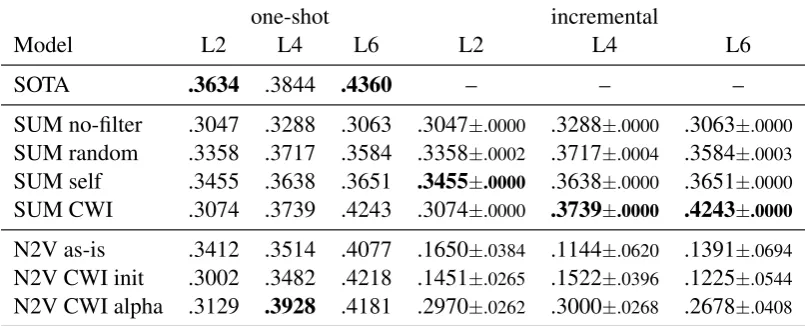
Our results on the definitional dataset, displayed in Table1, show a consistent hierarchy of filters with the SUM CWI model outperforming all other SUM models, in both one-shot and incremental evaluation setups. Results on the chimera dataset, displayed in Table2, are not as clear-cut, although they do exhibit a similar trend on both L4 and L6 test sets, with the notable result of achieving state-of-the-art performances with our SUM CWI model on the L4 and L6 test sets in incremental setup, and near state-of-the-art performance on the L6 test set in one-shot setup. This confirms once again that additive models can provide very robust baselines.
Qualitatively, the contribution of each filter on the definitional dataset can be exemplified on the following sentence, with nonce word Honey-well: “Honeywell International Inc is an Amer-ican multinational conglomerate company that produces [...] aerospace systems for a wide va-riety of customers from private consumers to ma-jor corporations and governments.”. Theno-filter
additive model outputs a rank of 383 (the gold vec-tor for honeywell is found to be the 383th clos-est neighbour of the predicted vector). The ran-dom model randomly removes most (but not all) high frequency words before summing, outputting a rank of 192 (filtered-out words include also con-tent words like international or company). The
self-information model reduces the size of the context words set even further by removing all high-frequency words left over by the random pro-cess (rank 170). Finally, theCWI model outputs the best rank at 85, removing all function words while keeping some useful high-frequency words such asinternationalorcompany.
5.2 Improving neural models in one-shot settings
Our results for neural models are also displayed in Table 1 and Table 2: as-is refers to the orig-inal N2V system; CWI init is N2V as-is with CWI-based context filtering instead of subsam-pling; andCWI alphais a model with a CWI-based
1We take the log of thesample intvalues computed by
one-shot incremental
Model MR MRR MR MRR
SOTA 49 .1754 – –
SUM no-filter 5,969 .0087 6,461±225 .0014±.0002
SUM random 3,047 .0221 3,113±179 .0071±.0012
SUM self 1,769 .0242 2,095±125 .0121±.0008
SUM CWI 935 .0374 961±24 .0322±.0011
N2V as-is 955 .0477 81,705±14,076 .0096±.0038
N2V CWI init 540 .0493 70,992±17,312 .0079±.0025
[image:5.595.141.455.64.229.2]N2V CWI alpha 763 .0404 983±175 .0341±.0021
Table 1: Performance of various additive (SUM) and neural (N2V) models on the definitional dataset, measured in terms of Median Rank (MR) and Mean Reciprocal Rank (MRR). SOTA inone-shotevaluation setup is reported by theForm-Contextmodel ofSchick and Sch¨utze(2018).
sum initialisation (as in SUM CWI), and a CWI-based learning rate computed on unfiltered context words, as detailed in§3.3.
When informativeness is incorporated to N2V in the original one-shot evaluation setup, we also observe near-systematic improvements. On the definitional dataset in Table1, CWI init improves over the standard N2V as-is model (MR 540 vs 955; MRR .0493 vs .0477) or over the SUM CWI baseline (MR 540 vs 935; MRR .0493 vs .0374). In comparison to CWI init, our CWI alpha model provides robust performances across evaluation setups and datasets, often reaching similar if not better results than our best baseline model (SUM CWI) showing that a neural model fully based on informativeness is a more robust alternative than its counterparts. See for example Table 1on the definitional dataset where the N2V CWI alpha model performs better than the SUM CWI model in one-shot setup (MR 763 vs. 935; MRR .0404 vs .0374) or Table2on the chimera dataset where it also performs better than the SUM CWI model on both the L2 (ρ .3129 vs .3074) and the L4 (ρ .3928 vs .3739) test sets and achieves state-of-the-art performance on the L4 test set.
5.3 Improving incremental learning
As stated in§2, recent approaches to nonce learn-ing have deviated from the original philosophy of N2V and in fact, N2V itself did not fully imple-ment an increimple-mental setting. We now show that the original N2V performance decreases signifi-cantly on both datasets in an incremental evalu-ation setup, without freezing of background
vec-tors. Compare the results of the N2V as-is model in bothone-shotandincrementalevaluation setups on the definitional dataset in Table1: MR 955 vs 81,705±14,076 and MRR .0477 vs .0096±.0038; and on the chimera dataset in Table2: ρ.3412 vs .1650±.0384 on L2; ρ .3514 vs .1144±.0620 on L4 and ρ .4077 vs .1391±.0694 on L6. We find this drastic decrease in performance to be related to two distinct phenomena: 1) asumeffect which leads vector representations for nonces to be close to each other due to the sum initialisation creat-ing very similar vectors in a ‘special’ portion of the vector space; and 2) asnowballeffect related to the ‘unfreezing’ of the background space which leads background vectors to be updated by back-propagation at a very high learning rate at every test iteration, moving their original meaning to-wards the semantics of the new context they are encountered in. This includes vectors for very fre-quent words, which are encountered again in their now shifted version when a new nonce is presented to the system. This snowball effect ends up sig-nificantly altering the quality of the background model and its generated representations.
Thesum effectis best illustrated by the decrease in performance of SUM models betweenone-shot
neg-one-shot incremental
Model L2 L4 L6 L2 L4 L6
SOTA .3634 .3844 .4360 – – –
SUM no-filter .3047 .3288 .3063 .3047±.0000 .3288±.0000 .3063±.0000
SUM random .3358 .3717 .3584 .3358±.0002 .3717±.0004 .3584±.0003
SUM self .3455 .3638 .3651 .3455±.0000 .3638±.0000 .3651±.0000
SUM CWI .3074 .3739 .4243 .3074±.0000 .3739±.0000 .4243±.0000
N2V as-is .3412 .3514 .4077 .1650±.0384 .1144±.0620 .1391±.0694
N2V CWI init .3002 .3482 .4218 .1451±.0265 .1522±.0396 .1225±.0544
[image:6.595.97.500.65.228.2]N2V CWI alpha .3129 .3928 .4181 .2970±.0262 .3000±.0268 .2678±.0408
Table 2: Performance of various additive (SUM) and neural (N2V) models on the chimera dataset, measured in terms of Spearman correlation. SOTA inone-shotevaluation setup on the L2 and L4 test sets are reported by theA la cartemodel ofKhodak et al.(2018), while SOTA on the L6 test set is reported by theattentive mimickingmodel ofSchick and Sch¨utze(2019a).
atively impact performance given that evaluation compares correlations between gold and predicted similarity rankings of nonces with a prefixed set of probes. Thesnowballeffect however is visible on both datasets in Table1and Table2when com-paring performances of N2V models between one-shotandincrementalsetups. It proves particularly salient for neural models which do not make use of informativeness-based adaptative learning rate (all N2V models but N2V CWI alpha).
Our notion of informativeness proves even more useful in the context of incremental nonce learn-ing: on the definitional dataset in Table 1, our informativeness-based models, be it SUM CWI or N2V CWI alpha, achieve best (and comparable) performances (MR 961±24 vs 983±175; MRR .0322±.0011 vs .0341±.0021). Moreover, we ob-serve that those models are able to mitigate the un-desirable effects mentioned above, almost totally for the sum effect (compare the performance of the SUM CWI model in Table1between the incre-mental and one-shot setups, versus the other SUM models), and partially for the snowballing interfer-ence of the high learning rate (compare the perfor-mance of the N2V CWI alpha model in Table1 be-tween the incremental and one-shot setups, versus the other N2V models). Performances of our SUM CWI and N2V CWI alpha models in incremental setup approach those of the one-shot setting. On the chimera dataset in Table2, which proves only sensitive to the snowball effect, we also observe that our N2V CWI alpha model is able to mitigate this effect, although performances of the model in
incremental setup remain below those of the one-shot setup, as well as those of the additive models in incremental setup.
6 Conclusion
We have proposed an improvement of the orig-inal N2V model which incorporates a notion of informativeness in the nonce learning process. We showed that our informativeness function was very beneficial to a vector addition baseline, and could be usefully integrated into the original N2V approach, both at initialisation stage and during learning, achieving state-of-the-art results on the chimera dataset and on the definitional dataset in an incremental evaluation setup. Although our proposed notion of informativeness proved to be mostly beneficial to incremental learning, noth-ing prevents it from benoth-ing incorporated to other non-incremental models of nonce learning, pro-vided that those models make use of contextual information. On top of the performance improve-ments observed, our proposed definition of infor-mativeness benefits from being intuitive, debug-gable at each step of the learning process, and of relying on no external resource. We make our code freely available athttps://github.
com/minimalparts/nonce2vec.
Acknowledgements
References
Yoshua Bengio, R´ejean Ducharme, Pascal Vincent, and Christian Janvin. 2003. A neural probabilistic
lan-guage model. Journal of Machine Learning
Re-search, 3:1137–1155.
Tom Bosc and Pascal Vincent. 2017. Learning word
embeddings from dictionary definitions only. In
Proceedings of the NIPS 2017 Workshop on Meta-Learning.
Tom Bosc and Pascal Vincent. 2018. Auto-encoding dictionary definitions into consistent word
embed-dings. InProceedings of the 2018 Conference on
Empirical Methods in Natural Language Process-ing, pages 1522–1532, Brussels, Belgium. Associ-ation for ComputAssoci-ational Linguistics.
Elia Bruni, Nam-Khanh Tran, and Marco Baroni. 2014.
Multimodal distributional semantics.Journal of Ar-tificial Intelligence Research, 49:1–47.
Ronan Collobert, Jason Weston, L´eon Bottou, Michael Karlen, Koray Kavukcuoglu, and Pavel Kuksa. 2011. Natural language processing (almost) from
scratch. Journal of Machine Learning Research,
12:2493–2537.
Jacob Devlin, Ming-Wei Chang, Kenton Lee, and Kristina Toutanova. 2018. BERT: pre-training of deep bidirectional transformers for language under-standing.CoRR, abs/1810.04805.
Aur´elie Herbelot and Marco Baroni. 2017. High-risk learning: acquiring new word vectors from tiny data. In Proceedings of the 2017 Conference on Empiri-cal Methods in Natural Language Processing, pages 304–309, Copenhagen, Denmark. Association for Computational Linguistics.
Eric Huang, Richard Socher, Christopher Manning, and Andrew Ng. 2012. Improving word represen-tations via global context and multiple word proto-types. InProceedings of the 50th Annual Meeting of the Association for Computational Linguistics (Vol-ume 1: Long Papers), pages 873–882, Jeju Island, Korea. Association for Computational Linguistics.
Mikhail Khodak, Nikunj Saunshi, Yingyu Liang, Tengyu Ma, Brandon Stewart, and Sanjeev Arora. 2018. A la carte embedding: Cheap but effective induction of semantic feature vectors. In Proceed-ings of the 56th Annual Meeting of the Association for Computational Linguistics (Volume 1: Long Pa-pers), pages 12–22, Melbourne, Australia. Associa-tion for ComputaAssocia-tional Linguistics.
Angeliki Lazaridou, Marco Marelli, and Marco Baroni. 2017. Multimodal word meaning induction from minimal exposure to natural text.Cognitive Science, 41(S4):677–705.
Thang Luong, Richard Socher, and Christopher Man-ning. 2013. Better word representations with
recur-sive neural networks for morphology. In
Proceed-ings of the Seventeenth Conference on Computa-tional Natural Language Learning, pages 104–113, Sofia, Bulgaria. Association for Computational Lin-guistics.
Tomas Mikolov, Kai Chen, Greg Corrado, and Jeffrey Dean. 2013a. Efficient estimation of word represen-tations in vector space.CoRR, abs/1301.3781.
Tomas Mikolov, Ilya Sutskever, Kai Chen, Greg Cor-rado, and Jeffrey Dean. 2013b. Distributed repre-sentations of words and phrases and their composi-tionality. InProceedings of the 26th International Conference on Neural Information Processing Sys-tems - Volume 2, NIPS’13, pages 3111–3119, USA. Curran Associates Inc.
Radim ˇReh˚uˇrek and Petr Sojka. 2010.Software
Frame-work for Topic Modelling with Large Corpora. In
Proceedings of the LREC 2010 Workshop on New Challenges for NLP Frameworks, pages 45–50, Val-letta, Malta. ELRA.
Timo Schick and Hinrich Sch¨utze. 2018. Learning se-mantic representations for novel words: Leveraging both form and context. CoRR, abs/1811.03866.
Timo Schick and Hinrich Sch¨utze. 2019a. Attentive mimicking: Better word embeddings by attending to informative contexts.CoRR, abs/1904.01617.
Timo Schick and Hinrich Sch¨utze. 2019b.Rare words: A major problem for contextualized embeddings
and how to fix it by attentive mimicking. CoRR,
abs/1904.06707.
Ashish Vaswani, Noam Shazeer, Niki Parmar, Jakob Uszkoreit, Llion Jones, Aidan N. Gomez, Łukasz Kaiser, and Illia Polosukhin. 2017. Attention is all
you need. InAdvances in neural information
pro-cessing systems, pages 5998–6008.