Proceedings of the 55th Annual Meeting of the Association for Computational Linguistics, pages 440–450 Vancouver, Canada, July 30 - August 4, 2017. c2017 Association for Computational Linguistics Proceedings of the 55th Annual Meeting of the Association for Computational Linguistics, pages 440–450
Vancouver, Canada, July 30 - August 4, 2017. c2017 Association for Computational Linguistics
A Syntactic Neural Model for General-Purpose Code Generation
Pengcheng Yin
Language Technologies Institute Carnegie Mellon University
Graham Neubig
Language Technologies Institute Carnegie Mellon University
Abstract
We consider the problem of parsing natu-ral language descriptions into source code written in a general-purpose programming language like Python. Existing data-driven methods treat this problem as a lan-guage generation task without considering the underlying syntax of the target pro-gramming language. Informed by previ-ous work in semantic parsing, in this pa-per we propose a novel neural architecture powered by a grammar model to explicitly capture the target syntax as prior knowl-edge. Experiments find this an effective way to scale up to generation of complex programs from natural language descrip-tions, achieving state-of-the-art results that well outperform previous code generation and semantic parsing approaches.
1 Introduction
Every programmer has experienced the situation where they know what they want to do, but do not have the ability to turn it into a concrete im-plementation. For example, a Python programmer may want to “sort my list in descending order,” but not be able to come up with the proper syn-tax sorted(my list, reverse=True) to
real-ize his intention. To resolve this impasse, it is common for programmers to search the web in natural language (NL), find an answer, and mod-ify it into the desired form (Brandt et al., 2009,
2010). However, this is time-consuming, and thus the software engineering literature is ripe with methods to directly generate code from NL descriptions, mostly with hand-engineered meth-ods highly tailored to specific programming lan-guages (Balzer, 1985; Little and Miller, 2009;
Gvero and Kuncak,2015).
In parallel, the NLP community has developed methods for data-driven semantic parsing, which attempt to map NL to structured logical forms ex-ecutable by computers. These logical forms can be general-purpose meaning representations (Clark and Curran, 2007; Banarescu et al., 2013), for-malisms for querying knowledge bases (Tang and Mooney, 2001; Zettlemoyer and Collins, 2005;
Berant et al.,2013) and instructions for robots or personal assistants (Artzi and Zettlemoyer,2013;
Quirk et al.,2015;Misra et al.,2015), among oth-ers. While these methods have the advantage of being learnable from data, compared to the pro-gramming languages (PLs) in use by program-mers, the domain-specific languages targeted by these works have a schema and syntax that is rela-tively simple.
Recently, Ling et al. (2016) have proposed a data-driven code generation method for high-level,
general-purposePLs like Python and Java. This work treats code generation as a sequence-to-sequence modeling problem, and introduce meth-ods to generate words from character-level mod-els, and copy variable names from input descrip-tions. However, unlike most work in semantic parsing, it does not consider the fact that code has to be well-defined programs in the target syntax.
In this work, we propose a data-driven syntax-based neural network model tailored for genera-tion of general-purpose PLs like Python. In or-der to capture the strong unor-derlying syntax of the PL, we define a model that transduces an NL state-ment into an Abstract Syntax Tree (AST; Fig.1(a),
§ 2) for the target PL. ASTs can be
deterministi-cally generated for all well-formed programs us-ing standard parsers provided by the PL, and thus give us a way to obtain syntax information with minimal engineering. Once we generate an AST, we can use deterministic generation tools to con-vert the AST into surface code. We hypothesize
Production Rule Role Explanation
Call7!expr[func] expr*[args] keyword*[keywords] Function Call .func: the function to be invoked.args: arguments list.keywords: keyword arguments list
If7!expr[test] stmt*[body] stmt*[orelse] If Statement .test: condition expression.body: statements in-side the If clause.orelse: elif or else statements For7!expr[target] expr*[iter] stmt*[body] For Loop .target: iteration variable.iter: enumerable to
iter-ate over.body: loop body.orelse: else statements stmt*[orelse]
FunctionDef7!identifier[name] arguments*[args] Function Def. .name: function name.args: function arguments .body: function body
[image:2.595.75.522.65.158.2]stmt*[body]
Table 1: Example production rules for common Python statements (Python Software Foundation,2016)
that such a structured approach has two benefits. First, we hypothesize that structure can be used to constrain our search space, ensuring generation of well-formed code. To this end, we propose a syntax-driven neural code generation model. The backbone of our approach is a grammar model
(§ 3) which formalizes the generation story of a derivation AST into sequential application of ac-tionsthat either apply production rules (§3.1), or emit terminal tokens (§3.2). The underlying syn-tax of the PL is therefore encoded in the grammar modela priorias the set of possible actions. Our approach frees the model from recovering the un-derlying grammar from limited training data, and instead enables the system to focus on learning the compositionality among existing grammar rules.
Xiao et al.(2016) have noted that this imposition of structure on neural models is useful for seman-tic parsing, and we expect this to be even more im-portant for general-purpose PLs where the syntax trees are larger and more complex.
Second, we hypothesize that structural informa-tion helps to model informainforma-tion flow within the neural network, which naturally reflects the recur-sive structure of PLs. To test this, we extend a standard recurrent neural network (RNN) decoder to allow for additional neural connections which reflect the recursive structure of an AST (§ 4.2).
As an example, when expanding the node ? in
Fig. 1(a), we make use of the information from both its parent and left sibling (the dashed rectan-gle). This enables us to locally pass information of relevant code segments via neural network con-nections, resulting in more confident predictions.
Experiments (§ 5) on two Python code gener-ation tasks show 11.7% and 9.3% absolute im-provements in accuracy against the state-of-the-art system (Ling et al.,2016). Our model also gives competitive performance on a standard semantic parsing benchmark1.
1Implementation available at https://github.
com/neulab/NL2code
2 The Code Generation Problem
Given an NL descriptionx, our task is to generate
the code snippetcin a modern PL based on the in-tent ofx. We attack this problem by first
generat-ing the underlygenerat-ing AST. We define a probabilistic grammar model of generating an ASTy givenx:
p(y|x). The best-possible ASTyˆis then given by ˆ
y= arg max
y p(y|x). (1) ˆ
yis then deterministically converted to the
corre-sponding surface code c.2 While this paper uses
examples from Python code, our method is PL-agnostic.
Before detailing our approach, we first present a brief introduction of the Python AST and its underlying grammar. The Python abstract gram-mar contains a set of production rules, and an AST is generated by applying several production rules composed of a head node and multiple child nodes. For instance, the first rule in Tab. 1 is used to generate the function call sorted(·) in
Fig.1(a). It consists of a head node of typeCall,
and three child nodes of type expr, expr* and keyword*, respectively. Labels of each node are
noted within brackets. In an AST, non-terminal nodes sketch the general structure of the target code, while terminal nodes can be categorized into two types: operation terminalsand variable ter-minals. Operation terminals correspond to basic arithmetic operations like AddOp.Variable
termi-nal nodes store values for variables and constants of built-in data types3. For instance, all terminal
nodes in Fig.1(a) are variable terminal nodes.
3 Grammar Model
Before detailing our neural code generation method, we first introduce the grammar model at its core. Our probabilistic grammar model defines the generative story of a derivation AST. We
Expr root
expr[value]
Call
expr*[args] keyword*[keywords]
Name
str(sorted) expr[func]
expr
Name
str(my_list)
keyword
str(reverse) expr[value]
Name
str(True)
Action Flow Parent Feeding
Apply Rule
Generate Token
GenToken with Copy
(a) (b)
Input: Code:
. .
.
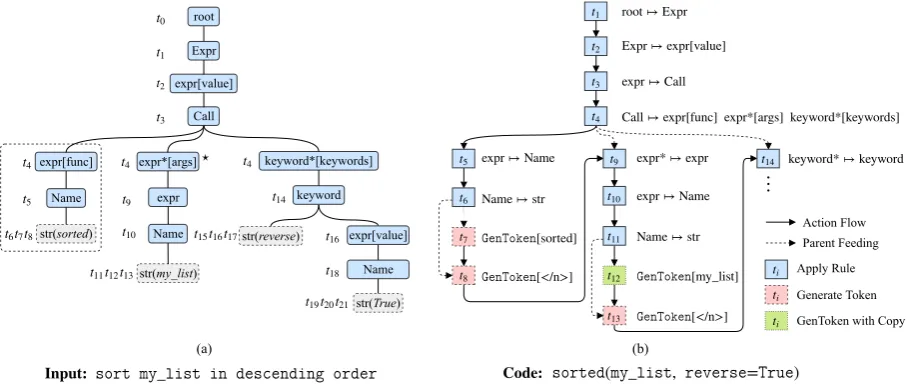
Figure 1: (a) the Abstract Syntax Tree (AST) for the given example code. Dashed nodes denote terminals. Nodes are labeled with time steps during which they are generated. (b) the action sequence (up tot14) used to generate the AST in (a)
torize the generation process of an AST into se-quential application ofactionsof two types:
• APPLYRULE[r]applies a production rulerto the current derivation tree;
• GENTOKEN[v]populates a variable terminal node by appending a terminal tokenv. Fig.1(b) shows the generation process of the tar-get AST in Fig. 1(a). Each node in Fig.1(b) in-dicates an action. Action nodes are connected by solid arrows which depict the chronological order of the action flow. The generation proceeds in depth-first, left-to-right order (dotted arrows rep-resent parent feeding, explained in§4.2.1).
Formally, under our grammar model, the prob-ability of generating an ASTyis factorized as:
p(y|x) = T
Y
t=1
p(at|x, a<t), (2)
where at is the action taken at time step t, and a<t is the sequence of actions before t. We will explain how to compute the action probabilities
p(at|·) in Eq. (2) in § 4. Put simply, the gen-eration process begins from a root node at t0, and proceeds by the model choosing APPLYRULE
actions to generate the overall program structure from a closed set of grammar rules, then at leaves of the tree corresponding to variable terminals, the model switches to GENTOKEN actions to
gener-ate variables or constants from the open set. We describe this process in detail below.
3.1 APPLYRULEActions
APPLYRULE actions generate program structure,
expanding the current node (the frontier node at
time step t: nft) in a depth-first, left-to-right
traversal of the tree. Given a fixed set of produc-tion rules, APPLYRULEchooses a rulerfrom the
subset that has a head matching the type of nft,
and usesr to expand nft by appending all child
nodes specified by the selected production. As an example, in Fig. 1(b), the rule Call 7! expr. . .
expands the frontier nodeCallat time stept4, and its three child nodesexpr,expr*andkeyword*
are added to the derivation.
APPLYRULE actions grow the derivation AST
by appending nodes. When a variable terminal node (e.g.,str) is added to the derivation and
be-comes the frontier node, the grammar model then switches to GENTOKEN actions to populate the
variable terminal with tokens.
Unary ClosureSometimes, generating an AST requires applying a chain of unary productions. For instance, it takes three time steps (t9 t11) to generate the sub-structure expr* 7! expr 7! Name7!strin Fig.1(a). This can be effectively
reduced to one step of APPLYRULEaction by
tak-ing the closure of the chain of unary productions and merging them into a single rule: expr* 7!⇤ str. Unary closures reduce the number of actions
needed, but would potentially increase the size of the grammar. In our experiments we tested our model both with and without unary closures (§5).
3.2 GENTOKENActions
Once we reach a frontier nodenftthat corresponds
to a variable type (e.g.,str), GENTOKENactions
[image:3.595.72.528.62.254.2]in-stance, a node that stores the name of a function (e.g., sorted) has a single token, while a node
that denotes a string constant (e.g., a=‘hello world’) could have multiple tokens. Our model
copes with both scenarios by firing GENTOKEN
actions at one or more time steps. At each time step, GENTOKEN appends one terminal token to
the current frontier variable node. A special</n>
token is used to “close” the node. The grammar model then proceeds to the new frontier node.
Terminal tokens can be generated from a pre-defined vocabulary, or be directly copied from the input NL. This is motivated by the observation that the input description often contains out-of-vocabulary (OOV) variable names or literal values that are directly used in the target code. For in-stance, in our running example the variable name
my listcan be directly copied from the the input
att12. We give implementation details in§4.2.2. 4 Estimating Action Probabilities
We estimate action probabilities in Eq. (2) using attentional neural encoder-decoder models with an information flow structured by the syntax trees.
4.1 Encoder
For an NL description x consisting of n words {wi}ni=1, the encoder computes a context sen-sitive embedding hi for each wi using a bidi-rectional Long Short-Term Memory (LSTM) net-work (Hochreiter and Schmidhuber, 1997), simi-lar to the setting in (Bahdanau et al.,2014). See supplementary materials for detailed equations.
4.2 Decoder
The decoder uses an RNN to model the sequential generation process of an AST defined as Eq. (2). Each action step in the grammar model naturally grounds to a time step in the decoder RNN. There-fore, the action sequence in Fig. 1(b) can be in-terpreted as unrolling RNN time steps, with solid arrows indicating RNN connections. The RNN maintains an internal state to track the generation process (§4.2.1), which will then be used to
com-pute action probabilitiesp(at|x, a<t)(§4.2.2).
4.2.1 Tracking Generation States
Our implementation of the decoder resembles a vanilla LSTM, with additional neural connections (parent feeding, Fig.1(b)) to reflect the topological structure of an AST. The decoder’s internal hidden state at time stept,st, is given by:
st=fLSTM([at 1 :ct:pt:nft],st 1), (3)
sort my_list in descending
ApplyRule[Call] Parent State
+
ApplyRule GenToken
type of ?
order
... ...
nonterminal variable terminal
[image:4.595.307.523.61.231.2]embedding of node type embedding of
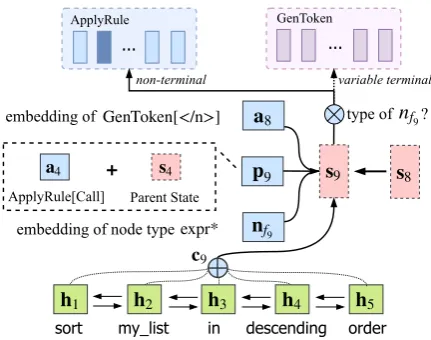
Figure 2: Illustration of a decoder time step (t= 9)
where fLSTM(·) is the LSTM update function. [:]denotes vector concatenation. st will then be used to compute action probabilitiesp(at|x, a<t) in Eq. (2). Here,at 1is the embedding of the pre-vious action. ctis a context vector retrieved from input encodings {hi} via soft attention. pt is a vector that encodes the information of the parent action. nft denotes the node type embedding of
the current frontier nodenft4. Intuitively, feeding
the decoder the information ofnfthelps the model
to keep track of the frontier node to expand.
Action Embedding at We maintain two action embedding matrices,WRandWG. Each row in WR (WG) corresponds to an embedding vector for an action APPLYRULE[r](GENTOKEN[v]).
Context Vectorct The decoder RNN uses soft at-tention to retrieve a context vectorctfrom the in-put encodings{hi}pertain to the prediction of the current action. We followBahdanau et al.(2014) and use a Deep Neural Network (DNN) with a sin-gle hidden layer to compute attention weights.
Parent Feeding pt Our decoder RNN uses ad-ditional neural connections to directly pass infor-mation from parent actions. For instance, when computings9, the information from its parent ac-tion stept4 will be used. Formally, we define the
parent action step pt as the time step at which the frontier node nft is generated. As an
exam-ple, for t9, its parent action step p9 is t4, since nf9 is the node?, which is generated att4 by the APPLYRULE[Call7!. . .]action.
We model parent information pt from two sources: (1) the hidden state of parent actionspt,
and (2) the embedding of parent actionapt. ptis
the concatenation. The parent feeding schema
ables the model to utilize the information of par-ent code segmpar-ents to make more confidpar-ent predic-tions. Similar approaches of injecting parent in-formation were also explored in the SEQ2TREE
model inDong and Lapata(2016)5.
4.2.2 Calculating Action Probabilities
In this section we explain how action probabilities
p(at|x, a<t)are computed based onst.
APPLYRULE The probability of applying rule r
as the current actionatis given by a softmax6:
p(at=APPLYRULE[r]|x, a<t) =
softmax(WR·g(st))|·e(r) (4) whereg(·)is a non-linearitytanh(W·st+b), and e(r)the one-hot vector for ruler.
GENTOKENAs in§3.2, a tokenv can be
gener-ated from a predefined vocabulary or copied from the input, defined as the marginal probability:
p(at=GENTOKEN[v]|x, a<t) = p(gen|x, a<t)p(v|gen, x, a<t)
+p(copy|x, a<t)p(v|copy, x, a<t). The selection probabilitiesp(gen|·)andp(copy|·) are given by softmax(WS · st). The prob-ability of generating v from the vocabulary, p(v|gen, x, a<t), is defined similarly as Eq. (4), except that we use the GENTOKEN embedding
matrixWG, and we concatenate the context vector ctwithstas input. To model the copy probability, we follow recent advances in modeling copying mechanism in neural networks (Gu et al., 2016;
Jia and Liang,2016;Ling et al.,2016), and use a pointer network (Vinyals et al.,2015) to compute the probability of copying thei-th word from the
input by attending to input representations{hi}:
p(wi|copy, x, a<t) =
exp(!(hi,st,ct))
Pn
i0=1exp(!(hi0,st,ct)) ,
where !(·) is a DNN with a single hidden layer. Specifically, ifwi is an OOV word (e.g., the vari-able name my list), which is represented by a
special<unk>token during encoding, we then
di-rectly copy the actual wordwi from the input de-scription to the derivation.
4.3 Training and Inference
Given a dataset of pairs of NL descriptionsxiand code snippetsci, we parse ci into its ASTyi and
5SEQ2TREEgenerates tree-structured outputs by
condi-tioning on the hidden states of parent non-terminals, while our parent feeding uses the states of parent actions.
6We do not show bias terms for all softmax equations.
Dataset HS DJANGO IFTTT
Train 533 16,000 77,495
Development 66 1,000 5,171
Test 66 1,805 758
Avg. tokens in description 39.1 14.3 7.4
Avg. characters in code 360.3 41.1 62.2
Avg. size of AST (# nodes) 136.6 17.2 7.0
Statistics of Grammar w/o unary closure
# productions 100 222 1009
# node types 61 96 828
terminal vocabulary size 1361 6733 0
Avg. # actions per example 173.4 20.3 5.0 w/ unary closure
# productions 100 237 –
# node types 57 92 –
[image:5.595.315.519.62.265.2]Avg. # actions per example 141.7 16.4 –
Table 2: Statistics of datasets and associated grammars
decompose yi into a sequence of oracle actions, which explains the generation story ofyiunder the grammar model. The model is then optimized by maximizing the log-likelihood of the oracle action sequence. At inference time, given an NL descrip-tion, we use beam search to approximate the best ASTyˆin Eq. (1). See supplementary materials for the pseudo-code of the inference algorithm.
5 Experimental Evaluation
5.1 Datasets and Metrics
HEARTHSTONE(HS) dataset (Ling et al.,2016)
is a collection of Python classes that implement cards for the card game HearthStone. Each card comes with a set of fields (e.g., name, cost, and description), which we concatenate to create the input sequence. This dataset is relatively difficult: input descriptions are short, while the target code is in complex class structures, with each AST hav-ing 137 nodes on average.
DJANGOdataset (Oda et al.,2015) is a collection of lines of code from the Django web framework, each with a manually annotated NL description. Compared with the HS dataset where card imple-mentations are somewhat homogenous, examples in DJANGOare more diverse, spanning a wide
va-riety of real-world use cases like string manipula-tion, IO operations, and exception handling.
IFTTT dataset (Quirk et al., 2015) is a domain-specific benchmark that provides an interest-ing side comparison. Different from HS and DJANGOwhich are in a general-purpose PL,
pro-grams in IFTTT are written in a domain-specific
App. Users of the App write simple instruc-tions (e.g., If Instagram.AnyNewPhotoByYou Then Dropbox.AddFileFromURL) with NL
de-scriptions (e.g., “Autosave your Instagram photos to Dropbox”). Each statement inside the If or Thenclause consists of a channel (e.g.,Dropbox)
and a function (e.g., AddFileFromURL)7. This
simple structure results in much more concise ASTs (7 nodes on average). Because all examples are created by ordinary Apps users, the dataset is highly noisy, with input NL very loosely con-nected to target ASTs. The authors thus provide a high-quality filtered test set, where each example is verified by at least three annotators. We use this set for evaluation. Also note IFTTT’s grammar has
more productions (Tab.2), but this does not imply that its grammar is more complex. This is because for HS and DJANGOterminal tokens are generated
by GENTOKENactions, but for IFTTT, all the code
is generated directly by APPLYRULEactions.
Metrics As is standard in semantic parsing, we measureaccuracy, the fraction of correctly gen-erated examples. However, because generating an exact match for complex code structures is non-trivial, we followLing et al.(2016), and use token-levelBLEU-4with as a secondary metric, defined as the averaged BLEU scores over all examples.8
5.2 Setup
Preprocessing All input descriptions are tok-enized using NLTK. We perform simple
canoni-calization for DJANGO, such as replacing quoted
strings in the inputs with place holders. See sup-plementary materials for details. We extract unary closures whose frequency is larger than a thresh-oldk(k= 30for HS and50for DJANGO).
ConfigurationThe size of all embeddings is 128, except for node type embeddings, which is 64. The dimensions of RNN states and hidden layers are 256 and 50, respectively. Since our datasets are relatively small for a data-hungry neural model, we impose strong regularization using recurrent
7LikeBeltagy and Quirk(2016), we strip function
param-eters since they are mostly specific to users.
8These two metrics are not ideal: accuracy only measures
exact match and thus lacks the ability to give credit to seman-tically correct code that is different from the reference, while it is not clear whether BLEU provides an appropriate proxy for measuring semantics in the code generation task. A more intriguing metric would be directly measuring semantic/func-tional code equivalence, for which we present a pilot study at the end of this section (cf. Error Analysis). We leave ex-ploring more sophisticated metrics (e.g. based on static code analysis) as future work.
HS DJANGO ACC BLEU ACC BLEU Retrieval System† 0.0 62.5 14.7 18.6
Phrasal Statistical MT† 0.0 34.1 31.5 47.6
Hierarchical Statistical MT† 0.0 43.2 9.5 35.9
NMT 1.5 60.4 45.1 63.4
SEQ2TREE 1.5 53.4 28.9 44.6
SEQ2TREE–UNK 13.6 62.8 39.4 58.2
LPN† 4.5 65.6 62.3 77.6
Our system 16.2 75.8 71.6 84.5
Ablation Study
– frontier embed. 16.7 75.8 70.7 83.8 – parent feed. 10.6 75.7 71.5 84.3 – copy terminals 3.0 65.7 32.3 61.7
+ unary closure – 70.3 83.3
– unary closure 10.1 74.8 –
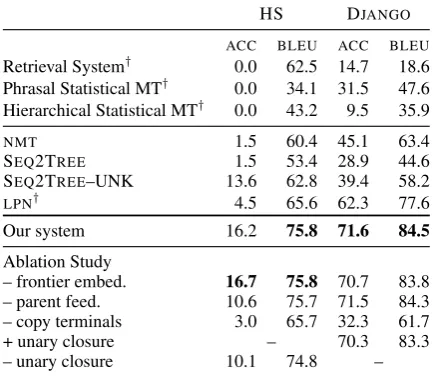
Table 3: Results on two Python code generation tasks.
†Results previously reported inLing et al.(2016).
dropouts (Gal and Ghahramani, 2016) for all re-current networks, together with standard dropout layers added to the inputs and outputs of the de-coder RNN. We validate the dropout probability from {0,0.2,0.3,0.4}. For decoding, we use a beam size of 15.
5.3 Results
Evaluation results for Python code generation tasks are listed in Tab. 3. Numbers for our sys-tems are averaged over three runs. We compare primarily with two approaches: (1) Latent Pre-dictor Network (LPN), a state-of-the-art
sequence-to-sequence code generation model (Ling et al.,
2016), and (2) SEQ2TREE, a neural semantic
pars-ing model (Dong and Lapata,2016). SEQ2TREE
generates trees one node at a time, and the tar-get grammar is not explicitly modeled a priori, but implicitly learned from data. We test both the original SEQ2TREEmodel released by the
au-thors and our revised one (SEQ2TREE–UNK) that
uses unknown word replacement to handle rare words (Luong et al., 2015). For completeness, we also compare with a strong neural machine translation (NMT) system (Neubig, 2015) using a
standard encoder-decoder architecture with atten-tion and unknown word replacement9, and include
numbers from other baselines used in Ling et al.
(2016). On the HS dataset, which has relatively large ASTs, we use unary closure for our model and SEQ2TREE, and for DJANGOwe do not.
9ForNMT, we also attempted to find the best-scoring
[image:6.595.308.525.64.252.2]Figure 3: Performance w.r.t reference AST size on DJANGO
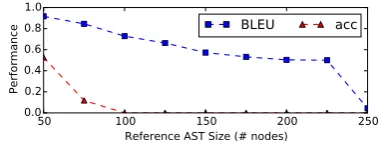
Figure 4: Performance w.r.t reference AST size on HS
System Comparison As in Tab. 3, our model registers 11.7% and 9.3% absolute improvements overLPN in accuracy on HS and DJANGO. This
boost in performance strongly indicates the impor-tance of modeling grammar in code generation. For the baselines, we findLPN outperformsNMT
and SEQ2TREE in most cases. We also note that
SEQ2TREE achieves a decent accuracy of 13.6%
on HS, which is due to the effect of unknown word replacement, since we only achieved 1.5% with-out it. A closer comparison with SEQ2TREE is
insightful for understanding the advantage of our syntax-driven approach, since both SEQ2TREE
and our system output ASTs: (1) SEQ2TREE
pre-dicts one node each time step, and requires addi-tional “dummy” nodes to mark the boundary of a subtree. The sheer number of nodes in target ASTs makes the prediction process error-prone. In contrast, the APPLYRULEactions of our grammar
model allows for generating multiple nodes at a single time step. Empirically, we found that in HS, SEQ2TREEtakes more than 300 time steps on
av-erage to generate a target AST, while our model takes only 170 steps. (2) SEQ2TREEdoes not
di-rectly use productions in the grammar, which pos-sibly leads to grammatically incorrect ASTs and thus empty code outputs. We observe that the ra-tio of grammatically incorrect ASTs predicted by SEQ2TREE on HS and DJANGO are 21.2% and
10.9%, respectively, while our system guarantees grammaticality.
Ablation Study We also ablated our best-performing models to analyze the contribution of each component. “–frontier embed.” removes the frontier node embedding nft from the decoder
RNN inputs (Eq. (3)). This yields worse results on DJANGO while gives slight improvements in
ac-CHANNEL FULLTREE
Classical Methods
posclass (Quirk et al.,2015) 81.4 71.0
LR (Beltagy and Quirk,2016) 88.8 82.5
Neural Network Methods
NMT 87.7 77.7
NN (Beltagy and Quirk,2016) 88.0 74.3
SEQ2TREE(Dong and Lapata,2016) 89.7 78.4
Doubly-Recurrent NN 90.1 78.2
(Alvarez-Melis and Jaakkola,2017)
Our system 90.0 82.0
– parent feed. 89.9 81.1
– frontier embed. 90.1 78.7
Table 4: Results on the noise-filtered IFTTTtest set of “>3 agree with gold annotations” (averaged over three runs), our model performs competitively among neural models.
curacy on HS. This is probably because that the grammar of HS has fewer node types, and thus the RNN is able to keep track ofnft without
de-pending on its embedding. Next, “–parent feed.” removes the parent feeding mechanism. The ac-curacy drops significantly on HS, with a marginal deterioration on DJANGO. This result is
interest-ing because it suggests that parent feedinterest-ing is more important when the ASTs are larger, which will be the case when handling more complicated code generation tasks like HS. Finally, removing the pointer network (“–copy terminals”) in GENTO -KEN actions gives poor results, indicating that it
is important to directly copy variable names and values from the input.
The results with and without unary closure demonstrate that, interestingly, it is effective on HS but not on DJANGO. We conjecture that this is
because on HS it significantly reduces the number of actions from 173 to 142 (c.f., Tab.2), with the number of productions in the grammar remaining unchanged. In contrast, DJANGO has a broader
domain, and thus unary closure results in more productions in the grammar (237 for DJANGO
vs. 100 for HS), increasing sparsity.
Performance by the size of ASTWe further in-vestigate our model’s performance w.r.t. the size of the gold-standard ASTs in Figs. 3and4. Not surprisingly, the performance drops when the size of the reference ASTs increases. Additionally, on the HS dataset, the BLEU score still remains at around 50 even when the size of ASTs grows to 200, indicating that our proposed syntax-driven approach is robust for long code segments.
Domain Specific Code GenerationAlthough this is not the focus of our work, evaluation on IFTTT
[image:7.595.83.275.155.226.2]set-input <name>Brawl</name> <cost>5</cost> <desc>
Destroy all minions except one (chosen randomly)
</desc> <rarity>Epic</rarity>...
pred. classBrawl(SpellCard):
def init (self):
super(). init (’Brawl’, 5, CHARACTER CLASS.
WARRIOR, CARD RARITY.EPIC)
defuse(self, player, game):
super().use(player, game)
targets = copy.copy(game.other player.minions) targets.extend(player.minions)
forminion intargets:
minion.die(self) A
ref. minions = copy.copy(player.minions)
minions.extend(game.other player.minions)
if len(minions) >1:
survivor = game.random choice(minions)
forminion inminions:
ifminion is not survivor: minion.die(self)
B
input join app config.path and string ’locale’ into a file path, substitute it for localedir.
pred. localedir = os.path.join(
app config.path, ’locale’) 3
input self.plural is an lambda function with an argument n, which returns result of boolean expression n not equal to integer 1
pred. self.plural = lambda n: len(n) 7
[image:8.595.70.291.65.338.2]ref. self.plural = lambda n: int(n!=1)
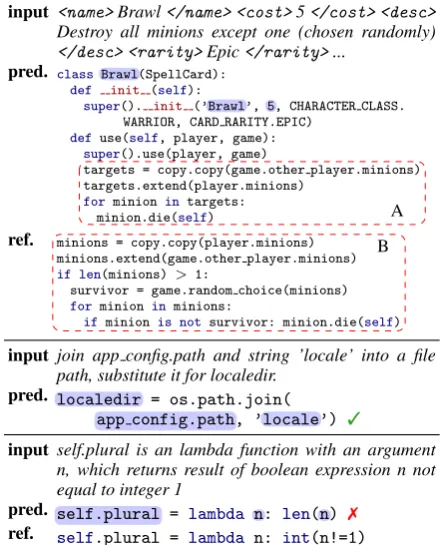
Table 5: Predicted examples from HS (1st) and DJANGO. Copied contents (copy probability>0.9) are highlighted.
ting, which helps to investigate similarities and differences between generation of more compli-cated general-purpose code and and more limited-domain simpler code. Tab. 4 shows the results, following the evaluation protocol in (Beltagy and Quirk, 2016) for accuracies at both channel and full parse tree (channel + function) levels. Our full model performs on par with existing neu-ral network-based methods, while outperforming other neural models in full tree accuracy (82.0%). This score is close to the best classical method (LR), which is based on a logistic regression model with rich hand-engineered features (e.g., brown clusters and paraphrase). Also note that the performance betweenNMTand other neural
mod-els is much closer compared with the results in Tab. 3. This suggests that general-purpose code generation is more challenging than the simpler IFTTT setting, and therefore modeling structural
information is more helpful.
Case Studies We present output examples in Tab. 5. On HS, we observe that most of the time our model gives correct predictions by fill-ing learned code templates from trainfill-ing data with arguments (e.g., cost) copied from input. This is in line with the findings inLing et al.(2016). How-ever, we do find interesting examples indicating that the model learns to generalize beyond trivial
copying. For instance, the first example is one that our model predicted wrong — it generated code block A instead of the gold B (it also missed a function definition not shown here). However, we find that the block A actually conveys part of the input intent by destroying all, not some, of the minions. Since we are unable to find code block A in the training data, it is clear that the model has learned to generalize to some extent from multiple training card examples with similar semantics or structure.
The next two examples are from DJANGO. The
first one shows that the model learns the usage of common API calls (e.g.,os.path.join), and
how to populate the arguments by copying from inputs. The second example illustrates the dif-ficulty of generating code with complex nested structures like lambda functions, a scenario worth further investigation in future studies. More exam-ples are attached in supplementary materials.
Error Analysis To understand the sources of er-rors and how good our evaluation metric (exact match) is, we randomly sampled and labeled 100 and 50 failed examples (with accuracy=0) from DJANGO and HS, respectively. We found that
around 2% of these examples in the two datasets are actually semantically equivalent. These exam-ples include: (1) using different parameter names when defining a function; (2) omitting (or adding) default values of parameters in function calls. While the rarity of such examples suggests that our exact match metric is reasonable, more advanced evaluation metrics based on statistical code analy-sis are definitely intriguing future work.
For DJANGO, we found that 30% of failed cases
were due to errors where the pointer network failed to appropriately copy a variable name into the correct position. 25% were because the gener-ated code only partially implemented the required functionality. 10% and 5% of errors were due to malformed English inputs and pre-processing er-rors, respectively. The remaining 30% of exam-ples were errors stemming from multiple sources, or errors that could not be easily categorized into the above. For HS, we found that all failed card examples were due to partial implementation er-rors, such as the one shown in Table5.
6 Related Work
Barzilay,2013;Raza et al.,2015;Manshadi et al.,
2013), with neural network-based approaches re-cently explored (Liu et al.,2016;Parisotto et al.,
2016; Balog et al., 2016). For general-purpose code generation, besides the general framework of Ling et al. (2016), existing methods often use language and task-specific rules and strate-gies (Lei et al.,2013;Raghothaman et al.,2016). A similar line is to use NL queries for code re-trieval (Wei et al.,2015;Allamanis et al., 2015). The reverse task of generating NL summaries from source code has also been explored (Oda et al.,
2015;Iyer et al.,2016). Finally, our work falls into the broad field of probabilistic modeling of source code (Maddison and Tarlow,2014;Nguyen et al.,
2013). Our approach of factoring an AST using probabilistic models is closely related to Allama-nis et al.(2015), which uses a factorized model to measure the semantic relatedness between NL and ASTs for code retrieval, while our model tackles the more challenging generation task.
Semantic ParsingOur work is related to the gen-eral topic of semantic parsing, which aims to transform NL descriptions into executable logical forms. The target logical forms can be viewed as DSLs. The parsing process is often guided by grammatical formalisms like combinatory cate-gorical grammars (Kwiatkowski et al.,2013;Artzi et al., 2015), dependency-based syntax (Liang et al., 2011; Pasupat and Liang, 2015) or task-specific formalisms (Clarke et al.,2010;Yih et al.,
2015; Krishnamurthy et al., 2016; Mei et al.,
2016). Recently, there are efforts in designing neural network-based semantic parsers (Misra and Artzi,2016;Dong and Lapata,2016;Neelakantan et al.,2016;Yin et al.,2016). Several approaches have be proposed to utilize grammar knowledge in a neural parser, such as augmenting the training data by generating examples guided by the gram-mar (Kocisk´y et al., 2016;Jia and Liang, 2016).
Liang et al. (2016) used a neural decoder which constrains the space of next valid tokens in the query language for question answering. Finally, the structured prediction approach proposed by
Xiao et al.(2016) is closely related to our model in using the underlying grammar as prior knowledge to constrain the generation process of derivation trees, while our method is based on a unified gram-mar model which jointly captures production rule application and terminal symbol generation, and scales to general purpose code generation tasks.
7 Conclusion
This paper proposes a syntax-driven neural code generation approach that generates an abstract syntax tree by sequentially applying actions from a grammar model. Experiments on both code gen-eration and semantic parsing tasks demonstrate the effectiveness of our proposed approach.
Acknowledgment
We are grateful to Wang Ling for his generous help withLPNand setting up the benchmark. We thank
I. Beltagy for providing the IFTTT dataset. We
also thank Li Dong for helping with SEQ2TREE
and insightful discussions.
References
Miltiadis Allamanis, Daniel Tarlow, Andrew D. Gor-don, and Yi Wei. 2015. Bimodal modelling of
source code and natural language. InProceedings
of ICML. volume 37.
David Alvarez-Melis and Tommi S. Jaakkola. 2017. Tree-structured decoding with doubly recurrent
neu-ral networks. InProceedings of ICLR.
Yoav Artzi, Kenton Lee, and Luke Zettlemoyer. 2015. Broad-coverage CCG semantic parsing with AMR. InProceedings of EMNLP.
Yoav Artzi and Luke Zettlemoyer. 2013. Weakly su-pervised learning of semantic parsers for mapping instructions to actions. Transaction of ACL1(1).
Dzmitry Bahdanau, Kyunghyun Cho, and Yoshua
Bengio. 2014. Neural machine translation by
jointly learning to align and translate. CoRR
abs/1409.0473.
Matej Balog, Alexander L. Gaunt, Marc Brockschmidt, Sebastian Nowozin, and Daniel Tarlow. 2016.
Deepcoder: Learning to write programs. CoRR
abs/1611.01989.
Robert Balzer. 1985. A 15 year perspective on
au-tomatic programming. IEEE Trans. Software Eng.
11(11).
Laura Banarescu, Claire Bonial, Shu Cai, Madalina Georgescu, Kira Griffitt, Ulf Hermjakob, Kevin Knight, Philipp Koehn, Martha Palmer, and Nathan Schneider. 2013. Abstract meaning representation
for sembanking. InProceedings of LAW-ID@ACL.
I. Beltagy and Chris Quirk. 2016. Improved seman-tic parsers for if-then statements. InProceedings of ACL.
Jonathan Berant, Andrew Chou, Roy Frostig, and Percy Liang. 2013. Semantic parsing on freebase from
Joel Brandt, Mira Dontcheva, Marcos Weskamp, and Scott R. Klemmer. 2010. Example-centric program-ming: integrating web search into the development
environment. InProceedings of CHI.
Joel Brandt, Philip J. Guo, Joel Lewenstein, Mira Dontcheva, and Scott R. Klemmer. 2009. Two stud-ies of opportunistic programming: interleaving web foraging, learning, and writing code. InProceedings of CHI.
Stephen Clark and James R. Curran. 2007. Wide-coverage efficient statistical parsing with CCG and log-linear models. Computational Linguistics33(4).
James Clarke, Dan Goldwasser, Ming-Wei Chang, and Dan Roth. 2010. Driving semantic parsing from the
world’s response. InProceedings of CoNLL.
Li Dong and Mirella Lapata. 2016. Language to logical form with neural attention. InProceedings of ACL.
Yarin Gal and Zoubin Ghahramani. 2016. A theoret-ically grounded application of dropout in recurrent
neural networks. InProceedings of NIPS.
Jiatao Gu, Zhengdong Lu, Hang Li, and Victor O. K.
Li. 2016. Incorporating copying mechanism in
sequence-to-sequence learning. In Proceedings of
ACL.
Tihomir Gvero and Viktor Kuncak. 2015. Interactive
synthesis using free-form queries. In Proceedings
of ICSE.
Sepp Hochreiter and J¨urgen Schmidhuber. 1997. Long
short-term memory.Neural Computation9(8).
Srinivasan Iyer, Ioannis Konstas, Alvin Cheung, and Luke Zettlemoyer. 2016. Summarizing source code
using a neural attention model. InProceedings of
ACL.
Robin Jia and Percy Liang. 2016. Data recombination for neural semantic parsing. InProceedings of ACL.
Tom´as Kocisk´y, G´abor Melis, Edward Grefenstette, Chris Dyer, Wang Ling, Phil Blunsom, and Karl Moritz Hermann. 2016. Semantic parsing with
semi-supervised sequential autoencoders. In
Pro-ceedings of EMNLP.
Jayant Krishnamurthy, Oyvind Tafjord, and Aniruddha Kembhavi. 2016. Semantic parsing to probabilistic
programs for situated question answering. In
Pro-ceedings of EMNLP.
Nate Kushman and Regina Barzilay. 2013. Using se-mantic unification to generate regular expressions
from natural language. InProceedings of NAACL.
Tom Kwiatkowski, Eunsol Choi, Yoav Artzi, and
Luke S. Zettlemoyer. 2013. Scaling semantic
parsers with on-the-fly ontology matching. In
Pro-ceedings of the EMNLP.
Tao Lei, Fan Long, Regina Barzilay, and Martin C. Ri-nard. 2013. From natural language specifications to
program input parsers. InProceedings of ACL.
Chen Liang, Jonathan Berant, Quoc Le, Kenneth D. Forbus, and Ni Lao. 2016. Neural symbolic ma-chines: Learning semantic parsers on freebase with
weak supervision. CoRRabs/1611.00020.
Percy Liang, Michael I. Jordan, and Dan Klein. 2011. Learning dependency-based compositional seman-tics. InProceedings of ACL.
Wang Ling, Phil Blunsom, Edward Grefenstette, Karl Moritz Hermann, Tom´as Kocisk´y, Fumin Wang, and Andrew Senior. 2016. Latent predictor
networks for code generation. In Proceedings of
ACL.
Greg Little and Robert C. Miller. 2009. Keyword pro-gramming in java. Autom. Softw. Eng.16(1). Chang Liu, Xinyun Chen, Eui Chul Richard Shin,
Mingcheng Chen, and Dawn Xiaodong Song. 2016. Latent attention for if-then program synthesis. In Proceedings of NIPS.
Thang Luong, Ilya Sutskever, Quoc V. Le, Oriol Vinyals, and Wojciech Zaremba. 2015. Addressing the rare word problem in neural machine translation. InProceedings of ACL.
Chris J. Maddison and Daniel Tarlow. 2014. Structured
generative models of natural source code. In
Pro-ceedings of ICML.
Mehdi Hafezi Manshadi, Daniel Gildea, and James F. Allen. 2013. Integrating programming by example
and natural language programming. InProceedings
of AAAI.
Hongyuan Mei, Mohit Bansal, and Matthew R. Wal-ter. 2016. Listen, attend, and walk: Neural mapping of navigational instructions to action sequences. In Proceedings of AAAI.
Dipendra K. Misra and Yoav Artzi. 2016. Neural
shift-reduce CCG semantic parsing. In Proceedings of
EMNLP.
Dipendra Kumar Misra, Kejia Tao, Percy Liang, and Ashutosh Saxena. 2015. Environment-driven lex-icon induction for high-level instructions. In Pro-ceedings of ACL.
Arvind Neelakantan, Quoc V. Le, and Ilya Sutskever. 2016. Neural programmer: Inducing latent
pro-grams with gradient descent. In Proceedings of
ICLR.
Graham Neubig. 2015. lamtram: A toolkit for lan-guage and translation modeling using neural net-works. http://www.github.com/neubig/lamtram. Tung Thanh Nguyen, Anh Tuan Nguyen, Hoan Anh
Nguyen, and Tien N. Nguyen. 2013. A statistical
semantic language model for source code. In
Yusuke Oda, Hiroyuki Fudaba, Graham Neubig, Hideaki Hata, Sakriani Sakti, Tomoki Toda, and
Satoshi Nakamura. 2015. Learning to generate
pseudo-code from source code using statistical ma-chine translation (T). InProceedings of ASE. Emilio Parisotto, Abdel-rahman Mohamed, Rishabh
Singh, Lihong Li, Dengyong Zhou, and Pushmeet Kohli. 2016. Neuro-symbolic program synthesis.
CoRRabs/1611.01855.
Panupong Pasupat and Percy Liang. 2015. Composi-tional semantic parsing on semi-structured tables. In Proceedings of ACL.
Python Software Foundation. 2016. Python abstract grammar. https://docs.python.org/2/library/ast.html.
Chris Quirk, Raymond J. Mooney, and Michel Galley. 2015. Language to code: Learning semantic parsers for if-this-then-that recipes. InProceedings of ACL.
Mukund Raghothaman, Yi Wei, and Youssef Hamadi. 2016. SWIM: synthesizing what i mean: code search and idiomatic snippet synthesis. In Proceed-ings of ICSE.
Mohammad Raza, Sumit Gulwani, and Natasa Milic-Frayling. 2015. Compositional program synthesis
from natural language and examples. In
Proceed-ings of IJCAI.
Lappoon R. Tang and Raymond J. Mooney. 2001. Us-ing multiple clause constructors in inductive logic
programming for semantic parsing. InProceedings
of ECML.
Oriol Vinyals, Meire Fortunato, and Navdeep Jaitly.
2015. Pointer networks. InProceedings of NIPS.
Yi Wei, Nirupama Chandrasekaran, Sumit
Gul-wani, and Youssef Hamadi. 2015.
Build-ing bing developer assistant.
Techni-cal report.
https://www.microsoft.com/en- us/research/publication/building-bing-developer-assistant/.
Chunyang Xiao, Marc Dymetman, and Claire Gardent. 2016. Sequence-based structured prediction for
se-mantic parsing. InProceedings of ACL.
Wen-tau Yih, Ming-Wei Chang, Xiaodong He, and Jianfeng Gao. 2015. Semantic parsing via staged query graph generation: Question answering with
knowledge base. InProceedings of ACL.
Pengcheng Yin, Zhengdong Lu, Hang Li, and Ben Kao. 2016. Neural enquirer: Learning to query tables in natural language. InProceedings of IJCAI.