Munich Personal RePEc Archive
Time-inconsistent environmental policies
with a consumer-friendly firm: tradable
permits versus emission tax
Garcia, Arturo and Leal, Mariel and Lee, Sang-Ho
Technologico de Monterrey, Technologico de Monterrey, Chonnam
National University
1 April 2018
Online at
https://mpra.ub.uni-muenchen.de/86407/
Time-inconsistent environmental policies with a consumer-friendly firm:
tradable permits versus emission tax
Abstract
This study considers the timing of environmental policies with a consumer-friendly firm having
abate-ment technology, and compares two market-based regulations: tradable permits and emission tax
regu-lations. When the government can credibly commit its policy, we show that the equilibrium outcomes
under both policies are equivalent in terms of permits price and tax rate. Under the non-committed
policy, however, the equivalence breaks down because firms have different incentives to induce
time-consistent policy to be adjusted ex post. In particular, compared to pre-committed government, firms
abate less emission to induce higher emission quotas under the permits policy while a consumer-friendly
firm abates more emissions to reduce tax rate under the tax policy. Finally, we show that tax policy
can induce higher welfare and lower environmental damage when the concern on consumer surplus is
moderate.
Keywords: abatement technology; consumer-friendly firm; environmental policy; tradable permits; emission tax
JEL classification: L13; L31; Q5
1. Introduction
During the last generation, the waves of market-based environmental protection have been salient
features of economic policies in polluting industries around the world. In light of the increasing
impor-tance of such environmental policy, the government has continuously conducted various environmental
regulation by using emission standards, quotas, subsidies, taxes and tradable permits. In particular, the
5
widespread acceptance of permits trading program generates an interesting debate among researchers
on the efficiency of environmental and climate change policy.1 Many economists have shown that
1
Kato (2006) introduced some useful real-world discussions on the tradable emission permits as climate change policy
instrument in the United Nations. Since the United States implemented permits trading system experimentally in 1980s,
many countries including the European Union and China introduced this program gradually during the last decade.
governments can promote social welfare by implementing market allocation of tradable permits or,
equivalently, emission taxes since they can minimize abatement costs when they differ between firms.2
Recent works on tradable permits have been conducted in a different situation of mixed market
10
where the objectives among firms differ. For example, Kato (2006, 2011) examined a standard mixed
market where a welfare-maximizing public firm competes with private firms whose objectives are to
maximize profits with homogeneous products in the same market.3 He showed that this asymmetry in
their objectives can work for improving social welfare even if the abatement technologies are the same
because tradable permits can induce the equalization of the marginal costs among firms.
15
The present paper extends the analysis into the other context of mixed market which are
char-acterized by the co-existence of for-profit firms and not-for-profit firms. In particular, we consider a
consumer-friendly firm which competes with a for-profit firm in a mixed duopoly market under the
same abatement technologies. We define the objective of the consumer-friendly firm as a combination
of consumer surplus and its profits. Thus, the firm puts a higher weight on output in order to commit
20
to a higher output than rival firm. This type of formulation can be viewed as one way of adopting
corporate social responsibility (CSR) initiatives, in which it utilizes consumer surplus as a proxy of
CSR concern.4 Owing to the current expansion of CSR, the heterogeneity of objectives among the
firms in this mixed market configuration is an essential part of our analysis.
This study examines tradable permits policy and compares its efficiency with that of emission tax
25
policy in the presence of a consumer-friendly firm. Further, we allow the possible ability of a
govern-ment to commit credibly to an environgovern-mental policy when a pollution-reducing abategovern-ment activity is
present. When the government determines its policy ex-ante, i.e., before the firms make their abatement
decisions, it can be credible only when the regulator possesses a commitment mechanism. Thus, if the
government can commit the level of permits or tax, both policies are fully equivalent under perfect
30
competition. However, once abatement has been chosen by the firms, the optimal policy determined
ex-ante is not ex-post optimal. This is because firms’ abatement costs are already sunk and thus the
world.
2
For example, Borenstein (1988), Malueg (1990) and Sartzetakis (1997) showed that the tradable permits can increase
social welfare in the competitive production and emission markets when there are differences with respect to the abatement
technologies among regulated firms. However, Requate (1993), Sartzetakis (2004) and Lee and Park (2005) demonstrated
that if firms differ in both production and abatement technologies, the tradable permits cannot always assure efficiency.
3
On the other hand, recent works on mixed markets with environmental tax policies can be found in Ohori (2006),
Wang and Wang (2009), Pal and Saha (2015), Xu and Lee (2015, 2018) and Xu et al. (2016).
4
Numerous theoretical studies have recently analyzed this type of formulation for analyzing the CSR activities in
different competition models. For example, see Goering (2012, 2014), Kopel and Brand (2012), Chang et al. (2014),
ex post government objective function differs from the ex-ante. Thus, such policies which require firms
to invest may be subject to a time-inconsistency problem. It resembles a hold-up problem, caused
by the strategic behavior of firms. Therefore, if the government cannot react to the firm’s abatement
35
activities, the equivalence of both policies might break down. This suggests that the ability of credible
commitment to an environmental policy in the policy-making process has significant implications to
support the equivalence between the two policies associated with a committed policy.
In the previous literature of environmental economics, Denicol`o (1999), Gersbach and Glazer (1999),
Requate and Unold (2003) investigated the commitment problem when the regulator is not able to
com-40
mit credibly to permits policy and shed light on the ex ante and ex post welfare effects of strategic
behaviors of the regulated firms. Petrakis and Xepapadeas (1999, 2001) and Poyago-Theotoky and
Teerasuwannajak (2002) pointed out the time-inconsistency problem under emission tax policy and
showed that if the regulator cannot commit credibly to the stringency of the tax, firms have strategic
incentives because the regulator has an ex-post possibility to ratchet up regulation. D’Amato and
Di-45
jkstra (2015) also examined environmental technology adoption with/without long-term commitment
in which the government ex-ante commits a tax rate before the innovation takes place or adjusts an
ex-post tax rate after the firms invest.5 Regarding the strategic choices in a dynamic setting with
comparison between taxes (price regulation) and permits (quantity regulation), Montero (2011), Wirl
(2014) and Moner-Colonques and Rubio (2015) examined firm’s innovation incentives when the
govern-50
ment has time-consistent temptations to revise its policy design after innovation and showed that the
performance of two policy instruments differ.
The present paper adopts the recent analysis of the comparison between the two market-based
environmental policies, tradable permits and emission tax policies, in a mixed duopoly with a
consumer-friendly firm in order to examine the efficiency between committed ex-ante policy and non-committed
55
ex-post policy. As a closely related work, Moner-Colonques and Rubio (2015) examined the timing of
the environmental policy in a private duopoly model where both firms have the same profit functions,
and showed that the welfare results between emission standard and emission tax depend on the efficiency
of abatement technology. However, our analysis considers a mixed duopoly model where both firms have
asymmetric payoff functions, and examines trading emission permits policy rather than non-tradable
60
emission permits policy. Hence, these two differences lead to different policy implications.
Under the committed policy, we show that the equilibrium outcomes under both policies are
equiv-alent in terms of permit price and tax rate. We also show that both permits price and tax increase as
5
Recent analysis of the timing of ex-post tax policies in mixed oligopolies can be found in Xu et al. (2017), Hsu et al.
the concern on consumer surplus rises because higher productions from the larger concern on consumer
surplus cause higher total emissions. Further, we show that both firms can earn higher profits with
65
permits rather than a tax, but the profit of a consumer-friendly firm is always larger than rival’s profit
ir-respective of policy instruments. However, both welfare and environmental damage are simultaneously
decreasing or increasing depending on the degree of consumer-friendliness. Thus, higher asymmetry
between the firms might result in the welfare loss, which can outweigh the gains obtained from the
environmental regulation. This result represents a typical trade-off between welfare and environmental
70
damage under the committed policy regime.
We also compare permits and tax policies under the non-committed policy and show that some
results under the committed policy still hold. However, we also find several different results in which
the equivalence breaks down.
First, both market price of permits and tax rate increase as the concern on consumer surplus rises
75
but permits price is always higher than the tax rate. This is because firms have different incentives to
induce ex-post time-consistent policy under the non-committed policy. In particular, compared to the
outcomes under the committed policy, both firms reduce abatement levels under the permits policy to
increase their emission quotas unless the concern is too large while a consumer-friendly firm increases
its abatement levels under the tax policy to reduce tax rate unless the concern is too small. Thus, the
80
significance of strategic incentives of the firms affect the equivalence properties of both policies.
Second, the abatement activities and emissions of a consumer-friendly firm are always larger than
those of a for-profit firm, but its relative amounts depend on the concern on consumer surplus and
policy instruments. In particular, both firms’ abatement activities under permits are always lower than
tax, and thus, total emissions under permits might be more significant than those under tax when the
85
consumer-friendliness is high.
Finally, under both policies, it is possible that welfare increases but environmental damage decreases
when the consumer-friendliness is not too large. This result sharply contrasts to the result under the
committed policy. Furthermore, under the non-committed policy, tax policy induces higher welfare
and lower environmental damage than permits policy when the consumer-friendliness is moderate.
90
Therefore, due to the larger time-consistent distortion of abatement activities with permits policy, tax
can be a better policy than permits in the presence of a consumer-friendly firm.
The remainder of this paper is organized as follows. In section 2, we formulate a Cournot duopoly
model with a consumer-friendly firm having abatement technology. We analyze tradable permits and
tax, respectively, in section 3 and 4. Finally, section 5 compares the results 5 and provide main finings.
95
2. Model
We consider a quantity-setting Cournot duopoly model.6 One of the firms is a consumer-friendly
(CF) firm (hereafter referred to as firm 0) that cares for not only its profits but consumers surplus. The
other is a for-profit (FP) firm (hereafter referred to as firm 1) that maximizes its profits only. Firms sell
100
homogeneous output,q0>0 andq1>0, respectively, at the market clearing pricep(Q) = 1−Qwhere
Q=q0+q1. We assume that both firms have identical technologies and the production cost function
takes a quadratic form,c(qi) =qi2,i∈ {0,1}.
Production leads to pollution,ei >0, but each firm can reduce pollution by undertaking abatement
activities. Suppose that firmichooses pollution abatement level zi >0. Then, the emission level can
105
be reduced toei=qi−zi by investing an amount of z
2
i
2 in abatement.
7
The government has a responsibility to regulate emissions. We consider two policy options that the
regulator may use to protect the environment. The first policy is a tradable permits regulation: The
government decides the total emission levels to maximize the social welfare and then assigns emission
quotas (permits)Ei to each firm. At the same time, the government allows the firms to trade emission
110
permits at the emission trading market.8 We assumed that the emission trading market is competitive
and thus the emission trading occurs by the market clearing price.9 Thus, if we define the net demand
of firm i as Di = ei−Ei, total net demand of emission permits is zero at the market equilibrium
D0+D1= 0.
The profit of firmiis given by:
πi=p·qi−q2i −
1 2z
2
i −λ· ei−Ei
, i= 0,1 (1)
The second policy consists in an emission tax regulation: The government imposes a tax on the
emission level, for which the tax rate ist. The resulting total tax revenue collected by the government
isT =tP
iei. The profit of firmiis given by:
πi=p·qi−q2i −
1 2z
2
i −t·ei, i= 0,1 (2)
We assume that the FP firm seeks only for profit maximization. However, the CF firm maximizes
profits plus a fraction of consumer surplus, CS= Q22. Thus, the payoff that CF firm maximizes is as
6
Our model could be extended to the oligopoly model without further insights gained.
7
The specific function guarantees the interior solutions in the equilibrium forθ∈[0,1].
8
This is the only difference with the command-and-control regulation of assigning emission quotas. We compared
non-tradable emission permits and tradable emission permits policies in Appendix B.
9
It implies that both firms do not have market powers in the emission market, but product market is in a duopolistic
competition. Regarding the interaction of a competitive market for emission permits with an imperfectly competitive
follows:
V0=π0+θCS (3)
The parameterθ∈[0,1] measures the degree of concern on consumer surplus that the CF firm has, as
115
a CSR-initiative, which is exogenously given.
The extent of environmental damage due to pollution by the industry is given by ED= (
P iei)
2
2 .
Note that total environmental damage under permits policy with an emission quota Ei to each firm
becomesED = (
P iEi)
2
2 . Then, the social welfare is the sum of consumer surplus (CS), the profits of
both firms (π0+π1) and the total taxes collected by the government (T) minus environmental damage
(ED):
W =CS+π0+π1+T−ED (4)
whereT = 0 if the government implements a tradable permits policy.10
We shall consider two alternative policy regimes, each featuring a three-stage game between a
welfare maximizing regulator and two firms with different objectives. Both policies are analyzed in
the context of committed or non-committed policy. In the committed policy, the regulator sets the
120
environmental instrument value such as emission quotas or tax, depending on policy implemented.
Taking the instrument value as given, the firms choose investment in abatement effort simultaneously
and independently. In thenon-committed policy, firms first select its abatement level, simultaneously
and independently, and then the regulator sets the emission quotas or tax. Finally, the firms select
output in the third stage.
125
10
We assume that the government utilizes a grandfathering approach for initial allocating of costless permits to the
firms. It has by far been the dominant allocation approach in practice, both because it can offset the costs of emission
reduction as well as for political reasons. See Stavins (1998) and Fowlie (2010). However, if the government implements
an auctioning for the initial allocating of permits,T is a fixed lump-sum amount and thus we can treat it as a constant
number. On the other hand, while the emission tax revenue can provide double-dividend effect, which can be used for not
only externality but for public finance to eliminate other distorting tax system such as income tax, the emission tax has
its own distorting effects on labor supply, which can have the excess burden as a tax on labor income. In the following
3. Committed policy
3.1. Tradable emission permits
In the third stage firms 0 and 1 choose their outputs to maximize (3) and (1), respectively. By
solving these problems the equilibrium output as a function of the permit price,λ, is obtained:
q0= (3 +θ)(1−λ)
3(5−θ) , q1=
(3−θ)(1−λ)
3(5−θ) , Q=
2(1−λ)
5−θ (5)
Note that each firm’s output decreases in the permit price. Also if the concern on consumer surplus
rises, the CF firm is more aggressive and thus increases its output while the FP firm decreases the
output. However, the total outputs increases.
130
In the second stage, firms choose abatement efforts to maximize their payoffs. Firm 0 choosesz0that
maximizes (3) while firm 1 choosesz1that maximizes (1). Solving these problems gives the equilibrium
abatement level as a function of the permit price:
zi=λ, i∈ {0,1} (6)
that defines a positive relationship between abatement and the permit price. It simply states that
tradable emission permits make the firm’s marginal cost in abatement equal to the permit price.
Substituting (5) and (6) into the total net demand of the emission quota, whereD0+D1=Pi((qi−
zi)−Ei) = 0, yields:
λ= 2−(5−θ) E0+E1
2(6−θ) (7)
One can easily check a negative relationship that the market price of permits is higher if the regulator
reduces the emission quota of firmi, i.e., ∂E∂λ i <0.
Substituting (7) into (5) and (6), we obtain outputs and abatement levels as functions of the emission
quotas. In this stage the regulator assigns the emission quota to each firm that maximizes social welfare,
given by expression (4). This maximization yields the following condition:
1−Q Ei, Ej
∂Q ∂Ej
−2 1
X i=0
qi Ei, Ej
∂qi
∂Ej
−
1
X i=0
zi Ei, Ej
∂zi
∂Ej
= 1
X i=0
Ei, j= 0,1 (8)
where the first term on the left-hand side measures the increase in consumer surplus coming from the
135
increase in total market outputs when the regulator raises the emission quotas. The second term stands
for the increase in production cost coming from the increase in each firm’s output, and the third term
stands for the decrease in abatement cost from the decrease in each firm’s abatement effort, respectively,
when the regulator raises the emission quotas. The right-hand side implies the increase in environmental
damages coming from increase in emission quotas.
From (8), we obtain the total emission quota
1
X i=0
Ei=
2 63−18θ−2θ2
H (9)
where H = 909−306θ+ 29θ2 > 0. When the government sets a non-discriminatory equal emission
quota, we have:11
Etpc0 =E
tpc
1 =
63−18θ−2θ2
H (10)
We employ superscripttpc to denote the equilibrium under the tradable permits policy with the
com-mitment. Then, we have ∂E
tpc i
∂θ > <0 ifθ
< >
3
7.It states that the relationship between the regulator’s optimal
emission quota and the concern on consumer surplus is non-monotonic. When the concern on consumer
surplus is low, the optimal emission quota increases with the concern. However, when the concern on
consumer surplus is increased past a certain level, the optimal emission quota begins decreasing with
145
the concern.
From (10) the equilibrium permit price, output, abatement levels and emissions are obtained:
λc= 99−9θ+ 2θ2
H , z
tpc
0 =z1tpc=λc
qtpc0 = 9(6−θ)(3 +θ)
H , q
tpc
1 =
9(6−θ)(3−θ)
H
etpc0 =
63 + 36θ−11θ2
H , e
tpc
1 =
63−72θ+ 7θ2
H (11)
In equilibrium under the committed permits policy, the output of CF firm is larger than that of FP
firm, but both firms make the same abatement effort; therefore the CF firm’s emission level is also
larger than its rival’s. Note that ∂qtpc0
∂θ >0, ∂q1tpc
∂θ <0 and ∂ztpc
i
∂θ > 0. Also, we have
∂λc
∂θ > 0. Thus,
the equilibrium permit price increases as the concern on consumer surplus rises. Furthermore,D0>0
150
which implies that the CF firm buys emission permits.
11
In Appendix C, we examine the case where the government sets a discriminatory emission quota under the committed
policy and show that our analysis remains except the firms’ profits. In reality, however, the information burden is quite
demanding for a discriminatory quotas system and also politically it might be very costly to manage the discriminatory
regulation especially under the large number of interest groups. Regarding the informational asymmetry between the
government and firms, Lee (1996) proposed an optional permits regulation while Lee and Kim (1995) and Lee and Kim
Finally, we have the resulting profits of the firms, environmental damage and social welfare:
π0tpc= 127251−76464θ−8091θ
2+ 6732θ3−652θ4
2H2
π1tpc=
127251−111456θ+ 38565θ2−5904θ3+ 320θ4
2H2
EDtpc= 2 63−18θ−2θ 22
H2
Wtpc= 189−54θ−6θ2
H (12)
Proposition 1. πtpc1 < πtpc0 for any 0< θ≤1;
It states that the profit of CF firm is always larger than that of FP firm in equilibrium under the
committed permits policy. This is because the CF firm is more aggressive in production to increase
consumer surplus, which induces less production of FP firm but more production in total outputs.12
155
Proposition 2. ∂ED∂θtpc >0 and ∂W∂θtpc >0 if 0≤θ < 37
It states that both welfare and environmental damage are increasing inθ unlessθ is so high. This
result implies that higher degree of θ might deteriorate the welfare because of excessive production.
This is because trading of emission permits induces excessive output redistribution from the FP firm to
CF firm in controlling emissions. Thus, higher asymmetry between the firms results in the inefficiency,
160
which can outweigh the gains obtained from the environmental regulation.13 It also states that both
welfare and environmental damage are simultaneously decreasing or increasing depending on the values
of θ. This result represents a typical trade off between welfare and environmental damage in the
literature.
3.2. Emission tax
165
In the third stage, firms choose their outputs to maximize their payoffs in (3) and (2), respectively.
Given the emission tax rate,t, the first-order conditions get the following equilibrium output level of
each firm and total outputs:
q0=
(3 +θ)(1−t)
3(5−θ) , q1=
(3−θ)(1−t)
3(5−θ) , Q=
2(1−t)
5−θ (13)
Note that each firm’s output coincides with that under permits policy in (5) ift=λ.
12
For more discussion on this point, see Lambertini and Tampieri (2015) and Leal et al. (2018).
13
It also happens in a symmetric duopoly when both firms have different costs. For more discussion on this point, see
In the second stage, firms choose abatement efforts to maximize their payoffs in (3) and (2),
respec-tively. The first-order conditions give the equilibrium abatement levels as a function of the tax:
zi=t, i∈ {0,1} (14)
It also defines a positive relationship between abatement and the tax, which also states that emission
tax make the firm’s marginal cost in abatement equal to the tax rate.
In the first stage the government sets the emission tax that maximizes social welfare in (4). Solving
the first-order condition yields the optimal emission tax, which is given by
tc =99−9θ+ 2θ2
H (15)
where H is defined as before. We have ∂tc
∂θ > 0. Thus, the optimal tax increases as the concern on
consumer surplus rises. From (11) and (15), it is easy to check that the equilibrium output, abatement
170
and emission levels, environmental damage and social welfare coincide with those of the committed
permit policy. Therefore, under regulatory commitment both policy instruments are equivalent in the
sense that they yield the same equilibrium outcomes.14
The profits of both firms under the committed tax regime are the followings:
πtaxc0 =
114777−71766θ−8271θ2+ 6768θ3−644θ4 2H2
πtaxc
1 =
114777−106758θ+ 38385θ2−5868θ3+ 328θ4
2H2 (16)
We employ superscripttaxc to denote the equilibrium under the tax policy with the commitment.
Proposition 3. πtaxc
1 < πtaxc0 for any0< θ≤1;
175
It states that in equilibrium under the committed tax, the profit of CF firm is always larger than
that of FP firm. This result is the same with that under the committed permit policy.
3.3. Comparing permits and tax
Proposition 4. πtaxc
0 < π
tpc
0 andπtaxc1 < π
tpc
1 for any θ∈[0,1]
Under the committed policy both firms can earn higher profits with permits policy. This is because
180
both firms can save tax payments under the same outcomes. It also implies that both firms prefer
permits policy to tax policy when they can choose or lobby for the policy instruments.
14
Note that this result does not depend onθ. Moner-Colonques and Rubio (2015) examined the timing of the
envi-ronmental policy in a private duopoly model with symmetric payoff functions, and showed that the equivalence between
emission standard and emission tax holds irrespective of the efficiency of abatement costs and environmental damage
4. Non-committed policy
4.1. Tradable emission permits
The last stage is the same as in subsection 3.1. In the second stage, the regulator assigns the welfare
maximizing emission quota to each firm taking as given the firms’ abatement levels. Welfare defined in
(4) becomes:
W =Q(λ, θ)−Q
2(λ, θ)
2 −
1
X i=0
qi2(λ, θ)−
1 2
1
X i=0
z2i −λ
1
X i=0
Di(Ei;zi, qi(λ, θ))−
1 2(
1
X i=0
Ei)2 (17)
The first-order conditions are:
−λ∂(D0+D1) ∂Ej
= 1
X i=0
Ei, j= 0,1 (18)
where ∂(D0+D1)
∂Ej =−1. Solving (18) we obtain the total emission quota
1
X i=0
Ei=λ (19)
Contrary to the committed policy, it defines a positive relationship between emission quotas and the
185
permits price, that is, the regulator increases the emission quota in response to an increase in the market
clearing permits price.
Substituting (5) and (18) into the total net demand of the emission quota, where D0+D1 =
P
i((qi−zi)−Ei) = 0, yields:
λ= 2−(5−θ) (z0+z1)
7−θ (20)
Contrary to the committed policy, we have a negative relationship that permits price is higher if firmi
reduces its abatement level, i.e., ∂λ
∂zi <0 or if the concern on consumer surplus increases, i.e.,
∂λ ∂θ >0.
In the first stage, firms choose their abatement efforts taking into account how the regulator is going
to respond. Under the non-discriminatory emission quota,15whereE
0=E1= λ2, firm 0 choosesz0that
maximizes (3) while firm 1 choosesz1 that maximizes (1). Solving these problems yields the following
equilibrium abatement levels:
z0tpn=
2(9−2θ) 12 + 6θ−θ2
Ω
z1tpn=
2(9−θ) 12−6θ+θ2
Ω (21)
15
In Appendix C, we also examine the case where the government sets a discriminatory emission quota under the
where Ω = (6−θ)R > R = 432−135θ+ 11θ2 > 0. We also employ superscript tpn to denote
190
the equilibrium under the tradable permits policy with non-commitment. It is easy to show that
ztpn0 > z1tpn. Thus, CF firm is more aggressive in investing abatement technology, which induces a
larger amount of abatement under the non-committed permits policy. Note that ∂ztpn0
∂θ >0, ∂ztpn1
∂θ <0,
and ∂(ztpn0 +z
tpn
1 )
∂θ >0.
From (21), the equilibrium permit price, outputs and emission quotas are obtained:
λn= 2 36−9θ+θ 2
R , E
tpn
0 =E
tpn
1 =
λn
2
qtpn0 = 3(8−θ)(3 +θ)
R , q
tpn
1 =
3(8−θ)(3−θ)
R ,
etpn0 =
216−42θ+ 9θ2−θ3
(6−θ) (432−135θ+ 11θ2), e
tpn
1 =
216−138θ+ 21θ2−θ3
(6−θ) (432−135θ+ 11θ2) (22)
In equilibrium under the non-committed permits policy, the output of CF firm is larger than that of FP
195
firm. We can also show thatetpn0 > etpn1 in (22). Thus, the emission level of CF firm is larger than that of
FP firm. Note that ∂q0tpn
∂θ >0, ∂q1tpn
∂θ <0 and ∂Qtpn
∂θ >0. Also, we have
∂λn
∂θ >0 and thus ∂Etpni
∂θ >0. It
states that in equilibrium under the non-committed permits policy, if the concern on consumer surplus
rises so does the permit price, and the emission quotas set by the regulator. Furthermore,D0>0 which
implies that the CF firm buys emission permits.
200
Finally, we have the resulting profits of the firms, environmental damage and social welfare:
πtpn0 =
2(268272−222912θ+ 25452θ2+ 17064θ3−5625θ4+ 633θ5−25θ6) Ω2
πtpn1 =
2 268272−305856θ+ 145548θ2−36396θ3+ 5031θ4−366θ5+ 11θ6
Ω2
EDtpn= 2 36−9θ+θ 22
R2
Wtpn= 6 225504−199584θ+ 60024θ
2−6156θ3−306θ4+ 99θ5−5θ6
Ω2 (23)
Proposition 5. πtpn1 < πtpn0 for any 0< θ≤1
It states that in equilibrium under the non-committed permits policy, the profit of CF firm is always
larger than that of FP firm. The economic reason is the same with the committed case where the CF
firm is more aggressive in production, which induces less production of FP firm.
Proposition 6. ∂ED∂θtpn >0 for any θ∈[0,1]but ∂W∂θtpn><0 if θ<
>θWtpn ≈0.544
205
It state that welfare decreases and environmental damage increases as the concern on consumer
surplus increases when θ is large. Thus, the emergence of a consumer-friendly firm is not always
non-committed tradable permits policy. This is because higher degree ofθinduces excessive production
of outputs, which deteriorates the welfare, and induces large emission quotas by strategic behaviors,
210
which also deteriorates environmental quality. Thus, higher asymmetry between the firms under the
non-committed tradable permits policy results in the welfare loss and environmental damage. This is
sharply contrast to the results in the committed policy.
4.2. Emission tax
The last stage is the same as in subsection 3.2. In the second stage, the regulator chooses the welfare
maximizing emission tax taking as given the firms’ abatement levels. The first order condition of this
problem yields:
t= 9 + 9θ+ 2θ
2−9(5−θ) (z 0+z1)
2 (27 +θ2) (24)
This expression defines a negative relationship between firms’ abatement investments and the tax, that
215
is, the regulator decreases the tax rate in response to an increase in the firms’ abatement levels. Thus,
firms can strategically use its choice of abatement to influence taxation: by increasing investment in
emission-reducing activities, the firms can expect a lower emission tax. Also as the concern on consumer
surplus increases, so does the emission tax.
In the first stage, firms choose their abatement efforts taking into account how the regulator is going
to respond. Firm 0 choosesz0 that maximizes (3) while firm 1 choosesz1that maximizes (2). Solving
these problems we derive the following optimal abatement efforts:
ztaxn0 =
40095 + 42768θ−2592θ2+ 1782θ3+ 63θ4+ 4θ6
D
ztaxn
1 =
40095−1944θ+ 10530θ2+ 387θ4+ 4θ6
D (25)
whereD= (99−9θ+ 2θ2)S > S= 4779−729θ+ 261θ2−27θ3+ 2θ4>0. We also employ superscript
220
taxnto denote the equilibrium under the tax policy with non-commitment. Then, we have thatztaxn
0 >
ztaxn
1 . It states that CF firm is more aggressive in investing abatement technology, which induces a
larger amount of total abatement under the tax policy. Unlike the non-committed permits policy, it
is noteworthy that ∂ztaxni
∂θ >0. Thus, both firms increase more abatement activities under tax policy
whenθincreases.
From (25), the optimal emission tax, and the equilibrium output and emission levels are obtained:
tn= 243 + 810θ+ 171θ2+ 4θ4
2S
qtaxn
0 =
9(3 +θ) 69−3θ+ 2θ2
2S ,
qtaxn
1 =
9(3−θ) 69−3θ+ 2θ2
2S ,
etaxn0 =
104247−48843θ+ 6723θ2−945θ3−234θ4+ 36θ5−8θ6
2D ,
etaxn
1 =
104247−82377θ−2997θ2−3915θ3−450θ4−36θ5−8θ6
2D (26)
In equilibrium under the non-committed tax, the CF firm’s output and abatement levels are larger
than those of the FP firm. But, we haveetaxn
0 > etaxn1 . Thus, the emissions generated by the CF firm
are higher than those generated by the FP firm. Note that ∂q0taxn
∂θ > 0, ∂qtaxn
1
∂θ <0, and
∂Qtaxn
∂θ > 0.
Also, ∂tn
∂θ >0. Thus, the tax rate increases asθincreases.
Finally, we have the resulting profits of the firms, environmental damage and social welfare:16
πtaxn
0 =
33373963359 +ψ0
2D2 ,
πtaxn
1 =
33373963359 +ψ1
2D2 ,
EDtaxn = (3−2θ) 351 + 45θ+ 12θ
2+ 2θ32
2S2 ,
Wtaxn =3(30801788919 +ψ2)
2D2 (27)
Proposition 7. πtaxn
1 < πtaxn0 if0< θ < θπ≈0.925
230
It states that in equilibrium under the non-committed tax policy, the profit of CF firm can be larger
than that of FP firm except the case when the consumer-friendliness is too high. Thus, similarly to
our previous results, higher production by the CF firm leads to higher profits to the CF firm in most
cases ofθ. However, if the consumer-friendliness is sufficiently high, higher production induces higher
tax rate, which might reduce the profits of the CF firm more than that of the FP firm. This is contrast
235
to our previous results.
Proposition 8. ∂ED∂θtaxn <0, but ∂Wtaxn ∂θ
> <0 ifθ
<
>θWtaxn ≈0.43
It states that welfare increases but environmental damage decreases as the concern on consumer
surplus increases whenθ is small. Thus, the emergence of a consumer-friendly firm might be desirable
16
to both the society and environment when its concern on consumer surplus is small under the
non-240
committed tax policy. This is because asθincreases, both firms not only increase outputs production
but undertake more abatement activities strategically under tax policy. However, asθis higher,
exces-sive production of outputs deteriorates the welfare but induces large abatement activities by strategic
behaviors, which improves environmental quality. This result sharply contrasts to the results under the
non-committed permits policy and committed tax policy.
245
4.3. Comparing permits and tax
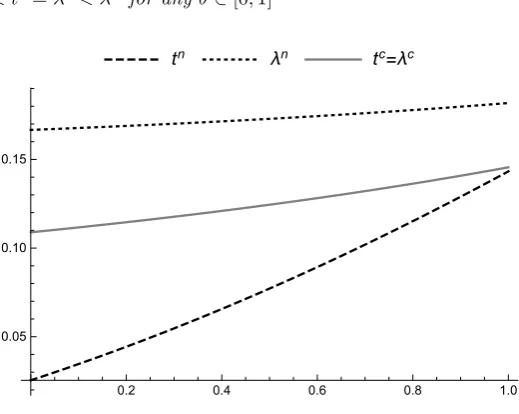
Proposition 9. tn< tc =λc< λn for any θ∈[0,1]
tn
λn tc
=λc
0.2 0.4 0.6 0.8 1.0
[image:16.595.75.456.134.460.2]0.05 0.10 0.15
Figure 1: Permits price and tax comparison.
Therefore, under the regulator’s inability to commit the equivalence between the two policy
in-struments breaks down.17 In particular, it states that under the non-committed policy where the
time-inconsistency occurs, the optimal tax is smaller than the equilibrium permits price. Figure 1
250
shows that both permits price and tax rate increase as the concern on consumer surplus rises. It also
shows that, compared to the equivalent tax rate or permits price, the tax rate becomes smaller and
permits price becomes larger.
This finding also indicates that firms’ strategic incentives depends not only on policy instruments
but the degree of consumer-friendliness. This is because firms would expect the regulator to change its
255
17
Note that this result does not depend onθ. Moner-Colonques and Rubio (2015) also showed that the equivalence
between emission standard and emission tax breaks down in a private duopoly model when the government cannot commit
[image:16.595.167.427.246.453.2]policy ex post and thus they have different incentives to induce time-inconsistent policy to be adjusted
ex post. In particular, compared to pre-committed government, firms abate less emission to induce
higher emission quotas under the permits policy while a consumer-friendly firm abates more emissions
to reduce tax rate under the tax policy. We will show these findings in the following proposition.
Proposition 10.
260
1. qtaxn
0 > q
tpn
0 ,qtaxn1 > q
tpn
1 andQtaxn> Qtpn for any θ∈[0,1];
2. ztaxn
0 > z0tpn, andztaxn1 > z1tpn for any θ∈[0,1];
3. etaxn
0 < etpn0 andetaxn1 < etpn1 ifθ > θe≈0.471;
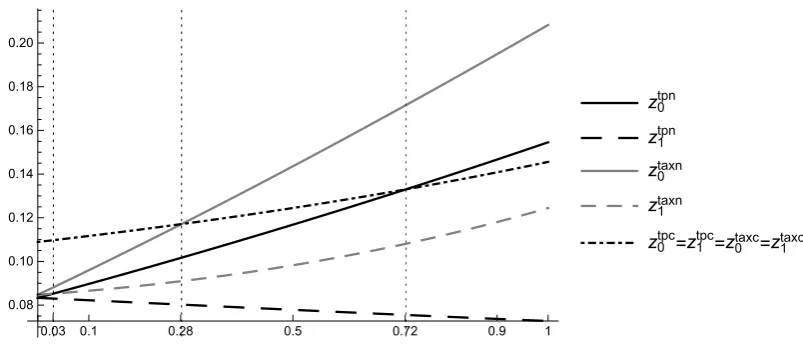
It states that under the non-committed policy, both firms produce more outputs but more
abate-ment investabate-ments with tax policy than permits policy. Thus, both firm’s emission levels become more
265
significant under permits policy when the concern on consumer surplus is relatively high. Fig. 2 shows
how both firms choose abatement levels strategically by expecting ex-post policies. In particular, under
permits policy, both firms reduce abatement levels unless the concern on consumer surplus is too large,
which induces ex-post permits policy with more emission quotas. Under tax policy, a consumer-friendly
firm increases its abatement levels to reduce tax rate unless the concern on consumer surplus is too
270
small, which induces a higher tax rate. Thus, these opposite incentives break down the equivalence
between permits and tax policies.
0.03 0.1 0.28 0.5 0.72 0.9 1
0.08 0.10 0.12 0.14 0.16 0.18 0.20
z0tpn
z1tpn
z0taxn
z1taxn
[image:17.595.94.496.433.609.2]z0tpc=z1tpc=z0taxc=z1taxc
Figure 2: Abatement comparison.
Proposition 11. πtaxn
0 < π
tpn
0 andπtaxn1 < π
tpn
1 for any θ∈[0,1].
It implies that under the non-committed policy both firms can earn higher profits with permits
policy due to the strategic effects on ex-post policy. Thus, as like in the committed policy, both firms
still prefer permits policy to tax policy when they can choose or lobby for the policy. It also implies
that irrespective of the timing of environmental policies, tradable permits policy can be an endogenous
choice of rent-seeking equilibrium in a political process.18
Proposition 12.
1. EDtaxn< EDtpn for any θ
ED≈0.466577< θ≤1 whereθED satisfiesEDtaxn=EDtpn;
280
2. Wtaxn> Wtpn for any 0≤θ < θ
W ≈0.957481whereθW satisfiesWtaxn =Wtpn;.
This proposition states that under the non-committed policy, tax policy induces higher welfare
and lower environmental damage than permits policy when the consumer-friendliness is moderate, i.e.,
EDtaxn < EDtpn and Wtaxn > Wtpn ifθ
ED < θ < θW. Because there are opposite strategic effects
between the two policies if the government can not make credible pre-commitment, we have larger
time-285
consistent distortion of abatement activities with permits policy. Therefore, from the policy perspective
of both welfare and environmental quality, tax policy can be a better policy than permits policy when
the concern on consumer surplus is moderate. Note that the welfare-superiority in the non-committed
tax policy holds whenθ= 0 where both firms have the same objectives in a duopoly market.19
5. Concluding remarks
290
We provided the analysis of different policy timing with respect to the two environmental regulatory
measures between tradable permits and emission tax in a mixed duopoly with a consumer-friendly firm.
We examined the strategic choices on abatement technologies and showed that the equilibrium outcomes
under both policies are equivalent in terms of permits price and tax rate only when the government can
credibly commit its policy. Also, we showed that the profit of a consumer-friendly firm is always larger
295
than rival’s profit but both firms can earn higher profits with permits.
Under the non-committed policy, however, the equivalence breaks down because firms have different
incentives to induce time-inconsistent policy to be adjusted ex post. In particular, compared to
pre-committed government, firms abate less emission to induce higher emission quotas under the permits
policy while a consumer-friendly firm abates more emissions to reduce tax rate under the tax policy.
300
18
Regarding rent-seeking behaviors over tradable permits policy, Rode (2014) examined the opportunity cost for a
rent-seeking lobby in EU’sCO2 ETS (Emissions Trading System). 19
In a private duopoly model Moner-Colonques and Rubio (2015) examined the time-inconsistent problem in both
emission standard and emission tax policy and showed that the welfare-superiority of tax policy over emission standard
We can summarize our findings under the non-committed policy. First, both firms’ abatement
activities under permits are lower than those under tax, but total emissions under tax are smaller than
those under permits when the concern on consumer surplus is high enough. Second, both permits price
and tax increase as the concern on consumer surplus rises, but due to the strategic incentive to increase
emission quotas under the permits policy, permits price is always higher than the equivalent tax. Finally,
305
tax policy induces more outputs, more abatements and less emissions than permits when the concern
on consumer surplus is moderate, and thus tax is a better policy than permits in the presence of a
consumer-friendly firm.
Our findings show that not only the regulator’s inability to commit but the firm’s CSR initiatives can
play significant roles in the design and implementation of environmental policy and have detrimental
310
effects on social welfare. However, our analysis has a limitation because of the simple structure of our
modelling with linear demand and quadratic cost functions. Thus, the importance of CSR should be
further examined in more general settings under the alternative market structure with the efficiency
parameter of abatement technology, product differentiation, dominant market power in the permits
market, different timing of the game and so on.20 This has to be left for future research.
315
References
Borenstein, S., 1988. On the efficiency of competitive markets for operating licenses. Quarterly Journal
of Economics 103, 357–385.
Brand, B., Grothe, M., 2015. Social responsibility in a bilateral monopoly. Journal of Economics 115,
275–289.
320
Chang, Y.M., Chen, H.Y., Wang, L.F.S., Wu, S.J., 2014. Corporate social responsibility and
interna-tional competition: A welfare analysis. Review of Internainterna-tional Economics 22, 625–638.
Denicol`o, V., 1999. Pollution-reducing innovations under taxes or permits. Oxford Economic Papers
51, 184–199.
D’Amato, A., Dijkstra, B.R., 2015. Technology choice and environmental regulation under asymmetric
325
information. Resource and Energy Economics 41, 224 – 247.
Fowlie, M., 2010. Emissions trading, electricity restructuring, and investment in pollution abatement.
American Economic Review 100, 837–869.
20
In Appendix B, we examine non-tradable emission permits regulation and compare the welfare consequences with
Gersbach, H., Glazer, A., 1999. Markets and regulatory hold-up problems. Journal of Environmental
Economics and Management 37, 151–164.
330
Goering, G.E., 2012. Corporate social responsibility and marketing channel coordination. Research in
Economics 66, 142 – 148.
Goering, G.E., 2014. The profit-maximizing case for corporate social responsibility in a bilateral
monopoly. Managerial and Decision Economics 35, 493–499.
Hsu, C.C., Lee, J.Y., Wang, L., 2017. Consumers awareness and environmental policy in differentiated
335
mixed oligopoly. International Review of Economics and Finance 51, 444–454.
Kato, K., 2006. Can allowing to trade permits enhance welfare in mixed oligopoly? Journal of Economics
88, 263–283.
Kato, K., 2011. Emission quota versus emission tax in a mixed duopoly. Environmental Economics and
Policy Studies 13, 43–63.
340
Kopel, M., Brand, B., 2012. Socially responsible firms and endogenous choice of strategic incentives.
Economic Modelling 29, 982 – 989.
Lambertini, L., Tampieri, A., 2015. Incentives, performance and desirability of socially responsible firms
in a cournot oligopoly. Economic Modelling 50, 40 – 48.
Leal, M., Garcia, A., Lee, S.H., 2018. The timing of environmental tax policy with a consumer-friendly
345
firm. Hitotsubashi Journal of Economics 59, 25–43.
Lee, S.H., 1996. An optional permit system for global pollution control. Economics Letters 50, 79 – 84.
Lee, S.H., Kim, I.T., 2000. Self-selection and optimal nonlinear effluent charges. Environmental and
Resource Economics 16, 1–14.
Lee, S.H., Kim, J.C., 1995. Oligopolistic incentives for pollution control with nonzero conjectures.
350
Economics Letters 49, 95 – 99.
Lee, S.H., Matsumura, T., Sato, S., 2018. An analysis of entry-then-privatization model: welfare and
policy implications. Journal of Economics 123, 1 – 18.
Lee, S.H., Park, S.H., 2005. Tradable emission permits regulations: The role of product differentiation.
International Journal of Business and Economics 4, 249–261.
Lian, X., Gong, Q., Wang, L., 2018. Consumer awareness and ex-ante versus ex-post environmental
policies revisited. International Review of Economics and Finance 55, 68–77.
Malueg, D., 1990. Welfare consequences of emission credit trading programs. Journal of Environmental
Economics and Management 18, 66–77.
Matsumura, T., Ogawa, A., 2014. Corporate social responsibility or payoff asymmetry? a study of an
360
endogenous timing game. Southern Economic Journal 81, 457–473.
Moner-Colonques, R., Rubio, S., 2015. The timing of environmental policy in a duopolistic market.
Economia Agraria y Recursos Naturales 15, 11–40.
Montero, J., 2011. A note on environmental policy and innovation when governments cannot. Energy
Economics 33, S13 – S19.
365
Ohori, S., 2006. Optimal environmental tax and level of privatization in an international duopoly.
Journal of Regulatory Economics 29, 225–233.
Pal, R., Saha, B., 2015. Pollution tax, partial privatization and environment. Resource and Energy
Economics 40, 19–35.
Petrakis, E., Xepapadeas, A., 1999. Does government precommitment promote environmental
inno-370
vation? In Environmental Regulation and Market Power: Competition, Time Consistency and
International Trade, Edward Elgar Publishing , 145–161.
Petrakis, E., Xepapadeas, A., 2001. To commit or not to commit: Environmental policy in imperfectly
competitive markets. Working paper, University of Crete .
Poyago-Theotoky, J., Teerasuwannajak, K., 2002. The timing of environmental policy: A note on the
375
role of product differentiation. Journal of Regulatory Economics 21, 305–316.
Requate, T., 1993. Pollution control in a cournot duopoly via taxes or permits. Journal of Economics
58, 255–291.
Requate, T., Unold, W., 2003. Environmental policy incentives to adopt advanced abatement
technol-ogy:: Will the true ranking please stand up? European Economic Review 47, 125 – 146.
380
Rode, A., 2014. Rent-seeking over tradable emission permits: Theory and evidence. Working paper,
Sartzetakis, E., 1997. Tradeable emission permits regulations in the presence of imperfectly competitive
product markets: Welfare implications. Environmental and Resource Economics 9, 65–81.
Sartzetakis, E., 2004. On the efficiency of competitive markets for emission permits. Environmental
385
and Resource Economics 27, 1–19.
Stavins, R., 1998. What can we learn from the grand policy experiment? lessons from so2 allowance
trading. Journal of Economic Perspectives 12, 69–88.
Wang, L., Wang, J., 2009. Environmental taxes in a differentiated mixed duopoly. Economic Systems
33, 389–396.
390
Wirl, F., 2014. Taxes versus permits as incentive for the intertemporal supply of a clean technology by
a monopolist. Resource and Energy Economics 36, 248 – 269.
Xu, L., Cho, S., Lee, S.H., 2016. Emission tax and optimal privatization in cournot-bertrand comparison.
Economic Modelling 55, 73–82.
Xu, L., Lee, S.H., 2015. Strategic privatization with tariffs and environmental taxes in an international
395
mixed duopoly. Hitotsubashi Journal of Economics 56, 135–154.
Xu, L., Lee, S.H., 2018. The timing of environmental policies with excess burden of taxation in free-entry
mixed markets. International Review of Economics and Finance Article in Press.
Xu, L., Lee, S.H., Matsumura, T., 2017. Ex-ante versus ex-post privatization policies with foreign
penetration in free-entry mixed markets. International Review of Economics and Finance 50, 1 – 7.
400
Appendix A. The values ofψi
ψ0=−19755079146θ+ 1776371067θ2+ 252749403θ3−547148034θ4+ 143738388θ5−34205409θ6
+ 4527819θ7−486567θ8+ 25272θ9+ 360θ10−144θ11+ 16θ12;
ψ1=−28584262773θ+ 13764085704θ2−3714674175θ3+ 1124686620θ4−180945819θ5+ 36948636θ6
−3873177θ7+ 563193θ8−36936θ9+ 4248θ10−144θ11+ 16θ12;
ψ2=−12416587524θ+ 3686527485θ2−1334901060θ3+ 129078927θ4−64796436θ5+ 1012095θ6
−1744740θ7−76626θ8−19440θ9−3168θ10−32θ12
Appendix B. Non-tradable Emission Permits
We examine non-tradable emission permits (NTEP), in which the government prohibits the firms
from trading emission permits. In this case, each firm can discharge emissions as long as it obeys its
own emission constraint, i.e.,ei =qi−zi ≤E. We derive and compare the equilibrium of committed
405
NTEP policy and that of non-committed NTEP policy, respectively. Recall that firms chooseqi in the
last stage under the effective regulatory constraint thatqi=E+zi.
Appendix B.1. Committed policy
Under ex-ante NTEP, firms choosezi after the government choosesE. Maximization problems of
CF firm and FP firm are given respectively by
Max
z0
π0+θCS+µ0 E−q0+z0
Max
z1
π1+µ1 E−q1+z1
(B.1)
Letµi be the shadow price of the emission constraint of firmi. Solving the maximization problem
of each firm with the binding constraint, we derive the following equilibrium abatement levels:
z∗
0 =
4 +θ−5E(4−θ)
4(6−θ) z
∗
1 =
4−θ−E(20−3θ)
4(6−θ) (B.2)
Then, the social welfare under NTEP is
W∗= 112−32θ−3θ
2−E2 1616−544θ+ 51θ2
+E 224−64θ−6θ2
16(6−θ)2 (B.3)
In this stage the regulator assigns the welfare-maximizing emission quota to each firm. Solving (B.3)
yields the optimal emission quota
E∗= 112−32θ−3θ 2
1616−544θ+ 51θ2 (B.4)
Regarding welfare comparisons, we have for anyθ∈[0,1]
W∗(E∗)−Wtpc= 45(6−θ)2θ2
(909−306θ+ 29θ2) (1616−544θ+ 51θ2) ≥0
W∗(Etpc
i )−Wtpc=
405(6−θ)2θ2
16 (909−306θ+ 29θ2)2 ≥0
W∗(E∗)−W′(E∗) = 80(6−θ)
2θ2
(1616−544θ+ 51θ2)2 ≥0 (B.5)
whereW′(E∗) is obtained inserting (5)-(7) and (B.4) into (4). These results support the findings in Kato
(2006, 2011) who showed that the command-and-control regulation might be superior to market-based
410
Appendix B.2. Non-committed policy
Underex-post NTEP, firms choosezi before the government choosesE. Then, the social welfare is
given by
W∗∗= 2(1−3E)E−2z2
0+ (1−4E)z1−2z12+z0 1−4E−z1 (B.6)
In the second stage, the regulator assigns the welfare-maximizing emission quota to each firm.
Solving (B.6) yields the optimal emission quota
E=1
6(1−2z0−2z1) (B.7)
Finally, making use ofqi =E+zi and (B.7) and inserting them into (B.1), firms chooseszi that
solve the maximization problem. This yields the following optimal abatement levels:
z∗∗
0 =
3(8 + 5θ)
16(18−θ) and z
∗∗
1 =
24 +θ
16(18−θ) (B.8)
The resulting equilibrium emission quota and welfare are:
E∗∗ = 4−θ
2(18−θ), W
∗∗(E∗∗) =3 5696−384θ−113θ
2
256(18−θ)2 (B.9)
Regarding welfare comparison between ex ante NTEP and ex post NTEP, we have:
W∗∗(E∗∗)−W∗(E∗) =−3 84992 + 32768θ−242032θ
2−22432θ3+ 4995θ4
256(18−θ)2(1616−544θ+ 51θ2)
> <0 ifθ
> <0.6459.
Therefore, the welfare comparison between ex ante NTEP and ex post NTEP depends on the degree of
consumer-friendliness.
Appendix C. Tradable emission permits with discriminatory quota
415
We examine discriminatory emission quota, in which the government allocates emission permits to
the firms differently and then allows firms to trade emission permits. In this case, we assume that
E0=αP1i=0EiandE1= (1−α)P1i=0Ei, whereαis exogenously given as 0≤α≤1. We derive and
compare the equilibrium of committed policy and that of non-committed policy, respectively.
Appendix C.1. Committed policy
420
Using the total emission quota in (9), we can setE0=α
2(63−18θ−2θ2)
H andE1= (1−α)
2(63−18θ−2θ2)
H .
Given that the permit price in (7) depends on the total emission quotas, the equilibrium permit price,
output and abatement levels in (11) remain the same. It is also easy to show thatEDtpc andWtpc in
However, the profits of the firms can be written as follows:
πtpc∗
0 =
114777−71766θ−8271θ2+ 6768θ3−644θ4
2H2 +αL,
πtpc∗
1 =
114777−106758θ+ 38385θ2−5868θ3+ 328θ4
2H2 + (1−α)L. (C.1)
whereL= 2(63−18θ−2θ2)(99−9θ+ 2θ2)/H2>0.
425
The difference between the firm’s profits is
πtpc∗
0 −π
tpc∗
1 =
2(−6237 + 11097θ−11754θ2+ 3177θ3−239θ4)
H2 + 2αL. (C.2)
Letα≡ 6237−11097θ+11754θ2−3177θ3+239θ4
2(99−9θ+2θ2)(63−18θ−2θ2) >0. Note thatαis a convex function ofθwhereα(0) =
1 2
andα(1) = 12.
Proposition 13. πtpc∗
0 ≥π
tpc∗
1 if and only if θ∈[0,1]andα≤α≤1.
From equation (16) and (C.1), we have πtpci =πtaxc
i +λcEi, i = 0,1 where λc is the equilibrium
price permit given in (11). This implies that Proposition 4 is satisfied under the discriminatory emission
430
quota.
Finally, given that the environmental damage, EDtpc, and welfare, Wtpc, are the same that in
equation (12), we can observe that they don’t depend on the distribution of the emission quotas.
Hence, Proposition 2 remains under discriminatory emission quota.
Appendix C.2. Non-committed policy
435
Using the total emission quota in (19), we can setE0=αλandE1= (1−α)λ. Then, firms choose
their abatement effortszi to maximize their objective functions in (3) and (1), respectively:
ztpn∗
0 =
396−21θ−28θ2+ 3θ3−2α(5−θ) 36−9θ+θ2
Ω ,
ztpn∗
1 =
(12−θ)(3−θ)(1−θ) + 2α(5−θ) 36−9θ+θ2
Ω (C.3)
Since the total abatement ofztpn∗
0 +ztpn1 ∗computed from (C.3) is the same total abatement ofz0tpn+
ztpn1 computed from (21), the abatement values of the discriminatory case yield the same equilibrium
permit price, therefore, they yield the same equilibrium outputs as in (22).
The equilibrium emission quotas are however:
Etpn0 ∗=αλn, E
tpn∗
By replacing (C.3) and (C.4) in (1), the equilibrium profits are:
πtpn∗
0 =
931824−828360θ+ 102735θ2+ 62436θ3−21010θ4+ 2368θ5−93θ6 + 4α 36−9θ+θ2
2412−681θ−89θ2+ 41θ3−3θ4
−4α2(5−θ)2 36−9θ+θ22
2Ω2
πtpn∗
1 =
1149552−1297512θ+ 615087θ2−153708θ3+ 21290θ4−1556θ5+ 47θ6
−4α 36−9θ+θ2
612−471θ+ 161θ2−23θ3+θ4
−4α2(5−θ)2 36−9θ+θ22
2Ω2
(C.5)
The difference between the profits of the firms under the discriminatory quota are:
πtpn∗
0 −πtpn1 ∗=
2 36−9θ+θ2
252−54θ−3θ2+θ3
(6−θ)
(2α−A)
Ω2 (C.6)
whereA≡ 9072−18036θ+18342θ2
−5949θ3
+771θ4
−35θ5
(36−9θ+θ2)(252
−54θ−3θ2+
θ3) . For any 0≤θ≤1, we have 0< A≤1.
Proposition 14. πtpn∗
0 ≥π
tpn∗
1 if and only if α≥A2, for any0≤θ≤1 and0≤α≤1.
440
Regarding profit’s comparison between tradable emission permits with discriminatory quota and
emission tax, we can draw Figure C.3. It shows that the tradable emission permit yields higher profits
to both firms regardless of the degree of consumer-friendliness, if the distribution of the allowed quotas
is more equitable. But, if the consumer friendliness is small, for high (small) values ofα, the firm 1 (0)
would obtain larger profits with the tax while the rival would obtain larger profits with the permits.
445
Proposition 15. For any 0≤θ≤1:
1. πtaxn
0 < π
tpn∗
0 if α > max{αnc0(θ),0}, whereαnc0(θ)is such that π
taxn
0 (αnc0) =π
tpn∗
0 (αnc0).
2. πtaxn
1 < π
tpn∗
1 if α < min{αnc1(θ),1}, whereαnc1(θ)is such thatπ
taxn
1 (αnc1) =π
tpn∗
(a) Firm 0’s profit comparison (b) Firm 1’s profit comparison
Figure C.3: Comparison of profits in non-committed policies: tradable emission permits vs emission tax
Finally, we can see that the environmental damage is the same as in (23) regardless of the value of
αwhile the welfare depends onα:
Wtpn∗=
1320624−1202904θ+ 377055θ2−43908θ3−508θ4+ 466θ5−25θ6 + 4α(5−θ) 36−9θ+θ2
180 + 15θ−22θ2+ 2θ3
−4α2(5−θ)2 36−9θ+θ22
Ω2
(C.7)
Proposition 16. ∂ED∂θtpn >0 for anyθ∈[0,1]but ∂W∂θtpn>< if θ<
>θWd(α).
Note thatWtpn∗is concave onαand thus it is maximized atαtpn∗= 180+15θ−22θ2+2θ3
2(180−81θ+14θ2−θ3)≥
1 2, which
450
increases inθ (α= 1
2 ifθ = 0). This represents that discriminatory emission quota is efficient in the
presence of a consumer-friendly firm. It also implies that the regulator should allow a larger emission
quota to the friendly firm and the quota should be higher for higher values of