Proceedings of the 45th Annual Meeting of the Association of Computational Linguistics, pages 992–999,
Weakly Supervised Learning for Hedge Classification in Scientific Literature
Ben Medlock
Computer Laboratory University of Cambridge
Cambridge, CB3 OFD
Ted Briscoe
Computer Laboratory University of Cambridge
Cambridge, CB3 OFD
Abstract
We investigate automatic classification of speculative language (‘hedging’), in biomedical text using weakly supervised machine learning. Our contributions include a precise description of the task with anno-tation guidelines, analysis and discussion, a probabilistic weakly supervised learning model, and experimental evaluation of the methods presented. We show that hedge classification is feasible using weakly supervised ML, and point toward avenues for future research.
1 Introduction
The automatic processing of scientific papers using NLP and machine learning (ML) techniques is an increasingly important aspect of technical informat-ics. In the quest for a deeper machine-driven ‘under-standing’ of the mass of scientific literature, a fre-quently occuring linguistic phenomenon that must be accounted for is the use of hedging to denote propositions of a speculative nature. Consider the following:
1. Our results prove that XfK89 inhibits Felin-9. 2. Our results suggest that XfK89 might inhibit Felin-9. The second example contains a hedge, signaled by the use of suggest and might, which renders the propositioninhibit(XfK89→Felin-9)speculative. Such analysis would be useful in various applica-tions; for instance, consider a system designed to identify and extract interactions between genetic en-tities in the biomedical domain. Case 1 above pro-vides clear textual evidence of such an interaction
and justifies extraction of inhibit(XfK89→Felin-9), whereas case 2 provides only weak evidence for such an interaction.
Hedging occurs across the entire spectrum of sci-entific literature, though it is particularly common in the experimental natural sciences. In this study we consider the problem of learning to automatically classify sentences containing instances of hedging, given only a very limited amount of annotator-labelled ‘seed’ data. This falls within theweakly su-pervisedML framework, for which a range of tech-niques have been previously explored. The contri-butions of our work are as follows:
1. We provide a clear description of the prob-lem of hedge classification and offer an im-proved and expanded set of annotation guide-lines, which as we demonstrate experimentally are sufficient to induce a high level of agree-ment between independent annotators.
2. We discuss the specificities of hedge classifica-tion as a weakly supervised ML task.
3. We derive a probabilistic weakly supervised learning model and use it to motivate our ap-proach.
4. We analyze our learning model experimentally and report promising results for the task on a new publicly-available dataset.1
2 Related Work
2.1 Hedge Classification
While there is a certain amount of literature within the linguistics community on the use of hedging in
1
available from www.cl.cam.ac.uk/∼bwm23/
scientific text, eg. (Hyland, 1994), there is little of direct relevance to the task of classifying speculative language from an NLP/ML perspective.
The most clearly relevant study is Light et al. (2004) where the focus is on introducing the prob-lem, exploring annotation issues and outlining po-tential applications rather than on the specificities of the ML approach, though they do present some results using a manually crafted substring match-ing classifier and a supervised SVM on a collection of Medline abstracts. We will draw on this work throughout our presentation of the task.
Hedging is sometimes classed under the umbrella concept ofsubjectivity, which covers a variety of lin-guistic phenomena used to express differing forms of authorial opinion (Wiebe et al., 2004). Riloff et al. (2003) explore bootstrapping techniques to identify subjective nouns and subsequently classify subjec-tive vs. objecsubjec-tive sentences in newswire text. Their work bears some relation to ours; however, our do-mains of interest differ (newswire vs. scientific text) and they do not address the problem of hedge clas-sification directly.
2.2 Weakly Supervised Learning
Recent years have witnessed a significant growth of research into weakly supervised ML techniques for NLP applications. Different approaches are of-ten characterised as either multi- or single-view, where the former generate multiple redundant (or semi-redundant) ‘views’ of a data sample and per-form mutual bootstrapping. This idea was for-malised by Blum and Mitchell (1998) in their presentation of co-training. Co-training has also been used for named entity recognition (NER) (Collins and Singer, 1999), coreference resolution (Ng and Cardie, 2003), text categorization (Nigam and Ghani, 2000) and improving gene name data (Wellner, 2005).
Conversely, single-view learning models operate without an explicit partition of the feature space. Perhaps the most well known of such approaches is expectation maximization (EM), used by Nigam et al. (2000) for text categorization and by Ng and Cardie (2003) in combination with a meta-level fea-ture selection procedure. Self-trainingis an alterna-tive single-view algorithm in which a labelled pool is incrementally enlarged with unlabelled samples
for which the learner is most confident. Early work by Yarowsky (1995) falls within this framework. Banko and Brill (2001) use ‘bagging’ and agree-ment to measure confidence on unlabelled samples, and more recently McClosky et al. (2006) use self-training for improving parse reranking.
Other relevant recent work includes (Zhang, 2004), in which random feature projection and a committee of SVM classifiers is used in a hybrid co/self-training strategy for weakly supervised re-lation classification and (Chen et al., 2006) where a graph based algorithm calledlabel propagationis employed to perform weakly supervised relation ex-traction.
3 The Hedge Classification Task
Given a collection of sentences, S, the task is to label each sentence as either speculative or non-speculative (specornspechenceforth). Specifically, Sis to be partitioned into two disjoint sets, one rep-resenting sentences that contain some form of hedg-ing, and the other representing those that do not.
To further elucidate the nature of the task and im-prove annotation consistency, we have developed a new set of guidelines, building on the work of Light et al. (2004). As noted by Light et al., speculative assertions are to be identified on the basis of judge-ments about the author’s intended meaning, rather than on the presence of certain designated hedge terms.
We begin with the hedge definition given by Light et al. (item 1) and introduce a set of further guidelines to help elucidate various ‘grey areas’ and tighten the task specification. These were developed after initial annotation by the authors, and through discussion with colleagues. Further examples are given in online Appendix A2.
The following are considered hedge instances:
1. An assertion relating to a result that does not necessarily follow from work presented, but could be extrapolated from it (Light et al.). 2. Relay of hedge made in previous work.
Dl and Ser have been proposed to act redundantly in the sensory bristle lineage.
3. Statement of knowledge paucity.
2
available from www.cl.cam.ac.uk/∼bwm23/
How endocytosis of Dl leads to the activation of N re-mains to be elucidated.
4. Speculative question.
A second important question is whether the roX genes have the same, overlapping or complementing functions. 5. Statement of speculative hypothesis.
To test whether the reported sea urchin sequences repre-sent a true RAG1-like match, we repeated the BLASTP search against all GenBank proteins.
6. Anaphoric hedge reference.
This hypothesis is supported by our finding that both pu-pariation rate and survival are affected by EL9. The following are not considered hedge instances:
1. Indication of experimentally observed non-universal behaviour.
proteins with single BIR domains can also have functions in cell cycle regulation and cytokinesis.
2. Confident assertion based on external work.
Two distinct E3 ubiquitin ligases have been shown to reg-ulate Dl signaling in Drosophila melanogaster.
3. Statement of existence of proposed alterna-tives.
Different models have been proposed to explain how en-docytosis of the ligand, which removes the ligand from the cell surface, results in N receptor activation.
4. Experimentally-supported confirmation of pre-vious speculation.
Here we show that the hemocytes are the main regulator of adenosine in the Drosophila larva, as was speculated previously for mammals.
5. Negation of previous hedge.
Although the adgf-a mutation leads to larval or pupal death, we have shown that this is not due to the adenosine or deoxyadenosine simply blocking cellular proliferation or survival, as the experiments in vitro would suggest.
4 Data
We used an archive of 5579 full-text papers from the functional genomics literature relating to Drosophila melanogaster (the fruit fly). The papers were con-verted to XML and linguistically processed using the RASP toolkit3. We annotated six of the pa-pers to form a test set with a total of 380spec sen-tences and 1157nspecsentences, and randomly se-lected 300,000 sentences from the remaining papers as training data for the weakly supervised learner. To ensure selection of complete sentences rather than
3
www.informatics.susx.ac.uk/research/nlp/rasp
Frel1 κ
Original 0.8293 0.9336 Corrected 0.9652 0.9848
Table 1: Agreement Scores
headings, captions etc., unlabelled samples were chosen under the constraints that they must be at least 10 words in length and contain a main verb.
5 Annotation and Agreement
Two separate annotators were commissioned to la-bel the sentences in the test set, firstly one of the authors and secondly a domain expert with no prior input into the guideline development process. The two annotators labelled the data independently us-ing the guidelines outlined in section 3. Relative F1 (Frel1 ) andCohen’s Kappa(κ) were then used to quantify the level of agreement. For brevity we refer the reader to (Artstein and Poesio, 2005) and (Hripc-sak and Rothschild, 2004) for formulation and dis-cussion ofκand Frel1 respectively.
The two metrics are based on different assump-tions about the nature of the annotation task. Frel1 is founded on the premise that the task is to recog-nise and label spec sentences from within a back-ground population, and does not explicitly model agreement onnspecinstances. It ranges from 0 (no agreement) to 1 (no disagreement). Conversely, κ
gives explicit credit for agreement on bothspecand
nspec instances. The observed agreement is then corrected for ‘chance agreement’, yielding a metric that ranges between −1 and 1. Given our defini-tion of hedge classificadefini-tion and assessing the manner in which the annotation was carried out, we suggest that the founding assumption of Frel1 fits the nature of the task better than that ofκ.
la-belings are reported in Table 1.
Annotator conferral violates the fundamental as-sumption of annotator independence, and so the lat-ter agreement scores do not represent the true level of agreement; however, it is reasonable to conclude that the actual agreement is approximately lower bounded by the initial values and upper bounded by the latter values. In fact even the lower bound is well within the range usually accepted as represent-ing ‘good’ agreement, and thus we are confident in accepting human labeling as a gold-standard for the hedge classification task. For our experiments, we use the labeling of the genetics expert, corrected for negligent instances.
6 Discussion
In this study we use single terms as features, based on the intuition that many hedge cues are single terms (suggest, likely etc.) and due to the success of ‘bag of words’ representations in many classifica-tion tasks to date. Investigating more complex sam-ple representation strategies is an avenue for future research.
There are a number of factors that make our for-mulation of hedge classification both interesting and challenging from a weakly supervised learning per-spective. Firstly, due to the relative sparsity of hedge cues, most samples contain large numbers of irrele-vant features. This is in contrast to much previous work on weakly supervised learning, where for in-stance in the case of text categorization (Blum and Mitchell, 1998; Nigam et al., 2000) almost all con-tent terms are to some degree relevant, and irrel-evant terms can often be filtered out (e.g. stop-word removal). In the same vein, for the case of entity/relation extraction and classification (Collins and Singer, 1999; Zhang, 2004; Chen et al., 2006) the context of the entity or entities in consideration provides a highly relevant feature space.
Another interesting factor in our formulation of hedge classification is that thenspecclass is defined on the basis of theabsence of hedge cues, render-ing it hard to model directly. This characteristic is also problematic in terms of selecting a reliable set of nspec seed sentences, as by definition at the beginning of the learning cycle the learner has lit-tle knowledge about what a hedge looks like. This
problem is addressed in section 10.3.
In this study we develop a learning model based around the concept of iteratively predicting labels for unlabelled training samples, the basic paradigm for both co-training and self-training. However we generalise by framing the task in terms of the acqui-sition of labelled training data, from which a super-vised classifier can subsequently be learned.
7 A Probabilistic Model for Training Data Acquisition
In this section, we derive a simple probabilistic model for acquiring training data for a given learn-ing task, and use it to motivate our approach to weakly supervised hedge classification.
Given:
• sample spaceX
• set of target concept classesY ={y1. . . yN} • target functionY :X → Y
• set of seed samples for each class S1. . .SN whereSi⊂ X and∀x∈ Si[Y(x) =yi] • set of unlabelled samplesU ={x1. . .xK}
Aim:Infer a set of training samplesTifor each con-cept classyisuch that∀x∈ Ti[Y(x) =yi]
Now, it follows that∀x∈ Ti[Y(x) =yi]is satisfied in the case that∀x∈ Ti[P(yi|x) = 1], which leads to a model in whichTiis initialised toSiand then iter-atively augmented with the unlabelled sample(s) for which the posterior probability of class membership is maximal. Formally:
At each iteration:
Ti←xj(∈ U)
wherej= arg max
j [P(yi|xj)] (1)
Expansion with Bayes’ Rule yields:
arg max
j [P(yi|xj)]
= arg max j
P(xj|yi)·P(yi)
P(xj)
(2)
marginalising over the classes in the denominator in expression 2, yielding:
arg max j
"
P(xj|yi)·P(yi)
PN
n=1P(yn)P(xj|yn)
#
(3)
so we are left with the class priors and class-conditional likelihoods, which can usually be esti-mated directly from the data, at least under limited dependence assumptions. The class priors can be estimated based on the relative distribution sizes de-rived from the current training sets:
P(yi) = |Ti|
P
k|Tk|
(4)
where|S|is the number of samples in training setS. If we assume feature independence, which as we will see for our task is not as gross an approximation as it may at first seem, we can simplify the class-conditional likelihood in the well known manner:
P(xj|yi) =
Y
k
P(xjk|yi) (5)
and then estimate the likelihood for each feature:
P(xk|yi) =
αP(yi) +f(xk,Ti)
αP(yi) +|Ti|
(6)
wheref(x,S)is the number of samples in training setS in which featurex is present, andαis a uni-versal smoothing constant, scaled by the class prior. This scaling is motivated by the principle that with-out knowledge of the true distribution of a partic-ular feature it makes sense to include knowledge of the class distribution in the smoothing mecha-nism. Smoothing is particularly important in the early stages of the learning process when the amount of training data is severely limited resulting in unre-liable frequency estimates.
8 Hedge Classification
We will now consider how to apply this learning model to the hedge classification task. As discussed earlier, the speculative/non-speculative distinction hinges on the presence or absence of a few hedge cues within the sentence. Working on this premise, all features are ranked according to their probability of ‘hedge cue-ness’:
P(spec|xk) =
P(xk|spec)·P(spec)
PN
n=1P(yn)P(xk|yn)
(7)
which can be computed directly using (4) and (6). Themmost probable features are then selected from each sentence to compute (5) and the rest are ig-nored. This has the dual benefit of removing irrele-vant features and also reducing dependence between features, as the selected features will often be non-local and thus not too tightly correlated.
Note that this idea differs from traditional feature selection in two important ways:
1. Only features indicative of the spec class are retained, or to put it another way,nspec class membership is inferred from the absence of strongspecfeatures.
2. Feature selection in this context isnota prepro-cessing step; i.e. there is no re-estimation after selection. This has the potentially detrimental side effect of skewing the posterior estimates in favour of the spec class, but is admissible for the purposes of ranking and classification by posterior thresholding (see next section).
9 Classification
The weakly supervised learner returns a labelled data set for each class, from which a classifier can be trained. We can easily derive a classifier using the estimates from our learning model by:
xj →spec if P(spec|xj)> σ (8)
whereσis an arbitrary threshold used to control the precision/recall balance. For comparison purposes, we also use Joachims’ SVMlight(Joachims, 1999).
10 Experimental Evaluation
10.1 Method
To examine the practical efficacy of the learning and classification models we have presented, we use the following experimental method:
1. Generate seed training data:SspecandSnspec 2. Initialise:Tspec← SspecandTnspec← Snspec 3. Iterate:
• OrderUbyP(spec|xj)(expression 3) • Tspec←most probable batch
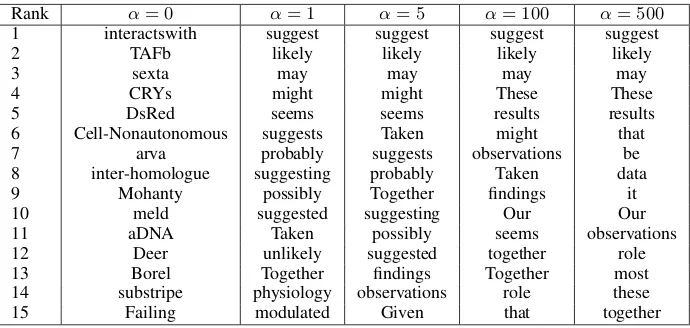
Rank α= 0 α= 1 α= 5 α= 100 α= 500
1 interactswith suggest suggest suggest suggest
2 TAFb likely likely likely likely
3 sexta may may may may
4 CRYs might might These These
5 DsRed seems seems results results
6 Cell-Nonautonomous suggests Taken might that
7 arva probably suggests observations be
8 inter-homologue suggesting probably Taken data
9 Mohanty possibly Together findings it
10 meld suggested suggesting Our Our
11 aDNA Taken possibly seems observations
12 Deer unlikely suggested together role
13 Borel Together findings Together most
14 substripe physiology observations role these
[image:6.612.134.479.70.234.2]15 Failing modulated Given that together
Table 2: Features ranked byP(spec|xk)for varyingα
• Compute spec recall/precision BEP (break-even point) on the test data
The batch size for each iteration is set to0.001∗ |U |. After each learning iteration, we compute the preci-sion/recall BEP for the specclass using both clas-sifiers trained on the current labelled data. We use BEP because it helps to mitigate against misleading results due to discrepancies in classification thresh-old placement. Disadvantageously, BEP does not measure a classifier’s performance across the whole of the recall/precision spectrum (as can be obtained, for instance, from receiver-operating characteristic (ROC) curves), but for our purposes it provides a clear, abstracted overview of a classifier’s accuracy given a particular training set.
10.2 Parameter Setting
The training and classification models we have pre-sented require the setting of two parameters: the smoothing parameterα and the number of features per samplem. Analysis of the effect of varyingα
on feature ranking reveals that whenα= 0, low fre-quency terms with spurious class correlation dom-inate and as α increases, high frequency terms be-come increasingly dominant, eventually smoothing away genuine low-to-mid frequency correlations. This effect is illustrated in Table 2, and from this analysis we choseα= 5as an appropriate level of smoothing. We usem= 5based on the intuition that five is a rough upper bound on the number of hedge cue features likely to occur in any one sentence.
We use the linear kernel for SVMlight with the
default setting for the regularization parameter C. We construct binary valued, L2-normalised (unit length) input vectors to represent each sentence, as this resulted in better performance than using frequency-based weights and concords with our presence/absence feature estimates.
10.3 Seed Generation
The learning model we have presented requires a set of seeds for each class. To generate seeds for the spec class, we extracted all sentences from U containing either (or both) of the termssuggest or
likely, as these are very good (though not perfect) hedge cues, yielding 6423spec seeds. Generating seeds fornspec is much more difficult, as integrity requires the absence of hedge cues, and this cannot be done automatically. Thus, we used the following procedure to obtain a set ofnspecseeds:
1. Create initial Snspec by sampling randomly fromU.
2. Manually remove more ‘obvious’ speculative sentences using pattern matching
3. Iterate:
• Order Snspec by P(spec|xj) using esti-mates fromSspecand currentSnspec • Examine most probable sentences and
re-move speculative instances
We started with 8830 sentences and after a couple of hours work reduced this down to a (still potentially noisy)nspecseed set of 7541 sentences.
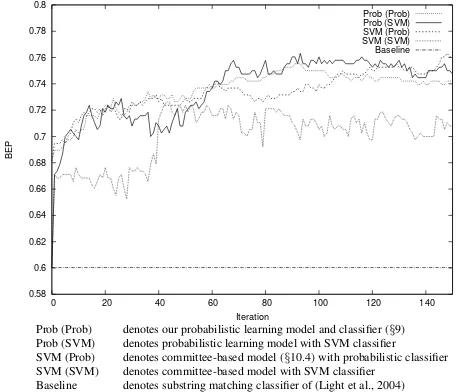
0.58 0.6 0.62 0.64 0.66 0.68 0.7 0.72 0.74 0.76 0.78 0.8
0 20 40 60 80 100 120 140
BEP
Iteration
Prob (Prob) Prob (SVM) SVM (Prob) SVM (SVM) Baseline
Prob (Prob) denotes our probabilistic learning model and classifier (§9) Prob (SVM) denotes probabilistic learning model with SVM classifier SVM (Prob) denotes committee-based model (§10.4) with probabilistic classifier SVM (SVM) denotes committee-based model with SVM classifier
[image:7.612.72.300.75.271.2]Baseline denotes substring matching classifier of (Light et al., 2004)
Figure 1: Learning curves
10.4 Baselines
As a baseline classifier we use the substring match-ing technique of (Light et al., 2004), which labels a sentence asspec if it contains one or more of the following: suggest, potential, likely, may, at least,
in part, possibl, further investigation, unlikely, pu-tative,insights,point toward,promiseandpropose.
To provide a comparison for our learning model, we implement a more traditional self-training pro-cedure in which at each iteration a committee of five SVMs is trained on randomly generated overlapping subsets of the training data and their cumulative con-fidence is used to select items for augmenting the labelled training data. For similar work see (Banko and Brill, 2001; Zhang, 2004).
10.5 Results
Figure 1 plots accuracy as a function of the train-ing iteration. After 150 iterations, all of the weakly supervised learning models are significantly more accurate than the baseline according to a binomial sign test (p < 0.01), though there is clearly still much room for improvement. The baseline classi-fier achieves a BEP of 0.60 while both classiclassi-fiers using our learning model reach approximately 0.76 BEP with little to tell between them. Interestingly, the combination of the SVM committee-based learn-ing model with our classifier (denoted by ‘SVM (Prob)’), performs competitively with both of the ap-proaches that use our probabilistic learning model
and significantly better than the SVM committee-based learning model with an SVM classifier, ‘SVM (SVM)’, according to a binomial sign test (p <0.01) after 150 iterations. These results suggest that per-formance may be enhanced when the learning and classification tasks are carried out by different mod-els. This is an interesting possibility, which we in-tend to explore further.
An important issue in incremental learning sce-narios is identification of the optimum stopping point. Various methods have been investigated to ad-dress this problem, such as ‘counter-training’ (Yan-garber, 2003) and committee agreement (Zhang, 2004); how such ideas can be adapted for this task is one of many avenues for future research.
10.6 Error Analysis
Some errors are due to the variety of hedge forms. For example, the learning models were unsuccess-ful in identifying assertive statements of knowledge paucity, eg: There is no clear evidence for cy-tochrome c release during apoptosis in C elegans or Drosophila. Whether it is possible to learn such examples without additional seed information is an open question. This example also highlights the po-tential benefit of an enriched sample representation, in this case one which accounts for the negation of the phrase ‘clear evidence’ which otherwise might suggest a strongly non-speculative assertion.
11 Conclusions and Future Work
We have shown that weakly supervised ML is ap-plicable to the problem of hedge classification and that a reasonable level of accuracy can be achieved. The work presented here has application in the wider academic community; in fact a key motivation in this study is to incorporate hedge classification into an interactive system for aiding curators in the con-struction and population of gene databases. We have presented our initial results on the task using a sim-ple probabilistic model in the hope that this will encourage others to investigate alternative learning models and pursue new techniques for improving ac-curacy. Our next aim is to explore possibilities of introducing linguistically-motivated knowledge into the sample representation to help the learner identify key hedge-related sentential components, and also to consider hedge classification at the granularity of as-sertions rather than text sentences.
Acknowledgements
This work was partially supported by the FlySlip project, BBSRC Grant BBS/B/16291, and we thank Nikiforos Karamanis and Ruth Seal for thorough an-notation and helpful discussion. The first author is supported by an University of Cambridge Millen-nium Scholarship.
References
Ron Artstein and Massimo Poesio. 2005. Kappa3= al-pha (or beta). Technical report, University of Essex Department of Computer Science.
Michele Banko and Eric Brill. 2001. Scaling to very very large corpora for natural language disambiguation. In Meeting of the Association for Computational Linguis-tics, pages 26–33.
Avrim Blum and Tom Mitchell. 1998. Combining la-belled and unlala-belled data with co-training. In Pro-ceedings of COLT’ 98, pages 92–100, New York, NY, USA. ACM Press.
Jinxiu Chen, Donghong Ji, Chew L. Tan, and Zhengyu Niu. 2006. Relation extraction using label propaga-tion based semi-supervised learning. InProceedings of ACL’06, pages 129–136.
M. Collins and Y. Singer. 1999. Unsupervised mod-els for named entity classification. InProceedings of the Joint SIGDAT Conference on Empirical Methods in NLP and Very Large Corpora.
George Hripcsak and Adam Rothschild. 2004. Agree-ment, the f-measure, and reliability in information re-trieval. J Am Med Inform Assoc., 12(3):296–298. K. Hyland. 1994. Hedging in academic writing and eap
textbooks.English for Specific Purposes, 13:239–256. Thorsten Joachims. 1999. Making large-scale sup-port vector machine learning practical. In A. Smola B. Sch¨olkopf, C. Burges, editor, Advances in Kernel Methods: Support Vector Machines. MIT Press, Cam-bridge, MA.
M. Light, X.Y. Qiu, and P. Srinivasan. 2004. The lan-guage of bioscience: Facts, speculations, and state-ments in between. In Proceedings of BioLink 2004 Workshop on Linking Biological Literature, Ontolo-gies and Databases: Tools for Users, Boston, May 2004.
David McClosky, Eugene Charniak, and Mark Johnson. 2006. Effective self-training for parsing. In HLT-NAACL.
Vincent Ng and Claire Cardie. 2003. Weakly supervised natural language learning without redundant views. In Proceedings of NAACL ’03, pages 94–101, Morris-town, NJ, USA.
K. Nigam and R. Ghani. 2000. Understanding the be-havior of co-training. In Proceedings of KDD-2000 Workshop on Text Mining.
Kamal Nigam, Andrew K. McCallum, Sebastian Thrun, and Tom M. Mitchell. 2000. Text classification from labeled and unlabeled documents using EM. Machine Learning, 39(2/3):103–134.
Ellen Riloff, Janyce Wiebe, and Theresa Wilson. 2003. Learning subjective nouns using extraction pattern bootstrapping. InSeventh Conference on Natural Lan-guage Learning (CoNLL-03). ACL SIGNLL., pages 25–32.
Ben Wellner. 2005. Weakly supervised learning meth-ods for improving the quality of gene name normal-ization data. InProceedings of the ACL-ISMB Work-shop on Linking Biological Literature, Ontologies and Databases, pages 1–8, Detroit, June. Association for Computational Linguistics.
Janyce Wiebe, Theresa Wilson, Rebecca Bruce, Matthew Bell, and Melanie Martin. 2004. Learning subjective language.Comput. Linguist., 30(3):277–308.
Roman Yangarber. 2003. Counter-training in discovery of semantic patterns. InProceedings of ACL’03, pages 343–350, Morristown, NJ, USA.
David Yarowsky. 1995. Unsupervised word sense dis-ambiguation rivaling supervised methods. In Pro-ceedings of ACL’95, pages 189–196, Morristown, NJ, USA. ACL.
Zhu Zhang. 2004. Weakly-supervised relation clas-sification for information extraction. In CIKM ’04: Proceedings of the thirteenth ACM international con-ference on Information and knowledge management, pages 581–588, New York, NY, USA. ACM Press.