Saving energy in the workplace: Why, and for whom?
Caroline Leygue
a,b,*, Eamonn Ferguson
a, Alexa Spence
a,baSchool of Psychology, University of Nottingham, United Kingdom
bHorizon Digital Economy Research, University of Nottingham, United Kingdom
a r t i c l e i n f o
Article history:
Received 27 September 2016 Received in revised form 8 June 2017
Accepted 18 June 2017 Available online 19 June 2017
Keywords: Energy saving Motivations Altruism
Organizational behavior
a b s t r a c t
Saving energy at work might be considered altruistic, because often no personal benefits accrue. How-ever, we consider the possibility that it can be a form of impure-altruism in that the individual expe-riences some rewards. We develop a scale to measure motivations to save energy at work and test its predictive power for energy-saving intentions and sustainable choices. In two studies (N¼293 and N¼94) motivations towards helping their organization and the planet were rated as important moti-vations, as was warm-glow (feeling good), indicating that impure-altruism does exist in this context. Energy saving was predicted by environmental concern and the desire to help one's organization. Notably, the stronger the motivations to promote one's reputation were, the weaker was the intention to save energy. Promoting motivations, particularly those that focus on benefits to the organization, may be an effective addition to environmental messages typically used as motivations in campaigns.
©2017 The Authors. Published by Elsevier Ltd. This is an open access article under the CC BY license (http://creativecommons.org/licenses/by/4.0/).
1. Introduction
To help prevent damage to the environment due to climate change, the UN set a target to keep the earth's temperature rise to well below 2Celsius above preindustrial levels within the Paris Agreement (UNFCCC, 2015). Within this, the EU has proposed to reduce its emissions to 40% below 1990 levels by 2030 (European Commission, 2012). Given pressures of climate change, energy se-curity and affordability, there is an increasing interest across sectors in how to change current energy use. One key area of behavior change in this context is people's energy use behavior in non-domestic buildings (Janda, 2011; Schelly, Cross, Franzen, Hall,& Reeve, 2011; Schipper, Bartlett, &Hawk, 1989). It has been sug-gested that around 33% of greenhouse gas emissions in the UK and 17% in the US are released from shared buildings within the busi-ness sector (non-industrial) (DECC, 2011; United States Department of State, 2010). Current advances on reducing energy use in work-places has mostly focused on improving physical infrastructure, appliances, system efficiency, or appointing key personnel with energy responsibilities (e.g., facilities managers, eco-champions) (Aragon-Correa, Matías-Reche, & Senise-Barrio, 2004; Christ-mann, 2000; Cordano & Frieze, 2000). There has been little
investigation of how to encourage normal, individual workers (with no energy responsibilities) to change their own energy use behavior to reduce emissions. This gap in the literature is the focus of this paper. Since energy use is not an element of most employees' job assignments, and is usually not taken into account in perfor-mance evaluations, it might be argued that people simply will not care about, or act to save energy.
The extent to which employees will try to reduce their energy use might depend on a number of motivations including if they see it as a key aim of their job (Rioux &Penner, 2001) or if they are motivated by more proactive prosocial behavior among employees, such as organizational citizenship behavior (Nisiforou, Poullis,& Charalambides, 2012; Schelly et al., 2011). The aim of the present research is to investigate what motivates employees to reduce their energy use at work when their job specifications do not include it. Indeed, energy saving can be considered an“extra-role”behavior (Ramus&Killmer, 2007) or an example of organizational citizen-ship behavior, as for the individual it is not normally directly or explicitly rewarded, but collectively is positive for the organization (LePine, Erez,&Johnson, 2002; Organ, 1997).
1.1. Promotion of energy saving among employees
Existing research on environmental behavior in the workplace shows that employees can be encouraged to adopt energy saving behaviors (Lo, Peters,&Kok, 2012). Using the Theory of Planned Behavior (TPB, seeAjzen, 1991), Greaves et al. (Greaves, Zibarras,& *Corresponding author. School of Psychology, University of Nottingham,
Not-tingham, NG7 2RD, United Kingdom.
E-mail address:[email protected](C. Leygue).
Contents lists available atScienceDirect
Journal of Environmental Psychology
j o u r n a l h o m e p a g e :w w w . e l s e v i e r . c o m / l o c a t e / j e p
http://dx.doi.org/10.1016/j.jenvp.2017.06.006
Stride, 2013) found that, in general, employees intended to turn off their computers when they left their desk for 1 h or more, and particularly if they think switching things off is a good thing (notably for the environment), and if the social norms of the workplacefit this behavior (see alsoZhang, Wang,&Zhou, 2014). Goal setting has also proven an effective intervention (McCalley& Midden, 2002), as well as the use of rewards, (Handgraaf, Van Lidth de Jeude, & Appelt, 2013), individual feedback (Murtagh et al., 2013), group discussions (Werner, Cook, Colby,&Lim, 2012), and group feedback and peer education (Carrico&Riemer, 2011).
We highlight that, to date, thepurposeof energy saving in the workplace, that is for what or for whom employees would save energy, has not been studied as a precursor of energy saving in-tentions. Importantly, research indicates that to change (environ-mental) behavior, via any intervention or a communication, the goal [of the behavior] promoted by the intervention must be acti-vated (Unsworth, Dmitrieva, &Adriasola, 2013). This gap in the existing literature indicates that previous research and applied interventions may therefore have miscommunicated energy sav-ings in ignoring the reasons that employees may have for saving energy. We adopt a functional approach as we are interested in identifying the goal(s) which energy saving behavior helps to fulfill (Snyder, 1993). We want to investigate whether saving energy in the workplace can havemultiple functions. Indeed people could, for example, have the goal to help their organization, and saving en-ergy could have the function to help attain this goal. Other goals could include feeling good about themselves (warm-glow), gain reputation as a good person or just because no-one else does (reluctant altruism;Ferguson, 2015). In this, saving energy in the workplace could have multiple functions for different people or even multiple functions for the same person. We want to look at various potential motivations to save energy and investigate their importance, as these could be drivers, to different degrees, to adopt energy saving behaviors in the workplace.
1.2. Motivations to save energy in the workplace
Many studies focusing on interventions to reduce energy in the workplace do not specify the reason or goal they used to encourage people to reduce their energy use (Carrico & Riemer, 2011; Handgraaf et al., 2013; Staats, Leeuwen,&Wit, 2000) and indeed a lack of motivation has been highlighted in some instances (Murtagh et al., 2013). Whilst motivations to save energy often differ between individuals/user groups, determining commonal-ities would help to highlight the most effective ways to frame en-ergy saving campaigns in different contexts. For example, cost is often a key motivation for users to save energy in residential con-texts (Brandon&Lewis, 1999; Spence, Demski, Butler, Parkhill,& Pidgeon, 2017), and is often used to encourage people to save en-ergy in behavioral interventions (Abrahamse, Steg, Vlek, & Rothengatter, 2005, 2007; Midden, Meter, Weenig, &Zieverink, 1983). However, research suggests that cost savings are often so low at the individual level that consumers may not consider behavior change worthwhile (Spence, Leygue, Bedwell,&O'Malley, 2014). In the workplace, for most workers or employees, saving electricity does not mean saving costs for oneself, as is the case for domestic use. Hence referring to energy in terms of costs might have a weaker impact on motivations in the workplace and other aspects of energy use may have a broader impact. On the other hand, cost saving potential as a collective may be much greater and motivating. In fact this technique of aggregating energy savings at the group level has been used successfully before, where university staff and students were told how much energy and costs in total
would be saved if all the classrooms' lights were turned off every day. Though, we note this was not compared to other methods of calculating savings, e.g. in terms of carbon or non-aggregated (Werner et al., 2012). There is currently little evidence about whether, and how, motivations to save energy in the workplace context do differ from a residential context.
Given the lack of cost incentive in the workplace, current research and interventions aiming at reducing the energy use of employees has mostly focused on the benefits of this behavior for the environment (Scherbaum, Popovich, & Finlinson, 2008; Unsworth et al., 2013) which may not capture the whole spec-trum of motivations involved. One reason for this is that sometimes energy saving behavior is studied as one of several environmental behaviors (Bamberg&M€oser, 2007; Lo et al., 2012). However, we propose that reducing one's energy use in the workplace could serve other functions and fulfill different goals other than envi-ronmental concern. Most people acknowledge the problems asso-ciated with climate change (Spence, Venables, Pidgeon, Poortinga, &Demski, 2010), but only a smaller proportion tend to feel they must or can do something to reduce it (Spence et al., 2010; Whitmarsh, Seyfang,&O'Neill, 2011). Targeting goals other than concern for the environment may therefore be useful in engaging every employee with saving energy in the workplace. We identify a number of theoretically relevant domains of motivation below.
1.3. Pure, impure, reluctant altruistic, and selfish motivations
At the organizational level, “corporate greening” has already been conceptualized as a pro-social behavior (Ramus &Killmer, 2007). At the individual level, given that most workplaces do not currently recognize or reward their employees for adopting energy saving behaviors, motivations to save energy at work may be mostly considered, at least in part, other-oriented or altruistic
the organization's image the employee enhances their own positive image. This is an aspect of impure altruism as the‘helper’helps the target and might indirectly benefit themselves as well (Andreoni, 1990; Griskevicius, Tybur,&Van den Bergh, 2010).
Research in pro-social behavior more generally, has shown that pro-social actions can also often be personally beneficial (Clary et al., 1998; Ferguson, Farrell,&Lawrence, 2008). Indeed, behav-iors often considered as purely altruistic, such as donating blood, also often result in people feeling good about themselves for doing the right thing (Ferguson, 2015; Ferguson, Atsma, De Kort, & Veldhuizen, 2012), an effect calledwarm-glowresulting in impure altruism as both the donor and recipient gain (Andreoni, 1990). As well as being experienced at the time of donation, it is possible that warm-glow can be an‘anticipated’motivation for action (Ferguson &Masser, 2017). Furthermore, in the specific context of the work-place, other self-oriented motivations can exist for‘altruistic’acts, again leading to impure altruistic motivations. For example, doing the right thing at work can be a way of obtaining approval from management and colleagues, as it could be viewed as a “taking charge” behavior (Ramus & Killmer, 2007). Indeed, impression management is a strong predictor of positive behaviors in the workplace that go beyond one's job description (Rioux&Penner, 2001).
Finally, altruistic acts can be performed when people think the cause is worthy and think others are unwilling to act (i.e., others are free riders). This form ofreluctant altruismwasfirst identified and described by Ferguson and colleagues, in the context of blood do-nations forfirst-time donors in the face of free-riding (Ferguson et al., 2012). Lack of trust in others to help, moral outrage and negative view of humanity are all facets of reluctant altruism (Ferguson&Masser, 2017; Ferguson, 2015) however in the context of saving energy at work lack of trust was the key parameter we focussed on. People then feel the energy to act because of negative feelings and lack of trust towards others who do not make any effort. So reluctant altruism-lack of trust could be an important motivator for prosocial behavior when free riding is high, as is likely to be the case in energy conservation in the workplace.
1.4. Current research
We propose that saving energy in the workplace can have
multiple functions or utilities, and so is a benevolent act, or an example of impure altruism, where both other-oriented and self-oriented motivations exist. Specifically, we want to investigate whether employees can be motivated to save energy by two forms of altruism or other-oriented motivations: environmental concern and helping their organization without benefit to the self (direct or indirect), and two forms of self-oriented motivations: warm glow and reputation building. We are also interested in consistency be-tween contexts, and whether energy saving functions at work could translate to goals at home, and so if we couldfind similar motiva-tions to save energy at home. If this is the case, motivamotiva-tions at work and at home should be related. Furthermore, we are interested in whether these motivations will have independent effects on energy saving behaviors. Also, we postulate that the extent to which people are motivated to save energy at work and intend to do so, should depend on their general attitude towards their workplace; the more they evaluate their job and their organization positively, the more they should be motivated to reduce their energy use to help their organization, and the more they should try to adopt sustainable behaviors. We propose that motivations identified may mediate the relationship between attitude towards the workplace and energy saving intentions. Finally, we expect that these moti-vations should affect how people make sustainable choices in the workplace.
In two studies, we measured motivations to save energy at work withinfive different organizations (N¼298 for Study 1 and N¼94 for Study 2): one private company (N ¼75) and one academic institution (N¼218, 5 participants left this question blank) in Study 1; and two private companies and one non-government organiza-tion (NGO) in Study 2. We developed a scale of Motivaorganiza-tions to save Energy in the Workplace (MEW) based on existing scales of moti-vations to volunteer, to donate blood, and to engage in citizen organizational behavior as well as theoretical considerations of self- and other-orientated motivations. There are important simi-larities between each of these behaviors and energy saving behavior at work: there is no direct benefit to the self, the benefi -ciaries are not people that are close to the actor, there is no obli-gation for the actor to perform these behaviors (Ferguson, 2015), and these behaviors need to be prolonged or repeated to be most effective at a communal level.
We tested the predictive validity of the scale by exploring the relations between motivations identified for saving energy, re-ported energy saving intentions in the workplace, attitude towards the workplace, and motivations to save energy at home. In a second study among a different sample, we explored the effects of these motivations on a more comprehensive measure of intentions to save energy, and direct sustainable choices.
1.5. Scale development
Based on the literature on altruistic behaviors such as blood donation, volunteering and citizen behavior (see above), we created an initial set of 28 items for the scale1. We distributed this scale in two business sites to measure the importance of each motivation, and the factor structure and validity of the scale were examined, as well as basic psychometric properties. To explore the antecedents and consequences of these energy saving motivations in the workplace, we included measures of general attitudes to-wards the workplace, and a scale measuring the self-reported fre-quency of environmental behaviors at work.
In addition, we were interested in knowing whether motiva-tions to save energy in the workplace would help predict sustain-able choices. To test this, we conducted a second study to look at energy saving motivations, and we examined whether they would predict how people would spend money from and for their orga-nization. We hypothesized the more people would be motivated to save energy at work, the more money they would choose to spend on sustainable products for their company.
2. Study 1
2.1. Method
2.1.1. Participants
To recruit participants, we contacted“gatekeepers”to ask for permission to advertise the study and use internal mailing lists to recruit volunteers to participate in a study on energy use at work in two sites: a large private company and a university in the United Kingdom. Both companies had organized campaigns on sustain-ability in the past (e.g., cycle to work) but no campaign on energy was taking place at the time of the study. The large private company was represented by one gatekeeper, at the university there were multiple gatekeepers as all academic and administrative de-partments were contacted. Exact response rate cannot be evaluated here as it is unclear how many gatekeepers agreed to advertise the
study and how (e.g., send emails to a mailing list or advertise on the intranet“message of the day”). Both the private company and the university total together approximately 10,000 employees.
Questionnaires werefilled in online using Qualtrics Research Suite©2(Qualtrics, 2015). The incentive to take part was entrance into a prize draw to win one of five£10 (Sterling) (15.26 USD) shopping vouchers. Two hundred and ninety eight participants (198 women and 100 men) took part in the study. Their ages ranged from 18 to 65, (M¼39.64, SD¼10.8). Thirty-five percent of this sample had managerial responsibilities at the time of the study. Just under half of the participants (47.7%) had a postgraduate qualifi -cation, 29.2% had a degree or equivalent, 15.5% a high school qualification. This sample consisted of more women and was more highly educated than the general population in the UK when compared to the most recently available data obtained from the Labor Force Survey in 2006. Participants had been working in their current organization for an average of 7.74 years.
2.1.2. Motivations to save energy
We constructed 28 items to measures people's motivations to save energy at work. Items were statements adapted from scales of motivations to donate blood (Evans&Ferguson, 2014; Ferguson et al., 2008), motivations to volunteer (Clary et al., 1998; Snyder, 1993), and motivations to adopt organizational citizenship behavior (Rioux & Penner, 2001). Participants had to rate each statement about why they save energy such as“to help my orga-nization save money on energy costs”or“because I'd feel proud of myself”on a 7-point scale according to how important each would be in their decision to save energy in the workplace. We con-structed 25 items to measure people's motivations to save energy at home following the same process as for motivations to save energy in the workplace, e.g., items included,“to save money on energy costs” and “because I feel worried about the environment”. Isomorphism between the items at work and at home was ensured by using the same items when possible or changing only one word (e.g., replacing“my colleagues”by“my friends”). Three items were specific to the workplace and the organization's image and were not adapted to the home context.
2.1.3. Behavioral intentions at work
Environmental behavior intentions at work were measured by 14 items adapted fromWhitmarsh and O'Neill (2010), seeAppendix 1. Participants had to rate each behavior on how likely they would consider performing them on a scale from 1-very unlikely to 4-very likely, with a non-applicable option also provided. Cronbach's
a
¼0.73 for environmental intentions in general, and Cronbach'sa
¼0.65 for energy saving intentions, after eliminating one item:“use an extra electric heater” which did not cohere with other behaviors included. Reliability indexes were lower than expected here (for example, Whitmarsh and O'Neill obtained a Cronbach's
a
of 0.92). This could be due to the fact that less items were used here (as the context of a workplace offers less examples of sustainable behaviors than the home). Also, people tend to have less control over their environmental behaviors and their energy use in the workplace compared to the home, and this could result in more variability between which behaviors can be adopted or not and how frequently.2.1.4. General attitude towards the workplace
We measured participants' general attitude towards their
workplace by asking them about their job satisfaction (Hackman& Oldham, 1975), their commitment to the organization (Allen & Meyer, 1990), and their organizational identification (Mael & Ashforth, 1992). Job satisfaction was measured by 3 items (e.g., Generally speaking, I am very satisfied with this job) (Cronbach's
a
¼0.88 if one item is removed), commitment to the organization by 5 items (e.g., this organization has a great deal of personal meaning for me) (Cronbach'sa
¼0.83), and organizational iden-tification by 6 items (e.g., When I talk about this organization, I usually say“we”rather than“they”) (Cronbach'sa
¼0.91). Partic-ipants had to rate each item on a 7 point scale from 1-strongly disagree to 7-strongly agree.2.2. Results
2.2.1. Motivations to save energy at work
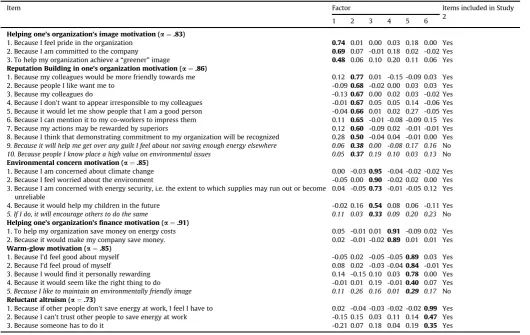
Given that the present study is thefirst investigation of multiple motivations to save energy at work, we conducted an exploratory factor analysis on participants’responses to the scale using Mplus 6 statistical software (Muthen&Muthen, 1998e2010). We used an MLR estimation3as the scale contained 7 points. Results show that the best model is a structure of 6 factors for motivations to save energy at work,
c
2¼410.99, df¼204, p¼0.0001, CFI¼0.941 and TLI¼0.899, RMSEA¼0.058. These values of CFI and RMSEA are close respectively to the values of 0.95 and 0.06 that are recom-mended by Hu and Bentler (Hu & Bentler, 1999). Comparative indices for a structure with 5 factors were not as good,c
2¼539.53, df¼226, p¼0.0001, CFI¼0.911 and TLI¼0.862, RMSEA¼0.068 and the Satorra-Bentler scaled chi-square difference test reveals that the difference between the two models is significant, TRd ¼127.04, df¼22, p < 0.001 with the 6 factor a better fit (Satorra&Bentler, 2001). A structure with 7 factors did not improve the indices,c
2 ¼427.74, df¼183, p¼0.0001, CFI¼0.931 and TLI¼0.867, RMSEA¼0.067 though the Satorra-Bentler scaled chi-square difference test reveals that the difference between the two models is not significant, TRd¼29.57, df¼21, p¼0.10.Environmental concern, warm glow and reputation building at work were found to be distinct motivations to save energy in the workplace, seeTable 1. In addition to this, two further factors were identified. A factor that representsreluctant altruismwas obtained, and altruism towards the company separated into two distinct factors: helping one's organization's finances and helping one's organization's image. We note that the factor concerning helping one's organization'sfinances contains only two items and that this is often considered as problematic. However, in this case the items are homogeneous and have face validity. Therefore the issues usually encountered with a low number of indicators should not be encountered (Gardner, Cummings, Dunham,&Pierce, 1998; Little, Lindenberger, & Nesselroade, 1999; Wanous, Reichers, & Hudy, 1997).
The average correlation across factors identified was 0.33. Mean levels of reported importance were calculated for each factor and a repeated measures ANOVA, F(5, 285) ¼ 171.85, p ¼ 0.0001,
h
2¼0.37, and post-hoc tests (Bonferroni adjusted) indicated thatenvironmental concern (M¼4.89,SD¼1.54), helping one's orga-nization'sfinances (M¼4.74,SD¼1.63), and warm-glow (M¼4.55,
SD¼1.47), were considered the most important motivations to save energy in the workplace followed by helping one's organization's image (M¼4.04,SD¼1.62) and reluctant altruism-lack of trust (M ¼ 3.72, SD ¼ 1.53). Reputation building at work was not considered an important motivation (M¼2.3,SD¼0.99). If we look
2 Copyright©2015 Qualtrics. Qualtrics and all other Qualtrics product or service names are registered trademarks or trademarks of Qualtrics, Provo, UT, USA.http:// www.qualtrics.com.
at both sites separately, the pattern is approximately the same, with participants in the private company scoring higher on motivations in general than participants at the university, F(1, 288)¼ 6.57,
p ¼0.01,
h
2 ¼0.02, for the main effect of the type of site. We observe an interaction effect between site and type of motivation,F(5, 284)¼2.84,p¼0.01,
h
2¼0.01, and post-hoc tests (Bonferroni adjusted) reveal that helping one's organization's image was rated as a more important factor in saving energy in the private company (M¼4.11,SD¼1.69) than in the university (M¼3.5,SD¼1.54),t(293)¼ 2.97,p¼0.003; the other types of motivations did not differ significantly between sites, seeFig. 1.
2.2.2. Motivations to save energy at home
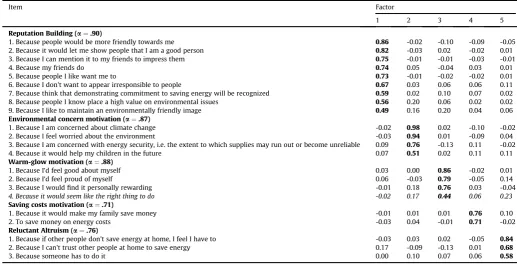
Responses to the motivations to save energy at home scale, were examined in the same way as in the workplace. Results show that the best model is a structure of 5 factors,
c
2 ¼373.8,df ¼205,p¼0.0001,CFI¼0.95,TLI¼0.92, andRMSEA¼0.053. The indices for a structure with 4 factors were not as good,
c
2 ¼ 536.97,df¼227,p¼0.0001,CFI¼0.91,TLI¼0.87, andRMSEA¼0.069. The Satorra-Bentler scaled chi-square difference test reveals that the difference between the two models is significant, TRd ¼185.41,
df¼22,p<0.001, with the 5 factor a betterfit. A structure with 6 factors slightly improved one index,
c
2 ¼ 338.24, df ¼ 184,p<0.001,CFI¼0.95 andTLI¼0.92,RMSEA¼0.054 and the Satorra-Bentler scaled chi-square difference test reveals that the difference between the two models is significant, TRd ¼ 37.25, df ¼ 21,
p¼0.02. However the 6th factor did not contain any clear and
unique items, with rotated loadings all inferior to 0.40 or loading equally on 2 factors. Environmental concern, warm glow and reputation building at home emerged as distinct factors, as they did in the workplace context. In addition a factor that represents costs and a factor that represents feelings of reluctant altruism-lack of trust were also obtained, seeTable 2.
The average interscale correlation was 0.36. Mean scores calculated for the motivations obtained indicated that participants rated costs as the most important motivation for saving energy at home (M¼6.33,SD¼1.04), followed by environmental concern (M¼4.91,SD¼1.7), and warm glow (M¼4.42,SD¼1.61). Again participants disagreed that feelings of reluctant altruism (M¼3.73,
SD¼1.63) and reputation building (M¼2.32,SD¼1.14), were important motivations. The factor structure and the psychometric properties of the 6 subscales were invariant across gender and work status.
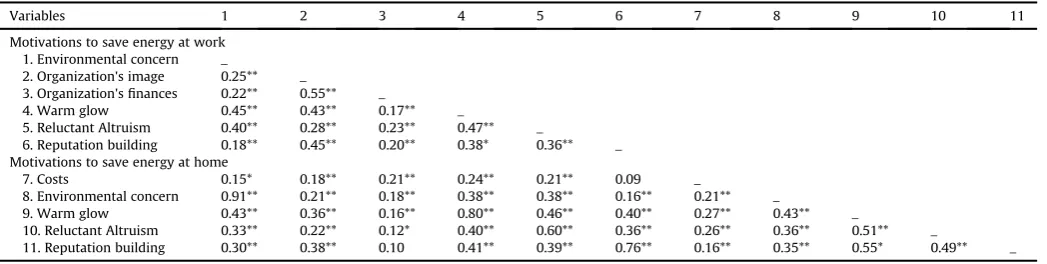
Motivations at work and at home were consistent, seeTable 3. We observe high correlations between both contexts regarding environmental concern motivations,r¼0.91, warm-glow motiva-tions,r¼0.80, reputation building,r¼0.76, and, to a lesser extent, reluctant altruism,r¼0.60.
2.2.3. Relationship between motivations, intentions to save energy at work, and attitude towards the workplace
[image:5.595.32.563.84.419.2]To validate the utility of the motivations we identify, we examined the extent to which each motivation would predict in-tentions to adopt environmental behaviors in the workplace. To
Table 1
Motivations to save energy at work factor pattern matrix (EFA, oblique rotation).
Item Factor Items included in Study
2
1 2 3 4 5 6
Helping one's organization's image motivation (a¼.83)
1. Because I feel pride in the organization 0.74 0.01 0.00 0.03 0.18 0.00 Yes
2. Because I am committed to the company 0.69 0.07 -0.01 0.18 0.02 -0.02 Yes
3. To help my organization achieve a“greener”image 0.48 0.06 0.10 0.20 0.11 0.06 Yes
Reputation Building in one's organization motivation (a¼.86)
1. Because my colleagues would be more friendly towards me 0.12 0.77 0.01 -0.15 -0.09 0.03 Yes
2. Because people I like want me to -0.090.68 -0.02 0.00 0.03 0.03 Yes
3. Because my colleagues do -0.130.67 0.00 0.02 0.03 -0.02 Yes
4. Because I don't want to appear irresponsible to my colleagues -0.010.67 0.05 0.05 0.14 -0.06 Yes 5. Because it would let me show people that I am a good person -0.040.66 0.01 0.02 0.27 -0.05 Yes 6. Because I can mention it to my co-workers to impress them 0.11 0.65 -0.01 -0.08 -0.09 0.15 Yes
7. Because my actions may be rewarded by superiors 0.12 0.60 -0.09 0.02 -0.01 -0.01 Yes
8. Because I think that demonstrating commitment to my organization will be recognized 0.28 0.50 -0.04 0.04 -0.01 0.00 Yes 9. Because it will help me get over any guilt I feel about not saving enough energy elsewhere 0.06 0.38 0.00 -0.08 0.17 0.16 No 10. Because people I know place a high value on environmental issues 0.05 0.37 0.19 0.10 0.03 0.13 No Environmental concern motivation (a¼.85)
1. Because I am concerned about climate change 0.00 -0.030.95 -0.04 -0.02 -0.02 Yes
2. Because I feel worried about the environment -0.05 0.00 0.90 -0.02 0.02 0.00 Yes
3. Because I am concerned with energy security, i.e. the extent to which supplies may run out or become unreliable
0.04 -0.050.73 -0.01 -0.05 0.12 Yes
4. Because it would help my children in the future -0.02 0.16 0.54 0.08 0.06 -0.11 Yes
5. If I do, it will encourage others to do the same 0.11 0.03 0.33 0.09 0.20 0.23 No
Helping one's organization'sfinance motivation (a¼.91)
1. To help my organization save money on energy costs 0.05 -0.01 0.01 0.91 -0.09 0.02 Yes
2. Because it would make my company save money. 0.02 -0.01 -0.020.89 0.01 0.01 Yes
Warm-glow motivation (a¼.85)
1. Because I'd feel good about myself -0.05 0.02 -0.05 -0.050.89 0.03 Yes
2. Because I'd feel proud of myself 0.08 0.02 -0.03 -0.040.84 -0.01 Yes
3. Because I wouldfind it personally rewarding 0.14 -0.15 0.10 0.03 0.78 0.00 Yes
4. Because it would seem like the right thing to do -0.01 0.01 0.19 -0.010.40 0.07 Yes
5. Because I like to maintain an environmentally friendly image 0.11 0.26 0.16 0.01 0.29 0.17 No
Reluctant altruism (a¼.73)
1. Because if other people don't save energy at work, I feel I have to 0.02 -0.04 -0.03 -0.02 -0.020.99 Yes 2. Because I can't trust other people to save energy at work -0.15 0.15 0.03 0.11 0.14 0.47 Yes
3. Because someone has to do it -0.21 0.07 0.18 0.04 0.19 0.35 Yes
investigate this, we ran a regression analysis (OLS), using the 6 types of motivations to save energy at work as predictors of envi-ronmental intentions at work. Results show that envienvi-ronmental behavior intention is predicted by environmental concern (B¼0.10,
p¼0.001), helping one's organization's image (B¼0.09,p¼0.001), and reputation building (B¼ 0.08,p¼0.006). The whole model predicts 22% of the variance in environmental intentions at work (adjustedR2¼0.22), seeTable 4.
Interestingly, the more people rate environmental concern and
their organization's image as important motivations to save energy, the more they intend to adopt environmental behavior at work. However, the more they indicate reputation building at work as an important motivation, the less they intend to adopt environmental behavior.
We were also interested in looking at energy-related behavior intentions in particular, for example, at work, turn off lights you're not using. To do this, we conducted a regression analysis using the mean score for energy related behavior intentions as a dependent
1 1.5 2 2.5 3 3.5 4 4.5 5 5.5
Environmental Concern
OrganizaƟon’s Finance
Warm-Glow OrganizaƟon’s Image
Reluctant Altruism
ReputaƟon Management
Averag
e Mo
Ɵ
va
Ɵ
on
Sc
or
e
Type of MoƟvaƟon
University
[image:6.595.146.461.69.288.2]Private Company
Fig. 1.Mean scores for motivations to save energy at work for each site. The error bars represent standard errors.
Table 2
Motivations to save energy at home factor pattern matrix (EFA, oblique rotation).
Item Factor
1 2 3 4 5
Reputation Building (a¼.90)
1. Because people would be more friendly towards me 0.86 -0.02 -0.10 -0.09 -0.05
2. Because it would let me show people that I am a good person 0.82 -0.03 0.02 -0.02 0.01
3. Because I can mention it to my friends to impress them 0.75 -0.01 -0.01 -0.03 -0.01
4. Because my friends do 0.74 0.05 -0.04 0.03 0.01
5. Because people I like want me to 0.73 -0.01 -0.02 -0.02 0.01
6. Because I don't want to appear irresponsible to people 0.67 0.03 0.06 0.06 0.11
7. Because think that demonstrating commitment to saving energy will be recognized 0.59 0.02 0.10 0.07 0.02
8. Because people I know place a high value on environmental issues 0.56 0.20 0.06 0.02 0.02
9. Because I like to maintain an environmentally friendly image 0.49 0.16 0.20 0.04 0.06
Environmental concern motivation (a¼.87)
1. Because I am concerned about climate change -0.02 0.98 0.02 -0.10 -0.02
2. Because I feel worried about the environment -0.03 0.94 0.01 -0.09 0.04
3. Because I am concerned with energy security, i.e. the extent to which supplies may run out or become unreliable 0.09 0.76 -0.13 0.11 -0.02
4. Because it would help my children in the future 0.07 0.51 0.02 0.11 0.11
Warm-glow motivation (a¼.88)
1. Because I'd feel good about myself 0.03 0.00 0.86 -0.02 0.01
2. Because I'd feel proud of myself 0.06 -0.03 0.79 -0.05 0.14
3. Because I wouldfind it personally rewarding -0.01 0.18 0.76 0.03 -0.04
4. Because it would seem like the right thing to do -0.02 0.17 0.44 0.06 0.23
Saving costs motivation (a¼.71)
1. Because it would make my family save money -0.01 0.01 0.01 0.76 0.10
2. To save money on energy costs -0.03 0.04 -0.01 0.71 -0.02
Reluctant Altruism (a¼.76)
1. Because if other people don't save energy at home, I feel I have to -0.03 0.03 0.02 -0.05 0.84
2. Because I can't trust other people at home to save energy 0.17 -0.09 -0.13 0.01 0.68
3. Because someone has to do it 0.00 0.10 0.07 0.06 0.58
[image:6.595.40.558.346.610.2]variable and the 6 types of motivations as independent variables. Results reveal the same pattern; the more environmental concern (B ¼ 0.09, p ¼ 0.001), and helping one's organization's image (B¼0.09,p¼0.001) are important motivations, the more people intend to adopt energy saving behaviors at work. Conversely, the more peoplefind reputation building motivations important, the less they intend to adopt energy saving behaviors (B ¼ 0.13,
p¼0.001). The whole model explains 14% of variance in energy-related behavior intention, seeTable 4.
Bivariate correlation analyses showed that motivations related to helping one's organization's image andfinances are correlated with the three indices of attitudes towards the workplace. Furthermore, environmental intentions and in particular energy saving intentions correlated with commitment to the organization
[image:7.595.34.558.84.216.2]and organizational identification, but not with job satisfaction, see
Table 5.
2.2.4. Relationship between attitude towards the workplace and energy saving intentions and the mediating role of motivations to help organizational image
The mechanisms underlying the relationships between contextual variables at work and energy saving intentions are of particular interest as these could inform potential interventions. Hence, we conducted mediation analyses to investigate whether the motivations to help one's organization's image would mediate the effects of commitment to the organization and organizational identification on energy behavior intentions. To do this, we used the MEDIATE method ofHayes and Preacher (2014)and due to the
Table 3
Correlations between motivations to save energy at work and motivations to save energy at home.
Variables 1 2 3 4 5 6 7 8 9 10 11
Motivations to save energy at work 1. Environmental concern _
2. Organization's image 0.25** _
3. Organization'sfinances 0.22** 0.55** _
4. Warm glow 0.45** 0.43** 0.17** _
5. Reluctant Altruism 0.40** 0.28** 0.23** 0.47** _
6. Reputation building 0.18** 0.45** 0.20** 0.38* 0.36** _
Motivations to save energy at home
7. Costs 0.15* 0.18** 0.21** 0.24** 0.21** 0.09 _
8. Environmental concern 0.91** 0.21** 0.18** 0.38** 0.38** 0.16** 0.21** _
9. Warm glow 0.43** 0.36** 0.16** 0.80** 0.46** 0.40** 0.27** 0.43** _
10. Reluctant Altruism 0.33** 0.22** 0.12* 0.40** 0.60** 0.36** 0.26** 0.36** 0.51** _
11. Reputation building 0.30** 0.38** 0.10 0.41** 0.39** 0.76** 0.16** 0.35** 0.55* 0.49** _
[image:7.595.82.506.272.377.2]Note. ***p<0.001; **p<0.01, *p<0.05.
Table 4
Regression model summary with motivations to save energy as criteria and energy saving intentions and environmental behavior intentions as dependent variables.
Variables Environmental intentions
B(SE)
Energy saving intentions B(SE)
Motivations to save energy at work
1. Environmental concern 0.10*** (0.02) 0.09*** (0.03)
2. Organization's image 0.09*** (0.02) 0.09** (0.03)
3. Organization'sfinances 0.003 (0.02) 0.01 (0.02)
4. Warm glow 0.01 (0.02) 0.03 (0.03)
5. Reluctant altruism 0.005 (0.02) 0.01 (0.03)
6. Reputation building 0.08** (0.03) 0.13** (0.04)
N 279 281
Adj. R2 0.22 0.14
[image:7.595.35.561.424.565.2]Note. ***p<0.001; **p<0.01, *p<0.05.
Table 5
Correlations between perceptions of the workplace and motivations to save energy at work.
Variables 1 2 3 4 5 6 7 8 9 10 11
Perceptions of the workplace
1. Job satisfaction _
2. Commitment to the organization 0.49** _
3. Organizational identification 0.41** 0.70** _ Motivations to save energy
4. Environmental concern -0.03 0.09 0.14* _
5. Organization's image 0.25** 0.50** 0.50** 0.25** _
6. Organization'sfinances 0.18** 0.36** 0.41** 0.22** 0.55** _
7. Warm glow 0.06 0.11 0.22** 0.45** 0.43** 0.17** _
8. Reluctant Altruism 0.08 0.15* 0.17** 0.40** 0.28** 0.23** 0.47** _
9. Reputation building -0.01 0.13* 0.25** 0.18** 0.45** 0.20** 0.38** 0.36** _
Behavior intentions
10. Environmental intentions 0.05 0.16** 0.16** 0.40** 0.33** 0.23** 0.26** 0.20** 0.04 _ _
11. Energy saving intentions 0.01 0.12* 0.12* 0.29** 0.26** 0.20** 0.21** 0.11 -0.04 _ _
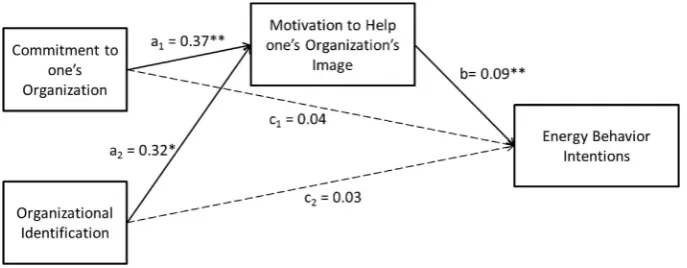
strict assumption of normally distributed data within the product-of-coefficients approach to mediation, we used bootstrapping to resample the data 10,000 times in estimating the indirect effects.4 Results show that organizational identification,B¼0.32,t¼4.05,
p¼0.001, and commitment to the organization,B¼0.37,t¼4.35,
p¼0.001, have a positive effect on motivation to save energy to help your organization's image. Motivation to save energy to help your organization's image predicts energy saving intentions,
B¼0.09,t¼3.59,p¼0.001, and the indirect effects of commitment (B¼0.035,LLCI¼0.01,ULCI¼0.06) and identification (B¼0.03,
LLCI¼0.01,ULCI¼0.05) on energy saving intentions are significant, see Fig. 2. Direct effects of organizational identification and commitment for the organization on energy behavior intention were both non-significant (B¼0.02,t¼0.66,p¼0.51, andB¼0.04,
t¼1.09,p¼0.27, respectively). This pattern of results indicates that the effects of commitment towards the organization and organi-zational identification indirectly impact intentions to save energy in the workplace through motivations to help your organization's image.
The results of Study 1 reveal that intentions, both of energy saving and of further environmental behavior, are mostly predicted by altruistic and impure altruistic motives such as environmental concern and wanting to help one's organization. Interestingly, self-oriented motives such as wanting to improve one's image at work (reputation building) negatively predicted intentions to save en-ergy. However, Study 1 focused on self-reports of behavior in-tentions, so the question of whether these motivations can predict actual behaviors remain. Furthermore, measuring sustainable be-haviors directly would reduce the reverse causality possibility that actually measures of intentions predict motivations. So the aim of Study 2 was to look at the effects of motivations to save energy at work on actual sustainable behaviors, measured online through a choice task. Furthermore, we were interested in examining the extent to which the results of Study 1 would replicate when using a more comprehensive measure of energy behavior intentions at work, that is, a measure that would also include social behaviors, such as discussion of issues with people in charge, or confrontation of people who waste energy.
3. Study 2
3.1. Method
3.1.1. Participants
A total of 94 employees (66 men, 27 women, one participant preferred not to state their gender) took part in Study 2. An op-portunity sample was drawn from three small to medium sized companies, with an average response rate of 37.12%. The three companies were two private companies, and an NGO. Age ranged from 18 to 62, with a mean of 31.57, and a SD of 10.66. Fifty percent of this sample had managerial responsibilities at the time of the study. Before filling in the questionnaire, participants were randomly assigned to one of 3 scenarios, where they had to imagine that they were working in a company that had decided to reduce its energy use. Scenarios were accompanied by 1 of 3 displays, one showing energy use in terms of CO2 emissions, one in terms of
costs, and the last was a combined CO2 and costs display. This
resulted in 32 seeing the CO2meter, 30 seeing the cost meter and
the remaining 31 seeing both cost and CO2readings on the same
meter. These were used for another study and did not affect the motivations to save energy scores, so will not be discussed in the present study. Participantsfilled in a scale to measure their moti-vations to reduce their energy use at work as in Study 1. In addition, they completed measures of intentions to adopt energy saving behaviours at work and a measure of sustainable choices5.
3.1.2. Motivations to save energy
The same scale of motivations to save energy at work was used as in Study 1, except for the items that had not been included in the
final factors for the analyses (see Table 1). So the new scale comprised of 24 items that participants had to rate on a 7-point scale.
3.1.3. Energy saving intentions
[image:8.595.132.476.66.200.2]Participants rated each of 15 energy saving behaviors (Cron-bach's
a
¼0.89) on how likely they would consider performing them on a scale from 1-very unlikely to 6-very likely, with a non-applicable option also provided. These included both individual behaviors e.g.,“turn off communal office equipment (e.g., printer, copy machine, lab equipment) after using them”, and social be-haviors “remind a colleague to switch something off to saveFig. 2.Direct and indirect effects of commitment to one's organization and organizational identification on energy saving intentions. Unstandardized coefficients are presented. a1 and a2represent the effects of commitment and identification on motivation to help one's organization's image, respectively, b the effects of this motivation on energy saving intentions, and c1and c2, respectively the direct effects of commitment and identification on energy saving intentions. ** representsp<0.01 and *p<0.05.
4 There was no significant interaction between the two independent variables (organizational identification and commitment to the organization) and the mediator (motivation to help your organization's image), indicating homogeneity of regression is established (and mediation analysis can be conducted (Keppel & Wickens, 2004).
energy”, seeAppendix 2.
3.1.4. Sustainable choices
The study comprised an indirect measure of sustainable behavior: participants were asked in a fictitious scenario to distribute 100,000 sterling pounds into five purchases for their company. To do this, they were given a list of 20 possibilities, of which two were choices that would help their company save en-ergy, e.g., ensure building operates at zero-carbon emissions by using Microgeneration (E.g. Solar Panels).
3.2. Results and discussion
3.2.1. Motivations to save energy at work
We computed six mean scores for each of the six motivation types as in Study 1, reputation building (Cronbach's
a
¼0.83), environmental concern (Cronbach'sa
¼0.82), helping one's orga-nization'sfinances (Cronbach'sa
¼0.88), helping one's organiza-tion's image (Cronbach'sa
¼ 0.86), warm glow (Cronbach'sa
¼0.85), and reluctant altruism (Cronbach'sa
¼0.65). The average correlation across factors identified was 0.48. A repeated measures ANOVA, F(5, 88)¼51.58, p¼0.0001, and post-hoc tests (Bonfer-roni) indicated that warm-glow (M ¼4.43, SD ¼1.36), environ-mental concern (M¼4.33, SD¼1.45), helping one's organization's image (M¼4.25, SD¼1.53), and helping one's organization'sfi -nances (M¼4.16, SD¼1.64) were considered the important mo-tivations to save energy in the workplace, whereas reluctant altruism (M¼3.46, SD¼1.30) and reputation building at work (M¼2.5, SD¼1.08) were not considered important. This pattern was not affected by the company the participant was from, F(2, 90)¼2.46, p¼0.09.3.2.2. Prediction of energy saving intentions
To examine whether the results of Study 1 would replicate, we ran a regression analysis (OLS), using the 6 motivations to save energy at work as predictors of energy saving intentions at work. Results show that energy saving intention is predicted by envi-ronmental concern (B¼0.25, p¼0.001), helping one's organiza-tion's finances (B ¼ 0.30, p ¼ 0.001), and reputation building (B ¼ 0.35, p ¼ 0.001). The whole model predicts 49% of the variance in energy saving behavioral intentions at work (adjusted R2¼0.49). The more people rate environmental concern and their organization'sfinances as important motivations to save energy, the more they intend to adopt environmental behavior at work. As in Study 1, the more they indicate reputation building at work as an important motivation, the less they intend to adopt environmental behavior.
3.2.3. Sustainable choices
We summed the total amount of money that each participant distributed to energy saving purchases for their company, then log-transformed the score. The regression analysis using this score as a dependent variable and the 6 motivations as predictors reveals the amount of money spent on sustainable options is predicted by environmental concern (B¼0.08, p¼0.02) and helping one's or-ganization'sfinances (B¼0.10, p¼0.007). Reputation building only had a marginal effect, (B¼ 0.09, p¼0.05). Interestingly, again reputation building had a negative impact on sustainable choices.
4. General discussion
Our results provide afirst exploration of motivations to save energy in the workplace and indicate that motivations to save en-ergy at work are different from those at home, necessitating mea-sures and interventions designed specifically for the workplace.
Indeed, in the home, where electricity has direct costs to the in-dividual, saving costs was the most important motivation. At work, helping one's company becomes an important motivation. Our research introduces a new measure of motivations to save energy in the workplace consisting of six factors: environmental concern, helping one's organization's finances, warm-glow, helping one's organization's image, reluctant altruism, and reputation building at work. However, motivations to save energy at work (MEW) indi-cated by our measure also correlated with motivations to save energy at home, showing consistency in people's rationales to save energy in different contexts.
In two studies, the MEW scale showed predictive validity in its relationships with energy behavior intentions in the workplace and sustainable choices. Importantly we highlight that a range of mo-tivations for saving energy exist in the workplace, beyond envi-ronmental imperatives, and these should be considered and taken into account when designing interventions for saving energy to ensure that maximum engagement with employees is achieved.
4.1. Saving energy as impure altruism
This research is thefirst, to our knowledge, to explore motiva-tions of employees to save energy in the workplace. The cross sectional study among two large companies (public and private) obtained comparable results in both sites. Furthermore, a second study in three smaller sites obtained similar outcomes. Our results are in line with the literature on other types of pro-social behaviors and show that several types of motivations to save energy at work exist. These can be classified as self-directed: reputation building and warm-glow, or altruistic: towards the planet (environmental motivations), towards the organization (motivations about the company's image andfinances), andfinally reluctant altruism-lack of trust (Evans&Ferguson, 2014; Ferguson, 2015).
Our data indicates that people are mostly motivated to save energy because of environmental reasons. In addition, behavior was often motivated by helping their company, and in order to gain warm-glow feelings. Energy savings may, therefore, often have aspects of impure altruism where others directly benefit but the individuals themselves also benefit from their actions.
4.2. Motivations to save energy in the workplace
The different motivational factors to save energy at work iden-tified here correlated relatively highly with each other, indicating that promoting one or fulfilling a specific motivation should not weaken another one. Also, self-oriented motivations did correlate with more altruistic ones, e.g. reputation building motivations correlated with helping your organization's image. Indeed, it is logical that a positive image of your organization could reflect positively on yourself, especially if people identify highly with their organization. Warm-glow motivations also correlated highly with environmental concern motivations, both in the workplace and at home. This is in line with recent work which considers environ-mental concern as both self-interested and pro-social (Bamberg& Moser, 2007€ ) and work on self-serving goals and biospheric goals in saving energy (Bolderdijk, Steg, Geller, Lehman, & Postmes, 2013). Bolderdjik and colleagues explain that people want to maintain a “positive self-concept” and prefer presenting them-selves and/or seeing themthem-selves as“green”rather than“greedy”, implying that environmental concern could also have a self-oriented function. In our present study, warm-glow also corre-lated highly with motivations to help one's organization.
4.3. Predictive validity of motivations to save energy in the workplace
Altruistic motivations were the most important in our sample and were the best predictor of intentions to save energy at work across Study 1 and 2, and more broadly to adopt environmental behaviors in the workplace in Study 1. Whilst self-serving moti-vations were also important, reputation building motimoti-vations spe-cifically were considered less important and actually negatively predicted energy saving intentions in both studies, using various measures of behavior intentions and actual behaviors. This might mean that people might not consider energy saving as something that would be recognized as a positive workplace behavior at the present time, or that it would not encourage them to do so even if it was; perhaps because it detracts, or is perceived to distract, from the main focus of their work. Indeed, this tendency of considering that saving energy in the workplace would not be done for repu-tation building or impression management, has been previously found for other organizational citizenship behaviors (Bolino, 1999; Dalal, 2005). Alternatively, people might think that saving elec-tricity at work would hurt their reputation, as“do-gooders” are sometimes evaluated negatively by others. Indeed, people are then reminded that they are not doing the right thing themselves, and fear reproach (Minson&Monin, 2012; Rothgerber, 2014). Future research should explore potential explanations and variations of reputation building motivations between contexts.
Whilst warm-glow was rated as an important motivation for people to save energy at work, it did not demonstrate predictive power for behavior intentions. This might be due to high correla-tions with the two main predictors of intencorrela-tions: environmental concern and helping one's organization's image. Interestingly, reputation building motivations and warm glow motivations are both self-orientated but differ in the notion that one could be experienced as intrinsic (warm-glow), the other extrinsic (reputa-tion building), hence demand characteristics might affect these in a different way. A comparable pattern of results was found by Zhang and colleagues (Zhang et al., 2014) on the prediction of attitudes towards electricity saving among office workers in China. They explored attitudinal beliefs rather than motivations to save energy and obtained a similar pattern of environmental benefits, organi-zational benefits and enjoyment (due to energy saving) having a positive effect on attitude, with anticipated extrinsic benefits to the
self having little effect. It would be interesting to explore whether the negative effects of reputation building promotion on behavioral intentions are also due to the extrinsic focus of this motivation. Both results show that neither the belief that you will get a reward, nor the goal to save energy to obtain a reward (both extrinsic focused), seem to encourage energy saving behaviors in the workplace, whereas intrinsic focused motivations (environmental aims and warm glow/enjoyment) appear to be more successful.
Notably, motivations to save energy in the workplace measured by our scale predict sustainable choices. We found that the more people found warm-glow motivations important, the more they wanted to participate in a second study on sustainability. We also found some preliminary evidence that environmental concern and motivations to enhance the company's image predict sustainable choices infinancial decisions in the workplace.
4.4. Organizational factors relating to motivations for energy saving in the workplace
Our data indicated that the more people are committed to their company, and the more they identify with it, the more motivations to help their company's image are important for them and the more, in turn, they intend to save energy at work. Energy saving in the workplace can hence be considered as an organizational citi-zenship behavior, as it is not normally specifically required, de-mands some extra effort, and correlates with commitment and identification. Interestingly, commitment and identification here had a positive effect on energy saving intentions when looked at individually (see similarfindings fromFeather&Rauter, 2004), but this effect disappeared when tested together. Their effect on behavior intentions is likely to be due to their common variance that could stem from general positive affect in, or positive attitude towards, the workplace (Bissing-Olson, Iyer, Fielding, & Zacher, 2013). These results show that energy savings in organizations can be promoted and increased through schemes focused on commitment and identification in the workplace as well as those targeted at more general well-being in the workplace. We highlight that motivations to save energy to help one's organization were only partially predicted by identification and commitment, so other organizational aspects that can affect this motivation should be explored in further research. Notably and in contrast, environ-mental motivations were only partly related to perceived contex-tual factors in the workplace (low correlations with organizational identification and no significant relationship with measures of commitment and satisfaction), highlighting that this is a universal factor that is not dependent on workplace context.
4.5. Limitations
and self-deceptive enhancement, as people may be reluctant to admit to certain“selfish”orientations. An interesting further study would be to see how participants react to reputation building motivations in the real world, and to look at real reactions to communications or larger scale interventions rewarding energy saving at work. Finally, we note that whilst we used a large sample of participants, this sample was not nationally representative of the UK population. Our sample in Study 1 was drawn from a sample of university staff and one large private company, and in Study 2 from 3 smaller companies. Also, the two studies differed in their gender proportions, with study 1 including more women and study 2 more men. These might have had an impact on our results as men and women can differ on their thoughts regarding climate change (McCright, 2010; Whitmarsh, 2011). Furthermore, our two study samples may have distinct characteristics, e.g. more positive views of their workplace, which could have influenced their motivations. Finally, respondents may be more altruistic than others, given that they were willing to help with this research. Our two studies also differed in the type of organizations they were taking place in, representing different types (e.g., for profit vs not for profit, private vs public), sizes, cultures and possibly attitude and behavior to-wards sustainability. These characteristics should be investigated in future research using larger, more representative samples, or in case studies that would investigate systematically the motivations in a single site (Tudor, Barr,&Gilg, 2008).
4.6. Practical implications
Our study reveals that various motivations to save energy exist in the workplace, so communications and interventions to save energy in the workplace should take people's personal motivations into account as impacts of interventions are stronger if the type of communication matches the individual's motivations (Shavitt & Nelson, 2002; Unsworth et al., 2013). Indeed, there is a“ congru-ency” effect of motivations and campaigns that Clary and col-leagues found for volunteering (Clary et al., 1998), that was also observed within literature on attitude functions (Shavitt&Nelson, 2002). Their studies showed that campaigns to promote volun-teering were evaluated more positively if they were congruent with participants' motivations to volunteer. Furthermore, communica-tions may result in being inefficient or even counterproductive if they focus on the wrong motivations. Indeed, it seems that repu-tation building motivations, and hence direct repurepu-tation building rewards, to save energy at work, could make people less willing to try to save energy. Further research should test this idea with terventions that go beyond simple text communications, as in-terventions that combine approaches, e.g. text communications alongside policy or structural changes, are usually found to be more impactful (Michie, van Stralen,&West, 2011; Spence&Pidgeon, 2009).
Campaigns to save energy could usefully focus on integrating various motivations and goals within company policies, in partic-ular to reduce the negativefindings that people are less likely to be sustainable if motivated by reputation building. More research is necessary to explore why this is the case. It could be that such extrinsic motives would impair motivations if they are already internalized (Deci, Koestner,&Ryan, 1999), or that saving energy could be perceived as actually bad for one's reputation. For example, interventions could help increase the reputation of peo-ple who save energy, for exampeo-ple by clarifying the importance of energy saving for the company, while not insisting on its moral dimension (Minson &Monin, 2012), and making energy saving action more visible (Griskevicius et al., 2010). Alternatively it may be possible to utilize feedback on how environmental actions can help an organizations image, in order to encourage energy saving
behavior without creating specific goals that could be perceived to be in conflict with work performance goals (Unsworth et al., 2013). Other self-oriented motivations, such as warm-glow, have a posi-tive effect on sustainable choices, and may have posiposi-tive effects on energy saving and campaigns.
Importantly in the workplace context, environmental goals and work performance goals are often presented as potentially competing goals, meaning that when one is activated, it will be at the expense of the other (Unsworth et al., 2013). In the workplace, important work performance goals are thought to be most effi -ciently fulfilled by not saving energy at work (e.g., taking the elevator, keeping one's computer on to save time). These goals, higher in the hierarchy of goals (focal goals) compared to envi-ronmental concern (background goal), in the context of the work-place, will encourage peoplenotto save energy (Fishbach, Zhang,& Koo, 2009; Kruglanski et al., 2002), or increase rebound effects or
“fads”of energy saving behaviors (Unsworth et al., 2013). Our re-sults show that promotion of energy saving policies at work can avoid these issues, because saving energy at work may then operate to fulfill work-related goals. Indeed, helping one's organization image andfinance are often higher in the hierarchy of work goals than environmental concern, and less in conflict with work per-formance, which can lower the potential for competing goals in the workplace.
Altogether, these results imply that in addition to environ-mental concern, energy saving motivations exist which may actu-ally complement work performance goals, and provide guidance on the design of energy saving interventions and campaigns. Inter-estingly, introducing environmental issues into organizations' op-erations (de Burgos Jimenez&Lorente, 2001) does not necessarily mean that a system of direct or indirect“social”reward should be introduced. We see here that it could be counterproductive if done superficially, however real and significant changes to social norms and culture in the workplace (which change current motivations and relationships with behavior) could have substantial benefits. In relation to organizational culture, promoting employee identifi ca-tion and commitment to the company may help to promote energy saving more broadly through increasing people's motivation to act to promote the organization's image. Making energy saving or environmental goals part of an organization's image is likely to be beneficial in highlighting this to employees as a clear organiza-tional goal.
Acknowledgments
This work was supported by the Engineering and Physical Sci-ences Research Council [grant numbers EP/G065802/1, EP/ K002589/1].
Appendix 1
Environmental behavior intentions at work study 1
a At work, turn off lights you're not using
b At work, turn off computers/screens etc. when not being used
c At work, put on layers of clothes rather than use additional heating
d Recycle at work
e Speak to key people in charge about energy issues f Take part in a campaign about an energy issue
g Read a document on your computer instead of printing it hTurn off your work computer at the end of your day
iTurn off your computer when you go on your lunch break
k Use an extra electric heater in your office
lTurn off shared appliances when you leave at the end of your day
m Use an alternative to work travel (e.g. teleconferencing) n Share transport with colleagues for work trips and events
Note: Items in bold were used as a scale for energy behavior intentions.
Appendix 2
Energy saving behavior intentions at work study 2
a Suggest procedural changes to save energy b Discuss energy saving measures with colleagues
c Turn off communal office equipment (e.g., printer, copy ma-chine, lab equipment) after using them
d Put on layers of clothes rather than use additional heating e Overtly disapprove (e.g. frowning, commenting) of other people
wasting electricity
f Speak to key people in charge about energy issues
g Consider energy efficiency or environmental factors when requesting a new purchase
h Turn off your printer before leaving for the day
i Turn off communal office equipment (e.g., printer, copy ma-chine, lab equipment) before leaving for the day
j Turn off your computer before leaving for the day
k Turn off your computer/monitor when you are away from your desk for a period of time (e.g. lunch)
l Turn off shared appliances when you leave at the end of your day
m Take part in a campaign about an energy issue
n Remind a colleague to switch something off to save energy o Turn off the lights before leaving for the day
p Turn off your monitor before leaving for the day
References
Abrahamse, W., Steg, L., Vlek, C., & Rothengatter, T. (2005). A review of intervention studies aimed at household energy conservation. Journal of Environmental Psychology, 25, 273e291.
Abrahamse, W., Steg, L., Vlek, C., & Rothengatter, T. (2007). The effect of tailored information, goal setting, and tailored feedback on household energy use, energy-related behaviors, and behavioral antecedents.Journal of Environmental Psychology, 27, 265e276.
ACCA. (2004). Towards transparency: Progress on global sustainability reporting (London).
Ajzen, I. (1991). The theory of planned behavior.Organizational Behavior and Human Decision Processes, 50, 179e211.
Allen, N. J., & Meyer, J. P. (1990). The measurement and antecedents of affective, continuance and normative commitment to the organization.Journal of Occu-pational Psychology, 63, 1e18.
Andreoni, J. (1990). Impure altruism and donations to public goods: A theory of warm-glow giving.The Economic Journal, 100, 464e477.
Aragon-Correa, J. A., Matías-Reche, F., & Senise-Barrio, M. E. (2004). Managerial discretion and corporate commitment to the natural environment.Journal of Business Research, 57, 964e975.
Bamberg, S., & M€oser, G. (2007). Twenty years after hines, hungerford, and tomera: A new meta-analysis of psycho-social determinants of pro-environmental behaviour.Journal of Environmental Psychology, 27, 14e25.
Bissing-Olson, M. J., Iyer, A., Fielding, K. S., & Zacher, H. (2013). Relationships be-tween daily affect and pro-environmental behavior at work: The moderating role of pro-environmental attitude. Journal of Organizational Behavior, 34, 156e175.
Bolderdijk, J. W., Steg, L., Geller, E. S., Lehman, P. K., & Postmes, T. (2013). Comparing the effectiveness of monetary versus moral motives in environmental cam-paigning.Nature Climate Change, 3, 413e416.
Bolino, M. C. (1999). Citizenship and impression management: Good soldiers or good actors?Academy of Management Review, 24, 82e98.
Brandon, G., & Lewis, A. (1999). Reducing household energy consumption: A qualitative and quantitativefield study.Journal of Environmental Psychology, 19, 75e85.
de Burgos Jimenez, J., & Lorente, J. J. C. (2001). Environmental performance as an
operations objective.International Journal of Operations&Production Manage-ment, 21, 1553e1572.
Carrico, A. R., & Riemer, M. (2011). Motivating energy conservation in the work-place: An evaluation of the use of group-level feedback and peer education. Journal of Environmental Psychology, 31, 1e13.
Christmann, P. (2000). Effects of‘best practices’of environmental management on cost advantage: The role of complementary assets.Academy of Management Journal, 43, 663e680.
Clary, E. G., Snyder, M., Ridge, R. D., Copeland, J., Stukas, A. A., Haugen, J., et al. (1998). Understanding and assessing the motivations of volunteers: A func-tional approach.Journal of Personality and Social Psychology, 74, 1516e1530. Cordano, M., & Frieze, I. H. (2000). Pollution reduction preferences of US
environ-mental managers: Applying Ajzen's theory of planned behavior.Academy of Management Journal, 43, 627e641.
Dalal, R. S. (2005). A meta-analysis of the relationship between organizational citizenship behavior and counterproductive work behavior.Journal of Applied Psychology, 90, 1241e1255.
DECC. (2011). In H. Gov (Ed.),UK climate change sustainable development indicator: 2010 greenhouse gas emissions, provisional figures and 2009 greenhouse gas emissions by fuel type and end user(London).
Deci, E. L., Koestner, R., & Ryan, R. M. (1999). A meta-analytic review of experiments examining the effects of extrinsic rewards on intrinsic motivation.Psychological Bulletin, 125, 627e668.
DEFRA. (2006).Environmental key performance indicators: Reporting guidelines for UK businesses.
European Commission. (2012).Commission Staff working paper: Analysis of options beyond 20% GHG emission reductions: Member State results Brussels(Belgium). Evans, R., & Ferguson, E. (2014). Defining and measuring blood donor altruism: A
theoretical approach from biology, economics and psychology.Vox Sanguinis, 106, 118e126.
Feather, N. T., & Rauter, K. A. (2004). Organizational citizenship behaviours in relation to job status, job insecurity, organizational commitment and identifi -cation, job satisfaction and work values.Journal of Occupational and Organiza-tional Psychology, 77, 81e94.
Ferguson, E. (2015). Altruism and blood donor recruitment and retention a review: Saintly sinners, reluctant altruisms and warm-glow givers.Transfusion Medicine, 25, 211e226.
Ferguson, E., Atsma, F., De Kort, W., & Veldhuizen, I. (2012). Exploring the pattern of blood donor beliefs infirst time, novice and experienced donors: Differentiating reluctant altruism, pure altruism, impure altruism and warm-glow.Transfusion, 52, 343e355.
Ferguson, E., Farrell, K., & Lawrence, C. (2008). Blood donation is an act of benev-olence rather than altruism.Health Psychology, 27, 327e336.
Ferguson, E., & Lawrence, C. (2016). Blood donation and altruism: The mechanisms of altruism approach.ISBT Science Series, 11, 148e157.
Ferguson, E., & Masser, B. (2017). Emotions and pro-sociality: Lessons for blood donation. In D. M. Williams, R. E. Rhodes, & M. T. Conner (Eds.),Affective de-terminants of health-related behavior. Oxford, United Kingdom: Oxford Univer-sity Press.
Fishbach, A., Zhang, Y., & Koo, M. (2009). The dynamics of self-regulation.European Review of Social Psychology, 20, 315e344.
Gardner, D. G., Cummings, L. L., Dunham, R. B., & Pierce, J. L. (1998). Single-item versus multiple-item measurement scales: An empirical comparison. Educa-tional and Psychological Measurement, 58, 898e915.
Greaves, M., Zibarras, L. D., & Stride, C. (2013). Using the theory of planned behavior to explore environmental behavioral intentions in the workplace.Journal of Environmental Psychology, 34, 109e120.
Griskevicius, V., Tybur, J. M., & Van den Bergh, B. (2010). Going green to be seen: Status, reputation, and conspicuous conservation.Journal of Personality and Social Psychology, 98, 392e404.
Hackman, R. J., & Oldham, G. (1975). Development of the job diagnostic survey. Journal of Applied Psychology, 60, 159e170.
Handgraaf, M. J., Van Lidth de Jeude, M. A., & Appelt, K. C. (2013). Public praise vs. private pay: Effects of rewards on energy conservation in the workplace. Ecological Economics, 86, 86e92.
Hayes, A. F., & Preacher, K. J. (2014). Statistical mediation analysis with a multi-categorical independent variable.British Journal of Mathematical and Statistical Psychology, 67, 451e470.
Hu, L. T., & Bentler, P. M. (1999). Cutoff criteria forfit indexes in covariance structure analysis: Conventional criteria versus new alternatives. Structural Equation Modeling: A Multidisciplinary Journal, 6, 1e55.
Janda, K. B. (2011). Buildings don't use energy: People do.Architectural Science Review, 54, 15e22.
Keppel, G., & Wickens, T. D. (2004).Design and analysis: A researcher's handbook(4th ed.). Upper Saddle River, NJ: Prentice-Hall.
Kruglanski, A. W., Shah, J. Y., Fishbach, A., Friedman, R., Chun, W. Y., & Sleeth-Keppler, D. (2002). A theory of goal systems.Advances in Experimental Social Psychology, 34, 331e378.
LePine, J. A., Erez, A., & Johnson, D. E. (2002). The nature and dimensionality of organizational citizenship behavior: A critical review and meta-analysis.Journal of Applied Psychology, 87, 52e65.