ASSESSMENT OF DENSITY FUNCTIONAL METHODS
FOR COMPUTING STRUCTURES AND ENERGIES OF
ORGANIC AND BIOORGANIC MOLECULES
Jie Cao
A Thesis Submitted for the Degree of PhD at the
University of St Andrews
2011
Full metadata for this item is available in St Andrews Research Repository
at:
http://research-repository.st-andrews.ac.uk/
Please use this identifier to cite or link to this item:
http://hdl.handle.net/10023/2589
Assessment of Density Functional Methods for Computing
Structures and Energies of Organic and Bioorganic Molecules
A thesis submitted for the degree of Ph.D.
by
Jie Cao
Supervised by Dr. Tanja van Mourik
University of St Andrews
I, Jie Cao, hereby certify that this thesis, which is approximately 26500 Words in length, has been
written by me, that it is the record of work carried out by me and that it has not been submitted in any previous application for a higher degree.
I was admitted as a research student in September 2007 and as a candidate for the degree of
Doctor of Philosophy in January 2009; the higher study for which this is a record was carried out in the university of St Andrews between 2007 and 2011.
Date……… signature of candidate………....
I hereby certify that the candidate has fulfilled the conditions of the Resolution and Regulations appropriate for the degree of Doctor of Philosophy in the University of St Andrews and that the
candidate is qualified to submit this thesis in application for that degree.
Date………. signature of supervisor………..
In submitting this thesis to the University of St Andrews I understand that I am giving permission
for it to be made available for use in accordance with the regulations of the University Library for the time being in force, subject to any copyright vested in the work not being affected thereby. I also understand that the title and the abstract will be published, and that a copy of the work may be
made and supplied to any bona fide library or research worker, that my thesis will be electronically accessible for personal or research use unless exempt by award of an embargo as
requested below, and that the library has the right to migrate my thesis into new electronic forms as required to ensure continued access to the thesis. I have obtained any third-party copyright permissions that may be required in order to allow such access and migration, or have requested
the appropriate embargo below.
The following is an agreed request by candidate and supervisor regarding the electronic publication of this thesis:
Access to all of printed copy but embargo of all ofelectronic publication of thesisfor aperiod of 2
years on the following ground:
publication would preclude future publication;
ACKNOWLEDGEMENT
First of all, I would like to thank my supervisor Dr. Tanja van Mourik for offering me a position in her group on this project so that I can have the opportunity to get an insight into the realm of computational chemistry, in which I did not have much experience before the project. Also I appreciate her consistent help throughout my work including discussion with me about every problem encountered, giving suggestions about relative issues, language corrections about my thesis, etc.
In addition, I would like to thank Dr. Herbert Früchtl for helping me with all those software problems including system configuration, software installation, etc. Many thanks to Dr. Wuzong Zhou for giving me advices concerning the research ideas and thesis writing experience. I will attribute my achievements to my group member for sharing their ideas and experience with me generously.
At last, I’d like to thank EaStCHEM for the hardware support for my calculations.
ABSTRACT
The work in this thesis mainly focuses on the assessment of density functional methods for computing structures and energies of organic and bioorganic molecules.
Previous studies found dramatic conformational and stability changes from B3LYP to MP2 geometry optimization for some Tyr-Gly conformers. Possible reasons could be large intramolecular basis set superposition errors (BSSEs) in the MP2 calculations and the lack of dispersion in the B3LYP calculations.
The fragmentation method and three kinds of rotation methods were used to investigate intramolecular BSSE. It is concluded that the rotation method cannot be used to correct intramolecular BSSE along a rotation profile.
Another methodology is to employ modern density functionals. We focused on M06-L with the Tyr-Gly conformer ‘book6’. Potential energy profiles were determined by computing the energy for geometries optimized at various fixed values of a distance that controls the degree of foldedness of the structure. M06-L manifested itself as a very promising method to investigate the potential energy surface of small peptides containing aromatic residues.
To predict Tyr-Gly structures, 108 potential conformers were created with a Fortran program. The geometry optimizations were done using M06-L/6-31G(d) and M05-2X/6-31+G(d). Two schemes were employed and the most stable conformers were compared to the 20 stable conformers found by B3LYP. Both schemes found 10 conformers similar to one of the B3LYP stable conformers, as well as several newly found conformers. The study of a missing B3LYP stable conformer showed that the possible reason of missing conformers may be the lack in dispersion in B3LYP theory.
To study the hydration effect, we studied the conformations of neutral and
zwitterionic 3-fluoro-γ-aminobutyric acid (3F-GABA) in solution using different
Table of Content
Assessment of Density Functional Methods for Computing Structures and Energies of Organic and
Bioorganic Molecules ...1
ACKNOWLEDGEMENT ...3
ABSTRACT...4
Table of Content...6
Chapter 1 General Introduction...8
1.1 Quantum chemistry ...8
1.2 The central theme of the thesis...9
1.3 The relations between the different projects presented in this thesis ... 11
Chapter 2 General Background Theory ...13
2.1 Introduction ...13
2.2 Computational chemistry methods...13
2.2.1 Ab initio methods ...14
2.2.1.1 Hartree-Fock Method (HF) ...14
2.2.1.2 Configuration Interaction (CI) [16] ...16
2.2.1.3 Multi-configuration Self Consistent Field (MCSCF) [11-12] ...16
2.2.1.4 Multi-reference Configuration Interaction (MRCI) ...17
2.2.1.5 Møller-Plesset Perturbation theory (MP) ...17
2.2.1.5.1 Rayleigh-Schrödinger perturbation theory (RS-PT)...18
2.2.1.5.2 Møller-Plesset Perturbation Theory ...19
2.2.1.6 Coupled cluster theory (CC) [19-21]...22
2.2.2 Semi-empirical quantum chemistry methods [22-23] ...22
2.2.3 Density Functional Theory (DFT) [24-25]...23
2.2.3.1 Introduction to Density Functional Theory ...23
2.2.3.2 Basic Principles: The Hohenberg-Kohn Theorem...24
2.2.3.3 The Kohn-Sham Formalism ...25
2.2.3.4 Classification of DFT Methods ...25
2.3 Basis sets [10-11, 62-64] ...26
2.3.1 Introduction ...26
2.3.2 Minimal basis sets ...28
2.3.3 Split-valence basis sets [66-67]...28
2.3.4 Pople basis sets [68-69]...29
2.3.5 Correlation-consistent basis sets ...30
2.4 Basis Set Superposition Errors (BSSE) and the Counterpoise Procedure (CP) ...31
2.5 Computational methods used in this work ...33
Chapter 3 Fragmentation Method and Rotation Method for Intramolecular BSSE Correction ...34
3.1 Abstract ...34
3.3 Methodology ...40
3.4 Results and Discussion...42
3.4.1 Propanediol as the model system ...42
3.4.2 C11H8O4as the model system...47
3.4.2.1 Scheme1 (Removal of central CH2group) ...47
3.4.2.2 Scheme2 (removal of central 5 carbon atoms) ...52
3.5 Conclusion ...59
Chapter 4 Performance of the M06-L Density Functional for a Folded Tyr-Gly Conformer ...61
4.1 Abstract ...61
4.2 Introduction ...61
4.3 Methodology ...65
4.4 Results...67
4.4.1 Performance of density functionals...67
4.4.2. Tyr-Gly geometries along the energy profile...70
4.5 Conclusions...75
Chapter 5 Predicting the Structure of Flexible Peptides ...77
5.1 Abstract ...77
5.2 Introduction ...77
5.3 Methodology ...82
5.3.1 Conformational creation procedure...82
5.3.2 Predicting the structure of Tyr-Gly...83
5.3.2.1 Scheme 1 ...83
5.3.2.2 Scheme 2 ...83
5.4 Results...85
5.4.1 Scheme 1 ...85
5.4.2 Scheme 2 ...91
5.5 Conclusion ...94
Chapter 6 Modelling Zwitterions in Solution: 3-fluoro-γ-amino-butyric acid (3F-GABA) ... 96
6.1 Abstract ...96
6.2 Introduction ...96
6.3 Methodology ...98
6.4 Results...101
6.4.1 Single-water molecule models ...101
6.4.2 Two-water molecule models ...106
6.4.3 Three-water molecule models ... 115
6.4.4 Five-water molecule models ...123
6.4.5 Relative stability comparison of different solvation models ...126
6.4.6 Hydrogen transition profiles...127
6.5 Conclusions...129
Chapter 7 Conclusion...131
Chapter 1
General Introduction
1.1 Quantum chemistry
As a branch of theoretical chemistry, quantum chemistry addresses chemistry problems by applying quantum mechanics and quantum field theory [1]. One of the areas that quantum chemistry has been widely applied to is the electronic behaviour of atoms and molecules relative to their chemical reactivity. Significant contributions have been made by scientists from both chemistry and physics because quantum chemistry lies on the border between them, and has a strong and active overlap with the field of atomic physics and molecular physics, as well as physical chemistry [2].
Quantum chemistry usually describes the fundamental behaviour of matter mathematically at the molecular scale, but it can span from elementary particles such as electrons and photons to the cosmos such as star-formation. In principle, it is possible to describe all chemical systems using this theory. However, in practice, it is only the simplest chemical systems that may be investigated in purely quantum mechanical terms, and approximations must be made for most practical purposes such as Hartree-Fock, post Hartree-Fock or density functional theory. Therefore, it is not necessary to understand the details of quantum mechanics for most chemistry, since the important implications of the theory, principally the orbital approximation, can be understood and applied in simpler terms.
The first step in solving a quantum chemical problem is usually solving the Schrödinger equation (or Dirac equation in relativistic quantum chemistry) with the electronic molecular Hamiltonian, which is called determining the electronic structure of the molecule. From the electronic structure of a molecule or crystal, its chemical properties can be implied.
Hamiltonian, or the physical state, of a particle, one corresponding to kinetic energy and the other to potential energy. In the Schrödinger wave equation used in quantum chemistry, the Hamiltonian does not contain terms for the spin of the electron.
From the solutions of the Schrödinger equation for the hydrogen atom, the form of the wave function for atomic orbitals and the relative energy of the various orbitals can be derived. The orbital approximation can be used to understand the other atoms such as helium, lithium and carbon.
1.2 The central theme of the thesis
Proteins (also known as polypeptides) are organic compounds made of amino acids arranged in a linear chain and folded into a globular form. By the peptide bonds, the amino acids in a polymer are joined together between the carboxyl and amino groups of adjacent amino acid residues. Proteins are the most attracting molecular devices when analyzing the complex structure of a biological system, and are likely involved in all processes of a living organism and responsible for behavioural changes in the cells. Because of the significant role of proteins in biological systems, it is very interesting for molecular biologists to look for the function of each protein, aiming to understand how they can change the state and behaviour of a cell and to use their functions to treat diseases with particular drugs if possible.
solvated environment. All these factors will cause the protein to take different conformations, leading to many difficulties in determining a single good protein model.
Peptides are short polymers of amino acids linked by peptide bonds, which have the same chemical structure as proteins, with shorter length though. Dipeptides are the shortest peptides and consist of two amino acids joined by a single peptide bond.
It is of significant interest to illustrate the most stable conformations of a peptide. The reason is that peptides have strong relevance to the protein folding problem. Although normally protein folding processes happen in a solution environment, it is still of great relevance to have a good understanding of the conformational preference of gas-phase peptides so as to understand how the structure changes from the gas-phase to a solvated environment. In this project, we focus on gas-phase peptides.
The search for the most stable peptide conformers is a complex issue due to the fact that one of the most prominent features of peptides is their extensive flexibility which means a large number of possible conformers have to be considered to identify the most stable of these, preventing the routine use of high-accuracy but computational expensive electronic structure methods. However, with the development of computer architecture, high-accuracy computational methods are becoming feasible to study peptides, such as the recently prevailing density functional theory.
In the past few years, different methodologies were explored to investigate the conformational features of peptides, with a variety of electronic structure methods being employed. The structure of the dipeptide Tyr-Gly was studied in a previous study by Toroz and van Mourik, in which two methodologies were considered. However, even the best methods used in this study (B3LYP/6-31+G(d) and MP2/6-31+G(d)) sometimes failed to predict the correct structures [5-6].
1.3 The relations between the different projects presented in this
thesis
From the previous researches on the Tyr-Gly conformation [5-6], some problems were found in the applied methodology during the conformational analysis of the Tyr-Gly dipeptide, displayed by dramatic conformational and stability changes from B3LYP to MP2 geometry optimization for some of the Tyr-Gly conformers. Two of these conformers, labelled book4 and book6, were studied in more detail over the last three years [5-8]. For “book4”, the B3LYP/6-31+G(d) and MP2/6-31+G(d) optimized structures mainly differed in the value of one particular dihedral angle. For “book6”, B3LYP/6-31+G(d) predicted an “open book” structure while MP2/6-31+G(d) predicted a more folded “closed book” structure. Looking into these problems, two causes have been discovered: Firstly, too folded conformers or a distorted potential energy surface with the minima missing may result from large intramolecular basis set superposition errors (BSSEs) in the MP2 calculations; Secondly, the missing conformers on the B3LYP potential energy surface may result from the lack of dispersion in the B3LYP calculations.
Evidently, intramolecular interactions with aromatic residues in the peptide can affect the conformation of peptides and proteins to a large extent. Particularly, the intramolecular BSSE can influence the interactions a lot, especially in cases when aromatic rings exist. The normal method for BSSE correction, the counterpoise (CP) procedure proposed by Boys and Bernardi [9], can only eliminate intermolecular BSSE and there is no direct way to solve the problem caused by intramolecular BSSE. In this thesis, we consider two methods proposed to eliminate intramolecular BSSE, which are the fragmentation method and the rotation method.
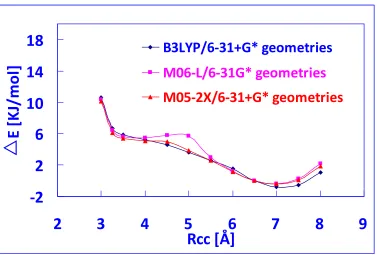
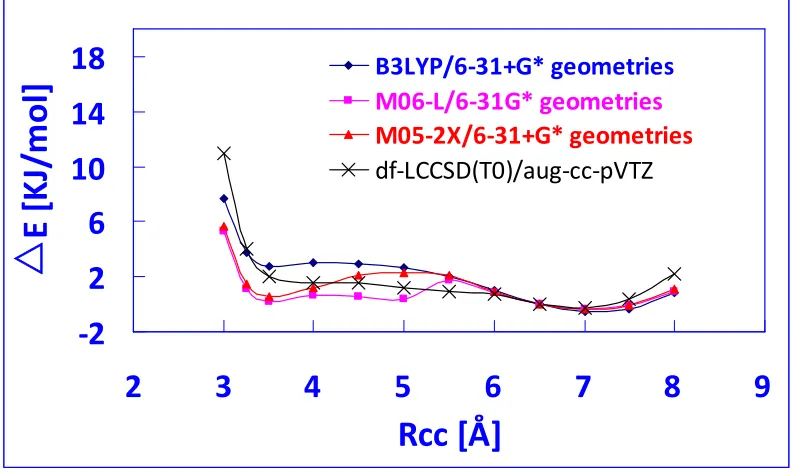
methods, a more reliable method is needed in the conformational search to reduce the possibility of obtaining false peptide structures, with relatively low computational expense. Therefore, the performance of the density functional M06-L for determining the structure of a folded Tyr-Gly conformer is studied. Potential energy profiles have been created for transition from the B3LYP to the MP2 conformer by optimizing the Tyr-Gly structure at fixed values of the RCC distance that controls the degree of
foldedness of the conformer. These are compared with a reference profile taken from previous work [6], which was obtained with the df-LCCSD(T0)/aug-cc-pVTZ method. The results show that M06-L yields results that excellently agree with the reference profile which enables itself a promising functional to study the potential energy surface of small aromatic peptides.
In the main project, the peptides are studied in the gas-phase. However, in a biological environment, water is present. Therefore, ultimately the structure prediction of peptides has to include water molecules into the system, which makes the study of hydration effects important. The third project presented in this thesis provides an initial investigation of solvation effects. In this project, the conformations of neutral
and zwitterionic 3-fluoro-γ-aminobutyric acid (3F-GABA) are studied in solution
Chapter 2
General Background Theory
2.1 Introduction
2.2 Computational chemistry methods
There are three kinds of electronic structure methods: ab initio methods, semi-empirical methods and density functional theory.
Ab initio quantum chemistry methods are computational chemistry methods based on quantum chemistry [10]. The term ab initio indicates that the calculation is from first principles and that no empirical data are used (other than a number of physical constants, such as the speed of light).
(MRCI) methods [11].
Another kind of computational chemistry approach includes the semi-empirical methods, whose main difference from ab initio methods is that they make many approximations and obtain some parameters from empirical data.
Density functional theory (DFT) is based on the proof by Hohenberg and Kohn that the ground-state electronic energy is determined completely by the electron density [13]. DFT describes a molecular system directly via its density, without first finding the wavefunction. It models electron correlation via functionals of the electron density.
2.2.1 Ab initio methods
2.2.1.1 Hartree-Fock Method (HF)
The Hartree-Fock (HF) method is an approximate method for the determination of the wave function and energy of a quantum system.
In order to solve the electronic Schrödinger equation [14]:
) , ( ) ( )
,
(r R E R r R
Helecelec eff elec (2.1) Here r,R represent the positions of electrons and the nuclei. Helec is the electronic Hamiltonian which, compared to the full Hamiltonian, neglects the kinetic energy term of the
nuclei, and elec is the electronic wavefunction. Eeff represents the effective nuclear potential function. Some approximations need to be made. These will lead to the Hartree-Fock method (which is the simplest ab initio method).
The first approximation is to decompose Ψ into a combination of molecular
orbitals (MOs) as (for a two-electron system):
) ( ) ( )
(r 1 r1 2 r2
(2.2)
where the Φn are the one-electron wavefunctions. However, this is not a good
coordinates of two electrons should lead to a sign change. Therefore we create a good form of the two-electron wavefunction as:
) ( ) ( ) ( ) ( )
(r 1 r1 2 r2 1 r2 2 r1
(2.3)
In general, the antisymmetry of an N-electron wavefunction can be achieved by constructing the wavefunction as a Slater Determinant :
) ( ) ( ) ( ) 2 ( ) 2 ( ) 2 ( ) 1 ( ) 1 ( ) 1 ( ! 1 2 1 2 1 2 1 N N N N N N N (2.4)
Here Φi are “spinorbitals”, which contain also the spin of the electron. Then the
second approximation is that the Hartree-Fock wavefunction consists of a single
Slater Determinant. After that, we use the third approximation: the MOs Φiare written
as a linear combination of pre-defined one-electron functions (basis functions or AOs):
N i
i c
1
(2.5)
Here cμi are the expansion coefficients, and χμ are the AOs or basis functions. This is
the LCAO (linear combination of atomic orbitals) approximation. The exact form of the wavefunction depends on the coefficients cμi. The Hartree-Fock method aims to
find the optimal wavefunction.
[15], which can be solved by the Self-Consistent Field (SCF) method.
The main weakness of the Hartree-Fock method is that it neglects electron correlation. In Hartree-Fock theory each electron moves in an average field of all the other electrons. Instantaneous electron-electron repulsions are ignored.
2.2.1.2 Configuration Interaction (CI) [16]
The Hartree-Fock method determines the best one-determinant wavefunction for a given basis set, lacking electron correlation. In order to overcome this weakness, additional Slater Determinants can be added to the wavefunction. By obtaining the additional determinants using single, double, triple, etc. excitations from the optimized HF determinant and putting them into a linear combination, we get the Configuration Interaction method:
S D
D D S
S HF
CI
a
a
a
0 (2.23)Here, φHFis the Hartree-Fock determinant, φSis the Hartree-Fock determinant
with one Molecular Orbital (MO) swapped with a virtual orbital (“single excitation”),
φDis the Hartree-Fock determinant with two MOs swapped with virtual orbitals (“double excitation”) and a0, aS, aDare CI expansion coefficients. The Configuration
Interaction method aims to find the optimal CI expansion coefficients a0, aS, aD, …by
using the variation principle (find those coefficients that yield the wavefunction with the lowest energy). When all possible excited Slater Determinants are included, it becomes Full CI which is very expensive and not feasible for any but the smallest systems.
2.2.1.3 Multi-configuration Self Consistent Field (MCSCF) [11-12]
When not only the CI expansion coefficients ai, but also the MOs in the
becomes an MCSCF. It is usually used for cases where HF does not give a qualitatively correct description.
In a special case, the Molecular Orbitals are divided into active and inactive spaces. The active space includes some of the highest occupied and some of the lowest unoccupied MOs. A full CI is performed for the active MOs. This case is called Complete Active Space SCF (CASSCF).
Usually when HF does not give a correct reference wavefunction, for example for molecular ground states that are almost degenerate with low-lying excited states, in bond breaking situations, or for describing excited states, MCSCF will be employed. It recovers some electron correlation, but mostly “static electron correlation” resulting from the additional flexibility required to qualitatively describe the system, and not so much “dynamic electron correlation” (energy lowering caused by correlating the motions of the electrons).
2.2.1.4 Multi-reference Configuration Interaction (MRCI)
Multi-reference Configuration Interaction is a CI with a MCSCF wavefunction as the reference. However, it is very computationally demanding.
2.2.1.5 Møller-Plesset Perturbation theory (MP)
2.2.1.5.1 Rayleigh-Schrödinger perturbation theory (RS-PT)
The MP-theory [17] is a special application of Rayleigh-Schrödinger perturbation
theory. In RS-PT one considers an unperturbed Hamiltonian operator Ĥ0 to which is
added a small (often external) perturbation :
V H
Hˆ ˆ0 ˆ (2.6)
where λ is an arbitrary real parameter. In MP-theory the zeroth-order wave function is
an exact eigenfunction of the Fock operator, which thus serves as the unperturbed operator. The perturbation is the correlation potential.
In RS-PT the perturbed wave function and perturbed energy are expressed as a power
series in λ:
n i i i n 0 ) ( lim (2.7)
n i i i n E E 0 ) ( lim (2.8)Substitution of these series into the time-independent Schrödinger equation gives a new equation: ) )( ( ) )( ˆ ( 0 ) ( 0 ) ( 0 ) (
0
n i i i n i i i n i i i E V
H
(2.9)
Equating the factors of λk
2.2.1.5.2 Møller-Plesset Perturbation Theory
The MP-energy corrections are obtained from Rayleigh-Schrödinger (RS) perturbation theory with the perturbation (correlation potential):
0| | 0
ˆ H F H F
V
(2.10)
Where the normalized Slater determinant Φ0 is the lowest eigenfunction of the Fock
operator:
/2
1 0 0
1
0 ( ( )) 2( )
N i i N k k f F (2.11)
Here N is the number of electrons of the molecule under consideration, H is the usual
electronic Hamiltonian, f(1) is the one-electron Fock operator, and εi is the orbital
energy belonging to the doubly occupied spatial orbital φi. The shifted Fock operator
serves as the unperturbed (zeroth-order) operator:
0 0
0 | |
ˆ F H F
H
(2.12)
The Slater determinant Φ0being an eigenfunction of F, it follows readily as:
0 0 0 0 0 0 0 0
0 | | 0 ˆ | |
F H H
F
(2.13)
So that the zeroth-order energy is the expectation value of H with respect to Φ0, i.e.,
0 0
0 E |H|
EMP HF
(2.14)
Since the first-order MP energy
0 |
ˆ
| 0
0
1 V
EMP
(2.15)
is zero, the lowest-order MP correlation appears in second order. This result is the Møller-Plesset theorem [17]: the correlation potential does not contribute in first-order to the exact electronic energy. In order to obtain the MP2 formula for a closed-shell molecule, the second-order RS-PT formula is written on the basis of doubly-excited Slater determinants. (Singly-excited Slater determinants do not contribute because of the Brillouin theorem). After application of the Slater-Condon rules for the simplification of N-eletron matrix elements with Slater determinants in bra and ket and integrating out spin, the MP2 energy becomes:
b a j i i j b a j i b a b a j i b a j i MP r r r E
) 2 ( ) 1 ( | | ) 2 ( ) 1 ( ) 2 ( ) 1 ( | | ) 2 ( ) 1 ( 2 ) 2 ( ) 1 ( | | ) 2 ( ) 1 ( 1 12 1 12 , , , 1 12 2 (2.16)where φi and φj are canonical occupied orbitals and φa and φb are canonical virtual
orbitals. The quantities εi, εj, εa, and εbare the corresponding orbital energies. Clearly,
through second-order in the correlation potential, the total electronic energy is given
by the Hartree-Fock energy plus second-order MP correction: E ≈ EHF + EMP2. The
Equivalent expressions are obtained by a slightly different partitioning of the Hamiltonian, which results in a different division of energy terms over zeroth- and first-order contributions, while for second- and higher-order energy corrections the two partitionings give identical results. This difference is due to the fact, well-known in Hartree-Fock theory, that
/2
1 0
0| | 0 2
N i i HF E F H (2.17)
(The Hartree-Fock energy is not equal to the sum of occupied-orbital energies). In the alternative partitioning one defines,
F Hˆ0
, Vˆ H F (2.18)
Clearly in the partitioning,
/2
1 0 2 N i i MP
E ,
/2
1 1 2 N i i HF MP E
E (2.19)
Obviously, the Møller-Plesset theorem does not hold in the sense that EMP1 ≠ 0. The
2.2.1.6 Coupled cluster theory (CC) [19-21]
While perturbation theory adds all types of corrections (S, D, T, Q, …) to the reference wavefunction to a given order (first, second, …), coupled cluster theory adds all corrections of a certain type to infinite order.
The coupled cluster wavefunction can be written as :
Ψcc = eT φ0 (2.20)
Where eT is the exponential operator and φ0 is the HF wavefunction. The
exponential operator can be expanded into a Taylor series:
eT= 1 + T + 1/2 T2+ 1/6 T3+ … (2.21)
The cluster operator is written in the form:
T = T1+ T2+ T3+ … + Tn (2.22)
Here T1represents the operator of all single excitations, T2represents the operator
of all double excitations and so forth. When all operators up to Tn are included, it
becomes full CI, which is not feasible for any but the smallest systems. Therefore, for large systems the cluster operator must be truncated at some excitation level. For example, when T = T1+ T2, it is the CCSD method; when T = T1+ T2+ T3 , it is the
CCSDT method; when the triples are derived based on perturbation theory, then it becomes the CCSD(T) method, which is a very accurate method.
2.2.2 Semi-empirical quantum chemistry methods [22-23]
They are very important in computational chemistry for treating large molecules where the full Hartree-Fock method without the approximations is too expensive. The use of empirical parameters appears to allow some inclusion of electron correlation effects into the methods. Semi-empirical calculations are much faster than their ab initio counterparts. However, their results can be very wrong if the molecule being computed is not similar enough to the molecules in the database used to parametrize the method. They have been most successful in the description of organic chemistry, where only a few elements are used extensively and molecules are of moderate size.
2.2.3 Density Functional Theory (DFT) [24-25]
2.2.3.1 Introduction to Density Functional Theory
During the past decades, the density functional theory has emerged as a powerful methodology for the simulation of chemical systems. It is built based on the premise that the energy of an electronic system can be defined in terms of its electron probability density, which means the electronic energy is regarded as a functional of the electron density, in the sense that there exists a one-to-one correspondence between the electron density of a system and its energy.
The advantage of the DFT treatment over a more pure approach based on the notion of a wavefunction can be best demonstrated according to the following: given a system comprising n electrons, its wavefunction would have three coordinates for each electron and one more per electron if the spin is included, i.e., a total of 4n coordinates, whereas the electron density depends only on three coordinates, independently of the number of electrons that constitute the system [26]. Therefore, the electron density maintains the same number of variables, independent of the system size while the complexity of the wavefunction increases with the number of electrons.
focused on a variety of aspects including the theory, methodological developments, and the practical application of DFT to specific problems. However, the range of possibilities in this field has been extended dramatically with the computational development in the past decades. For many years B3LYP has been the most widely used functional [34-35], but nowadays a great number of density functionals at different levels of sophistication have become available such as the famous Minnesota functionals from the Truhlar group [36-40].
2.2.3.2 Basic Principles: The Hohenberg-Kohn Theorem
The first time when the concept of density functional came out was in the late 1920s, developed by E. Fermi [41] and L. H. Thomas [42], who introduced the idea of expressing the energy of a system as a function of total electron density. In 1951, J. C. Slater [43] applied a very similar idea into the development of the Hartree-Fock-Slater method, which was initially considered as an approximate methodology to the Hartree-Fock theory, but thought of as a predecessor theory of DFT nowadays.
2.2.3.3 The Kohn-Sham Formalism
In 1965, with the introduction of atomic orbitals, W. Kohn and L. Sham [45] developed a formalism that was the foundation of the current application of DFT in the computational chemistry field. A practical way was yielded by this formalism to solve the Hohenberg-Kohn theorem for a set of interacting electrons, starting from a virtual system of non-interacting electrons which have an overall ground-state density equal to the density of some real system of chemical interest where electrons do interact. The difficulty in representing the kinetic energy of the system was the main problem behind initial DFT formalisms. The main assumption in the Kohn-Sham approach is that the kinetic energy functional of a system can be split into two parts: one part that can be calculated exactly and that considers electrons as noninteracting particles and a small correction term accounting for electron-electron interaction.
2.2.3.4 Classification of DFT Methods
DFT functionals can be classified into the following categories: the Local Density Approximation (LDA), the Generalized Gradient Approximation (GGA), hybrid GGA, hybrid-meta GGA and meta-GGA.
LDA assumes that the density locally can be treated as a uniform electron gas, or equivalently that the density is a slowly varying function; GGA assumes that the density functional depends on the up and down spin densities and their reduced gradient; Hybrid GGA contains a percentage of exact Hartree-Fock exchange; Hybrid-meta GGA in addition explicitly depends on the kinetic energy density. Meta-GGA has no Hartree-Fock exchange and depends on the up and down spin kinetic energy densities.
but it cannot be used for stacking interactions [53]. B97-1 tends to give the best results for a combination of thermochemical kinetics and nonbonded interactions [39] and is the best non-meta functional in a study on H-bonded and stacked structures of formic acid tetramers and formamide tetramers [54]. BHandH can obtain good results for dispersion systems, but it overestimates hydrogen-bonding interactions [55].
Hybrid meta GGA includes the following functionals: PWB6K, M05, M05-2X, M06-HF, M06 and M06-2X. PWB6K was used for thermochemistry and nonbonded interactions [56] and consistently performed well for noncovalent interactions [57-58]. The M05 and M05-2X, M06, M06-2X and M06-L functionals were developed by Truhlar et al. and are part of the M05 [59] and M06 [40, 60-61] series. The M06 suite was developed on the experience obtained from the M05 functionals and supercedes these essentially [40]. M06-L is a non-hybrid (local) functional, therefore, it is less computationally demanding. This is the reason why we investigate if it gives sufficiently accurate results in this thesis.
2.3 Basis sets [10-11, 62-64]
2.3.1 Introduction
In chemistry, a basis set is a set of functions used to generate the molecular orbitals, which can be expanded as a linear combination of basis functions with certain weights or coefficients to be determined. Generally these functions are centered on atoms, named atomic orbitals. Alternatively, they can be centered on bonds or lone pairs. In addition, basis sets can be composed of sets of plane waves down to a cutoff wavelength. These are often used in calculations involving systems with periodic boundary conditions.
situations are all represented as a linear combination of the basis functions in the basis set used. If the finite basis is expanded towards an infinite complete set of functions, it is said that those calculations are approaching the basis set limit [65].
Atomic orbitals may be Slater orbitals, which are functions that decay exponentially with distance from the nuclei. These Slater-type orbitals (STOs) can in turn be approximated by a linear combination of Gaussian-type orbitals (GTOs), as accomplished by Frank Boys. Since it is easier to compute overlap and other integrals with Gaussian basis functions, a great deal of computational savings can be realized using GTO-based basis sets.
Nowadays there are hundreds of basis sets composed of Gaussian-type orbitals. The smallest ones of these are called minimal basis sets, which are composed of the minimum number of basis functions required to represent all of the electrons on each atom.
The addition of polarization functions is probably the most common addition to minimal basis sets, denoted by an asterisk, *, in Pople-type basis sets. If two asterisks are added, the polarization functions are also added to light atoms (hydrogen and helium). These are auxiliary functions with one additional node. For example, in a minimal basis set, the only basis function positioned on a hydrogen atom would be a function approximating the 1s atomic orbital. When adding a polarization function to this basis set, additional flexibility is added to the basis set which effectively enables the creation of molecular orbitals that are more asymmetric about the hydrogen nucleus. Similarly, d-type functions can be added to a basis set containing s and p orbitals, and so on. A more precise notation than the * and * * notation indicates exactly which and how many functions are added to the basis set. For example, (p, d), which is equivalent to * *.
that diffuse functions are added to light atoms (hydrogen and helium) as well. These are very shallow Gaussian basis functions. The effect of additional diffuse basis functions can be significant concerning anions and other large, “soft” molecular systems.
2.3.2 Minimal basis sets
The most common minimal basis set is STO-nG, where n is an integer. N means the number of Gaussian primitive functions comprising a single basis function. In this situation, the core and valence orbitals are composed of the same number of Gaussian primitive orbitals. Minimal basis sets are typically insufficient to give accurate results for researches, but they are much cheaper in computational expense. Examples of minimal basis sets are:
STO-3G STO-4G STO-6G
2.3.3 Split-valence basis sets [66-67]
2.3.4 Pople basis sets [68-69]
The Pople-type split-valence basis sets can be denoted as X-YZg. X means the number of primitive Gaussians comprising each core atomic orbital basis function. The Y and Z mean that two basis functions are composing the valence orbitals; the first one is composed of a linear combination of Y primitive Gaussian functions, the other one is composed of a linear combination of Z primitive Gaussian orbitals. Therefore, two numbers after the hyphens mean that it is a split-valence double-zeta basis set. The forms of split-valence triple- and quadruple-zeta basis sets are denoted as X-YZWg and X-YZWVg, etc. The following forms are a list of frequently used split-valence basis sets of this type:
3-21G
3-21G* - Polarized
3-21+G - Diffuse functions
3-21+G* - With polarization and diffuse functions 4-21G
4-31G 6-21G 6-31G 6-31G* 6-31+G*
6-31G(3df, 3pd) 6-311G
2.3.5 Correlation-consistent basis sets
Dunning and coworkers [70-73] have developed some of the most widely used basis sets, which are designed to converge systematically to the complete-basis-set (CBS) limit using extrapolation techniques. For atoms in the first and second rows of the periodic table, the notation of the correlation consistent basis sets is cc-pVNZ where N=D, T, Q, 5, 6, … (D=double, T=triple, etc.). The “cc-p” means “correlation-consistent polarized” and the “V” (valence) indicates that these are split-valence basis sets. Larger shells of polarization (correlating) functions (d, f, g, etc.) are included successively. Presently these “correlation-consistent polarized” basis sets have been widely used. See the following as examples:
cc-pVDZ – Double-zeta cc-pVTZ - Triple-zeta cc-pVQZ - Quadruple-zeta cc-pV5Z - Quintuple-zeta, etc.
aug-cc-pVDZ, etc. - Augmented versions of the preceding basis sets with added diffuse functions.
2.4 Basis Set Superposition Errors (BSSE) and the Counterpoise
Procedure (CP)
In quantum chemistry, calculations of interaction energies are susceptible to basis set superposition error if they use finite basis sets. If the atoms of interacting molecules (or of different parts of the same molecule) approach one another, each individual monomer “borrows” functions from other nearby components, effectively increasing its basis set and decreasing its energy. If the total energy is minimized as a function of the system geometry, the short-range energies from the mixed basis sets in the system must be compared with the long-range energies from the unmixed sets, and this mismatch introduces an error, that is, BSSE.
Two methods exist to eliminate this problem. One is the chemical Hamiltonian approach (CHA) [74], which replaces the conventional Hamiltonian with one designed to prevent basis set mixing a priori, by removing all the projector-containing terms which would allow basis set extension.
The other method is the counterpoise approach (CP), which was proposed by Boys and Bernardi in 1970 [9]. In this procedure, the monomer calculations have the same flexibility as what is available to them in the dimer calculation, which means the monomer energies are evaluated in the complete dimer basis set.
The interaction energy ΔE is given by:
B A
AB R E E
E R
E
( ) ( ) (2.24)
Here EAB(R) is the energy of the AB dimer at geometry R, EAand EB are the
energies of the separate monomers, which equals the energy of AB when R=∞. The
) ( ) ( ) ( )
(R E R E{ } R E{ } R
E BAB
AB A AB
CP
(2.25)
The superscripts {AB} indicate that the monomer energies are computed in the dimer basis set, A∪B. The {B} basis in the E{AAB} calculation and the {A} basis in the {AB}
B
E calculation are usually referred to as "ghost" basis sets. Equation 2.24
represents the uncorrected interaction energy, referred to as ΔEnoCP. ΔE
BSSEis usually
defined as the difference between ΔECP and ΔEnoCP
: } { } { } { } { ) ( )
( BAB AA BB
AB A CP noCP
BSSE E E E R E R E E
E
(2.26)
Equation 2.25 is valid for the interaction between two atoms A and B, with interfragment distance R. If A and B are molecules, they are brought to the complex geometry R together with their geometry deformed to the same geometry as they have in the particular complex geometry one is studying. The energy required to bring monomer A to a particular intramolecular geometry rA is given by the deformation
energy: ) ( ) ( )
( { } { } e
A A A A A A def
A r E r E r
U
(2.27)
The deformation energy of B has a similar expression. Here, re means the
equilibrium geometry of molecule A. The deformation energy is a property of the monomer, therefore, it is computed in the monomer basis set, indicated by the superscripts {A} in Equation 2.27. The total counterpoise-corrected interaction energy with intermolecular geometrical parameters R and intramolecular parameters rAand rB
) ( ) ( ) , , ( ) , , ( ) , , ( ) , ,
( { } { } B
def B A def A B A AB B B A AB A B A AB B A CP r U r U r r R E r r R E r r R E r r R
E
(2.28)
Usually the deformation energy is very small at the complex’s optimized geometry. Therefore, neglecting it will only introduce a small error in the computed binding energy. However, if considering geometries further away from the equilibrium structure, the deformation energy must be taken into account.
As for the intramolecular BSSE, we can use the fragmentation method to perform the counterpoise correction and calculate the BSSE energy, which will be illustrated in detail in chapter 3.
2.5 Computational methods used in this work
In the “Fragmentation method and Rotation method for intramolecular BSSE correction” chapter, the B3LYP and MP2 levels of methods are performed with the software packages Gaussian (version 03) and NWChem [75].
In the “Performance of M06-L density functional for a folded Tyr-Gly conformer” chapter, the M05-2X/6-31+G* and M06-L/6-31G* optimizations, B3LYP, M05-2X and M06-L single-point calculations are performed with NWChem; whereas the mPW2-PLYP, B3LYP-D and mPW2-PLYP-D calculations were done with ORCA [76].
In the “Predicting the structure of flexible peptides” chapter, all the different levels of methods are performed with the software package Gaussian (version 09).
In the “Modelling zwitterions in solution: 3-fluoro-γ-aminobutyric acid
Chapter 3
Fragmentation Method and Rotation
Method for Intramolecular BSSE Correction
3.1 Abstract
Two different methods to correct the intramolecular BSSE were studied, namely, the fragmentation method and the rotation method, in order to have a better understanding of their differences and accuracies. The rotation method was further investigated by adding more ghost atoms to the system. Energy profiles were created by rotating one of the central carbon-carbon bonds. It was shown that propanediol was not a good model system to apply the fragmentation method while a new model system, C11H8O4, with scheme2 (generating the dimer for the fragmentation method
by removing the central five carbon atoms) solved this problem. Three kinds of rotation method were applied (the original rotation method, Palermo’s extended rotation method and a third rotation method proposed by us). However, the original and the third rotation method yielded BSSE energies with too negative values while Palermo’s extended rotation method obtained negative as well as positive BSSE values. The results show that the rotation method cannot be used to correct intramolecular BSSE along a rotational profile.
3.2 Introduction
conformation. However, the interactions may be affected a lot by intramolecular basis set superposition errors (BSSE), especially in cases when there are aromatic rings involved. Because the standard method for BSSE correction, the counterpoise (CP) procedure created by Boys and Bernardi [9], can only be applied to eliminate intermolecular BSSE, there is no direct way to solve the artificial attraction problem in the above situations.
To get an estimate of the intramolecular BSSE in a molecular system, one way is to break the molecule into two fragments, and use the CP method to compute the intermolecular BSSE in the complex system. But there is one problem with this approach, that is, to obtain non-radical fragments, the broken bonds may need to be saturated with additional hydrogens and some atoms around the broken bond may need to be removed in order to avoid overlapping or very close atoms.
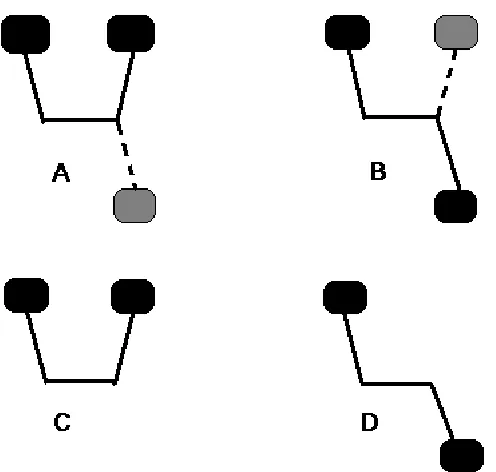
Recently Palermo et al. published an alternative approach for intramolecular BSSE correction, called the rotation method [77], which is displayed in Fig 3.1. The aim of the procedure is to get the interaction between the two ellipses in C. By rotating the central bond to that extent where the interaction between them can be excluded we get the non-interaction reference geometry, like D shows. But we cannot simply get the interaction energy by computing the difference of the energies of C and D because of the possible BSSE in C. That is why ghost atoms in both A and B are introduced according to the other’s conformation. Palermo et al. proposed that the CP-corrected interaction energy can be obtained using the following equation [77]:
B A rotation CP
E E
E
,
(3.1) Here the assumption is made that the calculation of the interacting geometry and the reference geometry should use the same size basis set. The interaction energy without CP-correction can be calculated using the following equation:
D C noCP
E E
E
The BSSE is computed as the difference between the sum of the energies of the two geometries with ghost functions and the sum of the energies of the structures without the ghost functions:
D C B A rotation
BSSE E E E E
(3.3)
Note that the BSSE according to equation 3.3 is not equal to (ΔEnoCP- ΔECP
Figure 3.1 Schematic drawing of the molecular fragments that define the rotation method. Solid lines, dark gray ellipses denote the molecular system; dashed lines, light-gray ellipses denote representation by ghost orbitals. A: optimal geometry with ghost atoms; B: non-interacting geometry with ghost atoms; C: optimal geometry; D: non-interacting geometry.
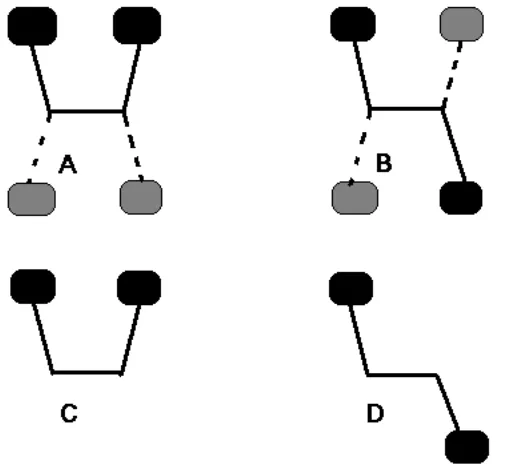
Figure 3.2 Schematic drawing of the molecular fragments that define the rotation method using extra ghost atoms. Solid lines, dark gray ellipses denote the molecular system; dashed lines, light-gray ellipses denote representation by ghost orbitals. A: optimal geometry with extra ghost atoms; B: non-interacting geometry with extra ghost atoms; C: optimal geometry; D: non-interacting geometry.
In the extended rotation method, Palermo et al. argued that extra ghost atoms were needed to make the CP-corrected interaction energy more accurate (see Fig 3.2). This should be the more correct way of correcting for intramolecular BSSE [79].
In the extended rotation method proposed by Palermo, the CP-corrected interaction energy is obtained using the following equation (again, with the assumption that the calculation of the interacting geometry and the reference geometry should use the same size basis set):
B A rotation CP
E E
E
,
D C noCP
E E
E
(3.5)
The BSSE is computed as the difference between the interaction energy without CP-correction and the CP-corrected interaction energy:
) ( ) ( , B A D C rotation CP noCP rotation
BSSE E E E E E E
(3.6)
Inspection of the individual terms in this equation shows no reason why the BSSE energy, defined like this, should always be negative. The fact that the BSSE energy calculated according to Eq. 3.6 can be positive shows that this energy quantity is not comparable to the definition of intermolecular BSSE (which can only be negative).
Thus, because the extended rotation method proposed by Palermo is not equivalent to the counterpoise procedure for intermolecular BSSE, which is demonstrated by equation (2.25). The reason is the common misconception that the size of the basis set should be the same in the interacting and non-interacting cases.
Therefore, we propose a third rotation method that is equivalent to equation (2.25) for the intermolecular case, where the CP-corrected interaction energy is calculated using the equation:
B C rotation CP E E
E
,
(3.7)
The interaction energy without CP-correction is calculated using the equation:
D C noCP
E E
E
(3.8)
The BSSE is calculated as the difference between the interaction energy without CP-correction and the CP-corrected interaction energy:
D B rotation CP noCP rotation
BSSE E E E E
,
3.3 Methodology
Figure 3.3 Atom labeled structure of propanediol
In order to see how well the rotation method corrects the interaction energy, some simple molecule models were used. One of the models is propanediol whose structure is shown in Figure 3.3.
First, the structure of propanediol was optimized with Gaussian 03 using the B3LYP method with the 6-31+G* basis set. Then by rotating the C3-C6 bond with
steps of 20˚, the propanediol’s energy was computed using the MP2 method with the
6-31+G* basis set.
Then the rotation method was applied. At each rotation step, the energy of propanediol with ghost atoms at the non-interacting geometry and the energy of propanediol at the non-interacting geometry with ghost atoms replacing the interacting part were also calculated using the MP2 method and the same basis set, like A and B shown in Fig 3.1. The interaction energy was then obtained by computing the difference of these two energies. After that, the fragmentation method was used. At each rotation step, the middle CH2group was removed which led to two
monomers. The broken bond was saturated by a hydrogen atom of which the position
O
O
H
H
C
C
C
H
H
H
H
H
H
3
6 7
2 8
1
4
5
13 12
11 10
was optimized using the B3LYP method with the 6-31+G* basis set. The intramolecular BSSE energy, the interaction energy and the energy of the resulting methanol dimer were calculated afterwards using the counterpoise procedure with the MP2 method and the 6-31+G* basis set.
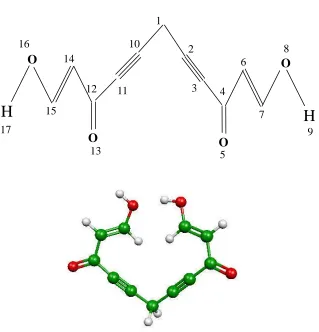
Figure 3.4 Atom labeled structure and three-dimensional plot of C11H8O4
The same procedure of the rotation method was implemented on a bit more complex molecule, C11H8O4, of which the atom-labeled structure and
three-dimensional plot are shown in Figure 3.4. The rotation bond was C1-C10. For the employment of the fragmentation method on the new molecule, two schemes were
O
O
H
1
2
3 4
5
7 6
8
9 10
11
13 O 12 14
15 O 16
H
performed. Scheme1 was to remove the middle CH2 group and saturate the broken
bonds and calculate the intramolecular BSSE energy, the interaction energy and the C5O2H4 dimer energy using the counterpoise procedure as done for propanediol.
Scheme2 was almost similar to Scheme1, the only difference was that instead of removing one carbon atom, the middle five carbon atoms were removed. The following computation was the same as above.
Also, the extended rotation method with extra ghost atoms included was investigated. In this case, two kinds of BSSE calculation method were employed, as illustrated by equations 3.4-3.9.
3.4 Results and Discussion
3.4.1 Propanediol as the model system
Relative CP-corrected Interaction Energies of Propanediol and Methanol Dimer
-40 -30 -20 -10 0 10 20 30 40 50
-100 0 100 200 300 400
Rotation Angle (degree)
R
e
la
ti
v
e
E
n
e
rg
y
(k
J
/m
o
l)
Propanediol from original rotation method
Methanol dimer from fragmentation method
Figure 3.5 The relative CP-corrected interaction energies of propanediol and
methanol dimmer. The energy at rotation angle = 108˚ was used as the reference for
the relative energies.
A B
[image:45.595.160.434.104.432.2]C D
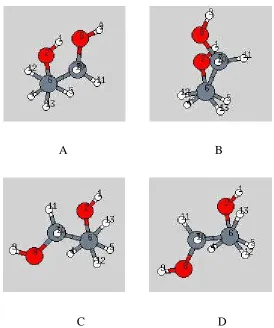
Figure 3.6 Newman projections of propanediol at different stages of the rotation procedure
The curve obtained by the rotation method can be explained as follows: at the
beginning, when the rotation angle (the O4-C1-C2-C3 torsion angle) is about -72˚, the
two oxygen atoms are close to each other, as shown in Figure 3.6 A. When the C1-C2 bond is rotated, hydrogens H4 and H12 get closer to each other, so do H5 and H13, which makes the interaction between them more repulsive, as shown in Figure 3.6 B.
The maximum at -12˚ occurs when the Newman projection turns into the eclipsed
more repulsive again and reaches the second maximum when the hydrogen atoms are eclipsed again. Because there is an attraction between O2 and H13, which reduces the overall repulsion energy of propanediol, the second maximum is much smaller than the first one. As the rotation continues, the interaction again decreases in repulsion and increases to the third maximum. The reason why the third maximum is much smaller than the first one is the same as above, when the hydrogen atoms are eclipsed. The curve of the fragmentation method is flatter and has only the first two maxima, probably due to the removal of the middle CH2group.
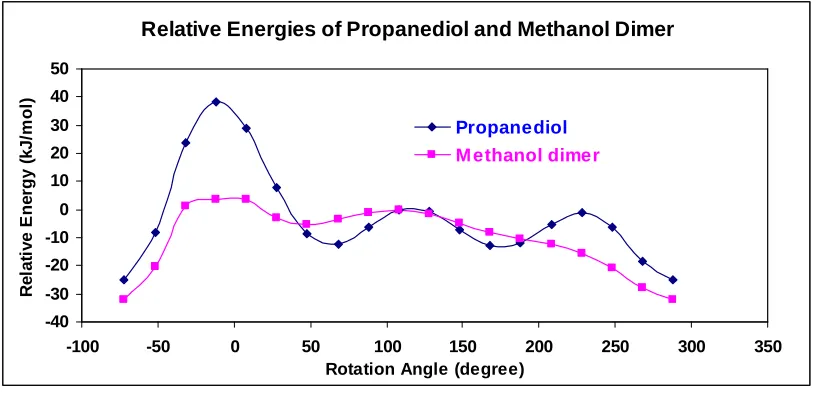
Relative Energies of Propanediol and Methanol Dimer
-40 -30 -20 -10 0 10 20 30 40 50
-100 -50 0 50 100 150 200 250 300 350 Rotation Angle (degree)
[image:46.595.94.502.305.505.2]R e la ti v e E n e rg y (k J /m o l) Propanediol M ethanol dimer
Figure 3.7 The uncorrected relative energies of propanediol and methanol dimmer.
The energy at rotation angle = 108˚ was used as the reference for the relative energies.
method. Thus, removal of the middle carbon atom resulted in extraordinary change of the curve of the model energy.
BSSE Energies of Propanediol
-40 -35 -30 -25 -20 -15 -10 -5 0 5
-100 0 100 200 300 400
Rotation Angle (degree)
B S S E E n e rg y (k J /m o l)
BSSE Energy from Original Rotation Method
BSSE energy from fragmentation method
Figure 3.8 BSSE energies of propanediol using the original rotation method
The BSSE energies calculated from the original rotation method and the fragmentation method are very different from each other, as shown in Figure 3.8. The fragmentation method yields BSSE energies between -20 and -10 kJ/mol, while the rotation method gives BSSE energies between 0 and -40 kJ/mol, with the left part of the curve decreasing and the right part going up with increasing rotation angles. In the middle point of the curve, which is the reference position, the BSSE energy jumps to 0, caused by the complete overlapping of the ghost atoms and the real atoms which makes the ghost atoms’ effect disappear. Note that the BSSE as defined for the original rotation method (Eq. 3.3) does not equal the difference between the uncorrected and CP-corrected interaction energies. Thus, the BSSE curve displayed in Figure 3.8 is not the same as difference between the uncorrected and CP-corrected interaction energy curves in Figure 3.5 and 3.7.
the model system to study the rotation methods, that is, the molecule is small. As a result, the two ends are too close to the central CH2 group which means that the
interaction between those two ends and the middle group cannot be neglected and the removal of the middle group therefore leads to inaccurate results. In order to avoid this problem, a new model, C11H8O4, was utilized, in which the two interaction parts
are far from the middle carbon atoms.
3.4.2 C
11H
8O
4as the model system
3.4.2.1 Scheme1 (Removal of central CH2group)
For scheme1, the C5H4O2 dimer was generated by removing the central CH2
group.
Relative CP-corrected Interaction Energies of C11H8O4and C5H4O2dimer in Scheme1
-200 -150 -100 -50 0 50
-100 -50 0 50 100 150 200 250 300 350
Rotation Angle (degree)
R e la ti v e E n e rg y (k J /m o l)
C11H8O4 from original rotation method
C5H4O2 dimer from fragmentation method
Figure 3.9 The relative CP-corrected interaction energies of C11H8O4and C5H4O2
dimer in scheme1 (Removal of central CH2group). The energy at rotation angle =
141˚ was used as the reference for the relative energies.
Figure 3.9 shows the CP-corrected relative interaction energies of C11H8O4
rotation step. It can be seen from the graph that the curve obtained from the rotation method is flat, with the energies varying between -14 kJ/mol and -18 kJ/mol. However, the curve obtained by the fragmentation method is totally different. There is a
maximum at a rotation angle of ~150˚.
Relative Energies of C11H8O4and C5H4O2Dimer in Scheme1
- 20 0 - 15 0 - 10 0 -5 0 0 5 0
- 1 00 - 5 0 0 5 0 1 00 15 0 2 0 0 2 50 30 0 3 5 0
Rotation Angle (degree)
R
e
la
ti
v
e
e
n
e
rg
y
(k
J
/m
o
l)
C11H8O4
C5H4O2 dimer
Figure 3.10 The uncorrected relative energies of C11H8O4and C5H4O2dimer in
scheme1 (Removal of central CH2group). The energy at rotation angle = 141˚ was
used as the reference for the relative energies.
Figure 3.10 shows the curve of the relative energies of C11H8O4 and the C5H4O2
dimer in scheme1. The same difference exists between the two curves as was observed for the CP-corrected interaction energies. Therefore, C11H8O4in connection
BSSE Energies of C11H8O4in Scheme1 -600 -500 -400 -300 -200 -100 0 100
-100 0 100 200 300 400 Rotation Angle (degree)
B S S E E n e rg y (k J /m o l)
BSSE Energy from Original Rotation Method
BSSE energy from fragmentation method
Figure 3.11 BSSE energies of C11H8O4in scheme1 (Removal of central CH2group)
using the original rotation method
Fig 3.11 shows the BSSE curves of the original rotation method and the fragmentation method for C11H8O4 in scheme1. For the fragmentation method, the
BSSE energies vary between -21 kJ/mol and -13 kJ/mol, while for the rotation method, the BSSE energies are much more negative, with the same curve shape as in the propanediol case.
Relative CP-corrected Interaction Energies of C11H8O4and C5H4O2dimer in Scheme1
-200 -150 -100 -50 0 50
-100 -50 0 50 100 150 200 250 300 350
Rotation Angle (degree)
R e la ti v e E n e rg y (k J /m o l)
C11H8O4 from Palermo's extended rotation method
C5H4O2 dimer from fragmentation method
Figure 3.12 Relative CP-corrected interaction energies of C11H8O4and C5H4O2dimer
in scheme1(Removal of central CH2group) using Palermo’s extended rotation method.
Next, we applied the extended rotation method proposed by Palermo et al.
Figure 3.12 shows the relative CP-corrected interaction energies of C11H8O4and
C5H4O2 in scheme1 using Palermo’s extended rotation method and the fragmentation
method at each rotation step. From the graph, it can be seen that the rotation method yields energies between -11 kJ/mol and 18 kJ/mol, while the dimer’s energies from the fragmentation method vary in a range of much larger magnitude, with a maximum
at a rotation angle of ~150˚.
Relative CP-corrected Interaction Energies of C11H8O4and C5H4O2dimer in Scheme1
-200 -100 0 100 200 300 400 500
-100 -50 0 50 100 150 200 250 300 350
Rotation Angle (degree)
R e la ti v e E n e rg y (k J /m o l)
C11H8O4 from the third rotation method
C5H4O2 dimer from fragmentation method
Figure 3.13 The relative CP-corrected interaction energies of C11H8O4and C5H4O2
dimer in scheme1 (Removal of central CH2group) using the third rotation method.
The energy at rotation angle = 141˚ was used as the reference for the relative energies.
Figure 3.13 shows the relative CP-corrected interaction energies of C11H8O4and
C5H4O2 in scheme1 using the third rotation method and the fragmentation method at
BSSE Energies of C11H8O4in Scheme1 -25 -20 -15 -10 -5 0 5 10 15
-100 0 100 200 300 400 Rotation Angle (degree)
B S S E E n e rg y (k J /m o l)
BSSE Energy from Palermo's extended rotation method
BSSE energy from fragmentation method
Figure 3.14 BSSE energies of C11H8O4in scheme1 (Removal of central CH2group)
using Palermo’s extended rotation method
BSSE Energies of C11H8O4in Scheme1
-450 -400 -350 -300 -250 -200 -150 -100 -50 0 50
-100 0 100 200 300
Rotation Angle (degree)
B S S E E n e rg y (k J /m o l)
BSSE Energy from our extended rotation method
BSSE energy from fragmentation method
Figure 3.15 BSSE energies of C11H8O4in scheme1 (Removal of central CH2group)
using the third rotation method
Figure 3.14 shows the BSSE energies of C11H8O4 in scheme1 using Palermo’s
extended rotation method. The energies obtained with this method vary between -15 and 13 kJ/mol, with the left part below 0 kJ/mol and the right part above 0 kJ/mol