Citation: Moreno, A. & dasNair, R.* (2015). Translating knowledge into practice: content analysis of online resources about sexual difficulties for individuals with traumatic brain injury. Sexual and Relationship Therapy. DOI: 10.1080/14681994.2015.1039937
Translating knowledge into practice: content analysis of online
resources about sexual difficulties for individuals with traumatic
brain injury
Jhon Alexander Morenoa,b* and Roshan das Nairc,d
aCentre for Interdisciplinary Research in Rehabilitation (CRIR) - Centre de R~eadapation Lucie- Bruneau (CRLB), Montreal, Canada; bDepartment ofPsychology, Centre de recherche en neuropsychologie et cognition (CERNEC), University ofMontreal, Montreal, Canada; cDivision of
Rehabilitation and Ageing, University ofNottingham, Nottingham, UK; dDepartment of Clinical Psychology & Neuropsychology, Nottingham University Hospitals NHS Trust, Nottingham, UK
(Received 5 November 2014; accepted 25 March 2015)
For many individuals with traumatic brain injury (TBI), the Internet is the only available source of information regarding their sexual problems following TBI. This study aimed to evaluate the content and the quality of patient or carer information that is readily available on the Internet about specific aspects of sexuality after TBI. A purposive (non-exhaustive) sample of eight leaflets available on the Internet related to sexuality following TBI was analysed using content analysis. Decreased desire was reported as the main sexual difficulty following TBI (87.5%), followed by inappropriate sexual behaviour (62.5%). Among the strategies to overcome these difficulties, all leaflets recommended seeking help from healthcare professionals; 42.8% were centred on the carer or the family, and only 28.5% was directly addressed to the individual with TBI. The information available overemphasises disinhibition, underscores other aspects of sexuality (e.g. sexual risk and inability to fantasise), and is conceived mainly for carers and families. A bias assuming that most individuals with TBI are involved in a romantic relationship was also present. Adolescents, women, older people, single people, and non-heterosexual individuals were not adequately represented. There is a need for Internet resources to provide specific recommendations for these groups.
Keywords: online resources; traumatic brain injury; sexuality; sexual rehabilitation; Internet
Introduction
After a traumatic brain injury (TBI), many survivors suffer in silence when they are con-fronted with sexual problems. Unfortunately, sexuality has not received as much attention as other aspects of rehabilitation but there is an increasing awareness of its importance as a health outcome. Cultural representations and myths surrounding disability influence health-care professionals who work with people with TBI, who may not think that this group would need information, consultation, and treatment of sexual difficulties (Anderson & Kitchin, 2000), and individuals with disabilities are often perceived as asexual (Esmail, Darry, Walter, & Knupp, 2010). Similarly, because of some invisible disabilities, healthcare professionals may not always be informed about how an individual’s cognitive deficits, for example, may affect their sexuality. Therefore, healthcare professionals may miss out on
this crucial aspect of an individual’s life, with the problem of translating knowledge into practice, while individuals with TBI feel that their sexuality is overlooked.
The main factors influencing healthcare professionals’ discussion of sexuality with service users correspond to the interdependence of structural factors (e.g. local policies, negative attitudes towards sexuality), healthcare organisational factors (e.g. lack of time and institutional policies), and healthcare practitioners’ personal aspects (e.g. lack of training and religion), among others (Dyer & das Nair, 2013). When individuals with TBI are unable to gain information related to sexuality within the healthcare system, or if they feel they cannot address these issues with healthcare professionals, they often turn to other resources, including close friends, partners, films, books, and the Internet. Also, young people are especially interested in sexual health information online (Buhi, Daley, Fuhrmann, & Smith, 2009) and TBI is more prevalent in young individuals (Roebuck-Spencer & Cernich, 2014).
Smith, Gertz, Alvarez, and Lurie (2000) conducted a study with 27 undergraduate students, which aimed to evaluate the accessibility and the quality of specific information about sex education on the Internet. They concluded that general information on sex education is incomplete and difficult to locate (Smith et al., 2000). If that is the case for people without brain injury, access to relevant information may be further limited by the degree of cognitive impairment that many individuals with TBI face. Therefore, the combination of an unresponsive healthcare system regarding sexuality issues following TBI and the survivor’s distress associated to the emotional, physical, behavioural, social, and financial changes post-injury leaves the individual with unaddressed and untreated sexual problems. Without accessibility to healthcare options, these problems can have a negative impact on the individual’s quality of life (Moreno et al., 2014; Wedcliffe & Ross, 2001).
To our knowledge, previous studies on sexuality following TBI have not assessed the content and the quality of patient and/or carer information that is available on the Internet about specific aspects of sexuality after TBI. For many individuals with TBI, partners, carers, and families, this might be the only access they have to this information. There-fore, it is important to understand the kind of material available, interrogate how informa-tion is conveyed, establish what is missing, and examine the possible barriers for accessibility that individuals with TBI may encounter. Given this gap in the literature, this study aimed to evaluate the content and the quality of the information that is available on the Internet about specific aspects of sexuality after TBI. Based on our clinical and research experience in this field, we hypothesised that information (1) will be limited to describing sexual difficulties, (2) assumes that individuals with TBI have a partner, and (3) will focus on heterosexual people.
Methods Procedu re
papers about sexuality and TBI intended for a specialized readership, and (2) intervention programs about sexuality and TBI.
Because of these criteria and to facilitate a thorough examination of data, we limited our search to the UK, Canada, Australia, and the USA. This was therefore not an exhaus-tive or systematic search, but one that we felt would approximate a search conducted by a community-dwelling individual with TBI or carer. For each combination of keywords, we systematically went through all entries on all the pages on Google, identifying the potential leaflets for inclusion, before moving to the next combination. This reduced selection bias as different combinations lead to different results (e.g. sexuality and TBI versus intimacy and TBI). Thus, we found 10 different leaflets using a combination of the aforementioned keywords. After carefully screening the leaflets, we excluded two: one that mainly addressed the way to overcome loneliness and another was conceived as an educational manual (not a leaflet). As these leaflets are freely available on the Internet, the approval of the research and ethics board was not necessary.
Analysis
The remaining eight leaflets were coded using content analysis. Content analysis focuses on the frequency with which certain “concepts” are present in texts. A concept is “a single idea, or ideational kernel” (Carley, 1993, p. 81). However, content analysis can go further than presenting counts of concepts, but also how these concepts are articulated. In fact, Hsieh and Shannon (2005) suggest that content analysis consists of different “approaches” and we have used what they term a “summative” approach, which involves “counting and comparisons, usually of keywords or content, followed by the interpreta-tion of the underlying context” (Hsieh & Shannon, 2005, p. 1277). Frequency counts allow us to discuss the emphasis and saliency of concepts across various documents in a given area. As mentioned, alongside the frequency counts, we also paid attention to the language used to convey the concepts (albeit, not as extensively as in other qualitative methods, such as discourse analysis). We followed the guidelines suggested by Carley (1993). We manually entered the following information from the leaflets into a table: intended audience, the sexual problems described, explanations of these difficulties, and suggested ways to deal with these problems. This was initially done by one author [Alexander Moreno (AM)] and verified by the second [Roshan das Nair (RdN)]. Any dis-crepancies were resolved through discussion.
The sexual difficulties described in the leaflets were re-coded based on the kind of problem they focused on (e.g. loss of libido, loss of interest in sex, and low sexual drive were categorised as “decreased desire”). This allowed for generalisation across leaflets. This part of the analysis was again led by AM and checked by RdN. Then, we established the frequency of each category across leaflets. This was done by a manual search of the whole paper for keywords that represented the categories. We used the same system to code the causes of sexual dysfunction included in the leaflets. Finally, we coded the rec-ommendations provided according to three categories: recrec-ommendations focused on the carer, suggestions targeting individuals with TBI, and strategies to cope with sexual diffi-culties via a healthcare provider.
Results
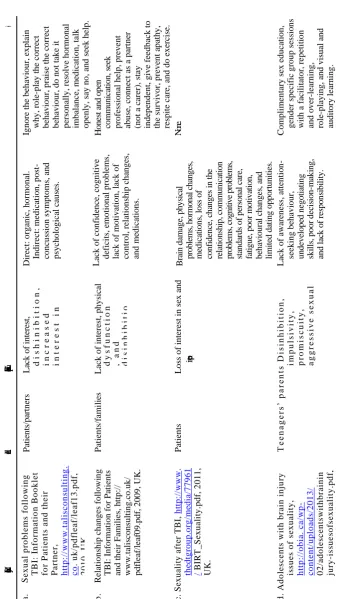
( co nt in ue d ) N on e. H o n es t an d o p en co m m u n ic at io n , se ek p ro fe ss io n al h el p , p re v en t ab u se , co n n ec t
as a p
artn er (n o t a ca re r), sta y in d ep en d en t, g iv e fe ed b ac k to th e su rv iv o r, p re v en t ap ath y , re sp it e ca re , an d d o e x erc ise . Ig n o re th e b eh av io u r, e x p lain wh y , ro le -p la y t h e co rre ct b eh av io u r, p ra ise th e co rre ct b eh av io u r, d o n o t ta k e it p erso n all y , re so lv e h o rm o n al imb alan ce , m ed ica ti o n , talk o p en ly , sa y n o , an d se ek h elp . Co m p li m en tary se x e d u ca ti o n , g en d er sp ec ifi c g ro u p se ss io n s with a fa cil it ato r, re p eti ti o n an d o v er -lea rn in g , ro le -p lay in g , an d v isu al an d au d it o ry lea rn in g . B ra in d am ag e, p h y si ca l p ro b le m s, h o rm o n al c h an g es , me d ic at io n s, l o ss o f co n fi d en ce , ch an g es i n t h e re la ti o n sh ip , co m m u n ic at io n p ro b le m s, c o g n it iv e p ro b le m s, st an d ar d s o f p er so n al c ar e, fa ti g u e, p o o r m o ti v at io n , b eh av io u ra l ch an g es , an d li m it ed d at in g o p p o rt u n it ie s. Lac k o f awa re n ess , att en ti o n -se ek in g b eh av io u r, u n d ev el o p ed n eg o ti at in g sk il ls , p o o r d ec is io n -m ak in g , an d l ac k o f re sp o n si b il it y . Lac k o f co n fid en ce , co g n it iv e d eficits, e m o ti o n al p ro b lem s, lac k o f m o tiv ati o n , lac k o f co n tro l, re latio n sh ip c h an g es, an d m ed ica ti o n s. Dire ct: o rg an ic, h o rm o n al. In d irec t: m ed ica ti o n , p o st -co n cu ss io n sy m p to m s, an d p sy ch o lo g ica l ca u se s. P at ie n ts /p ar tn ers L ac k o f in te re st , d i s h i n i b i t i o n , i n c r e a s e d i n t e r e s t i n s e x , a n d g e n i t a l p r o b l e m s .
Leaflet, URL, year, country
Intended audience
Kinds of sexual problems Explanations of these difficulties
Strategies to deal with them
[image:4.493.78.423.44.644.2]( co nt in ue d ) D ep re ss io n F ix d ep re ss ed m o o d : m e d i c a t i o n s f o r m o o d , m e d i c a t i o n s f o r s e x u a l f u n c t i o n i n g , i n d i v i d u a l a n d c o u p l e s c o u n s e l l i n g , a n d e n d o c r i n e w o r k u p . T h e y h i g h l i g h t t h a t s o m e p r o f e s s i o n a l s m a y f e e l u n c o m f o r t a b l e d i s c u s s i n g s e x u a l i s s u e s . D is cu ss a n d p ra ct ic e ap p ro p ri at e b eh av io u rs ; d is cu ss w it h a h ea lt h p ro fe ss io n al . C o g n it iv e im p ai rm en t, d ep re ss io n , re la ti o n sh ip ch an g es, an d lac k o f so cial sk il ls.
Leaflet, URL, year, country
Intended audience
Kinds of sexual problems Explanations of these difficulties
Strategies to deal with them
Da m ag e to th e b ra in , h o rm o n al ch an g es, m ed ica ti o n sid e effe cts, fa ti g u e, p ro b lem s with m o v em en t, d imin ish ed se lf -este em , co g n it iv e d iffi cu lt ies , em o ti o n al ch an g es, an d re latio n sh ip /so cial ch an g es. S ee k fo r p ro fe ss io n al h el p , co m p re h en siv e m ed ica l ex am , p sy ch o th era p y /co u n se ll in g , co u p les t h era p y , talk wi th th e p artn er, c h an g e p o siti o n s, p re v en t d istrac ti o n s, u se fil m s/ b o o k s, p ro m o te so cial ac ti v it ies , an d p ra cti ce sa fe r se x . Emo ti o n al p ro b lem s, m ed ica ti o n s, ass o ciate d in ju ries , re latio n sh ip b re ak d o w n , p rio r se x u al d iffi cu lt ies , re d u ce d co n fid en ce , an d o th er il ln ess es.
Leaflet, URL, year, country
Intended audience
Kinds of sexual problems Explanations of these difficulties
Strategies to deal with them
Half involved both carers and individuals with TBI (a, b, e, and h). In terms of gender and sexuality, only one (f) reported gender differences in terms of sexual difficulties, and none of them mentioned lesbian, gay, bisexual, transgender, and intersex (LGBTI) people.
We found that 87.5% of the leaflets described decreased desire as the main sexual dif-ficulty following TBI (a, b, c, e, f, g, and h). They were described as arousal difficulties (e, f, and g), loss of libido (h), decreased frequency of sex (h), loss of interest in sex (a, b, and c), and low sexual drive (e). The second most frequent difficulty corresponded to dis-inhibition (a, b, and d), uninhibited behaviour (e), or inappropriate sexual behaviour (h) (62.5%). The next category corresponded to physical problems (62.5%), such as genital problems (a), physical dysfunction (b), impotence (c and h), discomfort in body position-ing (f), lack of lubrication (f), diminished sensation (f), and limited movements (f). A total of 37.5% also described an increased interest in sex (a) and one labelled this as “promiscuity” (d). Inability to reach climax was included in 37.5% of the leaflets (f, g, and h). Under this umbrella term, we included anorgasmia (f), inability to reach orgasm (h), and difficulty to orgasm (g and h). Finally, the least reported sexual difficulties were fatigue (f), impulsivity and aggressive sexual behaviour (d), inability to masturbate (f), feeling unattractive (f), reproductive changes (g), sexual risk (g), and proneness to abuse (d), which accounted for 12.5% of the problems.
In terms of the explanation of the causes of sexual difficulties after TBI, 62.5% reported the indirect influence of medications as one of the major causes of sexual diffi-culties following TBI (a, b, c, g, and h). Two of the leaflets consistently reported that the use of medications explained 25% of the cases of erectile dysfunction (a and b). Social and relationship changes were cited as the cause of sexual difficulties following TBI in 62.5% of the leaflets (b, c, e, g, and h). They included communication problems (c), social changes (b and g), relationship breakdown (h), lack of social skills (e), and limited dating opportunities (c). Half of the leaflets described both direct brain damage associated to the injury and indirect physical injuries (a, c, g, and h) as an explanation for sexual difficulties. Therefore, on the one hand, they included suggestions that damage to specific brain regions linked to sexual response (c and g), hormonal dysregulation (a, c, and g), or other illnesses (h) could explain sexual problems. On the other hand, cognitive impairment was mentioned in 62.5% of the leaflets (e.g. poor decision-making) (b, c, d, e, and g), and 37.5% stated that behavioural changes were responsible for sexual changes post TBI (b, c, and d). These included lack of control (b), poor standards of personal care (c), diminished awareness (d), attention-seeking behaviour (d), undeveloped negotiating skills (d), and lack of responsibility (d). Finally, only 12.5% mentioned that prior sexual difficulties (h) and post-concussion symptoms could explain the presence of sexual difficulties after TBI (a).
(a and f), and contraception modifications according to cognitive difficulties (h). Of these seven leaflets, 42.8% centred their recommendations on the carer or the family. The strat-egies suggested ignoring the behaviour (when disinhibited) (a), explaining why a behav-iour is inappropriate (a), preventing abuse (b), role-playing the correct behavbehav-iour (a and d), praising the correct behaviour (a), not taking it personally (a), honest and open com-munication (b), connecting as a partner (not as a carer) (b), staying independent (b), giv-ing feedback to the survivor (b), and seekgiv-ing help (a). Only 28.5% of the recommendations directly targeted the individual with TBI and both of them assumed the existence of a romantic partner on the basis of the examples they provide (e.g. “a couple can resolve most relationship problems if they communicate frankly with each other”) (g and h). The leaflets suggested talking to the partner (g), changing (sexual) positions (g), preventing distractions (g), using erotic films/books (h), promoting social activities (g), and practicing safer sex (g).
Finally, half the leaflets provided links to other websites (a, b, f, and g), 37.5% recommended other reading materials (c, d, and e), and 12.5% listed either an organisation working with individuals with TBI (h) or a helpline (c).
While there were some examples of attempts to normalise sex as a “normal part of human functioning” (g), there were other instances of the use of non-inclusive language. Most leaflets assumed that people with TBIs were partnered, some suggested being legally partnered [e.g. “spouse” (a)], while others assumed monogamy and fidelity [e.g. “If you are unsure whether your partner
. . .
has been intimate with others. . .
” (g); “Information Booklet for Patients and their Partner” (a); “you and your partner” (f)]. Leaflets tended to use medicalised language (e.g. “organic basis” (c); “sexual regulation”; and “dysfunction” (b)], but some explained medical terms [e.g. “endocrine (hormonal)” (f)].Discussion
The aim of this study was to evaluate the content and the quality of patient or carer infor-mation that is available on the Internet about specific aspects of sexuality after TBI. To our knowledge, this is the first study analysing such written materials using content analysis. We found that in this purposive sample of leaflets, information was mostly limited to describing sexual difficulties in heterosexual adults who are in a romantic relationship. Adolescents, single people, female gender, older people, and LGBTI individuals were poorly represented, and only one addressed specifically gender differences. The language used in the leaflets tended to be formal and medicalised, and sometimes required a high degree of reading ability. This risks putting people off from reading the information or may also contribute to misunderstanding.
need to be adapted in certain instances. Therefore, part of the development of a more pro-active and inclusive perspective would be to develop written materials specific to those groups of individuals. Having a section completely directed to sexuality in materials for these particular groups (e.g. women and older women) could inform them that sexuality is part of their health outcomes and that healthcare providers may offer an open and safe environment to discuss it.
Exploring sexuality with adolescents with TBIs can be challenging. A critical review of the literature investigating adolescents’ use of the Internet for sex education shows that between 20% and 75% of adolescents report engaging with sex information online, including HIV/AIDS/STIs, pregnancy/childbirth, sex acts/behaviour, contraception/pro-tection, information about the body, relationships/social issues, and sexual identity/orien-tation (Simon & Daneback, 2013). Therefore, it is evident that the information available is so limited when some studies show an overall prevalence of child and adolescent TBI of approximately 30% (McKinlay et al., 2008). Behind this lack of information, there is a possible explanation about the paucity of research in this area with teenagers (das Nair, Talbot, Hughes, & Starza-Smith, 2007).
Like the older and younger groups, information for LGBTI groups is lacking. Having heterosexual-only information is inadequate. For example, assuming that an individual enrolled in a TBI program is heterosexual may lead to confusion, exclusion of the partner (where there is one), family conflicts, and misunderstandings (Mapou, 1990). Conversely, providing inclusive written materials either in the waiting room or the websites of clinics working with individuals with TBI would help clients, families, and carers understand that they have permission to talk about sexual issues.
Much of the information about sexual difficulties was couched within the sexual response cycle framework, with difficulties related to arousal and orgasm mainly identi-fied. The majority of the leaflets reported that decreased libido was a frequent complica-tion of TBI, and this is corroborated by research literature (Griffith & Lemberg, 1993; Kreuter, Dahllof, Gudjonsson, Sullivan, & Siosteen, 1998; Kreutzer & Zasler, 1989; Sander & Little, 2014). For instance, some studies report a decrease of sex drive of 40.8% (Downing, Stolwyk, & Ponsford, 2013). This is also related to the side-effects of some medications prescribed for individuals with TBI (Zasler, Katz, & Zafonte, 2007). Conversely, inappropriate sexual behaviour or disinhibition was addressed by 62.5% of the leaflets, when the occurrence of this is virtually low. For instance, a study of a com-munity-based cohort (n
=
507) with TBI reported a prevalence rate of inappropriate sex-ual behaviours of 8.9% over the previous three months, particularly in younger individuals with more severe injuries (Simpson, Sabaz, & Daher, 2013). Therefore, it is possible that the information available on the Internet overestimates this behaviour gener-ating more anxiety among individuals with TBI, and suggesting to families and carers that a healthy interest in sexuality may be misinterpreted as disinhibition.associated with sexual contact, including HIV or other sexually transmitted diseases (Cooper, 2002), is associated with the presence of cognitive deficits, such as dysexecutive symptoms (Moreno & McKerral, 2014). Unfortunately, even when the leaflets state that there is an indirect influence of cognitive deficits on sexual issues, they do not recom-mend specific interventions regarding cognitive rehabilitation.
In general, the leaflets suggested interventions conceived from a multidisciplinary perspective. This is compatible with existing models that recommend assessment and treatment of sexual difficulties from an interdisciplinary perspective (Simpson, 2001). However, the strategies to access those services may be limited because of difficulties when seeking help. This is alarming because research suggests that healthcare professio-nals working with individuals with TBI take a reactive approach to talk about sexual issues after TBI (Dyer & das Nair, 2014). Furthermore, another study found that 32% of individuals with TBI indicated that they would spontaneously raise issues of sexual diffi-culties with healthcare professionals only if directly asked or would not discuss them at all (Sander et al., 2012).
Another finding from our study is that there is very little information directed specifi-cally at the individual with TBI. Most of the information is intended for families and carers. However, family members and carers may experience feelings of embarrassment when addressing these issues with individuals with TBI. At the same time, sexual concerns may be misinterpreted as a manifestation of sexual inappropriateness, especially when behavioural changes are given prominence in the leaflets. Therefore, the “do’s and don’ts” suggested by some leaflets appear to be incomplete when an individual with TBI wants to learn how to promote a healthy sexual life. For example, we found almost no information about improving social skills to find a potential partner or to develop dating skills; and for those who are in a relationship, very little information is suggested about how to improve the quality of their relationship. This is important as it has been suggested that at least 15% of those who are married at the time of the TBI tend to separate or divorce two years after the injury (Arango-Lasprilla et al., 2008).
Providing additional links to resources is an excellent strategy when individuals with TBI are ready to go further in the search for treatment options regarding their sexual diffi-culties. However, most references link to other websites or other reading materials, which may be a challenge for those with more severe cognitive impairments. Therefore, the use of helplines may help those who are reluctant to have a face-to-face consultation. Web-sites may also do well to have videos embedded which describe some of these challenges and how to deal with them. Organisations such as Sexual Health and Disability Alliance (www.shada.org.uk) in the UK have produced such videos, albeit for training purposes.
The information available on the Internet can be an important resource for individuals with TBI, carers, and families. However, it needs to be constantly updated with the empirical evidence in the area. The language used needs to be sensitive to readers’ abilities and should be inclusive; homonegativity, ageism, and gender biases should be taken into account to avoid discrimination of specific groups of people.
Limitations and future directions
clinics have their own leaflets for internal use, with information more akin to our recom-mendations. Printed information could be the subject of a different content analysis.
The results of this study presume good accessibility of the Internet in individuals with TBI, as an alternative way to investigate their sexual difficulties. However, we know that some people may have barriers such as limited computer literacy, poor Internet access, or lack of a private space to look for information about sexuality. Another difficulty is the kind of output that the search engines generate. When attempting to find educational materials about sexuality, individuals may be unwittingly exposed to sexual content. This may be minimized if national TBI organisations or charities had sexuality information on their own websites or provided safe links to external sources. Other types of barriers of access concern the changes associated with the TBI itself. Individuals with TBI with motor difficulties, reading problems, visual impairment, or severe working memory deficits may not benefit from written information available on the Internet, independently of its quality.
Despite these limitations, this study makes some contributions to knowledge transla-tion and to the development of strategies to address sexuality after TBI. It provides new information that can shape the new written materials designed for individuals with TBI. This is basically one of the key elements of knowledge translation and evidence-based practice, i.e., to be able to provide treatments and recommendations based on the stron-gest available evidence (Bayley et al., 2014).
Recommendations
This study has shown that adolescents, single individuals, female gender, older people, and LGBTI individuals are poorly represented in the information about sexuality and TBI available on the Internet. One of the recommendations following this analysis is that more online information is needed to address sexuality in adolescents with TBI, with contents adapted to their reality and level of psychological development. For older people with TBI, inclusiveness is also advised. For instance, leaflets could include information about the normal changes of sexual response associated with age in parallel with those related to TBI, so that they can differentiate what is normal and what is not. More is needed regarding the recommendations to develop dating and social skills in single people (Struchen, 2014), and the ways to potentiate a fulfilling couple relationship for those who already have a partner/partners. Assuming non-heterosexuality in future leaflets will help to represent adequately alternative forms of sexual expression. Furthermore, the language used in leaflets should not be overtly formal and medicalised, if they are to have a wider reach, and should be assessed for readability.
Prospective leaflets should include gender differences in their conception. Male and female sexuality information should be available individually to capture the specific needs of each group of individuals with TBI.
An adjustment of the content of these materials according to the fact that hyposexual-ity seems to be more prevalent than hypersexuality after TBI, presenting the incidence rates, is also needed. The available information may be misleading and tend to produce a “sexual inappropriateness bias” in that every sexual behaviour can be misjudged as disin-hibition. This prevents from focusing on the behaviour and can stigmatise individuals with TBI. It may also prevent them from asking open questions about their sexual difficulties.
of the healthcare providers of the team. For instance, if neurocognitive deficits are an indirect cause of sexual dysfunction, then they could recommend specific interventions regarding cognitive rehabilitation and the effect that this interventions could have in their sexual lives. There needs to be more training and accessibility to specialised health pro-fessionals in healthcare services. Increasing awareness of the importance of sexuality as a health outcome can help to increase resources in terms of education of healthcare profes-sionals and accessibility for individuals with TBI.
Conclusions
This study evaluated the content and the quality of the information that is available on the Internet about specific aspects of sexuality after TBI. We found that while there was some information about problems encountered about sexuality, the information overemphasised some less prevalent aspects of TBI, such as disinhibition. There is also an underestimation of other aspects of sexual changes documented after TBI. The material is mostly targeted at carers and families, and to a lesser extent, individuals with TBI who are involved in a romantic relationship. Therefore, adolescents, older people, single people, women, and LGBTI individuals do not seem to be included. To minimise health inequalities, both spe-cific, targeted information and general inclusive information needs to be presented for indi-viduals with TBI and others in a way that is easily accessible, and the content of this information should be regularly updated based on current research evidence.
Disclosure statement
No potential conflict of interest was reported by the authors.
Notes on contributors
Alexander Moreno is a psychologist/neuropsychologist member of the Order of Psychologists of Quebec in Canada. He conducted his doctoral research about sexuality and traumatic brain injury in the Department of Psychology at the University of Montreal in Canada. He has an extensive back-ground in the area of assessment and diagnosis of individuals with neurological disorders. He has authored over 15 peer-reviewed scientific and review articles in both English and Spanish in the areas of neuropsychology, health psychology, sexuality, and rehabilitation.
Roshan das Nair is a consultant clinical psychologist and honorary associate professor. He special-ises in sexual health and neuropsychology, with a special interest in rehabilitation in neurological conditions. He is an experienced mixed-methods trialist and has authored several papers in peer-reviewed journals and books. His co-edited book, Intersectionality, Sexuality, & Psychological Therapies: Exploring Lesbian, Gay, and Bisexual Diversity was published in 2012 by BPS-Blackwell.
References
Anderson, P., & Kitchin, R. (2000). Disability, space and sexuality: Access to family planning serv-ices. Social Science & Medicine, 51(8), 1163
-
1173.Arango-Lasprilla, J., Ketchum, J.M., Dezfulian, T., Kreutzer, J.S., O’Neil-Pirozzi, T.M., Hammond, F., & Jha, A. (2008). Predictors of marital stability 2 years following traumatic brain injury. Brain Injury, 22(7
-
8), 565-
574.Buhi, E.R., Daley, E.M., Fuhrmann, H.J., & Smith, S.A. (2009). An observational study of how young people search for online sexual health information. Journal ofAmerican College Health, 58(2), 101-111.
Carley, K. (1993). Coding choices for textual analysis: A comparison of content analysis and map analysis. Sociological Methodology, 23, 75-126.
Colantonio, A., Harris, J.E., Ratcliff, G., Chase, S., & Ellis, K. (2010). Gender differences in self reported long term outcomes following moderate to severe traumatic brain injury. BMC Neurol-ogy, 10, 102.
Cooper, M.L. (2002). Alcohol use and risky sexual behavior among college students and youth: Evaluating the evidence. Journal ofStudies on Alcohol, 14, 101-117.
das Nair, R., Talbot, G., Hughes, g., & Starza-Smith, A. (2007). Sexuality in adolescents following traumatic brain injury: A systematic review of literature and research proposal. Journal of the International Neuropsychological Society, 13, 91.
Downing, M.G., Stolwyk, R., & Ponsford, J.L. (2013). Sexual changes in individuals with traumatic brain injury: A control comparison. Journal ofHead Trauma Rehabilitation, 28(3), 171-178. Dyer, K., & das Nair, R. (2013). Why don’t healthcare professionals talk about sex? A systematic
review of recent qualitative studies conducted in the United Kingdom. The Journal of Sexual Medicine, 10(11), 2658-2670.
Dyer, K., & das Nair, R. (2014). Talking about sex after traumatic brain injury: Perceptions and experiences of multidisciplinary rehabilitation professionals. Disability and Rehabilitation, 36(17), 1431-1438.
Esmail, S., Darry, K., Walter, A., & Knupp, H. (2010). Attitudes and perceptions towards disability and sexuality. Disability and Rehabilitation, 32(14), 1148-1155.
Farace, E., & Alves, W.M. (2000). Do women fare worse: A metaanalysis of gender differences in traumatic brain injury outcome. Journal ofNeurosurgery, 93(4), 539-545.
Goldin, Y., Cantor, J., Tsaousides, T., Spielman, L., & Gordon, W. (2014). Sexual functioning and the effect of fatigue in traumatic brain injury. Journal of Head Trauma Rehabilitation, 29(5), 418-426.
Griffith, E., & Lemberg, S. (1993). Sexuality and the person with traumatic brain injury: A guide for families. Philadelphia, PA: F.A. Davis Company.
Hanks, R.A., Sander, A., Millis, S.R., Hammond, F.M., & Maestas, K.L. (2013). Changes in sexual functioning from 6 to 12 months following traumatic brain injury: A prospective TBI model system multicenter study. Journal ofHead Trauma Rehabilitation, 28(3), 179-185.
Hibbard, M.R., Gordon, W.A., Flanagan, S., Haddad, L., & Labinsky, E. (2000). Sexual dysfunction after traumatic brain injury. NeuroRehabilitation, 15(2), 107-120.
Hsieh, H.F., & Shannon, S.E. (2005). Three approaches to qualitative content analysis. Qualitative Health Research, 15(9), 1277-1288.
Kreuter, M., Dahllof, A.G., Gudjonsson, G., Sullivan, M., & Siosteen, A. (1998). Sexual adjustment and its predictors after traumatic brain injury. Brain Injury, 12(5), 349-368.
Kreutzer, J.S., & Zasler, N.D. (1989). Psychosexual consequences of traumatic brain injury: Meth-odology and preliminary findings. Brain Injury, 3(2), 177-186.
Mapou, R. (1990). Traumatic brain injury rehabilitation with gay and lesbian individuals. Journal of Head Trauma Rehabilitation, 5(2), 67-72.
McKinlay, A., Grace, R.C., Horwood, L.J., Fergusson, D.M., Ridder, E.M., & MacFarlane, M.R. (2008). Prevalence of traumatic brain injury among children, adolescents and young adults: Prospective evidence from a birth cohort. Brain Injury, 22(2), 175-181.
Moreno, A., Gan, C., Zasler, N., & McKerral, M. (2014). Neurosexuality: Neurobehavioral approaches to the study of sexuality after traumatic brain injury. Symposium presented at the 91st American Congress ofRehabilitation Medicine: Translation to clinical practice. Toronto. Moreno, A., & McKerral, M. (2014). The relationship between sexual risk and executive
function-ing followfunction-ing traumatic brain injury. Paper presented at the 28th International Congress of Applied Psychology, Paris. Retrieved from https://b-com.mci-group.com/Abstract/Statistics/
AbstractStatisticsViewPage.aspx?AbstractID=185173
Moreno, A., Olivera, S., Valdivia, E., Gonz~alez, N., Stevens, L., Perrin, P., & Arango-Lasprilla, J. (2014). Sexual quality of life, sexual satisfaction, and relationship satisfaction in partnered indi-viduals with traumatic brain injury. Brain Injury, 28(4-5), 35.
Ponsford, J. (2003). Sexual changes associated with traumatic brain injury. Neuropsychological Rehabilitation, 13(1/2), 275-289.
Roebuck-Spencer, T., & Cernich, A. (2014). Epidemiology and societal impact of traumatic brain injury. In M. Sherer & A. Sander (Eds.), Handbook on the neuropsychology of traumatic brain injury (pp. 3-23). New York, NY: Springer.
Roozenbeek, B., Maas, A., & Menon, D. (2013). Changing patterns in the epidemiology of trau-matic brain injury. Nature Reviews Neurology, 9(4), 231-236.
Sander, A., & Little, K. (2014). Sexuality after traumatic brain injury. Archives of Physical Medi-cine and Rehabilitation, 95(9), 1801-1802.
Sander, A., Maestas, K.L., Nick, T.G., Pappadis, M.R., Hammond, F.M., Hanks, R.A., & Ripley, D. L. (2013). Predictors of sexual functioning and satisfaction 1 year following traumatic brain injury: A TBI model systems multicenter study. Journal ofHead Trauma Rehabilitation, 28(3), 186-194.
Sander, A., Maestas, K.L., Pappadis, M.R., Sherer, M., Hammond, F.M., Hanks, R., & NIDRR Traumatic Brain Injury Model Systems Module Project on Sexuality After TBI. (2012). Sexual functioning 1 year after traumatic brain injury: Findings from a prospective traumatic brain injury model systems collaborative study. Archives of Physical Medicine and Rehabilitation, 93(8), 1331-1337.
Simon, L., & Daneback, K. (2013). Adolescents’ use of the internet for sex education: A thematic and critical review of the literature. International Journal of Sexual Health, 25, 305-319. Simpson, G. (2001). Addressing the sexual concerns of persons with traumatic brain injury in reha-
bilitation settings: A framework for action. Brain Impairment, 2(2), 97-108.
Simpson, G., Sabaz, M., & Daher, M. (2013). Prevalence, clinical features, and correlates of inap-propriate sexual behavior after traumatic brain injury: A multicenter study. Journal of Head Trauma Rehabilitation, 28(3), 202-210.
Smith, M., Gertz, E., Alvarez, S., & Lurie, P. (2000). The content and accessibility of sex education information on the Internet. Health Education & Behavior, 27(6), 684-694.
Stelter, L. (2001). Silver surfers. Can you afford to ignore seniors on the web? Association for Healthcare Philanthropy Journal, 10-12.
Struchen, M.A. (2014). Social communication interventions. In M. Sherer & A. Sander (Eds.),
Handbook on the neuropsychology of traumatic brain injury (pp. 213-231). New York, NY: Springer.
Wedcliffe, T., & Ross, E. (2001). The psychological effects of traumatic brain injury on the quality of life of a group of spouses/partners. The South African Journal of Communication Disorders, 48, 77-99.