EFFECT OF STORAGE TIME OF EXTENDED POUR ALGINATE
1
Dr. A. S. Ramesh Chetty,
1
Prof and HOD, Department of Prosthodontics, Adhiparasakth
2
CRRI, Department of Prosthodontics, Adhiparasakth
3
Senior Lecturer, Department of Prosthodontics,
4
PostGraduate Student, Departmen
ARTICLE INFO ABSTRACT
Alginate is the choice of Impression material for most practicing dentist. But, these materials should be poured immediately
introduced. A study was conducted to check their accuracy over an extended period of time and was found to be sufficient if stored as per manufacturer’s instructions.
Backgroun
their dimensions over a period of time.
Aim: To
Methods:
poured. The change in dimension between the cast poured delay was studied.
Results: Conclusion:
losing its dimensional accuracy.
Copyright©2017, Dr. Ramesh Chetty et al. This is an open access article distributed under the Creative Commons Att use, distribution, and reproduction in any medium, provided the original work is properly cited.
INTRODUCTION
The choice of impression materials for a treatment protocol depends on the treatment being provided and the operator. Irreversible hydrocolloids stood the test in time because they are affordable and easy to manipulate. But the major disadvantage of this material is dimensional stability due to syneresis and imbibition effects (Patel et al., 2010
is that property of Irreversible Hydrocolloid by which it liberates water and imbibition means absorbing water
2016). This property of the material leads to change in dimensional accuracy of impression (Usama
Eames, 1984; Suchak et al., 1984; Torassian
et al., 2010) as, either loss or increase in water content will change the volume of the material which will lead to erroneous impression and hence poor cast. For this reason it is recommended that the casts be poured as soon
usually impressions of the prepared tooth are made with Non aqueous Impression material like Addition Silicone, those of the opposing dentition is done with Irreversible Hydrocolloid. When such impressions were transported to the Lab, the both poured after a delay. Conventional Irreversible
*Corresponding author: Ramesh Chetty,
Adhiparasakthi Dental College and Hospital, Melmaruvathur.
ISSN: 0975-833X
Article History:
Received 17th December, 2016
Received in revised form 20th January, 2017
Accepted 04th February, 2017
Published online 31st March,2017
Key words:
Alginate, Irreversible hydrocolloid, Extended pour alginate,
Dimensional accuracy, Syneresis, Imbibition.
Citation: Dr. A. S. Ramesh Chetty et al.2017. “
Journal of Current Research, 9, (03), 47439-47444.
RESEARCH ARTICLE
EFFECT OF STORAGE TIME OF EXTENDED POUR ALGINATE IMPRESSION ON
DIMENSIONAL ACCURACY
Dr. A. S. Ramesh Chetty,
2Dr. Jayashree,
3Dr. V. R. Arunkumar,
4and
2Dr. Gowtham
t of Prosthodontics, Adhiparasakthi Dental College, Melmaruvathur
t of Prosthodontics, Adhiparasakthi Dental College, Melmaruvathur
t of Prosthodontics, Adhiparasakthi Dental College, Melmaruvathur
artment of Prosthodontics, Adhiparasakthi Dental College, Melmaruvathur
ABSTRACT
Alginate is the choice of Impression material for most practicing dentist. But, these materials should be poured immediately or else they will get distorted. To overcome this, extended pour alginate were introduced. A study was conducted to check their accuracy over an extended period of time and was found to be sufficient if stored as per manufacturer’s instructions.
Background: To check the validity of the claim by the manufacturer that extended pour alginates retain their dimensions over a period of time.
To check the effect of storage time of extended pour alginate on dimensional accuracy.
Methods: Impressions of a model was made and stored. They were retrieved at set time period and cast was poured. The change in dimension between the cast poured immediately and the cast poured after a time delay was studied.
Results: The dimensional accuracy of the extended pour alginate was found satisfactory
Conclusion: Impressions made of extended pour alginate may be stored till a period of 5 days without ng its dimensional accuracy.
is an open access article distributed under the Creative Commons Attribution License, which use, distribution, and reproduction in any medium, provided the original work is properly cited.
The choice of impression materials for a treatment protocol depends on the treatment being provided and the operator. Irreversible hydrocolloids stood the test in time because they are affordable and easy to manipulate. But the major disadvantage of this material is dimensional stability due to ., 2010). Syneresis rty of Irreversible Hydrocolloid by which it liberates water and imbibition means absorbing water (Siviello, This property of the material leads to change in Usama Nassar, 2012;
et al., 2010; Patel as, either loss or increase in water content will change the volume of the material which will lead to erroneous impression and hence poor cast. For this reason it is recommended that the casts be poured as soon as possible. But usually impressions of the prepared tooth are made with Non-aqueous Impression material like Addition Silicone, those of the opposing dentition is done with Irreversible Hydrocolloid. When such impressions were transported to the Lab, they were both poured after a delay. Conventional Irreversible
Adhiparasakthi Dental College and Hospital, Melmaruvathur.
Hydrocolloids were not satisfactory in this regard. newer innovation; one of them
Alginate”. The manufacturer claims that, under ideal storage conditions, the impression can be stored even for over 5 days before cast is poured. Hence a study was designed
Rohanian et al., 2014) to check if pouring may be delayed for up to five days using extended
without change in dimensions as said by the manufacturer.
MATERIALS AND METHODS
Maxillary Model
A Dentulous Maxillary Model was made.For this an impression of a typodont was made and then the model was made out of Heat cured acrylic resin using White PMMA for the teeth portion and Pink PMMA for the rest. Notches were made on the Right Central incisor,
the Left First Molar. (Picture 1)
Special Tray
A special tray was constructed such that an even space of 5 mm was present for the impression material. Initially, 3 layers of 2 mm thick Spacer wax were adapted on the model.
Available online at http://www.journalcra.com
International Journal of Current Research Vol. 9, Issue, 03, pp.47439-47444, March, 2017
INTERNATIONAL
OF CURRENT RESEARCH
“Effect of Storage time of extended pour alginate impression on dimensional accuracy z
IMPRESSION ON
4
Dr. S. Elakkiya
i Dental College, Melmaruvathur
i Dental College, Melmaruvathur
i Dental College, Melmaruvathur
i Dental College, Melmaruvathur
Alginate is the choice of Impression material for most practicing dentist. But, these materials should be or else they will get distorted. To overcome this, extended pour alginate were introduced. A study was conducted to check their accuracy over an extended period of time and was found
To check the validity of the claim by the manufacturer that extended pour alginates retain
check the effect of storage time of extended pour alginate on dimensional accuracy.
Impressions of a model was made and stored. They were retrieved at set time period and cast was immediately and the cast poured after a time
The dimensional accuracy of the extended pour alginate was found satisfactory
Impressions made of extended pour alginate may be stored till a period of 5 days without
ribution License, which permits unrestricted
Hydrocolloids were not satisfactory in this regard. This led to newer innovation; one of them is the “Extended Pour Alginate”. The manufacturer claims that, under ideal storage conditions, the impression can be stored even for over 5 days before cast is poured. Hence a study was designed (Ahmad to check if pouring may be delayed for up to five days using extended-pour (Hydrogum 5) alginate without change in dimensions as said by the manufacturer.
AND METHODS
A Dentulous Maxillary Model was made.For this an on of a typodont was made and then the model was made out of Heat cured acrylic resin using White PMMA for the teeth portion and Pink PMMA for the rest. Notches were made on the Right Central incisor, the Right First Molar and
e 1)
A special tray was constructed such that an even space of 5-6 mm was present for the impression material. Initially, 3 layers of 2 mm thick Spacer wax were adapted on the model.
INTERNATIONAL JOURNAL OF CURRENT RESEARCH
Picture 1
Picture 2
Picture 3
Over this the special trays were made. Multiple escape holes were placed evenly all over the special tray. (Picture 2)
Impression making
A known amount of Alginate (Hydrogum 5) was taken in a stiff bowl (3 scoops). The required water as per the manufacturer’s instruction was added. The mixture was spatulated for 30 seconds using a curved spatula. Then the mixed alginate was loaded in the tray evenly and the impression was made. (Picture 3)
Picture 4
Picture 5
Preserving the Impression
The made impressions were covered with moist cotton and placed in a Ziploc pouch. These pouches was stored at temperature (20*C), as per the manufacturers instruction. A total of (10 X 5 = 50) impressions were made. (Picture 4)
Grouping of the Impressions
The made impressions were segregated into 5 groups, A,B,C,D and E , which were to be poured at, Immediately, 24 hrs, 48 hrs, 72 hrs and96 hrs after impression making.
Pouring the cast
Kalaibhai Dental Stone (Type 3) was used to make the casts. 150 gms of Dental stone was taken in bowl and the required water (30 ml) was added as per manufacturers instruction. Then it was spatulated and the cast was poured using a vibrator to remove air bubbles. The cast was left to set for 24 hrs and then it was retrieved from the impression. It was left alone for 24 hrs and then measurements were made. (Picture 5)
Making the measurements
The instrument used for making the measurements was an Electronic Vernier Caliper with a least count of 0.01mm.
On the casts measurements were made from the
Notch on the Right Central Incisor to the notch on the Right First Molar.
Notch on the Left First Molar to the notch on the Right First Molar.
(Picture 6)
The measurements were tabulated and statistically analyzed.
Statistical Analysis
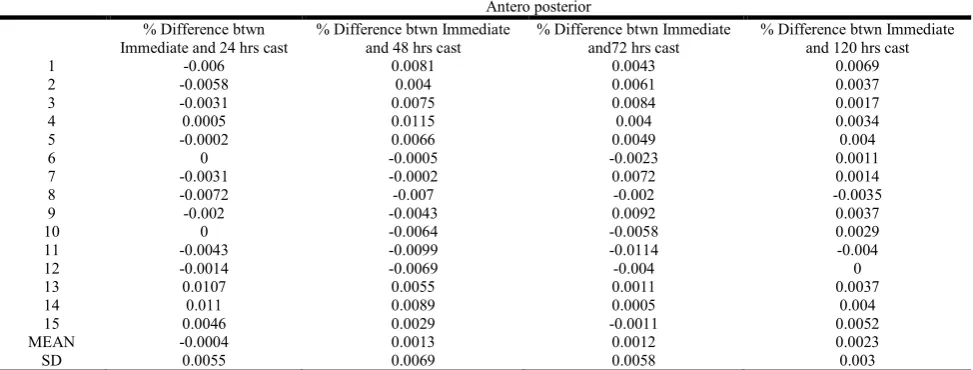
Descriptive statistics was done to find the Mean and standard deviation. (Table 1) (Graph 1), (Table 2) (Graph 2). One way ANOVA was also done to compare the casts poured at different time period with that of the model. Multi Variant ANOVA was done to compare the measurements done at various time periods.
RESULTS
From the measurements, it was found that, in the Cross Arch measurements, there was a consistent reduction in volume of the impression and thus a reduction in measurement (0, -0.0016, -0.0017, -0.0032) (Table 1).
Table 1.
Cross Arch % Difference btwn
Immediate and 24 hrs cast
% Difference btwn Immediate and 48 hrs cast
% Difference btwn Immediate and72 hrs cast
% Difference btwn Immediate and 120 hrs cast
1 0.0054 0.0044 -0.0028 -0.008
2 0.0122 0.0094 0.0054 -0.0008
3 0.0126 0.0046 0.0042 -0.0014
4 0.0054 0.0046 -0.0012 -0.0034
5 0.0072 0.0066 0.0012 -0.002
6 0.004 0.0026 0.0002 -0.0056
7 -0.0083 -0.0103 -0.0056 -0.0048
8 -0.0156 -0.0117 -0.0056 -0.0048
9 -0.0119 -0.0137 -0.0064 -0.004
10 -0.0075 -0.0095 -0.0068 -0.0113
11 -0.0081 -0.013 -0.0062 -0.0123
12 -0.0062 -0.0095 -0.0072 -0.005
13 0.0026 0.0038 0.0016 0.005
14 0.0028 0.0018 0 0.0038
15 0.0044 0.005 0.0038 0.007
MEAN 0 -0.0016 -0.0017 -0.0032
[image:3.595.70.533.397.589.2]SD 0.0088 0.0084 0.0044 0.0054
Table 2.
Antero posterior % Difference btwn
Immediate and 24 hrs cast
% Difference btwn Immediate and 48 hrs cast
% Difference btwn Immediate and72 hrs cast
% Difference btwn Immediate and 120 hrs cast
1 -0.006 0.0081 0.0043 0.0069
2 -0.0058 0.004 0.0061 0.0037
3 -0.0031 0.0075 0.0084 0.0017
4 0.0005 0.0115 0.004 0.0034
5 -0.0002 0.0066 0.0049 0.004
6 0 -0.0005 -0.0023 0.0011
7 -0.0031 -0.0002 0.0072 0.0014
8 -0.0072 -0.007 -0.002 -0.0035
9 -0.002 -0.0043 0.0092 0.0037
10 0 -0.0064 -0.0058 0.0029
11 -0.0043 -0.0099 -0.0114 -0.004
12 -0.0014 -0.0069 -0.004 0
13 0.0107 0.0055 0.0011 0.0037
14 0.011 0.0089 0.0005 0.004
15 0.0046 0.0029 -0.0011 0.0052
MEAN -0.0004 0.0013 0.0012 0.0023
SD 0.0055 0.0069 0.0058 0.003
[image:3.595.49.536.621.806.2]In the antero-posterior dimension, there was initially a reduction in volume seen and then an increase in volume and hence an increase in measurement made (
0.0012, 0.0023) (Table 2). MANOVA and ANOVA result show that, the results are statistically not significantly different from each other.
posterior dimension, there was initially a reduction in volume seen and then an increase in volume and hence an increase in measurement made (-0.0004, 0.0013, 0.0012, 0.0023) (Table 2). MANOVA and ANOVA result stically not significantly different
DISCUSSION
Irreversible hydrocolloids are the most commonly used impression material due to its cost effectiveness and ease of use. It is the material of choice for even Impression for Fixed
Graph 1.
Graph 2.
Prosthesis and Complete Denture final impressions, among Private Dental Practitioners. One of the most important shortfalls of this material is its dimensional stability, which requires it to be used for cast pouring almost immediately. But this is not usually possible in a busy practice; hence the cast was poured after a delay. Sometimes, when impressions made of Non-Aqueous Elastomeric impressions and impressions made of Alginate and sent together to the lab, where there may be delayed pouring of the cast. Various studies were done to check for the dimensional stability of different brands of Irreversible Hydrocolloids when poured after a delay (Shaba et al., 2007; Chen et al., 2004; Martin et al., 2007; Imbery et al., 2010; Manisha, 2015). Various studies showed varying results. Most studies showed that when casts were made within 10 min to 1hr the discrepancy was minimal; some studies even showed that impressions may be stored upto 3 hrs before cast pouring. In a study by Walker et al. (2010) all materials exhibited shrinkage after 30 minutes, with the conventional alginate continuing to shrink over time and the extended-storage alginates expanding with increased storage time. Hiraguchi et al. (Hiraguchi et al., 2010; Hiraguchi et al., 2005) reported that the effects of storing impressions for 3 hours after spraying them with a disinfectant solution results in a significant differences in dimensional change between the control and disinfected stone models. Sedda et al., (2008) evaluated the effect of storage time on the accuracy of the casts produced from irreversible hydrocolloid impressions and showed that when impressions were poured immediately, all alginates could reproduce the original model with no significant difference.
With further research and development, manufactures have come up with this Irreversible Hydrocolloids, which they claim may be poured after a delay of even 5 days, if the impression was preserved under optimal condition. So a study was initiated to check the validity of the manufacturer’s claim. The study was designed to check for dimensional change of the impression material stored under optimal condition. The study was made to be as close to daily practice as possible, hence a typodont model was used instead of a Metal die. Impressions were made and stored for required time period and then cast were poured. Both Antero-Posterior and Cross arch measurements were made to simulate and check dimensional change under clinical conditions on various planes. As it is accepted that immediate pour is a standard, the rest of the groups ( viz, those poured after 24 hrs, 48 hrs, 72 hrs and 120 hrs) were compared with that of the initially poured cast.
The result shows that no significant linear dimensional changes were recorded in delayed pouring of the impressions by using extended pour alginate impression material. According to ADA specification no 18, (American National Standards Institute/American Dental Association, 2004) a discrepancy of 0.5% was allowed. In the tests performed, the percentage of dimensional change ranged from, in cross arch ranges from -0.000063 to -0.003203 and in antero-posterior difference ranges from -0.0004536 to 0.002316, which were well within the limits. Results of ANOVA and MANOVA indicated that the casts obtained from the impressions made with 5 different intervals (immediate, 24h, 48h,72h and 120 h ) were not statistically different from each other. This measured change was similar to recommended values. So the extended pour alginate impression materials are capable of maintaining their dimensional stability upto 5 days.
Conclusion
Evidence suggests that delayed pouring with dental gypsum should not adversely affect dimensional accuracy of the generated casts with extended-storage alginate. Hence this extended pour alginate (hydrogum5) impression material can be acceptable for reproducing the casts with no changes in the dimensional stability even after five days of delayed pour. This study was done by operators who were skilled in their work. Further study to check using novice operators may be performed to study adaptability and user friendliness of the material.
REFERENCES
Ahmad Rohanian, GhasemOmmatiShabestari, Somayeh Zeighami, Mohammad Javad Samadi, Ahmad Reza Shamshiri. 2014. Effect of Storage Time of Extended-Pour and Conventional Alginate Impressions on Dimensional Accuracy of Casts. Journal of Dentistry, Tehran University of Medical Sciences, Vol. 11, (No. 6): 655-64
American National Standards Institute/American Dental Association. Specification No. 19: Dental elastometric impression materials. Chicago: American Dental Association. 2004. p. 5.
Chen, S.Y., Liang, W.M., Chen, F.N. 2004. Factors affecting the accuracy of elastomeric impression materials. J Dent.,
32(8):603-9.
Eames, W.B., Litvak, C.S. 1984. New irreversible hydrocolloid silicone impression material. J Prosthet Dent.,
52(4):479-84.
Hiraguchi, H., Kaketani, M., Hirose, H., Yoneyama, T. 2010. The influence of storing alginate impressions sprayed with disinfectant on dimensional accuracy and deformation of maxillary edentulous stone models. Dent Mat J., 29(3):309-15. Epub 2010 May 10.
Hiraguchi, H., Nakagawa, H., Wakashima, M., Miyanaga, K., Sakaguchi, S., Nishiyama, M. 2005. Effect of storage period of alginate impressions following spray with disinfectant solutions on the dimensional accuracy and deformation of stone models. Dent Mat J., 24(1):36-42. Imbery, T.A., Nehring, J., Janus, C., Moon, P.C. 2010.
Accuracy and dimensional stability of extended-pour and conventional alginate impression materials. J Am Dent Assoc. 141(1):32-9.
Manisha, M Kulkarni1, Ram U Thombare2 Dimensional Changes of Alginate Dental Impression Materials-An Invitro Study . Journal of Clinical and Diagnostic Research. 2015 Aug, Vol-9(8): 98-102
Martin, N., Martin, M.V., Jedynakiewicz, N.M. 2007. The dimensional stability of dental impression materials following immersion in disinfecting solutions. Dent Mater. 2007;23(6):760-8. Epub.
Patel, R.D., Kattadiyil, M.T., Goodacre, C.J., Winer, M.S. 2010. An in vitro investigation into the physical properties of irreversible hydrocolloid alternatives. J Prosthet Dent.,
104(5):325-32.
Patel, R.D., Kattadiyil, M.T., Goodacre, C.J., Winer, M.S. 2010. An in vitro investigation into the physical properties of irreversible hydrocolloid alternatives. J Prosthet Dent.,
104(5):325-32.
Sedda, M., Casarotto, A., Raustia, A., Borracchini, A. 2008. Effect of storage time on the accuracy of casts made from different irreversible hydrocolloids. J Contemp Dent Pract. 9(4):59-66.
Shaba, O.P., Adegbulugbe, I.C., Oderinu, O.H. 2007. Dimensional stability of alginate impression material over a four hours time frame. Nig Q J Hosp Med., 17(1):1-4. Siviello, C., Greco, F., Larobina, D. 2016. Analysis of the
aging effects on the viscoelasticity of alginate gels.Soft Matter. Sep 28. [Epub ahead of print]
Suchak, A., Fan, P.L., Stanford, J.W., Rhoades, C. 1984. Evaluation of an alginate substitute using specification requirements. J Am Dent Assoc. 108(2):210-1.
Torassian, G., Kau, C.H., English, J.D., Powers, J., Bussa, H.I., Marie Salas-Lopez, A. et al. 2010. Digital models vs. plaster models using alginate and alginate substitute materials. Angle Orthod., 80(4):474-81.
UsamaNassar, Bayan Hussein, Andrea Oko, Jason P Carey, Carlos Flores-Mir, 2012. Dimensional Accuracy of 2 Irreversible Hydrocolloid Alternative Impression Materials with Immediate and Delayed Pouring J Can Dent Assoc 78:c2
Walker, M.P., Burckhard, J., Mitts, D.A., Williams, K.B. 2010. Dimensional change over time of extended-storage alginate impression materials. Angle Orthod., 80:1110-5.