Design and Analysis of a Power Efficient Linearly
Tunable Cross-Coupled Transconductor Having
Separate Bias Control
Vijaya Bhadauria1*, Krishna Kant2, Swapna Banerjee3
1Electronics and Communication Engineering Department, Motilal Nehru National Institute of Technology, Allahabad, India 2Department of Computer Engineering and Application, GLA University, Mathura, India
3Electronics and Electrical Communication Engineering Department, Indian Institute of Technology, Kharagpur, India Email: *[email protected], [email protected], [email protected]
Received November 12, 2011; revised December 15, 2011; accepted December 24, 2011
ABSTRACT
A common current source, generally used to bias cross-coupled differential amplifiers in a transconductor, controls third harmonic distortion (HD3) poorly. Separate current sources are shown to provide better control on HD3. In this paper, a
detailed design and analysis is presented for a transconductor made using this biasing technique. The transconductor, in addition, is made to offer high Gm, low power dissipation and is designed for linearly tunable Gm with current mode
load as one of the applications. The circuit exhibits HD3 of less than –43.7 dB, high current efficiency of 1.18 V−1 and Gm of 390 S at 1 Vp-p @ 50 MHz. UMC 0.18 µm CMOS process technology is used for simulation at supply voltage of
1.8 V.
Keywords: Analog Electronics; Low Power Analog CMOS Circuit; Operational Transconductance Amplifier (OTA);
Multiple-Output OTA (MOTA); MOS Transconductors; Linearly Tunable Gm; Current Efficiency;
Linearization Techniques; Harmonic Distortion Analysis
1. Introduction
Transconductors interface a current mode circuit to a voltage signal, making it a fundamental element of ana-log circuits [1-4]. Performance of a transconductor dete-riorates due to higher total harmonic distortion (THD), more so at high signal level. Several techniques are de-voted to improve THD of transconductors [5-20]. Sán-chez-Sinencio and J. Silva-Martínez [4] have classified these as input signal attenuation [5-7], cancellation of nonlinear terms [7-12], and source degeneration [7, 11-19]. Besides these, adaptive biasing [16,19] and mo-bility compensation [20] techniques are also reported to improve THD.
One of the important building blocks in many analog circuits is a tunable linear transconductor [9,13,15,17, 21-25], which may be used for tuning center frequency and Q-factor of filters. Moreover it helps to compensate fabrication tolerances and environment parameters, espe-cially temperature.
A method of tuning transconductance, Gm is to control
the bias current (IBias) applied to the differential amplifier.
But Gm is proportional to the square root of IBias due to
which the allowable input signal swing is limited to small value [1]. In [17], the allowable input swing for a con-stant value of IBias is made independent of variation in Gm
by using current mirrors with source degeneration. Another tuning method uses source degeneration re-sistance (R). In this method due to degeneration, THD improves but at the cost of transconductance. Further, the condition of improvement, (1/Gm < R) [1] occupies large
area and add noise if passive resistance is used. In [13], tunability has been achieved using active resistance. But
Gm adjustment in this tuning method affects the
band-width, which has been compensated in [15] by employ-ing a separate source follower biased with constant cur-rent source.
Linearly adjustable Gm is realized using control
volt-age at inputs of one of the cross-coupled differential am-plifier [8,9]. In both the papers authors have used identi-cal transistors in the cross-coupled amplifiers to obtain linear tuning of Gm at supply voltage 5 V or higher.
Dif-ferent bias strategies are given in [25] to achieve tunabil-ity for ultra low range transconductance.
A low voltage transconductor on 0.18 µm technology is given by us in [23] in which bias currents of cross- coupled differential amplifiers and aspect ratio of their *Corresponding author.
transistors are adjusted to cancel third harmonic distor-tion. Shift level biasing is used in the cross-coupled dif-ferential amplifier to obtain tunability. The circuit is de-signed for resistive load, not suitable for current mode signal processing.
The topology cited in [23] is analyzed in detail in this paper. In addition diode mode MOSFETs are used as load for current mode signal processing in place of active resistance. A triode mode tail transistor is used in MA for better linear tuning instead of constant current source. Design steps in detail with algorithm are given for low HD3, high linearly tunable Gm and high frequency of
op-eration at low voltage. Efforts have also been made to maintain low power operation and high current efficiency. The circuit is developed for 1 Vp–p input signal for
fre-quency range upto 50 MHz.
The paper is organized as follows. In Section 2, block diagram, circuit design alongwith its algorithm and anal-ysis of the proposed circuit are given. In Section 3, si-mulation results are discussed and finally conclusions are drawn in Section 4.
2. Design and Analysis of Tunable
Transconductor
2.1. Block Diagram of Tunable Transconductor
The proposed transconductor is designed using main dif-ferential amplifier (MA) biased using tail transistors in triode mode, compensatory differential amplifier (CA) biased using separate constant current source for mini-mizing HD3 and level shifters (LS) are used for tunability.
Separate controls of the two bias currents of MA and CA provide flexibility, improvement in HD3 and better
tun-ing in comparison to others [8,9]. Block diagram of the proposed transconductor is shown in Figure 1 and the
complete circuit diagram is furnished in Figure2.
The square law model of MOSFETs is used in this work for design and analysis. Design steps are given be-low:
[image:2.595.311.536.84.295.2]Figure 1. Functional block diagram of the trnsconductor.
Figure 2. Circuit diagram of the transconductor.
2.1.1. Design of MA
Upper limit and lower limit of biasing current ( ) for MA are given as follows [3]: BiasMA
I
I
max
MA Diss DD
Bias P V
(1)
min 3dB
MA 2* * l n p
Bias
I C
G V
(2)
where PDiss is the specified total power consumption, Clis
the load capacitor, ω3dB is the 3 dB frequency, λn and λp
are the channel length coefficients of NMOS and PMOS transistors respectively. MA is designed using NMOS transistors and load using PMOS transistors.
Transconductance, m(MA) of MA and input swing, swing are given in [1,3] and are reproduced in Equation
(3) and Equation (4).
(MA)MA n ox MA Bias
m
G C W L I (3)
swing 2 Bias(MA) n ox MA
V I C W L
m
G I
(4)
From Equation (3) (MA) is the function of (MA)
Bias and
W L
GI
G G
MA. To keep high m(MA), higher
values of Bias(MA) are not used as it would lead to loss
of power. The second option is to increase the aspect ratio but that may deteriorate HD3 for specified input
swing {Equation (4)}.
The second option is preferred wherein, for better HD3,
the method of non-linear terms cancellation with the help of compensatory amplifier is used but at the cost of area occupied by it. However, the use of CA (Figure2)
re-duces overall transconductance. To maintain transcon-ductance m of the OTA at the desired level, m(MA)is
min
(MA)
Bias and aspect ratio
I
W L
G I
3
q
MA is determined
from Equation (3) for the modified value of m(MA). In
addition, Bias(MA) is allowed to vary independently of
CA as a function of tuning voltage by operating tail tran-sistor of MA in triode mode.
2.1.2. Design of CA
The ratio “p” of bias currents of MA and CA are adjusted [11,12] in accordance with Equation (5):
p (5) where p I Bias(MA) IBias(CA) and
MA MA
CA CA
. A lower value of “q” notonly increases power dissipation (due to high bias current of CA), but also lowers the overall transconductance, thereby, decreasing the current efficiency. On the other hand, due to higher values of “q” the harmonics will not be suppressed effectively. Moreover, it is difficult to bias the CA transistor in saturation region in the specified low voltage operation due to skewed overdrive voltages of the MA and CA. In the proposed circuit choosing a mod-erate “q” as 2 and equal channel length of MA and CA gives:
q W L W L
MA CA 2
W W (6) and Bias(MA) Bias(CA) . This ratio of bias currents is adjusted for the centre value of the tuning voltage range at which specified Gm is expected to occur.
8
I I
G
Overall transconductance Gm due to cross-coupling of MA and CA is the difference of m(MA) and Gm(CA), hence m(MA) is selected to get the specified Gm in
ac-cordance of Equation (7).
G
2 2 1
m(MA) q Gm
G q (7)
2.1.3. Design of Load
The PMOS transistors, Mp1 and Mp2 are selected in diode
mode as load. It is possible to easily convert the proposed transconductor to Multiple-output OTA suitable for rent mode signal processing by incorporating three cur-rent mirrors. The aspect ratio of load transistors is com-puted using the Equation (8), where in Equation (8)
max
CM is the maximum common mode input voltage at
MA, Vthn and Vthp are the threshold voltages of NMOS
and PMOS transistors respectively.
V
(MA) ( max W L * Bias Bias loadp ox DD CM
I I
C V V
CA) 2 thn thp
V V (8)
2.1.4. Design of LS
Linearly tunable Gm is obtained by modulating common
mode voltage with Vtune in two level shifters. The
tran-sistors (M5 and M6) of a level shifter of LS are selected to
have same aspect ratio to maintain same Vtune across gate
to source in both the transistors. They are biased in satu-ration region by following the conditions given in Equa-tion (9) and EquaEqua-tion (10).
1 or 2 DD thn
V V V V (9)
1
or 22
thn tune thn
V V V V V (10)
where 1
2
id DC
v V V
and 2 2
id DC v
V V are the
signal inputs applied at the gates of M5 and M7 of level
shifters, respectively. Same input V1 and V2 are applied to
the gate of M3 and M4 of CA. As per the Equation (10)
higher values of V1 (or V2) give better tuning range,
ac-cordingly, VDC is selected slightly less than to VDD.
Fur-ther, MA remains in saturation if and only if condition given in Equation (11) is satisfied.
MA1 2
tune thn P
V V orV V V (11)
where P(MA) is the drain to source voltage of tail
tran-sistor of MA Thus, the limits on Vtune are obtained as in
Equation (12). Transistors of other level shifter of LS are also made identical on the same ground.
V
(MA)1 2 1 2
min or 2,
or
thn tune thn
thn P
V V V V V
V V V V
(12)
2.1.5. Design of Tail Transistor of MA
As the bias current supplied to MA by its tail transistor is a function of tuning voltage, it is operated in triode mode. It needs VB VP(MA)Vthn, where VB1 is gate voltage of tail transistor of MA. The aspect ratio of tail transistor of MA is derived for the mentioned operating mode and is given in Equation (13):
W L
T(MA) IBias(MA)
nCox
VB1Vthn
VP(MA)
(13)2.1.6. Design of Tail Transistor of CA
Tail transistor of CA is chosen as constant current source independent of Bias MA( ) by biasing the transistor in
saturation. The aspect ratio of it is given in Equation (14): I
(CA) (CA) 2 2 2 Bias Tn ox B thn
I W L
C V V
2
(14)
where VB is gate voltage of tail transistor of CA.
2.2. Algorithm for Designing the Proposed Transconductor
The algorithm to design proposed transconductor is ummarized as below:
s
MAmax
Bias
I
Step 1 Compute /* from specified PDiss; refer Equation (1)*/
Step 2 Compute IBiasMAmax
MA MAmax
as Bias
I I
MA
m
G Gm
/* from specified ω3dB; refer Equation (2)*/
Step 3 Select Bi /* to increase current efficiency*/
Step 4 Compute /* for specified ; refer Equation (7)*/ Step 5 Compute W LMA /* using Equation (3)*/
Step 6 Calculate W LCA /* using Equation (6)*/
Step 7 Select diode mode MOSFET load /* for current mode signal processing*/ Step 8 Compute W Lload /* using Equation (8)*/
Step 9 Compute W LLS /*minimum size transistors*/ Step 10 Design tail transistor of MA /*refer (13)*/
Step 11 Design tail transistor of CA /*refer (14)*/ END
2.3. Analysis of the Circuit Equation (20) shows linear behaviour of Gm with Vtune,
as first part, MA
DC P thn
on the right handside of the equation is almost constant. Thus from Equa-tion (20) the tuning range is obtained and is given in Equation (21).
V V V
The analysis of the circuit is given below:
In Figure2, applying the square law to the transistors
of MA and CA, which are biased in saturation region, the currents, I1 and I2 through load transistors of the
cross-coupled amplifiers (MA-CA) are given by:
(MA)
2 1 d1 d4 MA 1 tune P thn
I I I V V V V
(MA)
2
P thn
V V
( )
2 CA V2 VPCA Vthn
1 2 3 MA 2
2
d d tune
I I I V V
(15)
( )
CA V V1 PCA Vthn
(16)
where
1 2 C W Lox
is the transconductanceparameter. P(MA) and VP(CA) are the drain to source
voltage across tail transistor of MA and CA respectively.
V
MA CA
MA2 vid VDC VP Vthn Vtune
The differential output current, io is given by
0 1 2
i I I
(17) where P(MA) P(CA) P
Since “q” is taken as 2 to minimize HD3:
V V V is assumed.
MA 2 CA
(18) Combining Equation (17) and Equation (18), one gets:
0 id M
i v A VDC VPVthn 2MAVtune (19)
From Equation (19) the transconductance Gm is
calcu-lated as,
0
MA 2 MA
m DC P thn tune
id
G V V V V
v
i
(20)
2
range
m MA tune
G V (21)
3. Simulation Results and Discussions
The proposed transconductor is simulated in Cadence VIRTUOSO environment using UMC 0.18 µm CMOS process technology. The transconductor is operated at 1.8 V and 27˚Celsius. Bias currents Bias(MA) and Bias(CA)
are kept at 200 µA and 25 µA, respectively to main-
I I
tainIBias(MA) IBias(CA) 8. Channel length is taken as 0.9
µm which is five times the minimum as specified by the technology for all the MOSFETs of the transconductor to minimize channel length modulation effect [26]. The differential signal input voltage of 0.25 V is generated using voltage controlled voltage source (VCVS) as test bench setup.
The objective of the simulation is to demonstrate fea-sibility of power efficiency, linear tuning of Gm offering
low harmonics with the help of separate bias control of cross-coupled amplifiers at 50 MHz and above. Different plots have been obtained to verify the designed aspects. Plot in Figure 3 shows the tunability of the proposed
transconductor. The tuning voltage, Vtune is varied from
0.5 V to 1.0 V in steps of 0.1 V. The lower value (0.5 V) is kept slightly higher than the threshold voltage of input transistors M5 and M7 of LS and upper value is selected
as per Equation (12) to keep them in saturation region.
Gmis tuned between 390 µS to 195 µS. Gm is falling with
increase in Vtune between ±0.25 V of vid i.e. 1 Vp-p,
Vp–p) the change in Gm w.r.t. Vtune is nonlinear and plots
for different values of Vtune are almost merged at a point,
indicates transconductance is independent of Vtune. The
reason being that as per Equation (12),
1
2
DD t , but at higher values, this conditionis violated. At 1 2 hn
V orV V V
DD thnV o transistor M5 and
M7 of Figure 2 are at the verge of saturation, and
varia-tion in drain to source voltage across it is small enough, making output of level shifter is almost constant, i.e. in-dependent of tuning voltage.
rV V V
As shown in Figure 4 the variation of
transconduc-tance with respect to tuning voltage is linear validating Equation (20). The small deviation may be attributed to body effect in LS transistors (M5 and M7) and voltage
drop in tail transistors.
Figure5 shows HD3 variation with respect to
differ-ential input signal amplitude for different values of tun-ing voltage. Distortion increases rapidly for the small val- ues i.e. upto approximately 150 mV (0.6 Vp–p) of the dif-
[image:5.595.59.284.338.504.2]ferential input signal amplitude but after that it in creases
Figure 3. Transconductance (Gm) vs differential signal input (vid) at different values of tuning voltage (Vtune).
Figure 4. Transconductance (Gm) vs tuning voltage (Vtune) at differential signal input (vid) = 0 V.
slowly due to cross-coupling effect. Harmonic distortion has also increased with the increase in tuning voltage due to decrease in DC current through MA. Figure6 shows
variation of HD3 with respect to Vtune.
Frequency response of the proposed transconductor for different values of tuning voltage is given in Figure 7.
The 3 dB frequency of the transconductor is above 53 MHz for the complete range of variation of transconduc-tance.
Gm, HD3, PDiss and Gm/IDD for the three different values
of Gm obtained from the simulation are given in Table1.
It may be noted that at lower values of transconductance current efficiency reduces. The reasons are twofold: firstly, transconductance is low and secondly lower tran-sconductance obtained at higher value of tuning voltage, gives high overdrive voltage to LS transistors which in turn draws higher current through LS.
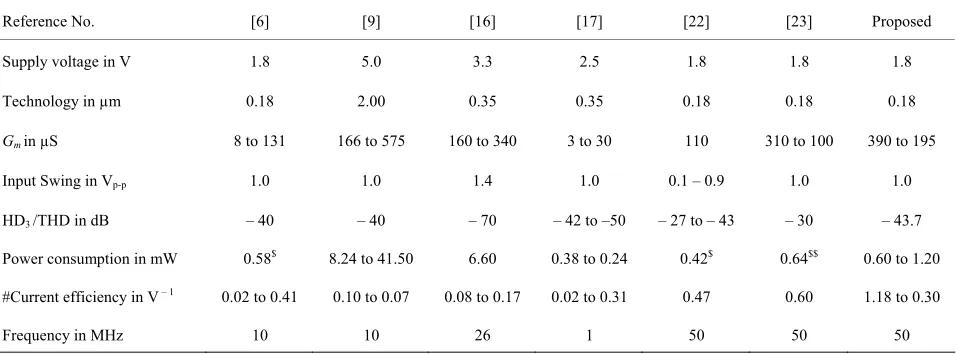
The performance is compared on eight metric points with other reported circuits as given in Table 2. The
[image:5.595.309.536.541.706.2]proposed transconductor offers better current efficiency
Figure 5. HD3 vs differential signal input (vid) at different tuning voltage (Vtune).
Figure 6. HD3 vs Tuning voltage at differential signal input (vid) = 0.25 V.
[image:5.595.58.284.543.708.2]4. Conclusions
A power efficient linearly tunable high Gm, cross-cou-
pled transconductor with separate bias currents (for low third harmonic distortion) is designed and analyzed in this paper. Results have been obtained with diode mode transistors as load extendable for MOTA, which is nec- essary for current mode signal processing. Transconduc-tance is varied in linear manner. Gm is tuned between 195
to 390 S when the tuning voltage is varied from 1.0 V to 0.5 V. Maximum current efficiency of 1.18 V–1 and
minimum HD3 less than –43.7 dB is obtained at 1 Vp–p @
50 MHz at the tuning voltage of 0.5 V. Comparative study reveals that the proposed circuit consumes low power and gives high current efficiency, with low HD3
[image:6.595.58.286.88.249.2]and high tunable transconductance for high frequency of operation compared to others.
Figure 7. Transconductance vs frequency at different tun-ing voltage (Vtune).
(1.18 V–1) and transconductance (390 µS) with lower
harmonics (–43.7 dB), at input swing of 1 Vp–p @50 MHz
in comparison to the others. However, the transconduc-tance reported in [9] is higher than the proposed at the cost of high supply voltage (5 V) and very low current efficiency (0.1 V–1 to 0.07 V–1).
5. Acknowledgements
[image:6.595.54.540.390.510.2]This work has been performed using the resources of VLSI Laboratory developed under Special Manpower Development Programme for VLSI Design and related software (SMDP-II) project funded by Department of
Table 1. Performance of proposed transconductor.
Performance Parameter Simulation results
Transconductance (Gm) Gm = 390 µS (Vtune= 0.5 V) Gm = 323 µS (Vtune= 0.75 V) Gm = 195 µS (Vtune = 1.0 V)
(HD3) at 1 Vp-p – 43.7dB – 40.5dB – 33.2 dB
Power consumption (Pdiss) 0.60 mW 0.79 mW 1.20 mW
Current efficiency (Gm/IDD) 1.18 V–1 0.74 V–1 0.30 V–1
3 dB Frequency 70 MHz 71 MHz 53 MHz
Table 2. Performance comparison of proposed transconductors with others.
Reference No. [6] [9] [16] [17] [22] [23] Proposed
Supply voltage in V 1.8 5.0 3.3 2.5 1.8 1.8 1.8
Technology in µm 0.18 2.00 0.35 0.35 0.18 0.18 0.18 Gmin µS 8 to 131 166 to 575 160 to 340 3 to 30 110 310 to 100 390 to 195
Input Swing in Vp-p 1.0 1.0 1.4 1.0 0.1 – 0.9 1.0 1.0
HD3 /THD in dB – 40 – 40 – 70 – 42 to –50 – 27 to – 43 – 30 – 43.7
Power consumption in mW 0.58$ 8.24 to 41.50 6.60 0.38 to 0.24 0.42$ 0.64$$ 0.60 to 1.20
#Current efficiency in V – 1 0.02 to 0.41 0.10 to 0.07 0.08 to 0.17 0.02 to 0.31 0.47 0.60 1.18 to 0.30
Frequency in MHz 10 10 26 1 50 50 50
Legend: # Calculated from the given data/average value in the references. $: Authors did not mention G
mat which the Power consumption values are reported.
: Power at a specific Gm.
[image:6.595.61.540.539.716.2]Information Technology, Ministry of Communication and Information Technology Government of India.
REFERENCES
[1] B. Razavi, “Design of Analog CMOS Integrated Cir-cuits,” Tata McGraw-Hill Publishing Company Limited, 2002.
[2] D. A. Johns and K. Martin, “Analog Integrated Circuit Design,” John Wiley and Sons, New York, 1997.
[3] P. E. Allen and D. R. Holberg, “CMOS Analog Circuit Design,” Oxford University Press, New York, 2004. [4] E. Sánchez-Sinencio and J. Silva-Martínez, “CMOS
Transconductance Amplifiers, Architectures and Active Filters: A Tutorial,” IEE Proceedings Circuits, Devices & Systems, Vol. 147, No. 1, 2000, pp. 3-12.
doi:10.1049/ip-cds:20000055
[5] J. Y. Kim and R. L. Geiger, “Characterisation of Linear MOS Active Attenuator and Amplifier,” Electronic Let-ters, Vol. 31, 1995, pp. 511-513.
doi:10.1049/el:19950353
[6] X. Zhang and E. I. El-Masry, “A Novel CMOS OTA Based on Body-Driven MOSFETs and Its Applications in OTA-C Filters,” IEEE Transactions on Circuits and Sys-tem-I Regular Papers, Vol. 54, No. 6, 2007, pp. 1204- 1211. doi:10.1109/TCSI.2007.897765
[7] J. Chen, E. Sanchez-Sinencio and J. Silva-Martinez, “Frequency Dependent Harmonic Distortion Analysis of a Linearized cross Coupled CMOS OTA and Its Applica-tion to OTA C-Filter,” IEEE Transactions on Circuits and System-I Regular Papers, Vol. 53, No. 3, 2006, pp. 499-510. doi:10.1109/TCSI.2005.859575
[8] Z. Wang and W. Guggenbuhl, “A Voltage-Controlled Linear MOS Transconductor Using Bias Offset Tech-nique,” IEEE Journal of Solid-State Circuits, Vol. 25, 1990, pp. 315-317. doi:10.1109/4.50321
[9] Y. Sun, C. Hill and S. Szczepanski, “Large Dynamic Range High Frequency Fully Differential CMOS Trans-conductance Amplifier,” Analog Integrated Circuits and Signal Processing, Vol. 34, 2003, pp. 247-255.
[10] D. V. Morozov and A. S. Kuroki, “Transconductance Amplifier with Low-Power Consumption,” IEEE Trans-actions on Circuits and System-II Express Briefs, Vol. 52, No. 11, 2005, pp. 776-779.
doi:10.1109/TCSII.2005.852190
[11] A. Lewinski and J. Silva-Martinez, “OTA Linearity En-hancement Technique for High Frequency Application With IM3 Below-65 dB,” IEEE Transactions on Circuits and System-II Express Briefs, Vol. 51, No 10, 2004, pp. 542-548. doi:10.1109/TCSII.2004.834531
[12] S. Ouzounov, E. Roza, H. Hegt, G. V. D. Weide and A. V. Roermund, “Design of MOS Transconductors with Low Noise and Low Harmonic Distortion for Minimum Cur-rent Consumption,” Integration, the VLSI Journal, Vol. 40, 2007, pp. 365-379.
[13] F. Krummenacher and N. Joehl, “A 4-MHz CMOS Con-tinuous-Time Filter with On-Chip Automatic Tuning,”
IEEE Journal of Solid-State Circuits, Vol. 23, No. 3,
1988, pp. 750-758. doi:10.1109/4.315
[14] J. Silva-Martinez, M. S. J. Steyaert and W. M. C. Sansen, “A Large-Signal Very Low-Distortion Transconductor for High-Frequency Continuous-Time Filters,” IEEE Journal of Solid-State Circuits, Vol. 26, No. 7, 1991, pp. 946-954. doi:10.1109/4.92014
[15] M. Kachare, A. J. Lopez-Martin, J. Ramirez-Angulo, and R. G. Carvajal, “A Compact Tunable CMOS Transcon-ductor with Linearity,” IEEE Transactions on Circuits and System-II Express Briefs, Vol. 52, No. 2, 2005, pp. 82-84. doi:10.1109/TCSII.2004.842065
[16] W. Huang and E. Sanchez-Sinencio, “Robust Highly- Linear High-Frequency CMOS OTA with IM3 Below-70 dB at 26 MHz,” IEEE Transactions on Circuits and Sys-tem-I Regular Papers, Vol. 53, No. 7, 2006, pp. 1433- 1447. doi:10.1109/TCSI.2006.875187
[17] F. A. P. Baruqui and A. Petraglia, “Linearly Tunable CMOS OTA With Constant Dynamic Range Using Source-Degenerated Current Mirrors,” IEEE Transac-tions on Circuits and System-II Express Briefs, Vol. 53, No. 9, 2006, pp. 797-801.
doi:10.1109/TCSII.2006.881162
[18] P. Monsurrò, S. Pennisi, G. Scotti and A. Trifiletti, “Lin-earization Technique for Source-Degenerated CMOS Differential Transconductors,” IEEE Transactions on Circuits and System-II, Vol. 54, No. 10, 2007, pp. 848- 852. doi:10.1109/TCSII.2007.906203
[19] K. Kuo and A. Leuciuc, “A Linear MOS Transconductor Using Source Degeneration and Adaptive Biasing,” IEEE Transactions on Circuits and System-II Express Briefs, Vol. 48, No. 10, 2001, pp. 937-943.
doi:10.1109/82.974782
[20] S. H. Yang, K. H. Kim, Y. You and K. R. Cho, “A Novel CMOS Operational Transconductance Amplifier Based on Mobility Compensation Technique,” IEEE Transac-tions on Circuits and System-II Express Briefs, Vol. 52, No. 1, 2005, pp. 37- 42. doi:10.1109/TCSII.2004.839539 [21] S. Koziel and S. Szczepanski, “Design of Highly Linear
Tunable CMOS OTA for Continuous-Time Filters,” IEEE Transactions on Circuits and System-II Analog and Digi-tal Signal Processing, Vol. 49, No. 2, 2002, pp. 110-122. doi:10.1109/TCSII.2002.1002513
[22] A. A. Fayed and M. Ismail, “A Low Voltage, Highly Linear Voltage-Controlled Transconductor,” IEEE Tran- sactions on Circuits and System-II Express Briefs, Vol. 52 No. 12, 2005, pp. 831-835.
doi:10.1109/TCSII.2005.853511
[23] V. Bhadauria and K. Kant, “A Novel Technique for Tun-ing Low Voltage Linear Transconductor,” 2010 Interna-tional Conference on Electronic Devices, System and Ap-plication (ICEDSA2010), 12-13 April 2010, Kuala Lum-pur, Malaysia, pp. 22-25.
doi:10.1109/ICEDSA.2010.5503108
[24] V. Bhadauria K. Kant and S. Banerjee, “A Tunable Transconductor with High Linearity,” Proceedings of Asia Pacific Conference on Circuits and Systems (APCCAS
2010), Kuala Lumpur, 6-9 December 2010, pp. 5-8. doi:10.1109/APCCAS.2010.5774749
[25] P. Bruschi, F. Sebastiano and N. Nizza, “CMOS
conductors with Nearly Constant Input Ranges over wide Tuning Intervals,” IEEE Transactions on Circuits and System-II Express Briefs, Vol. 53, No. 10, 2006, pp. 1002- 1006. doi:10.1109/TCSII.2006.882126