Study on the Effect of a Magnetic Field on Pb(II)
Removal Using Modified Chitosan
Lihong Duan1*, Siyuan Guo2*, Jinqing Yang3
1Institute of Polymer Science, Sun Yat-sen University, Guangzhou, China
2Light Industry & Chemical Engineering Research Institute, South China University of Technology, Guangzhou, China 3Guangdong Jiangmen Supervision Testing Institute of Quality & Metrology, Jiangmen, China
Email: *[email protected], *[email protected]
Received September 13, 2011; revised October 25, 2011; accepted November 6, 2011
ABSTRACT
This work examined the removal of Pb(II) using a chitosan derivative (SB, synthesized from benzaldehyde) assisted by a magnetic field. The adsorption capacity for Pb(II) was investigated. It was found that 1) the pH and concentration of the ion solution, as well as exposure time and strength of magnetic field, affected the degree of adsorption; and 2) stu- dies of the adsorption isotherms and kinetics of ions onto SB revealed that SB showed enhanced adsorption capacity towards Pb(II) ions in a magnetic field compared with magnetically untreated samples. The Langmuir and Freundlich isotherm were applied to describe the experimental adsorption, and the maximum adsorption capacity of SB for Pb(II) was 2.5040 mg/g, when assisted by a magnetic field of 480 kA/m.
Keywords: Magnetic Field; Chitosan; Pb(II); Removal
1. Introduction
Lead, an element belonging to non-degradable environ- mental pollutants, is widely distributed in nature. Lead ions and soluble lead salts are toxic and can cause harm on human health and plant growth. It can poison the ner- vous and blood system, cause convulsions, neurological retardation and anemia, affect child development in par- ticular. Molecular mechanism indicates that the free state Pb(II) is toxic form, if a stable complex of the ligand can form, the concentration of free state Pb(II) in the human body will reduce the free state, thereby decrease the toxi- city of lead on human [1].
Traditional methods for eliminating dissolved heavy metal ions include oxidation-reduction, chemical precipi- tation, filtration, ion exchange, electrochemical treatment, application of membrane separation and evaporation re- covery. However, these processes have considerable di- sadvantages including incomplete metal elimination, hi- gh reagent or energy consumption, expensive equipment and monitoring system requirements and the generation of toxic sludge or other waste products that require dis-posal [2-5].
In this paper, a magnetic field was applied to streng- then the adsorption of Pb(II) ions by the adsorbent. It has been demonstrated in recent years that magnetic fields influence the physicochemical properties of water and
aqueous solutions and suspensions [6-24]. Different hy- potheses for the influence of magnetic fields on water and aqueous solutions have been extensively studied [25- 27]. For example, Colic and Morse [25] indicated that electromagnetic fields exerted their effects through a pe- rturbation of the gas/liquid interface and that these ef- fects disappeared after the system was degassed. Further- more, Madsen [27] investigated the influence of a mag- netic field on the precipitation of some inorganic salts.
Chitosan (CS) is a basic polysaccharides in which the -NH2 groups can form -NH3+ under acidic conditions. In
addition, these -NH2 groups cannot entirely take part in
the coordination of metal ions, limiting its adsorption ca- pabilities and being disadvantageous for regeneration. Recently, there has been a growing interest in the che- mical modification of CS to improve its water solubility and strengthen its adsorption capabilities [28-32]. For example, the -NH2 groups of CS can react with
alde-hydes or ketones to form imines (Schiff base). It was re- ported that chitosan Schiff base (SB) could have excel-lent chelation ability with heavy metal ions [33].
The purpose of this study was to investigate the adso- rption behavior of Pb(II) on SB in a magnetic field. The influence of experimental conditions, such as exposure time, strength of magnetic field and the pH and concen- tration of Pb(II) ion solution, on the adsorption were studied. This information might be useful for further ap- plication in the treatment of waste effluents.
2. Experimental Procedure
2.1. Materials and Apparatus
Schiff base prepared by the reaction of the -NH2 groups
of CS and aldehydes of benzaldehyde (SB [34]); acetic acid and other chemicals used were analytical reagent.
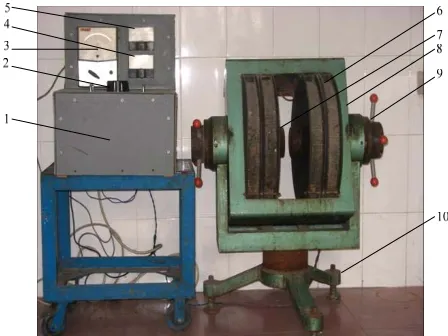
The setup for generating the magnetic field, shown in
Figure 1 and Table 1, was provided by the Light Indus-
try and Chemical Engineering Research Institute at the South China University of Technology.
2.2. Measurement of Pb(II) Ions
A stock solution (1000 mg/L) of Pb(II) ions was prepared from ultra-pure Pb(NO3)2. The stock solution was then
diluted to give standard solutions of appropriate concen- trations. The pH of the solutions was adjusted with HNO3
[image:2.595.61.285.354.522.2]and citrate-sodium sulfite reducing solution. Then, the rea- ction medium was extracted with chloroform and mea- sured using a spectrophotometer (Shimadzu UV2102PC) at 510 nm with diphenylhydantoin as the complexing a- gent.
Figure 1. Adjusted magnetic field equipment. 1. Voltage trans- former; 2. Regulator; 3. Device for recording the strength of the field; 4. Ammeter; 5. Voltmeter; 6. Coil; 7. Iron core; 8. Shell; 9. Handlebar; 10. Stand.
Table 1. The main performance parameters of the magnetic field.
Main property parameter
Total number of turns of excitation coil 3200 turns
Total resistance of coil 8.8 Ω
Maximum safe magnetic current 12.5 Α
Diameter of iron core 100 mm
Transversal surface area of magnetic pole 78.5 cm2
Space of magnetic pole 0 cm - 10 cm
Consumed power 1.4 kW
Total weight 440 Kg
All these batch tests were conducted in 100 ml stop- pered flasks in a water bath kept at 298 K. The agitation rate was held constant at 120 rpm.
2.3. Adsorption Experiments
All adsorption tests, including kinetics, isotherms and ma- gnetic field treatment, were performed as batch experi- ments with duplicates. Adsorption kinetics was generated with a fixed absorbent mass and constant conditions while the adsorption of Pb(II) ions for different times was investigated. The pH of the metal solution in these tests was adjusted to 4. In addition, when the adsorptions were observed in a magnetic field, the magnetic field strength was fixed at 400 kA/m.
Adsorption isotherms are typically generated either with a fixed absorbent mass and varying initial Pb(II) ion concentration (C0) or with varying absorbent mass and a
fixed C0 level. The latter approach was used in this study.
At least nine samples of 10 ml each with different Pb(II) ion concentrations ranging from 5 mg/L to 30 mg/L were placed in 50 ml conical bottles with 0.100 g of absorbent. The initial Pb(II) ion solutions were prepared by serial dilution of standard 1000 mg/L stock solutions.
When the effect of magnetic field treatment was stu- died, the magnetic field strength was varied from 160 kA/m to 800 kA/m. Meanwhile, the pH of the solution and the exposure time were fixed at 4 min and 30 min, respectively.
3. Results and Discussion
Adsorption kinetics and adsorption isotherms play im- portant roles in research on the adsorption capacity of an absorbent. Therefore, the exposure time and pH of metal solutions were studied in this report. Meanwhile, the ef- fect of field strength and concentration of Pb(II) solution on the adsorption was also investigated. Finally, adsorp- tion isotherms were also assessed.
3.1. Effect of Exposure Time
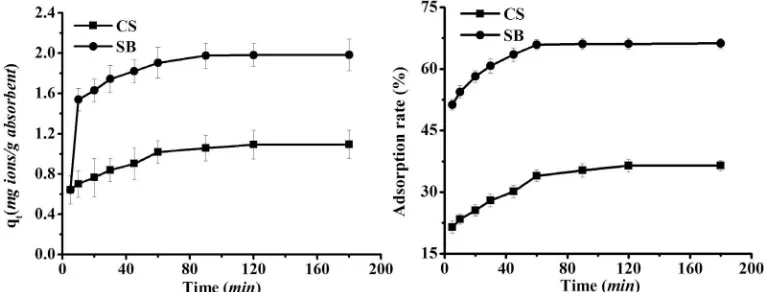
The adsorption kinetics curves of CS and SB untreated by magnetic field are shown in Figure 2. The exposure
[image:2.595.57.289.608.737.2]time varied in the range of 0 h - 180 h, and the initial metal concentration was fixed at 30 mg/L. According to
Figure 2, the trend in adsorption quantities and adsorp-
tion rates over time was similar for CS and SB. Specifi- cally, adsorption increased with increased exposure time but then remained almost constant after a certain value, eventually achieving equilibrium. The time to equilib- rium was 120 min for CS and approximately 60 min for SB. This phenomenon indicated that the adsorption rate of SB was higher than that of CS. It also could be seen that the adsorption quantity and adsorption rate of SB were higher than those of CS at any given time period. The
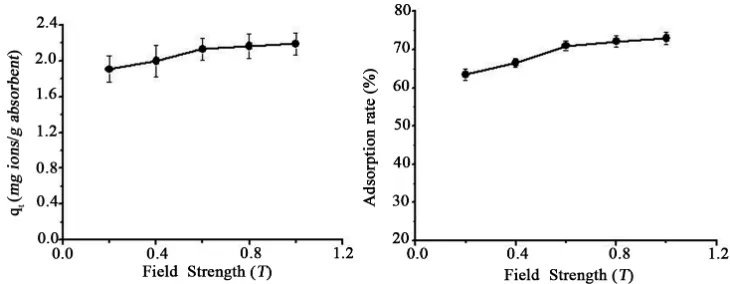
shown in Figure 4. In light of the data presented in Figu- re 4, the adsorption capability of SB in a magnetic field
was enhanced in the magnetic field strength range of 160 kA/m - 800 kA/m after 30 min. Furthermore, from 160 to 480 kA/m, the adsorption quantity and adsorption rate increased dramatically. However, the change became much less outside of this field strength range. Taking into account energy conservation, the magnetic field strength of 480 kA/m was recommended for further adsorption enhancement applications.
[image:3.595.106.489.369.515.2]sorption quantity and adsorption rate of SB corresponded to at least 0.8907 mg Pb(II)/g SB and 29.68% for Pb(II).
Figure 3 shows the adsorption kinetics curves of CS
and SB in a magnetic field of 400 kA/m. As can be seen, the trend was similar to the adsorption kinetics curves without magnetic field treatment. However, the periods required for adsorption equilibrium of CS and SB were both shorter (i.e., the equilibrium periods of CS and SB
were 90 min and 30 min, respectively). Comparing Fig- ures 2 and 3, the adsorption quantity and adsorption rate
of SB assisted by a magnetic field of 400 kA/m were at least 0.1003 mg Pb(II)/g SB and 3.34% higher than that of SB without assistance of magnetic field at any given time point for Pb(II). Furthermore, the adsorption quan-tity and adsorption rate of SB were at least 0.6555 mg Pb(II)/g SB and 21.85% more than those of CS at any corresponding adsorption period in the magnetic field of 400 kA/m. Therefore, the adsorption capabilities of CS and SB were enhanced in the presence of a magnetic field.
3.3. Effect of PH
The pH of the metal ion solution is an important parame- ter in the adsorption process as a whole and on the ad-sorption capacity of SB in particular. Figure 5 shows the
effect of pH on the adsorption capacity of SB for Pb(II) after exposure in a 480 kA/m magnetic field for 45 min. It can be seen that the amount of Pb(II) adsorbed by SB slowly increased when the pH of the metal solution in- creased from 1 to 5. The maximum adsorptions of Pb(II) ions on SB were found at pH 4.0 in a 480 kA/m magnetic field.
3.2. Effect of Magnetic Field Strength
The effect of magnetic field strength on adsorption is
[image:3.595.101.490.558.707.2]Figure 2. Effect of exposure time on adsorption of Pb(II) on CS and SB (Metal concentration: 30 mg/L; Dose: 0.0100 g/ml; pH 7.4).
Figure 4. Effect of field strength on adsorption of Pb(II) onto SB in a magnetic field (Metal concentration: 30 mg/L; Dose: 0.0100 g/ml; pH 7.4; Exposure time: 45 min).
Figure 5. Effect of pH on adsorption of Pb(II) onto SB in a magnetic field (Metal concentration: 30 mg/L; Dose: 0.0100 g/ml; Exposure time: 45 min; Strength of magnetic field: 480 kA/m).
3.4. Adsorption Isotherms
To investigate the adsorption mechanism, the kinetics da- ta obtained were analyzed using the Langmuir equation (Equation (1)) and the Freundlich equation (Equation (2)).
0 eq eq
eq
Q bC q
1bC (1) =
eq
lgq l eq
1
gK lg
n C
(2)
where Q0 is the maximum amount of metal ion per unit
weight of cell to form a complete monolayer on the sur-face bound at high Ceq (mg/g), and b is a constant
repre-senting the affinity of the binding sites. Q0 stands for a
practical limiting adsorption capacity when the surface is fully covered with metal ions and assists in the compare- son of adsorption performance, particularly in cases whe- re the sorbents do not reach their full saturation. Values of Q0 (mg/g), b (L/mg), and K, and 1/n were calculated
from the linear plot of 1/qeq vs 1/Ceq, the intercept of
lin-ear regression, and the plot of lgqeq – lgK vs lgCeq,
re-spectively. The metal ion adsorption experiments were carried out at different initial ion concentrations ranging
from 5 mg/L to 30 mg/L at the optimum pH of 4 under agitation at 130 rpm. In order to develop an equation that could accurately describe the experimental results and could be used for design purposes, analysis of isotherm data was important [2,35]. In addition, adsorption isothe- rms can be used to represent how a solute interacts with an adsorbent and to optimize the use of an adsorbent.
Figure 6 displays the Langmuir and Freundlich mode-
ls, respectively, of Pb(II) adsorption onto SB. The corre- lation coefficient and linear regression values are sum- marized in Table 2. The data indicated that the Langmuir
and Freundlich models were useful for describing the experimental data.
3.5. The Effect of Initial Concentration of Metal Ions
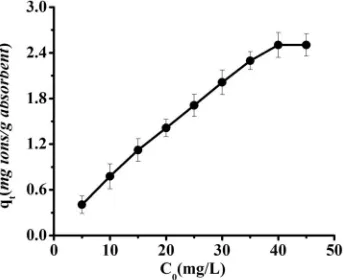
During the adsorption process of a solute from a solution onto a solid surface, there is a dynamic equilibrium be- tween the solute adsorbed on the solid surface and the solute remaining in solution. Figure 7 reveals that the
adsorption capacity of SB for Pb(II) ions increased with increasing metal concentration. The maximum adsorp- tion capacity of 2.5040 mg Pb(II)/g SB was reached at 40 mg/L metal ion solution concentrations.
Figure 6. Effect of pH on adsorption of Pb(II) onto SB in a magnetic field (Metal concentration: 30 mg/L; Dose: 0.0100 g/ml; Exposure time: 45 min; Strength of magnetic field: 480 kA/m).
Table 2. Parameters for the Langmuir and Freundlich equations.
Langmuir Freundlich Metal ions
Q0 b R2 K 1/n R2
Pb(II) 3.2906 14.50 × 10⁻² 0.9971 0.1519 0.6595 0.9960
The values were the average of three experiments; the temperature was 298 K.
Figure 7. Effect of metal concentration on adsorption of Pb(II) onto SB in a magnetic field (Dose: 0.0100 g/ml; Ex- posure time: 45 min; Strength of magnetic field: 480 kA/m; pH 4).
3.6. Discussion of the Mechanism for Magnetic Treatment of Adsorption Systems
It was previously reported [36] that magnetic treatment could reduce the viscosity and surface tension of solu- tions, an effect possibly concerned with resonance. When the magnetic field and the oscillation frequency of the molecules were in tune, resonance could occur. This re- sonance would then impart energy to the system for ac- tivation, changing the structure and nature of the material in the magnetic field. Magnetic treatment could thus promote the adsorption of metal ions. However, the me- chanism of magnetic treatment remains to be clarified in an in-depth study.
4. Conclusions
The adsorption of chitosan (CS) could be improved by condensation with benzaldehyde to form a Schiff base. The chitosan-benzaldehyde Schiff base (SB) had an ex- cellent adsorption capacity for Pb(II). This SB could ad- sorb twice as much Pb(II) as CS in half the time. This ad- sorption could be expressed with the Langmuir and Fre- undlich isotherm equation.
The adsorption ability, including adsorption amount and adsorption rate, could be enhanced with a suitable magnetic field. For example, upon treatment with a field strength of 480 kA/m, the adsorption equilibrium period for metal ions on SB shortened from 60 min to 30 min. In the future, the mechanism of magnetic treatment on ad- sorption will have to be studied deeply.
5. Acknowledgements
The authors are thankful for financial support from the Doctoral Discipline Special Foundation of the Education Ministry of China (20050561014) and the National “863” Science & Technology Project of China (2007AA100405).
REFERENCES
[1] T. L. Liao, G. L. Sun and H. P. Dong, “Research on the Toxicity of Lead Ion in Mimetic Membrane,” Guangdong Chemical Industry, No. 1, 2010, pp. 53-55.
http://202.116. 64.102 :81/asp/Detail.asp
[image:5.595.87.259.373.513.2]Immobi-lized Activated Sludge in a Packed Bed: Comparison with Granular Activated Carbon,” Process Biochemistry, Vol. 38, No. 2, 2002, pp. 175-186.
doi:10.1016/S0032-9592(02) 00053-5
[3] R. S. Bai and E. Abraham, “Studies on Chromium (VI) Adsorption Desorption Using Immobilized Fungal Bio-moss,” Bioresource Technology, Vol. 87, No. 1, 2003, pp. 17-26. doi:10.1016/S0960-8524(02)00222-5
[4] B. Benguella and H. Benaissa, “Effects of Competing Cations on Cadmium Biosorption by Chitin,” Colloids and Surfaces A: Physicochemical and Engineering As-pects, Vol. 201, No. 1-3, 2002, pp. 143-150.
doi:10.1016/S0927- 7757(01)00899-8
[5] F. Veglio and F. Beolchini, “Removal of Met also by Biosorption: A Review,” Hydrometallurgy, Vol. 44, No. 3, 1997, pp. 301-316.
doi:10.1016/S0304-386X(96)00059-X
[6] K. Higashitani, A. Kage, S. Katamura, K. Imai and S. Hatade, “Effects of a Magnetic Field on the Formation of CaCO3 Particles,” Journal of Colloid and Interface
Sci-ence, Vol. 156, No. 1, 1993, pp. 90-95. doi:10.1006/ jcis.1993. 1085
[7] S. Kobe, G. Dražić, A. C. Cefalas, E. Sarantopoulou and J. Stražišar, “Nucleation and Crystallization of CaCO3 in
Applied Magnetic Fields,” Crystal Engineering, Vol. 5, No. 3-4, 2002, pp. 243-253.
doi:10.1016/S1463-0184(02) 00035-7
[8] S. Kobe, G. Dražić, P. J. McGuiness, T. Meden, E. Saran-topoulou, Z. Kollia and A. C. Cefalas, “Control over Nanocrystalization in Turbulent Flow in the Presence of Magnetic Fields,” Materials Science and Engineering, Vol. 23, No. 6-8, 2003, pp. 811-815.
doi:10.1016/j.msec. 2003.09.136
[9] R. Gher, Z. A. Zhai, J. A. Finch and S. R. Rao, “Reduc-tion of Soluble Mineral Concentra“Reduc-tions in CaSO4
Satu-rated Water Using a Magnetic Field,” Water Research, Vol. 29, No. 3, 1995, pp. 933-940.
doi:10.1016/0043-1354(94) 002 14-R
[10] E. Chibowski, L. Hołysz and A. Szcześ, “Time Depend-ent Changes in Zeta PotDepend-ential of Freshly Precipitated Cal-cium Carbonate,” Colloids and Surfaces A: Physico-chemical and Engineering Aspects, Vol. 222, No. 1-3, 2003, pp. 41-54. doi:10.1016/S0927-7757(03)00232-2 [11] L. Hołysz, E. Chibowski and A. Szcześ, “Influence of
Impurity Ions and Magnetic Field on the Properties of Freshly Precipitated Calcium Carbonate,” Water Re-search, Vol. 37, No. 14, 2003, pp. 3351-3360.
doi:10.1016/S0043-1354 (03) 00159-3
[12] L. Hołysz, A. Szcześ and E. Chibowski, “Effects of a Static Magnetic Field on Water and Electrolyte Solu-tions,” Journal of Colloid and Interface Science, Vol. 316, No. 2, 2007, pp. 996-1002. doi:10.1016/j.jcis.2007.08.026 [13] J. M. D. Coey and S. Cass, “Magnetic Water Treatment,” Journal of Magnetism and Magnetic Materials, Vol. 209, No. 1-3, 2000, pp. 71-74.
doi:10.1016/S0304-8853(99) 00648-4
[14] C. Gabrielli, R. Jaouhari, G. Maurin and M. Keddam, “Magnetic Water Treatment for Scale Prevention,” Water
Research, Vol. 35, No. 13, 2001, pp. 3249-3259. doi:10. 1016/S0043-1354(01)00010-0
[15] E. Chibowski, A. Szcześ and L. Hołysz, “Influence of Sodium Dodecyl Sulfate and Static Magnetic Field on the Properties of Freshly Precipitated Calcium Carbonate,” Langmuir, Vol. 21, No. 18, 2005, pp. 8114-8122.
[16] S. A. Parsons, B. L. Wang, S. J. Judd and T. Stephenson, “Magnetic Treatment of Calcium Carbonate Scale-Effect of pH Control,” Water Research, Vol. 31, No. 2, 1997, pp. 339-342. doi:10.1016/S0043-1354(96)00238-2
[17] J. S. Backer and S. J. Judd, “Magnetic Amelioration of Scale Formation,” Water Research, Vol. 30, No. 2, 1996, pp. 247-260. doi:10.1016/0043-1354(95)00184-0
[18] H. Al-Qahtani, “Effect of Magnetic Treatment on Gulf Seawater,” Desalination, Vol. 107, No. 1, 1996, pp. 75- 81.
[19] F. Alimi, M. Tlili, C. Gabrielli, M. Georges and M. B. Amor, “Effect of a Magnetic Water Treatment on Homo-geneous and HeteroHomo-geneous Precipitation of Calcium Carbonate,” Water Research, Vol. 40, No. 10, 2006, pp. 1941-1950. doi:10.1016/j.watres.2006.03.013
[20] K. Higashitani, K. Okuhara and S. Hatade, “Effects of Magnetic Fields on Stability of Nonmagnetic Ultrafine Colloidal Particles,” Journal of Colloid and Interface Science, Vol. 152, No. 1, 1992, pp. 125-131.
doi:10.1016/ 0021-9797(92)90013-C
[21] K. Higashitani, H. Iseri, K. Okuhara, A. Kage and S. Hatade, “Magnetic Effects on Zeta Potential and Diffu-sivity of Nonmagnetic Colloidal Particles,” Journal of Colloid and Interface Science, Vol. 172, No. 2, 1995, pp. 383-388. doi:10.1006/jcis.1995.1268
[22] J. Oshitani, R. Uehara and K. Higashitani, “Magnetic Effects on Electrolyte Solutions in Pulse and Alternating Fields,” Journal of Colloid and Interface Science, Vol. 209, No. 2, 1999, pp. 374-379.
doi:10.1006/jcis.1998.5898
[23] P. Vallée, J. Lafait, L. Legrand, P. Mentré, M. O. Monod and Y. Thomas, “Effects of Pulsed Low Frequency Elec-tromagnetic Fields on Water Characterized by Light Scat-tering Techniques: Role of Bubble,” Langmuir, Vol. 21, No. 6, 2005, pp. 2293-2299. doi:10.1021/la047916u [24] M. C. Amiri and A. A. Dadkhah, “On Reduction in the
Surface Tension of Water Due to Magnetic Treatment,” Colloids Surfaces A: Physicochemical and Engineering Aspects, Vol. 278, No. 1-3, 2006, pp. 252-255.
doi:10.1016/j.colsurfa.2005.12.046
[25] H. Madsen, “Influence of Magnetic Field on the Precipi-tation of Some Inorganic Salts,” Journal of Crystal Growth, Vol. 152, No. 1-2, 1995, pp. 94-100.
doi:10.1016/0022-0248(95)00103-4
[26] M. Colic and D. Morse, “The Elusive Mechanism of the Magnetic ‘Memory’ of Water,” Colloids and Surfaces A: Physicochemical and Engineering Aspects, Vol. 154, No. 1-2, 1999, pp. 167-174.
doi:10.1016/S0927-7757(98)00894-2
[27] K. Higashitani and J. Oshitani, “Magnetic Effects on Thickness of Adsorbed Layer in Aqueous Solutions Evaluated Directly by Atomic Force Microscope,”
nal of Colloid and Interface Science, Vol. 204, No. 2, 1998, pp. 363-368. doi:10.1006/jcis.1998.5590
[28] P. Wanvimol and C. Suwabun, “Conjugation of Gallic Acid onto Chitosan: An Approach for green and Wa-ter-Based Antioxidant,” Carbohydrate Polymers, Vol. 72, No. 1, 2008, pp. 169-177.
doi:10.1016/j.carbpol.2007.08.002
[29] G. Ma, D.-Z. Yang, Y.-S. Z., X. Ming, J. F. Kennedy and N. Jun, “Preparation and Characterization of Water- Soluble N-Alkylated Chitosan,” Carbohydrate Polymers, Vol. 74, No. 1, 2008, pp. 121-126.
doi:10.1016/j.carbpol.2008.01.028
[30] C. Peggy, K. Motoichi, E. C. Joo, Y.-Y. Yang, “Synthesis and Characterization of Chitosan-G-Poly(Ethylene Gly-col)-Folate as a Non-Viral Carrier for Tumor-Targeted Gene Delivery,” Biomaterials, Vol. 28, No. 3, 2007, pp. 540-549. doi:10.1016/j.biomaterials.2006.08.046
[31] N. Zerrouk, G. Corti, S. Ancillotti, F. Maestrelli, M. Cirri and P. Mura, “Influence of Cyclodextrins and Chitosan, Separately or in Combination, on Glyburide Solubility and Permeability,” European Journal of Pharmaceutics and Biopharmaceutics, Vol. 62, No. 3, 2006, pp. 241-246. doi:10.1016/j.ejpb.2005.08.010
[32] V. M. Ramos, N. M. Rodríguez, M. S. Rodríguez, A. Heras and E. Agulló, “Modified Chitosan Carrying Phos-phonic and Alkyl Groups,” Carbohydrate Polymers, Vol. 51, No. 4, 2003, pp. 425-429.
doi:10.1016/S0144-8617(02)00211-4
[33] G. Manuel, S. N. Antonio, E. M. Maria, et al., “A Deriva-tive of Chitosan and 2,4-Pentanedione with Strong Che-lating Properties,” Carbohydrate Research, Vol. 233, No. 2, 1992, pp. 255-259.
doi:10.1016/S0008-6215(00)90939-X
[34] L.-H. Duan, J.-Q. Yang and S.-Y. Guo, “Study on Prop-erty of Modified Chitosan for Absorbing Cr (Ⅵ) in Mag-netic Field,” Journal of Shanxi University of Science and Technology, Vol. 28, No. 6, 2010, pp. 1-6.
[35] F. C. Wu, R. L. Tseng and R. S. Juang, “Comparative Adsorption of Metal and Dye on Flake- and Bead-Types of Chitosans Prepared from Fishery Wastes,” Journal of Hazardous Materials, Vol. 73, No. 1, 2000, pp. 63-75. doi:10.1016/S0304-3894(99)00168-5