J. exp. BioL (1979), 79. 41-46 Printed in Great Britain
DO FROGS DRINK?
BY P. J. BENTLEY AND T. YORIO
Departments of Pharmacology and Ophthalmology, Mount Sinai School of Medicine of the City University of New York, New York, N.Y. 10029 {U.S.A.)
(Received 30 May 1978)
SUMMARY
Drinking in response to dehydration and exposure to saline solutions was measured in adult Rana pipiens, Bufo marinas and Xenopus laevis, and tadpoles of Rana catesbeiana. These animals normally occupy quite different types of environments where the possible advantages of drinking may differ. Small amounts of the external media were swallowed by all the animals and the quantity usually increased when they were placed in hyperosmotic NaCl solution. However, no relationship between the oral intake of water and the particular conditions, such as the degree of dehydration, was observed. Usually 80-90% of the total water uptake occurred by absorption across the skin. Thus although 'secondary' type drinking takes place, 'primary' drinking did not appear to occur. These results directly confirm the general popular impression that amphibians, in contrast to other tetrapods and marine teleosts, do not drink in order to rehydrate.
INTRODUCTION
Drinking plays a vital role in the regulation of body fluids of most vertebrates, but there are some interesting exceptions, especially among the freshwater teleosts, elasmo-branchs and amphibians. Regulatory or 'primary* drinking occurs in response to thirst (see Fitzsimons, 1972). A further type of drinking, 'secondary' drinking, is not a regulatory response to a deficit of body water; it may take place during feeding or in response to stress. In mammals, primary drinking involves the stimulation of the thirst centre in the hypothalamus as a result of cellular dehydration or a decrease in the volume of the extracellular fluids. This type of response has also been observed in birds and reptiles (Fitzsimons, 1975; Fitzsimons & Kaufman, 1977). Drinking by marine teleost fish appears to be of the primary type, but the mechanism appears to be a reflex that does not involve the hypothalamus (Hirano, 1974).
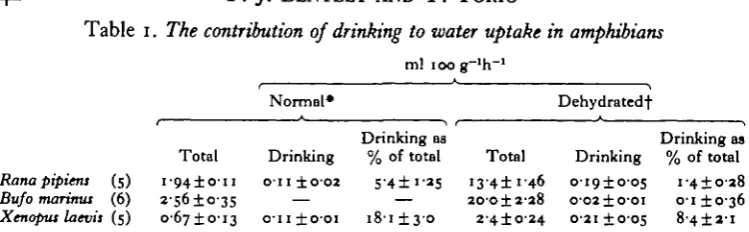
Table i. The contribution of drinking to water uptake in amphibians
ml ioo g"1!!"1
Normal* Dehydratedf
Drinking as Drinking as Total Drinking % of total Total Drinking % of total
Rana pipiens (5) I-Q4±O-II o n ± 0 0 2 5-411-25 13-411-46 0-1910-05 1-410-28 Bufo marinut (6) 2 5 6 ± 0 3 5 — — 2 0 0 ±2-28 o-O2±o-oi o - i ± o - 3 6 Xenoput laevis (5) 0-6710-13 O - I I ± O O I I 8 I ± 3 0 2-410-24 o - 2 i ± o - o s 8 - 4 ± a - i
• T h e difference between the total water uptake and that due to drinking represents that accumulated across the skin. T h e determination was made over a 15 h period, with the cloaca ligated, for Rana and Bufo, and 8 h for Xenopui.
t Dehydration equivalent to a loss in body weight of 23-30% was performed in a beaker in the laboratory. Water uptake and drinking were measured over a 2 h period; the cloaca was not tied. The results are as means is.E. of the number of experiments in parentheses.
frog, Rana cancrivora, which live in sea water, normally drink this solution (Gordon & Tucker, 1965); behaviour which is reminiscent of that of marine teleosts.
In this paper, drinking is examined in four types of amphibians that normally occupy different types of environment, where the possible advantages of drinking may differ.
METHODS
Drinking in anurans 43
Table 2. Effects of immersion in hyperosmotic 3-3% NaCl solutions on drinking in Rana pipiens and Bufo marinus
ml 100 g"1 h"1
Rana pipiens Bufo marinus
3-3 % NaCl* for 30 min
drinking 1-68 ±0-40 265 ± 0 3 3
Tap water)-for 30 min
drinking o-27±o-o8 o-39±o-a8 Means ± s.E. for six experiments.
• Under these conditions, the Na concentration of the body fluids rises markedly due to osmotic water loss and the accumulation of Na (see Bentley & Schmidt-Nielsen, 1971).
t This group of amphibians was first exposed to the 3-3 % NaCl and then placed in the tap water.
RESULTS
Rana pipiens (Ranidae)
The North American leopard frog is an amphibious anuran which divides its time between dry land and fresh water. When the experimental animals were confined to a beaker of tap water, water uptake due to drinking was about o-i ml 100 g"1 h- 1 (Table 1). The total water uptake under these conditions, which also includes that absorbed across the skin, was 1-9 ml 100 g"1 h- 1 so that the drinking only made up 5-4% of the total.
Five frogs were dehydrated by placing them in a beaker without water for 18 h. At this time, they had lost water equivalent to about 30% of their body weight. When placed in tap water, these frogs rapidly regained this lost water but only 1-4% of the total was taken up by drinking (Table 1), an even smaller proportion than in the normally hydrated frogs.
It has previously been shown that leopard frogs drink when placed in NaCl solutions equivalent in concentration to sea water (3*3%) (Bentley & Schmidt-Nielsen, 1971) and these observations were confirmed in the present series of experiments (Table 2). To see if this drinking behaviour is perpetuated or even increased when fresh water is subsequently made available, we transferred frogs treated in this way to a beaker of tap water. Drinking, however, was not much greater than that observed when they are normally hydrated.
Bufo marinus (Bufonidae)
Table 3. Drinking in tadpoles (Rana catesbeiana) immersed in NaCl solutions
ml 100 g"1 h"1 Tap water* o-18 ± 0-020 0-3 % NaCl 024 ± 0028 0 6 % NaCl 0 2 6 ± 0 0 5 3 0-9% NaCl 0-2310041 2 % NaCl for 30 min 0-8510-075 2 % NaCl then tap water 30 min 0-22 ± 0030
Results as means ± s.E. for eight experiments. • For 2 h except for 2 % NaCl.
Xenopus laevis (Pipidae)
The African clawed toad is an aquatic anuran. When the ponds and lakes were they normally live dry up, they burrow into the remaining mud where they aestivate until the next rainy season (Alexander & Bellerby, 1938). During this period, they accumu-late metabolites, principally urea, which they excrete in large amounts when water again becomes available (Balinsky et al. 1967). Compared to other species, this anuran only takes up water across its integument relatively slowly (Heller & Bentley, 1965; Yorio & Bentley, 1978). It thus appears to be a species in which water uptake by drinking would be especially appropriate. Local hearsay evidence suggests that they do this in the south-west of Cape Province in South Africa when they emerge from aestivation following rain (T. W. Mittag, personal communication).
In its normal aquatic type of environment water uptake by drinking by Xenopus was found to be equivalent to o-i ml 100 g"1 h"1 (Table 1). This quantity is 18% of the total water accumulated. The toads were dehydrated by leaving them in a beaker without water for 15 h when they lost water equivalent to about 26 % of their body weight. When replaced in fresh water, they drank fluid equivalent to 0*2 ml 100 g- 1 h- 1 over a 2 h period which is similar to the rate observed in the normally hydrated toads and 8 % of the total uptake. The Xenopus only regained their lost weight very slowly and after 2 h in tap water, had only reaccumulated one-fifth of the water which they lost. Thus, although drinking ought to have facilitated their rate of rehydration, they did not resort to it. This observation, however, does not exclude the possibility that these animals may drink in their native habitat.
Rana catesbeiana tadpoles
Drinking in anurans 45
DISCUSSION
Primary drinking, in response to dehydration or immersion in hyperosmotic saline solutions, was not observed in Rana pifriens, Bufo marinus or Xcnopus laevis. The tadpoles of Rana catesbeiana also did not display such a response. Most of the amphi-bians swallowed small amounts of water compared to that taken up across the skin even when they were normally hydrated in fresh water and this increased only slightly when they were placed in hyperosomotic saline. The fluid uptake thus appears to constitute 'secondary' drinking, which is not directly related to osmotic need. This type of water uptake has also been observed in aquatic urodele amphibians (Bentley,
IQ
73)-It is interesting that frogs can apparently ' taste' water and can distinguish between salt solutions of different concentration (Andersson & Zotterman, 1950; Araike & Saito, 1976). This ability, however, does not seem to subserve the usual type of thirst mechanism. Some amphibians appear to seek water in which to lie in order to rehy-drate. It has been suggested that this process may constitute a 'primeval thirst' (Fitzsimons, 1975) which is slaked by the absorption of water across the integument, instead of by more conventional oral drinking. Some of the physiological prerequisites, such as a 'thirst' mechanism, may thus be present. Amphibians are a diverse group of vertebrates and it remains possible that a drinking response like that seen in the amniotes may yet be identified among them. Their 'cutaneous drinking', however, appears to be a satisfactory process which has not hampered their occupation of even quite arid habitats.
Supported by the National Science Foundation grant no. BMS 75-07684.
REFERENCES
ADOLPH, E. F. (1943). Physiological Regulations, pp. no—116. Lancaster: The Jacques Cartel] Press. ALEXANDER, S. S. & BELLBRBY, C. W. (1938). Experimental studies on the sexual cycle of the South
African toad (Xenopus laevis). J. exp. Biol. 15, 74-81.
ANDERSSON, B. & ZOTTERMAN, Y. (1950). The water taste in the frog. Acta pkysiol. stand, ao, 95-100. ARAIKE, N. & SATO, M. (1976). Water response in frog taste cells. Comp. Biochem. Physiol. 54A, 149-156. BALINSKY, J. B., CHORITZ, E. L., COE, C. G. L. & VAN DER SCHANS, G. S. (1967). Amino acid meta-bolism and urea synthesis in naturally aestivating Xenopus laevis. Comp. Biochem. Physiol. 23, 50-68. BENTLEY, P. J. (1971). Endocrine? and Osmoregulation. A Comparative Account of the Regulation of Water
and Salt in Vertebrates, pp. 168. New York, Heidelberg, Berlin: Springer Verlag.
BENTLEY, P. J. (1973). Osmoregulation in the aquatic urodeles Amphhtma means (the Congo Eel) and
Siren lacerlina (the Mud Eel). Effects of vasotocin. Gen. comp. Endocrinol. ao, 386-391.
BENTLEY, P. J. & SCHMIDT-NIELSEN, K. (1971). Acute effects of sea water on frogs (Rana pipiens).
Comp. Biochem. Physiol. 40A, 547-548.
EVANS, D . (1973). Sodium uptake by the sailfin molly, Poedlia latiphtna: a kinetic analysis of a carrier system present in both freshwater-acclimated and seawater-acclimated individuals. Comp. Biochem.
Physiol. 45A, 843-850.
FITZSIMONS, J. T. (197a). Thirst. Physiol. Rev. 5a, 468-561.
FITZSIMONS, J. T. (1975). Thirst and sodium appetite in the regulation of body fluids. In Control
Mechanisms of Drinking (ed. G. Peters, J. T. Fitzsimons and L. L. Peters-Haefeli), pp. 1-7. Berlin,
Heidelberg, New York: Springer Verlag.
FITZSIMONS, j . T. & KAUFMAN, S. (1977). Cellular and extracellular dehydration, and angiotensin as stimuli to drinking in the common iguana Iguana iguana. J. Physiol., Lond. a65, 443-463.
GORDON, M. S. & TUCKER, V. A. (1965). Osmotic regulation in the tadpoles of the crab-eating frog
HELLHR, H. & BENTLEY, P. J. (1965). Phylogenetic distribution of the effects of neurohypophysial hormones on water and salt metabolism. Gen. comp. Endocrinol. 5, 96-108.
HIRANO, T. (1974). Some factors regulating water intake by the eel, Anguilla japomca. J. exp. Biol. 61,
737-747-KATZ, U. (1975). NaCl adaptation in Rana ribibunda and a comparison with the euryhaline toad Bufo
vtridit. J. exp. Biol. 63, 763-773.
KROCH, A. (1939). Osmotu Regulation in Aquatic Animals. Cambridge: University Press.