Proceedings of the Fourth Joint Conference on Lexical and Computational Semantics (*SEM 2015), pages 20–29,
A Hybrid Distributional and Knowledge-based Model of Lexical Semantics
Nikolaos Aletras
Department of Computer Science, University College London,
Gower Street, London WC1E 6BT
United Kingdom
Mark Stevenson
Department of Computer Science, University of Sheffield, Regent Court, 211 Portobello,
Sheffield S1 4DP United Kingdom
Abstract
A range of approaches to the representa-tion of lexical semantics have been explored within Computational Linguistics. Two of the most popular are distributional and knowledge-based models. This paper proposes hybrid models of lexical semantics that combine the advantages of these two approaches. Our mod-els provide robust representations of synony-mous words derived from WordNet. We also make use of WordNet’s hierarcy to refine the synset vectors. The models are evaluated on two widely explored tasks involving lexical semantics: lexical similarity and Word Sense Disambiguation. The hybrid models are found to perform better than standard distributional models and have the additional benefit of mod-elling polysemy.
1 Introduction
The representation of lexical semantics is a core prob-lem in Computational Linguistics and a variety of approaches have been developed. Two of the most widely explored have been knowledge-based and dis-tributional semantics.
Knowledge-based approaches make use of some external information source which defines the set of possible meanings for each lexical item. The most widely used information source is WordNet (Fell-baum, 1998), although other resources, such as Ma-chine Readable Dictionaries, thesaurii and ontologies have also been used (see Navigli (2009)).
One advantage of these resources is that they rep-resent the various possible meanings of lexical items
which makes it straightforward to identify ones that are ambiguous. For example, these resources would include multiple meanings for the wordball includ-ing the ‘event’ and ‘sports equipment’ senses. How-ever, the fact that there are multiple meanings as-sociated with ambiguous lexical items can also be problematic since it may not be straightforward to identify which one is being used for an instance of an ambiguous word in text. This issue has lead to signif-icant exploration of the problem of Word Sense Dis-ambiguation (Ide and V´eronis, 1998; Navigli, 2009). More recently distributional semantics has become a popular approach to representing lexical semantics (Turney and Pantel, 2010; Erk, 2012). These ap-proaches are based on the premise that the semantics of lexical items can be modelled by their context (Firth, 1957; Harris, 1985). Distributional seman-tic models have the advantages of being robust and straightforward to create from unannotated corpora. However, problems can arise when they are used to represent the semantics of polysemous words. Distri-butional semantic models are generally constructed by examining the context of lexical items in unanno-tated corpora. But for ambiguous words, likeball, it is not clear if a particular instance of the word in a corpus refers to the ‘event’, ‘sports equipment’ or another sense which can lead to the distributional se-mantic model becoming a mixture of different mean-ings without representing any of the meanmean-ings indi-vidually.
is created from an unannotated corpus and then re-fined using WordNet. The resulting models can be viewed as enhanced distributional models that have been refined using the information from WordNet to reduce the problems caused by ambiguous terms when models are created. Alternatively, it can be used as a version of the WordNet hierarchy in which dis-tributional semantic models are attached to synsets. Thereby creating a version of WordNet for which the appropriate synsets can be identified more easily for ambiguous lexical items that occur in text.
We evaluate our models on two standard tasks: lex-ical similarity and word sense disambiguation. Re-sults show that the proposed hybrid models perform consistently better than traditional distributional se-mantic models.
The reminder of the paper is organised as follows. Section 2 describes our hybrid models which com-bine information from WordNet and a standard dis-tributional semantic model. These models are aug-mented using Latent Semantic Analysis and Canoni-cal Correlation Analysis. Sections 3 and 4 describe evaluation of the models on the word similarity and word sense disambiguation tasks. Related work is presented in Section 5 and conclusions in Section 6.
2 Semantic Models
First, we consider a standard distributional seman-tic space to represent words as vectors (Section 2.1). Then, we make use of the WordNet’s clusters of syn-onyms and hierarchy in combination with the stan-dard distributional space to build hybrid models (Sec-tion 2.2) which are augmented using Latent Semantic Analysis (Section 2.3) and Canonical Correlation Analysis (Section 2.4).
2.1 Distributional Model
We consider a semantic spaceD, as a word by con-text feature matrix,L×C. Vector representations consist of context featuresCin a reference corpus. We made use of pre-computed publicly available vec-tors1optimised for word similarity tasks (Baroni et
al., 2014). Word co-occurrence counts are extracted using a symmetric window of two words over a cor-pus of 2.8 billion tokens obtained by concatenating
1http://clic.cimec.unitn.it/composes/
semantic-vectors.html
ukWaC, the English Wikipedia and the British Na-tional Corpus. Vectors are weighted using positive Pointwise Mutual Information and the set of context features consists of the top 300K most frequent words in the corpus.
2.2 Hybrid Models
2.2.1 Synset Distributional Model
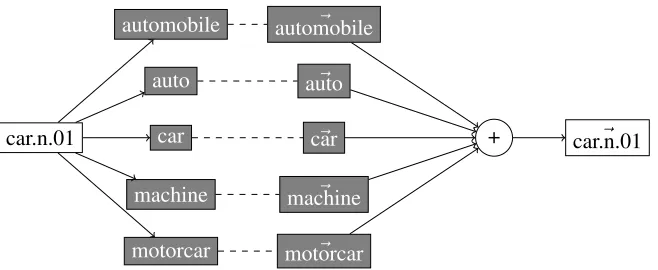
We assume that making use of information about the structure of WordNet can reduce noise introduced in vectors ofDdue to polysemy. We make use of all noun and verb synsets (excluding numbers and compounds) that contain at least one of the words in Lto create a vector-based synset representation,H. WhereH is a synset by context feature matrix, i.e. S×C. Each synset vector is generated by computing the centroid of its lemma vectors inS(i.e. the sum of the lemma’s vectors normalised by the number of the lemmas in the synset). For example, the vector of the synsetcar.n.01is computed as the centroid of its lemma vectors, i.e. car, auto, automobile, machine
andmotorcar(see Figure 1).
2.2.2 Synset Rank Model
The Synset Distributional Model provides a vector representation for each synset in WordNet which is created using information about which lemmas share synset membership. An advantage of this approach is that vectors from multiple lemmas are combined to form the synset representation. However, a disadvan-tage is that many of these lemmas are polysemous and their vectors represent multiple senses, not just the one that is relevant to the synset. For example, in WordNet the lemmamachine has several possi-ble meanings, only one of which is a member of the synsetcar.n.01.
car.n.01 car auto automobile
machine
motorcar
~
car
~
auto
~
automobile
~
machine
~
motorcar
[image:3.612.144.473.69.204.2]+ car.n.01~
Figure 1: In the Synset Distributional Model the vector representing a synset (white box) is computed as the centroid of its lemma vectors (grey boxes)
that synsets share with neighbours and reduces those that are not shared.
PageRank (Page et al., 1999) is a graph-based algo-rithm for identifying important nodes in a graph that has been applied to a range of NLP tasks including word sense disambiguation (Agirre and Soroa, 2009) and keyword extraction (Mihalcea and Tarau, 2004). LetG= (V, E)be a graph with a set of vertices, V, denoting synsets and a set of edges,E, denoting links between synsets in the WordNet hierarchy. The PageRank score (P r) overGfor a synset (Vi) can be computed by the following equation:
P r(Vi) =d· X Vj∈I(Vi)
1
O(Vj)P r(Vj) + (1−d)v (1)
whereI(Vi)denotes the in-degree of the vertexVi andO(Vj)is the out-degree of vertex Vj. dis the damping factor which is set to the default value of d= 0.85(Page et al., 1999). In standard PageRank all elements of the vectorvare the same, 1
N where N is the number of nodes in the graph.
Personalised PageRank (PPR) (Haveliwala et al., 2003) is a variant of the PageRank algorithm in which extra importance is assigned to certain vertices in the graph. This is achieved by adjusting the values of the vectorv in equation 1 to prefer certain nodes. The values inveffectively initialises the graph and assigning high values to nodes invmakes them more likely to be assigned a high PPR score.
For each context featurecinCifc∈LM where LM contains all the lemma names of synsets inS, we apply PPR to assign importance to synsets. The score of each synsetScin the personalisation vector
v, is set to 1
|Sc| where|Sc|is the number of synsets
that context featureibelongs. The personalisation value of all the other sysnets is set to 0.
We apply PPR over WordNet for each context feature using UKB (Agirre et al., 2009) and obtain weights for each synset-context feature pair resulting to a new semantic spaceHp, S×C, where vector
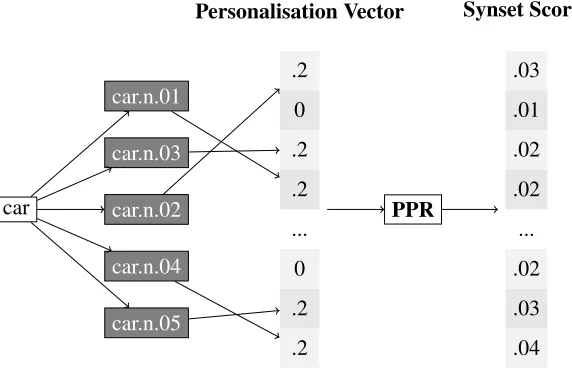
elements are weighted by PageRank values. Figure 2 shows how the synset scores are computed by ap-plying PPR over WordNet given the context feature
car. Note that we use the context features of the distributional modelD.
2.3 Latent Semantic Analysis
Latent Semantic Analysis (LSA) (Deerwester et al., 1990; Landauer and Dumais, 1997) has been used to reduce the dimensionality of semantic spaces lead-ing to improved performance. LSA applies Sin-gular Value Decomposition (SVD) to a matrix X, W ×C, which represents a distributional semantic space. This is a form of factor analysis whereXis decomposed into three other matrices:
X=UΣVT (2)
car car.n.02 car.n.03 car.n.01
car.n.04
car.n.05
Personalisation Vector
.2 0 .2 .2 ... 0 .2 .2
PPR
Synset Scores
[image:4.612.158.444.75.261.2].03 .01 .02 .02 ... .02 .03 .04
Figure 2: In the Synset Rank Model, each synset (grey boxes) is assigned with a score by computing PPR over WordNet. The personalisation vector (grey array) is initialised by assigning probabilities only to the synsets that include the context feature as a lemma name.
fewer singular values are used then the matrix prod-uct is an approximation of the original matrix. LSA reduces the dimensionality of the SVD by deleting coefficients in the diagonal matrixΣstarting with the smallest. The approximation of matrixXretaining theKlargest singular values,X, is then given by:˜
˜
X ≈UKΣKVKT (3)
whereUK is aW ×Kmatrix of word vectors,ΣK is aK×Kdiagonal matrix with singular values and VKis aK×Cmatrix of context feature vectors.
We apply LSA on the Synset Distributional Model, H and the Synset Rank model,Hp to obtained the
reduced semantic spacesH˜ andH˜prespectively.
2.4 Joint Representation using CCA
Recent work has demonstrated that distributional models can benefit from combining alternative views of data (see Section 5). H andHpprovide two
dif-ferent views of the synsets and we incorporate evi-dence from both to learn a joint representation using Canonical Correlation Analysis (CCA) (Hardoon et al., 2004). Given two multidimensional variablesx and y, CCA finds two projection vectors by max-imising the correlations of the variables onto these projections. The function to be maximised is:
ρ= p E[xy]
E[x2]E[y2] (4)
The dimensionality of the projection vectors is lower or equal to the dimensionality of the original vari-ables.
The computation of CCA directly overHandHp
is computationally infeasible because of their high dimensionality (300K). We apply CCA over the re-duced spaces learned using LSA,H˜ andH˜p to
ob-tain two joint semantic spaces following a similar approach to Faruqui and Dyer (2014). These are the spacesH∗, resulting from the projection of the Synset Distributional ModelH, and˜ H∗
p, resulting
from the projection of the Synset Rank ModelH˜p.
3 Word Similarity 3.1 Computing Similarity
Since hybrid models represent words as synset vec-tors, similarity between two words can be computed following two ways. First, we compute similarity be-tween two words as themaximumof their pairwise synset similarity. On the other hand, similarity can be computed as theaveragepairwise synset similarity using the synsets that the two words belong. Similar-ity is computed as the cosine of the angle between word or synset vectors.
3.2 Data
relat-Max
Model WS-353 WS-Sim WS-Rel RG MC MEN
Distributional Model
D 0.62 0.70 0.59 0.79 0.72 0.72
Hybrid Models - Full
H 0.49 0.60 0.36 0.69 0.64 0.58
Hp 0.58 0.67 0.49 0.82 0.86 0.63
Hybrid Models - LSA ˜
H 0.55 0.69 0.42 0.71 0.71 0.54
˜
Hp 0.58 0.68 0.46 0.85 0.86 0.55
Hybrid Models - CCA
H∗ 0.67 0.76 0.57 0.81 0.79 0.72
H∗
[image:5.612.162.455.69.325.2]p 0.52 0.62 0.41 0.86 0.80 0.56
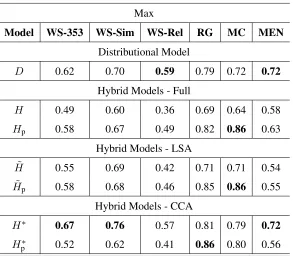
Table 1: Spearman’s correlation on various data sets. Maximum similarity between pairs of synsets.
edness. First, we make use ofWS-353(Finkelstein et al., 2001) which contains 353 pairs of words an-notated by humans. Furthermore, we make use of the similarity (WS-Sim) and relatedness (WS-Rel) pairs of words created by Agirre et al. (2009) from the original WS-353 data set.
We also made use of the RG (Rubenstein and Goodenough, 1965) and MC (Miller and Charles, 1991) data sets which contain 65 and 30 pairs of nouns respectively. Finally, we make use of the larger
MEN data set (Bruni et al., 2012) which contains 3,000 pairs of words that has been used as image tags. Annotations are obtained using croudsourcing.
3.3 Model Parameters
The parameters we need to tune are the number of the top components in LSA spaces,H˜ andH˜p, and
CCA spaces,H∗ andH∗
p. For the LSA spaces, we
tune the number of the topkcomponents in RG. We setk∈ {50,100, ...,1000}and select the value that maximises performance which isk= 700forH˜ and k= 650forH˜p. For the joint spaces learned using
CCA, we also tune the number of the toplcorrelated features in RG. We set l ∈ {10,20, ...,650} and select the value that maximises performance which
isl= 250forH∗andl= 40forH∗
p.
3.4 Evaluation Metric
Performance is measured as the correlation between the similarity scores returned by each proposed method and the human judgements. This is the stan-dard approach to evaluate word and text similarity tasks, e.g. (Budanitsky and Hirst, 2001; Agirre et al., 2009; Agirre et al., 2012). Our experiments use Spearman’s correlation coefficient.
3.5 Results
Table 1 shows the Spearman’s correlation of simi-larity scores generated by each model and human judgements of similarity across various data sets by taking the maximum pairwise similarity score of two words’ synsets. The first row of the table shows the results obtained by the word distributional model of Baroni et al. (2014). The full hybrid modelsH and Hp perform consistently worse than the
Average
Model WS-353 WS-Sim WS-Rel RG MC MEN
Distributional Model
D 0.62 0.70 0.59 0.79 0.72 0.72
Hybrid Models - Full
H 0.61 0.71 0.52 0.72 0.65 0.64
Hp 0.65 0.73 0.56 0.79 0.81 0.58
Hybrid Models - LSA ˜
H 0.59 0.70 0.48 0.68 0.68 0.63
˜
Hp 0.65 0.73 0.56 0.81 0.86 0.58
Hybrid Models - CCA
H∗ 0.70 0.77 0.64 0.78 0.84 0.74
H∗
[image:6.612.159.453.72.324.2]p 0.61 0.69 0.52 0.72 0.76 0.62
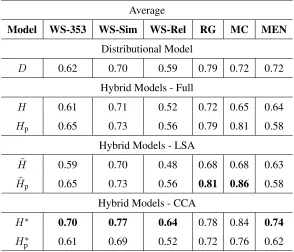
Table 2: Spearman’s correlation on various data sets. Average pairwise similarity between pairs of synsets.
kicked in games’) and ‘ball.n.04’ (‘the people as-sembled at a lavish formal dance’) is ‘ball’. In this case, the synset vector inHand the lemma vector in Dare identical and still polysemous. This problem does not hold inHp and therefore the correlations
are higher for that semantic space but still lower than those obtained forD. Applying LSA onH andHp
improves results but correlations are still lower than those obtained using D2. On the other hand, the
joint space learned by applying CCA,H∗, produces consistently better similarity estimates thanDwhile outperforms all the other models in the majority of the data sets. That confirms our main assumption than incorporating information obtained from a large corpus and a knowledge-base improves word vector representations.
Table 2 shows the Spearman’s correlation of sim-ilarity scores generated by each model and human judgements of similarity across various data sets by taking the average pairwise similarity score of two words’ synsets. Results show that using the average rather than the maximum system similarity improves results for almost all data sets. For example, the best
2Note that Baroni et al. (2014) found that applying SVD to Ddid not improve performance over using the full space.
hybrid model,H∗, achieves correlations that are be-tween 2% and 12% thanDfor the majority of data sets, although performance is 1% lower for the RG data set. This improved performance suggest that hu-man judgements of word similarity are based on the relation between all the senses of two given words rather than just the most similar ones.
4 Word Sense Disambiguation
4.1 Data
We test the efficiency of our hybrid models on the English All Words tasks of Senseval-2 (Palmer et al., 2001) and Senseval-3 (Snyder and Palmer, 2004), two standard data sets for evaluating WSD. Our ex-periments focus on the disambiguation of nouns in these data sets.
4.2 Word Sense Tagging
A simple approach to all-words WSD was imple-mented in which each sense of an ambiguous word is compared against its context and the most similar chosen.
Nouns Senseval-2 Senseval-3
Precision Recall Precision Recall Hybrid Models - Full
H 0.46 0.45 0.37 0.36
Hp 0.65 0.63 0.50 0.48
Hybrid Models - LSA ˜
H 0.45 0.44 0.39 0.37
˜
Hp 0.60 0.58 0.46 0.45
Hybrid Models - CCA
H∗ 0.44 0.43 0.36 0.34
H∗
[image:7.612.193.422.70.287.2]p 0.61 0.60 0.48 0.46
Table 3: Results obtained by hybrid models on SenseEval-2 and SenseEval-3 data sets (nouns only).
the wordbankin the following sentence:
“Banks provide payment services.”
Assume that the wordbank consists of two senses
‘bank.n.01’andbank.n.02defined as‘sloping land (especially the slope beside a body of water)’and“a financial institution that accepts deposits and chan-nels the money into lending activities’respectively.
First we consider the vectors of all the possible noun synsets containing the wordbank as a synset name. Then for each context word (provide,payment
andservice) that exists in our semantics spaces we compute a centroid vector from its constituent senses. Finally, we compute a context vector for the entire context by summing up all the context word vectors. We select the synset of the target word that its vector has the highest cosine similarity to the context vector.
4.3 Model Parameters
The parameters we need to tune are the same as for the word similarity task and we use the best settings obtained for that task. We also experimented with varying the number of surrounding sentences used as context by testing values between ±1 and ±4. The best performance was obtained using a context created from the sentence containing the target word and±1sentences surrounding it.
4.4 Evaluation Metrics
Word sense disambiguation systems are evaluated by computing precision and recall. Precision measures the proportion of disambiguated words that have been correctly assigned with a sense. Recall measures the proportion of words disambiguated correctly out of all words available for disambiguation.
4.5 Results
Table 3 shows the results obtained by using our hy-brid models on the two word sense disambiguation data sets. The full Synset Rank modelHp is consis-tently better method in terms of precision and recall in both data sets. On the other hand, it is somewhat surprising that dimensionality reduction and integra-tion of semantic spaces do not help in improving performance. That is theH˜pandHp∗models achieve lower precision and recall than the fullerHp.
The Synset Distributional modelsH,H˜ andH∗ consistently fail to perform well. The difference in precision and recall compared to the Synset Rank models is between12%and19%. This suggests that the knowledge-based weighting of the context fea-tures generates less noisy vectors for sense tagging.
expla-nation of this difference is that WSD requires the model to represent the possible senses of each am-biguous word. It is also important that these senses correspond to the ones used in the relevant lexicon (WordNet in this case). The Synset Rank modelHp does this by making use of information from Word-Net. However, these synset representations are dis-rupted by LSA and CCA which compress the seman-tic space by extracting general features from them. This is not a problem for word similarity since there is no need to model the senses found in the lexicon.
5 Related Work
Dealing with polysemy in distributional semantics is a fundamental issue since the various senses of a word type are conflated in a single vector. Previous work tackled the problem through vector adaptation, clustering and language models (Erk, 2012). Vector adaptation methods modify a traditional (i.e. poly-semous) target word vector by applying pointwise operations such as addition or multiplication to that and the surrounding words in a sentence (Mitchell and Lapata, 2008; Erk and Pad´o, 2008; Thater et al., 2011; Van de Cruys et al., 2011). Alternatively, clustering methods have been used to cluster together the different contexts a target word appears assum-ing that each cluster of contexts captures a different sense of the target word (Dinu and Lapata, 2010; Erk and Pado, 2010; Reisinger and Mooney, 2010). Language models have also been used to remove pol-ysemy from word vectors by predicting words that could replace the target word given a context (De-schacht and Moens, 2009; Washtell, 2010; Moon and Erk, 2013). More recently, Polajnar and Clark (2014) applied context selection and normalisation to improve the quality of word vectors. Our hybrid models are related to the vector adaptation methods since we modify the synset vectors using its lemmas’ vectors to remove noise.
Our work is also inspired by recent work on im-proving classic distributional vector representations of words by incorporating information from different modalities. For example, researchers have devel-oped methods that make use of both visual and con-textual information to improve word vectors (Bruni et al., 2011; Silberer et al., 2013; Lazaridou et al., 2014). Following a similar direction, Faruqui and
Dyer (2014) found that learning joint spaces from multilingual vector spaces using CCA improves the performance of standard monolingual vector spaces on semantic similarity. Fyshe et al. (2014) showed that integrating textual vector space models with brain activation data when people are reading words achieves better correlation to behavioural data than models of one modality.
Our hybrid models are also closely related to a supervised method proposed by Faruqui et al. (2015). Their method refines distributional semantic mod-els using relational information from various seman-tic lexicons, including WordNet, by making linked words in these lexicons to have similar vector repre-sentations. While our models are also based on using information from WordNet for refining vector repre-sentations, they are fundamentally different. They create synset vectors in an unsupervised fashion and more importantly can be used for sense tagging.
6 Conclusions
This paper proposed hybrid models of lexical seman-tics that combine distributional and knowledge-based approaches and offer advantages of both techniques. A standard distributional semantic model is created from an unannotated corpus and then refined by (1) using WordNet synsets to create synset vectors; and (2) applying a graph-based technique over WordNet to reweight synset vectors. The resulting hybrid mod-els can be viewed as enhanced distributional modmod-els using the information from WordNet to reduce the problems caused by ambiguous terms when models are created. Results show that our models perform better than traditional distributional models on lex-ical similarity tasks. Unlike standard distributional approaches the techniques proposed here also model polysemy and can be used to carry out word sense disambiguation.
References
Eneko Agirre and Aitor Soroa. 2009. Personalizing PageRank for word sense disambiguation. In Proceed-ings of the 12th Conference of the European Chapter of the Association for Computational Linguistics (EACL ’09), pages 33–41, Athens, Greece.
on similarity and relatedness using distributional and wordnet-based approaches. InProceedings of Human Language Technologies: The 2009 Annual Conference of the North American Chapter of the Association for Computational Linguistics (NAACL-HLT ’09), pages 19–27, Boulder, Colorado.
Eneko Agirre, Mona Diab, Daniel Cer, and Aitor Gonzalez-Agirre. 2012. Semeval-2012 task 6: A pilot on semantic textual similarity. InProceedings of the First Joint Conference on Lexical and Computational Semantics-Volume 1: Proceedings of the main confer-ence and the shared task, and Volume 2: Proceedings of the Sixth International Workshop on Semantic Eval-uation, pages 385–393. Association for Computational Linguistics.
Marco Baroni, Georgiana Dinu, and Germ´an Kruszewski. 2014. Don’t count, predict! a systematic comparison of context-counting vs. context-predicting semantic vec-tors. InProceedings of the 52nd Annual Meeting of the Association for Computational Linguistics (Volume 1: Long Papers), pages 238–247, Baltimore, Maryland. Elia Bruni, Giang Binh Tran, and Marco Baroni. 2011.
Distributional semantics from text and images. In Pro-ceedings of the Workshop on GEometrical Models of Natural Language Semantics (GEMS ’11), pages 22– 32, Edinburgh, UK, July.
Elia Bruni, Gemma Boleda, Marco Baroni, and Nam-Khanh Tran. 2012. Distributional semantics in techni-color. InProceedings of the 50th Annual Meeting of the Association for Computational Linguistics: Long Papers-Volume 1, pages 136–145, Jeju Island, Korea. Alexander Budanitsky and Graeme Hirst. 2001. Semantic
distance in WordNet: An experimental, application-oriented evaluation of five measures. InProceedings of the workshop on “WordNet and other Lexical Resources” at the Second Annual Meeting of the North American Association for Computational Linguistics, Pittsburgh, PA.
Scott Deerwester, Susan T. Dumais, George W. Furnas, Thomas K. Landauer, and Richard Harshman. 1990. Indexing by latent semantic analysis. Journal of the American Society for Information Science, 41(6):391– 407.
Koen Deschacht and Marie-Francine Moens. 2009. Semi-supervised semantic role labeling using the Latent Words Language Model. InProceedings of the 2009 Conference on Empirical Methods in Natural Language Processing, pages 21–29, Singapore.
Georgiana Dinu and Mirella Lapata. 2010. Measuring distributional similarity in context. InProceedings of the 2010 Conference on Empirical Methods in Natural Language Processing, pages 1162–1172, Cambridge, MA.
Katrin Erk and Sebastian Pad´o. 2008. A structured vector space model for word meaning in context. In Proceed-ings of the 2008 Conference on Empirical Methods in Natural Language Processing, pages 897–906, Hon-olulu, Hawaii.
Katrin Erk and Sebastian Pado. 2010. Exemplar-based models for word meaning in context. InProceedings of the ACL 2010 Conference Short Papers, pages 92–97, Uppsala, Sweden.
Katrin Erk. 2012. Vector space models of word meaning and phrase meaning: A survey. Language and Linguis-tics Compass, 6(10):635–653.
Manaal Faruqui and Chris Dyer. 2014. Improving vector space word representations using multilingual correla-tion. InProceedings of the 14th Conference of the Eu-ropean Chapter of the Association for Computational Linguistics, pages 462–471, Gothenburg, Sweden. Manaal Faruqui, Jesse Dodge, Sujay K Jauhar, Chris Dyer,
Eduard Hovy, and Noah A Smith. 2015. Retrofitting word vectors to semantic lexicons. InProceedings of the 2015 Conference of NAACL, Denver, Colorado. C. Fellbaum, editor. 1998.WordNet: An Electronic
Lexi-cal Database. The MIT Press, Cambridge, MA, Lon-don.
Lev Finkelstein, Evgeniy Gabrilovich, Yossi Matias, Ehud Rivlin, Zach Solan, Gadi Wolfman, and Eytan Ruppin. 2001. Placing search in context: The concept revisited. InProceedings of the 10th international conference on World Wide Web, pages 406–414, New York, USA. ACM Press.
J. Firth. 1957. A synopsis of linguistic theory 1930-1955. InStudies in Linguistic Analysis.
Alona Fyshe, Partha P. Talukdar, Brian Murphy, and Tom M. Mitchell. 2014. Interpretable semantic vectors from a joint model of brain- and text- based meaning. InProceedings of the 52nd Annual Meeting of the Asso-ciation for Computational Linguistics (Volume 1: Long Papers), pages 489–499, Baltimore, Maryland. David Hardoon, Sandor Szedmak, and John Shawe-Taylor.
2004. Canonical correlation analysis: An overview with application to learning methods.Neural computa-tion, 16(12):2639–2664.
Z. Harris. 1985. Distributional structure. In J. Katz, editor, The Philosophy of Linguistics, pages 26–47. Oxford University Press, New York.
Taher Haveliwala, Sepandar Kamvar, and Glen Jeh. 2003. An analytical comparison of approaches to personal-izing PageRank. Technical Report 2003-35, Stanford InfoLab.
Thomas K Landauer and Susan T Dumais. 1997. A so-lution to plato’s problem: The latent semantic analysis theory of acquisition, induction, and representation of knowledge. Psychological review, 104(2):211. Angeliki Lazaridou, Elia Bruni, and Marco Baroni. 2014.
Is this a wampimuk? cross-modal mapping between distributional semantics and the visual world. In Pro-ceedings of the 52nd Annual Meeting of the Associa-tion for ComputaAssocia-tional Linguistics (Volume 1: Long Papers), pages 1403–1414, Baltimore, Maryland. Rada Mihalcea and Paul Tarau. 2004. TextRank:
Bring-ing order into texts. InProceedings of International Conference on Empirical Methods in Natural Language Processing (EMNLP ’04), pages 404–411, Barcelona, Spain.
George A Miller and Walter G Charles. 1991. Contex-tual correlates of semantic similarity. Language and cognitive processes, 6(1):1–28.
Jeff Mitchell and Mirella Lapata. 2008. Vector-based models of semantic composition. InProceedings of ACL-08: HLT, pages 236–244, Columbus, Ohio. Taesun Moon and Katrin Erk. 2013. An inference-based
model of word meaning in context as a paraphrase distribution. ACM Transactions on Intelligent Systems and Technology (TIST), 4(3):42.
Roberto Navigli. 2009. Word Sense Disambiguation: a survey. ACM Computing Surveys, 41(2):1–69. Lawrence Page, Sergey Brin, Rajeev Motwani, and Terry
Winograd. 1999. The PageRank citation ranking: Bringing order to the web. Technical Report 1999-66, Stanford InfoLab.
Martha Palmer, Christiane Fellbaum, Scott Cotton, Lauren Delfs, and Hoa Trang Dang. 2001. English tasks: All-words and verb lexical sample. InThe Proceedings of the Second International Workshop on Evaluating Word Sense Disambiguation Systems, pages 21–24, Toulouse, France.
Tamara Polajnar and Stephen Clark. 2014. Improving distributional semantic vectors through context selec-tion and normalisaselec-tion. In Proceedings of the 14th Conference of the European Chapter of the Associa-tion for ComputaAssocia-tional Linguistics, pages 230–238, Gothenburg, Sweden. Association for Computational Linguistics.
Joseph Reisinger and Raymond J. Mooney. 2010. Multi-prototype vector-space models of word meaning. In Human Language Technologies: The 2010 Annual Con-ference of the North American Chapter of the Associ-ation for ComputAssoci-ational Linguistics, pages 109–117, Los Angeles, California.
Herbert Rubenstein and John B Goodenough. 1965. Con-textual correlates of synonymy. Communications of the ACM, 8(10):627–633.
Carina Silberer, Vittorio Ferrari, and Mirella Lapata. 2013. Models of semantic representation with visual at-tributes. InProceedings of the 51st Annual Meeting of the Association for Computational Linguistics (Volume 1: Long Papers), pages 572–582, Sofia, Bulgaria. Benjamin Snyder and Martha Palmer. 2004. The
en-glish all-words task. InSenseval-3: Third International Workshop on the Evaluation of Systems for the Semantic Analysis of Text, pages 41–43, Barcelona, Spain. Stefan Thater, Hagen F¨urstenau, and Manfred Pinkal.
2011. Word meaning in context: A simple and effective vector model. InProceedings of 5th International Joint Conference on Natural Language Processing, pages 1134–1143, Chiang Mai, Thailand.
Peter D. Turney and Patrick Pantel. 2010. From frequency to meaning: Vector space models of semantics. Journal of Artificial Intelligence Research, 37:141–188. Tim Van de Cruys, Thierry Poibeau, and Anna Korhonen.
2011. Latent vector weighting for word meaning in context. In Proceedings of the 2011 Conference on Empirical Methods in Natural Language Processing, pages 1012–1022, Edinburgh, Scotland, UK.