The AMU-UEdin Submission to the WMT 2017 Shared Task
on Automatic Post-Editing
Marcin Junczys-Dowmunt
Information Systems Laboratory Adam Mickiewicz University in Pozna´n
Roman Grundkiewicz
School of Informatics University of Edinburgh
Abstract
This work describes the AMU-UEdin sub-mission to the WMT 2017 shared task on Automatic Post-Editing. We explore mul-tiple neural architectures adapted for the task of automatic post-editing of machine translation output. We focus on neural end-to-end models that combine both in-putsmtandsrcin a single neural
architec-ture, modeling{mt, src} → pe directly.
Apart from that, we investigate the influ-ence of hard-attention models which seem to be well-suited for monolingual tasks, as well as combinations of both ideas. 1 Introduction
During the WMT 2016 APE two systems relied on neural models, the CUNI system (Libovický et al., 2016) and the shared task winner, the sys-tem submitted by the Adam Mickiewicz Univer-sity (AMU) team (Junczys-Dowmunt and Grund-kiewicz,2016). This submission explored the ap-plication of neural translation models to the APE problem and achieved good results by treating different models as components in a log-linear model, allowing for multiple inputs (the source
srcand the translated sentencemt) that were
de-coded to the same target language (post-edited translationpe). Two systems were considered, one
usingsrcas the input (src→ pe) and another
us-ingmtas the input (mt → pe). A simple
string-matching penalty integrated within the log-linear model was used to control for higher faithfulness with regard to the raw MT output. The penalty fires if the APE system proposes a word in its out-put that has not been seen inmt. The influence of
the components on the final result was tuned with Minimum Error Rate Training (Och, 2003) with regard to the task metric TER.
With neural encoder-decoder models, and multi-source models in particular, the combination ofmtandsrccan be now achieved in more
natu-ral ways than for previously popular phrase-based statistical machine translation (PB-SMT) systems. Despite this, results for multi-source or double-source models in APE scenarios are incomplete or unsatisfying in terms of performance.
In this work, we explore a number of single-source and double-single-source neural architectures which we believe to be better fits to the APE task than vanilla encoder-decoder models with soft at-tention. We focus on neural end-to-end models that combine both inputs mt andsrc in a single
neural architecture, modeling{mt, src} →pe
di-rectly. Apart from that, we investigate the influ-ence of hard-attention models which seem to be well-suited for monolingual tasks. Finally, we cre-ate combinations of both architectures.
Following (Junczys-Dowmunt and Grund-kiewicz,2016), we also attempt to generate more artificial data for the task. Instead of relying on filtering towards specific error rates, we generate text with fitting error rates from the start which allows us to retain more data.
2 Encoder-Decoder Models with APE-specific Attention Models 2.1 Standard Attentional Encoder-Decoder The attentional encoder-decoder model in Marian1 is a re-implementation of the NMT model in Ne-matus (Sennrich et al.,2017). The model differs from the standard model introduced byBahdanau et al.(2014) by several aspects, the most important being the conditional GRU with attention. The summary provided in this section is based on the description in Sennrich et al. (2017). More de-tails on the specific architectures in this shared
1https://github.com/marian-nmt/marian
task submission are given in Junczys-Dowmunt and Grundkiewicz(2017).
Given the raw MT output sequence
(x1, . . . , xTx) of length Tx and its manually
post-edited equivalent(y1, . . . , yTy)of lengthTy,
we construct the encoder-decoder model using the following formulations.
Encoder context A single forward encoder state −
→h
i is calculated as: − →
hi =GRU(−→hi−1,F[xi])
whereF is the encoder embeddings matrix. The
GRU RNN cell (Cho et al.,2014) is defined as: GRU(s,x) =(1−z)s+zs, (1)
s=tanh(Wx+rUs), r=σ(Wrx+Urs),
z=σ(Wzx+Uzs),
wherexis the cell input,sis the previous recurrent
state,W,U,Wr,Ur,Wz,Uzare trained model parameters2; σ is the logistic sigmoid activation function. The backward encoder state is calculated analogously over a reversed input sequence with its own set of trained parameters.
Let hi be the annotation of the source symbol at position i, obtained by concatenating the
for-ward and backfor-ward encoder RNN hidden states,
hi = [−→hi;←h−i], the set of encoder states C = {h1, . . . ,hTx}then forms the encoder context.
Decoder initialization The decoder is initial-ized with start state s0, computed as the average
over all encoder states:
s0 = tanh Winit
PTx
i=1hi
Tx
!
Conditional GRU with attention We follow the Nematus implementation of the conditional GRU with attention, cGRUatt:
sj =cGRUatt(sj−1,E[yj−1],C) (2)
wheresjis the newly computed hidden state,sj−1
is the previous hidden state, C the source context and E[yj−1] is the embedding of the previously
decoded symbolyi−1.
The conditional GRU cell with attention, cGRUatt, has a complex internal structure, consist-ing of three parts: two GRU layers and an inter-mediate attention mechanism ATT.
2Biases have been omitted.
Layer GRU1 generates an intermediate
repre-sentation s0j from the previous hidden state sj−1
and the embedding of the previous decoded sym-bolE[yj−1]:
s0j =GRU1(sj−1,E[yj−1]).
The attention mechanism, ATT, inputs the en-tire context set C along with intermediate hidden states0j in order to compute the context vectorcj as follows:
cj =ATT C,s0j
=
Tx X
i
αijhi,
αij = exp
(eij)
PTx
k=1exp(ekj)
,
eij =v|atanh Uas0j+Wahi,
where αij is the normalized alignment weight between source symbol at position i and target
symbol at position j andva,Ua,Wa are trained model parameters.
Layer GRU2 generates sj, the hidden state of the cGRUatt, from the intermediate representation
s0j and context vectorcj:
sj =GRU2 s0j,cj
.
Deep output Finally, givensj,yj−1, andcj, the output probability p(yj|sj, yj−1,cj) is computed by a softmax activation as follows:
p(yj|sj,yj−1,cj) =softmax(tjWo)
tj = tanh (sjWt1 +E[yj−1]Wt2 +cjWt3)
Wt1,Wt2,Wt3,Wo are the trained model
pa-rameters.
This rather standard encoder-decoder model with attention is our baseline and denoted as ENCDEC-ATT.
The following models reuse most parts of the architecture described above wherever possible, most differences occur in the decoder RNN cell and the attention mechanism. The encoders are identical, so are the deep output layers.
2.2 Hard Monotonic Attention
The target word vocabularyVy is extended with a special step symbol (Vy0 =Vy∪ {hSTEPi}) and wheneverhSTEPiis predicted as the output sym-bol, the hard attention is moved to the next encoder state. Formally, the hard attention mechanism is represented as a precomputed monotonic se-quence(a1, . . . , aTy)which can be inferred from
the target sequence(y1, . . . , yTy)(containing
orig-inal target symbols and Tx step symbols) as fol-lows:
a1 = 1
aj =
aj−1+ 1 ifyj−1 =hSTEPi aj−1 otherwise.
For a given context C = {h1, . . . ,hTx}, the
at-tended context vector at time stepjis simplyhaj.
Following the description byAharoni and Gold-berg(2016) for their LSTM-based model, we now adapt the previously described encoder-decoder model to incorporate hard attention. The encoder as well as the output layer of the previous model remain unchanged. Given the sequence of atten-tion indices (a1, . . . , aTy), the conditional GRU
cell (Eq.2) used for hidden state updates of the de-coder is replaced with a simple GRU cell (Eq.1) (thus removing the soft-attention mechanism):
sj =GRU sj−1,
E[yj−1];haj
(3) where the cell input is now a concatenation of the embedding of the previous target symbolE[yj−1]
and the currently attended encoder statehaj. This
model is labeled ENCDEC-HARD.
We find this architecture compelling for mono-lingual tasks that might require higher faithfulness with regard to the input. With hard monotonic at-tention, the translation algorithm can enforce cer-tain constraints:
1. The end-of-sentence symbol can only be gen-erated if the hard attention mechanism has reached the end of the input sequence, en-forcing full coverage;
2. ThehSTEPisymbol cannot be generated once the end-of-sentence position in the source has been reached. It is however still possible to generate content tokens.
Obviously, this model requires a target se-quence with correctly inserted hSTEPi symbols. For the described APE task, using the Longest
Common Subsequence algorithm (Hirschberg, 1977), we first generate a sequence of match, delete and insert operations which transform the raw MT output (x1,· · ·xTx) into the corrected
post-edited sequence(y1,· · ·yTy)3. Next, we map
these operations to the final sequence of steps and target tokens according to the following rules:
• For each matched pair of tokensx, ywe
pro-duce symbols:hSTEPiy;
• For each inserted target tokeny, we produce
the same tokeny;
• For each deleted source tokenx we produce
hSTEPi;
• Since at initialization of the model a1 = 1,
i.e. the first encoder state is already attended to, we discard the first symbol in the new se-quence if it is ahSTEPisymbol.
2.3 Hard and Soft Attention
While the hard attention model can be used to en-force faithfulness to the original input, we would also like the model to be able to look at informa-tion anywhere in the source sequence which is a property of the soft attention model.
By re-introducing the conditional GRU cell with soft attention into the ENCDEC-HARDmodel while also inputting the hard-attended encoder statehaj, we can try to take advantage of both
at-tention mechanisms. Combining Eq. 2and Eq. 3, we get:
sj =cGRUatt sj−1,
E[yj−1];haj
,C. (4)
The rest of the model is unchanged; the transla-tion process is the same as before and we use the same target step/token sequence for training. This model is called ENCDEC-HARD-ATT.
2.4 Soft Double-Attention
Neural multi-source models (Zoph and Knight, 2016) seem to be natural fit for the APE task, as raw MT output and original source language in-put are available. Although application to the APE problem have been reported (Libovický and Helcl, 2017), state-of-the-art results seem to be missing.
In this section we give details about our double-source model implementation. We rename the ex-isting encoder C to Cmtto signal that the first en-coder consumes the raw MT output and introduce
a structurally identical second encoder Csrc = {hsrc1 , . . . ,hsrcTsrc} over the source language. To compute the decoder start state s0 for the
multi-encoder model we concatenate the averaged en-coder contexts before mapping them into the de-coder state space:
s0 = tanh Winit
"PTmt
i=1 hmti
Tmt ;
PTsrc
i=1 hsrci
Tsrc
#! .
In the decoder, we replace the conditional GRU with attention, with a doubly-attentive cGRU cell (Calixto et al.,2017) over contexts Cmtand Csrc:
sj =cGRU2-att sj−1,E[yj−1],Cmt,Csrc (5)
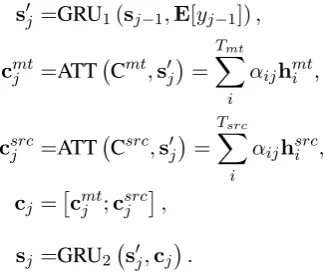
The procedure is similar to the original cGRU, differing only in that in order to compute the con-text vectorcj, we first calculate contexts vectors
cmt
j and csrcj for each context and then concate-nate the results:
s0j =GRU1(sj−1,E[yj−1]), cmtj =ATT Cmt,s0
j
=
Tmt X
i
αijhmti ,
csrcj =ATT Csrc,s0j=
Tsrc X
i
αijhsrci ,
cj =cmtj ;csrcj
,
sj =GRU2 s0j,cj
.
This could be easily extended to an arbitrary number of encoders with different architectures. During training this model is fed with a tri-parallel corpus, during translation both input sequences are processed simultaneously to produce the cor-rected output. This model is denoted as ENCDEC -DOUBLE-ATT.
2.5 Hard Attention with Soft Double-Attention
Analogously to the procedure described in sec-tion2.3, we can extend the doubly-attentive cGRU to take the hard-attended encoder context as addi-tional input:
sj =cGRU2-att
sj−1,
h
E[yj−1];hmtaj i
,Cmt,Csrc In this formulation, only the first encoder con-text Cmt is attended to by the hard monotonic at-tention mechanism. The target training data con-sists of the step/token sequences used for all pre-vious hard-attention models. We call this model ENCDEC-HARD+DOUBLE-ATT.
Data set Sentences TER
training set 2016 12,000 26.22
training set 2017 11,000 –
development set 2016 1,000 24.81
test set 2016 2,000 –
artificial-large 2016 4,335,715 36.63 artificial-small 2016 531,839 25.28 artificial 2017 15,158,354 27.45 Table 1: Statistics for artificial data sets in comparison to official training and development data, adapted fromJunczys-Dowmunt and Grund-kiewicz(2016).
3 Artifical Data
We also attempt to generate more artificial data for the task. Instead of relying on filtering towards specific error rates, we generate text with fitting error rates from the start which allows us to re-tain more data. To obre-tain the monolingual source data we follow the steps described by (Junczys-Dowmunt and Grundkiewicz, 2016). Next we train a English-to-German MT system using data from the WMT2016 shared task on IT translation. This system is used to translate it’s own training data into German. Although input sentence have been seen, the translations are far from perfect. Next we create an MT system to translate from correct German to imperfect German MT output. This system can now be applied to create raw Ger-man MT output from correct GerGer-man text.
In order to achieve matching TER statistics we use a simple implementation of the Nelder-Mead algorithm for parameter tuning. For unknown rea-sons, MERT or kb-Mira would not create output with the desired error-rates.
Using this system we create a new large set of pseudo-PE data, translating domain-selected monolingual data from German into German pseudo-MT output. The English input is created with an German-to-English phrase-based MT sys-tem. We translate about 15 million sentences in this manner, creating new artificial APE triplets. 4 Experiments and Results
[image:4.595.100.264.327.463.2]post-dev 2016 test 2016 test 2017
Model TER↓ BLEU↑ TER↓ BLEU↑ TER↓ BLEU↑
WMT17-baseline 1 – – – – 24.48 62.49
WMT17-baseline 2 – – – – 24.69 62.97
CONTRASTIVE 19.74 70.61 19.30 70.34 19.83 69.38
[image:5.595.121.479.64.162.2]PRIMARY – – 19.21 70.51 19.77 69.50
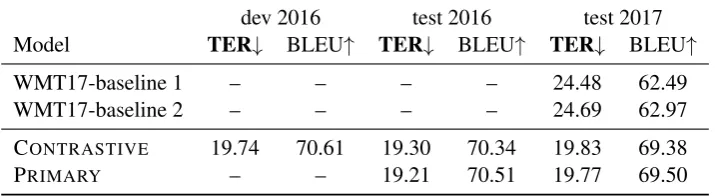
Table 2: Submitted system results
editing data and the respective development and test sets. The training data consists of a small set of 23,000 post-editing triplets (src, mt, pe),
where src is the original English text, mt is
the raw MT output generated by an English-to-German system, andpeis the human post-edited
MT output. The MT system used to produce the raw MT output is unknown, so is the original train-ing data. The task consist of automatically correct-ing the MT output so that it resembles human post-edited data. The main task metric is TER (Snover et al., 2006) – the lower the better – with BLEU (Papineni et al.,2002) as a secondary metric.
Table 1 summarizes the data sets used in this work. To produce our final training data set we oversample the original training data 20 times and add all three artificial data sets (they may overlap). This results in a total of slightly more than 21M training triplets. We keep the development set as a validation set for early stopping and report re-sults on the WMT16 test set. The data is already tokenized, additionally we truecase all files and apply segmentation into BPE subword units. We reuse the subword units distributed with the arti-ficial data set. For the hard-attention models, we create new target training and development files following the procedure from section2.2.
4.2 Training parameters
All models are trained on the same training data. Models with single input encoders take only the raw MT output (mt) as input, double-encoder
models use raw MT output (mt) and the original
source (pe). The training procedures and model
settings are the same whenever possible:
• All embedding vectors consist of 512 units, the RNN states use 1024 units. We choose a vocabulary size of 40,000 for all inputs and outputs. When hard attention models are trained the maximum sentence length is 100
to accommodate the additional step symbols, otherwise 50.
• To avoid overfitting, we use pervasive dropout (Gal,2015) over GRU steps and in-put embeddings, with dropout probabilities 0.2, and over source and target words with probabilities 0.2.
• We use Adam (Kingma and Ba,2014) as our optimizer, with a mini-batch size of 64. All models are trained with Asynchronous SGD (Adam) on three to four GPUs.
• We train all models until convergence (early-stopping with a patience of 10 based on dev-set cross-entropy cost), saving model check-points every 10,000 mini-batches.
• The best eight model checkpoints w.r.t. dev-set cross-entropy of each training run are averaged element-wise (Junczys-Dowmunt et al., 2016) resulting in new single models with generally improved performance. • For the multi-source models we repeat the
mentioned procedure four times with differ-ent randomly initialized weights and random seeds to later form model ensembles.
Training time for one model on four NVIDIA GTX 1080 GPUs or NVIDIA TITAN X (Pascal) GPUs is between two and three days, depending on model complexity.
4.3 Submitted System
im-dev 2016 test 2016
Model TER↓ BLEU↑ TER↓ BLEU↑
WMT16-baseline 1 (Bojar et al.,2016) 25.14 62.92 24.76 62.11
WMT16-baseline 2 (Bojar et al.,2016) – – 24.64 63.47
Junczys-Dowmunt and Grundkiewicz(2016) 21.46 68.94 21.52 67.65
Pal et al.(2017) SYMMETRIC – – 21.07 67.87
[image:6.595.106.494.67.174.2]Pal et al.(2017) RERANKING – – 20.70 69.90
Table 3: Results from the literature for the WMT 2016 APE development and test set
dev 2016 test 2016
Model TER↓ BLEU↑ TER↓ BLEU↑
ENCDEC-ATT 22.01 68.11 22.27 66.90
ENCDEC-HARD 22.72 66.82 22.72 65.86
ENCDEC-HARD+ATT 22.11 67.82 22.10 67.15
ENCDEC-DOUBLE-ATT 20.79 69.28 20.69 68.56
ENCDEC-DOUBLE-ATT×4 20.10 70.24 19.92 69.40
ENCDEC-HARD+DOUBLE-ATT 20.83 69.02 20.87 68.14 ENCDEC-HARD+DOUBLE-ATT×4 20.08 70.05 20.34 68.96 Table 4: Post-submission results, the main task metric is TER (the lower the better)
provement. This one-time looped system is our primary submission PRIMARY.
5 Post-submission analysis
This section is based on the work in Junczys-Dowmunt and Grundkiewicz (2017). After the submission we performed a number of in-depth experiments to verify our intuitions about the se-lected models for a better controlled data setting. We restricted all training, development data to data available during the WMT 2016 shared task on APE and test on test set 2016. We also only used artificial data made available by Junczys-Dowmunt and Grundkiewicz(2016), dicarding the newly created data in this work. To produce our final training data set we oversample the original training data 20 times and add the artificial data sets. This results in a total of slightly more than 5M training triplets. For the hard-attention mod-els, we create new target training and development files following the LCS-based procedure outlined in section2.2.
Table3contains a selection of most relevant re-sults for the WMT16 APE shared task – during the task and afterwards. WMT 2016-baseline 1 is the raw uncorrected mt output, baseline 2 is the results
of a vanilla phrase-based Moses system (Koehn et al., 2007) trained only on the official 12,000 sentences. Junczys-Dowmunt and Grundkiewicz (2016) is the best system at the shared task. Pal et al.(2017) SYMMETRICis the currently best re-ported result on the WMT16 APE test set for a sin-gle neural model (sinsin-gle source), whereasPal et al. (2017) RERANKING– the overall best reported re-sult on the test set – is a system combination ofPal et al.(2017) SYMMETRICwith phrase-based mod-els via n-best list re-ranking.
[image:6.595.107.491.211.361.2]Acknowledgments
This research was funded by the Amazon Aca-demic Research Awards program.
References
Roee Aharoni and Yoav Goldberg. 2016. Sequence to sequence transduction with hard monotonic atten-tion. arXiv preprint arXiv:1611.01487.
Dzmitry Bahdanau, Kyunghyun Cho, and Yoshua Bengio. 2014. Neural machine translation by jointly learning to align and translate. CoRR abs/1409.0473. http://arxiv.org/abs/1409.0473.
Ondˇrej Bojar, Rajen Chatterjee, Christian Feder-mann, Yvette Graham, Barry Haddow, Matthias Huck, Antonio Jimeno Yepes, Philipp Koehn, Varvara Logacheva, Christof Monz, Matteo Negri, Aurelie Neveol, Mariana Neves, Martin Popel, Matt Post, Raphael Rubino, Carolina Scarton, Lucia Specia, Marco Turchi, Karin Verspoor, and Marcos Zampieri. 2016. Findings of the 2016 conference on machine translation. In Proceedings of the First Conference on Ma-chine Translation. Association for Computational Linguistics, Berlin, Germany, pages 131–198. http://www.aclweb.org/anthology/W/W16/W16-2301.
Iacer Calixto, Qun Liu, and Nick Campbell. 2017. Doubly-attentive decoder for multi-modal neu-ral machine translation. CoRR abs/1702.01287. http://arxiv.org/abs/1702.01287.
Kyunghyun Cho, Bart Van Merriënboer, Caglar Gul-cehre, Dzmitry Bahdanau, Fethi Bougares, Hol-ger Schwenk, and Yoshua Bengio. 2014. Learn-ing Phrase Representations UsLearn-ing RNN Encoder-Decoder for Statistical Machine Translation. In Proc. of Empirical Methods in Natural Language Processing.
Yarin Gal. 2015. A Theoretically Grounded Appli-cation of Dropout in Recurrent Neural Networks. ArXiv e-prints.
Daniel S. Hirschberg. 1977. Algorithms for the longest common subsequence problem.J. ACM24(4):664– 675. https://doi.org/10.1145/322033.322044.
Marcin Junczys-Dowmunt, Tomasz Dwojak, and Hieu Hoang. 2016. Is neural machine translation ready for deployment? A case study on 30 transla-tion directransla-tions. arXiv preprint arXiv:1610.01108 http://arxiv.org/abs/1610.01108.
Marcin Junczys-Dowmunt and Roman Grundkiewicz. 2016. Log-linear combinations of monolingual and bilingual neural machine translation models for au-tomatic post-editing. In Proceedings of the First Conference on Machine Translation. pages 751– 758.
Marcin Junczys-Dowmunt and Roman Grund-kiewicz. 2017. An exploration of neural sequence-to-sequence architectures for auto-matic post-editing. CoRR abs/1706.04138. https://arxiv.org/abs/1706.04138.
Diederik P. Kingma and Jimmy Ba. 2014. Adam: A method for stochastic optimization. arXiv preprint arXiv:1412.6980http://arxiv.org/abs/1412.6980. Philipp Koehn, Hieu Hoang, Alexandra Birch, Chris
Callison-Burch, Marcello Federico, Nicola Bertoldi, Brooke Cowan, Wade Shen, Christine Moran, Richard Zens, et al. 2007. Moses: Open source toolkit for statistical machine translation. In Pro-ceedings of the 45th Annual Meeting of the Associa-tion for ComputaAssocia-tional Linguistics. AssociaAssocia-tion for Computational Linguistics, pages 177–180.
Jindrich Libovický and Jindrich Helcl. 2017. At-tention strategies for multi-source sequence-to-sequence learning. CoRR abs/1704.06567. http://arxiv.org/abs/1704.06567.
Jindˇrich Libovický, Jindˇrich Helcl, Marek Tlustý, Ondˇrej Bojar, and Pavel Pecina. 2016. CUNI system for WMT16 automatic post-editing and multimodal translation tasks. In Pro-ceedings of the First Conference on Machine Translation. Association for Computational Linguistics, Berlin, Germany, pages 646–654. http://www.aclweb.org/anthology/W/W16/W16-2361.
Franz Josef Och. 2003. Minimum error rate training in statistical machine translation. InProc. of the An-nual Meeting on Association for Computational Lin-guistics. pages 160–167.
Santanu Pal, Sudip Kumar Naskar, Mihaela Vela, Qun Liu, and Josef van Genabith. 2017. Neural auto-matic post-editing using prior alignment and rerank-ing. InProceedings of the European Chapter of the Association for Computational Linguistics. pages 349–355.
Kishore Papineni, Salim Roukos, Todd Ward, and Wei-Jing Zhu. 2002. BLEU: A method for au-tomatic evaluation of machine translation. In Proceedings of the 40th Annual Meeting on As-sociation for Computational Linguistics. Asso-ciation for Computational Linguistics, Strouds-burg, PA, USA, ACL ’02, pages 311–318. https://doi.org/10.3115/1073083.1073135.
Matthew Snover, Bonnie Dorr, Richard Schwartz, Lin-nea Micciulla, and John Makhoul. 2006. A Study of Translation Edit Rate with Targeted Human Anno-tation. In Proceedings of Association for Machine Translation in the Americas,.