University of Warwick institutional repository: http://go.warwick.ac.uk/wrap
A Thesis Submitted for the Degree of PhD at the University of Warwick
http://go.warwick.ac.uk/wrap/66299
This thesis is made available online and is protected by original copyright. Please scroll down to view the document itself.
Oligopoly Models and Information Transmission.
by
Morten Hviid
Thesis submitted for the degree of
Doctor of Philosophy
to the
UNIVERSITY OF WARWICK
Department of Economics
Contents
Table of contents List of tables List of figures Acknowledgements Declaration Summary I II INTRODUCTION
RISK-AVERSE DUOPOLISTS AND VOLUNTARY INFORMATION TRANSMISSION
1 Introduction.
2. The model.
3. Information sharing.
3.1 Both share information.
3.2 Unilateral sharing.
4. Concluding remarks.
Footnotes.
Appendix II.A.
III STACKELBERG LEADING CARTEL AND DIFFERENTIAL INFORMATION
1; Introduction.
2. Certainty.
2.1 An equivalent solution concept.
3. Cartel equilibrium under differential information.
4. Full information transmission from cartel to fringe.
5. Different information structures.
6. Related litterature.
IV
V
-ii-7. Concluding remarks.
Footnotes.
Appendix III.A.
A TWO STAGE DUOPOLY MODEL WITH UNCERTAINTY
1. Introduction.
2. The model.
3. Realisation known after stage 2.
3.1 The pricing subgame.
3.2 The capacity subgame.
4. Realisation known after stage 1.
5. Uniform distributed random variables.
6. Concluding remarks.
Footnotes.
Appendix IV.A.
PRIVATE INFORMATION IN A TWO STAGE DUOPOLY MODEL
1. Introduction.
2. The model.
3. The solution to the model.
3.1 The pricing stage.
3.2 A Stackelberg" type equilibrium.
3.3 The capacity stage.
4. Asymmetric information.
4.1 An analytical example.
4.2 Numerical examples.
4.3 Another example.
5. Concluding remarks.
Footnotes.
Appendix V.A.
VI CONSISTENT CONJECTURES WITH INFORMATION
TRANSMISSION (with Norman
J.
Ireland)' 1551. Introduction. 156
2. Consistent conjectures in an equilibrium
with information transmission. 161
3. Results. 110
4. Conclusion. 186
Footnotes. 188
VI GENERAL CONCLUSIONS 190
11.1 11.2 11.3 IV.! V.1 V.2 V.3 V.4 11.1 IV.l IV.2 IV.3 V.l V.2 V.3 VL1 VL2 VL3 VL4
-iv-LIST OF TABLES
Profits of firm i when both share information.
Profits of the transmitting fir~ from unilateral information sharing.
Profits of the recieving firm.
LIST OF FIGURES
ACKNOWLEDGEMENTS
My greatest dept is to my thesis supervisors Reader Norman
J.
Ireland and Professor Kevin Roberts and my supervisor at University of Copenhagen Professor Birgit Grodal. Theirdiscussions. comments guidance and general encouragement has been invaluable.
One or more of the chapters have benefitted from the valuable comments made by Torben Andersen. Huw Dixon. Clive Fraser. Geoff Frewer. Paul Geroski • Peter Skot. Henrik Vetter. Bente Villadsen. Xavier Vives and Paul Weller.
An earlier version of chapter IV and in parts chapter V has been presented at the Econometric Society Winter Symposium. Sandbjerg and at workshops at University of Copenhagen and Warwick. An earlier version of chapter VI has been presented at the 1986 Conference of the European Association for
Research in Industrial Economics. Berlin and in seminars in the Universities of Aarhus. Copenhagen and Warwick (by me) and University of Sheffield and Birkbeck Collede. London (by Norman
J.
Ireland). Comments and suggestions fromparticipants are greatefully acknowledged.
The study was made possible by a fellowship at University of Copenhagen. Denmark. and I am gratefull for both their
financial and the intellectual support.
-vi-Declaration
Summary
The thesis contains 5 independent papers togeth~r with an introduction and a general conclusion. All five papers
consider private information in simple oligopoly models with linear demand and cost functions. The problem to be analysed is the extend to which private information is transmitted between firms and the concequences thereof. In principle the
transmission (or dissemination) can take place voluntarily or involuntarily. In the case of voluntary information
transmission (or sharing) we assume that this is done honestly. One of the main results in this strand of the
literature is that firms have no incentives to share information unless they _can collude over strategies. In chapter II and III we show that this conclusion is not generally true.
In chapter II we consider the incentive- for' risk-averse firms to share their private information. We show that the
assumption of risk-aversion in some cases reverse the conclusion in the literature. In chapter III we show that there are cases in which private information and the sharing thereof within a collusive arrangement prove detrimental to the size of a stable collusive arrangement. Thus in some cases private information imply a disincentive to collude.
Chapter IV and V looks at the effect of uncertainty and private information on a two-~tage duopoly model in which firms first choose capacity. then compete over prices. In chapter IV we show that no pure strategy equilibrium exists regardless of whether uncertainty is resolved before or after capacity is chosen. A mixed strategy equilibrium is shown to exist. and the equilibrium is worked out for a specific
distribution of the random varia,.ble. In chapter V we modify the equilibrium concept by i~posing a
no-mill-price-undercutting rule. We shown that if firms' capacities differ. the firm with the highest capacity endogeneously sets the higher price. Examples of private-asymmetric information are considered and the main finding _f~om the examples are that
there are cases where neither firm wants to share the information of the best informed:
Chapter VI which is joint- work with Norman
J.
Ireland considers involuntary information transmission via output plans. This allows us to rationalise positive consistent conjectures in a simple oligopoly model.
-1-CHAPTER
I
The introduction of uncertainty into models of industrial
organisation is becomming more and more widespread. no doubt
due to its obvious relevance. Not only are firms subject to
an uncertain environment. They base their decisions in part
on information which is private or particular to that firm.
Firms may know their own local demand. local wages. their own
technology better that they know that of their competitors.
The effect of private information has been analysed
extensively in models with many agents. see Grossman(1981)
for an overview. The analysis of cases where firms are few
has only recently been undertaken. no doubt facilitated by
the more and more readily available techniques for solving
these models under various informational assumptions. In this
respect. the emergence of the Rational Expectations solution
techniques has been important. In deterministic models of
imperfect competition we normally assume that firms take into
consideration the reactions of other firms when choosing
their own strategy. Under uncertainty. and especially when
firms have private information. the assumption that firms use
their information consistently when forming expectations is
natural.
What makes the oligopoly models difficult to solve when firms
have private information is that a firm must have a
conjecture about both how the other firms react to its
strategies and how they react to their own private
-3-learning. (e.g. Cyert and DeGroot(1974). Kirman(1975.1983) ).
where firms are uncertain about their residual demand
function. Their private information is the historical data on
their own output level and price. The main result from their
models is that. if firms start out with a misspecified model
of their residual demand they may never learn the true model.
but they may converge to a self-fulfilling belief which
differs from the true model.
Other oligopoly models with uncertainty have been analysed by
Basar and Ho(1974). Levine and Ponssard(1979). Ponssard(1979)
and Sakai(1984.1985).
In a duopoly model with linear demand, having random
intercept, Basar and Ho(1974) shows the existence and
uniqueness of affine equilibrium strategies when firms
observe a linear signal on a random variable. Levine and
Ponssard(1979) considers the value of information in
two-player zero-sum games. They show that information has a value
to the player. Ponssard(1979) considers a n-firm oligopoly
model where firms producing a homogeneous good are faced with
a linear inverse demand curve with random intercept. There
are two types of firms, informed and uninformed. A
Cournot-Nash equilibrium is shown to exist with expected profits of
the informed being an increasing function of the number of
informed firms. Information is showed to have a positive
value. Sakai(1985) considers a simple duopoly model to
evaluate information in the case where cost functions are
its own costs. the costs of its opponent. the costs of both
or nothing at all. Firms are assumed risk-neutral Cournot
players. Whether or not information has a value depends on
the size of the variance of costs and their correlation. If
costs are positively correlated more information may be
harmfull to the firms. Sakai(1984) considers a model like the
above. only now one of the players is assumed to be a
Stackelberg leader. Again information is shown to have a
value. In deriving the results. it is assumed that the
follower does not learn the information of the leader. This
should be kept in mind when interpreting the results.
Private information may get disseminated via firm behaviour.
This has been considered within models of competition where
dissemination typically takes place via the price system (for
a survey of dissemination of information in competitive
financial markets. see Andersen(1985». Dissemination of
information is more likely to take place in industries with
few firms because these firms exercise a greater influence on
each other and hence have a greater incentive to monitor each
others actions.
It is this aspect of oligopoly models with uncertainty which
is considered in this thesis. i.e. the extend to which
private information is transmitted between firms in
industries where the number of firms is small. Private
information can in principle be transmitted in two ways.
-5-By voluntary information transmission we understand
situations where one firm, either directly or through a third
party transmit all or part of its information to another
firm. It is assumed throughout that the information
transmitted this way should be true. One possible
interpretation is that firms submit their information to a
third party - an auditor - who discards all untrue
information, or who can punish a lying firm sufficiently hard
to ensure truth-telling. The models which have sofar been
analysed in the literature, and the models which will be
analysed in the following are all essentially one-period
models (as goods are only traded once, the two-stage models
in chapters IV and V can be seen as covering only one, albeit
long, period in time). These models are not well suited to
analyse deceptive information transmission because all firms
have an incentive to overstate bad news and understate good
news. Hence they will never be believed or the extend of
deception can be unravelled by the others. We are thus not
concerned with information as a mean to decieve others.
Rather we try to see to what extend truthfull information is
beneficial. Another argument in favour of doing this is that,
if information transmission was beneficial conditional on the
information being true, then surely these firms would set up
a body or an institution to ensure this. Further, often such
third parties do exists (e.g. trade associations and
statistical offices). Hence what may seem as involuntary
information transmission may be a way of implementing
truthful information transmission, necessary because,
the first place, truthtelling cannot be insured. Some of the
services of the statistical office could possibly be
interpreted in this way.
One might ask why a firm would want to share its private
information with its competitors. Firstly it allows firms to
follow demand more closely as well as allowing for more
efficient production. Secondly, it may facilitate informal
collusive arrangements as these become easier to monitor. One
might expect that information transmission is more likely to
be preferred if the private information is about demand
factors (at times referred to as public variables, as they
affect all firms directly) exactly because this directly
enables firms to follow demand more closely and to choose a
more efficient production process. On the other hand firms
may be less willing if the private information is about some
aspect of the firms cost or technology (often referred to as
private variables as they only affect others indirectly),
because firms might give away information which would put
them at a strong disadvantage in e.g. price wars. A repor~ by
the Danish monopoly authorities has more than once been
suppressed at the wish of the firms in question, because it
contained too detailed information on technology and
cost-structures in an industry.
As it turns out the results in the literature differs
markedly from this. A series of papers: Clarke{1983a,b),
Gal-Or{1985a,1986), Li(1986), Novshek and Sonnenshein(1982) and
-7-information. The standard assumptions of these models, which
will also to a large extend be made use of in the thesis,
are: (a) Linear demand function. (b) Constant marginal costs.
(c) Either random demand intercept or random marginal costs
about which each firm recieve a signal. (d) The expectations
of the random variable conditional on the signal is linear in
the signal. (e) The decision to share is made before
recieving the signal and firms can commit themselves to share
honestly.
In a model with normal distributed random intercept and
normal distributed signals, Novshek and Sonnenshein(1982)
found that firms were indifferent between sharing all their
information and no sharing at all. They consider fulfilled
expectations (Bayesian-Nash) equilibrium. Clarke(1983a)
showed that the result hinged on the strong equilibrium
concept which required that firms ex-ante market expectations
were realised ex-post. Clarke(1983a) and the papers which
followed used the less restrictive Bayesian-Nash (or rational
expectations) equilibrium which only requires that decisions
are based on best Bayes estimates of the other firms
information. Clarke(1983a) found that firms in general had no
incentives to share information. Clarke(1983b) generalised
this to a n-firm oligopoly model and showed that there is
never a mutual incentive for all firms in the industry to
share their information unless they may cooperate on their
strategy choice once information has been shared. Vives(1984)
generalised the model to the case of symmetric differentiated
conventional case of competitive goods, if firms were price
setters then firms have an incentive to share information.
Gal-Or(1985) generalised Clarke(1983b) to the case where
signals may be correlated and firms are allowed partial
revelation of their information. Still firms have no
incentives to share information. Finally Li(1986) generalised
the results to allow for all distributions for which the
posterior expectation is linear in the recieved signal.
In a Cournot model with random marginal costs and a perfect
signal on own costs, Okada(1982) showed that each firm would
choose to reveal its private cost information to its rival.
Gal-Or(1986) extended this to allow noisy signals and partial
revelation and showed that firms have an incentive to share
information if goods are substitutes and firms quantity
setters, or if goods are complements and firms price setter •.
Thus Gal-Or reverse the results found in Vives(1984).
Shapiro(1986) generalised the model to an-firm Cournot
oligopoly and cases of asymmetry across firms. Shapiro also
explicitly modelled the incentives of firms to join a trade
association that exchanged cost information. Li(1986)
extended Shapiro(1986) by showing that perfect revelation is
the unique equilibrium.
Finally Harris and Lewis(1982) consider a two-stage duopoly
model where firms first choose investment and then output
level. A priori firms are uncertain about the intercept in a
common linear demand function. Prior to choosing investment
-9-variable. Prior to choosing output. the realisation of the
random variable is made known to both. They show the
existence and uniqueness of a pure strategy equilibrium.
Among other they find that firms may not be better off by
observing a more precise signal and that firms prefer the
signal to be a bit noisy. Further. if the signals are
positively correlated. then more precise signals are
preferred. the reverse is true when signals are negatively
correlated. This also implies that the incentive to share
information diminishes as the correlation between signals
decrease and become negative.
The thesis contains five major chapters together with this
introduction and a short conclusion. In chapter II we show
that the results that there are no incentives for sharing
demand information may be reversed if firms are risk-averse
because in that case information sharing benefits firms as it
reduces the variance of the random variables. Assuming that
firms have constant absolute risk aversion. we identify cases
where firms prefer to share information. This result does not
necessarily require that the firms are very risk averse. i.e.
that their utility function is very concave. This indicates
that the results in the literature may hinge on the
functional forms. Further in a working paper Nalebuff and
Zeckhauser(1986) show that the results also hinges on the
assumed information structure. All in all this implies that
the results should be interpreted with care.
share information if they can coordinate their strategy
choice. To shed some light on this we consider a model with
endogeneous cartel formation. We identify cases where private
information caused a disincentive to cartel formation. These
cases were those where the cartel cannot avoid disseminating
most of the shared information to firms not in the cartel.
The main implication of this is that information sharing may
be detrimental to collusive arrangements and we cannot be
sure that information sharing leads to a greater degree of
collusion.
In chapter IV and V we consider a two-stage model in which
firms first choose capacity. then prices. In this model both
voluntary and involuntary information transmission is
possible because the strategy choice in the first stage may
contain information. Chapter IV contains the analysis of a
two stage model under uncertainty. It is shown that no pure
strategy equilibrium exists. A mixed strategy exists. and
this is worked out for a specific distribution of the random
variable.
Chapter V invokes a more sophisticated conjecture on behalf
of the firms which ensures that a pure strategy equilibrium
exists. In.solving this model.we show that if capacity is
exogeneously given. an '-.dogeneous Stackelberg leader exist.
We consider asymmetric information and show that the best
informed do-not. in general want to share its information with
the worse informed. But more surprising .there are cases where
-11-other firm. It seems to be the case that both firms prefer
both to be totally ignorant in the first stage because this
biases the capacities downwards, and totally informed in the
second stage as this ensures an efficient choice of prices.
The transmission of information involuntarily is interesting
as firms do use resources on monitoring competitors, and
resources are spent on industrial espionage. We therefore
attempt to model situations where firms via their plans
transmit part or all of their information. In a joint paper
with Norman
J.
Ireland, chapter VI, we show that if firms canlearn each others output plans, we can rationalise positive
consistent conjectures even in a simple model. This result
comes about because a production plan carries two messages.
Firstly how much the firm plans to produce and secondly how
the firm views the strength of the market demand. Hence a
firm may be so heartened by an expansive plans of the other
firms that it itself increase its actual output.
In. summary, we have shown that private information and the
transmission thereof can have very marked effects on the
results of even simple duopoly and oligopoly models. A major
problem in these models is the difficulty in solving even the
most simple cases. Even more troublesome is the fact that
changes in functional forms, information sets or stochastic
formulations may have quite dramatic effects on the results.
This is borne out by even a small degree of risk aversion
reversing the results in the literature. This would seem to
empirical matter. Whereas this is to a large extend true, the
models analysed in this thesis point to some severe problems
with empirical analysis. This we shall return to in chapter
-13-CHAPTER II
Risk-Averse Duopolists and Voluntary
1. Introduction.
In the literature it is by now well established that Cournot
duopolists producing a homogeneous good do not wish to share
information about a random element in demand if they are
constrained to acting non-cooperatively. see e.g.
Clarke{1983a.b}. Gal-Or{1985a}. Li(1985} and Vives{1984}.
Clarke{1983b} concludes:
"If all industry firms are observed to pool
information without paying each other compensation. they must be setting quantities cooperatively on the basis of the homogenized information. Hence information-pooling mechanisms like trade
associations can be considered prima facie evidence that firms are illegally cooperating to restrict output". (Clarke. 1983b. p.392. his italics}
This seems a very strong conclusion to draw from a very simple
model. One of the simplifying assumptions of the previous
models is that firms are risk-neutral. Hence firms do not gain
explicitly from the reduced variance in the conditional
expectations of the random variable after information has been
shared. By introducing risk aversion the conclusion may be
reversed.
we consider a simple model of two firms producing a homogeneous
good and facing a demand curve having a random intercept. Firms
are assumep.to choose their output level to maximise expected
utility of profits. Fo~ simplicity. we assume that firms have
constant absolute risk aversion. Prior to choosing output each
-15-is common knowledge. It -15-is the information contained in th-15-is
signal which firms may share.
In solving the model, we will be looking for Bayesian-Nash (or
rational expectations) equilibria. The problem is that, when
firms have private information, firms must form expectations
(or conjectures) about how other firms react to their own
private information. In the literature it is commonplace to
require that e~pect~tions are rational in the sense that they
are not rejected ex post. In the context of voluntary
infbT~ation sharing, firms cannot evaluate the effects of
sharing if they have no expectations as to how the other firms
react to the new information. The requirement of rational (or
consistent) expectations is naturally extreme, but there seem
at present no serious alternative.
By way of solving the model, we also consider the effect of
uncertainty and private information on risk-averse duopolists.
The setup allows us to consider two special cases. The case
where firms observes a perfect signal corresponds to the case
where firms are informed about the realisation of the
stochastic parameter prior to choosing output. The case where
firms ~b~~rves a useless sign~l corresponds to the case where
firms receives no information on the realisation until after
their output choice.
The chapter is o!ganised as follows. In section 2 we set up and
solve the model. In section 3 we consider the incentives for
considered. In the first, section 3.1, a firm cannot obtain the
information of the other firm unless i t submits its own
information. The question asked is whether it is in the common
interest of the firms to share information. In the second case,
section 3.2, we consider unilatteral information sharing,
establishing whether it is in the private interest of a firm to
share its information with the other firm. An affirmative
answer in the second case naturally constitutes a stronger
result than in the ~irs~ case. Note, though, that if firms have
a public but not private incentive to share information, there
must be incentives to set up an institution or a third party,
which can enforce that both firms share their information.
-11-2. The model.
Consider the following duopoly model with imperfect
information. Demand is given by:
- 2
a - N(a,a ). a
where q~ is output of firm i. a can be interpreted as the
1
(1)
firms' prior estimate o~ a. ,Costs are assumed constant per unit
and subsumed in a. Assume that firms are risk averse and assume
that they maximise expected utility of profits given their
information. We choose the simplest form of utility function.
If firms have constant absolute risk aversion, this corresponds
to firms maximising:
i=l,2 (2)
with respect to qi' where Ii is the information set of firm i,
and a is a positive constant, the Arrow-Pratt measure of the
degree of absolute risk aversion, for simplicity and symmetry
assumed identical for both firms.
First order conditions associated with this are:
i=I.2 (4)
In accordance with the literature on information sharing.
assume that firm i observes a private signal on a prior to
choosing its output level. The signals of the firms are
uncorrelated and are both unbiased estimators of a. They are
given by
i=I.2 (5)
2
where ~i ~ N(O.a~} and COV(~I'~2}=O. These signals could be
interpreted as private forecasts. As a and ~i are both normal.
the distribution of a conditional on the signal is normal and
given by:l}
(6)
where
2
a
t = 2 a 2
a + a
{7}
a ~
Note that t is a measure of the precision {or quality} of the
private infor~ation. The closer is t to 1. the more precise is
the signal. The information set of firm i when no information
-19-(8)
As a is assumed normal. variances and covariances are
independent of the realisations of the stochastic variables.
The actual observation of Si does not alter the variance of a.
The variance is affected by the knowledge that a signal of the
form (5) will be observed. Hence. from (8). qi is a linear
function of the conditional expectations of a and qj. This
makes the conjecture that a firm·s choice of output is linear
in its signal reasonable.2) Specifically. assume that firm i
expects firm j·s output to depend linearly on its information
in the following way:
c
o
-a + c -(S-a)
1 jwhere
Co
and cl are positive constants whos value is to bedetermined below. Using" (9) we find:
Using
(6). (9)-(l2).
we can write(4)
as{l-cO)-a
qi =
2
+ a-[l
+2
C1
1
2- - - 2-c -{l-t)-u
t 1 a
(9)
(lO)
(II)
(l2)
In a Bayesian-Nash (rational expectations) equilibrium, the
expected response (9) and the actual response (13) must
coincide. This implies: .
1 - c
0-(14)
Co = 2
a- [1_+ 2 +
c 1
2-c
]-(1-t)-02
t 1 - a
(1 - c1)-t c
1 = 2 (15)
2 + a- [1 + c
1 - 2
~
c ]- ( 1- t) _~2
t 1 a
Lemma 1. For CO>O, C
1>O, there exists an unique pair cO,c1
~olving (14) and (15). Further
Proof:
Rewrite (14) and (15) as:
t + (l-t)-c
1
(16)
This implies that cO~c1 with equal~ty for t=l. Further, for any
c
1' there exists an unique cO.
To find c
1, use (15) to define:
(17)
This is a third-order polynomial having at most three roots. We
can put restrictions on c
-21-Otherwise from (9) an increase in expected demand leads to a
reduction in output. The first term in (17) is non-negative because t~l. Hence the last two terms must be non-positive
implying:
t
2+t
As
Co
is increasing in c1 this also implieswhich gives us the second part of the lemma, and puts bound on
the possible values of c
1. To show the first part, we note that
Thus
must
range
fee)
=
t<
0fee}
>
0for
show
of
8f 8c1
some 0 ~
that f(
c1 · From c
1 ~
} is
(17):
for c1
=
0t
f( 2t ,
t
=
2+t) =
monotone in
F or 0 / ~ c / t we have 8f
>
01 ~ ---2 +t ~. uC
1
O. To show uniqueness, we
c
1 over the permissible
,
Hence there exists ~n unique equilibrium v~lue of c
1 lying
t
between 0 and 2+t. Further, from.(16) there exists a unique cO.
Thus we have proven the existence of an equilibrium in our
model. Further, using (14) and (15) and implicit function'
theorem, we can show that
dCl
( I t ~O (18)
Recall that t is a measure of the quality of the private
information. Thus (16) implies that equilibrium firm output as
given by (9) is increasing in the precision of th~ pri~ate
information. Conversely, one can show that
8c O
~ 0
8c l ~
0 (19)
aa-
8a8cO ~ 0
8c 1
~ 0 (20)
802 a 802 a
Thus the more risk-averse, or the higher the variance, the
lower is equilibrium output.
The result in (16) suggests that profits may be decreasing in t
because we have two counterbalancing effects. Better
information increases output which depresses profits. but it
also decrease the viriance of profits which increases the
expected utility of profits. The effect of a change in the
degree of risk-aversion would tend to be opposite of the
effects from a change in't because an increase in a leads to a
fall in output and hence an increase in expected profits. On
the other hand, firms become increasingly worried about the
2
variance of profits. The effects from a change in 0 are harder
-23-to assess as these also leads -23-to changes in t which again
affects Co and c
1' Hence we can not get clear comparative static results on the effect on expected utility of profits
2
from changes in t, a and a .
a
Although we cannot get explicit expressions for Co and c1' we
can, use (9) to write expected utility of profits as:
aUa c1 2 2 . 2 2 -2
2 [ [
- ----2 ---(S-c -c +4-c -2-c t 0 1 0 0' 1 c +e -2-C)+C -2-c -c 1 0 0 0 1
]-a
2
c
1 [2
]
--- c -6-c t I l +1 (21)
Before turning to information transmission. we consider three
special cases of (21): t=O. t=1 and a=O.
If the information received is usel~ss.· i.e. U ~ ~ and t=O. E.
1
---=2 and c
1 = O. The expected 3 + a-a
then from (14) and (15). Co
=
a
utility of profits is:
(22)
If the information received is perfect. then t=l and c
O=c1=&.
(22) and (23) are interesting when one recalls the debate in
the literature on price variation in a competitive model. An
early result by Oi(1961) showed that firms preferred greater
variance 'in price if the realisation of the price was known
prior to their output choice. This corresponds to the first
case above. equation (22). Later Sandmo(1971) and Ishii(1977)
showed that if the realisation was known only after outpu~ was
choosen. corresponding to equation (23). firms preferred less
variation in the price. Here we get less cl~ar results. From
(20). we see that if a is large (a~2 sufficient) we get the
same result as Oi(1961). The results on (23) are ambiguous.
Thus with few firms acting strategically. we cannot reproduce
the results from the competitive literature.
The final special case. which will be used in section 3 as a
bench-mark. is risk neutrality. a=O. From (14) and (15) we get
and c 1 = 2+t. Profits become: t
(24)
-25-3. Information sharing.
We consider two sharing systems. In both cases we assume that
the information is transmitted via a third party, an auditor
who can determine whether or not the information is true. This
ensures truth-telling and allows us to disregard problems of
strategic misinformation. As we consider only one-shot (or
atemporal) games, the model is not suitable for analysing cases
where firms deliberately misinform. It is easy to see that in a.
one-shot game where truth-telling is not required, both will
claim that demand is low. When demand is actually low, both
want to avoid over-production. When demand is high, both want
the other to leave it a larger share of the market.
It is worth mentioning that such third parties actually exists.
Trade associations can collect data from firms and. to the
extend that the realisation can be observed ex post, punish any
firm found lying (e.g. by banishing the firm from
the-association). Another institution is statistical offices. These
offices sometimes relies on firms reports in order to produce
their statistics faster than could be done by using infbrmation
from e.g. the excise office. Firms are sometimes given an
incentive to report their date by being given a sneakpreviev
of the data (compare with the second case below). Given that
the problem is verification, it is further concievable.that an
actual independent auditpr is used. The basic point is that if
firms have an incentiv to sh.re if they dQ so truthfully, then
will be set up.
In the first case analysed, firms only get access to the
information of the other firm if it itself submits its
information. Hence the two situations to compare is "no
sharing" with "both sharing". In the second case, a firm get
the information recieved by the auditor regardless of whether
it has submitted any information. In this case we consider the
model as a two stage game, where firms in the first stage
decides whether or not to submit its information to the
auditor. Under risk neutrality, no information transmission
takes place in either case. If firms are risk averse we shall
see below that this is no longer generally true.
3.1 Both share information.
If firms share their information, their information set become
i=1,2
We can construct a composite signal S summarising the
information of the two signals as follows:
S
=
a +VAR(S)
1
-.~
2 1
1 + -.~
2 2
2 1 2
=
u a + -·u 2 ~The general formulas are given in appendix II.A. When both
share the information, t is redefined as
(25)
(26)
t = 2-t l+t
>
t
-27-(28)
As above we can calculate the expected utility of profits. The
difference from (23) is not only that t is redefined. but more
importantly that the output of. the two firms are closer
correlated.
'" '" -2 '" [ 2 "') 2 c -(1-2-c )-a + c - 1 - --c - 0
o
0 1 ~ 1 a'" "'3 2-t 4-c1
--",-t
'" '"
where
Co
and c1 are evaluated at eqUilibrium.(29)
Let us first look at the special case of risk-neutrality; a=O:
"'.
=
1/3 c1 = --", t 2+tUsing {28} we find comparing {24} and {30}:
So even if they both share their information. information
sharing is sub-optimal under risk-neutrality.
(30)
For a
>
0, we no longer have an unambiguous result, so we turnto some numerical examples. We are looking for combinations of
t, a, a and a! such that information sharing is preferred by
the two firms.
Generally we would like to have risk sharing preferred for as
small an a as possible because the smaller is a the closer we
are to the case of risk neutrality. Interest then centres on a
and a 2 . Given the assumed normal distribution, we can place a
some restrictions on these, loosely speaking the latter must be
small relative to the former to avoid negative realisations of
demand. In order to make the probability of observing a
negative realisation of the demand intercept small, we choose a
2
large relative to a . Now:
a
Prob{a<O} < .05
Prob{a<O} < .01
Prob{a<O} < .001
-2 . a
"2
>
2.27aa
-2 a
"2
>
5.43 a a-2 a
"2
>
9.55aa
For expositional purposes, choose a .
=
A/a2a , where A is somePositive constant. This implies that a-a2 a becomes constant.
. . 2
Then, given A (=a-aa) and t, we can find
Co
and c1 and. express
-2 2
expected utility of profits as a linear function of a and a . a
Also, letting P and S denotes private information and sharing
respectively, we can write expected utility of profits given by
-29-E(U(I1~}}
(32)E(U(I1~»
(33)where fi and
C
i • i=s.p are constants. Using equation (32) and
-2 2
(33) we can find the combination of a and a a for which firm i
-2 2
is indifferent between sharing and not sharing. a = A-a • a
-2 2
where A is given by A =
(C -C
p s s p )/(f -f ). Thus any a 10 a<
Aimplies that firm i have an incentive to share its information
with firm j.
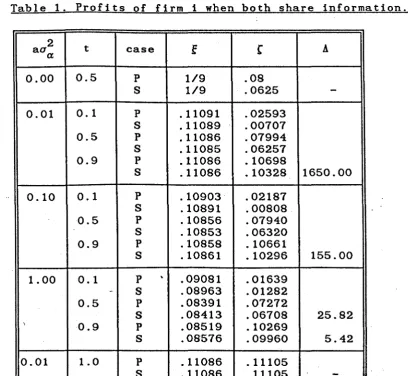
Below in table 1 we have worked through some numerical
examples. with A given if relevant.
Table 1. Profits of firm i when both share information.
2 t
f
C
Aao case
a
0.00 0.5 P 1/9 .08
S 1/9 .0625
-0.01 0.1 P .11091 .02593
S .11089 .00707
0.5 P .11086 .07994
S .11085 .06257
0.9 P .11086 .10698
S .11086 .10328 1650.00
0.10 0.1 P .10903 .02187
S .10891 .00808
0.5 P .10856 .07940
S .10853 .06320
0.9 P .10858 .10661
S .10861 .10296 155.00
1.00 0.1 P , .09081 .01639
- S .08963 .01282
0.5 P .08391 .07272
S .08413 .06708 25.82
\
0.9 P .08519 .10269
S .08576 .09960 5.42
0.01 1.0 P .11086 .11105
S .11086 .11105
[image:38.509.58.466.412.788.2]2
-From table 1 note that if t=0.9, a=0.01, a =1 and a ) 41 a
information sharing is preferred. Thus it is possible to
reverse the result obtained under risk-neutrality even with a
low absolute degree of risk aversion provided that
a
is2
sufficiently greater than a . Note further that the higher is
a
a, the more readily do we get information sharing.
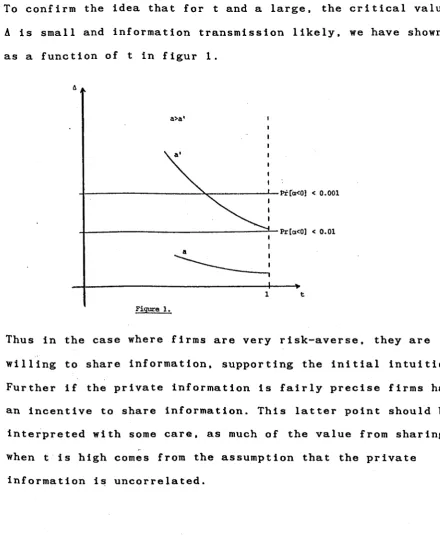
To confirm the idea that for t and a large, the critical value
A is small and information transmission likely, we have shown A
as a function of t in figur 1.
a>a'
+---~---L-t>i'ra<O] < 0.001
+ - - - " ' , - p r [ a < O ] < 0.01
,
~
1 t
Figure 1.
Thus in the case where firms are very risk-averse, they are
willing to share information, supporting the initial intuition.
Further if the private information is fairly precise firms have
an incentive to share information. This latter point should be
inteipreted with some care, as much of the value from sharing
..
When t is high comes from the assumption that the private
[image:39.502.28.469.250.787.2]
-31-3.2 Unilateral sharing.
In this case a firm recieve the pooled information from the
auditor indepenent of whether or not it has itself transmitted
any information. We then have to consider the incentives to
unilaterally transmit their information. Assume that only firm
i transmit its information. The information sets then become:
The problem becomes less tractable because we have to look at
asymmetric solutions to (14) and (15). Given that a solution
exists we can write down expected utility of profits of the
firm transmitting its information unilaterally as:
1 2 [ [ 2 2 1 2 2 1
- --a-a - c -c - - + (1-2-c -c ) -c - - +
, 2 a Oi 1j tj Oi OJ 1i ti
- 3 2-t i 2 2
- c - 2 - - - - c -c --- +
where c
Oi ' cOj ' cli and clj are evaluated at equilibrium.
Let us first consider risk-neutrality .
1 -2
=
g·a
• { 2
ti 2/tj } 2 + - · 0
{4-t t}2 a i j
{35}
Now ti=t and t j =2t/{1+t}. Comparing (35) with (24) we see that sharing is not profitable for firm i, hence in combination with
{29} we have the well known result that under risk-neutrality,
is a dominating strategy not to share information.
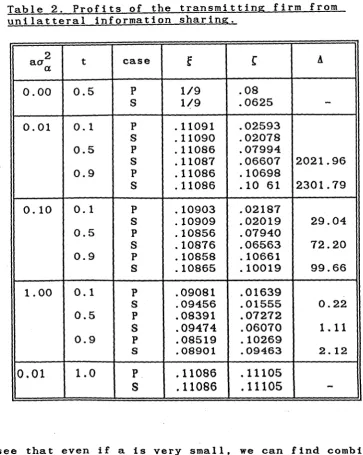
Turning to a
>
0, we work through the same numerical examplesas presented in table 1. The results are presented in table 2
-33-Table 2. Profits of the transmitting firm from unilatteral information sharing.
2 t case
f
r
Aaa
a
0.00 0.5 P 1/9 .08
S 1/9 .0625
-0.01 0.1 P .11091 .02593
S .11090 .02078
0.5 P .11086 .07994
S .11087 .06607 2021.96
0.9 P .11086 .10698
S .11086 .10 61 2301.79
0.10 0.1 P .10903 .02187
S .10909 .02019 29.04
0.5 P .10856 .07940
S .10876 .06563 72.20
0.9 P .10858 .10661
S .10865 .10019 99.66
1.00 0.1 P .09081 .01639
S .09456 .01555 0.22
0.5 P .08391 .07272
S .09474 .06070 1. 11
0.9 P .08519 .10269
s
.08901 .09463 2.120.01 1.0 P .11086 .11105
S
.110S6 .11105-We see that even if a is very small. we can find combinations
of
a
anda
2
such that unilatteral information sharing is apreferred by the transmitting firm. Further the critical value
of A,to the transmitting firm seems to be increasing in a for
fixed
a:
and t. and decreasing in t. Note that the picture hereis reversed in the case of varying t. This is naturally caused
by the fact that if you are the only firm transmitting. then
,
the concequence is .small when your information is imprecise.
You are not giving so much away.
[image:42.517.72.436.74.530.2]information once it has recieved the information of firm i. The
numerical examples are presented in table 3 below, where the
case 1S denotes only firm i sharing and 2S denotes both
sharing.
Table 3. Profits of the recieving firm.
2 t
f
r
Aaa case
a
0.00 0.5 1S 1/9 .08
2S 1/9 .06612
-0.01 O. 1 1S .110893 .04127
2S .110892 .00707
0.5 1S .110845 .11153
2S .110855 .06257 5264.34
0.9 1S .110858 .11569
2S .110862 .10328 3877.25
0.10 0.1 1S .10902 .04013
2S .10891 .00808
0.5 1S .10853 .11115
2S .10853 .06320
0.9 1S . 10859 .11540
2S .10861 .10296 615.83
1.00 O. 1 1S .09539 .03084
2S .08963 .01282
0.5 1S .09245 .10519
2S .08413 .06704
0.9 1S .08669 .11247
2S .08576 .09960
0.01 1.0 1S .11086 .11105
2S .11086 .11105
-Here we see that in all but a.few cases (e.g. a=0.1, t=0.9,
a!=1
anda=26)
firm j would not prefer to submit itsinformation once it has got the information of firm i. Thus
transmission is only in some, possibly few, cases a dominant
[image:43.522.53.469.71.700.2]
-35-without having to submit its own information (but such cases do
exist. e.g. t=.9 and A=.Ol). This implies a potential need for
a coordination devise because of the cases where both firms
would benefit from sharing if only they could commit to both
submitting the information. The coordination could be supplied
by the auditor by simply requiring that a firm to obtain some
4. Concluding remarks
Two things have been shown in this paper. Firstly. we found
that the output level of risk averse Cournot duopolists was
increasing in the quality of their private information and
decreasing in their perception of risk. The effect on profits
was less clear. but from the numerical results in table 1 - 3.
it seems that expected utility of profits are decreasing in the
degree of absolute risk aversion.
Secondly. we have shown that once one allows for risk-aversion.
it is no longer generally true that duopolists do not want to
share information. This was shown using numerical examples. and
is yet another example of the non-robustness of results derived
in models analysing the effect of private information.
We also found cases where firms had an incentive to share their
information. but where this would require that they could only
obtain the shared information if they submitted their own. As
argued above. this need not be restrictive and can tentatively
be used to explain some institutional arrangements. as well as
the practise of some institutions ..
Besides having to resort to numerical examples. the paper makes
a number of heroic assumptions regarding both the specification
of the utility function anq the distributions of the stochastic
variables. Firstly. the aim was to provide examples where the
-37-are sufficient. Secondly. we did not need the utility functions
to be very' concave to get the result. so we would expect the
results to hold for other functions as well. Thirdly. we could
have used other distributions. The important thing is the
linear update rule (6). As shown in Ericson(1969}. see also
Li(19S6}. this rule also holds with other distributions which
do not suffer from the problem of having positive probabilities
of negative realisations.
Finally. the model analysed have been an atemporal Cournot
oligopoly model. we should like to point out a problem with
these models when private information is introduced. If we
consider a dynamic model with learning as e.g. Kirman{19S3}.
where firms in a duopoly over time learn about their residual
demand. then although firms' estimates of the parameters may
converge. strong assumptions are needed to insure that they
converge to the actual parameters of the residual demand. Thus
even in a rational expectations model. the outcome may differ
from the Cournot outcome because the estimates are biased. This
implies that the assumption of unbiased estimates of the random
parameter (i.e. (5» is far stronger than commonly thought. as
in ensures that the expected output will be the Cournot output.
It would therefore be interesting to consider models where
firms have to learn the parameters from past observations on
price and their own output level. a task left for future
Footnotes:
I} .The linearity of the conditional expectation E(aISi}
does not hinge specifically on the normality assumption. It would be equally true if f.i. the prior was gamma and the signal poisson. or if the prior was beta and the signal binomial. see Ericson(1969}. .
-39-Appendix II.A
In general if 8
1,82 are bivariat normal with variance-covariance matrix
then we can construct a composite signal 8 summarising the information of the two signals as follows:
where
CHAPTER
I I IStackelberg Leading Cartel and
-41-1. Introduction.
The question which concerns us is to what extend firms have an
incentive to share private information. A number of papers.
Clarke(1983a.b). Gal-Or(1985a.1986) , Novshek and
Sonnenshein(1982). Li(1985). Sakai(1985). Shapiro(1985) and
Vives(1984) have considered Cournot or Bertrand models where
firms were allowed to pool information. The general conclusion
to emerge is that in equilib~ium. firms have no incentives to
share information. In these models. firms are not allowed to
collude over strategies, only information. Clarke(1983b) points
out that if firms are allowed to collude over strategies the
result would be reversed. Our aim is to set up a simple model
in which firms choose whether or not to share information and
collude over the choice of strategies.
To this end, we consider a model of endogenous cartel
formation. where the cartel is assumed to pool the information
of the members. We use the Stackelberg solution concept with
the cartel acting as the Stackelberg leader. The non-cartel
members act as Cournot followers. taking the output chosen by
the cartel and the other followers as
given~)
In the caseconsidered here. this solution concept is equivalent to the one
suggested in Selten(1913). To obtain a benchmark with which to
evaluate the impact of imperfect information and information
sharing the model is solve~ under certainty. This is compared
to the solutions under different information structures to see
rise to larger or smaller cartels. i.e. whether there is a gain
from sharing information.
We consider a model of differential information. No firm
believes that any other individual firm has access to better
information. Each firm observes a private signal on a random
variable. essential for their choice of strategy. In accordance
with the literature. this is assumed to be the intercept of a
common inverse demand function. ~ ca~tel bases its choice of
output on its signal. and the expected response of the
followers. A follower base its choice of output on its private
signal. the other followers' expected response to their signal.
and the output of the cartel. which given the sequential nature
of the game is known to them with certainty. In general we
assume the following timing of events. Prior to observing their
signal. firms choose whether or not to belong to a cartel
acting as specified above. When the cartel is formed. firms
recieve their signal and the cartel chooses its strategy. At
this stage it is assumed that no firm will be allowed to leave
or join the cartel. Following the disclosure of the strategy of
the cartel. the followers choose their strategy
non-cooperatively and without communication.
We assume that the n firms .in the industry are identical in all
important respects. having access to the same technology.
producing a homogeneous good. and observing a signal with a
Common mean and variance. The question is firstly whether a
stable cartel exists in such a model. Secondly. what is the
*
-43-are in the cartel?
We
shall call this the critical number of firms. This number is of interest because all firms areidentical. If only a subset of all firms are in the cartel, the
firms outside have higher expected profits than does the cartel
members. Although such a cartel can be stable, no process apart
from side payment will ensure the establishment of the cartel,
because otherwise identical firms would be treated differently.
*
Hence a stable cartel would only emerge for n ~ n . For the
purpose of assessing the effect of in(orm~tion sharing within
*
the cartel, the interest centres around the effect on n . If
*
differential information leads to a higher n , we will say that
information sharing contributes to collusion. If on the other
*
hand it leads to a lower n , then information sharing hampers
collusion.
In section 2 the model is solved under certainty, It is shown
that a unique stable cartel exists and can be characterised
fully. As noted above, the Stackelberg solution concept is in
this case formally identical to the solution concept proposed
in Selten(1973). This solution concept is described in section
2, where the equivalence is further elaborated.
In section 3, a model with differential information in which
each firm is assumed to observe a private signal on a random
variable is solved. It is assumed that firms act as if they
only had access to their own information, i.e~ there is no
learning.
section 3 reveals all its information to the followers is used.
This implies that the followers become the better informed. and
not surpricingly this gives a disencentive to cartel formation.
In section 5 we sketch a model in which it is not possible for
the followers to learn all the information of the leader. We
establish necessary conditions for how little of the cartel
information the followers are allowed to learn in order that
information transmission on its own lead to a larger cartel
(i.e. a larger cartel).
Section 6 considers some related papers. Sakai(1984) on
Stackelberg games. Clarke(1982) and Shapiro(1985) on Cournot
games with collusion.
Section 7 concludes the paper and points at directions for
-45-2. Certainty.
Assume that the industry contains n firms, initially in a
Cournot-Nash equilibrium. Entry is not allowed, thus n is
fixed. Let demand be linear with the slope normalised to -1.
P
=
a - Q ( 1 )where P is the price and qi output level of firm i. Let
marginal costs be constant, for simplicity set equal to zero,
implying that price is interpreted as net of marginal costs.
We assume that firms choose whether or not to belong to a
cartel prior to choosing their output level. The cartel
maximises joint profits and firms get an equal share of this
profit. The cartel choose its strategy (output level) proir to
the firms outside the cartel. This can be described as a
three-stage game version of d'Aspremont et al(1983}. In three-stage I,
firms simultaneously choose whether or not to belong to the
cartel. The number of cartel members is made known to all. In
stage 2 the cartel choose its output level. This is made known
to the other firms. In stage 3 the followers, that is firms not
in the cartel, choose their output level simultaneously. The
last two stages are simply the Stackelberg leader-follower
oligopoly model where the followers are individual Cournot
firms.
Looking for a subgame perfect equilibrium we first solve the
Stackelberg sub-game for'a given number of cartel members k.
If k=O we get the n-firm Cournot model. the solution to which
is:
q(O) =
n+T
aP(O) = n+l a
ncO) = [n:l]2
Let superscript f and c denote follower and cartel firm
respectively and let Ui(k). i=f.c denote firm profit of a
follower and cartel member respectively if the cartel has k (2)
members. The resulting equilibrium depends on k. the number of
cartel members.
qC(k)
=
2-k a 1 ~ k ~ nqf(k) = 2-(n-k+l) a 1 ~ k ~ n-l
P(k)
=
2-(n-k+l) a 1 ~ k ~ n2
UC(k)
=
4-k- (n-k+l) a 1 ~ k ~ n (3)nf(k)
2 a
1 ~ k ~ n-l (4)
=
. 2..
-47-Note that the total cartel output QC is always equal to a/2.
the mon~poly output level. independent of k and n. This is only
true for this special case where marginal costs are identical.
It arises because the resudial demand of the cartel. given the
1 c
optimal reaction of the fringe (given by P n-k+1·(a-Q ) ) is an
anti-clockwise rotation of the demand curve around P(Q)=O.
Hence the first order condition of the cartel is independent of
nand k.
*
An equilibrium in the first stage is a k such that firm i is
indifferent between changing its position. Thus if firm i
belong to the cartel:
(5)
If firm i is a follower:
(6)
*
Then k is an equilibrium if (5) and (6) holds for all i.
By ·inspection
aiT
f0
auf
au
c
au
ck ~ n+1
ak
>
•ak
>
ak
ak
~
0 for ~ 2 where we for simplicity treat Ui(k) (i=c.f) as continuousfunctions of k. Comparing (2) and (3) .we see that UC(l)
>
-U(O).Further nf(k)
~
nC(k) for k~
2
a
4n
n+1 Finally:
-r
.
From this follows that a k* exists. For k
<
n+1n+l f c
violated. At k = ~ we have IT (k) = IT (k) and (5) holds. If
(6) holds. 'we have an equilibrium. Otherwise we know that (5)
must hold for k+l and we can preceed in an iterative manner
until (6) holds or k=n is reached.
In the present case we can find an analytical expression for
M'
k . Using (3) and (4) we can write (5) and (6) as:
(5' )
3en+l+j n2-2en-1
4 (6' )
For n>4 a stable cartel k is given by
3en+5-j n2-2en-1
4 (1)
The distance between the upper and lower bound is equal to one.
A stable cartel exists and is unique. because as is shown in
appendix III.A. the lower bound in (1) cannot be an integer.
The equilibrium can be characterised as follows:2)
if n ~ 4
if n