How does Early Supplier Involvement (ESI)
timing affect development costs
Author: David Basi
University of Twente P.O. Box 217, 7500AE Enschede
The Netherlands
ABSTRACT
Despite the fact that a great deal of quantitative and cross-sectional research has
been done about the relationship between supplier involvement timing and
development costs, little emphasis is put on explaining how Early Supplier
Involvement (ESI) timing affects development costs. The aim of this paper is to
get a better understanding of the relationship between ESI timing and
development costs, provide a more fine-grained understanding, come up with
alternative explanations, and identify potential modifying conditions. To achieve
this, a qualitative cross-sectional case study has been conducted. This qualitative
research suggests that development costs are positively affected by (1) suppliers’
information and expertise, (2) suppliers’ know-how about production
possibilities, (3) the fact that suppliers can recognize problems early on in the
new development process, and (4) that suppliers can identify opportunities to
reduce costs, however only when suppliers are willing to share the benefits of the
savings. Additionally, the research also suggests that ESI could increase
development costs when a customer heavily depends on the supplier and the
suppliers can increase its prices knowing that the customer will more or less
accept it.
Supervisors: Dr. M de Visser
Keywords
Early Supplier Involvement (ESI), Supplier Integration Stages, Supplier Involvement Timing, Development Costs, Supplier Expertise, Supplier Know-how
Permission to make digital or hard copies of all or part of this work for personal or classroom use is granted without fee provided that copies are not made or distributed for profit or commercial advantage and that copies bear this notice and the full citation on the first page. To copy otherwise, or republish, to post on servers or to redistribute to lists, requires prior specific permission and/or a fee.
5th IBA Bachelor Thesis Conference, July 2nd, 2015, Enschede, The Netherlands.
1.
INTRODUCTION
New product development has received renewed attention of executives and companies within the last decade (Handfield, Ragatz, Peterson, & Monczka, 1999). Successful new product development has also become more challenging due to the rapid rate of technological innovation, globalization, reduced product life cycle, increasing market fragmentation, and product differentiation. This has led to pressure on all firms to produce new products more effectively and efficiently (Handfield et al., 1999; McGinnis & Vallopra, 1999). And one important dimension of successful new product development is the containment of development costs (Kessler, 2000).
In such a competitive environment, suppliers are becoming increasingly important for manufacturers (Handfield et al., 1999). Handfield et al. (1999) argue that suppliers have a large and direct impact on time-to-market for new products, technology, quality, and costs. Successful supplier integration can differ on several levels such as the structure of the involvement, degree of responsibility of the supplier, inter-company communication, intellectual property agreement, and the stage at which the supplier is involved.
Early supplier involvement (ESI) is believed to be of high importance because decisions that are made in the design phase have a major effect on product quality, cycle time, and costs (Handfield, 1994; Hartley, Meredith, McCutcheon, & Kamath, 1997). It is thus important for companies to bring the right expertise in the design phase and leverage the skills of suppliers to reduce development costs (Clark, 1989; Ragatz, Handfield, & Scannell, 1997).
This paper will specifically focus on the relationship between supplier involvement timing and development costs. A great deal of quantitative and cross-sectional research is done about supplier involvement timing on development costs, however these studies provide little explanation of the relationship. The aim of this paper is to get a better understanding of the relationship between the timing of supplier involvement and development costs, provide more fine-grained understanding, come up with alternative explanations, and identify potential modifying conditions. In order to do this, a qualitative research is necessary.
The paper is organized as follows. The paper is introduced in the first section. The second section introduces the theoretical background where early supplier involvement (ESI) and development costs are defined and briefly explained. Additionally, previous findings regarding the relationship between ESI and development costs will be examined in section two. The methodology section (section three) will present the research design and research questions. Results will be presented in section four. Section five will include the conclusions, limitations, and future research. And finally, the references used in this study will be included in section six.
2.
THEORETICAL BACKGROUND
It is important to first define the timing of supplier involvement and Early Supplier Involvement (ESI). Thus, in this section the timing of supplier involvement and ESI will be defined and briefly explained. This section also includes the definition of development costs and previous literature on the relationship between ESI on development costs.
2.1
Early Supplier Involvement (ESI)
The timing of supplier involvement is defined by McIvor and Humphreys (2004) as the stage at which the firms begin to search for suppliers and make them aware of the product
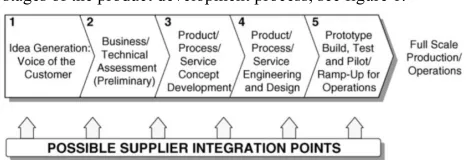
[image:2.595.308.542.90.170.2]development/project. Suppliers can get involved in several stages of the product development process, see figure 1.
Figure 1: Possible Supplier Integration Stages
The ‘generic’ new product development process as seen in figure 1 consists of interdependent and overlapping stages that occur during the development of new products or services, from the ‘idea generation’ stage to the ‘full scale production or service delivery’ stage. Several problems, such as performance, quality, timing, and costs often arise during the process, which results in changes and trade-offs in the design. For this reason, before reaching the finalization stage, the design can be modified a couple of times.
In the ‘idea generation’ stage, the firm considers the need for the product or service and typically taps on customers’ opinions and ideas on what the product or service should possess, and how much it might cost. If a supplier possesses a new technology, that technology may also be assessed in the first stage. The second stage is identifying potential technical solutions to the customer requirements of the first stage and performing a business assessment of the expected product or service. The concept of the product or service is conceived in the third stage alongside the creation of a preliminary prototype model. The actual product or service development process begins in stage four when designers from both the firm and the suppliers create design specifications and build a working prototype. This working prototype allows for testing and verification. The latest step is to enter full-scale production where the supplier ramps up the volumes (Handfield et al., 1999).
Early supplier involvement (ESI) is defined as a vertical collaboration between supply chain partners in which the manufacturer(s) involve the supplier(s) at an early stage of the product development process (Mikkola & Skjøtt-Larsen, 2006). At least 80 percent of the total cost of the product is ‘locked in’ by the first two stages of the product development process, Therefore decisions made in the first two stages have major effects on the resulting product or service costs. Design changes in the lateral stages are above all difficult and costly to make. Handfield et al. (1999) argue that it is then of high importance to involve suppliers early in the process for their product, process, and technical expertise. According to literature, there are several reasons to involve suppliers early; suppliers can identify potential problems early on in the process (Brown & Eisenhardt, 1995; Handfield, 1994; Hartley et al., 1997; Ragatz et al., 1997), suppliers can identify opportunities to reduce costs (Hartley et al., 1997), involving suppliers at an early stage can improve the communication between the supplier and the buyer (McIvor & Humphreys, 2004; Petersen, Handfield, & Ragatz, 2003), early involvement will increase suppliers perceived contribution (Handfield, 1994), and when facing technology uncertainty (Ragatz, Handfield, & Petersen, 2002), buyers can benefit from suppliers’ information and expertise (Petersen et al., 2003).
development process (McIvor & Humphreys, 2004). It is also a possibility for a buying company to be ‘locked into’ a particular supplier, especially when different technologies are competing for a future industry standard (Handfield et al., 1999).
2.2
Development Costs
In this paper, the development costs are defined as the total costs incurred by a company from the initiation to the implementation of the product/service/project.
2.3
Literature Review
There are many different results from the literature regarding the effects of ESI on new product development costs. Griffin and Hauser (1992) argued that involving suppliers earlier is always better. Brown and Eisenhardt (1995) then found that extensive supplier integration in the early stages (product design) could cut the complexity of the design and in turn create a more productive and faster product development process. Extensive supplier integration at an early stage could also lead to suppliers alerting the buyer to potential problems early on, and making it possible to fix the problem earlier and easier. Supplier integration led to significant product performance improvements, which led to a competitive advantage for the firms that Ragatz et al. (1997) studied. And Hartley et al. (1997) implied that “key suppliers should be involved as early as possible in product development regardless of whether they are providing a standard or custom component” (p. 264). It was also found that ESI led to an increased number of supplier base initiatives and innovations (Bidault, Despres, & Butler, 1998). Build on that, Kessler (2000) stated that by using more external (versus internal) ideas and technologies lower development costs were achieved. Research by Ragatz et al. (2002) added to this that a greater use of technology sharing and direct supplier involvement on the new product development process could mitigate cost overruns associated with complex new technologies. This statement was proven to be correct by a more recent research by Petersen, Handfield, and Ragatz (2003) who stated: “supplier involvement on project teams seems to be even more important when the technology is complex or when the buying company does not have a high level of internal expertise in the area” (p. 296). They also found that the reason for this was the ability to capture external expertise early in the process. An more recent research conducted by Petersen, Handfield, and Ragatz (2005), who tried to find a relationship between project team effectiveness on design performance monitored by the timing of supplier integration, found that indeed “project team effectiveness had a greater affect on design performance for suppliers who were integrated earlier in the new product development process” (p. 382). Furthermore, Hoegl and Wagner (2005) studied the buyer-supplier collaboration relationship and found that the collaboration improved the project performance regardless of the suppliers’ share in the project. Additionally, they found a significant positive relationship between strong buyer-supplier collaboration and efficiency (development costs) and effectiveness (product costs).
However, some researchers found no relationship regarding ESI and development costs and success. McGinnis and Vallopra (1999) research indicated that ESI had no significant effect on new product development success and product development success is not affected by the decision when and how to involve suppliers. They state that the contribution of supplier involvement varies depending on the situation. This, of course, contradicted the findings of Griffin and Hauser (1992) who
stated that ESI is always better. Primo and Amundson (2002) studied several supplier relationship variables (e.g. timing and responsibility) and also found no connection between any supplier relationship variables and project costs.
While there is a great deal of support for ESI, the research findings are mixed regarding involving suppliers early in the new product development process. Additionally, little explanation is provided as to how ESI timing affects development costs
3.
METHODOLOGY
The research design of this paper is based on a cross-sectional case study. As the purpose of this paper is exploratory, case studies in combination with interviews will be used to acquire a great sense of information. The reason for this type of design is due to the fact that the paper’s purpose is to get a better understanding of the relationship between the timing of supplier involvement and development costs, provide a more fine-grained understanding, come up with alternative explanations, and identify potential modifying conditions. For this reason, it is not the purpose of this paper to generalize the results. Six interviews were held at six different companies regarding supplier involvement timing and development costs in a specific project. The companies AkzoNobel, Apollo (twice), Siemens, Sensata, and Bronkhorst High-Tech B.V. were respectively chosen due to their innovative advancements. The interviews were conducted with project managers, recorded, and later analyzed through the use of quotes. The interview questions are shown in table 1. The questions are divided in four blocks, the first two are questions concerning the two variables development costs and supplier involvement timing, question three is concerned with the relationship between the two variables as question four is more of an invitation towards the respondent to provide additional information regarding factors other than mentioned in question three that affected development costs.
For this project, how did the development/project costs turn out to be compared to the budgeted/expected costs?
For this project, at which stage did the supplier get involved (approximately)?
And why in that particular stage?
Looking at previous research, several reasons/factors are given as to how Early Supplier Involvement can affect development/project costs:
• Early problem recognition
• Suppliers might know more about what is possible or not when facing technological uncertainty
• Enhanced information and expertise of the suppliers
• Identify opportunity to reduce costs
development/project costs?
Were there other factors that affected the development/project costs that were more important than involving suppliers at a specific stage?
Table 1: Interview Questions
The first two questions can provide an indication of the relationship and direction of the relationship between the timing of supplier involvement and development costs. The latter two questions will provide some insights and explanations as to how the timing of supplier involvement affects development costs and whether there are some potential modifying conditions.
4.
RESULTS
This section will provide the results from the six cases of AkzoNobel, Apollo (twice), Siemens, Sensata, and Bronkhorst High-Tech B.V. For privacy reasons the names of the interviewees will not be mentioned.
4.1
Case one: AkzoNobel
AkzoNobel is a leading global paints and coatings company and a major producer of specialty chemicals (Akzonobel.com, 2015). This case is in particular about the product Intersleek 900, which is a special paint for ships. In this highly successful project, the supplier was involved at the first stage in the new product development process (the idea generation). AkzoNobel was interested in new materials that would improve the previous Intersleek (Intersleek 750) product. The main reason for involving the supplier at the first stage of this project was that the Intersleek paint consisted of 10 to 12 ingredients and AkzoNobel did not have the capacity to produce these by themselves. Additionally, the supplier had capabilities and access to equipment and know-how that they did not possess. AkzoNobel divided the development process in two big stages for this project, the research stage, and the product development stage. The research stage had no budget, and for the product development stage the expected time was two years. The expected time of the actual product development time turned out to be correct. The development costs made by AkzoNobel for this project were also as expected (however, actual numbers were not given by the project manager). When asked about the potential positive effects of ESI, the project manager mentioned that early problem recognition, in a sense that the supplier can recognize the problem of the customers early on, was not that important as suppliers rarely know the market better than AkzoNobel, and as AkzoNobel is a world leader in its respective market, it will know its customers’ problems and needs better than its suppliers. Identifying opportunities to reduce costs was also considered rare by the project manager, as suppliers would most likely keep the benefits of the savings to themselves. However, the project manager believed that two aspects were of high importance when it came to ESI. The first being that the suppliers know more about what is possible to produce and what is not when facing technology uncertainty. The second aspect is the enhanced information and expertise of the supplier. The project manager believed that ESI had major affect on development costs as they had much less work to do by simply using the suppliers’ information and know-how. The project manager added to this that another factor of ESI was of major importance for AkzoNobel, being that after they identified the molecule for the product, the supplier knew how
to manufacture quantities for AkzoNobel to test in small areas of the ships before further development (often for free).
4.2
Case two: Apollo
Apollo is a multinational that manufactures and sells high quality tires (Apollovredestein.nl, 2015). The first case of Apollo is about improved tires for wet breaking. These tires required a special kind of rubber specifically for wet breaking. In this project, the supplier was involved at the first stage or in the project manager’s own words: “before the beginning”. The reason for early involvement of the supplier was that the supplier already delivered the raw materials and thus had additional information for the functionality of the product and the know how to achieve this in the best way possible. The development costs turned out to be more or less as expected because of the good organized planning and Apollo worked with a known supplier. When asked about the possible positive effects of ESI on the development costs, the project manager believed that two aspects to be of high importance; enhanced information and expertise of the supplier, and the ability of the supplier to identify opportunities to reduce costs. Additionally, the project manager believed that in this particular project the important aspects were sharing the right information with the supplier, and standardized communication. The supplier could produce better products when given the right information, which would lead to lower development costs, and when having standardized communication, products could be produced faster thus reducing development costs.
4.3
Case three: Apollo
The second case of Apollo is about new types of tires for a specific customer, for privacy reasons the project manager did not name the customer or the type of tire. The supplier in this project was involved at the first stage of the new product development process. The customer demanded that a new test to be conducted due to the introduction of a new type of tires which required different measurements and demanded that Apollo worked closely with a specific German supplier, therefore, the main reason of involving the supplier at the first stage was the demand of the customer. The development costs turned out to be as expected because the price was agreed to in the beginning as the supplier was involved from stage one. The ESI in this project did not affect development costs due to the fixed cost and price. However, the project manager did mention that he believed that early problem recognition, and enhanced information and expertise of the supplier were important aspects of ESI.
4.4
Case four: Siemens
Siemens any price (at the first round) knowing they would more or less have to accept it. This was, however, no problem for Siemens as this would allow them to be the market leader and ahead of the competition. The agreement with the supplier was to only supply for Siemens for one year with this technology, giving Siemens a one-year advantage over competitors.
4.5
Case five: Sensata
Sensata is the world’s leading supplier of sensors and controls across a broad range of markets and applications (Sensata.com, 2015). This case is about a project that required Sensata to create product samples of a new component ready for production (if customer was satisfied) in only 20 weeks. In comparison, other projects take about 10 to 12 months to complete. The supplier was involved at the beginning stages (1-2). The project manager said that Sensata usually does not involve the supplier at the beginning because most of the projects are long-term and can take up to two years to complete, thus giving them enough time to come up with their own ideas and developments before involving a supplier. But due to the lack of time in this project, the supplier had to be involved immediately as the design and pre-production had to be created quickly. The push to work early with the supplier was the lack of time for major changes and experiments. At the beginning, Sensata and the supplier reviewed the customer’s need and both companies’ capabilities. The expected development costs of the project were estimated in a process called DTC by creating a rough outline of the products and compare it to old samples that have been produced in the past. The project manager said that in total, the costs were reduced by 30% compared to the expected costs as calculated by DTC because of the supplier integration and access to more expertise of the supplier. When asked about what aspects of ESI affected the developments costs the project manager considered some aspects that were of high importance. The reduction of redundancy along the reduction of time allowed Sensata to benefit from savings and reduce the development costs. Because of the expertise of the supplier, the tooling time was reduced thus reducing the costs. The change of materials (metal components) allowed Sensata to reduce costs as well. Due to supplier’s suggestions the initial customer demands were changed and, in this specific project, less silver was used in the end product without affecting the functionality of the product, allowing for major cost savings. At last, the project manager said that the experience of the supplier played a role as the supplier had more experience from other customers.
4.6
Case six: Bronkhorst High-Tech B.V.
Bronkhorst High-Tech B.V. develops, manufactures and markets high quality mass flow and pressure meters and controllers for gas and (low flow) liquid applications across various industries (Bronkhorst.com, 2015). This case is about a Sensotube that Bronkhorst manufactured in the past. The supplier in this project was involved at stage three of the new product development process as Bronkhorst had an idea and made a prototype of the instrument first before involving the supplier. However, when introducing the prototype of the instrument to suppliers to produce large quantities, none of the suppliers in the Netherlands were able to do so due to the fact that it was not possible to setup the production process. Bronkhorst had wrong assumptions about he specifications of the instrument, so at the time of the introduction of the supplier at stage three, the specifications had to be changed. This took a lot of time and cost a lot of money. Although there was no budget for this project, it was noticed that the costs were too high at the end of the project, due to the change in specifications. The project manager, however, said that in the future, the company will aim to involve the supplier at the begin
stages as the supplier would know and communicate beforehand what the production possibilities are and would recognize the problems earlier. This will save Bronkhorst a lot of time and money, as they would not face the problem to change the specifications later in the development process. Additionally, the project manager said that ESI is of major importance, as “90% of the costs and price occurs at the early stages of new product development”.
5.
ANALYSIS
Results show that five out of the six companies involved the suppliers in the early stages of the new product development process, whereas one company involved the suppliers at the later stages (stage 3). Three out of the five companies that involved the suppliers at the early stages had the same development costs as expected, one company had its costs reduced by 30% and one company had its development costs doubled. The company that involved its suppliers at later stages had higher development costs than expected.
The reason that the three companies had the same development costs as expected and that one company even had its development costs reduced by 30% is, according to the project managers’ statements, due to ESI. Firstly, suppliers know what is possible to produce and what is not and can recognize problems early, this will prevent re-designing the product later on in the development process due to wrong assumptions and will save the companies time and money. Secondly, companies can make use of the suppliers’ information and expertise/know-how, thus reducing extra work and development costs. Thirdly, suppliers could identify opportunities to reduce development costs due to their expertise, however, it is important to note that as this worked for some companies, one company’s project manager stated that this is rarely the case since some suppliers will use the benefits of the savings for themselves. For AkzoNobel, another factor as to how ESI affected their development costs was the fact that due to early involvement, the supplier knew how and was able to make quantities of the product for testing before further development. Additionally, Sensata had its development costs reduced by 30% and the project manager stated that the following factors of ESI were of major influence on development costs; reduction of redundancy, reduction of time, reduction of tooling time due to supplier’s expertise, changes in materials used in production, and changes in the initial customer need due to supplier’s suggestions.
One company, Bronkhorst High-Tech B.V. involved their supplier at the later stage (stage 3) after they already formulated the idea and created a prototype of the product. This, however, did not end well for the company. As mentioned in the previous paragraph, involving suppliers early is a way of recognizing problems early in the process and preventing re-designing of a product. For this very reason, this company had to change the specifications of the products due to the fact that they involved the supplier later in the development process and noticed that the production of their sample was not possible, this had major effects on the development costs according to the project manager.
6.
DISCUSION AND CONCLUSION
The purpose of this paper was to get a better understanding as to how ESI timing affects the development costs of a new product development. Based on six interviews with innovative companies this research has come to a conclusion that the timing of ESI can affect development costs in several ways and directions. First, involving suppliers at the early stages could reduce development costs by providing the customer with know-how about production possibilities at early stages and thus saving the customer time and money by preventing re-designs at later stages. Second, suppliers’ information and expertise at an early stage could be used to reduce extra work and costs. Third, suppliers can identify opportunities to reduce costs for the customer at earlier stages when involved at the beginning of the development process. Fourth, suppliers can suggest, early in the development process, to use different materials in products, which will reduce the development costs and keep the product function the same.
Involving the supplier at later stages could increase development costs simply due to the fact that the generated idea by the customer might not be possible to produce by suppliers. This could cause delays and a re-design of the product, which will increase development costs significantly.
Involving the supplier at the early stages could, however, also increase the development costs. Becoming depended on the supplier can cause an opportunistic behavior from the supplier and forcing the customer to pay the higher prices.
The implication of this research is that involving suppliers at an early stage could reduce development costs, however, it is important for customers to not become solely dependent on a supplier as they might face opportunistic behavior and end up with increased development costs. It is however important to note that it might be necessary for a customer to be dependent of a supplier in order to reach it goals. Another implication is that customers that involve suppliers at later stages might face might be forced to re-design their initial idea/product and might face delays due to generating an idea that is not possible for production by suppliers.
7.
LIMITATIONS AND FUTURE
RESEARCH
The first limitation of this paper is that the project managers were asked to answer concerning to only one project rather on a more complete view of their experience across many projects. The second limitation is that the selected companies were all located in The Netherlands rather than across the world. The third limitation of this paper is that the companies selected belonged to two or three types of industries rather than a wide range of industries. For future research, it might be important to explore factors such as cultural compatibility between the company and supplier and supplier capability. Another future research idea is the exploration of how ESI affects development costs in a wider range of industries.
8.
REFERENCES
Akzonobel.com,. (2015). About Us - AkzoNobel Global. Retrieved 14 June 2015, from
https://www.akzonobel.com/aboutus/
Apollovredestein.nl,. (2015). Apollo Vredestein B.V.. Retrieved 14 June 2015, from
http://www.apollovredestein.nl/about-apollo-redestein/apollo-vredestein-bv?Lang=en-US Bidault, F., Despres, C., & Butler, C. (1998). New product
development and early supplier involvement (ESI):
the drivers of ESI adoption. International journal of
technology management, 15(1-2), 49-69.
Bronkhorst.com,. (2015). About Bronkhorst High-Tech B.V. -
Bronkhorst®. Retrieved 14 June 2015, from
http://www.bronkhorst.com/en/about_us/ Brown, S. L., & Eisenhardt, K. M. (1995). Product
development: Past research, present findings, and future directions. Academy of management review, 20(2), 343-378.
Clark, K. B. (1989). Project scope and project performance: the effect of parts strategy and supplier involvement on product development. Management science, 35(10), 1247-1263.
Griffin, A., & Hauser, J. R. (1992). Patterns of communication among marketing, engineering and manufacturing—A comparison between two new product teams.
Management science, 38(3), 360-373.
Handfield, R. B. (1994). Effects of concurrent engineering on make-to-order products. Engineering Management,
IEEE Transactions on, 41(4), 384-393.
Handfield, R. B., Ragatz, G. L., Peterson, K., & Monczka, R. M. (1999). Involving suppliers in new product development? California management review, 42, 59-82.
Hartley, J. L., Meredith, J. R., McCutcheon, D., & Kamath, R. R. (1997). Suppliers' contributions to product development: An exploratory study. Engineering
Management, IEEE Transactions on, 44(3), 258-267.
Hoegl, M., & Wagner, S. M. (2005). Buyer-supplier collaboration in product development projects.
Journal of Management, 31(4), 530-548.
Kessler, E. H. (2000). Tightening the belt: methods for reducing development costs associated with new product innovation. Journal of Engineering and Technology
Management, 17(1), 59-92.
McGinnis, M. A., & Vallopra, R. M. (1999). Purchasing and supplier involvement: issues and insights regarding new product success. Journal of Supply Chain
Management, 35(2), 4-15.
McIvor, R., & Humphreys, P. (2004). Early supplier
involvement in the design process: lessons from the electronics industry. Omega, 32(3), 179-199. Mikkola, J. H., & Skjøtt-Larsen, T. (2006). Platform
management: Implication for new product development and supply chain management.
European Business Review, 18(3), 214-230.
Petersen, K. J., Handfield, R. B., & Ragatz, G. L. (2003). A Model of Supplier Integration into New Product Development*. Journal of product innovation
management, 20(4), 284-299.
Petersen, K. J., Handfield, R. B., & Ragatz, G. L. (2005). Supplier integration into new product development: coordinating product, process and supply chain design. Journal of Operations management, 23(3), 371-388.
Primo, M. A., & Amundson, S. D. (2002). An exploratory study of the effects of supplier relationships on new product development outcomes. Journal of Operations management, 20(1), 33-52.
Ragatz, G. L., Handfield, R. B., & Petersen, K. J. (2002). Benefits associated with supplier integration into new product development under conditions of technology uncertainty. Journal of Business Research, 55(5), 389-400.
product development. Journal of product innovation
management,14(3),190-202.
Sensata.com,. (2015). About | Sensata Technologies, the
company. Retrieved 14 June 2015, from
http://www.sensata.com/about/
Siemens.com,. (2015). About Siemens - Siemens Global
Website. Retrieved 14 June 2015, from