University of Warwick institutional repository:
http://go.warwick.ac.uk/wrap
A Thesis Submitted for the Degree of PhD at the University of Warwick
http://go.warwick.ac.uk/wrap/71063
This thesis is made available online and is protected by original copyright.
Please scroll down to view the document itself.
Analytic Methods In Combinatorics
by
Jan Volec
Thesis
Submitted to the University of Warwick
and Universit´e Paris Diderot – Paris 7
for the degree of
Doctor of Philosophy
Mathematics Institute and UFR d’Informatique
Contents
Acknowledgments iii
Declarations iv
Abstract v
R´esum´e vi
Notation and preliminaries 1
Chapter 1 Flag Algebras 3
1.1 Flag algebra setting for graphs . . . 3
1.2 Semidefinite method . . . 9
Chapter 2 Hypergraphs with positive lower density 14 2.1 Random tournaments construction . . . 15
2.2 Flag algebra setting . . . 18
2.3 3-graphs with 4 vertices spanning at most 2 edges . . . 20
2.4 Uniqueness of the tournament construction . . . 29
Chapter 3 Monotone subsequences in permutations 36 3.1 Flag algebra setting . . . 38
3.2 Monotone subsequences of length four . . . 42
3.3 Stability of almost extremal configurations . . . 45
3.4 Extremal configurations . . . 48
3.5 Monotone subsequences of length five . . . 53
3.6 Monotone subsequences of length six . . . 56
4.1.1 Graphons . . . 61
4.1.2 Finite forcibility . . . 62
4.1.3 Finite forcibility and non-compactness . . . 65
4.2 Partitioned graphons . . . 65
4.3 Rademacher graphon . . . 72
4.4 Forcing the graphon . . . 75
Appendix A Supplementary computations for Chapter 2 84 A.1 Matrices I1, I2, I3 andI4 from proof of Theorem 2.20 . . . 84
Appendix B Supplementary computations for Chapter 3 90 B.1 Proof of Theorem 3.20 . . . 90
B.2 Proof of Theorem 3.23 . . . 91
Acknowledgments
My big thanks go to Dan and Jean-S´ebastien for their supervising and without
any doubts an exceptional care during my whole studies. I also want to thank my
collaborators – Jozsi Balogh, Roman Glebov, Ping Hu, Dan Kr´al’, Bernard Lidick´y,
Oleg Pikhurko and Bal´azs Udvari. Working together on the joint projects was always
full of enjoyable moments.
My acknowledgments go to all the three institutions I was based at during
my doctoral studies. I spent the first year at Computer Science Institute of Charles
University in Prague, where I was also supported by the Grant Agency of Charles
University (GAUK 601812). In the following two years, my studies were split
be-tween the University of Warwick and LORIA in Nancy. I am very grateful to both
of the institutions for their great and inspiring atmosphere. My stays in France were
also supported by a grant from French government.
Thanks to my friends Rafael Barbosa, Zdenˇek Dvoˇr´ak, Florent Foucaud,
Andzrej Grzesik, Tereza Klimoˇsov´a, Matjaˇz Krnc, Martin Kupec, Anita
Liebe-nau, Luk´aˇs Mach, Guillem Perarnau, Will Perkins, Florian Pfender, Jakub
Slia-can, Robert ˇS´amal and Vojta T˚uma for both mathematical and non-mathematical
Declarations
This thesis consists of four chapters.
a) Chapter 1 contains an introduction to flag algebras, which is a framework
de-veloped by Razborov [59] for problems in extremal combinatorics. Most of the
content of this chapter follows the exposition in [59].
b) The results from Chapter 2 were obtained together with Roman Glebov and Dan
Kr´al’. The corresponding paper [34] is submitted for publication. An extended
abstract was accepted to the proceedings of Erd˝os Centennial conference [35] and
to the proceedings of Eurocomb 2013 conference [36].
c) The results from Chapter 3 were obtained together with Jozef Balogh, Ping Hu,
Bernard Lidick´y, Oleg Pikhurko, and Bal´asz Udvari. The paper [8] contains the
results from Section 3.2 and it has been accepted for publication in
Combina-torics, Probability and Computing. The results from Section 3.2 are also a part
of the PhD thesis of Ping Hu. The paper [9] with the results from Section 3.5
and Section 3.6 will be submitted for publication.
d) The results from Chapter 4 were obtained together with Roman Glebov and Dan
Kr´al’. The corresponding paper [33] is submitted for publication.
With the exception described under the point (c), none of the results appeared in
any other thesis.
All the collaborators have agreed with the inclusion of our joint work into
Abstract
In the thesis, we apply the methods from the recently emerged theory of limits of
discrete structures to problems in extremal combinatorics. The main tool we use is
the framework of flag algebras developed by Razborov.
We determine the minimum thresholddthat guarantees a 3-uniform
hyper-graph to contain four vertices which span at least three edges, if every linear-size
subhypergraph of the hypergraph has density more than d. We prove that the
threshold valuedis equal to 1/4. The extremal configuration corresponds to the set
of cyclically oriented triangles in a random orientation of a complete graph. This
answers a question raised by Erd˝os.
We also use the flag algebra framework to answer two questions from the
extremal theory of permutations. We show that the minimum density of monotone
subsequences of length five in any permutation is asymptotically equal to 1/256, and
that the minimum density of monotone subsequences of length six is asymptotically
equal to 1/3125. Furthermore, we characterize the set of (sufficiently large) extremal
configurations for these two problems. Both the values and the characterizations of
extremal configurations were conjectured by Myers.
Flag algebras are also closely related to the theory of dense graph limits,
where the main objects of study are convergent sequences of graphs. Such a sequence
can be assigned an analytic object called a graphon. In this thesis, we focus on
finitely forcible graphons. Those are graphons determined by finitely many subgraph
densities. We construct a finitely forcible graphon such that the topological space
of its typical vertices is not compact. In our construction, the space even fails to be
R´
esum´
e
Dans cette th`ese, nous appliquons `a des probl`emes de combinatoire extr´emale les m´ethodes de la th´eorie des limites de structures discr`etes, qui a ´et´e r´ecemment d´evelopp´ee. L’outil principal utilis´e est celui des alg`ebres de drapeaux, d´evelopp´e par Razborov.
Nous d´eterminons le seuil minimum, d, garantissant que tout hypergraphe 3-uniforme contient quatre sommets induisant au moins trois arˆetes, si tout sous-hypergraphe d’ordre lin´eaire en l’ordre de l’sous-hypergraphe a une densit´e strictement plus grande que d. Nous prouvons que cette valeur seuil d est ´egale `a 1/4. La configuration extr´emale correspond `a un ensemble de triangles orient´es de fa¸con cyclique dans une orientation al´eatoire d’un graphe complet. Ceci r´epond `a une question pos´ee par Erd˝os.
Nous utilisons ´egalement la th´eorie des alg`ebres de drapeaux pour r´epondre `
a deux questions de th´eorie extr´emale des permutations. Nous montrons que la den-sit´e minimum d’une sous-suite monotone de longueur cinq dans toute permutation est asymptotiquement ´egale `a 1/256, et que la densit´e minimum d’une sous-suite monotone de longueur six est asymptotiquement ´egale `a 1/3125. Par ailleurs, nous caract´erisons l’ensemble des configurations extr´emales (suffisamment grandes) pour ces deux probl`emes. Les deux valeurs ainsi que les caract´erisations de configurations extr´emales avaient ´et´e conjectur´ees par Myers.
Notation and preliminaries
We follow the basic graph theory notation from the book of Bondy and Murty [10]. For a graphG, we denote the set of vertices ofGbyV(G) and the set of edges ofG byE(G)⊆ V(2G). Analogously, for every integerrand everyr-uniform hypergraph H, or an r-graph for short, we again let V(H) to be the set of vertices of H and E(H) ⊆ V(rH) to be the set of (hyper)edges of H. Note that the definition of a 2-graph coincide with the one for a graph. We call the cardinality ofV(H) theorder
ofH and denote it byv(H), and the cardinality of E(H) thesize ofH and denote it bye(H).
For a vertexvin an graphH, we defineNH(v) :={u∈V(H) :uv ∈E(H) to
be theneighborhood of v, andNH[v] :=NH(v)∪ {v} to be theclosed neighborhood
of v. If the graph H is clear from the context, we omit the H from the subscript and write onlyN(v) orN[v]. We refer to the size ofN(v) as to the degree of v. If H is a 3-graph andu and v are two of its vertices, we define theco-degree of u and
v to be the size of the setNH(u, v) :={w∈V(H) :uvw∈E(H)}.
For an r-graph H, we denote by H the complement of H, i.e., the r-graph with the vertex-setV(H) and the edge-set V(rH)\E(H). For a subset of vertices S ⊆ V(H), we denote by H[S] the induced subhypergraph (or simply subgraph if r= 2), i.e., ther-graph with the vertex-set S and the edge-set{e∈E(H) :e⊆S}. An independent set of an r-graph H is a subset of I ⊆ V(H) such that e(H[I]) = 0. Thechromatic number ofH, which we denote byχ(H), is the smallest integerksuch that V(H) can be partitioned into kindependent sets.
We say that anr-graph H is linear if every two edges intersect in at most one vertex. Note that every 2-graph, i.e., every graph, is linear.
One of the basic questions in extremal combinatorics is to determine the maximum possible number of edges in ann-vertexr-graph that does not contain a copy of some fixedr-graphF. For an r-graph F, we define theextremal number of F as
and the Tur´an density of F, which is denoted by π(F), as limn→∞ex(n, F)/ nr
. Note that for a fixed r-graph F, the function ex(n, F)/ nr is non-increasing, the hence limit always exists.
For two graphsGandH, we define thecompositionG◦H(which is sometimes called the lexicographical product of G and H) to be the graph on the vertex set V(G)×V(H) in which a vertex (u, v) is adjacent to a vertex (u0, v0) if and only if either uu0 ∈ E(G), or u = u0 and vv0 ∈ E(H). In other words, we replace each vertex of Gby a copy of H, and linking these copies by complete bipartite graphs according to the edges ofG. This notion has a naturally generalizes tor-graphs. The composition-closure of a family F ofr-graphs is the smallest family of r-graphsF0 that containsF as a subfamily and which satisfiesG◦H∈ F0 for everyG, H ∈ F0. For anr-graph H and an integer`, the `-th blow-up of H is the r-graph on `·v(H) vertices which is constructed fromH by replacing each vertexv ofH with an independent set of` vertices Iv, and each edge of H with a complete r-partite
r-graph, where each part has size `. Analogously, for an r-graph H and an integer k, thek-th iterated blow-up ofH is ther-graph on the vertex-setV(H)kisomorphic
to
H◦H◦ · · · ◦H
| {z }
k-times
.
In other words, we first take an `-th blow-up of H for ` being v(H)k−1, and then
we place a copy of the (k−1)-th iterated blow-up of H inside Iv for every vertex
Chapter 1
Flag Algebras
The main tool used in the thesis is the framework of flag algebras. It was introduced by Razborov [59] as a general tool to approach problems from extremal combina-torics. The work of Razborov was inspired by the theory of dense graph limits, which is discussed in Section 4.1.
The flag algebra method have been successfully applied to various prob-lems in extremal combinatorics. To name some of the applications, they were used for attacking the Caccetta-H¨aggkvist conjecture [43, 63], Tur´an-type problems in graphs [60, 54, 57, 64, 19, 38, 40, 58, 70, 42] 3-graphs [61, 56, 5, 29, 28, 34] and hypercubes [4, 7], extremal problems in a colored setting [41, 44, 6, 18], or in ge-ometry [45]. More details on these applications can be found in a recent survey of Razborov [62].
In this chapter, we follow the approach of Razborov [59] and introduce the framework of flag algebras for the graphs. Exactly the same scheme can also be used to setup flag algebras for the oriented graphs, the `-uniform hypergraphs (`-graphs), the permutations, and many others. In fact, Razborov introduced in [59] the framework for an arbitrary universal first-order logic theory without constants or function symbols. We decided to present in this section the flag algebra setup for the particular instance of graphs rather than in the general setting, since it might be easier to understand the ideas of the framework in this way.
1.1
Flag algebra setting for graphs
The central notions we are going to introduce are an algebra A and algebras Aσ,
whereσ is a fixed graph with a fixed labelling of its vertex set. In order to precisely describe the algebras A and Aσ on formal linear combinations of graphs, we first
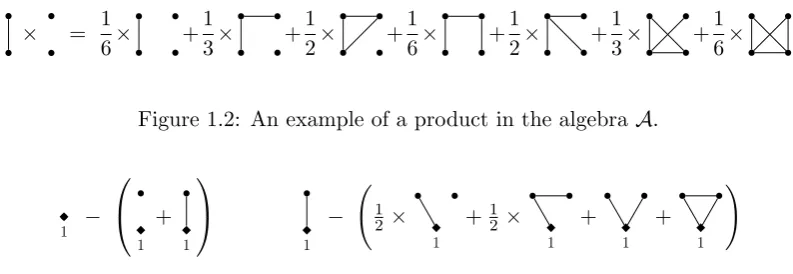
non-• − + + +
!
− 13 × +23 × +
[image:14.595.128.518.117.157.2]!
Figure 1.1: Two examples of linear combinations used in generatingK.
isomorphic graphs. Next, for every ` ∈ N, let F` ⊂ F be the set of all graphs of
order `. For convenience, we fix an arbitrary ordering on the elements the set F` for every`∈N, i.e., we always assume thatF`={F1, F2, . . . , F|F`|}.
For H ∈ F` and H0 ∈ F`0, we define p(H, H0) to be the probability that
a randomly chosen subset of `vertices in H0 induces a subgraph isomorphic to H. Note thatp(H, H0) = 0 if`0 < `. LetRF be the set of all formal linear combinations of elements ofF with real coefficients. Furthermore, letK be the linear subspace of
RF generated by all the linear combinations of the form
H− X
H0∈F
v(H)+1
p(H, H0)·H0.
Two examples of such linear combinations are depicted in Figure 1.1. Finally, we setA to be the spaceRF factored byK, and the element corresponding to K in A to be the zero element ofA.
The space A comes with a natural definition of an addition and a multipli-cation by a real number. We now introduce the notion of a product of two elements from A. We start with the definition for the elements of F. ForH1, H2 ∈ F, and
H ∈ Fv(H1)+v(H2), we define p(H1, H2;H) to be the probability that a randomly
chosen subset of V(H) of size v(H1) and its complement induce in H subgraphs
isomorphic toH1 andH2, respectively. We set
H1×H2:=
X
H∈Fv(H1)+v(H2)
p(H1, H2;H)·H.
See Figure 1.2 for an example of a product with H1 = and H2 = . The
mul-tiplication on F has a unique linear extension to RF, which yields a well-defined multiplication also in the factor algebra A. A formal proof of this is given in [59, Lemma 2.4]. Observe that the one-vertex graph • ∈ F is, modulo K, the neutral element of the product inA.
Let us now move to the definition of the algebraAσ, whereσ is a fixed finite
× = 1
6× +
1
3× +
1
2× +
1
6× +
1
2× +
1
3× +
[image:15.595.121.518.119.256.2]1 6×
Figure 1.2: An example of a product in the algebra A.
1 1
−
1
+
1
1
− 12 ×
1
+12 ×
1
+
1
+
1
!
Figure 1.3: Two examples of linear combinations used in generatingKσ, whereσ is
the one-vertex type.
atype. We follow the same lines as in the definition of A. Let Fσ be the set of all
finite graphsH with a fixedembeddingof σ, i.e., an injective mappingθfrom V(σ) toV(H) such that θ is an isomorphism between σ and H[Im(θ)]. The elements of Fσ are usually called σ-flags, the subgraph induced by Im(θ) is called the root of
a σ-flag, and the vertices Im(θ) are called the rooted or the labelled vertices. The vertices that are not rooted are called the non-rooted or the non-labelled vertices. For every` ∈N, we define Fσ
` ⊂ Fσ to be the set of all `-vertex σ-flags fromFσ.
Also, for each typeσ and each integer`, we fix an arbitrary ordering on the elements of the setFσ
`.
In the analogy to the case ofA, for twoσ-flagsH∈ FσandH0 ∈ Fσ with the
embeddings ofσgiven byθandθ0, respectively, we setp(H, H0) to be the probability that a randomly chosen subset ofv(H)−v(σ) vertices inV(H0)\θ0(V(σ)) together withθ0(V(σ)) induces a subgraph that is isomorphic toH through an isomorphism f that preserves the embedding of σ. In other words, the isomorphism f has to satisfyf(θ0) =θ. Let RFσ be the set of all formal linear combinations of elements ofFσ with real coefficients, and letKσ be the linear subspace of
RFσ generated by all the linear combinations of the form
H− X
H0∈Fσ v(H)+1
p(H, H0)·H0.
See Figure 1.3 for two examples of such linear combinations in the caseσis the one-vertex type. We define Aσ to be
RFσ factored byKσ and, analogously to the case for the algebraA, we let the element corresponding toKσ to be the zero element of
1
×
1
= 12 ×
1
+12 ×
1 1
×
1
=
1
+
1
Figure 1.4: Two examples of a product in the algebraAσ, whereσ is the one-vertex
type.
We now define the product of two elements from Fσ. Let H
1, H2 ∈ Fσ
and H ∈ Fσ
v(H1)+v(H2)−v(σ) be σ-flags, and θ be the fixed embedding of σ in H.
Similarly to the definition of the multiplication forA, we definep(H1, H2;H) to be
the probability that a randomly chosen subset ofV(H)\θ(V(σ)) of sizev(H1)−v(σ)
and its complement inV(H)\θ(V(σ)) of sizev(H2)−v(σ), extendθ(V(σ)) inH to
subgraphs isomorphic to H1 and H2, respectively. Again, by isomorphic we mean
that there is an isomorphism that preserves the fixed embedding ofσ. We set
H1×H2:=
X
H∈Fσ
v(H1)+v(H2)−v(σ)
p(H1, H2;H)·H.
Two examples of a product in Aσ for σ being the one-vertex type are depicted in
Figure 1.4. The definition of the product for the elements ofFσ naturally extends
to Aσ. It follows that the unique σ-flag of size v(σ) represents, modulo Kσ, the
neutral element of the product inAσ.
Now consider an infinite sequence (Gn)n∈Nof graphs with increasing orders.
We say that the sequence (Gn)n∈N is convergent if the probabilities p(H, Gn)
con-verge for everyH ∈ F. A standard compactness argument (e.g., using Tychonoff’s theorem [73]) yields that every such infinite sequence has a convergent subsequence. Fix a convergent sequence (Gn)n∈N of graphs with increasing orders. For
every H ∈ F, we set φ(H) = limn→∞p(H, Gn), and we then linearly extend φ to
A. We usually refer to the mappingφas to thelimitof the sequence. The obtained mapping φ is a homomorphism from A to R, see [59, Theorem 3.3a]. Moreover, for every H ∈ F, it holds φ(H) ≥ 0. Let Hom+(A,R) be the set of all such homomorphisms, i.e., the set of all homomorphismsψfrom the algebraAtoRsuch thatψ(H)≥0 for every H∈ F. It is interesting to see that this set is exactly the set of all the limits of convergent sequences of graphs [59, Theorem 3.3b].
Let (Gn)n∈N be a convergent sequence of graphs and φ ∈ Hom+(A,R) its
limit. For a typeσ and an embedding θ of σ in Gn, we define Gθn to be the graph
rooted on the copy of σ that corresponds to θ. For every n ∈ N and Hσ ∈ Fσ,
we define pθn(Hσ) = p(Hσ, Gσ
n). Picking θ at random gives rise to a probability
distributionPσn on mappings from Aσ to
con-t
1
|
σ
=
t
1
|
σ
= 23×
t
1
|
σ
= 13 ×
Figure 1.5: Three examples of applying the averaging operatorJ·Kσ, whereσdenotes
the one-vertex type.
verges (as n tends to infinity) for every H ∈ F, the sequence of these probability distributions on mappings from Aσ to
R weakly converges to a Borel probability measure on Hom+(Aσ,R), see [59, Theorems 3.12 and 3.13]. We denote the limit
probability distribution byPσ. In fact, for anyσ such thatφ(σ)>0, the homomor-phism φ itself fully determines the probability distribution Pσ [59, Theorem 3.5]. Furthermore, any mapping φσ from the support of the distribution Pσ is in fact a
homomorphism fromAσ to
R such that φσ(Hσ)≥0 for allHσ ∈ Fσ [59, Proof of Theorem 3.5].
The last notion we introduce is theaveraging (or downward) operatorJ·Kσ :
Aσ → A. It is the linear operator defined on the elements ofH ∈ Fσ by
JHKσ :=p σ H ·H∅,
where H∅ is the (unlabelled) graph from F corresponding to H after unlabelling all its vertices, and pσH is the probability that a random injective mapping from V(σ) to V(H∅) is an embedding of σ inH∅ yielding aσ-flag isomorphic to H. See Figure 1.5 for three examples of applying the averaging operator J·Kσ, where σ is the one-vertex type.
The key relation betweenφand φσ is the following
∀Hσ ∈ Aσ, φ(JH σ
Kσ) =φ(JσKσ)·
Z
φσ(Hσ), (1.1)
where the integration is with respect to the probability measure given by the random distributionPσ onφσ. Note that
φ(JσKσ) =
Aut σ∅
v σ∅! ·φ
σ∅
.
Vaguely speaking, the relation 1.1 corresponds to the conditional probability formula
The relation (1.1) implies that ifφσ(Aσ)≥0 almost surely for some Aσ ∈ Aσ, then
φ(JA σ
Kσ)≥0. In particular, for every homomorphism φ∈Hom+(A,R) and every
linear combinationAσ ∈ Aσ it holds
φr(Aσ)2z
σ
≥0. (1.2)
We note that a stronger variant of (1.2) can be proven using Cauchy-Schwarz’s inequality. Specifically, [59, Theorem 3.14] states that
∀φ∈Hom+(A,R),∀Aσ, Bσ ∈ Aσ, φ
r
(Aσ)2z
σ× r
(Bσ)2z
σ
≥φ(JAσ×BσKσ)2.
Letσ be a type, Aσ ∈ Aσ, and mthe minimum integer such that
Aσ= X
Fσ∈Fσ m
αFσ ·Fiσ.
We say that`:= 2m−v(σ) is the order of the expressionr(Aσ)2z
σ. It follows that
r
(Aσ)2z
σ =
X
F∈F`
αF ·Fi.
Since the operator J·Kσ is linear, it immediately follows that for every φ ∈
Hom+(A,R),Aσ1, Aσ2, . . . AσK ∈ Aσ, and non-negative reals α1, α2, . . . , αK we have
φrα1·(Aσ1)2+α2·(Aσ2)2+· · ·+αK·(AσK)2 z
σ
≥0.
Hence for every finite set S ⊆ Fσ and every real symmetric positive semidefinite
matrixM of size |S| × |S|it holds that
φ qxTSM xS y
σ
≥0,
where xS is the |S|-dimensional vector from whose i-th coordinate is equal to the
i-th element of S. Note that we used the fact that every real symmetric positive semidefinite matrix M of size s×s can be written as a sum of squares. In other words, there exists an integerd≤ssuch that
M = X
j∈[d]
λj·vj×(vj)T ,
where vectors vi, for i∈[d], form an orthonormal eigen-basis of M and λi are the
ofd0 non-negative reals λ0j and vectorsvj0 ∈Rs, the matrix
M0 := X
j∈[d0]
λ0j·vj0 × vj0T
is a symmetric positive semidefinite matrix of sizes×s.
1.2
Semidefinite method
The heart of the semidefinite method are inequalities of the form (1.2). These inequalities turned out to be very useful while dealing with problems from extremal combinatorics. Before moving to the description of the method itself, let us illustrate this on a small example. Consider the following inequality, whereσis the one-vertex type:
u
v3×
1
−
1
!2}
~ σ
≥0 . (1.3)
The definition of the product onAσimplies that the left-hand side of (1.3) is equal to
u
v3×
1 + 1
−6×
1 2 1 +1 2 1
+ 3×
1 + 1 } ~ σ ,
and an application of the averaging operator yields that
u
v3×
1
−
1
!2}
~ σ
= 3×
1
+ 3×
1 − 1 − 1 .
Therefore, everyφ∈Hom+(A,R) satisfies
φ
3×
1
+ 3×
1 − 1 − 1
≥0 ,
and hence also
φ
4×
1
+ 4×
1
≥φ
Since the right-hand side of the last inequality is equal to one, we conclude that
φ
1
+
1
≥ 1
4 (1.4)
for every φ∈ Hom+(A,R). This is a well-known inequality due to Goodman [37]. Note that the inequality (1.4) is best possible. This can be seen, for example, by considering the limit of the sequence of Erd˝os-Renyi random graphs Gn,1/2 with
increasing orders (the sequence is convergent with probability 1). Another example where the inequality (1.4) is tight is the sequence of complete balanced bipartite graphs with increasing orders (it is straightforward to check that this sequence is convergent).
Now consider a general linear combination A∈ A. One of the fundamental problems in extremal combinatorics is to determine the smallest value ofφ(A) over all φ ∈ Hom+(A,R). The semidefinite method is a tool from the flag algebra framework that systematically searches for inequalities of the form (1.2), like the
inequality (1.3) in the case whenA=
1
+
1
, in order to find a lower bound on
min
φ∈Hom+(A,
R)
φ(A). (1.5)
Note that since Hom+(A,R) is compact, such a minimum exists for everyA∈ A. The semidefinite method works as follows. First, fix an upper bound ` on the order of flags in all the terms of linear inequalities we are going to consider, including also the terms of the objective function A. Without loss of generality,
A= X
F∈F`
αF ·F. Next, fix an arbitrary list of types σ1, . . . , σK of order at most`.
Recall our aim is to find a lower bound on (1.5). The semidefinite method finds a way how to expressA in the algebraA as follows:
A=
X
k∈[K]
X
j∈[Jk]
bkj ·
s
Aσk
j
2{
σk
| {z }
R
+
X
F∈F`
βF ·F
| {z }
S
+
c· X
F∈F`
F
| {z }
T
, (1.6)
where
• J1, . . . JK are non-negative integers,
• Aσ1
j ∈ Aσ1 so that the order of s
Aσ1
j
2{
σ1
.. .
• AσK
j ∈ AσK so that the order of s
AσK
j
2{
σK
is at most`for everyj∈[JK],
• bkj ≥0 for every k∈[K] andj ∈[Jk],
• βF ≥0 for every F ∈ F`, and
• c∈R.
Sinceφ(R)≥0,φ(S)≥0, and φ(T) =cfor allφ∈Hom+(A,R), we conclude that φ(A)≥c. Note thatR is a positive linear combination of inequalities (1.2) of order at most`, henceR=PF∈F
`rF ·F for some choice of realsrF.
For a fixed choice of the parameters`andσ1, . . . , σK, finding such an
expres-sion ofAcan be formulated as a semidefinite program. Note that all the expressions A, R, S and T can be written as linear combinations of the elements from F`, i.e., they can be viewed as vectors in R|F`|. Furthermore, the bound obtained by the semidefinite method is “best possible” in the following sense. Letc0 be the obtained
bound. For every expression of A as a linear combination of the form (1.6), the coefficientcin this combination is at mostc0. Note that there might be (and often
there are) different combinations that yield the boundc0.
Let us now describe the corresponding semidefinite program in more detail. Fix one of the typesσk∈ {σ1, . . . , σK}. Since the semidefinite method uses
inequal-itiesr(Aσk)2
z σk
of order at most`, it follows that
Aσk = X
Fi∈Fmσk(k)
αi·Fi
for some integerm(k) such thatm(k)≤ `+v(σk)
2 . Without loss of generality,m(k) =
j`+v(σ
k) 2
k
. Therefore,
R= X
k∈[K]
X
j∈[Jk]
bkj ·
u
w v
X
Fi∈Fmσk(k)
αk,j,i·Fi
2} ~
σk
= X
k∈[K]
q
xTσkMσkxσk
y
σk, (1.7)
where
• each vectorxσk is the|F
σk
m(k)|-dimensional vector whosei-th coordinate is equal
to thei-th element of Fσk
• each matrixMσk is equal to
X
j∈[Jk]
bkj ·
αk,j,1, αk,j,2, . . . , αk,j, F
σk m(k)
T
×
αk,j,1, αk,j,2, . . . , αk,j, F
σk m(k)
.
Note that the matricesMσ1, . . . , MσK are symmetric positive semidefinite matrices
with real entries.
Now recall that R = PF∈F
`rF ·F. The equation (1.7) implies that all
the coefficients rF depends only on the entries of the matrices Mσ1, . . . , MσK. For
a given set of matrices Mσ1, . . . , MσK, we write rF(Mσ1, . . . , MσK) to denote the
coefficient in front ofF inR. Using this notation, the semidefinite program for the objective valueA= P
F∈F`
αF ·F can be written as
maximize
c∈R
c
subject to αF ≥c+rF(Mσ1, . . . , MσK) ∀F ∈ F`,
Mσ1 0,
.. .
MσK 0,
(1.8)
where the constraints Mσk 0, for k ∈ [K], denote that the matrices Mσk are
positive semidefinite.
Let us now focus on the dual program of the semidefinite program (1.8).
We start with introducing some additional notation. For a homomorphism φ ∈
Hom+(A,R) and an integer`, thelocal density `-profile of φis the vector
φ` := φ(F1), φ(F2), . . . , φ(F|F`|)
.
We denote thei-th coordinate of φ` by φ`(Fi). Furthermore, for A=
X
F∈F`
αF ·F,
whereαF are arbitrary fixed reals, we define
φ`(A) :=
X
F∈F`
αF ·φ`(F).
With a slight abuse of notation, we use this notion also for an arbitrary vector z∈R|F`|, i.e., we writez(F
i) for thei-th coordinate ofz, and we usez(A) to denote
the value of P
F∈F`
LetPF` :=φ`:φ∈Hom+(A,R) be the set of all local density `-profiles. Note that PF` ⊆[0,1]|F`|. For a combination A = X
F∈F`
αF ·F, it follows from the
definitions that the value of (1.5) is equal to the minimum value of φ`(A), where
the minimum is taken over allφ` ∈ PF`.
Now fixK typesσ1, . . . , σK of order at most`. LetSF` be the set of vectors
z∈R|F`|that satisfy
• all the linear inequalities of the form z
r
(Aσk)2
z σk
≥ 0, where k ∈ [K],
Aσk ∈ Aσk, and the order of the expression
r
(Aσk)2
z σk
is at most `,
• the non-negative inequalitiesz(F)≥0 for every F ∈ F`, and
• the equationzPF∈F
`F
= 1.
It immediately follows thatPF` ⊆ SF`. It also follows that the set SF` is a convex set.
Recall that the aim of the semidefinite method is to find the minimum of φ(A), where φ ∈ Hom+(A,R), which is the same as the minimum of φ`(A) for
φ` ∈ PF`. The duality of semidefinite programing (see, e.g., [39, Theorem 4.1.1])
implies that the dual of (1.8) is the following semidefinite program:
minimize
z∈SF`
z(A). (1.9)
Therefore, if the semidefinite method finds a proof that for everyφ∈Hom+(A,R) it holds that φ(A) ≥ c, where c ∈R, it also holds that z(A) ≥c for any z ∈ SF`. In particular, ifφ, ψ∈Hom+(A,R) andλ∈(0,1), then
λ·φ`(A) + (1−λ)·ψ`(A)≥c. (1.10)
Note that the |F`|-dimensional vector λ·φ` + (1−λ)·ψ` is usually not a local
Chapter 2
Hypergraphs with positive lower density
One of the most well-known results in extremal graph theory is Tur´an’s theorem [72], which determines the largest possible number of edges in ann-vertex graph without a complete subgraph of a given size. Erd˝os, Simonovits, and Stone [23, 24] gener-alized Tur´an’s theorem by showing that the extremal number of a fixed graphF is asymptotically determined by its chromatic number. Specifically, for every graphF with at least one edge,
ex(n, F) =
χ(F)−2 χ(F)−1+o(1)
n 2
.
These extremal questions are dual to determining the minimum number of edges m(F) that guarantees that ann-vertex graphGwith at leastm(n, F) edges contains a copy ofF, sincem(n, F) = ex(n, F) + 1.
For problems studied in this chapter, we impose a stronger density assump-tion on a (hyper)graph, where we wish to find a copy of some fixed (hyper)graphF. Instead of only assuming that the whole graph has a sufficiently large density, we assume that also every sufficiently large subset of vertices, say of size at least δn, has large relative density. Formally, we define theδ-linear densityof a graph G to be the smallest density induced by aδ-fraction of the set of vertices, i.e.,
d(G, δ) := min (
e(G[A])
|A| 2
: A⊆V(G),|A| ≥δ·v(G) )
.
Note that for any graph G, the function d(G, δ) is a non-decreasing function of δ taking values in [0,1].
Observation 2.1. For every ε > 0 and a fixed graph F, there exist δ > 0 and
n0 ∈N such that every graph Gon at least n0 vertices with d(G, δ)≥ε contains F
as a subgraph.
A proof of this observation follows, e.g., from [65, Theorem 1].
The notion of theδ-linear density has a natural generalization to r-graphs. For anr-graphH, we define
d(H, δ) := min (
e(Hn[A])
|A|
r
: A⊆V(H),|A| ≥δ·v(H) )
.
Since in this chapter we mostly deal with sequences of 3-graphs, it is natural to define the lower density of an increasing sequence of 3-graphs (Hn)n∈N to be the
smallest δ-linear density and denote it byλ((Hn)n∈N). Formally,
λ((Hn)n∈N) := limδ →0+
n lim inf
n→∞ d(Hn, δ)
o .
It is natural to ask for what r-graphs F we can generalize Observation 2.1, i.e., what is the set ofr-graphsF such that that every sufficiently large r-graph H with a positive δ-linear density contains a copy ofF. Frankl and R¨odl [30] showed that for every r-graph F from the composition-closure of the set of all r-partite r-graphs, there exists a positive constant δ such that every larger-graph H with a positiveδ-linear density contains a copy ofF. Until now, these are the onlyr-graphs F with this property we know.
2.1
Random tournaments construction
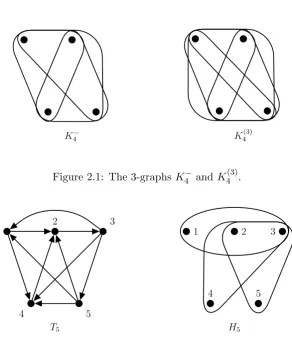
In order to simplify the notation in this chapter, we denote byK4(3) the complete 3-graph on 4 vertices, and byK4−the 3-graph on 4 vertices with 3 edges; see Figure 2.1. Erd˝os and S´os [26, Problem 5] asked whether a sufficiently large 3-graphH with a positiveδ-linear density contains a copy ofK4(3), or at least a copy ofK4−. However, F¨uredi observed that the following construction of Erd˝os and Hajnal [22] gives a negative answer to the above question in a very strong sense.
Construction 2.2. Consider a random tournament Tn on n vertices. Let Hn be
the 3-graph on the same vertex set consisting of exactly those triples that span a cyclically oriented triangle inTn.
K4− K (3) 4
Figure 2.1: The 3-graphsK4− and K4(3).
1 2 3
4 5
T5
1 2 3
4 5
[image:26.595.173.466.94.448.2]H5
Figure 2.2: An example of the Construction 2.2 forn= 5.
information about this problem and its history can be found in [69, Section 5]. One can check that in every 3-graph obtained in this way, any four vertices span at most two edges, i.e., for every n ∈ N the 3-graph Hn does not contain K4−. It remains
to show that for everyδ >0, the δ-linear density of a typicalHn tends to 1/4 as n
goes to infinity. In fact, we prove that even (1/logn)-linear density almost surely tends to 1/4.
We start with the following standard concentration lemma.
Lemma 2.3. Let p ∈ [0,1], r ∈ N such that r ≥ 2, and n ∈ N. In an n-vertex
r-graph H, we associate with every edge e∈E(H) a random event E(e) such that
• PE(e)=p for every e∈E(H), and
• The events E(e) and E(e0) are independent whenever |e∩e0| ≤1.
there exists a positive constant c such that
P
"
∃A⊆V(H),|A| ≥ n
logn :
|{e∈E(H[A]) : E(e)}| −p|E(H[A])|>
|A|
r
logn
#
=e
−c·n2
log4 (n).
Proof. Fix an arbitrary setA⊆V(H) with|A| ≥n/logn. We claim that
P "
|{e∈E(H[A]) : E(e)}| −p|E(H[A])|>
|A|
r
logn #
=e
−c0·n2
log4(n) (2.4)
for somec0 >0. The statement of the lemma then follows easily by a union bound over all subsets ofV(H) of size at least n/logn, so it remains to prove the claim.
Consider an edge-coloring of H[A] with r2 |Ar−2|−2 colors, such that every color class is a linear r-graph, i.e., any two edges of the same color intersect in at most one vertex. Since every fixed edge intersects in at least two vertices less than
r
2
|A|−2
r−2
other edges, such a coloring can be found in a greedy way. Since
r 2
|A| − 2 r−2
·|A|(|A| −1) r4·logn <
|A|
r
logn,
we infer that the event inside the probability formula in (2.4) implies that in at least one of the color classes, say C, the size of {e ∈ C : E(e)} deviates from its expectation by at least|A|(|A| −1)/(r4·logn).
Fix a color class C. First, observe that |C| ≤ |A2|/ r2 = |Ar|(|(rA−1)|−1). The events E(e) and E(e0) are independent for every e, e0 ∈ C, hence by Chernoff’s inequality (see, e.g., [2, Corollary A.1.7]) we obtain
P
|{e∈C: E(e)}| −p|C|> |A|(|A| −1) r4·logn
<2·exp
−2|A|2(|A| −1)2 |C| ·r8·log2n
,
which is equal to e
−c0·n2
log4n for c0 sufficiently small (recall that |A| ≥ n/logn and
|C|<|A|(|A|−1)). The claim now follows by a union bound over all color classes.
We are ready to show that the lower density in Construction 2.2 is equal to 1/4.
Observation 2.5. Consider a random sequence (Hn)n∈N from Construction 2.2.
With probability1, the lower density of (Hn)n∈N is equal to1/4.
Proof. Recall that |V(Hn)| = n. Let H be the complete 3-graph on n vertices,
the underlying tournament of Hn form an oriented cycle. Lemma 2.3 yields that
with probability 1−e
−c·n2
log4n, for all subsets A⊆V(H
n) of size at leastn/logn, the
number of edges inHn[A] is between (1/4−1/logn) |A3|
and (1/4 + 1/logn) |A3|. Therefore, by Borel-Cantelli Lemma (see, e.g., [2, Lemma 8.6.1]), with probability one there existsn0 ∈N such that the property above is true for every n≥n0. But
this immediately implies that the lower density of (Hn)n∈N is 1/4.
The main result of this chapter is that the Construction 2.2 is essentially the best possible. This answers a question of Erd˝os from [21], which is based on the ori-ginal problem of Erd˝os and S´os, positively.
2.2
Flag algebra setting
The proof of the main theorem is based on the semidefinite method described in Section 1.2. Through the whole chapter, we will useF to denote the set of all non-isomorphic finite K4−-free 3-graphs, and Fk to denote the subset of F containing all k-vertex K4−-free 3-graphs. Next, for a fixed K4−-free 3-graph σ with a given labelling of its vertices, we defineFσ to be the set all finiteK−
4 -free 3-graphs with
a fixed embedding ofσ, andFσ
k to be the appropriate subsets. Analogously to the
graph setting presented in Section 1.1, we construct an algebra A, algebras Aσ,
whereσ is a fixed labelledK4−-free 3-graph, and averaging operatorsJ·Kσ :A
σ → A.
Finally, we denote by Hom+(A,R) the set of all algebra homomorphismsψfrom A toRsuch thatψ(F)≥0 for every F ∈ F.
A sequence ofK4−-free 3-graphs (Hn)n∈N of increasing order is convergent if
the limit limn→∞p(F, Hn) exists for everyF ∈ F. As in the graph case, there is a
one-to-one correspondence between the set Hom+(A,R) and the set of all vectors in [0,1]F that represents the limit probabilities of convergent sequences.
We derive now some additional inequalities that are valid for any convergent sequence of 3-graphs (Hn)n∈Nwith lower density at least 1/4.
Let us first informally explain the main idea behind the inequalities. Consider an arbitrary type σ that has a positive density in the limit, and let F be a σ-flag with exactly one non-rooted vertex. Furthermore, assume thatnis sufficiently large. Now fix a copy S of σ inHn and consider the set U(S) of all vertices u ∈ V(Hn)
that extendsS to a copy of F. The following two outcomes can happen:
• The size ofU(S) is small, i.e.,o(n). But then, for this choice ofS, both the
• The size of U(S) is large, i.e., Ω(n). But then, by the assumption on the
lower density, for this choice of S, the probability that three random points belong toU(S) and span an edge is asymptotically at least a quarter of the probability that three random points belongs toU(S).
Analysis of these two outcomes is given in the following lemma.
Lemma 2.6. Let (Hn)n∈N be a convergent sequence of 3-graphs with lower density
at least1/4. Let φbe its limit, σ a type and F ∈ Fσ
|σ|+1 a σ-flag. In addition, let
κ:=F3= X
G∈Fσ v(σ)+3
αG·G and κ+:=
X
G∈Fσ v(σ)+3
α+G·G,
where
α+G :=
αG if the three non-labelled vertices of Gspan an edge, and
0 otherwise.
It holds that
φ J4κ
+−κ
Kσ
≥0. (2.7)
Note that the values of the coefficients αG are uniquely determined by the choice
ofF. Also note that αG∈ {0,1}for everyG∈ Fvσ(σ)+3.
Proof. First observe that if φ σ∅ = 0, then all the terms in the left-hand side of (2.7) are equal to zero. For the rest of the proof, we assumeφ σ∅>0.
Suppose for the contrary that (2.7) is not true, i.e., φ(J4κ
+−κ
Kσ) = −εr
for some εr > 0. Let qn be the values of the expression J4κ
+−κ
Kσ evaluated on
the densities of Hn. Since the sequence (Hn)n∈N is convergent, there exists n0 ∈N
such thatqn0 ≤ −εr/2. Moreover, since (Hn) has lower density at least 1/4, we may
assume that d(Hn0, βe) ≥ 1/4 for βe := 3
p
εr/13. It follows that one can get βeεr
for free.
Fix an embedding θ of σ in Hn0. Let q
θ
n0 be the value of the expression
(4κ+−κ) evaluated on the rooted densities of Hθ
n0. If there are less than βen
vertices that extend θ to F, then qθn0 is at least −6 (βe)3 −o(1). On the other
hand, if at leastβen vertices extendθ toF, then the density of the subhypergraph
induced by those vertices is at least 1/4 and hence 4κ+≥κ−o(1). In other words,
qθn0 ≥ −o(1).
Recall that pσσ∅ denotes the probability that a random labelling of V σ∅
with labels1, . . . , v σ∅ produces the typeσ, and note thatpσσ∅·p σ∅, Hn0
The definition of the conditional probability yields that
qn0 =p
σ σ∅·p
σ∅, Hn0
·E
h qnθ0
i
≥ −6 (βe)3−o(1),
where the average is taken over all possible embeddings θ of σ in Hn0. However,
the choice ofβe implies that qn0 ≥ −6εr/13−o(1) which contradicts the fact that
qn0 ≤ −εr/2.
We are now ready to present the two inequalities we are going to use in the next step. Letσbe the unique type on 2 vertices; from now on, we also write “2” to denote this type. We denote the 3-vertexσ-flag with no edges byF0, and the 3-vertex
σ-flag with one edge byF1. The first inequality is an instance of (2.7) forσ =2and
F =F1. Let κ1 be the corresponding κ and let κ+1 be the corresponding κ+. The
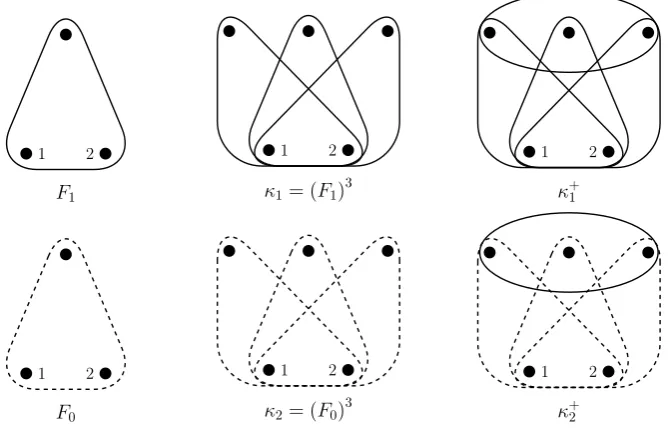
first line in Figure 2.3 shows the flagF1 and the corresponding linear combinations
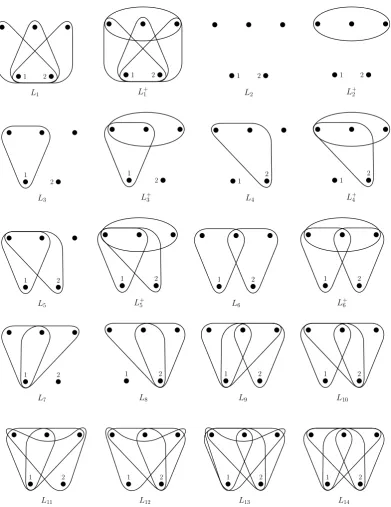
κ1 and κ+1. Since all σ-flags in Fσ are K4−-free, it follows that κ1 =L1 +L+1 and
κ+1 =L+1. The σ-flagsL1 and L+1 are depicted in Figure 2.4.
Analogously, letκ2 beκ and letκ+2 beκ+from (2.7) forF =F0 (again, σ is
equal to2). The second line in Figure 2.3 shows the flag F0, and the combinations
κ2 andκ+2. It holds that
κ2 = 14
X
i=2
Li+
6
X
i=2
L+i and κ+2 =
6
X
i=2
L+i ,
where the σ-flags L2, . . . , L14 and L+2, . . . , L+6 are again depicted in Figure 2.4.
Lemma 2.6 yields that
φ J4κ+1 −κ1K2
≥0, (2.8)
and
φ J4κ+2 −κ2K2
≥0. (2.9)
2.3
3
-graphs with
4
vertices spanning at most
2
edges
In this section, we present the main result of this chapter. Specifically, we prove the following theorem.
Theorem 2.10. For everyεTHM >0there existδTHM>0andnTHM∈Nsuch that
every 3-graphH on at least nTHM vertices withd(H, δTHM)≥1/4 +εTHM contains
1 2
F1
1 2
κ1= (F1)3
1 2
κ+ 1
1 2
F0
1 2
κ2= (F0)3
1 2
[image:31.595.157.493.113.328.2]κ+2
Figure 2.3: The expressions used in the inequalities (2.8) and (2.9). A solid line denotes an edge, a dashed line a non-edge, and finally we sum over all the possible choices edge/non-edge for the triples where there is neither a dashed nor a solid line.
Recall that F7 is the set of all K4−-free 3-graphs of size 7. It holds that |F7|= 8157. Let EXT7 be the set of all 3-graphs from F7 that can possibly appear
as induced subhypergraphs of the 3-graphs from Construction 2.2. It holds that |EXT7|= 247. We start the proof of Theorem 2.10 with the following lemma.
Lemma 2.11. There exist rational numbers (αG)G∈F7, where αG = 0 for G ∈
EXT7, and αG < 0 otherwise, such that the following holds. If φ is an element of
Hom+(A,R) that satisfies (2.8) and (2.9), then
φ
X
G∈F7
αG·G
≥0.
Proof. Using the method from Section 1.2, an instance of the SDP was used to find positive rationals γ1 and γ2 and 8 symmetric positive semidefinite matrices
M1, M2, . . . M8 with rational entries such that the following holds:
φ
γ1·J4κ
+
1 −κ1K2+γ2·J4κ
+
2 −κ2K2+
X
i∈[8]
Jx T
i MixiKσi
=φ
X
G∈F7
αG·G
,
1 2
L1
1 2
L+ 1
1 2
L2
1 2
L+ 2
1 2
L3
1 2
L+3
1 2
L4
1 2
L+4
1 2
L5
1 2
L+ 5
1 2
L6
1 2
L+ 6
1 2
L7
1 2
L8
1 2
L9
1 2
L10
1 2
L11
1 2
L12
1 2
L13
1 2
[image:32.595.127.519.138.646.2]L14
• the typeσ1 is the type with one vertex,
• the typeσ2 is the type with three vertices and no edge,
• the typeσ3 is the type with three vertices and one edge,
• the types σ4, . . . , σ8 are the five specific types on five vertices given in
Fig-ure 2.5,
• the vector x1 ∈ (RF4σ1)|F σ1
4 | is the vector whose j-th coordinate is equal to
thej-th element of the canonical base of RF4σ1,
• fori= 2,3, the vector xi ∈(RF5σi)|F σi
5 |is the vector whose j-th coordinate is
equal to thej-th element of the canonical base ofRF5σi, • for i = 4,5, . . . ,8, each vector xi ∈ (RF6σi)|F
σi
6 | is the vector whose j-th
coordinate is equal to thej-th element of the canonical base ofRF6σi, and
• αG= 0 if G∈EXT7, and αG<0 otherwise.
The left-hand side of the inequality above is non-negative by (1.2), (2.8), and (2.9).
The proof of the previous lemma was found with a computer assistance. We used semidefinite programming libraries CSDP [11] and SDPA [74] to find an ap-proximate solution of the corresponding semidefinite program. The apap-proximate solution was then turned into an exact one by a careful rounding. For the round-ing part, we used a mathematical software Sage [71]. Also note that the sizes ai
of the setsFσ1
4 ,F
σ2
5 ,F
σ3
5 ,F
σ4
6 ,F
σ5
6 ,F
σ6
6 ,F
σ7
6 , andF
σ8
6 , which coincide with the order
of the matricesMi, are 5,95,47,191,135,95,101, and 148, respectively.
The numerical values of γ1, γ2, and the entries of the matrices M1, . . . , M8
can be downloaded fromhttp://honza.ucw.cz/phd/. Each matrixMiis not stored
directly but as an appropriate number of vectorsvij ∈Qai and positive rationalswj
i
such that
Mi = ri
X
j=1
wij·vij×vji
T
,
wherer1 = 3, r2 = 45, r3 = 21, r4 = 63, r5 = 60, r6= 43, r7= 31,and r8 = 25.
In order to make an independent verification of our computations easier, we created a sage script called “lemma 2 13-verify.sage”, which is also available on the web page mentioned above.
1
σ1
3
1 2
σ2= 123
3
1 2
σ3
3 5 4
1 2
σ4= 123,124
3 5 4
1 2
σ5= 123,124,135
3 5 4
1 2
σ6= 123,124,135,245
3 5 4
1 2
σ7= 123,124,135,145
3 5 4
1 2
[image:34.595.132.519.114.293.2]σ8= 123,124,125
Figure 2.5: The typesσ1 through σ8. A solid line denotes an edge, a triple without
a solid line spans a non-edge.
Corollary 2.12. Let F be a 3-graph of size at most 7 such that its induced density in the 3-graphs from Construction 2.2 is zero. If φ ∈ Hom+(A,R) satisfies (2.8)
and (2.9), then φ(F) = 0.
We are now ready to present the proof of Theorem 2.10.
Proof of Theorem 2.10. Suppose to the contrary that there existsd >1/4 and a se-quence (Hn)n∈N of K4−-free 3-graphs of increasing orders with lower density d. In
other words
λ (Hn)n∈N
=d >1/4.
Let us assume, without loss of generality, that (Hn)n∈N converges and φC is the
limit; We aim to show that the edge density of φC is zero, contradicting the fact
that it must be at least the lower density of the sequence.
LetB be the graph depicted in Figure 2.6, which we call the butterfly 3-graph. Since the 3-graphs from Construction 2.2 are B-free, Corollary 2.12 implies thatφ(B) = 0 whenever a homomorphismφ∈Hom+(A,R) satisfies (2.8) and (2.9). In particular, for the limitφ of any convergent sequence of K4−-free 3-graphs with lower density at least 1/4, we haveφ(B) = 0.
Instead of applying the claim directly toφC, we first construct from (Hn)n∈N
a new sequence (Hn0)n∈
N such that λ (H
0
n)n∈N
= 1/4. The new sequence is ob-tained by arandom sparsification of (Hn)n∈N, i.e., removing each edge of each Hn
Figure 2.6: The butterfly 3-graph B.
following observation, which is an immediate corollary of Lemma 2.3.
Observation 2.13. Let(Hn)n∈N be a sequence of3-uniformK −
4 -free3-graphs with
d := λ (Hn)n∈N
> 1/4. Furthermore, for every n ∈ N, let Hn0 be a random subhypergraph of Hn obtained by removing every hyperedge of Hn independently
with probability1−41d. Then
P h
λ Hn0n
∈N
= 1/4i= 1.
Let (Hn0)n∈Nbe a sequence of 3-graphs obtained from (Hn)n∈Nby a random
sparsification with probability 1−41d. All the following holds with probability one. Letφ0C be its limit (the sequence (Hn0)n∈
Nmust be convergent). Lemma 2.6 implies
thatφ0C satisfies both (2.8) and (2.9). Hence, by Corollary 2.12, the induced density of B in φ0C is equal to zero. But this implies thatφC(F) = 0 for any F ∈ F that
contains B as a non-induced subhypergraph. This holds because otherwise there would be some F ∈ F that contains a non-induced copy of B and φC(F) > 0.
However, a positive proportion of the induced copies of F from φC will be then
turned, by a random sparsification, to induced copies of B in φ0C. We conclude that thenon-induced density of the butterfly 3-graph B inφC is equal to zero. In
particular, any non-negative combination of the elements of F5 that contain the butterfly as a non-induced subhypergraph must be zero inφC.
We are now ready to conclude that the edge density ofφC is zero. Letρ∈ F3
be the 3-graph on three (non-rooted) vertices that span an edge. Letσ be the one-vertex type andρ1 ∈ F3σ the flag corresponding toρ with exactly one rooted vertex.
Observe that all the elements ofFσ
5 with positive coefficients in the expression (ρ1)2
containB as a subhypergraph. So, φC J(ρ1)
2
Kσ
= 0, which implies that
φC(ρ)2 =φC(Jρ1Kσ)
2 ≤φ
C J(ρ1)
2
Kσ
Theorem 2.10 together with the 3-uniform version of the Hypergraph Re-moval Lemma (see, e.g., [67, Theorem 3] for the general r-uniform version of the lemma) immediately implies that if the δ-linear density is more than 1/4, we do not have only one but actually many copies ofK4−. Let us first precisely state the version of the removal lemma for 3-graphs, which actually follows already from the results in [31].
Lemma 2.14 (Hypergraph Removal Lemma, 3-uniform case). For every εRL >0
and fixed k-vertex 3-graph F, there exists γRL >0 such that every3-graph H on n
vertices with less than γRL · nk
copies of F can be made F-free by removing less than εRL· n3 edges.
We are now ready to derive the counting version of Theorem 2.10.
Corollary 2.15. For everyεCNT>0there existγCNT>0,δCNT>0andnCNT∈N
such that every 3-graphH on at least nCNT vertices withd(H, δCNT)≥1/4 +εCNT
containsγCNT· v(H4 )
copies of K4−.
Proof. Suppose for a contradiction there is ε0 >0 such that for every γ >0, δ >0
and n ∈ N we can find a 3-graph H(n, δ, γ) on at least n vertices, with δ-linear density at least 1/4 +ε0, and with less than γ· n4 copies of K4−. Fix such ε0 and
for everyγ, δ and n, fix one such 3-graphH(n, δ, γ).
LetnTHM andδTHMbe the constants from Theorem 2.10 applied forεTHM:=
ε0/2. Fix an integer k so that klogk > nTHM and 1/k < δTHM. Next, let γRL :=
γRL(k) be the constant given by the Hypergraph Removal Lemma for K4− applied
forεRL :=ε0/(3k3). Finally, let
G:=H(k·logk,1/k, γRL(k)).
This means that every S ⊆V(G) of size at least v(G)/k ≥ logk contains at least (1/4 +ε0) |S3| edges. Moreover, Gcan be transformed to a K4−-free 3-graphG0 by
removing less than ε0
3k3 ·
v(G0) 3
edges. Consequently, every S ⊆ V(G0) of size at leastv(G0)/k contains at least (1/4 + 2ε0/3) |S3|
−O(|S|2) edges. Since k is large, it follows that
1
4 +
2ε0
3
·
|S|
3
−O |S|2>
1
4 +
ε0
2
·
|S|
3
.
Therefore,d(G0,1/k)>1/4 +ε0/2 and Theorem 2.10 imply thatG0 contains a copy
Also, exploiting the fact that the semidefinite method seeks for a vector minimizing a given linear function over a convex superset of the set Hom+(A,R), we can replace the d(H, δ) ≥ 1/4 +ε condition by another that controls only the densities inside subsets that are common neighborhood of two vertices in H and inside subsets that are common neighborhoods in the complement ofH.
Theorem 2.16.For everyε >0there existδ >0andn0 ∈Nsuch that the following
is true. Every 3-graph H on n ≥ n0 vertices such that for every {u, v} ∈ V(2H)
satisfies the following two conditions:
• if|NH(u, v)| ≥δn, then H[NH(u, v)]has density at least (1/4 +ε), and
• if|NH(u, v)| ≥δn, then H[NH(u, v)]has density at least (1/4 +ε),
containsK4− as a subhypergraph.
Proof. Suppose for a contradiction the theorem is false. Hence there exist a positive ε0 and a convergent sequence ofK4−-free 3-graphs (Hn)n∈Nof increasing orders such
that eachHn satisfies the two conditions from the statement of this theorem. We
denote the limit of this sequence byφC.
First, we claim that the edge density ofφC is positive (in fact, it is strictly
more than 1/32). Fix two arbitrary vertices u and v in Hn. Since either uvw ∈
E(Hn), oruvw∈E(Hn) for everyw∈V(Hn)\ {u, v}, it follows that there is a set
S⊆V(Hn) with at least v(Hn)/2−1 vertices such that Hn[S] has edge density at
least (1/4+ε0). But this means thatHnhas edge density at least 1/32+ε0/8−o(1).
Let us now analyze some further properties of φC. Let σ = 2 be the
two-vertex type. Recall thatF0 is the 3-vertex σ-flag with no edges, andF1 is the edge
with two rooted vertices. If P[φσC(F1) = 0] = 1, then, by averaging over all pairs
of the vertices, we conclude that the edge density ofφC is zero. However, we know
the edge density is more than 1/32. Analogously, if P[φσC(F0) = 0] = 1, then the
edge density of φC must be one. However, since φC K4−
= φC
K4(3)
= 0, the edge density ofφC is trivally at most 1/2, a contradiction. Therefore, there exists a
positiveγ such that
P[φσC(F1)≥γ]≥γ,
and similarly
P[φσC(F0)≥γ]≥γ.
pairs{u, v}have large co-degree in the complement. Since the density on every such subset is at least 1/4 +ε0 >1/4, the inequalities (2.8) and (2.9) have some slack for
φ=φC. More precisely, there exists a positiveζ such that
φC J4κ
+
1 −κ1K2
≥ζ, (2.17)
and
φC J4κ
+
2 −κ2K2
≥ζ. (2.18)
Now recall the semidefinite program (1.8) and its dual (1.9). In the proof of Lemma 2.11, we used the semidefinite method to find two positive rationalsγ1 and
γ2 and an expression
R=
8
X
i=1
ri
X
j=1
bij·
s
Aσi
j
2{
σi
,
wherebij ≥0, Aσi
j ∈ Aσi, and the order of the expression s
Aσi
j
2{
σi
is at most 7
for everyi∈[8] andj∈[ri], such that the following is true:
γ1·J4κ
+
1 −κ1K2+γ2·J4κ
+
2 −κ2K2+R =
X
G∈F7
αG·G,
where αG = 0 for every G ∈ EXT7, and αG < 0 for every G ∈ F7 \EXT7. It
holds that φ(R) ≥0 for every φ ∈Hom+(A,R). Furthermore, the reasoning from Section 1.2 yields that the boundz(R)≥0 holds also for every vectorz∈R|F7|that
satisfies the following:
• all the linear inequalities of the formz
r
(Aσ1)2
z σ1
≥0, where Aσ1 ∈ Aσ1
and the order of the expressionr(Aσ1)2
z σ1
is at most 7,
.. .
• all the linear inequalities of the formz
r
(Aσ8)2
z σ8
≥0, where Aσ8 ∈ Aσ8
and the order of the expressionr(Aσ8)2
z σ8
is at most 7,
• the non-negative inequalitiesz(F)≥0 for every F ∈ F7, and • the equationz PF∈F7F= 1.
The typesσ1, . . . , σ8 are the same types as in Lemma 2.11, i.e., the types depicted
Finally, Recall the 3-graph B depicted in Figure 2.6. We slightly abuse the notation and useB also to denote the linear combination of the elements ofF7 that is equal to B in A. Our aim is to use the homomorphism φC for constructing a
vectorz ∈ SF7 that satisfies the inequalities (2.8), (2.9) and z(B) >0. This is an immediate contradiction, because on one hand
z γ1·J4κ
+
1 −κ1K2+γ2·J4κ
+
2 −κ2K2+R
≥0,
but on the other hand every 3-graphG∈EXT7 does not contain B as an induced
subhypergraph, and hence
z
X
G∈F7
αG·G
<0.
Let us emphasize that in the argument we do not need that the vectorz ∈ SF7 to be a 7-local density profile of some convergent sequence of 3-graphs.
Letφb ∈Hom+(A,R) be the limit corresponding to the sequence of 3-graphs (Bk)k∈N, where Bk is the k-th balanced blow-up of the butterfly 3-graph B. Every
3-graphBk is K4−-free, and the density of B tends to 24/625, i.e.,φb(B) = 24/625.
For every ξ ∈ [0,1], let φξ := ξ·φC+ (1−ξ)·φb. Since the set SF7 is convex, it
follows that (φξ)`∈ SF7 for every ξ∈[0,1]. However, since φ1 =φC satisfies even
the inequalities (2.17) and (2.18), there exists a pointξ0 ∈(0,1) such that
φξ0 J4κ
+
1 −κ1K2
≥ζ/2≥0,
and
φξ0 J4κ
+
2 −κ2K2
≥ζ/2≥0.
However,φξ0(B) = (1−ξ0)·φb(B)>0, a contradiction.
2.4
Uniqueness of the tournament construction
In the last section of this chapter, we show that the limit of any convergent sequence of K4−-free 3-graphs with lower density 1/4 has to be equal to the limit of the se-quence of 3-graphs from Construction 2.2. In order to do so, we use the argument of Falgas-Rarvy, Pikhurko and Vaughan [27], who proved the following closely re-lated result.
n0 ∈N such that every 3-graph H on n≥n0 vertices with the minimum co-degree
at least(1/4 +ε)·n contains a copy ofK4−.
The relation between Theorems 2.10 and 2.19 is that the 3-graphs from Con-struction 2.2 serve as extremal configurations for the corresponding two problems. The entire section is devoted to a proof of the following theorem.
Theorem 2.20. Let (Hn)n∈N be a convergent sequence ofK4−-free3-graphs so that
λ((Hn)) = 1/4, and let φ ∈ Hom+(A,R) be its limit. It holds that φ is equal to
the homomorphismψ, which is the limit of the sequence of3-graphs from Construc-tion 2.2 with increasing orders.
Proof. Without loss of generality, v(Hn) = n. Recall that the set EXT7 is the
set of all 7-vertex induced subhypergraphs of the 3-graphs from Construction 2.2. Corollary 2.12 and the induced version of the Hypergraph Removal Lemma [66, Theorem 6] implies that there exists a sequence of 3-graphs (Hn0)n∈Nsuch that each
Hn0 can be obtained fromHnby adding or removingo(n3) edges, and every 7-vertex
induced subhypergraph ofHn0 is isomorphic to one of the 3-graphs from EXT7. Note
that (Hn0)n∈Nis a convergent sequence of 3-graphs. Also note that the density of any
fixed 3-graphGin (Hn0)n∈N tends toφ(G). Since the application of the Hypergraph
Removal Lemma changed onlyo(n3) edges, it holds thatλ((Hn0)) = 1/4. Therefore, it is enough to show that the limit of (Hn0)n∈Nis equal to ψ.
The induced subhypergraph property satisfied by the 3-graphsHn0 yields the following important fact: for every induced subhypergraphZ of anyHn0 on at most 7 vertices, there exists a tournament TZ such that the edges ofZ are in one-to-one
correspondence to the cyclically oriented triangles inTZ.
We now setup a variant of the flag algebra framework for convergent se-quences of 3-graphs that satisfy this property on 7-vertex induced subhypergraphs. LetG be the set of all 3-graphs such that each of their 7-vertex induced subhyper-graphs is isomorphic to one of the 3-subhyper-graphs from EXT7. Also, for any type σ with
the underlying 3-graph from G, let Gσ be the corresponding set of all the σ-flags
with this property. Finally, letA0 be the corresponding flag algebra defined byG. It follows that there exists a homomorphismφ0 ∈ Hom+(A0,R) which represents the limit of the sequence (Hn0)n∈N.
Letσ =2be the 2-vertex type and letF0 andF1be the σ-flags on 3 vertices
with zero edges and one edge, respectively. Since Hn0 was obtained from Hn by
adding or removing o(n3) edges, the homomorphism φ0 satisfies the following two
inequalities, which are direct analogues of (2.8) and (2.9) in the algebra A0:
φ0 J4ι
+ 1 −ι1K2
≥0 and φ0 J4ι
+ 2 −ι2K2
where
ι1 := (F1)3 =
X
G∈Gσ
5
αG·G, ι+1 :=
X
G∈Gσ
5
α+G·G,
ι2 := (F0)3 =
X
G∈Gσ
5
βG·G, and ι+2 :=
X
G∈Gσ
5
βG+·G.
The values of the coefficientsαG and βG are uniquely determined,
α+G:=
αG if the three non-labelled vertices ofG span an edge, and
0 otherwise,
and
βG+:=
βG if the three non-labelled vertices of Gspan an edge, and
0 otherwise.
Note that all the values ofαG, α+G, βGandβG+are either zero or one for everyG∈ G5σ.
Letρ∈ G be the 3-graph on 3 vertices with one edge. Using the semidefinite method, we find four positive definite matrices M10, . . . , M40 such that the following inequality in the algebraA0 holds:
ρ= X
F∈G6
αG·G≤
1 4·
X
F∈G6
F − X
i∈{1,2}
γi0·q
4ι+i −ιi y
2−
X
i∈[4]
q
(xiIi)T ·Mi0·(Iixi) y
σi,
(2.21) where
• αG=e(G)/20 for everyG∈ G6,
• γ10 = 148803/16384 andγ20 = 70943/16384, • the typeσ1 =2 is the two-vertex type,
• the typeσ2 is the type with four vertices a, b, c, dand no edge,
• the typeσ3 is the type with four vertices a, b, c, dand the edgeabc,
• the typeσ4 is the type with four vertices a, b, c, dand the edges abcand abd,
• the vectorx1 ∈(RG4σ1)|G σ1
4 |is the vector whosej-th coordinate is equal to the
j-th element of the canonical base of RG4σ1,
• fori= 2,3,4, the vector xi ∈(RG5σi)|G σi
5 | is the vector whosej-th coordinate