1
Master thesis
Jigsaw method, metatextual
knowledge, and prior subject
knowledge in multiple
documents reading
comprehension
Student:
Milou Morren
Student number:
s1929941
Master:
Psychology, Learning Sciences
Institution:
University of Twente
Faculty:
Behavioural, Management and Social Sciences
Candidate
M.D. (Milou) Morren
Degree
Master of Science in Psychology, University of Twente
School
Faculty of Behavioural, Management and Social Sciences
Drienerlolaan 5
7522 NB Enschede
The Netherlands
First supervisor
Prof. Dr. P.C.J. (Eliane) Segers
University of Twente, Enschede / Radboud University, Nijmegen
E-mail: [email protected]
Second supervisor
Dr. A.M. (Alieke) van Dijk
University of Twente, Enschede
Dankwoord
Circa een jaar geleden stond ik gespannen klaar voor het startschot van mijn thesis. Gemotiveerd om
dit avontuur aan te gaan, maar ook onzeker of ik mij hierdoor heen kon slaan met mijn recent
geconstateerde blessure. Mijn motivatie was daarom om niet als eerste de finish te behalen, maar om
mijn persoonlijke record te verbreken. Dit resulteerde in een ware ontwikkeling op zowel
wetenschappelijk, als persoonlijk vlak. Allen die mij hierbij gecoacht, aangemoedigd en gesteund
hebben wil ik hierbij graag bedanken.
Allereerst wil ik mijn begeleiders Eliane Segers en Alieke van Dijk bedanken. Eliane, bedankt voor je
steun en vertrouwen tijdens het proces. Op de momenten dat ik onzeker was, gaf jij mij het vertrouwen
dat het goed ging komen. Bedankt voor je begeleiding en geduld bij het structureren van de thesis en
het analyseren van de onderzoeksresultaten. Alieke, bedankt dat je deur altijd voor mij open stond voor
vragen of om te sparren. Met jouw kennis inspireerde, motiveerde en stimuleerde je mij tijdens het
proces.
Daarnaast wil ik de betrokken docent, roostermaker en de respondenten van het ROC van Twente in
Almelo bedanken voor het meewerken, meedenken en het bijdragen aan dit onderzoek. Zonder jullie
had deze thesis niet kunnen worden geschreven.
Ook wil ik graag familie en vrienden bedanken. Laura, hartelijk dank voor het delen van jouw
ervaringen en tips. Daarnaast wil ik je bedanken dat je altijd voor mij klaar stond in deze periode. Koen
en Jean-Paul, bedankt voor jullie kritische blik en advies. Mijn ouders Dick en Rina en mijn vriend
Mario bedankt voor jullie onvoorwaardelijke steun tijdens het proces. Tot slot wil ik Fleur, Lianne en
Annefleur bedanken voor hun vertrouwen en support.
1
Abstract
This study investigated the effects of the cooperative jigsaw method, metatextual knowledge, and prior
subject knowledge on multiple documents reading comprehension. In total, 49 students of secondary
vocational education participated in this study and were divided in a jigsaw condition and an individual
condition. The participants were tested on metatextual knowledge, prior subject knowledge, multiple
documents reading comprehension, and quality of jigsaw cooperation. The materials consisted of four
texts on broiler chicken, with different arguments for or against this. The results showed that reading
just one text and next cooperate through the jigsaw method with students who each read another text,
resulted in comparable multiple documents reading comprehension (as measured via content elements
and main messages) as individual reading of all four texts. Furthermore, metatextual knowledge and
prior subject knowledge did not have an effect on multiple documents reading comprehension, neither
in the jigsaw nor the individual reading condition. It can be concluded that jigsaw is a promising method
for multiple documents reading comprehension assignments, as it results in comparable multiple
documents reading comprehension compared to an individual reading method where students have to
read more documents and lack learning advantages on a social level.
Keywords: multiple documents reading comprehension; jigsaw; metatextual knowledge; prior subject knowledge
1. Introduction
In the current information and knowledge society, there is a high increase in rate of knowledge
production and dissemination through modern technologies. As a result, people often need to read
multiple documents to gain a complete understanding of an issue or to find an answer to their question
(Stadtler & Bromme, 2014). This also plays a role in education, where students are increasingly required
to handle and interpret information from multiple documents in reading assignments (Gil, Bråten,
Vidal-Abarca, & Strømsø, 2010; Rouet & Eme, 2002). However, secondary vocational education students (in
Dutch called mbo-students) experience problems in multiple documents reading comprehension. They
experience information overload when they receive high amounts of textual information from multiple
documents. Furthermore, they find it difficult to integrate textual information in one broad
understanding about the subject described in multiple documents (Groeneveld & Van Steensel, 2009).
These problems could be explained by having low metatextual knowledge and/or having low prior
subject knowledge. Metatextual knowledge is knowledge about features of texts and reading strategies
(Rouet & Eme, 2002), and prior subject knowledge refers to knowledge about a particular topic prior
2
Bråten, Anmarkrud, Brandmo, and Strømsø (2014) explain that problems with multiple
documents reading comprehension could be solved with instructional methods that target students’
strategic processing and foster beliefs, orientations, and knowledge that underlie multiple documents
reading comprehension. Examples of such methods are explicit instruction of integration, modeling of
integration, uses of graphic organizers, summarization and annotation of single texts, and cooperative
discussions with multiple texts (Barzilai, Zohar, & Mor-Hagani, 2018). Cooperative methods
specifically seem promising, because they enable students to enhance their reading comprehension
through sharing knowledge and learning from each other (Aronson & Patnoe, 2011).
One cooperative method that could be useful for multiple documents reading comprehension is
jigsaw, where groups divide one overall assignment in multiple information sources or topics (Aronson
& Patnoe, 2011). Specifically, in jigsaw an assignment or task is divided over group members who
share knowledge from their source or topic (Amador & Mederer, 2013; Aronson & Patnoe, 2011;
Oshima, Oshima, & Fujita, 2018). Hereby, students are able to use each other’s knowledge to “get the whole picture” (Aronson & Patnoe, 2011, p. 27) instead of building on their individual knowledge,
including metatextual and prior subject knowledge (Ozuru, Dempsey, & McNamara, 2009). The
interactions with group members within the cooperation are key for making sense and giving meaning
to information of multiple documents (Van Rijk, Volman, De Haan, & Van Oers, 2017). Through
jigsaw, students are able to understand an issue from different perspectives with reduced cognitive effort
(Aronson & Patnoe, 2011; Mayer, 2014).
Even though jigsaw seems promising for multiple documents reading comprehension, teachers
at school scarcely use the method for reading assignments (Jansen van Rosendaal, 2018; Van Elsäcker,
2002). As students are required to comprehend information from multiple documents, more insights are
needed into the effects of jigsaw on multiple documents reading comprehension (see Bråten, Braasch,
& Salmerón, 2016; Ghaith & El-Malak, 2004; Slavin, 2015; Zuo, 2011). Therefore, this study aimed to
provide more insights into the effects of the cooperative jigsaw method, metatextual knowledge, and
prior subject knowledge on multiple documents reading comprehension. The results could provide
researchers with more understanding of multiple documents reading comprehension, and the effects of
jigsaw, metatextual knowledge, and prior subject knowledge on this. Furthermore, the study could
provide practitioners with insights on how to support students’ multiple documents reading
comprehension.
1.1 Multiple documents reading comprehension
Multiple documents reading comprehension refers to the mental representation and understanding of an
issue based on information from multiple text-based documents (Strømsø, 2017). Forming a mental
representation about an issue using multiple documents is more complex than when doing this using a
3
must visually process the described words, identify their phonological, orthographic, and semantic
representation, and connect them to understand the underlying meaning of the sentence (Perfetti &
Stafura, 2014). This meaning must then be integrated across sentences, in which the reader must use
relevant prior subject knowledge about the subject, generate inferences, identify the text structure, and
take the author’s goals and motives in account (Graesser, 2015). In forming a mental representation of
an issue by using multiple documents, the reader also has to go beyond within-document integration.
Specifically, he or she has to compare, contrast, corroborate, and connect the content of multiple
documents in a mental representation (Ferguson, Bråten, Strømsø, & Anmarkrud, 2013). Perfetti,
Rouet, and Britt (1999) refer to this mental representation as “the documents model”. The documents
model consists of an intertext model and a situation model. The intertext model contains the obtained
information about the relationships among and within the documents and the events described within
each document. The situation model combines the information about the topic or situation described in
the multiple documents (Perfetti et al., 1999). In multiple documents reading comprehension, the reader
must connect the intertext model and situation model, note and elaborate upon the perspectives
discussed in multiple documents, and draw connecting inferences among them (Ferguson et al., 2013).
Multiple documents reading comprehension tasks are important to facilitate a deep and
integrated text understanding from multiple documents (Gil et al., 2010). According to the MD-TRACE
model of Rouet and Britt (2011), multiple documents reading comprehension tasks must require
students to construct a task model, determine the information requirement to perform the task model,
select, process, and integrate information from multiple documents, construct the final task model, and
finally assess the quality of the final task product to facilitate multiple documents reading
comprehension (Rouet & Britt, 2011). Earlier studies have shown that argumentation tasks facilitate
multiple documents reading comprehension by helping students to interpret, understand, and integrate
information of multiple documents and by stimulating a generally deeper engagement with information
described in multiple documents (Britt & Rouet, 2012; Le Bigot & Rouet, 2007; Nussbaum, 2008;
Wiley & Vos, 1999). With argumentation tasks, the extent to which students are able to comprehend
information from multiple documents and to make connections between this information are made
visible (Diakidoy, Ioannou, & Christodoulou, 2017; Wiley & Vos, 1999).
1.2 The effects of metatextual knowledge and prior subject knowledge on multiple
documents reading comprehension
Individual variation among readers may impact to what extent the reader is able to connect the intertext
model and situation model, to note and elaborate upon the perspectives described in multiple
documents, and to draw connecting inferences among them (Kintsch, 1998; Snow, 2002). Two relevant
4
prior knowledge about the subject of the text (Kostons & Van der Werf, 2015; McNamara, Ozuru, &
Floyd, 2017; Rouet & Eme, 2002).
Metatextual knowledge is defined as “the knowledge a person possesses about texts and text
comprehension activities” (Rouet & Eme, 2002, p. 121). For example, it refers to knowledge about the
functions of structural text features (Brand-Gruwel & Stadtler, 2011; Rouet & Eme, 2002) and reading
strategies (Potocki, Ros, Vibert, & Rouet, 2017). Metatextual knowledge allows readers to understand
the organizational structure of a text and to see how viewpoints are presented, developed and illustrated
(Horning, 2011). Hereby, it permits students to regulate their reading of multiple documents to improve
comprehension (Kozminsky & Kozminsky, 2001).
Prior subject knowledge, or topic-relevant prior knowledge, refers to “readers’ pre-existing
knowledge related to the text content” (Ozuru et al., 2009, p. 228). Prior knowledge about a subject influences the reader’s ability to give meaning to information, as readers are able to compare their prior
subject knowledge to new information (Anderson, 2004; Kozminsky & Kozminsky, 2001; McLaughlin,
2012). Furthermore, when readers have prior subject knowledge, they are more able to associate,
connect, and understand information elements (Kostons & Van der Werf, 2015). This knowledge helps
readers in connecting information from multiple documents to construct one broad understanding about
the particular subject (Kostons & Van der Werf, 2015; Kozminsky & Kozminsky, 2001; McNamara,
2001). Therefore, prior subject knowledge is considered to be an important predictor of multiple
documents reading comprehension (Shapiro, 2004; Rouet & Britt, 2011). In fact, most definitions of
reading comprehension involve the interaction between the text and readers’ prior subject knowledge
(Alfassi, 2004; Meneghetti, Carretti, & De Beni, 2006; Tarchi, 2010).
1.3 Jigsaw method to support multiple documents reading comprehension
Aronson (1978) developed “the jigsaw classroom” as a cooperative learning method (see also Aronson
& Bridgeman, 1979). In jigsaw, a complex learning task or subject is divided in different topics over
group members within mixed-topic cooperation groups. Hereby, group members obtain information
about one of the topics, making themselves expert on that topic. The knowledge of all different topics
is necessary to complete the whole learning task successfully. This means that group members are
dependent on each other’s knowledge to perform the whole learning task (Aronson & Patnoe, 2011;
Johnson, Johnson, & Stanne, 1989; Mayer, 2008). Therefore, the jigsaw method is often compared to a
puzzle, whereby all different puzzle pieces are necessary to complete the whole puzzle
(Hertz-Lazarowitz, Kagan, Sharan, Slavin, & Webb, 2013; Van Dijk, 2017; Van Keulen & Koster, 2006).
The jigsaw method could be an effective method for multiple documents reading
comprehension in several ways. First, as jigsaw group members are dependent on each other’s
knowledge, they become each other’s resources instead of competitors (Aronson & Patnoe, 2011;
5
take an active part in their individual learning and to take a prominent and active role in the group
process to share their knowledge actively with their group members (Aronson & Patnoe, 2011;
Hertz-Lazarowitz et al., 2013). When students take such an active role in their learning process and knowledge
sharing, it benefits their reading comprehension (McLaughlin, 2012). Second, the interaction with group
members helps students to make sense of and give meaning to information of multiple documents. As
students actively share knowledge, they are encouraged to think about and express their views and ideas,
which helps them to make sense of a subject (Van Rijk et al., 2017). In these interactions, both the
sharing and receiving of knowledge benefits the learning process and achievement (Webb, 1982, 2008).
Third, the jigsaw method helps students to see the subject from multiple perspectives, as group members
share their different views from their expertise within the cooperation (Mayer, 2014). Hereby, the group
members are able to construct a broader understanding about the subject, and enhance their knowledge
to a greater extent (Barrett, 2017; Heltemes, 2009; Nelson, 2008). Fourth, students have to invest less
cognitive effort and overcome less individual working memory limitations in comparison to individual
reading. In jigsaw, task-relevant information is divided among group members, which provides a larger
reservoir of cognitive capacity (Kirschner, Paas, & Kirschner, 2009; Mayer, 2014). This so-called
“distribution benefit” (Mayer, 2014, p. 547) could prevent students’ experienced information overload
and improve reading comprehension.
1.4
The present study
The above overview of the literature indicated that students experience multiple documents reading
comprehension as a challenge, which could be explained by a lack of metatextual knowledge and prior
subject knowledge (Kostons & Van der Werf, 2015, Rouet & Eme, 2002). The cooperative jigsaw
method could be a promising method in multiple documents reading comprehension (Kazemi, 2012;
Meng, 2010). The division of sources or topics of the overall assignment reduces cognitive effort of
students (Mayer, 2014). The resource interdependence encourages group members to interact with each
other to share knowledge (Aronson & Patnoe, 2011). This interaction helps students in making sense
and giving meaning to the issue described in the multiple documents (Van Rijk et al., 2017).
Furthermore, it helps understanding the issue from different perspectives (Aronson & Patnoe, 2011).
The present study aimed to provide more insights into the effects of jigsaw, metatextual knowledge,
and prior subject knowledge on multiple documents reading comprehension. The study hereby also
considered the interaction effects of jigsaw and metatextual or prior subject knowledge on multiple
documents reading comprehension. Based on the literature overview, two hypotheses were proposed:
Hypothesis 1: Performing a multiple documents reading comprehension task by the cooperative jigsaw
method results in better multiple documents reading comprehension (expressed in content elements and
6
Hypothesis 2: Performing a multiple documents reading comprehension task with metatextual
knowledge and prior subject knowledge results in better multiple documents reading comprehension
(expressed in content elements and main messages), which is more prominent when the task is
performed individually compared to cooperation by jigsaw.
To examine hypotheses 1 and 2, an experimental study was conducted in which students were asked to
execute a multiple documents reading comprehension task individually or with the jigsaw method. The
subject of the documents was broiler chicken. This subject was chosen, because it involved conflicting
views and arguments. Hereby, the subject could provide a challenge to integrate all views and
arguments in one coherent representation. Prior to the multiple documents reading comprehension task,
the metatextual knowledge of the participants, and their prior subject knowledge about broiler chicken
were measured. After the multiple documents reading comprehension task, the quality of the jigsaw
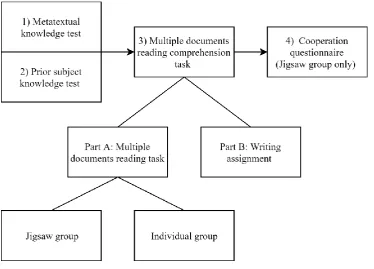
[image:9.595.71.446.336.605.2]cooperation was measured. The design of the present study is visualized in Figure 1.
Figure 1. Overview of the study design
2. Method
2.1 Participants
Students that followed a social care education at ROC of Twente, a school for secondary vocational
education, were approached to participate in the study. In total, three classes were involved in the study.
7
49 participants were able to join the study. From these 49 participants, 10 (20%) were male and 39
(80%) were female. Their ages ranged from 16 to 24, the average age was 19.
In preparation, the researcher divided the initial group of 59 students in two conditions: the
jigsaw condition (N = 28) and individual condition (N = 31). The participants were not equally spread
over the two conditions, because the number of participants in the jigsaw condition needed to be
divisible by four as the jigsaw groups in this study consisted of four people. The researcher assigned
the participants to a condition by dividing them alternately using an alphabetic list of names. The
participants of the jigsaw condition were divided over seven jigsaw groups, again based on alternate
use of the list of names.
During the experiment, 10 participants were not present that were originally assigned to the
jigsaw condition (N = 3) or individual condition (N = 7). When participants from the jigsaw condition
were absent, new members for their group were selected from the individual condition poule. Hereby,
the same selecting strategy was used as before, where participants were alternately selected with an
alphabetic list of names. In total, three jigsaw groups were adjusted, or in other words, their missing
group members were replaced with participants from the individual condition. No groups were
eliminated, which means that there were still seven jigsaw groups. The final 49 participants were
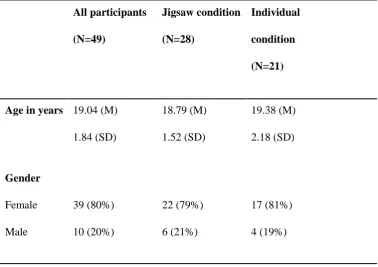
divided among the jigsaw condition (N = 28) and individual condition (N = 21). The descriptive
[image:10.595.72.451.471.738.2]statistics of participants’ characteristics are shown in Table 1.
Table 1.
Participant Characteristics
All participants
(N=49)
Jigsaw condition
(N=28)
Individual
condition
(N=21)
Age in years 19.04 (M)
1.84 (SD)
18.79 (M)
1.52 (SD)
19.38 (M)
2.18 (SD)
Gender
Female
Male
39 (80%)
10 (20%)
22 (79%)
6 (21%)
17 (81%)
8
2.2
Materials
2.2.1 Metatextual knowledge test
To measure the metatextual knowledge of the participants, the metatextual knowledge test of Potocki,
Ros, Vibert and Rouet (2017) was used, after it was translated to Dutch. The test consisted of 15 multiple
choice questions related to reading strategies (“How do you…”) and characteristics of texts (“What
is…’’). The metatextual knowledge was measured by calculating the total score of the correct answers
on these questions. Potocki et al. (2017) had a Cronbach’s alpha of α = .69 when they used the test with
40 students. However, the Cronbach’s alpha in this study was only α = .27. Three items were deleted to improve the alpha to α = .54. As this score was still below the threshold of .7, the internal consistency
was insufficient (George & Mallery, 2003). This means that the test was not reliable. Therefore, the
results of the metatextual knowledge test need to be interpreted with caution.
2.2.2 Prior subject knowledge test
The open recall test by Gijlers, Weinbergen, Van Dijk, Bollen, and Van Joolingen (2013) was used to
measure participants’ prior subject knowledge about broiler chicken. In the open recall test, the
participants had to write or draw as much information as they could within three minutes. The prior
subject knowledge was measured by calculating the total score of correct and new items. An item was
coded as correct when it consisted of truthful information. An example of a correct item was that a
broiler chicken is used for fast food (see Wakker Dier, 2019). An example of an incorrect item was that
a broiler chicken lays eggs, as broiler chickens are too young to lay eggs (see Martin, 2013; Jozzie,
2013). An item was coded as new when the participant had not mentioned a specific topic before. For
example, when the participant mentioned fast food once, this would count as a new item. When a
participant also mentioned synonyms for fast food, these items would not be coded as new. Practical
examples, such as McDonalds for fast food, were counted as new items. The interrater agreement of the
test was measured by coding 10 percent of the data by an independent second coder. The average
weighted Cohen’s Kappa score was κ = .97. As this score was above .81, the strength of agreement was
perfect (Landis & Koch, 1977). This means that the test was reliable.
2.2.3 Multiple documents reading comprehension task
In the multiple documents reading comprehension task, four contrasting texts about broiler chicken
were used with an average length of 179 words. The texts were original parts of articles of the animal
welfare organization Wakker Dier in the Netherlands, an online Dutch library, an online Dutch health
blog, and the Dutch weblog The Daily Standard (see Appendix A-D). In selecting these texts, the
reliability of the texts and reading level of the participants, as indicated by their teacher, were taken into
account. The participants received these texts on paper with font style Calibri and font size 11, to assure
9 2.2.4 Writing assignment
The writing assignment consisted of an argumentation task to measure multiple documents reading
comprehension. Argumentation tasks make visible to what extent people comprehend information from
multiple documents and make connections between the information (Diakidoy et al., 2017; Wiley &
Vos, 1999). In the current study, the argumentation task was executed in the form of a writing
assignment to challenge the participants to gather and organize knowledge obtained from the multiple
documents reading comprehension task (Durst & Newell, 1989; Hebert, Simpson, & Graham, 2013).
This helps students to transform and integrate information (Hemmerich & Wiley, 2002; Voss & Wiley,
2001; Wiley, 2001; Britt, Wiemer-Hastings, Larson, & Perfetti, 2004) and to self-explain information
from texts (Chi, De Leeuw, Chiu, & LaVancher, 1994). In the writing assignment, the participants were
asked to substantiate their opinion about broiler chicken with the information that they had obtained
during part A of the multiple documents reading task (see Figure 1).
To measure multiple documents reading comprehension, first the data of the writing assignment
were coded on content elements and main messages, based on the study of Ferguson et al. (2013).
Content elements consisted of perspectives that were discussed in the multiple documents, and the main
messages consisted of general inferences of the multiple documents. The interrater agreement of the
described content elements and main messages was measured by coding 10 percent of the data by an
independent second coder. The average weighted Cohen’s Kappa score was κ = 1. As this score was
above .81, the strength of agreement was perfect (Landis & Koch, 1977). This means that the test was
reliable.
Second, the equality scores of the content elements and the equality scores of the main messages
described in the writing assignment were calculated by the formula of Van Dijk (2017):
√((25 − 𝑥1)2+ (25 − 𝑥2)2+ (25 − 𝑥3)2+ (25 − 𝑥4)2)). Hereby, the equality scores of the described content elements were calculated based on their proportional part relative to all content
elements of each document. The equality scores of the main messages were calculated based on their
proportional part relative to the main messages of all documents together. In both cases, a perfect
proportional distribution would mean a distribution of 25% per document. The equality represented the
sum of the deviation from this 25% per document. Finally, the equality scores were decoded, so that an
equality score of 100 would be a perfect score. The higher the equality score, the higher the extent of
equal distribution of information from multiple documents described in the writing assignment.
2.2.5 Cooperation questionnaire
Cooperation between group members is an important element of jigsaw (Tarhan & Sesen, 2012). To
evaluate the quality of cooperation of the jigsaw groups, the study used the cooperation questionnaire
by Gommans, Segers, Burk, and Scholte (2015). This questionnaire measures the experienced extent of
10
which there were dominant group members within the cooperation), and mutual listening (to which
group members listened to each other’s suggestions within the cooperation). These three aspects of
cooperation satisfaction, mutual listening and low dominance are considered to be important conditions
of the cooperative jigsaw method (Adams, 2013; Hedeen, 2003; Leyva-Moral & Camps, 2016).
Because the traditional cooperation questionnaire of Gommans et al. (2015) focuses on
cooperation in duos, the questions were adjusted to the group sizes within this study. Cooperation
satisfaction, dominance, and mutual listening were assessed in respectively three, two and two 10-point
interval scale questions (1 = not much/well, 10 = very much/well). The Cronbach’s alpha of cooperation satisfaction was α = .58, dominance was α =.27 and mutual listening consisted of α = .92. In the case of cooperation satisfaction, one item was deleted to improve the alpha to α = .67. Mutual listening had an
excellent internal consistency as the alpha score was above .9 (Streiner, 2003). However, as the scores
of cooperation satisfaction and dominance were below the threshold of .7, their internal consistency
was insufficient. This means that these components of the questionnaire were not reliable (George &
Mallery, 2003). Therefore, results regarding cooperation satisfaction and dominance need to be
interpreted with caution.
The results of this test were not used to test the hypotheses, instead, they were used to evaluate
the quality of cooperation within the jigsaw condition. As cooperation satisfaction (77.14%) and mutual
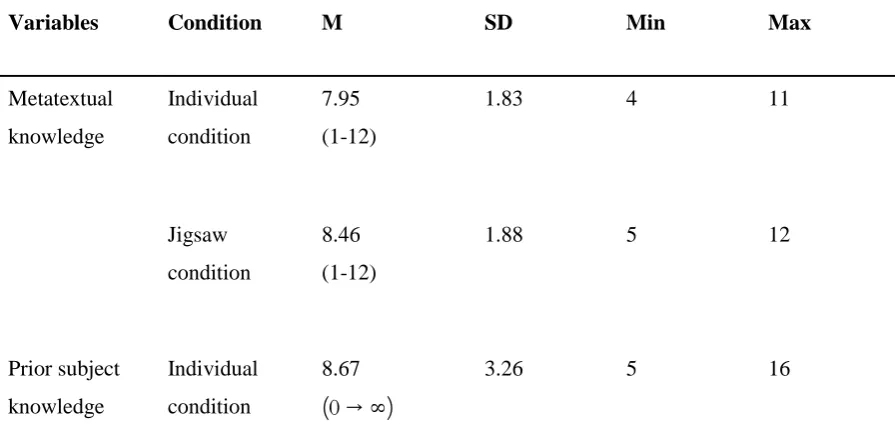
listening (86.05%) scored high and dominance (64.45%) scored moderate (see Table 2), we concluded
that the jigsaw groups cooperated to a moderate satisfactory level.
2.3 Procedure
First, permission was obtained from the ethics committee of University of Twente to perform this study.
The participants were asked to participate in this study by signing a consent form. In the consent form,
the participants were informed about the research goal and anonymization of the data. Subsequently,
the experiment started in which the participants first had to perform the metatextual test within 15
minutes. After that, they had to perform the open recall test about broiler chicken within three minutes.
Next, the participants were split in the jigsaw condition and the individual condition. The researcher
divided the participants in the jigsaw condition into groups of four participants. Every group received a
package of in total four documents about broiler chicken, of which every group member had to read
one of these documents individually within 5 minutes. Subsequently, they had to discuss the content of
their documents with their jigsaw group within 10 minutes. At the same time, the participants of the
individual condition had to read the same four documents individually within 15 minutes. After
finishing the multiple documents reading task, all participants of the jigsaw condition and individual
condition had to perform the writing assignment, in which they had to substantiate their opinion about
broiler chicken based on the obtained knowledge during the multiple documents reading task within 15
11
about their cooperation in their jigsaw groups, which lasted 5 minutes. An overview of the sequence of
tests can be found in Figure 1.
3. Results
3.1 Descriptive statistics
To test the hypotheses, first the descriptive statistics of the metatextual knowledge, prior subject
knowledge, content elements, main messages, cooperation satisfaction, dominance, and mutual
listening were computed (see Table 2).
Second, Pearson’s correlations were computed between condition (individual reading or
jigsaw), metatextual knowledge, prior subject knowledge, content elements, and main messages. As
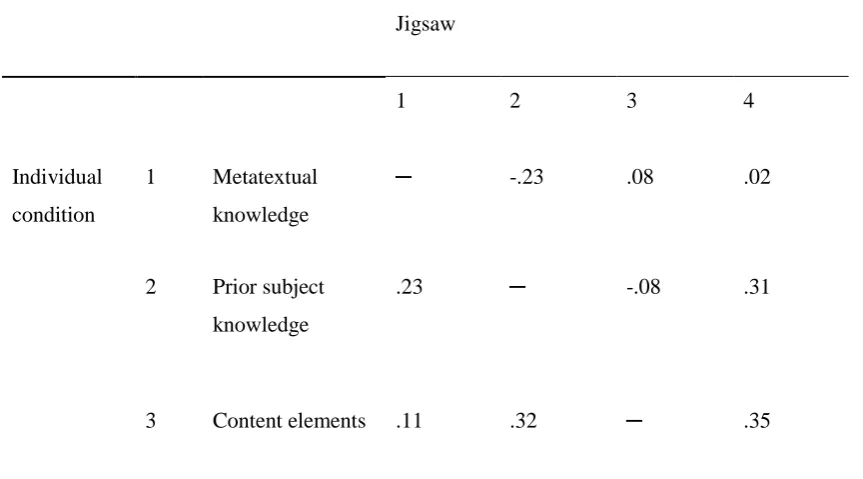
can be seen in Table 3, prior subject knowledge correlated significantly (p = .05) with main messages when conditions (individual reading and jigsaw) were taken together for the analysis. Table 4 shows
that when the two conditions were analyzed separately, the correlation was no longer significant
(individual reading, p = .47; jigsaw, p = .11). No further significant correlations were found. Even though the correlations were not significant, it seems that metatextual knowledge and prior subject
knowledge had higher positive correlations with multiple documents reading comprehension (as
measured via content elements and main messages) in the individual condition compared to the jigsaw
condition, except for prior subject knowledge on the described main messages in the multiple
[image:14.595.73.521.493.713.2]documents reading comprehension task.
Table 2.
Descriptive Statistics
Variables Condition M SD Min Max
Metatextual
knowledge
Individual
condition
7.95
(1-12)
1.83 4 11
Jigsaw
condition
8.46
(1-12)
1.88 5 12
Prior subject
knowledge
Individual
condition
8.67 (0 → ∞)
12
Jigsaw
condition
7.29 (0 → ∞)
4.17 1 15
Content elements Individual condition 41.18 (1-100)
20.70 13.40 71.14
Jigsaw
condition
46.87
(1-100)
19.08 13.40 82.68
Main messages Individual
condition
42.56
(1-100)
20.27 13.40 71.14
Jigsaw
condition
36.20
(1-100)
25.41 13.40 100
Cooperation satisfaction Jigsaw condition 15.43 (1-20) 77.14% 1.75 13 19
Dominance Jigsaw
condition
12.89
(1-20)
64.45%
2.73 9
13 Table 3.
Correlation Matrix Both Conditions Together
1 2 3 4 5
1 Condition ─
2 Meta textual
knowledge
.14 ─
3 Prior subject
knowledge
-.18 -.08 ─
4 Content
elements
.14 .11 .04 ─
5 Main
messages
-.14 .05 .28* .21 ─
* p < .05
Table 4.
Correlation Matrix Jigsaw Condition and Individual Condition Separately
Jigsaw
1 2 3 4
Individual
condition
1 Metatextual
knowledge
─ -.23 .08 .02
2 Prior subject
knowledge
.23 ─ -.08 .31
[image:16.595.71.503.481.720.2]
14
4 Main messages .15 .17 .05 ─
Note: The correlations of the individual condition are shown on the left, the correlations of the jigsaw condition are shown on
the right.
* p < .05
3.2 The effects of Jigsaw, metatextual knowledge and prior subject knowledge on multiple
documents reading comprehension
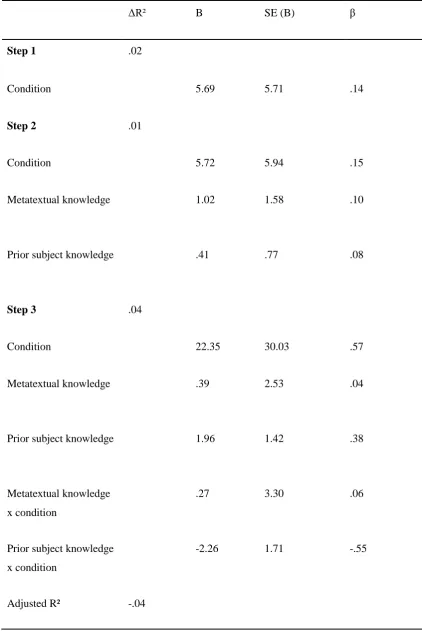
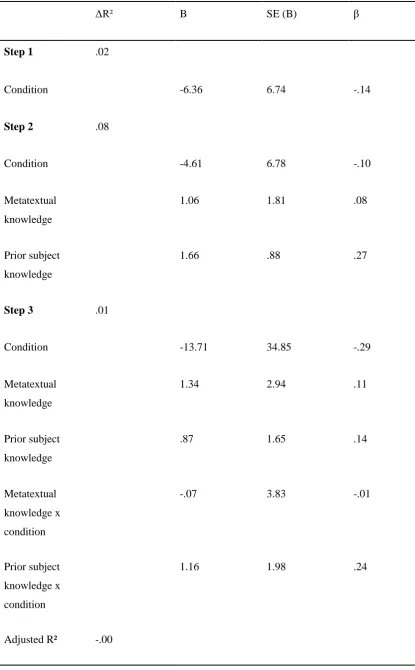
To test hypotheses 1 and 2, a hierarchical regression analysis was conducted (see Table 5 and 6). In a
regression analysis, residues are required to have a normal distribution (Ganzeboom, 2015). In this
study, metatextual knowledge (Skewness .03; Kurtosis -.65), prior subject knowledge (Skewness .26;
Kurtosis -.34), content elements (Skewness -.39; Kurtosis -.80) and main messages (Skewness -.24;
Kurtosis -.85) were all normally distributed.
Hypothesis 1 states that performing a multiple documents reading task by the cooperative
jigsaw method results in better multiple documents reading comprehension (expressed in content
elements and main messages) compared to performing the same task individually. To test this
hypothesis, in step 1, participants’ condition (jigsaw or individual reading) was entered as independent
variable to the dependent variables of content elements and main messages. No significant effects were
found of condition on content elements (p = .32) or main messages (p = .35); the conditions were comparable in their multiple documents reading comprehension.
Hypothesis 2 states that performing a multiple documents reading comprehension task with
metatextual knowledge and prior subject knowledge results in better multiple documents reading
comprehension (expressed in content elements and main messages), which is more prominent when the
task is performed individually compared to cooperation by jigsaw. To test this hypothesis, step 2 and 3
of the hierarchical regression analysis were conducted. In step 2, metatextual knowledge and prior
subject knowledge were entered as independent variables to the dependent variables of content elements
and main messages. No significant effects were found of metatextual knowledge on content elements
(p = .52) or main messages (p = .56), and of prior subject knowledge on content elements (p = .60) or main messages (p = .07). Despite the significant correlation of prior subject knowledge and main messages, as described in the descriptive analytics, there was no unique prediction of prior subject
knowledge on multiple documents reading comprehension when controlling for metatextual
knowledge. In step 3, the interaction of condition and metatextual knowledge or prior subject
knowledge was entered as independent variable to the dependent variables of content elements and main
messages. No significant effects were found of the interaction of condition and metatextual knowledge
15
Table 5. Hierarchical Regression Analysis Content Elements
ΔR² B SE (B) β
Step 1 .02
Condition 5.69 5.71 .14
Step 2 .01
Condition 5.72 5.94 .15
Metatextual knowledge 1.02 1.58 .10
Prior subject knowledge .41 .77 .08
Step 3 .04
Condition 22.35 30.03 .57
Metatextual knowledge .39 2.53 .04
Prior subject knowledge 1.96 1.42 .38
Metatextual knowledge
x condition
.27 3.30 .06
Prior subject knowledge
x condition
-2.26 1.71 -.55
Adjusted R² -.04
16 Table 6. Hierarchical Regression Analysis Main Messages
ΔR² B SE (B) β
Step 1 .02
Condition -6.36 6.74 -.14
Step 2 .08
Condition -4.61 6.78 -.10
Metatextual
knowledge
1.06 1.81 .08
Prior subject
knowledge
1.66 .88 .27
Step 3 .01
Condition -13.71 34.85 -.29
Metatextual
knowledge
1.34 2.94 .11
Prior subject
knowledge
.87 1.65 .14
Metatextual
knowledge x
condition
-.07 3.83 -.01
Prior subject
knowledge x
condition
1.16 1.98 .24
17
4. Discussion
The aim of the present study was to investigate the effects of the cooperative jigsaw method, metatextual
knowledge, and prior subject knowledge on multiple documents reading comprehension. The findings
showed no effects of jigsaw on multiple documents reading comprehension. Moreover, no effects were
found of metatextual knowledge and prior subject knowledge on multiple documents reading
comprehension, which was comparable in a cooperative jigsaw and individual reading condition.
With respect to hypothesis 1, the findings showed no significant effects of the cooperative
jigsaw method on multiple documents reading comprehension. This is in contrast with prior studies
who showed that jigsaw improves students’ reading comprehension compared to individual reading
(e.g., Nurbianta & Dahlia, 2018; Sami Ali, 2001). An explanation could be that in jigsaw, students are
dependent on their group member’s capabilities in selecting relevant information from their text (see
Griffin, Wiley, Britt, & Salas, 2017). When students are not able to select what information is relevant,
their group misses out on knowledge that was relevant to share or receive (Garcia, Abrego, & Robert,
2017). Hence the students from this study may not have benefited from the jigsaw method, as they did
not obtain the needed knowledge from their group members. Another explanation for our findings could
be that the students lacked required social skills for the cooperative learning method. Jigsaw demands
social efforts to communicate knowledge and coordinate actions with group members (Mayer, 2014).
When participants have the required social skills, jigsaw is used more effectively (Shaaban, 2006) which
leads to higher achievement and productivity in the groups (Johnson & Johnson, 2008).
With regard to hypothesis 2, the findings showed no significant effects of metatextual
knowledge and prior subject knowledge on multiple documents reading comprehension, which was
comparable in a cooperative jigsaw condition and an individual reading condition. This is contrary to
findings of earlier studies who claim that metatextual knowledge and prior subject knowledge improve
readers’ multiple documents reading comprehension (Kostons & Van der Werf, 2015; Kozminsky &
Kozminsky, 2001). One explanation could be that students were not able to activate metatextual
knowledge and prior subject knowledge in the right way. According to Kostons and Van der Werf
(2015), metatextual knowledge should be activated by asking students to write down in key words what
strategies they had used while reading a text prior to the multiple documents reading comprehension
test. They explain that if metatextual knowledge is not activated in the right way, it may be “less likely
that students will use what they know during the learning task, leading to inferior text comprehension”
(Kostons & Van der Werf, 2015, p. 266). In other words, students may not have been able to use their
metatextual knowledge in their multiple documents reading comprehension, as this knowledge was not
activated in the right way. Hattan, Singer, Loughlin, and Alexander (2015) claim that prior subject
knowledge also needs to be activated appropriately before readers can use it. Students that have high
prior subject knowledge are able to benefit from their knowledge in multiple documents reading
18
a certain perspective while reading a text (Wetzels, Kester, & Van Merriënboer, 2011). For example,
when reading texts about broiler chicken, students could take the perspective of an environmentalist.
As this study used no perspective taking exercises, the students with high prior subject knowledge may
not have been able to use their prior subject knowledge to enhance their reading comprehension
(Kostons & Van der Werf, 2015; Wetzels et al., 2011).
Interestingly, the effects of metatextual knowledge and prior subject knowledge were
comparable in the cooperative jigsaw and individual reading condition. This was in contrast with prior
studies who showed that students in jigsaw groups are able to use each other’s knowledge to “get the
whole picture” (Aronson & Patnoe, 2011, p. 27) instead of building on their individual metatextual and
prior subject knowledge (Ozuru, Dempsey, & McNamara, 2009). An explanation for the contradictory
finding could be found in the experienced moderate dominance (64.45%) of the jigsaw groups.
According to Adams (2013), dominance of a group member is one of the possible risk factors in
knowledge sharing with jigsaw. If there is a dominant group member within a jigsaw cooperation, other
group members are often not allowed to share their knowledge before questions or comments are made
by the dominant group member (Adams, 2013). Hence, in the moderate dominant cooperation of this
study, the students may not have been able to benefit and learn from each other’s knowledge, as
dominant group members prevented this learning process. As a result, metatextual knowledge and prior
subject knowledge had comparable effects on the cooperative Jigsaw and individual learning condition.
The present study has several limitations that need to be considered. First, the metatextual knowledge test and two components (cooperation satisfaction and dominance) of the cooperation
questionnaire were not reliable. Therefore, the results of these tests need to be interpreted with caution.
The tests may be unreliable due to the small sample size (see Vos, 2009). Therefore, future research is
recommended to involve a larger sample size. Second, multiple documents reading comprehension was
measured with a writing task. As a result, the test may have measured not only the extent of multiple
documents reading comprehension, but also the participants’ writing skills. Hereby, the writing skills
may have influenced the scores of reading comprehension, as for example, students may not have been
able to translate their knowledge into the writing assignment (Bolle, 2010). Future research is
recommended to consider the advantages and disadvantages of different measure methods of multiple
documents reading comprehension when they decide upon a method to use. Third, the study did not
have a longitudinal design. Therefore, we could not conclude from the present study whether the jigsaw
method or metatextual knowledge and prior subject knowledge were predictive for multiple documents
reading comprehension. Future research is recommended to examine the effects of the cooperative
jigsaw method, metatextual knowledge and prior subject knowledge over a longer period of time.
Fourth, due to the small sample size and overrepresentation of females in this study, the findings cannot
be generalizable to the whole student population (Vos, 2009). Future research is recommended to
involve a larger sample size with greater gender diversity. Furthermore, scholars are advised to involve
19
regions or countries, with different subject matters, to examine if the findings are generalizable across
different settings.
Implications of the study are for the school environment. In current education, teachers scarcely use the jigsaw in their classes for multiple documents reading tasks (Jansen van Rosendaal, 2018; Van
Elsäcker, 2002). Based on the findings of this study, teachers are advised to use the method more often.
The jigsaw results in comparable multiple documents reading comprehension as individual methods,
while the students read less documents. Therefore, jigsaw is an useful method to prevent students from
experiencing information overload. Jigsaw also brings many learning advantages on a social level (see
Van Dijk, 2017). When teachers decide to use the jigsaw method, it could be beneficial for them to
invest in students’ social and cooperative skills to ensure effective use of the method. For example, they
could involve more cooperative reading assignments in their classes. Furthermore, it could be useful
for them to appoint a leader within the groups that monitors the equal contribution of group members
(see Adams, 2013). Hereby, they could prevent dominance in the groups that hinders knowledge sharing
and multiple documents reading comprehension. Moreover, when teachers want students to use their
metatextual knowledge and prior subject knowledge, they are advised to activate this knowledge with
activating exercises. For example, they could ask students to write down in key words what strategies
they use while reading a text to activate metatextual knowledge and they could ask students with high
prior knowledge to take a perspective during reading a text (Kostons & van der Werf, 2015; Wetzels,
et al., 2011). Hereby, students are more able to use and share their knowledge with group members, to
enhance their multiple documents reading comprehension.
To conclude, the present study showed no significant effects of jigsaw, metatextual knowledge,
and prior subject knowledge on multiple documents reading comprehension. From this study, it can be
concluded that the cooperative jigsaw method is a promising method for multiple documents reading
comprehension assignments, as it results in comparable multiple documents reading compared to an
20
References
Aarnoutse, C., & Schellings, G. (2003). Learning reading strategies by triggering reading motivation.
Educational Studies, 29(4), 387-409.
Adams, F. H. (2013). Using jigsaw technique as an effective way of promoting cooperative
learning among primary six pupils in Fijai. International Journal of Education and Practice, 1(6), 64-74.
Alfassi, M. (2004). Reading to learn: Effects of combined strategy instruction on high school
students. Journal of Educational Research, 97(4), 171−184.
Amador, J. A., & Mederer, H. (2013). Migrating successful student engagement strategies
online: Opportunities and challenges using jigsaw groups and problem-based learning.
Journal of Online Learning and Teaching, 9(1), 89-105.
Anderson, R.C. (2004). Role of reader’s schema in comprehension, learning, and memory.
In R.B. Ruddell, M.R. Ruddell, & H. Singer (Eds.), Theoretical models and processes of reading (5th ed., pp. 594–606). Newark, DE: International Reading Association.
Aronson, E. (1978). The jigsaw classroom. Beverly Hills, CA: Sage.
Aronson, E., & Bridgeman, D. (1979). Jigsaw groups and the desegregated classroom: In
pursuit of common goals. Personality and Social Psychology Bulletin, 5(4), 438-446.
Aronson, E., & Patnoe, S. (2011). Cooperation in the classroom: The Jigsaw method. London, UK: Pinter & Martin.
Barrett, K. (2017). The effect of homogeneous versus heterogeneous reading achievement
groups on 4th graders reading comprehension (Master’s thesis, Goucher College).
Retrieved from https://mdsoar.org/bitstream/handle/11603/7475/BarrettKristin_
FinalActionResearch.pdf?sequence=1&isAllowed=y
Barzilai, S., Zohar, A. R., & Mor-Hagani, S. (2018). Promoting integration of multiple texts: a review
of instructional approaches and practices. Educational Psychology Review, 30(3), 973-999. Bolle, T. (2010). Taal in het mbo: Een vak apart? Levende Talen Magazine, 97(6), 22-26.
Brand-Gruwel, S., & Stadtler, M. (2011). Solving information-based problems: Evaluating
sources and information. Learning and Instruction, 21(2), 175–179.
Bråten, I., Anmarkrud, Ø., Brandmo, C., & Strømsø, H. I. (2014). Developing and testing a model of
direct and indirect relationships between individual differences, processing, and multiple-text
comprehension. Learning and Instruction, 30, 9-24.
Bråten, I., Braasch, J. L., & Salmeron, L. (2016). Reading multiple and non-traditional texts:
New opportunities and new challenges. In E. B. Moje, P. Afflerbach, P. Enciso, & N.
21
Bråten, I., & Strømsø, H. I. (2006). Effects of personal epistemology on the understanding of
multiple texts. Reading Psychology, 27(1), 457–484.
Britt, M. A., & Rouet, J. F. (2012). Learning with multiple documents: Component skills and
their acquisition. In J.R. Kirby & M.J. Lawson (Eds.), Enhancing the quality of learning:Dispositions, instruction, and learning processes (pp. 276-314). New York, NY: Cambridge University Press.
Britt, M. A., Wiemer-Hastings, P., Larson, A. A., & Perfetti, C. A. (2004). Using intelligent feedback
to improve sourcing and integration in students' essays. International Journal of Artificial Intelligence in Education, 14(3-4), 359-374.
Chi, M.T.H., De Leeuw, N., Chiu, M;, & LaVancher, C. (1994). Eliciting self-explanations improves
understanding. Cognitive Science, 18, 439-477. De Groot, J. (2014). Niks mis met plofkop. Retrieved from
https://www.dagelijksestandaard.nl/2014/04/niks-mis-met-plofkip/
Diakidoy, I. A. N., Ioannou, M. C., & Christodoulou, S. A. (2017). Reading argumentative
texts: Comprehension and evaluation goals and outcomes. Reading and Writing, 30(9), 1869-1890.
Durst, R., & Newell, G. E. (1989). The uses of functions: James Britton’s category system and
research on writing. Review of Educational Research, 58, 375–394.
Ferguson, L. E., Bråten, I., Strømsø, H. I., & Anmarkrud, Ø. (2013). Epistemic beliefs and
comprehension in the context of reading multiple documents: Examining the role of
conflict. International Journal of Educational Research, 62, 100-114. Ganzeboom, H. (2015). Stappenplan Regressie-Analyse. Retrieved from
http://www.harryganzeboom.nl/Teaching/stappenplan_regressie-analyse.pdf.
Garcia, A., Abrego, J., Robert, R. (2017). Using the Jigsaw Method for Meaningful Learning to
Enhance Learning and Retention in an Educational Leadership Graduate School Course.
Global Journal of Human-Social Science, 17(5), 4-16.
George, D., & Mallery, P. (2003). SPSS for Windows step by step: A simple guide and reference. 11.0 update (4th ed.). Boston, MA: Allyn & Bacon.
Ghaith, G., & El-Malak, M. A. (2004). Effect of Jigsaw II on literal and higher order EFL
reading comprehension. Educational Research and Evaluation, 10(2), 105-115.
Gijlers, H., Weinberger, A., Van Dijk, A. M., Bollen, L., & Van Joolingen, W. (2013).
Collaborative drawing on a shared digital canvas in elementary science education:
The effects of script and task awareness support. International Journal of Computer- Supported Collaborative Learning, 8(4), 427-453.
Gil, L., Bråten, I., Vidal-Abarca, E., & Strømsø, H. I. (2010). Understanding and integrating
multiple science texts: Summary tasks are sometimes better than argument tasks.
22
Gommans, R., Segers, E., Burk, W. J., & Scholte, R. H. (2015). The role of perceived
popularity on collaborative learning: A dyadic perspective. Journal of Educational Psychology, 107(2), 599.
Graesser, A. C. (2015). Deeper learning with advances in discourse science and technology.
Policy Insights from the Behavioral and Brain Sciences, 2(1), 42-50.
Griffin, T. D., Wiley, J., Britt, M. A., & Salas, C. R. (2017). The role of clear thinking in learning
science from multiple-document ınquiry tasks. International Electronic Journal of Elementary Education, 5(1), 63-78.
Groeneveld, M. J., & Van Steensel, K. (2009). Kenmerkend mbo: Een vergelijkend onderzoek naar de kenmerken van mbo-leerlingen, vmbo-leerlingen en de generatie Einstein. Hilversum: Hiteq.
Hattan, C., Singer, L. M., Loughlin, S., & Alexander, P. A. (2015). Prior Knowledge Activation in
Design and in Practice. Literacy Research: Theory, Method, and Practice, 64(1), 478-497. Hebert, M., Simpson, A., & Graham, S. (2013). Comparing effects of different writing activities on
reading comprehension: A meta-analysis. Reading and Writing, 26(1), 111-138.
Hedeen, T. (2003). The reverse jigsaw: A process of cooperative learning and discussion.
Teaching Sociology, 31(3), 325-332.
Heeremans, M. M. (2007). Coöperatief leren en begrijpend lezen in het basisonderwijs: Effecten van coöperatief leren op leesmotivatie en tekstbegrip (Doctoral dissertation, University of Utrecht). Retrieved from
https://dspace.library.uu.nl/bitstream/handle/1874/23273/070906%20hele%20scriptie.doc;seq
uence=1
Heltemes, L. (2009). Social and academic advantages and disadvantages of within-class
heterogeneous and homogeneous ability grouping. Mathematical and Computing Sciences Masters. Paper 93.
Hemmerich, J. & Wiley, J. (2002). Do argumentation tasks promote conceptual change about
volcanoes. Proceedings of the Twenty-Fourth Annual Conference of the Cognitive Science. Society. Hillsdale, NJ: Erlbaum.
Hertz-Lazarowitz, R., Kagan, S., Sharan, S., Slavin, R., & Webb, C. (2013). Learning to cooperate, cooperating to learn. New York, NY: Springer Science & Business Media.
Horning, A.S. (2011). Where to put the manicules: A theory of expert reading. Across the Disciplines, 8(2), 8-33.
Jansen van Rosendaal, B. (2018). Differentiatie bij Begrijpend Lezen: Hoe leerkrachten in het basisonderwijs differentiatie vormgeven begrijpend lezen en hun overwegingen daarbij (Master's thesis, University of Leiden). Retrieved from
23
endaal%2C%20Brechtje-s1449540-MA%20Thesis%20PEDA-2018.pdf?sequence=1
Johnson, D.W., Johnson, R.T., & Stanne, M.B. (1989). Impact of goal and resource
interdependence on problem-solving success. Journal of Social Psychology, 129(1), 621-629.
Jozzie (2013). Wanneer leggen kippen eieren? Retrieved from
https://dier-en-natuur.infonu.nl/vogels/115462-wanneer-leggen-kippen-eieren.html
Kazemi, M. (2012). The effect of Jigsaw technique on the learners’ reading achievement: The
case of English as L2. The Modern Journal of Applied Linguistics, 5(3), 170-184.
Kintsch, W. (1998). Comprehension: A paradigm for cognition. New York, NY: Cambridge University Press.
Kirschner, F., Paas, F., & Kirschner, P. A. (2009). Individual and group-based learning from
complex cognitive tasks: Effects on retention and transfer efficiency. Computers in Human Behavior, 25(2), 306-314.
Kostons, D., & Van der Werf, G. (2015). The effects of activating prior topic and
metacognitive knowledge on text comprehension scores. British Journal of Educational Psychology, 85(3), 264-275.
Kozminsky, E., & Kozminsky, L. (2001). How do general knowledge and reading strategies
ability relate to reading comprehension of high school students at different
educational levels? Journal of Research in Reading, 24(2), 187-204.
Landis, J. R., & Koch, G. G. (1977). The measurement of observer agreement for categorical
data. Biometrics, 159-174.
Le Bigot, L., & Rouet, J. F. (2007). The impact of presentation format, task assignment, and
prior knowledge on students' comprehension of multiple online documents. Journal of Literacy Research, 39, 445–470.
Leyva-Moral, J. M., & Camps, M. R. (2016). Teaching research methods in nursing using
Aronson's Jigsaw Technique: A cross-sectional survey of student satisfaction. Nurse Education Today, 40, 78-83.
Martin, Q. (2013). Het korte leven van een plofkip. Retrieved from
https://dier-en-natuur.infonu.nl/diversen/111759-het-korte-leven-van-een-plofkip.html
Mayer, R.E. (2008). Learning and instruction (2nd ed.). Hoboken, NJ: Pearson Education.
Mayer, R.E. (2014). The Cambridge handbook of multimedia learning (2nd ed). New York, NY: Cambridge University Press.
McLaughlin, M. (2012). Reading comprehension: What every teacher needs to know. The Reading Teacher, 65(7), 432-440.
McNamara, D. S. (2001). Reading both high-coherence and low-coherence texts: Effects of
24
McNamara, D. S., Ozuru, Y., & Floyd, R. G. (2017). Comprehension challenges in the fourth grade:
The roles of text cohesion, text genre, and readers’ prior knowledge. International Electronic Journal of Elementary Education, 4(1), 229-257.
Meneghetti, C., Carretti, B., & De Beni, R. (2006). Components of reading comprehension
and scholastic achievement. Learning and Individual Differences, 16(4), 291−301.
Meng, J. (2010). Jigsaw cooperative learning in English reading. Journal of Language Teaching and Research, 1(4), 501-504.
Nejad, S. G., & Keshavarzi, A. (2015). The effect of cooperative learning on reading
comprehension and reading anxiety of pre-university students. Journal of Applied Linguistics and Language Research, 2(8), 169-180.
Nelson, L. D. (2008). ORGB. Mason, OH: South Western Cengage Learning.
Nurbianta, N., & Dahlia, H. (2018). The effectiveness of Jigsaw method in improving students
reading comprehension. English Teaching Journal, 9(1), 70-86.
Nussbaum, E. M. (2008). Collaborative discourse, argumentation, and learning: Preface and
literature review. Contemporary Educational Psychology, 33(3), 345-359.
Oshima, J., Oshima, R. & Fujita, W. (2018). A mixed-methods approach to analyze shared
epistemic agency in Jigsaw instruction at multiple scales of temporality. Journal of Learning Analytics, 5(1), 10-24.
Ozuru, Y., Dempsey, K., & McNamara, D.S. (2009). Prior knowledge, reading skill, and text
cohesion in the comprehension of science texts. Learning and Instruction, 19(3), 228- 242.
Peeck, J., van den Bosch, A. B., & Kreupeling, W. J. (1982). Effect of mobilizing prior knowledge on
learning from text. Journal of Educational Psychology, 74, 771–777. doi:10.1037/00220663.74.5.771
Perfetti, C. A., Rouet, J. F., & Britt, M. A. (1999). Toward a theory of documents
representation. In H. van Oostendorp & S. R. Goldman (Eds.), The construction of mental representation during reading (pp. 99–122). Mahwah, NJ: Erlbaum.
Perfetti, C. A., & Stafura, J. (2014). Word knowledge in a theory of reading
comprehension. Scientific Studies of Reading, 18(1), 22-37.
Pernambuco (2012). Plofkip is beter voor het milieu dan biologische kip. Retrieved from
https://dier-en-natuur.infonu.nl/milieu/103904-plofkip-is-beter-voor-het-milieu-dan-
biologische-kip.html
Potocki, A., Ros, C., Vibert, N., & Rouet, J. F. (2017). Children’s visual scanning of textual
documents: Effects of document organization, search goals, and metatextual
25
Rouet, J. F., & Britt, M. A. (2011). Relevance processes in multiple document
comprehension. In M. T. McCrudden, J. P. Magliano, & G. Schraw (Eds.), Text relevance and learning from text. Charlotte, NC: Information age.
Rouet, J. F., & Eme, E. (2002). The role of metatextual knowledge in text comprehension.
In P. Chambres & M. Izaute (Eds.), Metacognition: Process, function and use (pp. 121-133). Boston, MA: Springer.
Sami Ali, M. F. A. (2001). The effect of using the jigsaw reading technique on the EFL pre-
service teachers’ reading anxiety and comprehension. Journal of Education College, 2, 1-21.
Shaaban, K. (2006). An initial study of the effects of cooperative learning on reading comprehension,
vocabulary acquisition, and motivation to read. Reading Psychology, 27(5), 377-403.
Shapiro, A. M. (2004). How including prior knowledge as a subject variable may change
outcomes of learning research. American Educational Research Journal, 41(1),
159−189.
Slavin, R. E. (2015). Cooperative learning in elementary schools. Education, 43(1), 5-14.
Snow, C. E. (2002). Reading for understanding: Toward an R&D program in reading comprehension. Santa Monica, CA: RAND.
Stadtler, M., & Bromme, R. (2014). The content–source integration model: A taxonomic
description of how readers comprehend conflicting scientific information. In D. N.
Rapp & J. Braasch (Eds.), Processing inaccurate information: Theoretical and applied perspectives from cognitive science and the educational sciences (pp. 379– 402). Cambridge, MA: MIT Press.
Stockdale, S. L., & Williams, R. L. (2004). Cooperative learning groups at the college level:
Differential effects on high, average, and low exam performers. Journal of Behavioral Education, 13(1), 37-50.
Streiner, D. L. (2003). Starting at the beginning: An introduction to coefficient alpha and
internal consistency. Journal of Personality Assessment, 80(1), 99-103.
Strømsø, H. I. (2017). Multiple models of multiple-text comprehension: A
commentary. Educational Psychologist, 52(3), 216-224.
Tarchi, C. (2010). Reading comprehension of informative texts in secondary school: A focus
on direct and indirect effects of reader’s prior knowledge. Learning and Individual Differences, 20(50), 415-420.
Tarhan, L., & Sesen, B. A. (2012). Jigsaw cooperative learning: acid–base theories. Chemistry Education Research and Practice, 13(3), 307-313.
26
https://research.utwente.nl/en/publications/learning-together-in-mixed-ability-elementary-classrooms
Van Elsäcker, W. (2002). Development of reading comprehension: The engagement perspective. Enschede: Feboprint.
Van Keulen, H., & Koster, A. S. (2006). Samenwerkend leren met de Jigsaw-methode. Onderzoek van Onderwijs, 35(4), 67-71.
Van Loon, N. (2018). Plofkip: Weet jij wat je eet? Retrieved from
https://www.extragezond.nl/gezondheid/plofkip-weet-jij-wat-je-eet/
Van Rijk, Y., Volman, M., de Haan, D., & Van Oers, B. (2017). Maximising meaning:
Creating a learning environment for reading comprehension of informative texts from
a Vygotskian perspective. Learning Environments Research, 20(1), 77-98. Vos, H . J. (2009). Social research methods. Edinburgh, UK: Pearson Education.
Voss, J. F. & Wiley, J. (2001) Developing understanding in history. In P. K. Smith & A.D. Pellegrini
(Eds.) Psychology of Education: Major Themes. Routledge/Falmer: London.
Wakker Dier (2018). Plofkipcampagne: Het leed van plofkippen moet stoppen. Retrieved from
https://www.wakkerdier.nl/campagnes/plofkip/
Wakker Dier (2019). Bedrijven en plofkip. Retrieved from
https://www.wakkerdier.nl/campagnes/plofkip/plofkip-vrij/
Webb, N. M. (1982). Student interaction and learning in small groups. Review of Educational research, 52(3), 421-445.
Webb, N.M. (2008). Teacher practices and small-group dynamics in cooperative learning classrooms.
In R. M. Gillies, A. F. Ashman and J. Terwel (Eds), The teacher’s role in implementing cooperative learning in the classroom (pp. 201-221). Los Angeles, CA: University of California.
Wetzels, S. A. J., Kester, L., & Van Merriënboer, J. J. G. (2011). Adapting prior subject
knowledge activation: Mobilisation, perspective taking, and learners’ prior subject
knowledge. Computers in Human Behavior, 27(1), 16-21.
Wiley, J. (2001). Supporting understanding through task and browser design. Proceedings of the Twentythird annual Conference of the Cognitive Science Society. Hillsdale, NJ: Erlbaum Wiley, J., & Vos, J. F. (1999). Constructing arguments from multiple sources: Tasks that
promote understanding and not just memory for text. Journal of Educational Psychology, 91(2), 301–31.
Zuo, W. (2011). The Effects of Cooperative Learning on Improving College Students'