Case Report
Small cell carcinoma of the urinary bladder
Tadashi Terada
Department of Pathology, Shizuoka City Shimizu Hospital, Shizuoka, Japan
Received February 22, 2012; Accepted June 29, 2012; Epub July 17, 2012; Published August 15, 2012
Abstract: Primary small cell carcinoma of the urinary bladder is very rare; only several studies have been reported in the English literature. A 62-year-old woman was admitted to our hospital because of hematuria and dysuria. Blad-der endoscopy revealed a large polypoid tumor at the bladBlad-der base. Transurethral bladBlad-der tumorectomy (TUR-BT) was performed. Many TUR-BT specimens were obtained. Histologically, the bladder tumor was pure small cell car-cinoma. Immunohistochemically, the tumor cells were positive for cytokeratin (CK) AE1/3, CK CAM5.2, CK8, CK18, neurone-specific enolase, chromogranin, NCAM (CD56), synaptophysin, Ki-67 (labeling=100%), p53, KIT (CD117), and platelet-derived growth factor receptor-α (PDGFRA). The tumor cells were negative for CK5/6, CK 34BE12, CK7, CK14, CK19, CK20, p63, CD45, and TTF-1. A molecular genetic analysis using PCR-direct sequencing showed no mutations of KIT (exons 9, 11, 13 and 17) and PDGFRA (exons 12 and 18) genes. No metastases were found by various imaging techniques. The patient is now treated by cisplatin-based chemotherapy.
Keywords: Small cell carcinoma, urinary bladder, immunohistochemistry, KIT, PDGFRA
Introduction
Primary small cell carcinoma of the urinary
bladder is very rare; only a few studies have
been reported in the English literature [1-5].
Like small cell lung carcinoma (SCLC), small cell
carcinoma of the urinary bladder shows
aggres-sive biological behavior and the prognosis is
poor [1-5]. However, extensive
immunohisto-chemical studies have not been performed in
small cell carcinoma of the urinary bladder. KIT
and platelet-derived growth factor receptor-α
(PDGFRA) have been investigated only once [5]
in small cell carcinoma of the urinary bladder.
Recent studies of SCLC showed that KIT protein
is expressed in a significant percentage of
SCLC [6-15]. In addition, one report showed
that KIT gene mutations are present in SCLC
[13], but others not [12, 14, 15]. PDGFRA
pro-tein in SCLC has not been reported.
PDGFRA
gene in SCLC has been investigated in one
study [15], which showed no mutations.
KIT
and
PDGFRA
, both mapped to 4q12,
encode receptor tyrosine kinase oncoproteins
called KIT (CD117) and PDGFRA, respectively
[16-21]. Both molecules are transmembranous
oncoproteins involved in tumorigenesis, in
par-ticular in gastrointestinal stromal tumor
[16-21].
The author reports herein an autopsy case of
small cell carcinoma of the urinary bladder with
an emphasis on immunohistochemistry and on
KIT
and
PDGFRA
.
Case report
A 62-year-old woman was admitted to our
hos-pital because of hematuria and dysuria.
Bladder endoscopy revealed a large polypoid
tumor at the bladder base. Transurethral
blad-der tumorectomy (TUR-BT) were performed.
Many TUR-BT specimens were obtained.
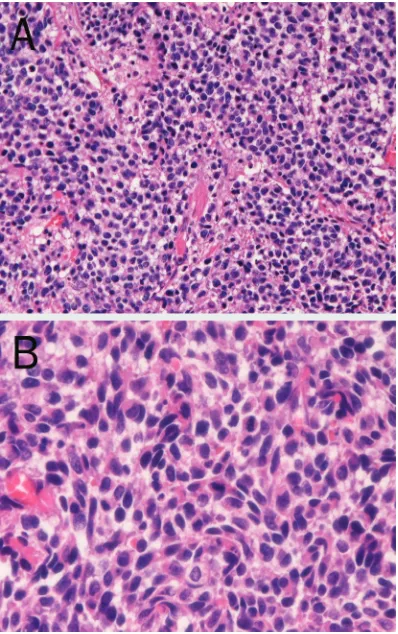
Histologically, the bladder tumor is pure small
cell carcinoma consisting of small cells with
hyperchromatic nuclei, inconspicuous nucleoli,
molded nuclei, scant cytoplasm, and increased
nucleo-cytoplasmic ration (Figure 1A and 1B).
An immunohistochemical study was performed
with the used of Dako EnVision method as
pre-viously
described
[22-24].
eno-lase, chromogranin, NCAM (CD56) (Figure 2B),
synaptophysin (Figure
2C), Ki-67
(label-ing=100%), p53, KIT (CD117) (Figure 2D), and
PDGFRA (Figure 2E). The tumor cells were
neg-ative for CK5/6, CK 34BE12, CK7, CK14, CK19,
CK20, p63, CD45, and TTF-1.
A molecular genetic analysis for
KIT
(exons 9,
11, 13 and 17) and
PDGFRA
(exons 12 and 18)
genes was performed, in paraffin
microdissec-tion specimens, by the PCR-direct sequencing
method, as previously described [25-29]. The
exons of both genes were selected because
they are frequent mutation sites [16]. The
prim-ers are shown in Table 1. In brief, genomic DNA
was extracted from paraffin blocks with
pro-teinase K digestion and phenol/chloroform
extraction, and subjected to PCR for 40 cycles
(94°C for one minute, 52°C for one minute,
72°C for one minute), using a thermal cycler
(GeneAmp PCR system 9700, Applied
Biosystems, ABI, CA). The annealing
tempera-ture was 53°C. PCR products were extracted,
and subjected to a computed automatic DNA
sequencer (ABI PRISM 3100 Genetic Analyzer,
Applied Biosystems, ABI, CA). These techniques
revealed that there were no mutations of the
KIT
gene (exons 9, 11, 13, and 17) and
PDGFRA
gene (exons 12 and 18) in this tumor. The
patient is now treated by cisplatin-based
chemotherapy.
Discussion
The present urinary bladder tumor was
appar-ent primary small cell carcinoma histologically.
Immunohistochemical demonstration of
neu-Figure 1. A: Low power view of small cell carcinoma [image:2.612.91.525.82.260.2]of the bladder. The tumor cells are medullary and consist of small cell with hyperchromatic nuclei. No differentiation is noted. Transurethral tumorectomy specimen, HE, x40. B: High power view of small cell carcinoma of the bladder. The tumor cells are small and show hyperchromatic nuclei, inconspicuous nu-cleoli, molded nuclei, scant cytoplasm and increased nucleo-cytoplasmic rationb. Transurethral tumorec-tomy specimen, HE, x200.
Table 1. Primer sequence
Forward Reverse
KIT exon 9
5’-TCC TAG AGT AAG CCA GGG CTT-3’ 5’-TGG TAG ACA GAG CCT AAA CAT CC-3’
KIT exon11
5’-GAT CTA TTT TTC CCT TTC TC-3’ 5’AGC CCC TGT TTC ATA CTG AC-3’
KIT exon 13
5’-GCT TGA CAT CAG TTT GCC AG -3’ 5’-AAA GGC AGC TTG GAC ACG GCT TTA-3’
KIT exon 17
5’-CTC CTC CAA CCT AAT AGT GT-3’ 5’-GTC AAG CAG AGA ATG GGT AC-3’
PDGFRA exon12
5’-TTG GAT ATT CAC CAG TTA CCT GTC-3’ 5’-CAA GGG AAA AGC TCT TGG-3’
PDGFRA exon 18
[image:2.612.90.289.284.601.2]ron-specific enolase, chromogranin,
synapto-physin, NCAM (CD56) and KIT supports the
diagnosis. Small cell carcinoma can occur in
any organ, though the vast majority occurs in
the lung. Small cell carcinoma of the urinary
bladder is extremely rare. In general, small cell
carcinoma is very aggressive tumor with poor
prognosis.
There have been no comprehensive
immuno-histochemical studies in small cell carcinoma
of the urinary bladder. The present case showed
the immunoprofile. CK immunoprofile of
blad-der small cell carcinoma have not been
report-ed. In the present case, the CK profile was CK
AE1/3 +, CK CAM5.2 +, CK8 +, CK 18+, CK5/6
-, CK 34BE12 -, CK7 -, CK14 -, CK19 -, and
CK20 -. The CK7-/CK20- pattern is compatible
with primary bladder small cell carcinoma.
Neuroendocrine antigens (chromogranin,
syn-aptophysin, NCAM, neuron specific enolase)
were all positive, indicating that the present
tumor is small cell neuroendocrine carcinoma.
p63 was negative, indicating that the present
tumor is not urothelial carcinoma. Ki-67
label-ing was 100%, indicatlabel-ing very high proliferative
activity of this tumor. p53 was positive,
sug-gesting p53 gene mutation. CD45 was
nega-tive, indicating that the tumor cells are not
hematopoietic cells. TTF-1 was negative,
sug-gesting that the present tumor is not
metasta-sis from SCLC.
[image:3.612.92.523.72.296.2]KIT and PDGFRA gene mutational status has
been reported only once in small cell
carcino-ma of the urinary bladder [5]. The report
showed no mutations of KIT and PDGFRA
genes. KIT is expressed in various tumors
including gastrointestinal stromal tumor (GIST),
mast cell neoplasm, melanoma, germ cell
tumor, hematopoietic malignancies and SCLC
[16, 21]. The KIT protein expression in SCLC
varies among researchers [6-15]; it is reported
to be 100% [6], 73% [7], 37% [8], 60% [9], 78%
[10], 53% [11], 40% [13], 64% [14], and 30%
[14].
KIT expression without
KIT
gene
muta-tions is thought to be due to
KIT
gene
amplifica-tion [15]. The prognostic implicaamplifica-tions of
posi-tive KIT protein in SCLC is controversial and no
definite conclusions were obtained [7-10, 13]. If
activating KIT mutations are present, treatment
of imatinib methylate may be effective [15, 21].
KIT
mutations are frequent in GIST, acute
myeloid leukemia and mast cell neoplasms
[21]. With regard to SCLC, one report showed
KIT
mutations [13], while others indicated no
KIT
mutations in SCLC [10, 12, 14]. Boldrini et
al. [13] reported two mutations in exon 9 and
three mutations of exon 11 in
KIT
gene were
found in 60 SCLC. In contrast, Sihto et al. [15]
showed no
KIT
mutations in 31 SCLC. More
studies of
KIT
mutations remain to be
per-formed in small cell carcinoma.
To the best of my knowledge, there is only one
study of
PDGFRA
mutations in small cell
carci-noma. Sihto et al. [15] found no
PDGFRA
muta-tions in 31 SCLC. The present case also showed
no
PDGFRA
mutations. PDGFRA protein
expres-sion has not been reported in small cell
carci-noma. The present case showed weak
expres-sion of PDGFRA, suggesting that a small
amount of PDGFRA is present in small cell
car-cinoma. Much more studies remain to be done
in PDGFRA expression and
PDGFRA
gene
muta-tions in small cell carcinoma.
In conclusion, the author reported a case of
pri-mary small cell carcinoma of the urinary
blad-der with immunohistocheimcal studies and
molecular genetic analysis of KIT and PDGFRA.
Conflict of interest statement
The author declares that he has no conflict of
interest.
Address correspondence to: Tadashi Terada, MD, PhD, Department of Pathology, Shizuoka City Shimizu Hospital, Miyakami 1231, Shimizu-Ku, Shizuoka, 424-8636, Japan Tel: 81-54-336-1111; Fax: 81-54-336-1315; E-mail: piyo0111jp@yahoo. co.jp
References
[1] Shahab N. Extrapulmonary small cell carcino-ma of the bladder. Semin Oncol 2007; 34: 15-21.
[2] Jones TD, Kernek KM, Yang XJ, Lopez-Beltran A, MacLennan GT, Eble JN, Lin H, Pan CX, Tre-tiakova M, Baldridge LA, Cheng L. Thyroid tran-scriptional factor 1 expression in small cell carcinoma of the urinary bladder: an immuno-histochemical prolifile of 44 cases. Hum Pathol 2005; 36: 718-723.
[3] Kurosa N, Hayashi Y, Nishida Y, Itoh H. Com-bined small and transitional cell carcinoma of the urinary bladder with CA19-9 production. Pathol Int 1999; 49: 462-467.
[4] Cheng C, Nicholson A, Lowe DG, Kirby RS. Oat cell carcinoma of urinary bladder. Urology 1992; 39: 504-507.
[5] Terada T. Autopsy case of primary small cell carcinoma of the urinary bladder: KIT and
PDGFRA expression and mutations. Pathol Int 2009; 59: 247-250.
[6] LaPoint RJ, Bourne PA, Wang HL, Xu H. Coex-pression of c-kit and bcl-2 in small cell carci-noma and large cell neuroendocrine
carcino-ma of the lung. Appl Immunohistochem Mol Morphol 2007; 15: 401-406.
[7] López-Martin A, Ballestín C, Garcia-Carbonero R, Castaño A, Lopez-Ríos F, López-Encuentra A, Sánchez-Cespedes M, Castellano D, Bartolo-mé A, Cortés-Funes H, Paz-Ares L. Prognostic value of KIT expression in small cell lung carci-noma. Lung Cancer 2007; 56: 405-413. [8] Micke P, Basrai M, Faldum A, Bittinger F,
Rönnstrand L, Blaukat A, Beeh KM, Oesch F, Fischer B, Buhl R, Hengstler JG. Characteriza-tion of c-kit expression in small cell lung carci-noma: prognostic and therapeutic implica-tions. Clin Cancer Res2003; 9: 188-194. [9] Camps C, Sirera R, Bremnes RM, Garde J,
Safont MJ, Blasco A, Berrocal A, Sánchez JJ, Calabuig C, Martorell M. Analysis of c-kit ex-pression in small cell lung carcinoma: preva-lence and prognostic implications. Lung Can-cer 2006; 52: 343-347.
[10] Rossi G, Cavazza A, Marchioni A, Migaldi M, Bavieri M, Facciolongo N, Petruzzelli S, Longo L, Tamberi S, Crinò L. KIT expression in small cell carcinoma of the lung: effects of chemo-therapy. Mod Pathol2003; 16: 1041-1047. [11] Naeem M, Dahiya M, Clark JI, Creech SD, Alkin
S. Analysis of c-kit protein expression in small-cell lung carcinoma and its implications for prognosis. Hum Pathol2002; 33: 1182-1187. [12] Mojica WD, Saxena R, Starostik P, Cheney RT.
CD117 + small cell lung cancer lacks the asp 816 val point mutation in exon 17. Histopathol-ogy 2005; 47: 517-522.
[13] Boldrini L, Ursino S, Gisfredi S, Faviana P, Do-nati V, Camacci T, Lucchi M, Mussi A, Basolo F, Pingitore R, Fontanini G. Expression and muta-tional status of c-kit in small-cell lung cancer: prognostic relevance. Clin Cancer Res 2004; 15: 4101-4108.
[14] Burger H, Den Bakker MA, Stoter G, Verweij J, Nooter K. Lack of c-kit exon 11 activating mu-tations in c-kit/CD117-positive SCLC tumor specimens. Eur J Cancer 2003; 39: 793-799. [15] Sihto H, Sarlomo-Rikala M, Tynninen O, Tanner
M, Andersson LC, Franssila K, Nupponen NN, Joensuu H. KIT and platelet-derived growth fac-tor recepfac-tor alpha tyrosine kinase gene muta-tions and KIT amplifications in human solid tumors.J Clin Oncol2005; 23: 49-57.
[16] Hirota S, Isozaki K. Pathology of gastrointesti-nal stromal tumor. Pathol Int 2006; 56:1-9. [17] Losota J, Miettinen M. KIT and PDGFRA
muta-tions in gastrointestinal stromal tumors (GISTs). Semin Diang Pathol 2006; 23: 91-101.
[19] Hirota S, Isozaki K, Moriyama Y, Hashimoto K, Nishida T, Ishiguro S, Kawano K, Hanada M, Kurata A, Takeda M, Muhammad Tunio G, Mat-suzawa Y, Kanakura Y, Shinomura Y, Kitamura Y. Gain-of-function mutations of c-kit in human gastrointestinal stromal tumor. Science 1998; 279: 577-580.
[20] Hirota S, Ohashi A, Nishida T, Isozaki K, Kinoshita K, Shinomura Y, Kitamura Y. Gain-of-function mutations of platelet-derived growth factor receptor alpha gene in gastrointestinal stromal tumor. Gastroenterology 2003; 125: 660-667.
[21] Miettinen M, Lasota J. KIT (CD117): a review on expression in normal and neoplastic tissue, and mutations and their clinicopathologic cor-relation.Appl Immunohistochem Mol Morphol 2005: 13: 205-220.
[22] Terada T, Kawaguchi M, Furukawa K, Sekido Y, Osamura Y. Minute mixed ductal-endocrine carcinoma of the pancreas with predominant intraductal growth. Pathol Int2002; 52: 740-746.
[23] Terada T, Kawaguchi M. Primary clear cell ad-enocarcinoma of the peritoneum. Tohoku J Exp Med 2005; 271: 271-275.
[24] Terada T. Ductal adenoma of the breast: Im-munohistochemistry of two cases. Pathol Int 2008; 58: 801-805.
[25] Terada T. Gastrointestinal stromal tumor of the uterus: a case report with genetic analyses of
c-kit and PDGFRA genes.Int J Gynecol Pathol 2009; 28: 29-34.
[26] Terada T. Primary extragastrointestinal stromal tumors of the transverse mesocolon without c-Kit mutations but with PDGFRA mutations. Med Oncol 2009; 26: 233-237.
[27] Terada T. Primary multiple extragastrointesti-nal stromal tumors of the omentum with differ-ent mutations of c-kit gene. World J Gastroen-terol 2008: 14: 7256-7259.
[28] Terada T. Mediastinal seminoma with multiple KIT gene mutations. Pathology 2009; 41: 695-697.
[29] Terada T. Low incidence of KIT gene mutations and no PDGFRA gene mutations in primary cu-taneous melanoma: an immunohistochemical and molecular genetic study of Japanese cas-es. Int J Clin Oncol 2010; 15: 453-456. [30] Terada T. Mutations and protein expression of