Leaf wetting frequently occurs due to not only precipitation but also night-time dew formation, guttation and fog, and it largely affects plant physi-ological and ecphysi-ological functions (Monteith and Unsworth 2013, Yang et al. 2017). Therefore, studies on leaf wetting were conducted based on various viewpoints. As the most common motivation, wetting frequency and duration were analysed in relation to the risk of disease occurrence for crops (Bass et al. 1991). It is also reported that
long-term leaf wetting such as rainfall irreversibly damages the photosynthesis process (Ishibashi and Terashima 1995). These are examples of the negative effects of leaf wetting on plants; however, interesting positive effects on water relations have recently been recognized.
For example, Boucher et al. (1995), Cassana and Dillenburg (2013), and Eller et al. (2016) found that the direct absorption of dew water by leaves (foliar absorption) improved root growth by influencing
Analysis of leaf wetting effects on gas exchanges of corn
using a whole-plant chamber system
Daisuke YASUTAKE
1,*, Gaku YOKOYAMA
2, Kyosuke MARUO
2, Yueru WU
3,
Weizhen WANG
3, Makito MORI
4, Masaharu KITANO
11Faculty of Agriculture, Kyushu University, Fukuoka, Japan
2Graduate School of Bioresource and Bioenvironmental Sciences, Kyushu University, Fukuoka, Japan
3Cold and Arid Regions Environmental and Engineering Research Institute, Chinese Academy of Sciences, Lanzhou, P.R. China
4Faculty of Agriculture, Kochi University, Nankoku, Kochi, Japan *Corresponding author: [email protected]
ABSTRACT
Yasutake D., Yokoyama G., Maruo K., Wu Y.R., Wang W.Z., Mori M., Kitano M. (2018): Analysis of leaf wetting effects on gas exchanges of corn using a whole-plant chamber system. Plant Soil Environ., 64: 233–239.
A whole-plant chamber system equipped with a transpiration sap flow meter was developed for measuring the transpiration rate even if leaves are wetted. A preliminary experiment in which dynamics of transpiration rate and/ or evaporation rate of wetted and non-wetted plants were measured and compared with each other demonstrated the validity of the measurement system. The system was then used to analyse leaf wetting effects on gas exchange of corn under slight water stress conditions of soil (a volumetric soil water content of 9.7%). Leaf wetting decreased vapour pressure in leaves by decreasing leaf temperature but it increased vapour pressure in the air; therefore, va-pour pressure difference between leaves and air, as a driving force of transpiration, was significantly lower in wetted plant. As a result, transpiration rate decreased by 44% and leaf conductance as an index of stomatal aperture was increased by leaf wetting. Such increasing leaf conductance due to leaf wetting increased the photosynthetic rate by 30% and therefore it improved water use efficiency (2.4 times). These results suggest that morning leaf wetting due to night time dew formation may have an advantage in crop production in semi-arid regions.
Keywords: dew water; desert ecosystem; photosynthesis; stomatal closure; water stress; Zea mays L.
the shoot water potential in woody plants. These studies suggested that dew may play an important role in water relations in forest ecosystems. Zhang et al. (2015) reported the importance of dew as a land-surface water resource in semi-arid regions, though dew had not been generally considered in the water balance because its amount is approximately one order of magnitude lower than that of evapotranspi-ration. Furthermore, Yasutake et al. (2006) observed a relationship between morning heavy leaf wetting due to night time dew formation and midday depres-sions in stomatal conductance and photosynthesis in semi-arid cornfields, where the midday depres-sions occurred just after the disappearance of leaf wetting due to evaporation. Yasutake et al. (2015) then conducted an intensive survey to analyse the night time leaf wetting process and its effects on plant water relations. Their results suggested that leaf wetting might play a role in improving water use efficiency by avoiding excessive transpirational water loss (water stress), which should bring midday depressions in stomatal aperture and photosyn-thesis. However, Yasutake et al. (2015) discussed the gradient as a driving force of transpiration only based on the leaf-to-air humidity. To demonstrate this hypothesis, it is necessary to measure leaf gas exchanges (transpiration rate, photosynthetic rate, etc.) when leaves are wetted.
The chamber method, as one of the most standard methods for measuring leaf gas exchanges (Jones 2014), is applicable for the photosynthetic measure-ment but not for the transpiration measuremeasure-ment of wetted leaves (Yokoyama et al. 2018), because evaporation of water attached to leaves should be included for transpiration. On the other hand, the transpiration sap flow meter method could be applied for measuring transpiration of a whole-plant (Wang et al. 2017) even if leaves are wetted. In this study, therefore, two methods mentioned above were combined for the measurement of leaf gas exchanges such as transpiration rate, leaf conductance, and photosynthetic rate of a wetted whole plant. The goals of this study were to: (1) develop a whole chamber system equipped with the chamber method and sap flow meter method and (2) analyse leaf wetting effects on gas exchanges of corn by using the whole chamber system under a soil water condition assumed as semi-arid field.
MATERIAL AND METHODS
[image:2.595.87.517.473.728.2]Whole plant chamber system and methods of analyses. Figure 1 shows a schematic diagram of the whole-plant chamber system developed for analysing leaf gas exchange characteristics of a
Figure 1. Schematic diagram of a whole plant chamber system for analysing the gas exchange characteristics of a single plant
Flowmeter H LED light
1.2 m
Leaf thermometer
0.5 m Transpiration
flowmeter Stirring
fan
Valve
Valve
Flowmeter
Air
flowregulator blowerAir
Air
path Outflow
Sampling
path DataLogger PC
Flowmeter
Humidity sensor
CO2
analyzer Pump Outflow
Buffer tank
Silica gel Air flowregulator
Soda lime
Inflow Air
single plant even if it is wetted. The system pri-marily consisted of a whole-plant chamber (0.6 × 0.5 × 1.2 m), an air humidity sensor (HMP60, Vaisala Co., Ltd., Helsinki, Finland), an infrared CO2-gas analyser (LI-820, Li-cor Inc., Lincoln, USA), a transpiration sap flow meter (SGB19-WS, Dynamax Inc., Houston, USA), a T-type thermo-couple with a diameter of 0.1 mm, a programmable data logger (CR-1000, Campbell Scientific Inc., Logan, USA), an air blower (U2V-07S, Showa Denki Co., Ltd., Osaka, Japan), some flow meters (FSM2-DNV-1, CKD Corporation, Aichi, Japan, and P-100, Tokyo Keiso Co., Ltd., Tokyo, Japan), some air regulators and valves, air paths, and an artifi-cial light source with 12 LED units (LLM0312A, Stanley Electric Co., Ltd., Tokyo, Japan).
The air blower facilitates air flow through the chamber at a constant rate of 110 L/min, where va-pour and CO2 concentrations of air in the chamber can be roughly controlled by changing the ratio of air flowing into the soda lime and silica gel cells. A part of the flowing air is collected from the positions just before and after the chamber and sent to the humidity sensor and CO2-gas analyser to measure their vapour and CO2 concentrations. Vapour flux (i.e. the transpiration rate (Tr) when the plant is not wetted, and the evapotranspiration rate (ET) when the plant is wetted) and CO2 flux (i.e. the photosynthetic rate (P)) from the plant can be evaluated based on the chamber method using those gas concentrations and air flow rate (Jones 2014). Tr can also be measured by the sap flow meter method, which is effective for measur-ing the Tr of wetted plants as well as non-wetted plants. Concerning the measurement of wetted plants, the difference between ET values measured by the chamber method and Tr values measured by the sap flow meter method is the evaporation rate (E) of the water attached to leaf surfaces.
Furthermore, leaf conductance (GL; a reciprocal of the sum of stomatal resistance and leaf boundary layer resistance) as an index of stomatal aperture can be evaluated as follows (Yasutake et al. 2009):
GL = Tr p/(eL – eA)
Where: eL (kPa) – vapour pressure at leaf temperature measured by the T-type thermocouple; eA (Pa) – vapour pressure of air; p (kPa) – atmospheric pressure.
On the other hand, light intensity in the chamber can be controlled by changing a setting height of the LED light source above the chamber. Figure 2
shows the distribution of photosynthetic photon flux density (PPFD) on a cross-sectional plane at a height of 80 cm in the chamber when the LED light was closest to the chamber. Heterogeneity of PPFD distribution was found and its average value was 847 ± 132 μmol/m2/s, which roughly
corresponded to values recorded in the morning on clear days in the semi-arid corn fields (Yasutake et al. 2006).
Preliminary experiment on the validity of vapour flux measurements. Two methods for measuring vapour fluxes of plants (Tr and/or ET) were installed in the whole-plant chamber system, and the validity of those measurements needed to be determined. Therefore, we conducted two pre-liminary experiments in a laboratory environment, in which corn plants (Zea mays L., cv. Pioneer P2307) at the 10th leaf stage were planted in pots
(a volume of 8 L) with well-watered vermiculite. One plant was not wetted and the time change in Tr values was measured by two methods. The other plant was wetted by spraying water on all leaf surfaces well until surplus water dripped off. The amount of water attached on leaves, meas-ured from the difference in leaf weight before and after wetting treatment to other corn leaves in advance, was 99.9 g/m2 (SD = 24.1 g/m2, n =
20). Similar to the measurements for not wetted plants, time change in vapour fluxes (Tr and/or ET) was measured after wetting treatments. In this preliminary experiment, PPFD was set to the maximum (847 μmol/m2/s), and the soil surface of
[image:3.595.305.529.550.709.2]the pots was covered with a plastic film to prevent evaporation from the soil. Three plants were used
Figure 2. Spatial distribution of photosynthetic photon flux density on a cross sectional plane in the chamber at a height of 80 cm
μmol/m2/s
for respective experiments. The averaged values of Tr and/or ET measured by different methods were compared to each other.
Experiment on wetting effects. In a greenhouse located at the Kyushu University, corns were grown in pots (a volume of 8 L) with well-watered soil (clay:silt:sand = 6.7:14.7:78.6), simulated as a field soil in semi-arid regions (Nomiyama et al. 2015), for approximately 4 weeks after sowing. For corn at the 10th leaf stage with a leaf area of 0.18 ± 0.0012 m2,
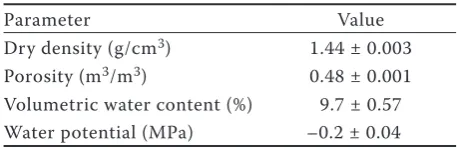
irrigation was stopped to decrease volumetric soil water content to around 10% that corresponded with conditions observed in semi-arid crop fields (e.g. Yasutake et al. 2006, 2015). Such corn plants were transported to the laboratory and used for the wetting experiment. Table 1 shows the soil physical parameters and soil water conditions of the experiment.
Two treatments were applied to the plants. One treatment entailed wetting the plants in the same manner as the preliminary experiment (wetted treatment), and the other served as a control in which the plants were grown under normal condi-tions (non-wetted treatment). Immediately after applying the treatments, the time change in gas exchanges and related parameters for plants were measured at a constant PPFD of 847 μmol/m2/s,
and the averages of three plants were recorded from 20 to 30 min post treatment. Soil evapora-tion from pots was prevented by covering the soil surface with a film. Based on the measurements of gas exchange parameters, the water use efficiency (WUE) was also evaluated as P/Tr.
Statistical analysis. Statistical analysis of gas ex-changes and related parameters (TL, eL, eA, eL – eA, Tr, GL, P and WUE) between the wetted and non-wetted treatments was conducted using a Student’s t-test in the statistical program R (version 3.2.4, R Development Core Team, Vienna, Austria).
RESULTS AND DISCUSSION
Validity of measuring the transpiration of wetted plants. Figure 3 shows the results of the preliminary experiment, i.e. time change in water vapour fluxes (Tr, E or ET) of non-wetted and wet-ted corn plants measured by the whole-plant cham-ber system. The Tr values for non-wetted plants were nearly the same between the two treatments (Figure 3a). Furthermore, such values were rela-tively constant at approximately 5–6 mmol/m2/s,
which was reasonably consistent with the results of Yasutake et al. (2006).
On the other hand, there was a notable differ-ence between ET and Tr for wetted plants, in which Tr was approximately half of ET at the start of the measurement (Figure 3b). This difference should be E of water attached to leaf surface. ET and Tr then gradually decreased and increased, respectively, with time; this might be attributed to decreasing E due to leaf wetness drying. ET and Tr finally equalized at around 5 mmol/m2/s when
leaf wetness disappeared, similar to the results seen in Figure 3a.
These results suggest that Tr could be measured adequately by the chamber method and sap flow meter method installed in the whole-plant chamber system. Furthermore, the whole-plant chamber system can be used to analyse the water vapour dynamics of wetted plants.
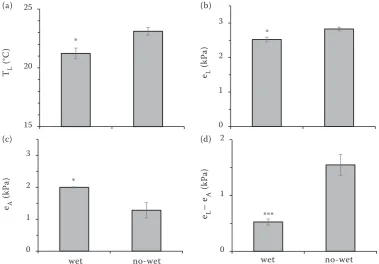
Wetting effects on gas exchanges and related parameters. Figure 4 shows the parameters related to gas exchange, such as TL, eL, eA, and eL – eA under the wetted and non-wetted treatments. Leaf wetting prevented an increase in TL due to the heat capacity and latent heat of water; there-fore, TL accompanied by a decrease in eL was significantly lower in the wetted treatment than those in the non-wetted treatment. However, eA was significantly higher in the wetted treatment than it was in the non-wetted treatment. This observation could be attributed to accelerating evapotranspiration (Figure 3), which should in-crease humidity around the leaves in the wetted treatment. Pan et al. (2010) found a positive linear relationship between wetting amount and relative humidity. eL – eA as a driving force of transpiration in the wetted treatment was approximately 34% of that in the non-wetted treatment. That is, leaf wetting significantly decreased the driving force of transpiration (eL – eA). Such results were consist-Table 1. Means of dry density and porosity of the soil
with standard errors of three dates
Parameter Value
Dry density (g/cm3) 1.44 ± 0.003
Porosity (m3/m3) 0.48 ± 0.001
Volumetric water content (%) 9.7 ± 0.57
Water potential (MPa) –0.2 ± 0.04
[image:4.595.62.291.641.716.2]ent with those reported by Yasutake et al. (2015), in which the effects of leaf wetting on TL, eL, and eL – eA were analysed in cornfield. However, they did not observe an increase in eA due to wetting. The present study showed a potential multiplier effect of decreasing eL and increasing eA due to leaf wetting.
Figure 5 shows the gas exchange characteristics (ET, E, Tr, GL, P and WUE) of a whole plant under the wetted and non-wetted treatments. Leaf wet-ting caused extremely high ET, in which a large amount (75%) of ET was E and the remaining 25% was Tr. Komori and Kim (2016) reported that 0
2 4 6 8
0 2 4 6 8 10
[image:5.595.69.488.90.341.2]Time (min)
Figure 3. Time course patterns
of transpiration rates (Tr) of a
non-wetted corn plant (a) and evapotranspiration rate (ET)
and Tr of a wetted corn plant
(b) measured by the different methods (chamber method and sap flow method). The means and standard error bars of three data are shown
Figure 4. (a) Leaf temperature (TL); (b) vapour pressure in leaves (eL); (c) vapour pressure of air (eA), and
(d) vapour pressure difference between leaf and air (eL–eA) of wetted and non-wetted corn plants. The means
and standard error bars of three data are shown. Different letters represent significant differences at P < 0.05
from the Student’s t-test
(a)
(b)
Tr
(m
m
ol
/m
2/s
)
ET
, Tr
(m
m
ol
/m
2/s
) 0 10 20 30
0 20 40 60 80 100 120
15 20 25
0 1 2 3
0 1 2 3
0 1 2
(a) (b)
(c) (d)
TL
(°
C
)
eA
(k
Pa
)
eL
(k
Pa
)
e L
–
e A
(k
Pa
)
wet no-wet wet no-wet
* *
*
[image:5.595.104.484.441.705.2]wetness by dew deposition affected ET through E in paddy fields during the dry season. This Tr value for the wetted treatment corresponded to only 56% of that for the non-wetted treatment. Thus, the whole-plant chamber system developed in the present study might quantitatively reveal the suppression effect of leaf wetting on Tr and E.
A ratio of values for the wetted treatment to the non-wetted treatment corresponded to 34% for the driving force of transpiration (eL – eA) (Figure 4) but 56% for Tr. This difference in ratios could be attrib-uted to GL, an index of stomatal aperture, which was significantly higher in the wetted treatment than that in the non-wetted treatment. It is well known that higher humidity at a constant light intensity induces increasing stomatal aperture (i.e. higher stomatal conductance) through decreasing Tr (e.g. Kramer and Boyer 1995, Yasutake et al. 2014). Therefore, leaf wetting should enhance stomatal aperture through a similar mechanism of the humidity effect.
According to the increasing GL caused by leaf wet-ting, P for the wetted treatment was also significantly higher (1.3 times) than for the non-wetted treatment. The positive effects of leaf wetting on stomatal ap-erture and photosynthesis observed in the present study were inconsistent with those of the previous
studies (Ishibashi and Terashima 1995, Hanba et al. 2004). Ishibashi and Terashima (1995) observed a rapid stomatal closure after wetting due to a great increase in the turgor pressure of epidermal cells than that of guard cells – a phenomenon known as the hydropassive process (Zeiger 1983). Hanba et al. (2004) examined the leaf wetting effects from the viewpoint of leaf wettability and observed de-creases in stomatal aperture and photosynthesis for the non-wettability leaf, such as corn leaf (Urrego-Pereira et al. 2013). The difference in stomatal and photosynthetic responses to wetness between the past and present studies may be attributed to the degree and duration of wetness in the leaves. These previous studies applied wetting treatments to plants, simulating rain (heavy and long-term wetting), while the present study simulated night time dew forma-tion with relatively low levels and short periods of wetting. Wetness was no longer visible 20–30 min after the application of the wetting treatment, and E approached zero at 100 min (Figure 3). Such moderate wetness on leaves should positively affect stomatal aperture and photosynthesis in the present study.
Furthermore, because Tr and P, respectively, de-creased and inde-creased due to leaf wetting, WUE (= P/Tr) for the wetted treatment was 2.4 times higher
Figure 5. (a) Evaporation and transpiration rates (E and Tr); (b) leaf conductance (GL); (c) photosynthetic rate (P)
and (d) water use efficiency (WUE = P/Tr) of wetted and non-wetted corn plants. The means and standard error
bars of three data are shown. Different letters represent significant differences at P < 0.05 from the Student’s t-test
0 2 4 6 8 10
0 0.1 0.2 0.3 0.4 0.5 0.6
0 5 10 15 20 25
0 2 4 6 8 10
(a) (b)
(c) (d)
wet no-wet wet no-wet
***
*
* *
E
an
d
Tr
(m
m
ol
/m
2/s
)
P
(μ
m
ol
/m
2/s
)
GL
(m
ol
/m
2/s
)
W
U
E
(m
m
ol
/m
ol
)
[image:6.595.101.482.443.710.2]than that for the non-wetted treatment. This finding indicates that leaf wetting provides an advantage for water use efficiency in crops. The results of Zhang et al. (2015) might support such a notion, as they pointed out the importance of leaf wetting due to dew formation as a water source in a semi-arid region.
In conclusion, a whole-plant chamber system was developed that is able to measure the transpiration rate in crops even when the leaves are wetted. This system was additionally applied to analyse the effects of leaf wetting on gas exchange characteristics in corn. Leaf wetting induced stomatal openings by decreas-ing transpirational water loss, and photosynthesis and water use efficiency subsequently improved significantly. These results suggest that morning leaf wetting due to night time dew formation might have an important role in crop production in semi-arid regions. Further study is needed to demonstrate this hypothesis regarding the advantage of night time dew formation in semi-arid crop production.
Acknowledgements
We would like to thank Prof. Akira Miyazaki (Kochi University) for providing a whole-plant chamber.
REFERENCES
Bass B., Savdie I., Gillespie T.J. (1991): Simulation of leaf wetness duration for field corn. Agricultural and Forest Meteorology, 57: 69–84.
Boucher J.-F., Munson A.D., Bernier P.Y. (1995): Foliar absorption of dew influences shoot water potential and root growth in Pinus strobus seedlings. Tree Physiology, 15: 819–823. Cassana F.F., Dillenburg L.R. (2013): The periodic wetting of leaves
enhances water relations and growth of the long-lived conifer Araucaria angustifolia. Plant Biology, 15: 75–83.
Eller C.B., Lima A.L., Oliveira R.S. (2016): Cloud forest trees with higher foliar water uptake capacity and anisohydric behavior are more vulnerable to drought and climate change. New Phy-tologist, 211: 489–501.
Hanba Y.T., Moriya A., Kimura K. (2004): Effect of leaf surface wetness and wettability on photosynthesis in bean and pea. Plant, Cell and Environment, 27: 413–421.
Ishibashi M., Terashima I. (1995): Effects of continuous leaf wet-ness on photosynthesis: Adverse aspects of rainfall. Plant, Cell and Environment, 18: 431–438.
Jones H.G. (2014): Plants and Microclimate: A Quantitative
Ap-proach to Environmental Plant Physiology. 3rd Edition. New
York, Cambridge University Press.
Komori D., Kim W. (2016): Impact of dew deposition on water flux dynamics at a tropical rainfed paddy field in the dry season. Journal of Agricultural Meteorology, 72: 29–36.
Kramer P.J., Boyer J.S. (1995): Water Relations of Plants and Soils. San Diego, Academic Press.
Monteith J.L., Unsworth M.H. (2013): Principles of Environmental
Physics. 4nd Edition. Oxford, Elsevier Ltd.
Nomiyama R., Yasutake D., Sago Y., Mori M., Tagawa K., Cho H., Wu Y.R., Wang W.Z., Kitano M. (2015): Evapotranspiration integrated model for analysis of soil salinization affected by root selective absorption. Environmental Control in Biology, 53: 199–204. Pan Y.X., Wang X.P., Zhang Y.F. (2010): Dew formation
character-istics in a revegetation-stabilized desert ecosystem in Shapotou area, Northern China. Journal of Hydrology, 387: 265–272. Urrego-Pereira Y.F., Martínez-Cob A., Fernández V., Cavero J.
(2013): Daytime sprinkler irrigation effects on net photosyn-thesis of maize and alfalfa. Agronomy Journal, 105: 1515–1528. Wang Y.Y., Zhang X., Xiao X.H., Heitman J., Horton R., Ren T.S. (2017): An empirical calibration for heat-balance sap-flow sen-sors in maize. Agronomy Journal, 109: 1122–1128.
Yang X.D., Lv G.H., Ali A., Ran Q.Y., Gong X.W., Wang F., Liu Z.D., Qin L., Liu W.G. (2017): Experimental variations in functional
and demographic traits of Lappula semiglabra among dew
amount treatments in an arid region. Ecohydrology, 10: e1858. Yasutake D., Ishikawa K., Sago Y., Araki T., Kitano M., Kobayashi T., Hidaka K. (2009): Absorption of transport of water and ions in corn and sunflower plants grown under saline conditions. Journal of Agricultural Meteorology, 65: 19–26.
Yasutake D., Kitano M., Kobayashi T., Hidaka K., Wajima T., He W.J. (2006): Evaluation of canopy transpiration rate by apply-ing a plant hormone ‘abscisic acid’. Biologia, 61: S315–S319. Yasutake D., Mori M., Kitano M., Nomiyama R., Miyoshi Y.,
Hisaeda D., Cho H., Tagawa K., Wu Y.R., Wang W.Z. (2015): Night-time leaf wetting process and its effect on the morning humidity gradient as a driving force of transpirational water loss in a semi-arid cornfield. Biologia, 70: 1485–1489. Yasutake D., Yu X., Asano T., Ishikawa M., Mori M., Kitano
M., Ishikawa K. (2014): Control of greenhouse humidity and airflow with fogging and circulation systems and its effect on leaf conductance in cucumber plants. Environmental Control in Biology, 52: 101–105.
Yokoyama G., Yasutake D., Kitano M. (2018): A preliminary experiment on the effects of leaf wetting on gas exchange in tomato leaves. Environmental Control in Biology, 56: 13–16. Zeiger E. (1983): The biology of stomatal guard cells. Annual
Review of Plant Physiology, 34: 441–475.
Zhang Q., Wang S., Yang F.L., Yue P., Yao T., Wang W.Y. (2015): Characteristics of dew formation and distribution, and its contribution to the surface water budget in a semi-arid region in China. Boundary-Layer Meteorology, 154: 317–331.