doi:10.4236/ijcns.2011.42010 Published Online February 2011 (http://www.SciRP.org/journal/ijcns)
Performance of Block Diagonalization Scheme for
Downlink Multiuser MIMO System with Estimated
Channel State Information
Feng Wang, Marek E. Bialkowski
School of Information Technology and Electrical Engineering, The University of Queensland, Brisbane, Australia E-mail:{fwang, meb}@itee.uq.edu.au
Received December 7, 2010; revised January 8, 2011; accepted January 10, 2011
Abstract
In this paper, we study the performance of block diagonalization (BD) scheme for a downlink multiuser multi-input multi-output (MIMO) system with imperfect channel state information (CSI). At each mobile user, information about the channel is obtained by applying the minimum mean-square-error (MMSE) chan-nel estimation method. The chanchan-nel state information is fed back to the base station through error-free uplink channels. A theoretical analysis is performed showing that channel estimation errors contribute to co-channel interferences thus deteriorating sum rate capacity. Computer simulations are performed to evaluate the im-pact of channel estimation errors on the sum rate capacity. The results show that if the MSE of the channel estimation is not less than 10-2, the impact of channel estimation errors is significant and cannot be neglected. To combat this adverse effect, a proper transmit power level is required for the training signals.
Keywords:MIMO, Block Diagonalization, Sum Rate
1. Introduction
In the last decade, wireless MIMO communication sys-tems employing multiple antennas at transmitter and re-ceiver have received a considerable attention. The main reason is that MIMO technology is capable of improving significantly the signal transmission quality in rich scat-tering environment without the need for extra operational frequency bandwidth [1]. Recently, a significant shift of research focus has been observed from peer-to-peer links to multiuser MIMO systems [2]. A multiuser MIMO system typically consists of a base station equipped with multiple antennas and a number mobile users, each pos-sibly equipped with multiple receive antennas. The base station transmits data to these mobiles users. To elimi-nate or reduce interference, the base station is required to employ orthogonalization techniques. These orthogo-nalization techniques distribute signals to mobile users among different dimensions of resources and thus obtain a minimum interference between them. One of the popu-lar orthogonalization techniques is the time division mul-tiple access (TDMA) technique. With TDMA, the base station transmits to a mobile user on a particular time slot. Alternatively, the base station can transmit to multiple
users simultaneously by employing other orthogonaliza-tion techniques such as dirty-paper-coding (DPC) [3] or multiple beamforming [4]. DPC pre-cancels interference at the base station by using the perfect channel state in-formation (CSI) and the full knowledge of the transmit-ted signals. Information theoretic works have proved that DPC is capable of achieving sum capacity [5,6]. How-ever, it is not suitable for implementation in practical systems because of its complexity. Due to this reason, researchers have investigated a number of sub-optimal approaches. Among them, BD has been proved to have the ability of achieving a large fraction of DPC capacity with much reduced complexity [4] In this approach, the base station transmits signals to multiple mobile users by applying orthogonal beamforming weights. As a result, each mobile user’s beamforming weights lie in the null space of all other mobile users’ channels. This is equiva-lent to having orthogonal channels between different mobile users.
F. WANG ET AL. 83
interferences is proposed under the assumption that the transmitter has full CSI and the information about the interference plus noise covariance matrix for in-cell users. Researchers have also considered an impact of an an-tenna array configuration and mutual coupling on the sum capacity promised by BD. In [8], the impact of mu-tual coupling on BD performance in terms of sum rate capacity is addressed. In, [9] comparisons between BD schemes employing uniform circular array (UCA) and uniform linear array (ULA) are given. To further im-prove the sum capacity, a fast antenna selection scheme at base station is presented in [10]. However, most of the existing research results are based on the assumption of perfect channel state information at mobile users. In practical situations, the mobile users obtain CSI by ap-plying channel estimation schemes. In this paper, we assume that the mobile users employ the training-based MMSE channel estimation [11]. Based on this assump-tion, we evaluate the impact of channel estimation errors on the performance of a multiuser MIMO system em-ploying BD scheme in terms of sum rate capacity.
The paper is structured as follows. Section 2 presents the system model. In Section 3, the BD scheme is intro-duced. Section 4 is devoted to the channel estimation by mobile users. We introduce the channel estimation errors into the BD scheme and present an analysis of the impact of channel estimation errors on the system capacity in Section 5. Section 6 presents numerical results accompa-nied by discussion. Section 7 concludes the paper.
[image:2.595.59.283.572.707.2]2. System Model
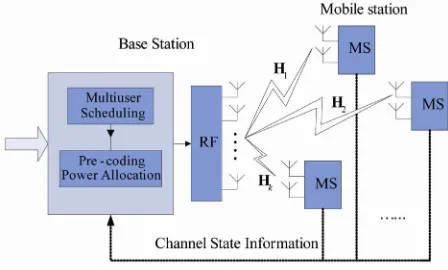
Figure 1 illustrates a multiuser MIMO system model. We consider a downlink scenario, where the base station broadcasts information to L mobile users. We assume that K out of L mobile users are scheduled by higher lay-ers scheme, and each selected mobile user receives mul-tiple data streams. The base station employs Nttransmit
antennas and the kth mobile user is equipped with nk
re-ceiving antennas. The downlink complex channel matrix
Figure 1. Multiuser MIMO system model.
between the base station and the kth mobile terminal is denoted by CMk Nt
k
Η The elements of Hk are
de-scribed by zero-mean circular symmetric complex Gaus-sian random variables, which are appropriate for a nar-row-band system operating in a non-line-of-sight (NLOS) rich scattering environment. The (p,q)th elements of Hk
represent the channel fading between the qth transmitting antennas at base station and the pth receiving antenna at the kth mobile user. The mobile terminals are spatially separated As they do not share the same scattering envi-ronment, it is assumed that they experience independent fading.
By assuming xkCN 1 denotes the transmitted sig-nal vector intended for the kth mobile user, and ηk ∈
CMk×1 represents the zero-mean additive white Gaussian noise vector with variance n2, the Mk × 1 received
sig-nal vector at the kth mobile terminal is given as
1
, 1, ,
K
k k i k
i
k
y H x η K
K
(1)
It is assumed that there are Lk data streams intended for the kth mobile terminal. Assuming that the beam-forming process takes place at the base station, the transmitted signals can be written as
, 1, , k k k k
x w s (2) where CLk 1
k
s represents the data streams for the kth
mobile terminal and CN Lk
k
w denotes the beam-forming matrix for the for the kth mobile terminal.
3. Linear Beamforming Schemes
The received signal at the kth MS, given as (1), is re-written as
1
1,
K
k k i i k
i
K
k k k k i i k
i i k
y n s n n
s n s n
H w
H w H w n
(3)
where the second term represents the co-channel inter-ference (CCI) caused by the multiuser sharing the downlink resources. The principal idea of the block di-agonalization is to find the beamforming vectors which can zero-force the CCI. To enable the users to receive their own data with a zero co-channel interference, the base station has to apply the transmit beamforming weights such that
, 1
i k i k K
H w 0 (4)
With the beamforming vectors satisfying (4), the CCI is completely eliminated and thus the kth MS observes a point-to-point MIMO link with the base station.
K
All the elements of the optimal training matrix should have the same magnitude. One of the most popular training matrices is given as [12]
1, , 1, 1, ,
T
T T T T
k k k
H H H H H (5)
the constraint of (4) can be rewritten as
k k
H w 0 (6)
1
1 1
1
1 1 1
1
1
M
M M
pilot
N M N
M M N M
W W
p N
W W
P
(11) Equation (6) indicates that the beamforming vectors
for the kth mobile user should lie in the null space of (5). By applying singular value decomposition (SVD), the following is obtained
where j2 N N
W e and pilot is the transmitted
train-ing power constraint. As a result, the received signals at the kth mobile user can be expressed as
p †
(1) (0)
k
k k k k
Ω 0
H U V V
0 0
(7)
where k is the diagonal matrix with all non-negative sing- ular values. contains vectors corresponding to the zero singulars. They form an orthogonal basis for the space of (5). The columns are the candidate beamform-ing vectors.
Ω
0
k
V
k k k
S H P η (12)
The task of the mobile users at this stage is to recover the channel matrix between the base station and the kth
mobile user based on the knowledge of the received sig-nals Sk and the training matrix P. Different methods,
including least squares (LS), minimum mean-square- error (MMSE) and their improved versions [11], can be employed by the MIMO channel estimator at the kth
mobile user. We assume that the output of the channel estimator at the kth mobile user is . The channel estimation error can be expressed by an error matrix, which is given as
est k
H
By using the beamforming vectors generated by (7), the CCI is completely eliminated and the mobile users observe point-to-point MIMO links with the base station. As a result, the effective MIMO link for the kth mobile user is described by
0 ,
eff k k k
H H V (8)
Therefore, the broadcasting sum rate capacity for a downlink multiuser MIMO system employing block di-agonalization scheme can be written as
err est k k
H H Hk (13)
†2 2 ,
1
1 log det
K
BD eff k eff k
k n
C E
I H H ,
(9)
The performance of the channel estimator is charac-terized by the error matrix given by (13) and evaluated in terms of mean-square-error (MSE). The MSE of the channel estimator at the kth mobile user is expressed by
est est H
k k k
MSE tr E
H H (14)
4. Channel Estimation Errors
where tr(·) represents the trace operation over a matrix and (·)His the conjugate transpose of a matrix. Smaller values of MSE indicate a higher accuracy of the channel estimation. For a given MIMO channel estimator, the MSE of the channel estimator is decided by a few factors, including transmitted power to noise ratio (TPNR) in the training mode, and the number of antenna elements at the transmitter and receiver.
We assume that training-based MIMO channel estima-tion methods are employed by the multiuser MIMO sys-tem, where the base station is broadcasting pilot signals to mobile users and all the mobile users perform channel estimation independently. The mobile users send the estimated channel state information to the base station via uplink feedback channels. Based on these channel state information, the base station performs beamforming, interference cancellation and downlink data transmission. In Figure 2, a basic downlink information frame struc-ture is shown.
5. Sum-Rate Capacity with Channel
Estimation Errors
Assuming M N represent the number of the training
signal vectors, the training sequences can be given as We assume that the uplink CSI feedback channels are error-free. Consequently, the base station has an access to the same channel estimation results as the active mobile
1, 2, , M
P p p p (10)
F. WANG ET AL. 85
ˆ
users. Based on these CSI, the base station performs beamforming, power allocation and data transmission. By using the estimated CSI, the Formula (3) can be re-written as
1 1, 1 ˆ ˆ ˆ K estk k i i k
i
K
k k k k i i
i i k Co channel interference K
err
k i i k
i
Channel error interference
y n s n n
s n
s n n
H wH w H w
H w
s n
(15)
We can see that in (15), the kth mobile user is receiv-ing the signals inclusive the co-channel interference (CCI) from other mobile users, white additive noise and the interference caused by channel estimation errors. With the channel estimation errors taken into account, the overall estimated channel matrices are given as
1 2 1 2 , , , , , , Test T T T
K
T
T T T
err err err
K
H H H H
H H H
T k (16)
Following (16), the co-channel mobile users’ they can be expressed as
1 1 1
1 1 1
, , ,
, , ,
T
est T T T T
k k k K
T
T T T
err err err err
k k K
H H H H H
H H H H
(17)
To cancel the co-channel interference, the weights for the kth mobile user should be lying in the null space of (17). By performing SVD over the co-channel mobile users’ overall channel, we have
† 1 0 † 1 0 † 1 0 est est est est est k
k k k k
k
k k k
err err err err k k k Ω 0
H U V V
0 0
Ω 0
U V V
0 0
Ω 0
U V V
0 0 (18)
The first term in (18) is the SVD result of the er-ror-free overall matrix and the second term represents the SVD result of the channel estimation error matrix. As a result of (18), the candidate beamforming vectors for the
kth mobile user are given as . By setting the beamforming vectors as
0
est k V
0
ˆ est k k
w V (19)
The effective MIMO link with the channel estimation
errors taken into account for the kth mobile user is de-scribed by
,
ˆ ˆ
eff k k k
H H w (20)
However, due to the existing channel estimation errors, the constraint shown by (6) is obviously not held any more, and has been changed to
ˆ k k
H w 0 (21)
Formula (21) shows that the channel estimation errors contribute to co-channel interference. The channel ca-pacity between the base station and the kth mobile user can then be written as
1
2 ˆ , ˆ ˆ
log det H
k eff k
R E I H N Hk eff k, (22) where is the noise and coherent channel interference matrix for the kth mobile terminal. It can be represented by ˆ k N 2 1,
ˆ K ˆ ˆH H
k n k i i k
i i k
N I H w w H (23)
6. Numerical Results
[image:4.595.86.241.513.606.2]In this section, we evaluate the performance of the linear beamforming schemes for the downlink multiuser MIMO system with the imperfect channel state information, which is obtained by the channel estimators at the mobile users. We assume that the mobile users employ the same channel estimator and they perform channel estimation independently. We assume that all the mobile users em-ploy the MMSE channel estimator. We refer a multiuser MIMO system as
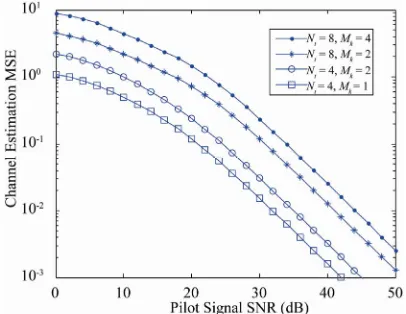
system, where K repre-sents the number of mobile users, M is the number of receive antennas at the mobile user and N refers to the number of antennas at the base station. As Monte Carlo approach is applied, each point in the presented results is obtained from an average of 10000 independent simula-tion runs.Figure 3 displays the channel estimation MSE of MMSE estimator for the kth mobile user. Two situations are included, in where the numbers of transmit antenna are fixed to 8 and 4, while the number of receive antenna at the kth mobile user is varied.
at SNR = 20 dB, the MMSE channel estimator at a mobile user with 2 receive antennas achieves MSE = 0.725 for the situation where the number of transmit antennas is 8 and MSE = 0.240 when the number of transmit antenna is 4.
In Figures 4 and 5, the impact of channel estimation error on the performance of multiuser MIMO system in terms of sum rate capacity is investigated. The sum rate of the block diagonalization is illustrated as a function of data SNR and channel estimation MSE. It can be seen from these figures that the presence of channel estima-tion errors deteriorates the sum rate capacity. In the re-gion of low SNR, the noise has a dominating impact on the performance of the block diagonalization while the co-channel interference introduced by channel estimation errors has a limited impact. As a result, the sum rate ca-pacity varies slightly with MSE. In the region of high SNR, the co-channel interference introduced by channel estimation errors takes the dominating role and has a significant impact on the sum rate capacity.
[image:5.595.318.522.80.231.2]When the MSE is greater or equal to 10-1, the exis-tence of channel estimation errors significantly decreases
Figure 3. Channel estimation MSEs of the MMSE estimator versus SNR.
0 5
10 15
20 25
30
-3 -2 -1 0 1 0 10 20 30 40
SNR Log(MSE)
S
u
m
R
a
te
(b
p
s
/H
z
)
Figure 4. Impact of channel estimation error on the sum rate capacity of 2 × (2 × 4) system.
0 10
20 30
-3 -2 -1 0 1 0 20 40 60
SNR Log(MSE)
S
um
R
at
e(
bps
/H
z
)
Figure 5. Impact of channel estimation error on the sum rate capacity of 4 × (2 × 8) system.
[image:5.595.70.273.343.500.2] [image:5.595.316.527.539.702.2]the sum rate capacity. When the MSE is smaller or equal to 10-2, the impact of channel estimation errors is small and can be neglected. The simulation results also indicate that a reasonable transmit power (or SNR) is required for the training signals to make sure that the channel esti-mator at mobile users have a channel estimation MSE as low as 10-2.
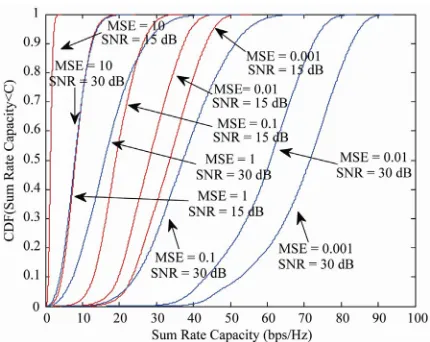
Figure 6 and Figure 7 present the cumulative distri-bution of the sum rate capacity for 2 × (2 × 4) and 4 × (2 × 8) systems, respectively.
These two figures further confirm the results shown earlier in Figures 5 and 6. The presence of channel esti-mation errors has a negative impact on the sum rate ca-pacity of a multiuser MIMO system. It can be observed from the presented results that the gaps between the sum rates for the same MSE with different SNR levels (15 dB for red plots and 30 dB for blue plots) decrease with the MSE. To combat the negative impact brought by channel estimation errors, a higher transmit power is required for data transmission. In Figure 6, it can be seen that the 2× (2 × 4) system achieves similar capacity when the channel
[image:5.595.69.272.543.691.2]F. WANG ET AL. 87
Figure 7. CDF of sum rate capacity for a 4 × (2 × 8) system.
estimation error MSE = 1 at SNR = 15 dB and MSE = 10 at SNR = 30 dB. These results indicate that to combat the increased MSE from 1 to 10, an increased transmit data SNR from 15 dB to 30 dB is required. In Figure 7, it can be seen that the 4 × (2 × 8) system achieves similar ca-pacity for the situations when channel estimation MSE = 1 at SNR = 15 dB and channel estimation MSE = 10at SNR = 30 dB. These results show that to combat the in-creased MSE from 1 to 10, an inin-creased transmit SNR from 15 dB to 3 dB is required.
7. Conclusions
In this paper, we have investigated the impact of channel estimation errors on the performance of block diagonali-zation scheme for a multiuser MIMO system. Theoretical analysis has been presented showing that the presence of channel estimation error contributes to co-channel inter-ference of the mobiles users, thus rendering deteriorated sum rate capacity of the system. Monte Carlo simulations have been carried out to evaluate the impact of channel estimation errors on the performance of multiuser system in terms of sum rate capacity. The results have shown that to combat the negative impact brought by channel estimation errors, an extra power is required for data transmission. The results also have shown that when the MSE is not less than 10-2, the impact of channel estima-tion errors is reduced to a very low level. The simulaestima-tion results have also revealed that a reasonable transmit power is required for the training signals to make sure that the channel estimator at mobile users offers channel estimation MSE as low as 10-2.
8. References
[1] E. Telatar, “Capacity of Multi-Antenna Gaussian Channels,”
European Transactions on Telecommunications, Vol. 10, No. 6, November 1999, pp. 585-596. doi:10.1002/ett.44 60100604
[2] D. Gesbert, M. Kountouris, R. W. Heath Jr., C. Chae and T. Salzer, “Shifting the MIMO Paradigm,” Signal Pro- cessing Magazine, Vol. 24, No. 5, September 2007, pp. 36-46.
[3] M. Costa, “Writing on Dirty Paper,” IEEE Transactions on Inforamtion Theory, Vol. 29, No. 3, May 1983, pp. 439- 441. doi:10.1109/TIT.1983.1056659
[4] Q. H. Spencer, A. L. Swindlehurst and M. Haardt, “Zero- Forcing Methods for Downlink Spatial Multiplexing in Multi-User MIMO Channels,” IEEE Transactions on In- formation Theory, Vol. 42, No. 3, February 2004, pp. 461-471.
[5] W. Weingarten, Y. Steinberg and S. Shamai, “The Capacity Region of the Gaussian Multiple-Input Multiple-Output Broadcast Channel,” IEEE Transactions on Information Theory, Vol. 52, No. 9, September 2006, pp. 3936-3964. doi:10.1109/TIT.2006.880064
[6] W. Yu and J. Cioffi, “Sum Capacity of Gaussian Vector Broadcast Channels,” IEEE Transactions on Information Theory, Vol. 50, No. 9, September 2004, pp. 1875-1892. doi:10.1109/TIT.2004.833336
[7] S. Shim, J. S. Kwak, R. W. Heath and J. Andrews, “Block Diagonalization for Multi-User MIMO with Other-Cell Interference,” IEEE Transactions on Wireless Communi- cations, Vol. 7, No. 7, July 2008, pp. 2671-2681. doi:10. 1109/TWC.2008.070093
[8] F. Wang and M. E. Bialkowski, “Performance of Block Diagonalization Broadcasting Scheme for Multiuser MIMO System Operating in Presence of Spatial Correlation and Mutual Coupling,” International Journal of Communi- cations, Network and System Sciences, Vol. 3, No. 3, March 2010, pp. 266-272. doi:10.4236/ijcns.2010.33034
[9] F. Wang, X. Liu and M. E. Bialkowski, “Performance of Block Diagonalization for Multiuser MIMO System with Uniform Circular Array and Uniform Linear Array: A Compare,” Proceedings of 6th International Conference on Wireless Communications, Networking and Mobile Computing, Chengdu, 23-25 September 2010, pp. 1-4.
[10] F. Wang and M. E. Bialkowski, “Fast Transmit Antenna Selection Scheme Employing Block Diagonalization for Multiuser MIMO System,” Proceedings of Asia-Pacifia Microwave Conference, Yokohama, 7-10 December 2010, pp. 1-5.
[11] M. Biguesh and A. B. Gershman, “Training-Based MIMO Channel Estimation: A Study of Estimator Tradeoffs and Optimal Training Signals,” IEEE Transactions on Signal Processing, Vol. 54, No. 3, March 2006, pp. 884-893. doi:10.1109/TSP.2005.863008