Proceedings of EACL '99
N a m e d Entity Recognition without Gazetteers
Andrei Mikheev, Marc Moens and
C l a i r e G r o v e r
HCRC Language Technology Group,
University of Edinburgh,
2 Buccleuch Place, Edinburgh EH8 9LW, UK.
m i k h e e v @ h a r l e q u i n , co. u k M. M o e n s @ e d . ac. Uk C. G r o v e r @ e d . ac. u k
A b s t r a c t
It is often claimed that Named En- tity recognition systems need extensive gazetteers--lists of names of people, or- ganisations, locations, and other named entities. Indeed, the compilation of such gazetteers is sometimes mentioned as a bottleneck in the design of Named En- tity recognition systems.
We report on a Named Entity recogni- tion system which combines rule-based grammars with statistical (maximum en- tropy) models. We report on the sys- tem's performance with gazetteers of dif- ferent types and different sizes, using test material from the MUC-7 competition. We show that, for the text type and task of this competition, it is sufficient to use relatively small gazetteers of well-known names, rather than large gazetteers of low-frequency names. We conclude with observations about the domain indepen- dence of the competition and of our ex- periments.
1
Introduction
Named Entity recognition involves processing a text and identifying certain occurrences of words or expressions as belonging to particular cate- gories of Named Entities (NE). NE recognition software serves as an important preprocessing tool for tasks such as information extraction, informa- tion retrieval and other text processing applica- tions.
W h a t counts as a Named Entity depends on the application t h a t makes use of the annotations. One such application is document retrieval or au- t o m a t e d document forwarding: documents an- noted with NE information can be searched more "Now also at Harlequin Ltd. (Edinburgh office)
accurately than raw text. For example, NE an- notation allows you to search for all texts that mention the company "Philip Morris", ignoring documents about a possibly unrelated person by the same name. Or you can have all documents forwarded to you about a person called "Gates", without receiving documents about things called gates. In a document collection annotated with Named Entity information you can more easily find documents about Java the programming lan- guage without getting documents about Java the country or Java the coffee.
Most common among marked categories are names of people, organisations and locations as well as temporal and numeric expression. Here is an example of a text marked up with Named Entity information:
<ENAMEX TYPE='PERSON' >Flavel
Donne</ENAMEX> is an analyst with <ENAMEX TYPE= ' ORGANIZATION ' >General Trends
</ENAMEX>, which has been based in <ENAMEX TYPE='LOCATION'>Little Spring</ENAMEX> since <TIMEX TYPE='DATE' >July 1998</TIMEX>.
gazetteers are reduced to 25,000 and 9,000 names; conversely, they also show that the addition of an e x t r a 42 entries to the gazetteers improves perfor- mance dramatically.
This raises several questions: how important are gazetteers? is it i m p o r t a n t that they are big? if gazetteers are important but their size isn't, then what are the criteria for building gazetteers? One might think t h a t Named Entity recognition could be done by using lists of (e.g.) names of peo- ple, places and organisations, but that is not the case. To begin with, the lists would be huge: it is estimated t h a t there are 1.5 million unique sur- names just in the U.S. It is not feasible to list all possible surnames in the world in a Named Entity recognition system. T h e r e is a similar problem with company names. A list of all current compa- nies worldwide would be huge, if at all available, and would immediately be out of date since new companies are formed all the time. In addition, company names can occur in variations: a list of company names might contain "The Royal Bank of Scotland plc", but that company might also be referred to as "The Royal Bank of Scotland", "The Royal" or "The Royal plc". These variations would all have to be listed as well.
Even if it was possible to list all possible or- ganisations and locations and people, there would still be the problem of overlaps between the lists. Names such as Emerson or Washington could be names of people as well as places; Philip Morris could be a person or an organisation. In addition, such lists would also contain words like "Hope" and "Lost" (locations) and "Thinking Machines" and "Next" (companies), whereas these words could also occur in contexts where they don't refer to named entities.
Moreover, names of companies can be complex entities, consisting of several words. Especially where conjunctions are involved, this can create problems. In "China International Trust and In- vestment Corp decided to do something", it's not o b v i o u s whether there is a reference here to one company or two. In the sentence "Mason, Daily and Partners lost their court case" it is clear t h a t "Mason, Daily and Partners" is the name of a company. In the sentence "Unfortunately, Daily and Partners lost their court case" the name of the company does not include the word "unfortunate- ly", but it still includes the word "Daily", which is just as common a word as "unfortunately".
In this paper we report on a Named Entity recognition system which was amongst the highest scoring in the recent MUC-7 Message Understand- ing Conference/Competition ( M U C ) . One of the
features of our system is t h a t even when it is run without any lists of name.,; of organisations or peo- ple it still performs at a level comparable to t h a t of many other MUC-systems. We report on exper- iments which show the di[fference in performance between the NE system with gazetteers of differ- ent sizes for three types of named entities: people, organisations and locations.
2 T h e M U C C o m p e t i t i o n
The MUC competition for which we built our sys- tem took place in March 1998. Prior to the com- petition, participants received a detailed coding manual which specified what should and should not be marked up, and how the m a r k u p should proceed. T h e y also received a few hundred arti- cles from the New York Times Service, marked up by the organisers according to the rules of the coding manual.
For the competition itself, participants received 100 articles. T h e y then had 5 days to perform the chosen information extraction tasks (in our case: Named Entity recognition) without human inter- vention, and m a r k u p the text with the Named En- tities found. T h e resulting marked up file t h e n had to be returned to the organisers for scoring.
Scoring of the results is done automatically by the organisers. T h e scoring software compares a participant's answer file against a carefully pre- pared key file; the key file is considered to be the "correctly" a n n o t a t e d file. Amongst m a n y other things, the scoring software calculates a system's recall and precision scores:
R e c a l l : Number of correct tags in the answer file over total number of tags in the key file.
P r e c i s i o n : Number of correct tags in the answer file over total number of tags in the answer file.
Proceedings of EACL '99
category organization person location
learned lists recall I precision
49 75
26 92
76 93
common lists combined lists recall lprecision recall lprecision
3 51 50 72
31 81 47 85
74 94 86 90
Figure 1: NE recognition with simple list lookup.
3 F i n d i n g N a m e d E n t i t i e s 3.1 A s i m p l e s y s t e m
We decided first to test to what extent NE recog- nition can be carried out merely by recourse to list lookup. Such a system could be domain and lan- guage independent. It would need no grammars or even information about tokenization but simply mark up known strings in the text. Of course, the development and maintenance of the name lists would become more labour intensive.
(Palmer and Day, 1997) evaluated the perfor- mance of such a minimal NE recognition system equipped with name lists derived from MUC-6 training texts. T h e system was tested on news- wire texts for six languages. It achieved a recall rate of about 70% for Chinese, Japanese and Por- tuguese and about 40% for English and French. The precision of the system was not calculated but can be assumed to be quite high because it would only be affected by cases where a capitalized word occurs in more than one list (e.g. "Columbi- a" could occur in the list of organisations as well as locations) or where a capitalised word occurs in a list but could also be something completely differ- ent (e.g. "Columbia" occurs in the list of locations but could also be the name of a space shuttle).
We trained a similar minimal system using the MUC-7 training data (200 articles) and ran it on the test data set (100 articles). The corpus we used in our experiments were the training and test corpora for the MUC-7 evaluation.
From the training d a t a we collected 1228 person names, 809 names of organizations and 770 names of locations. T h e resulting name lists were the only resource used by the minimal NE recognition system. It nevertheless achieved relatively high precision (around 90%) and recall in the range 40- 70%. The results are summarised in Figure 1 in the "learned lists" column.
Despite its simplicity, this type of system does presuppose the existence of training texts, and these are not always available. To cope with the absence of training material we designed and tested another variation of the minimal system.
Instead of collecting lists from training texts we in- stead collected lists of commonly known e n t i t i e s - - we collected a list of 5000 locations (countries and American states with their five biggest cities) from the CIA World Fact Book, a list of 33,000 orga- nization names (companies, banks, associations, universities, etc.) from financial Web sites, and a list of 27,000 famous people from several websites. The results of this run can be seen in Figure 1 in the "common lists" column. In essence, this sys- tem's performance was comparable to t h a t of the system using lists from the training set as far as lo- cation was concerned; it performed slightly worse on the person category and performed badly on organisations.
In a final experiment we combined the two gazetteers, the one induced from the training texts with the one acquired from public resources, and achieved some improvement in recall at the ex- pense of precision. T h e results of this test run are given in the "combined lists" column in Figure 1. We can conclude that the pure list lookup approach performs reasonably well for locations (precision of 90-94%; recall of 75-85%). For the person category and especially for the organiza- tion category this approach does not yield good performance: although the precision was not ex- tremely bad (around 75-85%), recall was too low (lower than 50%)--i.e. every second person name or organization failed to be assigned.
For document retrieval purposes low recall is not necessarily a major problem since it is often sufficient to recognize just one occurrence of each distinctive entity per document, and many of the unassigned person and organization names were just repetitions of their full variants. But for many other applications, and for the MUC competition, higher recall and precision are necessary.
3.2 C o m b i n i n g r u l e s a n d s t a t i s t i c s
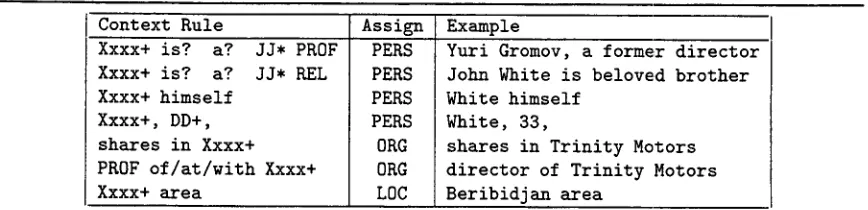
[image:3.596.81.502.87.161.2]Context Rule Assign Example Xxxx+ is? a? JJ* PROF
Xxxx+ is? a? JJ* KEL Xxxx+ himself
Xxxx+, DD+, shares in Xxxx+ PROF of/at/with Xxxx+ Xxxx+ area
PERS PERS PERS PERS 0RG
0RG L0C
Yuri Gromov, a former director John White is beloved brother White himself
White, 33,
shares in Trinity Motors director of Trinity Motors Beribidjan area
Figure 2: Examples of sure-fire transduction material for NE. X x x x + is a sequence of capitalized words; DD is a digit; P R O F is a profession; R E L is a relative; J J* is a sequence of zero or m o r e adjectives; L O C is a known location.
string of words like " A d a m Kluver" has an inter- nal (phrasal) structure which suggests t h a t this is a person name; b u t we know t h a t it can also be used as a shortcut for a n a m e of organization ( " A d a m Kluver Ltd.") or location ( " A d a m Klu- ver C o u n t r y P a r k " ) . Looking it up on a list will not necessarily help: the string m a y not be on a list, m a y be on more t h a n one list, or m a y be on the wrong list. However, somewhere in the text, there is likely to be some contextual material which makes it clear w h a t t y p e of n a m e d entity it is. Our s t r a t e g y is to only m a k e a decision once we have identified this bit of contextual information. We further assume t h a t , once we have identi- fied contextual material which makes it clear t h a t " A d a m Kluver" is (e.g.) the n a m e of a company, t h e n any other mention of " A d a m Kluver" in t h a t d o c u m e n t is likely to refer to t h a t company. If the a u t h o r at some point in the same text also wants to refer to (e.g.) a person called "Adam Kluver", s / h e will provide some e x t r a context to m a k e this clear, and this context will be picked up in the first step. T h e fact t h a t at first it is only an assump- tion r a t h e r t h a n a certainty t h a t " A d a m Kluver" is a company, is represented explicitly, and later processing components t r y to resolve the uncer- tainty.
If no suitable context is found anywhere in the t e x t to decide what sort of N a m e d Entity "Adam Kluver" is, the system can check other resources, e.g. a list of known c o m p a n y names and apply compositional phrasal g r a m m a r s for different cat- egories. Such g r a m m a r s for instance can state t h a t if a sequence of capitalized words ends with the word "Ltd." it is a n a m e of organization or if a known first name is followed by an unknown capitalized word this is a person name.
In our MUC system, we implemented this ap- proach as a staged combination of a rule-based system with probabilistic partial matching. We
describe each stage in turn. 3.3 Step 1. Sure-fire R u l e s
In the first step, the s y s t e m applies sure-fire gram- m a r rules. These rules combine internal and ex- ternal evidence, and only fire when a possible can- didate expression is surrounded by a suggestive context. Sure-fire rules rely on known c o r p o r a t e designators (Ltd., Inc., etc.), person titles (Mr., Dr., Sen.), and definite contexts such as those in Figure 2. T h e sure-fire rules a p p l y after POS tagging and simple semantic tagging, so at this stage words like "former" have already been iden- tified as J J (adjective), words like "analyst" have been identified as PROF (professions), and words like "brother" as REL (relatives).
At this stage our MUC s y s t e m treats informa- tion from the lists as likely r a t h e r t h a n definite and always checks if the context is either sugges- tive or non-contradictive. For example, a likely c o m p a n y n a m e with a conjunction (e.g. "China International Trust and I n v e s t m e n t C o r p " ) is left untagged at this stage if the c o m p a n y is not listed in a list of known companies. Similarly, the system postpones the m a r k u p of unknown organizations whose name starts with a sentence initial c o m m o n word, as in "Suspended Ceiling C o n t r a c t o r s L t d denied the charge".
Names of possible locations found in our gazetteer of place names are m a r k e d as LOCATION only if they a p p e a r with a context t h a t is sugges- tive of location. "Washington", for example, can just as easily be a s u r n a m e or the n a m e of an or- ganization. Only in a suggestive context, like "in Washington", will it be m a r k e d up as location. 3.4 S t e p 2. P a r t i a l M a t c h 1
After the sure-fire symbolic transduction the sys- t e m performs a probabiiistic partial m a t c h of the identified entities. First, the system collects all n a m e d entities already identified in the document.
[image:4.596.83.517.80.185.2]Proceedings of EACL '99
It then generates all possible partial orders of the composing words preserving their order, and marks them if found elsewhere in the text. For instance, if "Adam Kluver Ltd" had already been recognised as an organisation by the sure-fire rule, in this second step any occurrences of "Kluver Ltd", "Adam Ltd" and "Adam Kluver" are also tagged as
possible
organizations. This assignment, however, is not definite since some of these words (such as "Adam") could refer to a different entity. This information goes to a pre-trained maxi- mum entropy model (see Mikheev (1998) for more details on this aproach). This model takes into ac- count contextual information for named entities, such as their position in the sentence, whether they exist in lowercase in general, whether they were used in lowercase elsewhere in the same docu- ment, etc. These features are passed to the model as attributes of the partially matched words. If the model provides a positive answer for a partial match, the system makes a definite assignment. 3.5 Step 3. R u l e R e l a x a t i o nOnce this has been done, the system again applies the g r a m m a r rules. B u t this time the rules have much more relaxed contextual constraints and ex- tensively use the information from already exist- ing markup and from the lexicon compiled dur- ing processing, e.g. containing partial orders of al- ready identified named entities.
At this stage the system will mark word se- quences which look like person names. For this it uses a g r a m m a r of names: if the first capital- ized word occurs in a list of first names and the following word(s) are unknown capitalized words, then this string can be tagged as a PERSON. Note that it is only at this late stage that a list of names is used. At this point we are no longer concerned that a person name can refer to a company. If the name g r a m m a r had applied earlier in the process, it might erroneously have tagged "Adam Kluver" as a PERSON instead of an ORGANIZATION. But at this point in the chain of N~. processing, that is not a problem anymore: "Adam Kluver" will by now already have been identified as an ORGANIZATION by the sure-fire rules or during partial matching. If it hasn't, then it is likely to be the name of a person.
At this stage the system will also a t t e m p t to re- solve conjunction problems in names of organisa- tions. For example, in "China International Trust and Investment Corp", the system checks if pos- sible parts of the conjunctions were used in the text on their own and thus are names of different organizations; if not, the system has no reason to assume t h a t more than one company is being
talked about.
In a similar vein, the system resolves the at- tachment of sentence initial capitalized modifiers, the problem alluded to above with the "Suspended Ceiling Contractors Ltd" example: if the modifier was seen with the organization name elsewhere in the text, then the system has good evidence that the modifier is part of the company name; if the modifier does not occur anywhere else in the text with the company name, it is assumed not to be part of it.
This strategy is also used for expressions like "Murdoch's News C o r p ' . The genitival "Mur- doch's" could be part of the name of the organisa- tion, or could be a possessive. Further inspection of the text reveals t h a t Rupert Murdoch is referred to in contexts which support a person interpreta- tion; and "News Corp" occurs on its own, without the genitive. On the basis of evidence like this, the system decides that the name of the organisation is "News C o r p ' , and that "Murdoch" should be tagged separately as a person.
At this stage known organizations and locations from the lists available to the system are marked in the text, again without checking the context in which they occur.
3.6 S t e p 4. P a r t i a l M a t c h 2
At this point, the system has exhausted its re- sources (rules about internal and external evi- dence for named entities, as well as its gazetteers). The system then performs another partial match to annotate names like "White" when "James White" had already been recognised as a person, and to annotate company names like "Hughes" when "Hughes Communications Ltd." had al- ready been identified as an organisation.
S t a g e O R G A N I Z A T I O N P E R S O N L O C A T I O N Sure-fire Rules
Partial Match 1 Relaxed Rules Partial Match 2 Title Assignment
R: 42 P: 98 R: 75 P: 98 R: 83 P: 96 R: 85 P: 96 R: 91 P: 95
R: 40 P: 99 R: 80 P: 99 R: 90 P: 98 R: 93 P: 97 R: 95 P: 97
R: 36 P: 96 R: 69 P: 93 R: 86 P: 93 R: 88 P: 93 R: 95 P: 93
Figure 3: Scores obtained by the system through different stages of the analysis. R - recall P - precision.
a location (the fact t h a t it contained the word "States"); and there was external evidence that it could be a location (the fact that it occurred in a conjunction with "Russia", a known location). These two facts in combination m e a n t that the system correctly identified "UTited States" as a location.
3.7 Step 5. Title A s s i g n m e n t
Because titles of news wires are in capital letters, they provide little guidance for the recognition of names. In the final stage of NE processing, enti- ties in the title are marked up, by matching or partially matching the entities found in the text, and checking against a maximum entropy model trained on document titles. For example, in "GEN- ERAL TRENDS ANALYST PREDICTS LITTLE SPRING EXPLOSION" "GENERAL TRENDS" will be tagged as an organization because it partially matches "General Trends Inc" elsewhere in the text, and " L I T T L E SPRING" will be tagged as a location because elsewhere in the text there is support- ing evidence for this hypothesis. In the headline "MURDOCH SATELLITE EXPLODES ON T A K E - O F F " , "Murdoch" is correctly identified as a person be- cause of mentions of R u p e r t Murdoch elsewhere in the text. Applying a name g r a m m a r on this kind of headline without checking external evi- dence might result in erroneously tagging "MUR- DOCH SATELLITE" a s a person (because "Mur- doch" is also a first name, and "Satellite" in this headline starts with a capital letter).
4 M U C r e s u l t s
In the MUC competition, our system's combined precision and recall score was 93.39%. This was the highest score, b e t t e r in a statistically signifi- cant way t h a n the score of the next best system. Scores varied from 93.39% to 69.67%. Further de- tails on this can be found in (Mikheev et al., 1998). T h e table in Figure 3 shows the progress of the performance of the system we fielded for the MUC competition through the five stages.
As one would expect, the sure-fire rules give
very high precision (around 96-98%), but very low recall--in other words, they d o n ' t find m a n y named entities, but the ones they find are correct. Subsequent phases of processing add gradually more and more named entities (recall increases from around 40% to around 90%), but on occa- sion introduce errors (resulting in a slight drop in precision). Our final score for 0RGhNISATION, PERSON and LOCATION is given in the b o t t o m line of Figure 3.
5 T h e r o l e o f g a z e t t e e r s
Our system fielded for the MUC competition made extensive use of gazetteers, containing a r o u n d 4,900 names of countries and other place names, some 30,000 names of companies and other organ° isations, and around 10,000 first names of peo- ple. As explained in the previous section, these lists were used in a judicious way, taking into ac- count other internal and external evidence before making a decision about a named entity. Only in step 3 is information from the gazetteers used without context-checking.
It is not immediately obvious from Figure 3 what exactly the impact is of these gazetteers. To t r y and answer this question, we ran our system over 70 articles of the MUC competition in differ- ent modes; the remaining 30 articles were used to compile a limited gazetteer as described below and after that played no role in the experiments.
F u l l g a z e t t e e r s . We first ran the system again with the full gazetteers, i.e. the gazetteers used in the official MUC system. T h e r e are minor dif- ferences in Recall and Precision compared to the official MUC results, due to the fact t h a t we were using a slightly different (smaller) corpus.
N o gazetteers. We then ran the system with- out any gazetteers. In this mode, the system can still use internal evidence (e.g. indicators such as "Mr" for people or " L t d " for organisations) as well as external evidence (contexts such as "XXX, the chairman of YYY" as evidence t h a t XXX is a person and YYY an organisation).
[image:6.596.73.502.81.165.2]Proceedings of EACL '99
Full gazetteer Ltd gazetteer Some locations No g a z e t t e e r s recall prec'n recall prec'n recall prec'n recall prec'n
organisation 90 93 87 90 87 89 86 85
person 96 98 92 97 90 97 90 95
location 95 94 91 92 85 90 46 59
Figure 4: Our MUC system with extensive gazetteers, with limited gazetteers, with short list of locations, and without gazetteers, tested on 70 articles from the MUC-7 competition.
and names of people should still be handled rel- atively well by the system, since they have much internal and external evidence, whereas names of locations have fewer reliable contextual clues. For example, expressions such as "XXX is based in YYY" is not sure-fire evidence that YYY is a lo- cation - it could also be an organisation. And since many locations are so well-known, they re- ceive very little extra context ("in China", "in Paris", vs "in the small town of Ekeren").
S o m e l o c a t i o n s . We then ran the system with some locational information: about 200 names of countries and continents from www. yahoo, corn/ R e g i o n a l / a n d , because MUC rules say explicitly that names of planets should be marked up as locations, the names of the 8 planets of our so- lar system. T h e hypothesis was that even with those reasonably common location names, Named Entity recognition would already dramatically im- prove. This hypothesis was confirmed, as can be seen in Figure 4.
Inspection of the errors confirms that the sys- tem makes most mistakes when there is no inter- nal or external evidence to decide what sort of Named E n t i t y is involved. For example, in a ref- erence to "a Hamburg hospital", "Hamburg" no longer gets marked up as a location, because the word occurs nowhere else in the text, and that context is not sufficient to assume it indicates a lo- cation (cf. a Community Hospital, a Catholic Hos- pital, an NHS Hospital, a Trust-Controlled Hos- pital, etc). Similarly, in a reference to "the Bonn government", "Bonn" is no longer marked up as a location, because of lack of supportive context (cf. the Clinton government, the Labour government, etc). And in financial newspaper articles NYSE will be used without any indication that this is an organisation (the New York Stock Exchange).
L i m i t e d g a z e t t e e r s . The results so far sug- gest that the most useful gazetteers are those that contain very common names, names which the au- thors can expect their audience already to know about, r a t h e r than far-fetched examples of little known places or organisations.
This suggests that it should be possible to tune a system to the kinds of Named Entities t h a t oc- cur in its particular genre of text. To test this hypothesis, we wanted to know how the system would perform if it started with no gazetteers, started processing texts, then built up gazetteers as it goes along, and then uses these gazetteers on a new set of texts in the same domain. We sim- ulated these conditions by taking 30 of the 100 official MUC articles and extracting all the names of people, organisations and locations and using these as the only gazetteers, thereby ensuring t h a t we had extracted Named Entities from articles in the same domain as the test domain.
Since we wanted to test how easy it was to build gazetteers automatically, we wanted to minimise the amount of processing done on Named Enti- ties already found. We decided to only used first names of people, and marked them all as "likely" first names: the fact that "Bill" actually occurs as a first name does not guarantee it will definitely be a first name next time you see it. Company names found in the 30 articles were put in the company gazetteer, irrespective of whether they were full company names (e.g. "MCI Communications Cor- p" as well as "MCI" and "MCI Communication- s"). Names of locations found in the 30 texts were simply added to the list of 200 location names al- ready used in the previous experiments.
The hope was that, despite the little effort in- volved in building these limited gazetteers, there would be an improved performance of the Named Entity recognition system.
Figure 4 summarises the Precision and Recall results for each of these modes and confirms the hypotheses.
6 D i s c u s s i o n
[image:7.596.74.503.82.149.2]eighties. And simple techniques for extending the gazetteers on the basis of a sample of just 30 arti- cles already makes the system competitive again. These experiments suggest that the collection of gazetteers need not be a bottleneck: through a judicious use of internal and external evidence rel- atively small gazetteers are sufficient to give good Precision and Recall. In addition, when collecting these gazetteers one can concentrate on the
obvi-
ous
examples of locations and organisations, since these are exactly the ones that will be introduced in texts without much helpful context.However, our experiments only show the useful- ness of gazetteers on a particular type of text, viz. journalistic English with mixed case. The rules as well as the maximum entropy models make use of internal and external evidence in that type of text when trying to identify named entities, and it is obvious that this system cannot be applied with- out modification to a different type of text, e.g. scientific articles. Without further formal eval- uations with externally supplied evaluation cor- pora it is difficult to judge how general this text type is. It is encouraging to note that Krupka and Hausman (1998) point out that the MUC-7 articles which we used in our experiments have less exter- nal evidence than do Wall Street Journal articles, which suggests that on Wall Street Journal arti- cles our system might perform even better than on MUC-7 articles.
A c k n o w l e d g e m e n t s
The work reported in this paper was supported in part by grant GR/L21952 (Text Tokenisation Tool) from the Engineering and Physical Sciences Research Council, UK. We would like to thank Steve Finch and Irina Nazarova as well as Colin Matheson and other members of the Language Technology Group for help in building various tools and other resources that were used in the development of the MUC system.
R e f e r e n c e s
Alessandro Cucchiarelli, Danilo Luzi, and Paola Velardi. 1998. Automatic semantic tagging of unknown proper names. In
Proceedings of
the 36th Annual Meeting of the Association for
Computational Linguistics and Proceedings of
the 17th International Conference on Compu-
tational Linguistics,
pages 286-292, Montr4al, Canada, August 10-14.George R. Krupka and Kevin Hausman. 1998. Isoquest, Inc: Description of the NetOwl(TM) extractor system as used for MUC-7. In
Seventh Message Understanding Conference
(MUC-7): Proceedings of a Conference held
in Fairfax, Virginia, 29 April-1 May, 1998.
http://www, muc. sale. com/proceedings/ muc_7_toc, html.
George R. Krupka. 1995. Description of the S R A system as used for MUC-6. In
Sixth Message
Understanding Conference (MUC-6): Proceed-
ings of a Conference ,~eld in Columbia, Mary-
land, November 6-8, 1995,
pages 221-235, Los Altos, Ca. Morgan Kaufmann.David D. McDonald. 1996. Internal and external evidence in the identification and semantic cat- egorization of proper names. In Bran Boguraev and James Pustejovsky, editors,
Corpus Pro-
cessing for Lexical Acquisition,
chapter 2, pages 21-39. The MIT Press, Cambridge, MA. Andrei Mikheev, Claire Grover, and Marc Moens.1998. Description of the LTG system used for MUC-7. In
Seventh Message Understanding
Conference (MUC-7): Proceedings of a Con-
ference held in Fairfax, Virginia, 29 April-
1 May, 1998.
h t t p : / / w , r ~ . m u c . s a i c . c o t a / proceedings/muc_7_toc, html.Andrei Mikheev. 1998. Feature lattices for max-
i m u m entropy modelling.
In Proceedings of
the 36th Annual Meeting of the Association for
Computational Linguistics and Proceedings of
the 17th International Conference on Compu-
tational Linguistics,
pages 848-854, Montreal, Quebec, August 10-14.Richard Morgan, Roberto Garigliano, Paul Callaghan, Sanjay Poria, Mark Smith, Ag- nieszka Urbanowicz, Russel Collingham, Marco Costantino, and Chris Cooper. 1995. Descrip- tion of the LOLITA system as used in MUC- 6. In
Sixth Message Understanding Conference
(MUC-6): Proceedings of a Conference held
in Columbia, Maryland, November 6-8, 1995,
pages 71-86, Los Altos, Ca. Morgan Kaufmann. D. Palmer and D. Day. 1997. A statistical profile of the Named Entity task. In