Improving Word Alignment using Word Similarity
Theerawat Songyot
Dept of Computer Science University of Southern California
David Chiang†
Dept of Computer Science and Engineering University of Notre Dame
Abstract
We show that semantic relationships can be used to improve word alignment, in ad-dition to the lexical and syntactic features that are typically used. In this paper, we present a method based on a neural net-work to automatically derive word simi-larity from monolingual data. We present an extension to word alignment models that exploits word similarity. Our exper-iments, in both large-scale and resource-limited settings, show improvements in word alignment tasks as well as translation tasks.
1 Introduction
Word alignment is an essential step for learn-ing translation rules in statistical machine trans-lation. The task is to find word-level transla-tion correspondences in parallel text. Formally, given a source sentence e consisting of words e1, e2, . . . , el and a target sentence f consisting
of words f1, f2, . . . , fm, we want to infer an
alignmenta, a sequence of indicesa1, a2, . . . , am
which indicates, for each target wordfi, the
corre-sponding source wordeaior a null word. Machine translation systems, including state-of-the-art sys-tems, then use the word-aligned corpus to extract translation rules.
The most widely used methods, the IBM mod-els (Brown et al., 1993) and HMM (Vogel et al., 1996), define a probability distributionp(f,a |e)
that models how each target word fi is
gener-ated from a source word eai with respect to an alignment a. The models, however, tend to mis-align low-frequency words as they have insuffi-cient training samples. The problem can get worse in low-resource languages. Two branches of re-search have tried to alleviate the problem. The
†Most of the work reported here was performed while the
second author was at the University of Southern California.
first branch relies solely on the parallel data; how-ever, additional assumptions about the data are re-quired. This includes, but is not limited to, ap-plying prior distributions (Mermer and Sarac¸lar, 2011; Vaswani et al., 2012) or smoothing tech-niques (Zhang and Chiang, 2014). The other branch uses information learned from monolin-gual data, which is generally easier to acquire than parallel data. Previous work in this branch mostly involves applying syntactic constraints (Yamada and Knight, 2001; Cherry and Lin, 2006; Wang and Zong, 2013) and syntactic features (Toutanova et al., 2002) into the models. The use of syntac-tic relationships can, however, be limited between historically unrelated language pairs.
Our motivation lies in the fact that a meaningful sentence is not merely a grammatically structured sentence; its semantics can provide insightful in-formation for the task. For example, suppose that the models are uncertain about aligningetof. If the models are informed thateis semantically re-lated toe0,f is semantically related tof0, andf0is a translation ofe0, it should intuitively increase the probability thatf is a translation ofe. Our work focuses on using such a semantic relationship, in particular, word similarity, to improve word align-ments.
In this paper, we propose a method to learn sim-ilar words from monolingual data (Section 2) and an extension to word alignment models in which word similarity can be incorporated (Section 3). We demonstrate its application in word alignment and translation (Section 4) and then briefly discuss the novelty of our work in comparison to other methods (Section 5).
2 Learning word similarity
Given a word w, we want to learn a word simi-larity model p(w0 | w) of what words w0 might be used in place of w. Word similarity can be used to improve word alignment, as in this
per, but can potentially be useful for other nat-ural language processing tasks as well. Such a model might be obtained from a monolingual the-saurus, in which humans manually provide sub-jective evaluation for word similarity probabilities, but an automatic method would be preferable. In this section, we present a direct formulation of the word similarity model, which can automatically be trained from monolingual data, and then consider a more practical variant, which we adopt in our experiments.
2.1 Model
Given an arbitrary word typew, we define a word similarity modelp(w0 | w) for all word typesw0 in the vocabularyV as
p(w0|w) =X
c
p(c|w)p(w0 |c)
where c is a word context represented by a se-quence w1, w2, . . . , w2n consisting ofnword
to-kens on the left and n word tokens on the right ofw, excludingw. The submodel p(c | w) can be a categorical distribution. However, modeling the word context model,p(w0 | c), as a categori-cal distribution would cause severe overfitting, be-cause the number of all possible contexts is|V|2n,
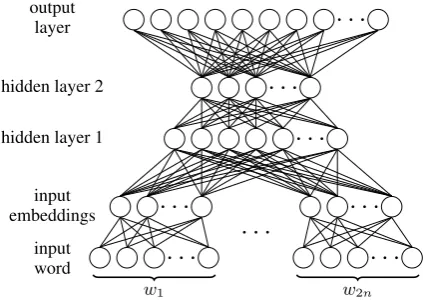
which is exponential in the length of the context. We therefore parameterize it using a feedforward neural network as shown in Figure 1, since the structure has been shown to be effective for lan-guage modeling (Bengio et al., 2006; Vaswani et al., 2013). The input to the network is a one-hot representation of each word inc, where the spe-cial symbols<s>,</s>,<unk>are reserved for sentence beginning, sentence ending, and words not in the vocabulary. There is an output node for eachw0 ∈ V, whose activation isp(w0 | c). Following Bengio et al. (2006), the network uses a shared linear projection matrix to the input em-bedding layer, which allows information sharing among the context words and also substantially reduces the number of parameters. The input em-bedding layer has a dimensionality of 150 for each input word. The network uses two hidden layers with 1,000 and 150 rectified linear units, respec-tively, and a softmax output layer. We arbitrarily usen= 5throughout this paper.
2.2 Training
We extract training data by either collecting or sampling the target wordsw ∈ V and their word
input
word
. . .
. . .
w1 w2n
. . .
input
embeddings
. . .
. . .
hidden layer 1
. . .
hidden layer 2
. . .
output
[image:2.595.312.524.66.216.2]layer
. . .
Figure 1: The structure of the word context model
contexts from monolingual data. The submodel p(c | w) can be independently trained easily by maximum likelihood estimation, while the word context modelp(w0 |c)may be difficult to train at scale. We follow previous work (Mnih and Teh, 2012; Vaswani et al., 2013) in adopting noise-contrastive estimation (Gutmann and Hyv¨arinen, 2010), a fast and simple training algorithm that scales independently of the vocabulary size.
2.3 Model variants
The above formulation of the word similarity model can be interpreted as a mixture model in whichw0is similar towif any of the context prob-abilities agrees. However, to guard against false positives, we can alternatively reformulate it as a product of experts (Hinton, 1999),
p(w0 |w) = Z(1w)expX
c
p(c|w) logp(w0 |c)
where Z(w) is a normalization constant. Under this model,w0 is similar towifallof the context probabilities agree. Both methods produce reason-ably good word similarity; however, in practice, the latter performs better.
Since most of the p(w0 | w) will be close to zero, for computational efficiency, we can se-lect the k most similar words and renormalize the probabilities. Table 1 shows some examples learned from the 402M-word Xinhua portion of the English Gigaword corpus (LDC2007T07), us-ing a vocabulary V of the 30,000 most frequent words. We setk= 5for illustration purposes.
3 Word alignment model
p(w0|country) p(w0|region) p(w0|area) country 0.8363 region 0.8338 area 0.8551 region 0.0558 area 0.0760 region 0.0524 nation 0.0522 country 0.0524 zone 0.0338 world 0.0282 province 0.0195 city 0.0326 city 0.0273 city 0.0181 areas 0.0258
Table 1: Examples of word similarity
The method can easily be applied to other related models, for example, the log-linear reparameteri-zation of Model 2 by Dyer et al. (2013). Basically, all the IBM models involve modeling lexical trans-lation probabilitiesp(f |e)which are parameter-ized as categorical distributions. IBM Model 1, for instance, is defined as
p(f,a|e)∝Ym i=1
p(fi|eai) =
m
Y
i=1
t(fi |eai)
where eacht(f |e)denotes the model parameters directly corresponding to p(f | e). Models 2–5 and the HMM-based model introduce additional components in order to capture word ordering and word fertility. However, they have p(f | e) in common.
3.1 Model
To incorporate word similarity in word alignment models, we redefine the lexical translation proba-bilities as
p(f |e) =X
e0,f0
p(e0|e)t(f0 |e0)p(f |f0)
for allf, e, including words not in the vocabulary. While the factorp(e0 |e)can be directly computed by the word similarity model, the factorp(f |f0) can be problematic because it vanishes forf out of vocabulary. One possible solution would be to use Bayes’ rule
p(f |f0) = p(f0p|(ff)0)p(f)
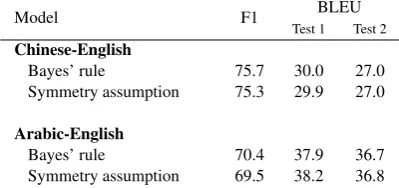
wherep(f0 |f)is computed by the word similar-ity model. However, we find that this is prone to numerical instability and other complications. In our experiments, we tried the simpler assumption thatp(f |f0) ≈p(f0 | f), with the rationale that both probabilities are measures of word similarity, which is intuitively a symmetric relation. We also compared the performance of both methods. Ta-ble 2 shows that this simple solution works as well as the more exact method of using Bayes’ rule. We describe the experiment details in Section 4.
Model F1 Test 1BLEUTest 2
Chinese-English
Bayes’ rule 75.7 30.0 27.0 Symmetry assumption 75.3 29.9 27.0
Arabic-English
Bayes’ rule 70.4 37.9 36.7 Symmetry assumption 69.5 38.2 36.8
Table 2: Assuming that word similarity is sym-metric, i.e. p(f | f0) ≈ p(f0 |f), works as well as computingp(f |f0)using Bayes’ rule.
3.2 Re-estimating word similarity
Depending on the quality of word similarity and the distribution of words in the parallel data, ap-plying word similarity directly to the model could lead to an undesirable effect where similar but not interchangeable words rank in the top of the trans-lation probabilities. On the other hand, if we set
p(e0|e) =1[e0=e]
p(f0|f) =1[f0=f]
where1denotes the indicator function, the model reduces to the standard IBM models. To get the best of both worlds, we smooth the two models together so that we rely more on word similarity for rare words and less for frequent words
˜
p(w0|w) = count(w)1[w0=w] +α p(w0 |w) count(w) +α
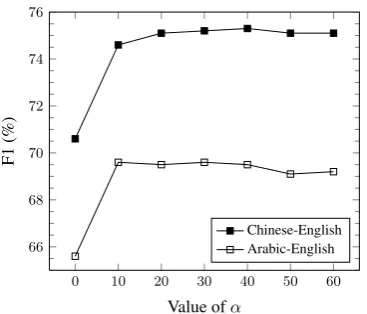
This can be thought of as similar to Witten-Bell smoothing, or addingα pseudocounts distributed according to our p(w0 | w). The hyperparame-terαcontrols how much influence our word sim-ilarity model has. We investigated the effect ofα by varying this hyperparameter in our word align-ment experialign-ments whose details are described in Section 4. Figure 2 shows that performance of the model, as measured by F1 score, is rather insensi-tive to the choice ofα. We used a value of40 in our experiments.
3.3 Training
Our word alignment models can be trained in the same way as the IBM models using the Expec-tation Maximization (EM) algorithm to maximize the likelihood of the parallel data. Our extension only introduces an additional time complexity on the order of O(k2) on top of the base models,
[image:3.595.317.517.64.158.2]0 10 20 30 40 50 60 66
68 70 72 74 76
Value ofα
F1
(%)
[image:4.595.315.521.59.239.2]Chinese-English Arabic-English
Figure 2: Alignment F1 is fairly insensitive to α over a large range of values
The larger the value ofkis, the closer to the full-vocabulary models our estimations are. In prac-tice, a small value ofkseems to be effective since p(w0|w)is negligibly small for mostw0.
4 Experiments
4.1 Alignment experiments
We conducted word alignment experiments on 2 language pairs: Chinese-English and Arabic-English. For Chinese-English, we used 9.5M+12.3M words of parallel text from the NIST 2009 constrained task1 and evaluated on 39.6k+50.9k words of hand-aligned data (LDC2010E63, LDC2010E37). For Arabic-English, we used 4.2M+5.4M words of parallel text from the NIST 2009 constrained task2 and evaluated on 10.7k+15.1k words of hand-aligned data (LDC2006E86). To demonstrate performance under resource-limited settings, we additionally experimented on only the first eighth of the full data, specifically, 1.2M+1.6M words for Chinese-English and 1.0M+1.4M words for Arabic-English. We trained word similarity models on the Xinhua portions of English Gigaword (LDC2007T07), Chinese Gigaword (LDC2007T38), and Arabic Gigaword (LDC2011T1), which are 402M, 323M, and 125M words, respectively. The vocabularyV was the 30,000 most frequent words from each corpus
1Catalog numbers: LDC2003E07, LDC2003E14,
LDC2005E83, LDC2005T06, LDC2006E24, LDC2006E34, LDC2006E85, LDC2006E86, LDC2006E92, and LDC2006E93.
2Excluding: United Nations proceedings (LDC2004E13),
ISI Automatically Extracted Parallel Text (LDC2007E08), and Ummah newswire text (LDC2004T18)
1-10 11-20 21-30 31-40 41-50 51-60
30 40 50 60 70 80
38.1 52.4
56.9 55.4
59.5 60.1
58.5 63.7
66.3 66.4
70.5 71.5
Source word frequency
F1
(%)
Baseline Our model
Figure 3: F1 scores for words binned by fre-quency. Our model gives the largest improvements for the lowest-frequency words.
and thek= 10most similar words were used. We modified GIZA++ (Och and Ney, 2003) to incorporate word similarity. For all experiments, we used the default configuration of GIZA++: 5 iterations each of IBM Model 1, 2, HMM, 3 and 4. We aligned the parallel texts in both forward and backward directions and symmetrized them using grow-diag-final-and (Koehn et al., 2005). We evaluated alignment quality using precision, recall, and F1.
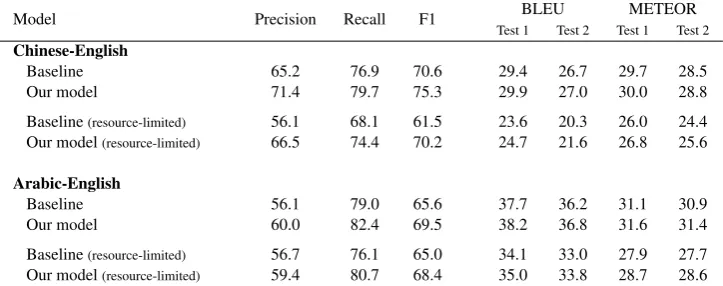
The results in Table 3 suggest that our modeling approach produces better word alignments. We found that our models not only learned smoother translation models for low frequency words but also ranked the conditional probabilities more ac-curately with respect to the correct translations. To illustrate this, we categorized the alignment links from the Chinese-English low-resource ex-periment into bins with respect to the English source word frequency and individually evaluated them. As shown in Figure 3, the gain for low fre-quency words is particularly large.
4.2 Translation experiments
[image:4.595.92.276.62.219.2]Model Precision Recall F1 Test 1BLEUTest 2 Test 1METEORTest 2
Chinese-English
Baseline 65.2 76.9 70.6 29.4 26.7 29.7 28.5 Our model 71.4 79.7 75.3 29.9 27.0 30.0 28.8 Baseline(resource-limited) 56.1 68.1 61.5 23.6 20.3 26.0 24.4 Our model(resource-limited) 66.5 74.4 70.2 24.7 21.6 26.8 25.6
Arabic-English
[image:5.595.119.481.63.206.2]Baseline 56.1 79.0 65.6 37.7 36.2 31.1 30.9 Our model 60.0 82.4 69.5 38.2 36.8 31.6 31.4 Baseline(resource-limited) 56.7 76.1 65.0 34.1 33.0 27.9 27.7 Our model(resource-limited) 59.4 80.7 68.4 35.0 33.8 28.7 28.6
Table 3: Experimental results. Our model improves alignments and translations on both language pairs.
build a hierarchical phrase-based translation sys-tem (Chiang, 2007) trained using MIRA (Chiang, 2012). Then, we evaluated the translation qual-ity using BLEU (Papineni et al., 2002) and ME-TEOR (Denkowski and Lavie, 2014), and per-formed significance testing using bootstrap resam-pling (Koehn, 2004) with 1,000 samples.
Under the resource-limited settings, our meth-ods consistently show 1.1–1.3 BLEU (0.8–1.2 METEOR) improvements on Chinese-English and 0.8–0.9 BLEU (0.8–0.9 METEOR) improvements on Arabic-English, as shown in Table 3. These im-provements are statistically significant (p <0.01). On the full data, our method improves Chinese-English translation by 0.3–0.5 BLEU (0.3 ME-TEOR), which is unfortunately not statistically significant, and Arabic-English translation by 0.5– 0.6 BLEU (0.5 METEOR), which is statistically significant (p <0.01).
5 Related work
Most previous work on word alignment problems uses morphosyntactic-semantic features, for ex-ample, word stems, content words, orthography (De Gispert et al., 2006; Hermjakob, 2009). A variety of log-linear models have been proposed to incorporate these features (Dyer et al., 2011; Berg-Kirkpatrick et al., 2010). These approaches usu-ally require numerical optimization for discrimi-native training as well as language-specific engi-neering and may limit their applications to mor-phologically rich languages.
A more semantic approach resorts to training word alignments on semantic word classes (Ma et al., 2011). However, the resulting alignments are only used to supplement the word alignments learned on lexical words. To our knowledge, our
work, which directly incorporates semantic rela-tionships in word alignment models, is novel.
6 Conclusion
We have presented methods to extract word simi-larity from monolingual data and apply it to word alignment models. Our method can learn simi-lar words and word simisimi-larity probabilities, which can be used inside any probability model and in many natural language processing tasks. We have demonstrated its effectiveness in statistical ma-chine translation. The enhanced models can sig-nificantly improve alignment quality as well as translation quality.
Acknowledgments
We express our appreciation to Ashish Vaswani for his advice and assistance. We also thank Hui Zhang, Tomer Levinboim, Qing Dou, Aliya Deri for helpful discussions and the anonymous review-ers for their insightful critiques. This research was supported in part by DOI/IBC grant D12AP00225 and a Google Research Award to Chiang.
References
Yoshua Bengio, Holger Schwenk, Jean-S´ebastien Sen´ecal, Fr´ederic Morin, and Jean-Luc Gauvain. 2006. Neural probabilistic language models. In Innovations in Machine Learning, pages 137–186. Springer.
Taylor Berg-Kirkpatrick, Alexandre Bouchard-Cˆot´e, John DeNero, and Dan Klein. 2010. Painless un-supervised learning with features. InProceedings of HLT NAACL, pages 582–590.
Parameter estimation. Computational Linguistics, 19(2):263–311.
Colin Cherry and Dekang Lin. 2006. Soft syntac-tic constraints for word alignment through discrim-inative training. In Proceedings of COLING/ACL, pages 105–112.
David Chiang. 2007. Hierarchical phrase-based trans-lation. Computational Linguistics, 33(2):201–228. David Chiang. 2012. Hope and fear for discriminative
training of statistical translation models. Journal of Machine Learning Research, 13(1):1159–1187. Adri`a De Gispert, Deepa Gupta, Maja Popovi´c, Patrik
Lambert, Jose B. Mari˜no, Marcello Federico, Her-mann Ney, and Rafael Banchs. 2006. Improving statistical word alignments with morpho-syntactic transformations. InAdvances in Natural Language Processing, pages 368–379. Springer.
Michael Denkowski and Alon Lavie. 2014. Meteor universal: Language specific translation evaluation for any target language. InProceedings of the EACL 2014 Workshop on Statistical Machine Translation. Chris Dyer, Jonathan Clark, Alon Lavie, and Noah A.
Smith. 2011. Unsupervised word alignment with arbitrary features. InProceedings of ACL: HLT, vol-ume 1, pages 409–419.
Chris Dyer, Victor Chahuneau, and Noah A. Smith. 2013. A simple, fast, and effective reparameteriza-tion of IBM Model 2. InProceedings of NAACL-HLT, pages 644–648.
Michael Gutmann and Aapo Hyv¨arinen. 2010. Noise-contrastive estimation: A new estimation princi-ple for unnormalized statistical models. In Inter-national Conference on Artificial Intelligence and Statistics (AI-STATS), pages 297–304.
Ulf Hermjakob. 2009. Improved word alignment with statistics and linguistic heuristics. InProceedings of EMNLP, volume 1, pages 229–237.
Geoffrey E. Hinton. 1999. Products of experts. In International Conference on Artificial Neural Net-works, volume 1, pages 1–6.
Philipp Koehn, Amittai Axelrod, Chris Callison-Burch, Miles Osborne, and David Talbot. 2005. Ed-inburgh system description for the 2005 IWSLT speech translation evaluation. InProceedings of the International Workshop on Spoken Language Trans-lation (IWSLT).
Philipp Koehn, Hieu Hoang, Alexandra Birch, Chris Callison-Burch, Marcello Federico, Nicola Bertoldi, Brooke Cowan, Wade Shen, Christine Moran, Richard Zens, Chris Dyer, Ondˇrej Bojar, Alexandra Constantin, and Evan Herbst. 2007. Moses: Open source toolkit for statistical machine translation. In Proceedings of ACL: Interactive Poster and Demon-stration Sessions, pages 177–180.
Philipp Koehn. 2004. Statistical significance tests for machine translation evaluation. In Proceedings of EMNLP.
Jeff Ma, Spyros Matsoukas, and Richard Schwartz. 2011. Improving low-resource statistical machine translation with a novel semantic word clustering al-gorithm. InProceedings of MT Summit.
Cos¸kun Mermer and Murat Sarac¸lar. 2011. Bayesian word alignment for statistical machine translation. InProceedings of ACL: HLT, volume 2, pages 182– 187.
Andriy Mnih and Yee Whye Teh. 2012. A fast and simple algorithm for training neural probabilistic language models. InProceedings of ICML.
Franz Josef Och and Hermann Ney. 2003. A sys-tematic comparison of various statistical alignment models. Computational linguistics, 29(1):19–51. Kishore Papineni, Salim Roukos, Todd Ward, and
Wei-Jing Zhu. 2002. BLEU: a method for automatic evaluation of machine translation. In Proceedings of ACL, pages 311–318.
Kristina Toutanova, H. Tolga Ilhan, and Christopher D. Manning. 2002. Extensions to HMM-based sta-tistical word alignment models. InProceedings of EMNLP, pages 87–94.
Ashish Vaswani, Liang Huang, and David Chiang. 2012. Smaller alignment models for better trans-lations: unsupervised word alignment with the`0 -norm. InProceedings of ACL, volume 1, pages 311– 319.
Ashish Vaswani, Yinggong Zhao, Victoria Fossum, and David Chiang. 2013. Decoding with large-scale neural language models improves translation. In Proceedings of EMNLP.
Stephan Vogel, Hermann Ney, and Christoph Tillmann. 1996. HMM-based word alignment in statistical translation. InProceedings of COLING, volume 2, pages 836–841.
Zhiguo Wang and Chengqing Zong. 2013. Large-scale word alignment using soft dependency cohe-sion constraints. Transactions of the Association for Computational Linguistics, 1(6):291–300.
Kenji Yamada and Kevin Knight. 2001. A syntax-based statistical translation model. InProceedings of ACL, pages 523–530.