Review Article
Hemiarthroplasty compared with total
hip arthroplasty for displaced fractures of
femoral neck in the elderly: a systematic review
and meta-analysis of fourteen randomized clinical trials
Danfeng Xu1, Xuting Li2, Fanggang Bi3, Chiyuan Ma4, Lei Lu5, Jinhui Cao5
Departmenst of 1Pain Treatment, 5Orthopaedic Surgery, Shaoxing Central Hospital, Shaoxing, People’s Republic
of China; 2Department of Neurology, Shaoxing Shangyu People’s Hospital, Shangyu, Shaoxing, People’s Republic
of China; 3Department of Orthopaedic Surgery, The First Affiliated Hospital of Zhengzhou University, Zhengzhou,
People’s Republic of China; 4Department of Orthopaedic Surgery, The Second Affiliated Hospital, School of Medi
-cine, Zhejiang University, Hangzhou, People’s Republic of China
Received September 17, 2017; Accepted April 12, 2018; Epub June 15, 2018; Published June 30, 2018
Abstract: The optimal choice for displaced femoral neck fracture (FNF) in the elderly remains controversial, with alternatives including hemiarthroplasty (HA) and total hip arthroplasty (THA). This study was performed to determine the effects of HA compared with THA on rates of mortality, revision, dislocation, infection, operating time, and hip function in elderly patients with a displaced FNF. Electronic databases were carefully searched for relevant publica-tions. All prospective randomized controlled trials directly comparing mortality rate, revision rate, dislocation, or hip function assessment between HA and THA were retrieved. Fourteen studies involving 1523 patients were included in the analysis. There was no significant difference in 1-year mortality rate between groups. The revision rate after THA showed a slight decrease compared with that after HA. There was a significant risk of dislocation after treat -ment with THA. The risk of infection did not differ between HA and THA. The operating time for THA was greater than that for HA. Patients treated with THA had significantly higher Harris Hip Scores. In conclusion, THA for treatment of displaced FNF significantly reduces the risk of revision surgery and tends toward better hip functional outcome scores at the cost of greater dislocation rates, blood loss, and operating time.
Keywords: Displaced femoral neck fracture, hemiarthroplasty, total hip arthroplasty, dislocation, Harris hip score
Introduction
The proportion of elderly people is increasing as the world’s population ages, which is pre-dicted to result in a rise in the incidence of osteoporotic hip fractures. It is estimated that about 1.6 million hip fractures occurred in 2000 [1], and the incidence of hip fractures is expected to increase to more than six million worldwide by the year 2050 [2]. Treatment options for fractures of the femoral neck in
elderly patients include internal fixation, hemi -arthroplasty (HA), and total hip -arthroplasty
(THA). Internal fixation is recommended as the
treatment of choice in young patients with dis-placed femoral neck fracture (FNF) [3] and in
very elderly patients not medically fit for pros
-thetic surgery [4]. Arthroplasty (HA or THA) is a preferred treatment modality in the elderly pop-ulation (> 60 years) [5]. The choice between HA
and THA has always been difficult for elderly
patients with displaced FNF.
revi-sion because of acetabular erorevi-sion [9]. In con-trast, the major early complication of THA is dislocation, the rate of which increases in asso-ciation with the use of a posterior approach and a smaller prosthetic head size [10]. The reported rates of dislocation after THA to treat displaced FNF have ranged from 0 to 20.2% [11-13]. Nevertheless, most orthopedic sur-geons prefer HA in the management of this injury, reporting decreased operation time, blood loss, and risk of mortality because the procedure is quicker and often simpler than THA [14].
A number of recent randomized trials have compared the treatment of displaced FNF between HA and THA. These trials have over-come the limitations of earlier studies by de- creasing bias through randomization. However, their small sample sizes (range, 40-252
patients) and wide confidence intervals (CI)
surrounding the treatment effects have limited the inferences that can be made based on their results.
Previous systematic reviews have included few randomized trials. There have been several meta-analyses [15-18], and a limited number of studies have evaluated the optimal type of arthroplasty in properly designed RCTs. The overall conclusion is that there is inadequate evidence to support the choice between differ-ent types of arthroplasty. Given the recdiffer-ent increase in the number of published random-ized trials evaluating alternative strategies for treatment of hip fractures, we conducted a me- ta-analysis of randomized trials to assess the clinical results with regard to the rates of mor-tality, revision surgery, dislocation, infection, and hip function of HA compared with those of THA in the treatment of displaced FNF. We hypothesized that HA may be associated with a greater risk of revision surgery but a decreased risk of mortality, and that THA may result in bet-ter hip function in follow-up.
Methods
This study was conducted strictly according to the methods established in the PRISMA 2015 checklist and the Cochrane Handbook for Systematic Reviews of Interventions 5.0.2 [19]. Literature search
We identified the articles that were published in
electronic databases and met the following
eli-gibility criteria: (1) the target population was
patients ≥ 65 years of age with displaced FNF;
(2) the intervention compared HA with THA; (3) the outcome measure was the available data including mortality or revision or dislocation rate or hip function assessment; (4) the
follow-up period was ≥ 1 year; and (5) the study was a
prospective randomized controlled trial.
Three independent investigators searched electronic databases (EMBASE, PubMed, ISI Web of Science, Cochrane Central Register of Controlled Trials, and China National Knowle- dge Infrastructure) with no restrictions in pu-
blication year or language. We identified the
population (hip fracture or femoral neck frac-ture), intervention (hemiarthroplasty AND total hip arthroplasty), methodology (clinical trial), and used the keywords “femoral neck fracture” AND “arthroplasty”. Results were last updated on August 31, 2017. We also manually searched the reference lists of manuscripts included to
identify other reports not identified by our origi -nal search.
Two of the authors reviewed the titles and fol-lowed the eligibility criteria independently. Re- dundant publications were excluded by title review. We then chose potentially eligible stud-ies for retrieval and reviewed the abstracts. Then, publications retrieved as full text were
read in detail. All publications included fulfilled
the eligibility criteria. Quality assessment
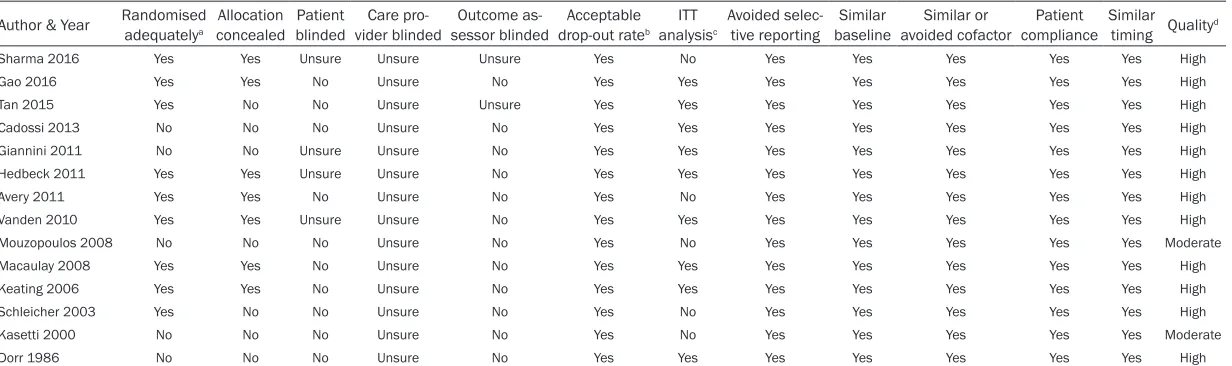
Two investigators evaluated the methodologi-cal quality of each study using to a 12-item scale: randomized adequately, allocation con-cealed, patient blinded, care provider blinded, outcome assessor blinded, acceptable dropout rate, ITT analysis, avoided selective reporting, similar baseline, similar or avoided cofactor, patient compliance, and similar timing. [19] The kappa test was used to assess divergence, and consensus was obtained by discussion with the third investigator. According to the 12-item standard (Table 1), 12 studies were of high quality and the other two studies were of moderate quality. The weighted kappa for the agreement on study quality between the in-
vestigators was 0.87 (95% confidence interval
(95% CI) = 0.81-0.93). Data extraction
demograph-Table 1. Methodological quality of the included studies based on the 12-items scoring system
Author & Year Randomised adequatelya concealedAllocation blindedPatient vider blindedCare pro- sessor blindedOutcome as- drop-out rateAcceptable b analysisITT c Avoided selec-tive reporting baselineSimilar avoided cofactorSimilar or compliancePatient Similar timing Qualityd
Sharma 2016 Yes Yes Unsure Unsure Unsure Yes No Yes Yes Yes Yes Yes High
Gao 2016 Yes Yes No Unsure No Yes Yes Yes Yes Yes Yes Yes High
Tan 2015 Yes No No Unsure Unsure Yes Yes Yes Yes Yes Yes Yes High
Cadossi 2013 No No No Unsure No Yes Yes Yes Yes Yes Yes Yes High
Giannini 2011 No No Unsure Unsure No Yes Yes Yes Yes Yes Yes Yes High
Hedbeck 2011 Yes Yes Unsure Unsure No Yes Yes Yes Yes Yes Yes Yes High
Avery 2011 Yes Yes No Unsure No Yes No Yes Yes Yes Yes Yes High
Vanden 2010 Yes Yes Unsure Unsure No Yes Yes Yes Yes Yes Yes Yes High
Mouzopoulos 2008 No No No Unsure No Yes No Yes Yes Yes Yes Yes Moderate
Macaulay 2008 Yes Yes No Unsure No Yes Yes Yes Yes Yes Yes Yes High
Keating 2006 Yes Yes No Unsure No Yes Yes Yes Yes Yes Yes Yes High
Schleicher 2003 Yes No No Unsure No Yes No Yes Yes Yes Yes Yes High
Kasetti 2000 No No No Unsure No Yes No Yes Yes Yes Yes Yes Moderate
Dorr 1986 No No No Unsure No Yes Yes Yes Yes Yes Yes Yes High
aOnly if the method of sequence made was explicitly introduced could get a “Yes”; sequence generated by “Dates of Admission” or “Patients Number” receive a “No”. bDrop-out rate < 20% could get a “Yes”, otherwise “No”. cITT =
[image:3.792.91.707.84.267.2]Figure 2. Publication bias assessed by begg’s test.
ics (sample size, age, sex distribution), and mean follow-up time. In addition to the data on mortality rates, we abstracted data on revision rates, rates of wound infection (at the bone implant interface), rates of dislocation, postop-erative hip function assessment, intraoppostop-erative blood loss, and surgical time. Intention-to-treat data from the trials were used. If relevant data were not reported, we attempted to obtain them from the accompanying graphs. We also attempted to contact the corresponding au- thors to request further data for our analysis if necessary.
[image:4.612.90.375.339.524.2]stracts according to the eligibility criteria, only 23 were retrieved as full text. Nine of these studies were excluded: two were nonrandom-ized comparisons, three were review articles, one was an observational study, and three were randomized trials that had been followed by publication of an article on the same trial with longer follow-up. Thus, 14 published studies [11, 12, 20-31] comparing HA with THA were ultimately eligible for the investigation (Figure 1). The weighted kappa for the agreement of eligibility between the investigators was 0.85 (95% CI, 0.78-0.92). No publication bias was Figure 1. A PRISMA flowchart illustrated the selection of studies included in
our systematic review.
Statistical analysis
We used Review Manager so- ftware (Version 5.3. Copen- hagen: The Nordic Cochrane Centre, The Cochrane Colla- boration, 2014) for statistical
analysis and generating fig -ures, and used the Mantel-Haenszel to analyze dichoto-mous outcomes and calculate the risk ratios between HA and THA. For continuous variables, we calculated means weighted by study size. We used the I2
statistic to assess heteroge- neity between studies; we considered I2 values of 25%,
50%, and 75% to indicate low, medium, and high heterogene-ity, respectively. We used the
fixed-effects model when I2 <
50%; otherwise, we used the random-effects model. The results are expressed as risk ratio (RR) and 95% CI for dichotomous outcomes, and as weighted mean difference (WMD) and 95% CI for con- tinuous outcomes. We used Begg’s test to assess publica-tion bias.
Results
Literature review
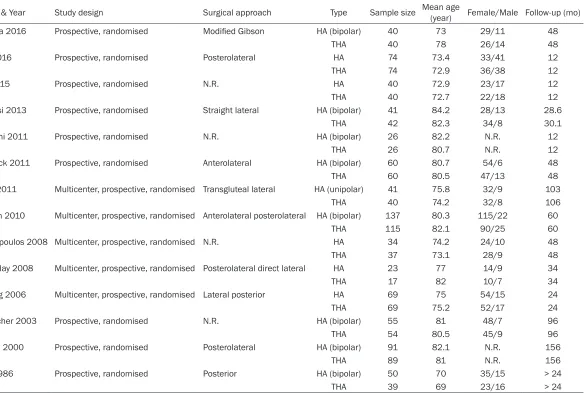
Table 2. Study characteristics and intervention of the trials
Author & Year Study design Surgical approach Type Sample size Mean age (year) Female/Male Follow-up (mo)
Sharma 2016 Prospective, randomised Modified Gibson HA (bipolar) 40 73 29/11 48
THA 40 78 26/14 48
Gao 2016 Prospective, randomised Posterolateral HA 74 73.4 33/41 12
THA 74 72.9 36/38 12
Tan 2015 Prospective, randomised N.R. HA 40 72.9 23/17 12
THA 40 72.7 22/18 12
Cadossi 2013 Prospective, randomised Straight lateral HA (bipolar) 41 84.2 28/13 28.6
THA 42 82.3 34/8 30.1
Giannini 2011 Prospective, randomised N.R. HA (bipolar) 26 82.2 N.R. 12
THA 26 80.7 N.R. 12
Hedbeck 2011 Prospective, randomised Anterolateral HA (bipolar) 60 80.7 54/6 48
THA 60 80.5 47/13 48
Avery 2011 Multicenter, prospective, randomised Transgluteal lateral HA (unipolar) 41 75.8 32/9 103
THA 40 74.2 32/8 106
Vanden 2010 Multicenter, prospective, randomised Anterolateral posterolateral HA (bipolar) 137 80.3 115/22 60
THA 115 82.1 90/25 60
Mouzopoulos 2008 Multicenter, prospective, randomised N.R. HA 34 74.2 24/10 48
THA 37 73.1 28/9 48
Macaulay 2008 Multicenter, prospective, randomised Posterolateral direct lateral HA 23 77 14/9 34
THA 17 82 10/7 34
Keating 2006 Multicenter, prospective, randomised Lateral posterior HA 69 75 54/15 24
THA 69 75.2 52/17 24
Schleicher 2003 Prospective, randomised N.R. HA (bipolar) 55 81 48/7 96
THA 54 80.5 45/9 96
Kasetti 2000 Prospective, randomised Posterolateral HA (bipolar) 91 82.1 N.R. 156
THA 89 81 N.R. 156
Dorr 1986 Prospective, randomised Posterior HA (bipolar) 50 70 35/15 > 24
THA 39 69 23/16 > 24
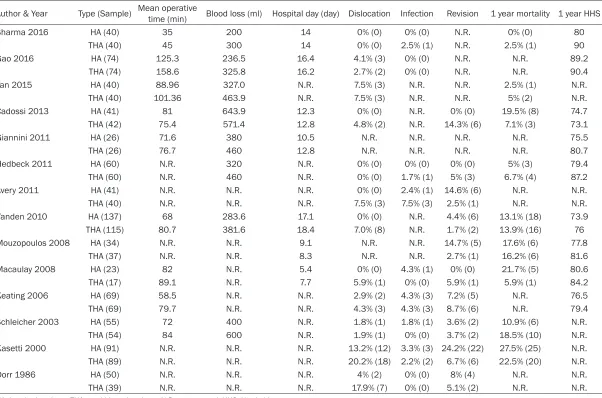
Table 3. Details of outcome measurements of the trials
Author & Year Type (Sample) Mean operative time (min) Blood loss (ml) Hospital day (day) Dislocation Infection Revision 1 year mortality 1 year HHS
Sharma 2016 HA (40) 35 200 14 0% (0) 0% (0) N.R. 0% (0) 80
THA (40) 45 300 14 0% (0) 2.5% (1) N.R. 2.5% (1) 90
Gao 2016 HA (74) 125.3 236.5 16.4 4.1% (3) 0% (0) N.R. N.R. 89.2
THA (74) 158.6 325.8 16.2 2.7% (2) 0% (0) N.R. N.R. 90.4
Tan 2015 HA (40) 88.96 327.0 N.R. 7.5% (3) N.R. N.R. 2.5% (1) N.R.
THA (40) 101.36 463.9 N.R. 7.5% (3) N.R. N.R. 5% (2) N.R.
Cadossi 2013 HA (41) 81 643.9 12.3 0% (0) N.R. 0% (0) 19.5% (8) 74.7
THA (42) 75.4 571.4 12.8 4.8% (2) N.R. 14.3% (6) 7.1% (3) 73.1
Giannini 2011 HA (26) 71.6 380 10.5 N.R. N.R. N.R. N.R. 75.5
THA (26) 76.7 460 12.8 N.R. N.R. N.R. N.R. 80.7
Hedbeck 2011 HA (60) N.R. 320 N.R. 0% (0) 0% (0) 0% (0) 5% (3) 79.4
THA (60) N.R. 460 N.R. 0% (0) 1.7% (1) 5% (3) 6.7% (4) 87.2
Avery 2011 HA (41) N.R. N.R. N.R. 0% (0) 2.4% (1) 14.6% (6) N.R. N.R.
THA (40) N.R. N.R. N.R. 7.5% (3) 7.5% (3) 2.5% (1) N.R. N.R.
Vanden 2010 HA (137) 68 283.6 17.1 0% (0) N.R. 4.4% (6) 13.1% (18) 73.9
THA (115) 80.7 381.6 18.4 7.0% (8) N.R. 1.7% (2) 13.9% (16) 76
Mouzopoulos 2008 HA (34) N.R. N.R. 9.1 N.R. N.R. 14.7% (5) 17.6% (6) 77.8
THA (37) N.R. N.R. 8.3 N.R. N.R. 2.7% (1) 16.2% (6) 81.6
Macaulay 2008 HA (23) 82 N.R. 5.4 0% (0) 4.3% (1) 0% (0) 21.7% (5) 80.6
THA (17) 89.1 N.R. 7.7 5.9% (1) 0% (0) 5.9% (1) 5.9% (1) 84.2
Keating 2006 HA (69) 58.5 N.R. N.R. 2.9% (2) 4.3% (3) 7.2% (5) N.R. 76.5
THA (69) 79.7 N.R. N.R. 4.3% (3) 4.3% (3) 8.7% (6) N.R. 79.4
Schleicher 2003 HA (55) 72 400 N.R. 1.8% (1) 1.8% (1) 3.6% (2) 10.9% (6) N.R.
THA (54) 84 600 N.R. 1.9% (1) 0% (0) 3.7% (2) 18.5% (10) N.R.
Kasetti 2000 HA (91) N.R. N.R. N.R. 13.2% (12) 3.3% (3) 24.2% (22) 27.5% (25) N.R.
THA (89) N.R. N.R. N.R. 20.2% (18) 2.2% (2) 6.7% (6) 22.5% (20) N.R.
Dorr 1986 HA (50) N.R. N.R. N.R. 4% (2) 0% (0) 8% (4) N.R. N.R.
THA (39) N.R. N.R. N.R. 17.9% (7) 0% (0) 5.1% (2) N.R. N.R.
found in the Begg’s test (Begg’s bias = 1.25, p = 0.21; Figure 2).
Characteristics and interventions
Table 2 lists the characteristics and interven-tions of the 14 trials. They were all prospective
randomized controlled trials, among which five
trials were multicenter prospective studies. A total of 1523 patients were included: 781 in the HA group and 742 in the THA group. The mean age was 77.7 years in the HA group and 77.8 years in the THA group. The majority of pa- tients were female (female/male = 938/346). The surgical approach was recorded in 10 stud-ies [11, 12, 20, 21, 23, 24, 26, 27, 29, 30]. The
mean length of follow-up was more than 57.6 months. All trials had an acceptable dropout rate (< 20%).
Mortality
Nine reports [12, 20, 22-24, 27-29, 31] includ-ing a total of 1015 patients provided one-year mortality rates (Table 3), which ranged from 0 to 27.5% after HA and from 2.5% to 22.5% af- ter THA. The 1-year mortality rate was 13.8% (72/521) in the HA group versus 12.7% (63/494) in the THA group. There was no evi-dence of heterogeneity (I2 = 0%, P = 0.57). The
pooled 1-year mortality data did not differ
[image:7.612.94.523.74.224.2]sig-nificantly between patients that had undergone
[image:7.612.98.521.297.454.2]Figure 3. 1-year mortality. Forest plot comparing risk ratios of 1-year mortality after hemiarthroplasty versus total hip arthroplasty in displaced femoral neck fractures in the healthy elderly. Mantel-Haenszel statistical method was used with the ‘fixed-effects’ analysis method for dichotomous data. M-H: Mantel-Haenszel, THA: total hip arthroplasty, HA: hemiarthroplasty.
Figure 5. Dislocation. Forest plot comparing risk ratios of dislocation after hemiarthroplasty versus total hip arthro-plasty in displaced femoral neck fractures in the healthy elderly. Mantel-Haenszel statistical method was used with the ‘fixed-effects’ analysis method for dichotomous data. M-H: Mantel-Haenszel, THA: total hip arthroplasty, HA: hemiarthroplasty.
HA or THA (RR = 1.08, 95% CI = 0.79-1.47, P = 0.63, Figure 3).
Revision
Ten reports [11, 12, 23, 24, 26-31] including a total of 1163 patients provided revision rates (Table 3), which ranged from 0 to 24.2% after HA and from 1.7% to 14.3% after THA. The revi-sion rate was 8.3% (50/601) in the HA group versus 5.3% (30/563) in the THA group. There was little evidence of heterogeneity across the studies (I2 = 45%, P = 0.06). There was a trend
toward decreased revision after THA compared
with that after HA (RR = 1.57, 95% CI = 1.02-2.41, P = 0.04; Figure 4).
Dislocation
Twelve [11, 12, 20-24, 26, 27, 29-31] of the included studies provided data on dislocation; two studies [20, 24] reported no cases of dis- location in either treatment group (Table 3). Another two studies [25, 28] did not report dislocation. The risk of dislocation was 3.2% (23/721) in the HA group versus 7.1% (48/679) in the THA group. There was no evidence of heterogeneity across the studies (I2 = 0%, P =
[image:8.612.98.519.321.468.2]Figure 7. Operating time. Forest plot comparing risk ratios of total operating time after hemiarthroplasty versus total hip arthroplasty in displaced femoral neck fractures in the healthy elderly. Inverse variance statistical method was used with the ‘random effects’ analysis method for continuous data. IV inverse variance, THA total hip arthroplasty, HA hemiarthroplasty.
0.50). The pooled data indicated a significant
risk of dislocation after treatment with THA for displaced FNF (RR = 0.47, 95% CI = 0.30-0.74, P = 0.001; Figure 5).
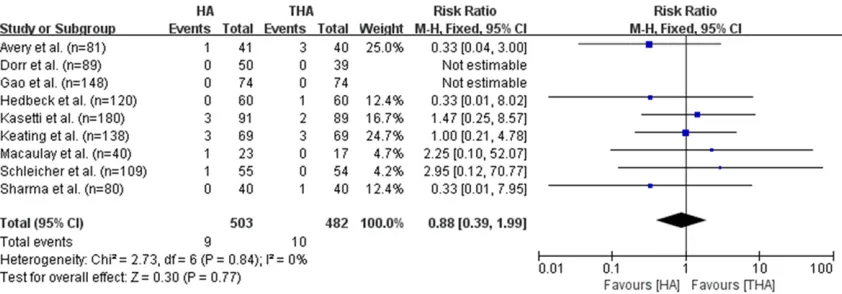
Infection
Infection, which was reported in nine studies [11, 12, 20, 21, 24, 26, 29-31] including a total of 985 patients (Table 3), developed in 0-4.3% of patients treated with HA and in 0-4.3% of those treated with THA. The risk of dislocation was 1.8% (9/503) in the HA group versus 2.1% (10/482) in the THA group. There was no evi-dence of heterogeneity across the studies (I2 =
0%, P = 0.84). The risk of infection did not differ between HA and THA groups (RR = 0.88, 95% CI = 0.39-1.99, P = 0.77; Figure 6).
Blood loss and surgical time
Blood loss was estimated in eight studies [20-25, 27, 31] that included a total of 924 patients, and surgical time was reported in nine studies [20-23, 25, 27, 29-31] that included a total of 850 patients (Table 3). Patients that under-went THA had more blood loss than those treat-ed with HA. However, because the values were in various formats, we could not calculate
whether the difference was significant. The
operating time for THA was longer than that for HA (WMD, 13.77 minutes; 95% CI, 7.52-20.03, P < 0.0001; Figure 7).
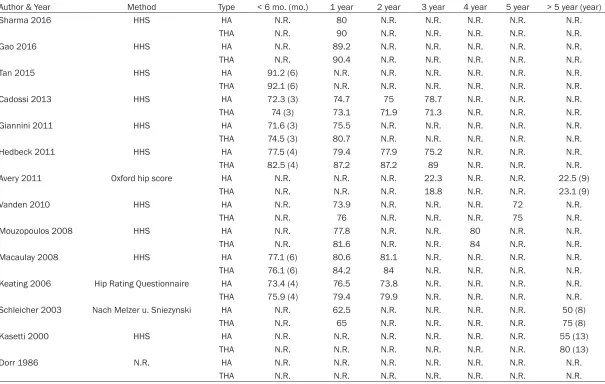
Functional outcome
The Harris Hip Score (HHS) ranges from 0-100 points and includes function, pain, deformity, and range of motion. Nine studies [20, 21,
23-25, 27-30] reported the HHS after 1-year follow-up (Table 4). A difference was observed in HHS total scores: patients treated with THA
scored significantly higher than those treated
with HA (WMD = 4.06; 95% CI = 0.68-7.43, P = 0.02; Figure 8).
Discussion
The primary findings of this meta-analysis were:
relative to HA, THA substantially reduced the prevalence of surgical revision with very tight
confidence intervals, suggesting that the
re-duction in relative risk is at least 50%. However,
this benefit appears to come at the price of a
substantially increased risk of dislocation, more surgical blood loss, and a longer opera-tion time. THA and HA do not appear to differ with regard to their effects on the risk of infec-tion and 1-year mortality, but patients in the THA group are more likely to have better hip function.
Table 4. Summary of HHS in the studies
Author & Year Method Type < 6 mo. (mo.) 1 year 2 year 3 year 4 year 5 year > 5 year (year)
Sharma 2016 HHS HA N.R. 80 N.R. N.R. N.R. N.R. N.R.
THA N.R. 90 N.R. N.R. N.R. N.R. N.R.
Gao 2016 HHS HA N.R. 89.2 N.R. N.R. N.R. N.R. N.R.
THA N.R. 90.4 N.R. N.R. N.R. N.R. N.R.
Tan 2015 HHS HA 91.2 (6) N.R. N.R. N.R. N.R. N.R. N.R.
THA 92.1 (6) N.R. N.R. N.R. N.R. N.R. N.R.
Cadossi 2013 HHS HA 72.3 (3) 74.7 75 78.7 N.R. N.R. N.R.
THA 74 (3) 73.1 71.9 71.3 N.R. N.R. N.R.
Giannini 2011 HHS HA 71.6 (3) 75.5 N.R. N.R. N.R. N.R. N.R.
THA 74.5 (3) 80.7 N.R. N.R. N.R. N.R. N.R.
Hedbeck 2011 HHS HA 77.5 (4) 79.4 77.9 75.2 N.R. N.R. N.R.
THA 82.5 (4) 87.2 87.2 89 N.R. N.R. N.R.
Avery 2011 Oxford hip score HA N.R. N.R. N.R. 22.3 N.R. N.R. 22.5 (9)
THA N.R. N.R. N.R. 18.8 N.R. N.R. 23.1 (9)
Vanden 2010 HHS HA N.R. 73.9 N.R. N.R. N.R. 72 N.R.
THA N.R. 76 N.R. N.R. N.R. 75 N.R.
Mouzopoulos 2008 HHS HA N.R. 77.8 N.R. N.R. 80 N.R. N.R.
THA N.R. 81.6 N.R. N.R. 84 N.R. N.R.
Macaulay 2008 HHS HA 77.1 (6) 80.6 81.1 N.R. N.R. N.R. N.R.
THA 76.1 (6) 84.2 84 N.R. N.R. N.R. N.R.
Keating 2006 Hip Rating Questionnaire HA 73.4 (4) 76.5 73.8 N.R. N.R. N.R. N.R.
THA 75.9 (4) 79.4 79.9 N.R. N.R. N.R. N.R.
Schleicher 2003 Nach Melzer u. Sniezynski HA N.R. 62.5 N.R. N.R. N.R. N.R. 50 (8)
THA N.R. 65 N.R. N.R. N.R. N.R. 75 (8)
Kasetti 2000 HHS HA N.R. N.R. N.R. N.R. N.R. N.R. 55 (13)
THA N.R. N.R. N.R. N.R. N.R. N.R. 80 (13)
Dorr 1986 N.R. HA N.R. N.R. N.R. N.R. N.R. N.R. N.R.
THA N.R. N.R. N.R. N.R. N.R. N.R. N.R.
Figure 8. Harris hip score. Forest plot comparing risk ratios of total Harris hip score after hemiarthroplasty versus total hip arthroplasty in displaced femoral neck fractures in the healthy elderly. Inverse variance statistical method was used with the ‘random effects’ analysis method for continuous data. IV inverse variance, THA total hip arthro-plasty, HA hemiarthroplasty.
so it is the most comprehensive evaluation of the available evidence to date. The 14 trials included in our study were all prospective, ran-domized control trials; regardless of the integ-rity and care with which they are conducted, randomized trials reduce the risk of bias by ran-domization, concealment of allocation, blind-ing, and complete follow-up.
The validity of our findings was further strength -ened by strictly following the Cochrane Hand- book for Systematic Reviews of Interventions 5.0.2 and the PRISMA 2015 checklist. We developed explicit eligibility criteria, thoroughly assessed the methodological quality of the studies, demonstrated the reproducibility of study selection and assessment criteria, per-formed quantitative analysis, explored possible reasons for differences in results between studies, and performed statistical analysis of the revision rate, 1-year mortality rate, disloca-tion rate, infecdisloca-tion rate, operadisloca-tion duradisloca-tion, blood loss, and hip function postoperatively. Despite these advantages of our review, some limitations should be acknowledged. First, we may have failed to identify all relevant random-ized trials as a result of a publication bias against studies that did not demonstrate a
sig-nificant difference in effect between two treat -ments. To counter this, we used Begg’s test to
investigate the potential influence of publica -tion bias on our results. Second, the inclusion of prospective studies was inadequately ran-domized. Five trials included in our analysis were not randomized adequately; they gener-ated randomization by alternation or hospital registration number (odd or even), which could
lead to bias and reduce the level of evidence in our analysis. Third, several eligible trials had a short follow-up of 1 year. Although some stud-ies indicated general complications and HHS
within the first year, we feel that long-term fol -low-up would be more comprehensive and valu-able to evaluate the effectiveness of arthro-plasty after displaced FNF.
Recently, Paul et al. [17] performed a meta-analysis of eight studies including a total of 986 patients. They found that THA decreased the rate of revision but increased the rate of
dislocation, and found no significant differenc -es in mortality rate; but their -estimat-es of func-tion, pain, and quality of life were less clear. Hopley et al. [32] conducted an extensive anal-ysis with four randomized, three quasi-random-ized, and eight retrospective cohort studies, and concluded that patients treated with THA for displaced FNF may obtain better outcomes than those treated with HA. Nevertheless, they found that dislocation was more common with
THA, which is consistent with our findings.
Dislocation is the major concern after primary THA for treatment of displaced FNF. Blomfeldt and Hedbeck et al. [24, 33] reported no dislo-cations in any patients in their research using an anterolateral approach. It is interesting to contrast this with other reports on primary THA in patients with FNF using the posterolateral approach, where the dislocation rate ranges from between 7-20% [11, 12, 26, 29, 34]. Two
studies confirmed that dislocation is not a
reported that placing the acetabular cup in about 20-25° anteversion, using short external rotators, and choosing a large head size [37] could circumvent dislocation.
The results of our analysis indicate that THA was associated with a longer operation time and greater number of hospital days, but it did not increase the number of general complica-tions or the mortality rate. Conversely, THA
sig-nificantly decreased the rates of revision and
tended to yield better hip functional outcome scores compared with HA. Function improved with time after THA in some studies [12, 24, 28, 30, 31]. Ravikumar and Schleicher [12, 31] found that HHS remained stable in 75 and 80 patients treated with THA after 8 and 13 years of follow-up, respectively. Acetabular erosion following HA may explain the relatively poor hip function in HA patients [24, 26]. However, the revision rate for acetabular erosion after HA was low [26, 38]. Additionally, the rates of
infec-tion and mortality did not differ significantly
between the two groups, similar to previous results [16, 17]. Patients in the HA group had shorter surgical times and less blood loss. HA
may be sufficient for elderly patients with
comorbidities.
Age appeared to be an important factor in the requirement for revision surgery. Kannan et al. [39] reviewed national registry data in Australia and Italy and found that the revision rate did
not differ significantly in patients less than 75 years but was significantly lower after HA in
those older than 75 years. Skoldenberg et al. [40] designed a randomized controlled trial comparing mortality, complications, reopera-tion, HHS, and quality of life after THA versus
HA in patients aged ≥ 80 years with a
displa-ced FNF over a study period of 10 years. In previous studies, the age groups were ob- scure, and we could not analyze the results in different age groups. Future studies should subdivide patients into age groups, i.e., < 70
years, 70-75 years, 75-80 years, and ≥ 80
years old, so that the respective outcomes can be assessed.
The results of our analysis indicate that, in com-parison with HA, THA to treat displaced FNF
significantly reduces the risk of revision surgery
and tends toward better hip functional outcome score at the cost of greater dislocation rate,
blood loss, and operation time. Dislocation could be circumvented in THA by using an anterolateral approach and choosing a large head size. HA is associated with reduced
surgi-cal time and less blood loss. HA may be suffi -cient for elderly patients with comorbidities. Future studies should assess the outcomes in different age groups.
Acknowledgements
This study was funded by the National Natural Science Foundation of China (NO. 81371954 and 81472113), and the Fund of Health Department of Zhejiang Province (Hangzhou, Zhejiang, China) (2016KYA178).
Disclosure of conflict of interest
None.
Address correspondence to: Jinhui Cao, Depart- ment of Orthopaedic Surgery, Shaoxing Central Hospital, Hua-yu Road 1, Keqiao, Shaoxing 312000, People’s Republic of China. Tel: 8613676871276; E-mail: [email protected]
References
[1] Johnell O and Kanis JA. An estimate of the worldwide prevalence and disability associat-ed with osteoporotic fractures. Osteoporos Int 2006; 17: 1726-1733.
[2] De Laet CE and Pols HA. Fractures in the el-derly: epidemiology and demography. Bail-lieres Best Pract Res Clin Endocrinol Metab 2000; 14: 171-179.
[3] Bhandari M, Devereaux PJ, Swiontkowski MF, Tornetta P 3rd, Obremskey W, Koval KJ, Nork S, Sprague S, Schemitsch EH and Guyatt GH. In-ternal fixation compared with arthroplasty for displaced fractures of the femoral neck. A me-ta-analysis. J Bone Joint Surg Am 2003; 85-a: 1673-1681.
[4] Parker MJ, Khan RJ, Crawford J and Pryor GA. Hemiarthroplasty versus internal fixation for displaced intracapsular hip fractures in the el-derly. A randomised trial of 455 patients. J Bone Joint Surg Br 2002; 84: 1150-1155. [5] Ossendorf C, Scheyerer MJ, Wanner GA,
Sim-men HP and Werner CM. TreatSim-ment of femoral neck fractures in elderly patients over 60 years of age - which is the ideal modality of primary joint replacement? Patient Saf Surg 2010; 4: 16.
for proximal femoral fractures in adults. Co-chrane Database Syst Rev 2010; Cd001706. [7] Keating JF, Grant A, Masson M, Scott NW and
Forbes JF. Displaced intracapsular hip frac-tures in fit, older people: a randomised com -parison of reduction and fixation, bipolar hemi -arthroplasty and total hip -arthroplasty. Health Technol Assess 2005; 9: iii-iv, ix-x, 1-65. [8] Calder SJ, Anderson GH, Jagger C, Harper WM
and Gregg PJ. Unipolar or bipolar prosthesis for displaced intracapsular hip fracture in octoge-narians: a randomised prospective study. J Bone Joint Surg Br 1996; 78: 391-394. [9] Squires B and Bannister G. Displaced
intracap-sular neck of femur fractures in mobile inde-pendent patients: total hip replacement or hemiarthroplasty? Injury 1999; 30: 345-348. [10] Berry DJ, von Knoch M, Schleck CD and
Harm-sen WS. Effect of femoral head diameter and operative approach on risk of dislocation after primary total hip arthroplasty. J Bone Joint Surg Am 2005; 87: 2456-2463.
[11] Dorr LD, Glousman R, Hoy AL, Vanis R and Chandler R. Treatment of femoral neck frac-tures with total hip replacement versus ce-mented and noncece-mented hemiarthroplasty. J Arthroplasty 1986; 1: 21-28.
[12] Ravikumar KJ and Marsh G. Internal fixation versus hemiarthroplasty versus total hip ar-throplasty for displaced subcapital fractures of femur--13 year results of a prospective ran-domised study. Injury 2000; 31: 793-797. [13] Skinner P, Riley D, Ellery J, Beaumont A,
Cou-mine R and Shafighian B. Displaced subcapital fractures of the femur: a prospective random-ized comparison of internal fixation, hemiar -throplasty and total hip replacement. Injury 1989; 20: 291-293.
[14] Bhandari M, Devereaux PJ, Tornetta P, 3rd, Swiontkowski MF, Berry DJ, Haidukewych G, Schemitsch EH, Hanson BP, Koval K, Dirschl D, Leece P, Keel M, Petrisor B, Heetveld M and Guyatt GH. Operative management of dis-placed femoral neck fractures in elderly pa-tients. An international survey. J Bone Joint Surg Am 2005; 87: 2122-2130.
[15] Wang F, Zhang HF, Zhang ZY, Ma CB and Feng XM. Comparison of bipolar hemiarthroplasty and total hip arthroplasty for displaced femoral neck fractures in the healthy elderly: a meta-analysis. BMC Musculoskelet Disord 2015; 16: 13.
[16] Carroll C, Stevenson M, Scope A, Evans P and Buckley S. Hemiarthroplasty and total hip ar-throplasty for treating primary intracapsular fracture of the hip: a systematic review and cost-effectiveness analysis. Health Technol As-sess 2011; 15: 1-74.
[17] Burgers PT, Van Geene AR, Van den Bekerom MP, Van Lieshout EM, Blom B, Aleem IS, Bhan-dari M and Poolman RW. Total hip arthroplasty versus hemiarthroplasty for displaced femoral neck fractures in the healthy elderly: a meta-analysis and systematic review of randomized trials. Int Orthop 2012; 36: 1549-1560. [18] Zhao Y, Fu D, Chen K, Li G, Cai Z, Shi Y and Yin
X. Outcome of hemiarthroplasty and total hip replacement for active elderly patients with displaced femoral neck fractures: a meta-anal-ysis of 8 randomized clinical trials. PLoS One 2014; 9: e98071.
[19] Furlan AD, Malmivaara A, Chou R, Maher CG, Deyo RA, Schoene M, Bronfort G and van Tul-der MW. 2015 updated method guideline for systematic reviews in the cochrane back and neck group. Spine (Phila Pa 1976) 2015; 40: 1660-1673.
[20] Sharma V, Awasthi B, Kumar K, Kohli N and Ka-toch P. Outcome analysis of hemiarthroplasty vs total hip replacement in displaced femoral neck fractures in the elderly. J Clin Diagn Res 2016; 10: RC11-13.
[21] Huandong Gao SW. Comparion of hemiarthro-plasty and total hip arthrohemiarthro-plasty for displaced femoral neck fracture in the elderly. Chin J Med 2016; 51.
[22] Tan X. Hemiarthroplasty compared with total hip arthroplasty for displaced femoral neck fractures. For All Health 2015; 9.
[23] Cadossi M, Chiarello E, Savarino L, Tedesco G, Baldini N, Faldini C and Giannini S. A compari-son of hemiarthroplasty with a novel polycar-bonate-urethane acetabular component for displaced intracapsular fractures of the femo-ral neck: a randomised controlled trial in el-derly patients. Bone Joint J 2013; 95B: 609-615.
[24] Hedbeck CJ, Enocson A, Lapidus G, Blomfeldt R, Tornkvist H, Ponzer S and Tidermark J. Com-parison of bipolar hemiarthroplasty with total hip arthroplasty for displaced femoral neck fractures: a concise four-year follow-up of a randomized trial. J Bone Joint Surg Am 2011; 93: 445-450.
[25] Giannini S, Chiarello E, Cadossi M, Luciani D and Tedesco G. Prosthetic surgery in fragility osteopathy. Aging Clin Exp Res 2011; 23: 40-42.
[26] Avery PP, Baker RP, Walton MJ, Rooker JC, Squires B, Gargan MF and Bannister GC. Total hip replacement and hemiarthroplasty in mo-bile, independent patients with a displaced in-tracapsular fracture of the femoral neck: a seven- to ten-year follow-up report of a pro-spective randomised controlled trial. J Bone Joint Surg Br 2011; 93: 1045-1048.
Gos-lings JC, van Dijk CN and Raaymakers EL. A comparison of hemiarthroplasty with total hip replacement for displaced intracapsular frac-ture of the femoral neck: a randomised con-trolled multicentre trial in patients aged 70 years and over. J Bone Joint Surg Br 2010; 92: 1422-1428.
[28] Mouzopoulos G, Stamatakos M, Arabatzi H, Vasiliadis G, Batanis G, Tsembeli A, Tzurbakis M, Safioleas M. The four-year functional result after a displaced subcapital hip fracture treat-ed with three different surgical options. Int Or-thop 2008; 367-73.
[29] Macaulay W, Nellans KW, Garvin KL, Iorio R, Healy WL and Rosenwasser MP. Prospective randomized clinical trial comparing hemiar-throplasty to total hip arhemiar-throplasty in the treat-ment of displaced femoral neck fractures: win-ner of the Dorr Award. J Arthroplasty 2008; 23: 2-8.
[30] Keating JF, Grant A, Masson M, Scott NW and Forbes JF. Randomized comparison of reduc-tion and fixareduc-tion, bipolar hemiarthroplasty, and total hip arthroplasty. Treatment of displaced intracapsular hip fractures in healthy older pa-tients. J Bone Joint Surg Am 2006; 88: 249-260.
[31] Schleicher I, Kordelle J, Jurgensen I, Haas H and Melzer C. Femoral neck fracture in the el-derly-bipolar hemiarthroplasty vs total hip re-placement. Unfallchirurg 2003; 106: 467-471. [32] Hopley C, Stengel D, Ekkernkamp A and Wich
M. Primary total hip arthroplasty versus hemi-arthroplasty for displaced intracapsular hip fractures in older patients: systematic review. Bmj 2010; 340: c2332.
[33] Blomfeldt R, Tornkvist H, Eriksson K, Soder-qvist A, Ponzer S and Tidermark J. A rando- mised controlled trial comparing bipolar hemi-arthroplasty with total hip replacement for dis-placed intracapsular fractures of the femoral neck in elderly patients. J Bone Joint Surg Br 2007; 89: 160-165.
[34] Baker RP, Squires B, Gargan MF and Bannister GC. Total hip arthroplasty and hemiarthroplas-ty in mobile, independent patients with a dis-placed intracapsular fracture of the femoral neck. A randomized, controlled trial. J Bone Joint Surg Am 2006; 88: 2583-2589.
[35] Enocson A, Tidermark J, Tornkvist H and Lapi-dus LJ. Dislocation of hemiarthroplasty after femoral neck fracture: better outcome after the anterolateral approach in a prospective co-hort study on 739 consecutive hips. Acta Or-thop 2008; 79: 211-217.
[36] Enocson A, Hedbeck CJ, Tidermark J, Petters-son H, Ponzer S and Lapidus LJ. Dislocation of total hip replacement in patients with fractures of the femoral neck. Acta Orthop 2009; 80: 184-189.
[37] Konan S, Rhee SJ and Haddad FS. Total hip arthroplasty for displaced fracture of the femo-ral neck using size 32 mm femofemo-ral head and soft tissue repair after a posterior approach. Hip Int 2009; 19: 30-35.
[38] Leonardsson O, Karrholm J, Akesson K, Garel-lick G and Rogmark C. Higher risk of reopera-tion for bipolar and uncemented hemiarthro-plasty. Acta Orthop 2012; 83: 459-466. [39] Kannan A, Kancherla R, McMahon S, Hawdon
G, Soral A and Malhotra R. Arthroplasty options in femoral-neck fracture: answers from the na-tional registries. Int Orthop 2012; 36: 1-8. [40] Skoldenberg O, Chammout G, Mukka S, Muren